
Buch.-Ham. ex D.Don
Description
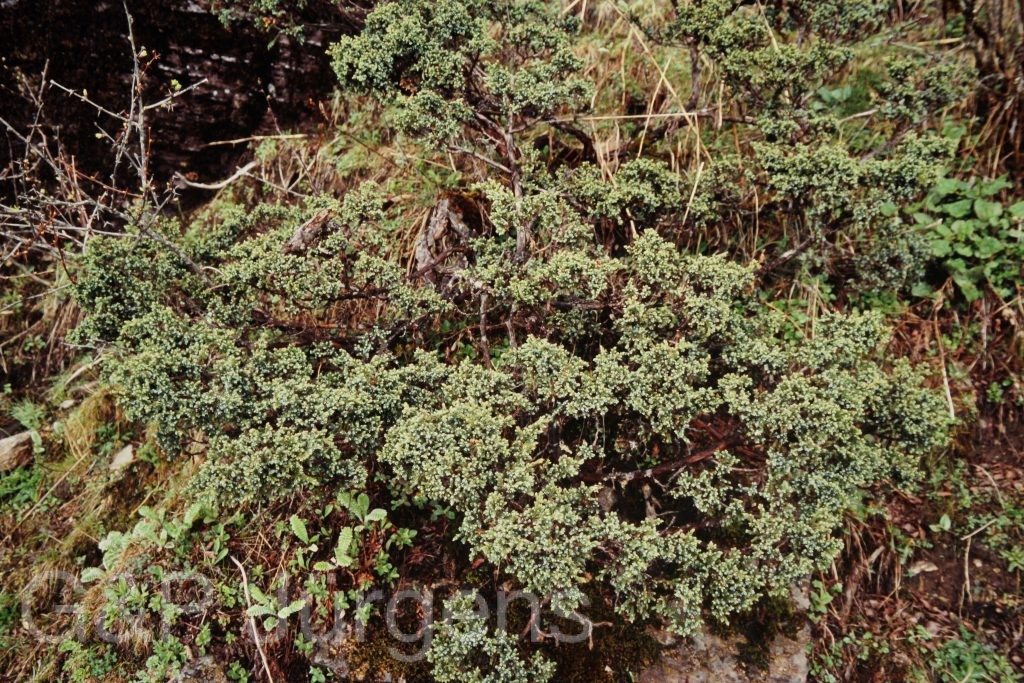
Juniperus squamata Buch.-Ham. ex D.Don is a variable, mostly prostrate to shrubby juniper of the Cupressaceae, native across the Himalaya and central and western China and recorded from Nepal, India, Bhutan, Pakistan, Afghanistan and Myanmar; with over 3,300 georeferenced records, many from cultivation in Europe, North America and Australasia, it is a widely grown ornamental as well as a wild montane species. In the wild it occupies high-altitude scrub, rocky alpine slopes, open conifer forest margins, ridges and exposed crests near and above the treeline. The photographed plant from Labana in Bhutan at about 3,600 m in May is typical of its subalpine to alpine station, where it often forms low spreading mats anchoring thin stony soils.
It is an evergreen shrub, frequently decumbent and mat-forming but sometimes erect and small-tree-like, with reddish-brown, flaking bark and ascending branchlet tips that are characteristically nodding. The foliage is entirely needle-like (acicular) and arranged in dense whorls of three, each leaf rigid, sharply pointed, concave and glaucous-white on the upper surface, giving the plant a frosted appearance. The species is usually dioecious; the seed cones are small, ovoid, ripening from green through reddish to glossy black, fleshy and berry-like, and contain a single seed.
Juniperus squamata belongs to section Juniperus, the needle-leaved junipers, and is morphologically variable across its range, having given rise to numerous horticultural cultivars selected for habit and foliage colour. As a slow-growing pioneer of harsh exposed sites it contributes to soil stabilisation at high elevation. The species is widespread and assessed as Least Concern, though local stands are affected by grazing and fuelwood collection.
Author: Buch.-Ham. ex D.Don · Sources: POWO (Kew), Flora of China Vol. 4, Flora of Bhutan Vol. 1, GBIF, Adams: Junipers of the World (2014)