
Siebold & Zucc.
Description
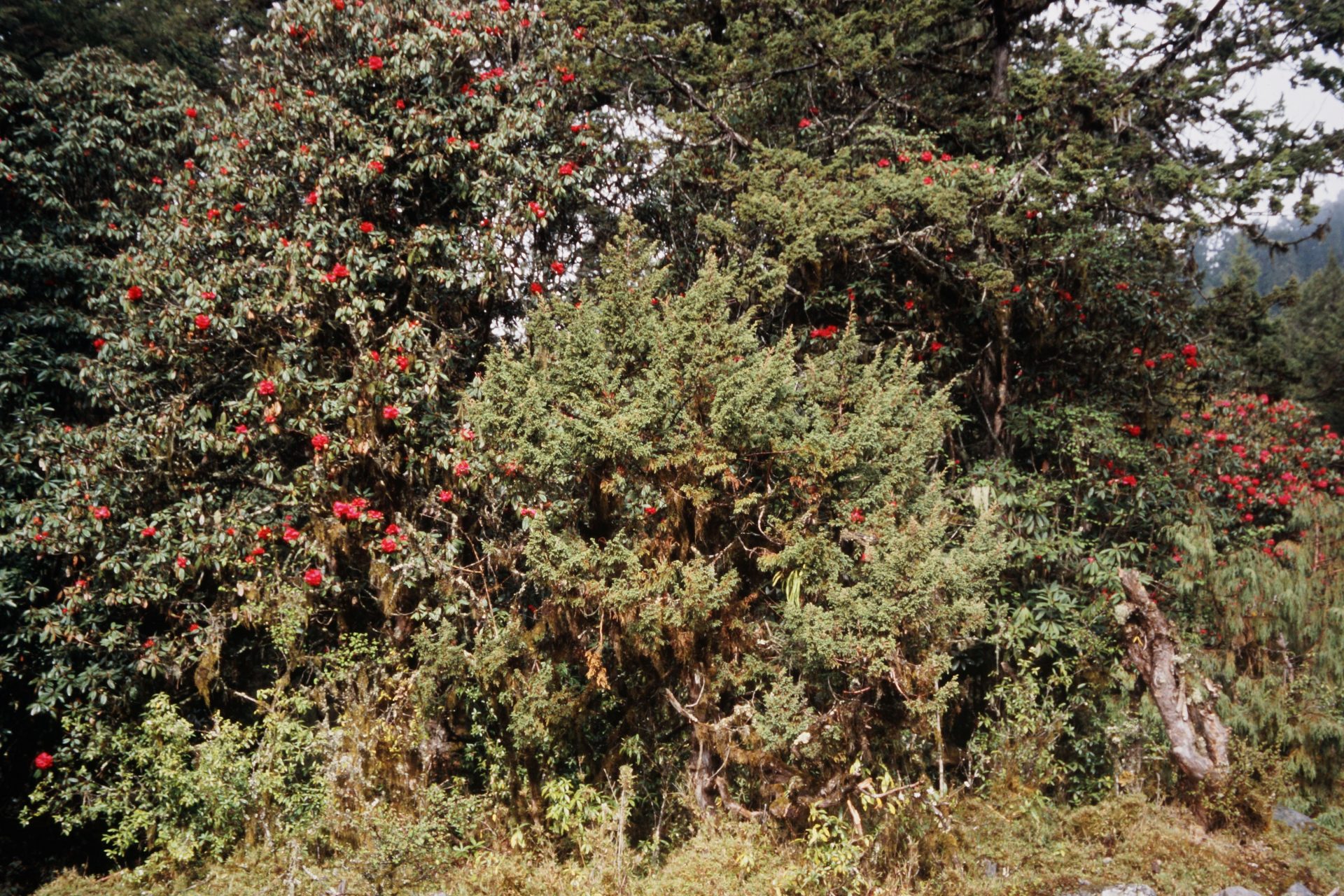
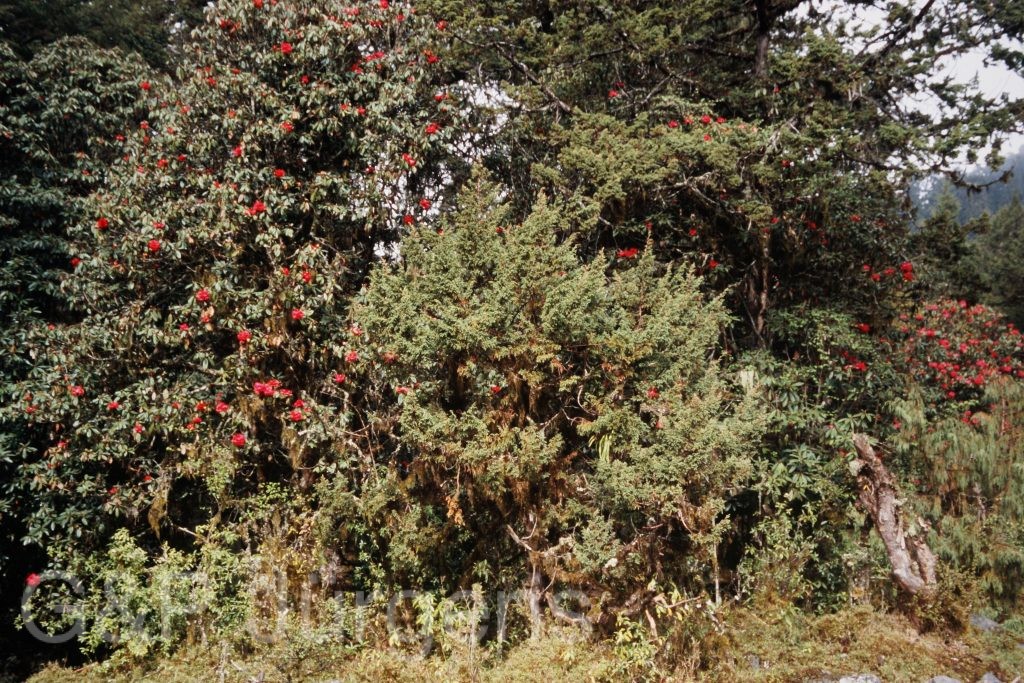
Juniperus rigida is a coniferous shrub or small tree of temperate East Asia, very well represented in GBIF with 6235 occurrences centred on Korea, Japan, China and the Russian Far East, alongside numerous cultivated records in Europe and North America. It grows on dry, rocky slopes, exposed ridges, sandy soils and open montane woodland, tolerating poor substrates and cold, often from the hills to the subalpine zone. The individual photographed at Gogona in Bhutan at 3250 m in May reflects its occurrence at higher Himalayan elevations, where it persists on stony, well-drained ground in cool montane conditions.
The plant is a dioecious, evergreen shrub or tree with spreading to pendulous branches and reddish-brown, fibrous bark that peels in strips. The leaves are all needle-like (acicular), borne in whorls of three, rigid, sharply pointed and deeply grooved adaxially with a single white stomatal band, a combination giving the foliage a harsh, prickly texture reflected in the epithet rigida. The male cones are small and axillary, shedding pollen in spring; the female structures develop into fleshy, berry-like seed cones (galbuli) that ripen blue-black with a glaucous bloom over about two years, each typically enclosing three seeds.
Juniperus rigida belongs to section Juniperus, the needle-leaved junipers, and is closely allied to J. communis, from which it differs in its longer, more rigid leaves and arching habit. It is widely cultivated as an ornamental and for bonsai, explaining many of its extralimital records. Ecologically it is a hardy pioneer of disturbed and stressful sites, and it remains common and of least concern across its broad native range.
Author: Siebold & Zucc. · Sources: POWO (Kew), GBIF, Flora of China Vol. 4, Flora of Bhutan Vol. 1, Flora of Nepal, Flora of Pakistan, Adams' Junipers of the World