
L.
Description
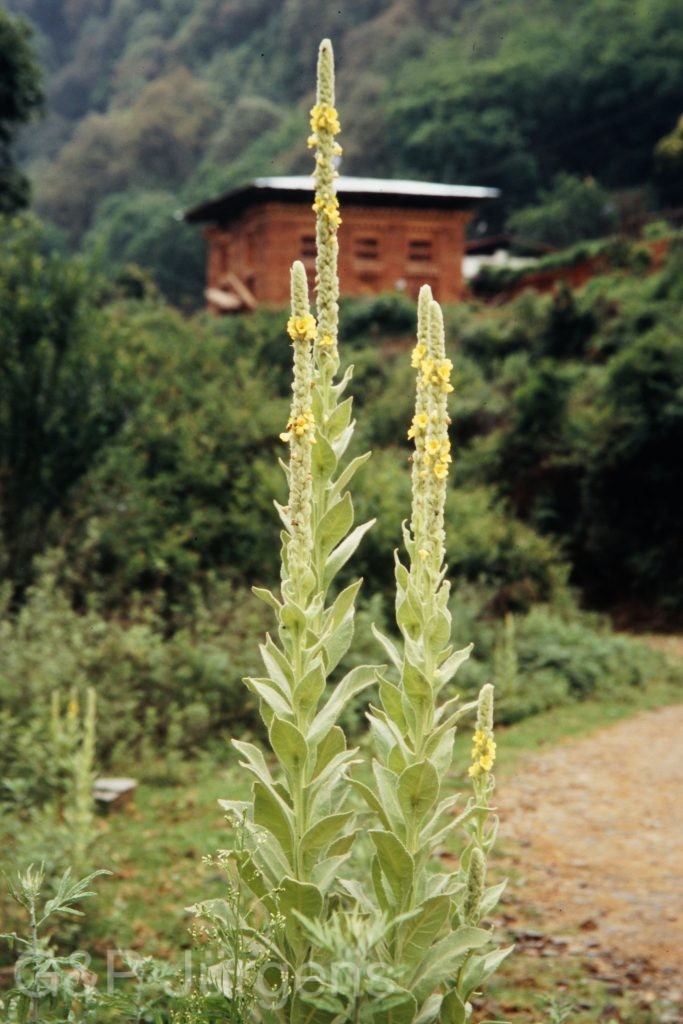
Verbascum thapsus L., common or great mullein, is a robust biennial herb native to Europe and western Asia and now one of the most widely naturalised plants on Earth. The enormous GBIF dataset (over 340,000 occurrences) reflects its near-cosmopolitan spread across North America, Europe, Australia, New Zealand and temperate Asia, including the Himalaya. It is a pioneer of open, disturbed, well-drained sites: roadsides, pastures, river gravels, fallow ground and waste places. The plant photographed at Wangdi in Bhutan at 2,400 m in June illustrates its successful establishment in the warm-temperate Himalayan valleys, where it behaves as a ruderal colonist of disturbed terrain.
In its first year the plant forms a dense basal rosette of large, oblong to obovate leaves; in the second it produces a stout, usually unbranched flowering stem up to 2 m tall. The whole plant is densely covered with soft, branched, stellate-woolly hairs giving a greyish, felted appearance and reducing water loss and herbivory. Leaves are decurrent along the stem. The inflorescence is a long, dense, spike-like raceme of yellow flowers; each flower has a five-lobed, slightly irregular rotate corolla and five stamens, the upper three with woolly white or yellowish filament hairs. The fruit is an ovoid septicidal capsule packed with very numerous minute seeds.
A single plant can produce hundreds of thousands of long-lived seeds, underpinning its weediness and its classification as an invasive species in parts of North America and Australasia. The placement of Verbascum has shifted between Scrophulariaceae and a narrowly circumscribed family in modern phylogenetic systems, but it is most often retained in Scrophulariaceae sensu APG. Long used in traditional medicine for respiratory complaints, it remains of pharmacological and ecological interest as a model colonising ruderal.
Author: L. · Sources: POWO (Kew), Flora of Pakistan, Flora of China Vol. 18, GBIF, Murbeck: Monographie der Gattung Verbascum (1933)