
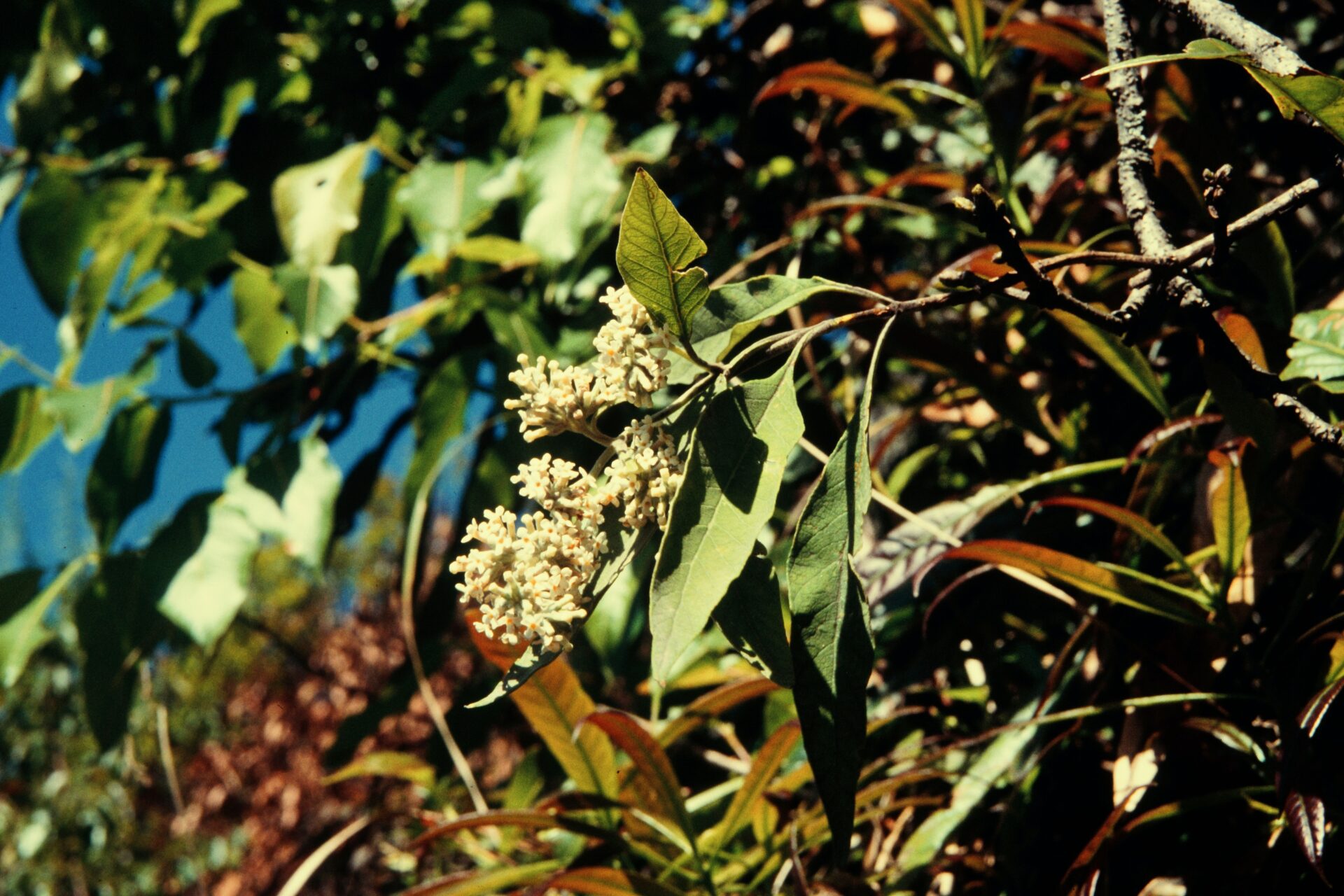
Wall.
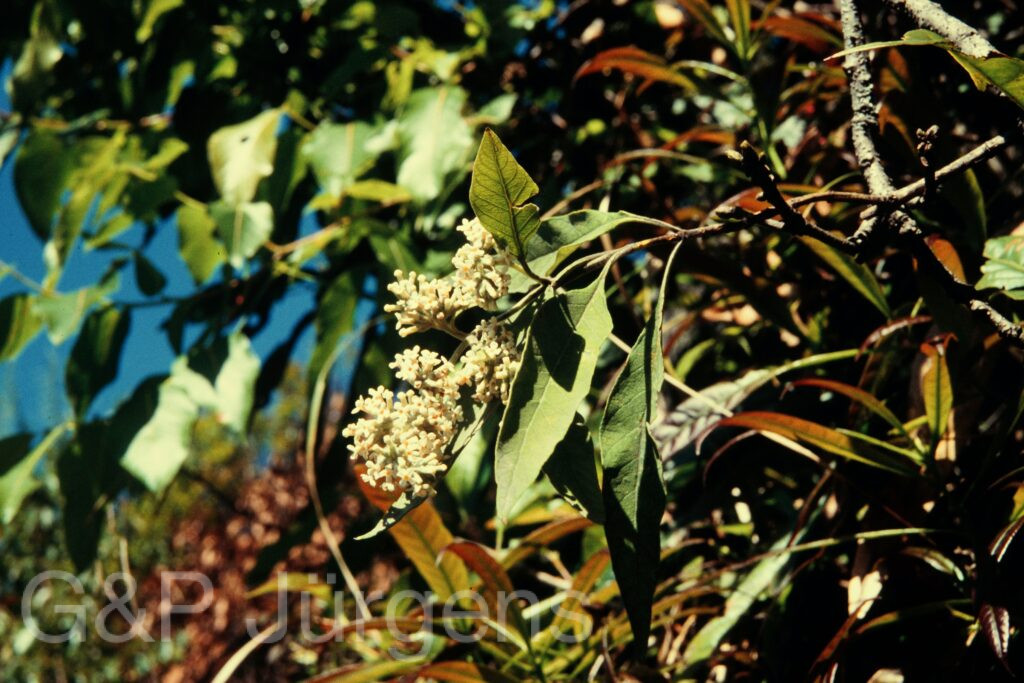
Description
Buddleja paniculata is a shrubby butterfly-bush of the Himalaya and adjacent China, with GBIF occurrences across Nepal, northern India, Bhutan, Myanmar, Vietnam, Thailand and southwest China (further codes being cultivated and herbarium records). It favours open, sunny situations on dry slopes, river terraces, cliffs, roadsides and forest margins in the subtropical to warm-temperate zone, mostly between 1,000 and 2,800 m. The illustrated plant was photographed in the Arun Valley of eastern Nepal at about 1,900 m in May, where it flowers in the dry pre-monsoon season on stony, well-drained ground.
The plant is an erect, much-branched shrub 1-3 m tall with quadrangular, stellate-tomentose young branches. The leaves are opposite, lanceolate to ovate-lanceolate, with a green, somewhat rugose upper surface and a paler, densely stellate-hairy underside, and crenate-serrate margins. The flowers are small and fragrant, crowded into slender, often nodding panicles of cymose clusters; the corolla is tubular with four short lobes, white to pale lilac with an orange or yellow throat, and the calyx is densely tomentose. The fruit is a small, two-valved septicidal capsule releasing numerous minute, narrowly winged seeds dispersed by wind.
The genus Buddleja, formerly placed in its own family Buddlejaceae or in Loganiaceae, is now treated within an enlarged Scrophulariaceae. Buddleja paniculata is among the more cold-tolerant Asian species and an important early-season nectar source for butterflies and other insects. It is widespread, often colonising disturbed and degraded ground, and is not of conservation concern; some forms are grown ornamentally for their scented winter-to-spring bloom.
Author: Wall. · Sources: POWO (Kew), GBIF, Flora of China Vol. 19 (Buddlejaceae), Flora of Nepal, Leeuwenberg: The Loganiaceae of Africa – Buddleja revision works