Caryophyllaceae

Edgew.

Nepal 99 651 2 ergebnis
West-Nepal Kagmara-La 5000m, July

Description

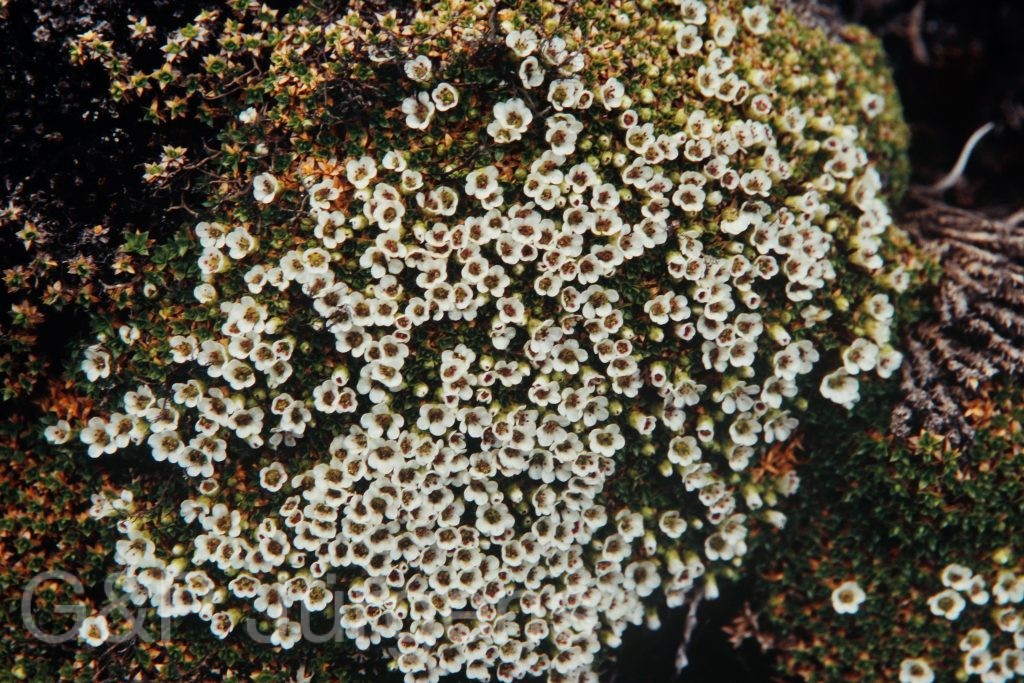
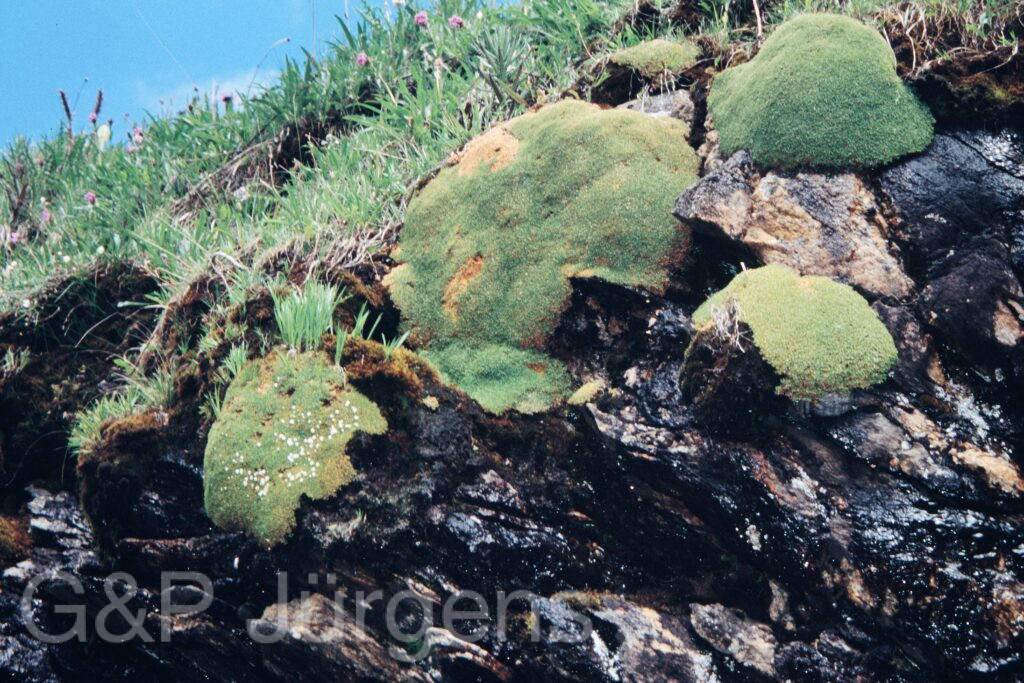
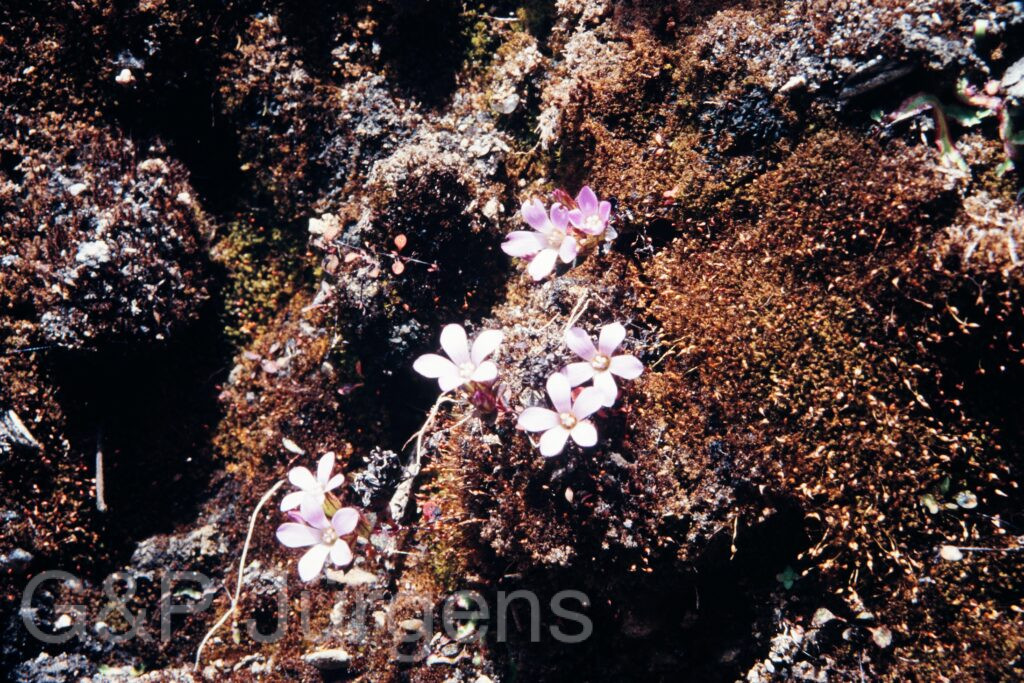
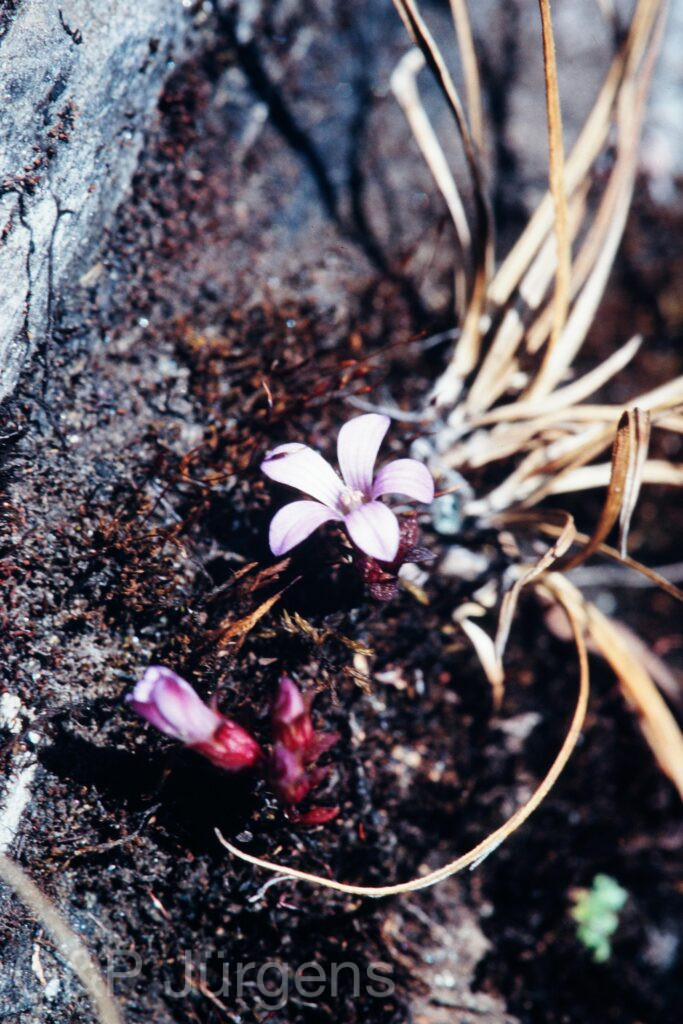
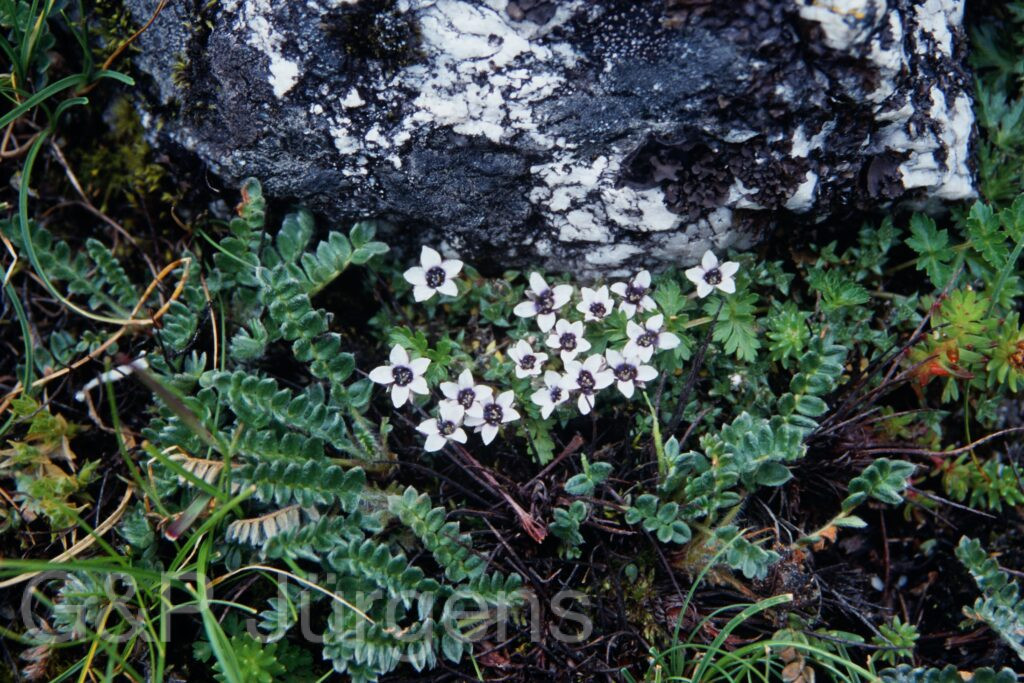
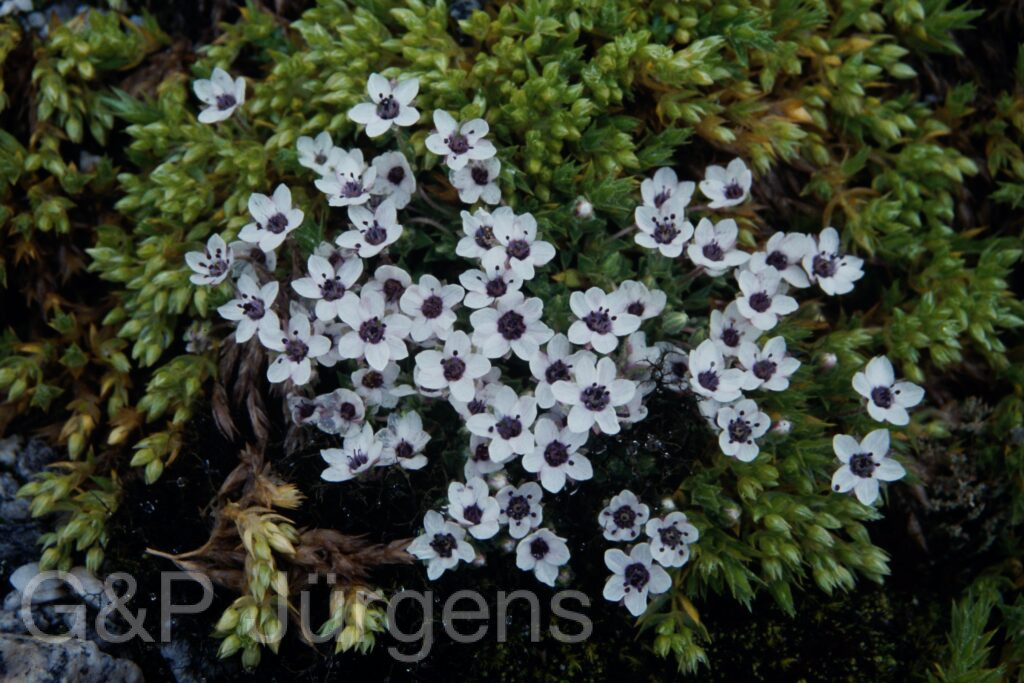
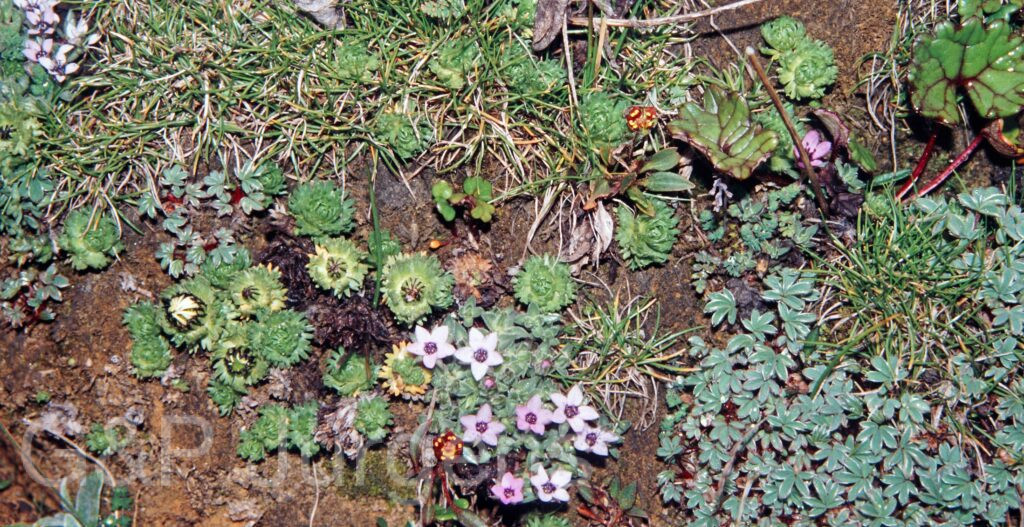
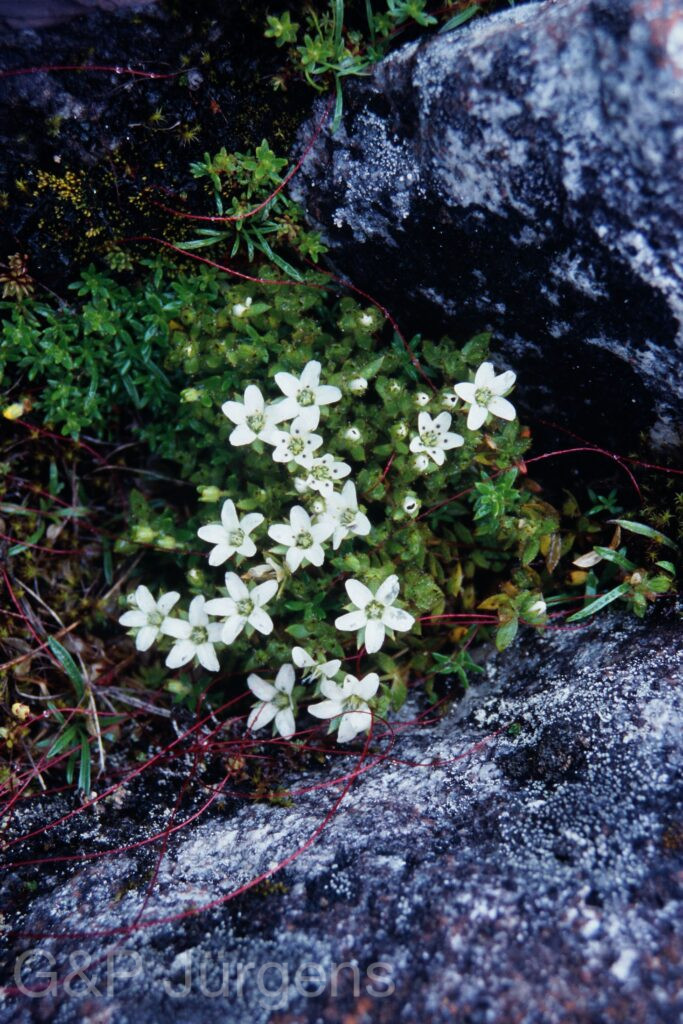
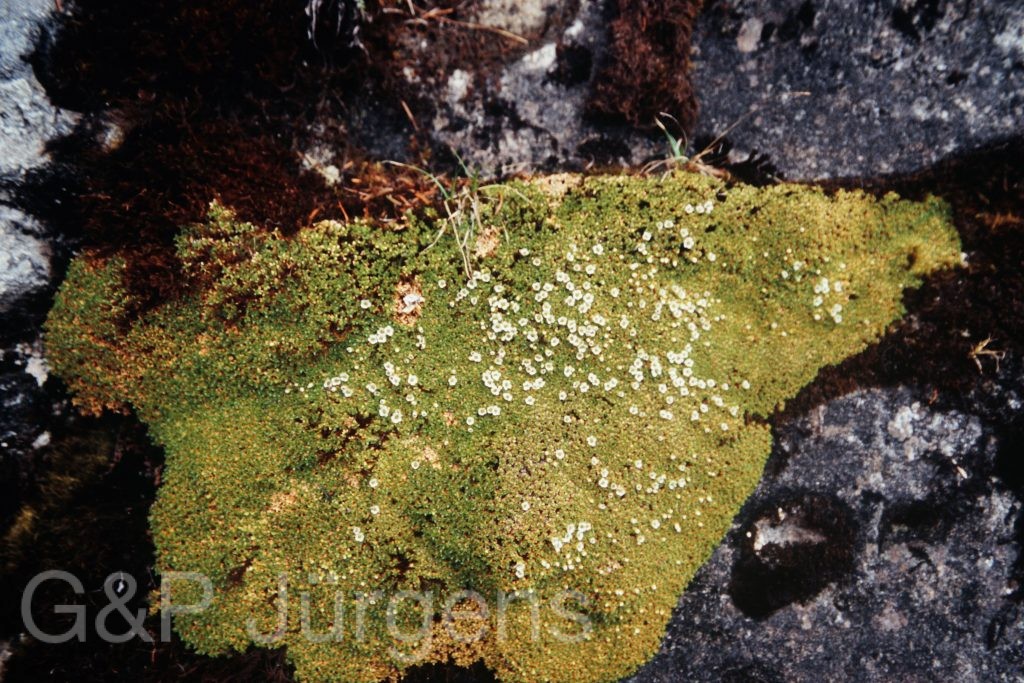
Arenaria melandryoides is a high-alpine cushion plant of the central and eastern Himalaya, recorded from China, Bhutan, India and Nepal across 35 GBIF occurrences. It is a specialist of the upper alpine and subnival belt, occupying open screes, gravelly slopes, moraines and rock crevices at very high elevations, typically above 4000 m. The population imaged on the Kagmara-La in West Nepal at 5000 m in July exemplifies its extreme montane habitat, where it flowers during the brief summer growing season amid sparse, frost-pruned vegetation on exposed, well-drained substrates.

The species is a low, tufted to cushion-forming perennial herb with a stout, woody rootstock and numerous short, densely leafy shoots forming compact mats. The leaves are small, sessile, linear-lanceolate and somewhat rigid, opposite and crowded, often ciliate. The flowers are solitary or few, borne on short pedicels; the calyx comprises five free, lanceolate sepals, and the five white petals are entire and slightly exceed the calyx. There are typically ten stamens and a superior ovary bearing three styles, ripening into a capsule that dehisces by valves to shed numerous small seeds adapted to wind and gravity dispersal on open ground.

The name Arenaria melandryoides is here treated as a synonym, with the accepted name being Arenaria melandryoides; the related epithet melandryiformis reflected in the source link points to ongoing nomenclatural revision within this taxonomically complex group. Arenaria sensu lato in the Himalaya has been repeatedly recircumscribed, with many species transferred among segregate genera. As a cushion-forming subnival specialist, the plant illustrates the convergent growth forms that buffer alpine Caryophyllaceae against cold, wind and short seasons.

Author: Edgew. · Sources: POWO (Kew), GBIF, Flora of China Vol. 6, Flora of Bhutan Vol. 1, Flora of Nepal, Flora of Pakistan, McNeill's revision of Arenaria
Edgew. & Hook.f.

Sikkim2003 289 P400
Sikkim Saniti-Lake 4250m August

Description

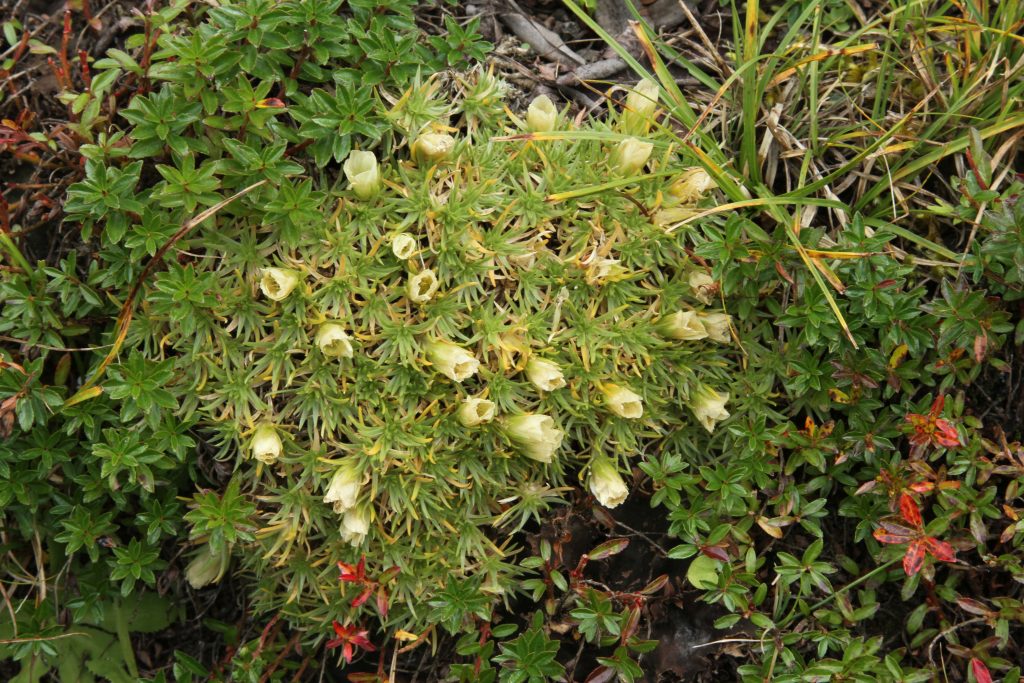
Arenaria ciliolata is a small alpine sandwort of the central and eastern Himalaya, recorded from Nepal, Bhutan, India and China, with an additional outlying datum (gbif_countries: NP, BT, IN, CN, IS) and about 134 GBIF occurrences. It grows on open alpine turf, gravelly and stony slopes, rock crevices and screes well above the treeline, where it forms low cushions or mats in the cold, well-drained habitats typical of the genus. The illustrated material was collected near Saniti Lake in Sikkim at about 4250 m in August, a high-alpine setting where late-summer flowering follows snowmelt. In GBIF the name carries gbif_status SYNONYM, with Arenaria ciliolata given as the accepted name.

The plant is a tufted to mat-forming perennial arising from a branched woody base, with short, densely leafy stems. The leaves are small, opposite, sessile, narrow and rigid, often pungent-tipped and conspicuously ciliate on the margins, the feature evoked by the epithet. The flowers are solitary or few in lax cymes, with five free, white petals exceeding the five lanceolate, often ciliate-margined sepals; the stamens are typically ten and the styles three. The fruit is a capsule opening by valves or teeth at the apex to shed numerous small seeds.

Arenaria is a large, predominantly Northern Hemisphere genus of the pink family with a marked centre of diversity in the mountains of Asia, and the cushion-forming alpine species such as A. ciliolata have figured in repeated taxonomic and phylogenetic reassessments that have realigned segregates within tribe Arenarieae, accounting for the synonymy noted in GBIF. Adapted to harsh high-mountain conditions, the species is widespread across the Himalayan alpine zone and is of no conservation concern.

Author: Edgew. & Hook.f. · Sources: POWO (Kew), GBIF, Flora of Nepal, Flora of China, Annotated Checklist of the Flowering Plants of Nepal, Caryophyllaceae account in The Families and Genera of Vascular Plants

Wall.

Bh09 18 P30
Bhutan Chele-La, 4000m June
Bh09 19 P35
Bhutan Chele-La, 4000m June
Nepal 99 512 ergebnis
West-Nepal Churta-Khola 3900m, June

Description

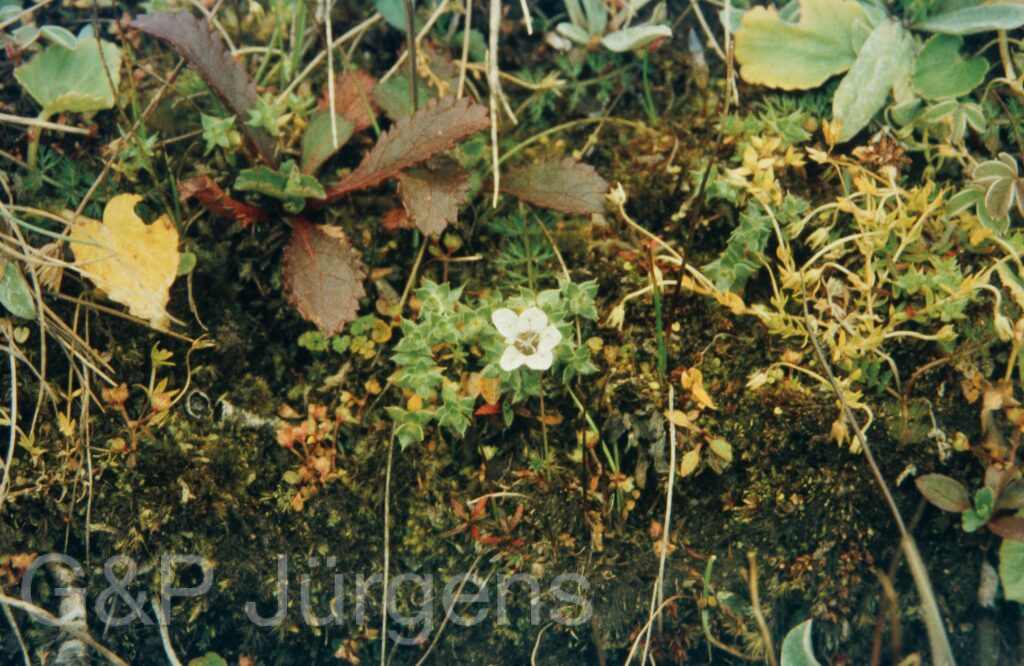
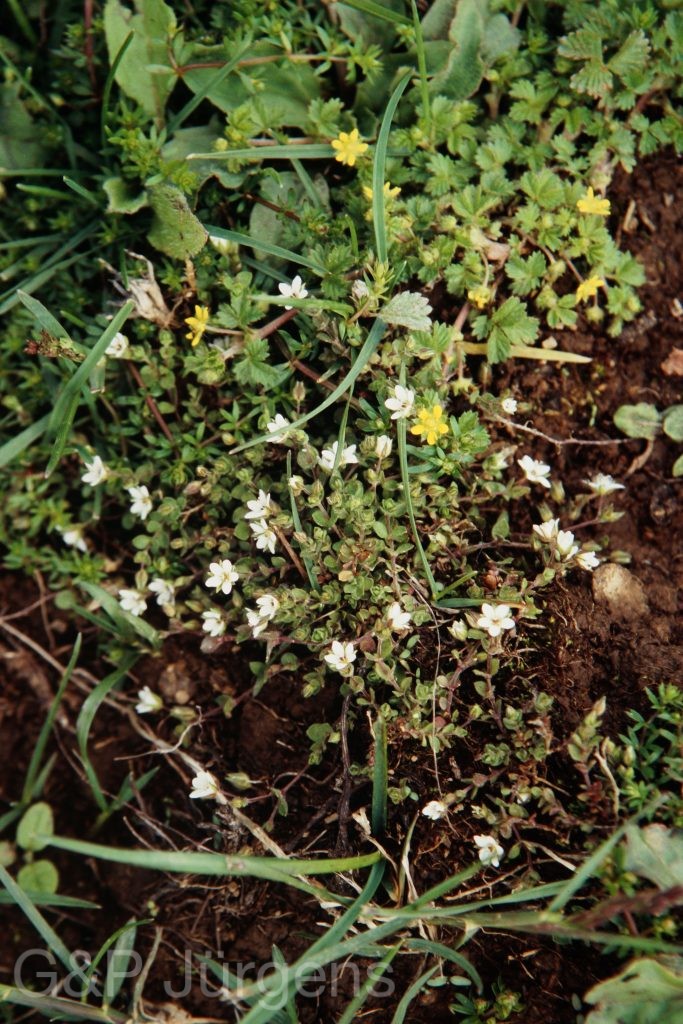
Arenaria densissima is a high-alpine cushion sandwort of the Sino-Himalaya, recorded from China (CN), Nepal (NP) and Bhutan (BT), with 159 GBIF occurrences reflecting its restricted upper-montane to alpine distribution. It is a plant of stony alpine turf, gravelly slopes, screes and exposed ridges, typically between about 3800 and 4800 m, where the dense cushion habit is an adaptation to cold, wind and intense radiation. The illustrated collections were made at Chele-La in Bhutan at around 4000 m and at the Churta-Khola in West-Nepal at about 3900 m, both in June at the start of the alpine flowering season.

It is a small, mat- or cushion-forming perennial herb with a woody, branched rootstock giving rise to densely crowded, congested shoots that form low compact tufts. The leaves are small, sessile, linear to subulate and rigid, closely imbricate and often spine-tipped, creating the dense mossy cushion alluded to by the epithet densissima. The flowers are small, solitary or few, sessile or shortly pedicellate among the leaves; they have five free, ovate sepals, five entire white petals, ten stamens and a superior ovary with styles. The fruit is a small capsule dehiscing by valves or teeth to release minute seeds.

Arenaria, in the family Caryophyllaceae, is a large genus well represented in the high mountains of Asia, where the cushion growth-form has evolved repeatedly as a convergent response to the alpine environment. Species such as A. densissima are characteristic of the Himalayan high-alpine cushion-plant communities and are of biogeographic and ecological interest as pioneers stabilising substrate and providing microhabitats in the cold desert and alpine zones.

Author: Wall. · Sources: POWO (Kew), GBIF, Flora of China, Flora of Nepal, Flora of Bhutan, Monograph of the genus Arenaria (McNeill)

Majumdar

Bhutan2012 301
Bhutan Shale-La, 4100m September

Description

Arenaria edgeworthiana is a Himalayan sandwort recorded from Nepal, China, Bhutan and India, with around 96 georeferenced occurrences in GBIF. In the GBIF backbone the name is treated as a synonym; here Arenaria edgeworthiana is taken as the accepted name for the taxon. It occupies open, well-drained alpine habitats, including stony slopes, rock crevices, gravelly flats and short turf above the treeline, generally between roughly 3500 and 4500 m. The illustrated material was gathered at Shale-La in Bhutan at about 4100 m in September, a typical high-alpine station where this small mat-forming herb grows among scattered cushion plants on exposed ridges.

The plant is a low, tufted or cushion-forming perennial with slender, much-branched stems arising from a woody base. The leaves are small, opposite, sessile and narrowly linear to subulate, often somewhat rigid and crowded, giving the shoots a moss-like or imbricate appearance. The flowers are solitary or few in lax cymes, white, with five free sepals and five entire petals; the stamens are typically ten and the styles usually three, characters that place the plant securely within Arenaria sensu lato. The fruit is a small capsule dehiscing by valves and releasing several minute seeds.

The genus Arenaria has been repeatedly recircumscribed, with many Himalayan cushion species transferred among segregate genera such as Eremogone, which accounts for the synonymy reflected in databases. Plants of this group are well adapted to severe high-mountain conditions, their dense compact habit conserving heat and moisture. No formal conservation assessment applies, but like other restricted alpine endemics it depends on stable, undisturbed high-elevation habitat.

Author: Majumdar · Sources: POWO (Kew), GBIF, Flora of Bhutan, Flora of China, Annotated Checklist of the Flowering Plants of Nepal, McNeill revision of Arenaria

Benth.

Garw 2005 333 ergebnis
India Garhwal Bagubasa 4150m, September

Description

Arenaria festucoides Benth. is a tufted alpine sandwort of the Caryophyllaceae, distributed through the Himalaya and Tibetan plateau in India, Nepal, Pakistan and SW China, with around 126 georeferenced records concentrated along the high Sino-Himalayan ranges. It is a plant of open, well-drained habitats: stony alpine meadows, gravel flats, fine scree and grassy slopes above the treeline, where it forms low patches among rocks. The photographed population from Bagubasa in the Garhwal Himalaya at about 4,150 m in September lies squarely within its typical high-alpine elevational range, where it flowers and fruits late in the short mountain summer. In GBIF the name is treated as a synonym, but the accepted name is likewise rendered Arenaria festucoides, so it stands as the valid designation here.

The species is a densely caespitose perennial forming firm cushions or mats from a branched woody caudex. The leaves are crowded, narrowly linear to subulate and rigid, grass-like (hence the epithet festucoides), often pungent-tipped and somewhat keeled. The small flowers are borne singly or in few-flowered cymes on short pedicels; the five free sepals are lanceolate and acute, exceeded by the five entire white petals. There are typically ten stamens and three styles, the ovary maturing into a small ovoid capsule that dehisces by valves to release several minute seeds.

Arenaria is a large and taxonomically complex genus, and several segregate genera (Eremogone, Odontostemma) have been carved from its Himalayan members, so generic placement of this and allied species has shifted in recent treatments. The compact cushion habit, reduced leaf surface and deep caudex are classic adaptations to wind exposure, drought and frost at high elevation. The species is widespread across its range and not regarded as threatened.

Author: Benth. · Sources: POWO (Kew), Flora of China Vol. 6, Flora of Pakistan, GBIF, McNeill: Taxonomic studies in the Alsinoideae (1962)

Diels

Nepal 95 384 P683 ergebnis
Nepal Bahanjyang 3800m, October
Nepal 95 385 P684 ergebnis
Nepal Bahanjyang 3800m, October

Description

Arenaria forrestii is a high-alpine cushion plant of the Sino-Himalayan region, recorded from China, Bhutan, India and Nepal across some 164 GBIF occurrences. The photographed plant was found at Bahanjyang in Nepal at about 3800 m in October, a typical setting for a species inhabiting open alpine turf, stony slopes, gravelly screes and rocky crevices, generally between 3500 and 4800 m. It forms low compact mats on exposed, well-drained substrates where the cushion habit conserves moisture and buffers against wind, frost and intense montane insolation.

The plant is a densely caespitose perennial forming tight cushions or mats from a branched, somewhat woody caudex and slender rhizomatous base. The leaves are small, sessile, linear to subulate, opposite, rigid and often imbricate, the older bases persisting. Flowering stems are short and few-flowered; the flowers are solitary or in small cymes, with five free, often dark-veined sepals and five white, entire petals exceeding the calyx. The fruit is a small ovoid capsule dehiscing by teeth and releasing several minute reniform seeds.

GBIF treats the recorded name as a synonym, with Arenaria forrestii as the accepted name. The species belongs to the speciose genus Arenaria (sandworts), well represented among Himalayan cushion-forming alpines that contribute to the distinctive scree and meadow communities of the high passes. Such cushion plants act as nurse structures, modifying their microhabitat and facilitating other alpine species. No conservation concern is recognised, populations being widespread though confined to specialised high-elevation habitats.

Author: Diels · Sources: POWO (Kew), GBIF, Flora of China, Flora of Nepal, Flora of Bhutan, McNeill – Monograph of Arenaria (Caryophyllaceae)

Edgew.

Sikkim2003 305 G431
Sikkim Saniti-Lake 4250m, August
Sikkim2003 306 G432
Sikkim Saniti-Lake 4250m, August
Nepal 99 789 ergebnis
West-Nepal Baga-La-Phedi 4400m, July

Description

Arenaria glanduligera is a cushion- or mat-forming sandwort of the high Himalaya, recorded by GBIF (about 240 occurrences) from Nepal, China, India and Bhutan. It is a true alpine of the upper alpine and subnival zones, growing on open stony slopes, gravelly flats, moraine and exposed ridges where snow lies late and the growing season is short. The photographed plants came from Sikkim near Saniti Lake at about 4250 m in August and from West Nepal at Baga-La-Phedi at around 4400 m in July, both well above the timberline and typical of its range, which extends to over 4500 m in the wettest, most exposed habitats of the inner ranges.

The plant is a low, densely tufted perennial forming compact mats from a branched, woody base. The stems are short, crowded and glandular-hairy, the indumentum giving rise to the epithet glanduligera. The leaves are opposite, small, narrowly lanceolate to subulate, acute and somewhat rigid, often ciliate on the margins. The flowers are solitary or few at the stem tips; each has five free, lanceolate sepals and five white, entire, obovate petals that exceed the sepals, with ten stamens and a superior ovary bearing three styles. The fruit is a small capsule dehiscing by valves to release numerous minute seeds, the inflorescence rendered slightly viscid by the glandular hairs.

GBIF treats the binomial as a synonym, with Arenaria glanduligera here regarded as the accepted name for the taxon. The species belongs to the large and taxonomically intricate genus Arenaria of the Caryophyllaceae, well represented in the Himalaya by a swarm of high-alpine cushion species adapted to cold, wind and intense radiation. It is locally frequent in suitable terrain and of no conservation concern.

Author: Edgew. · Sources: POWO (Kew), GBIF, Flora of China, Flora of Bhutan, Annotated Checklist of the Flowering Plants of Nepal, McNeill's revisional studies of Arenaria (Caryophyllaceae)

M.Bieb.

Bh09 185 P322
Bhutan Phajoding, 3600m June
Sikkim 2006 414 ergebnis
India West-Bengal, Kishong 2800m, May

Description

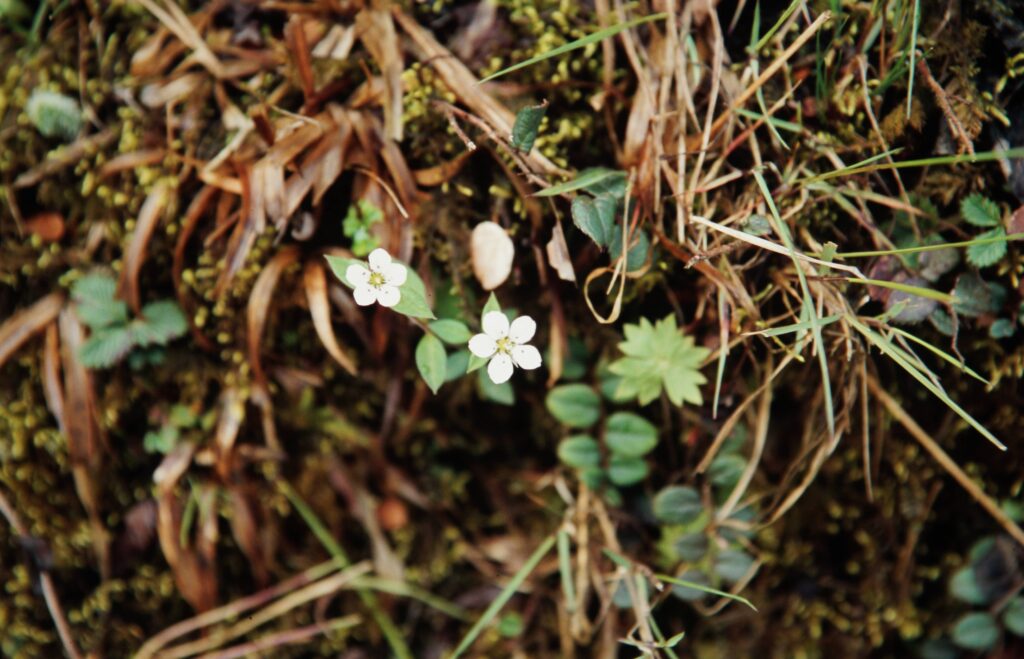
Arenaria rotundifolia is a small alpine sandwort with a wide Eurasian montane distribution, documented by 331 georeferenced records reaching from the Caucasus and Anatolia (TR, GE, AM) and the Balkans (GR, AL, BG, ME, RS) eastward through Iran (IR) and Central Asia (KZ, UZ, TJ, KG) to China (CN), Nepal (NP) and India (IN). It is a plant of moist, open alpine and subalpine ground, growing on rocky slopes, screes, streamsides, damp turf and shaded banks at high elevation. The plants recorded at Phajoding in Bhutan at 3600 m in June and at Kishong in West Bengal at 2800 m in May illustrate its presence in cool, moist Himalayan montane habitats toward the eastern edge of its range.

It is a small, slender, tufted to loosely mat-forming perennial herb with delicate, ascending to decumbent, often glandular-hairy stems. The leaves are opposite, distinctly small and rounded, ovate to suborbicular, shortly petiolate below and sessile above, giving rise to the epithet rotundifolia. The flowers are borne in few-flowered, lax cymes; each has five free, green sepals and five white, entire (not notched) petals, ten stamens and a superior ovary with three styles, in the usual arrangement of the genus. The fruit is a small capsule opening by teeth twice the number of the styles to release numerous minute, reniform seeds.

Arenaria (Caryophyllaceae) is a large, taxonomically difficult genus of mostly cushion- or mat-forming herbs of cold and rocky habitats, in which species circumscription has long been complicated by reticulate variation across its broad Holarctic range. A. rotundifolia, with its wide trans-Eurasian montane distribution, exemplifies this pattern. It is a frequent and widespread alpine herb of no conservation concern, valued chiefly as an indicator of moist, high-elevation rock and turf communities.

Author: M.Bieb. · Sources: POWO (Kew), GBIF, Flora of Bhutan, Flora of China, Flora Europaea, McNeill monographic studies of Arenaria (Caryophyllaceae)

(Franch.) Pax

BhutanPG2011 117
Bhutan Chogham, 3450m June
Bh2008 38 G66
Bhutan Dochu-La, 3000m April
Sikkim 2006 79 ergebnis
India West-Bengal, Kalipokkri 3100m, May

Description

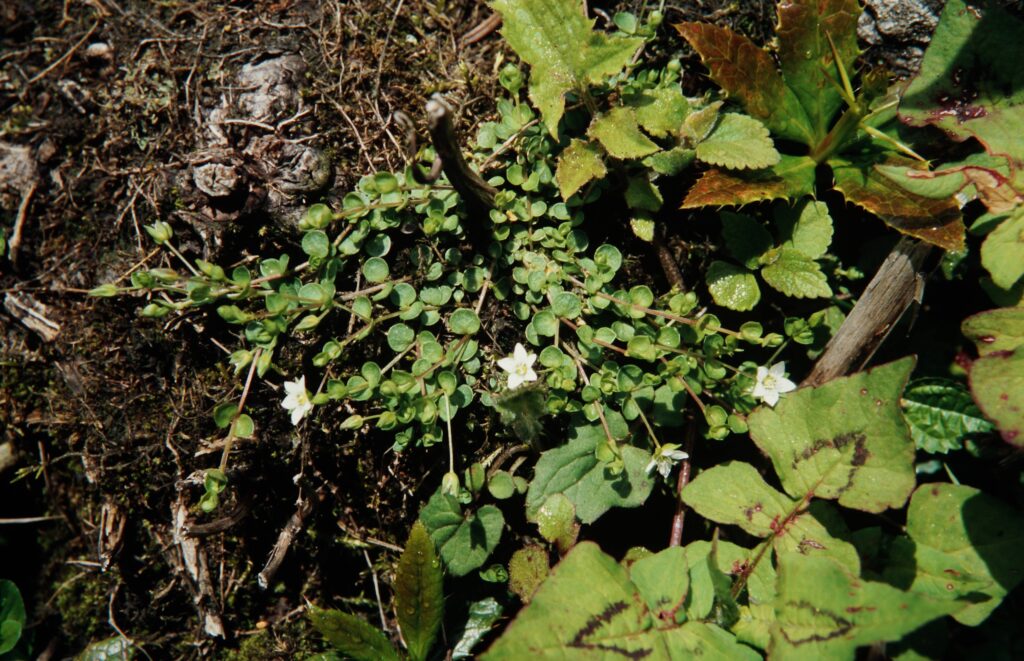
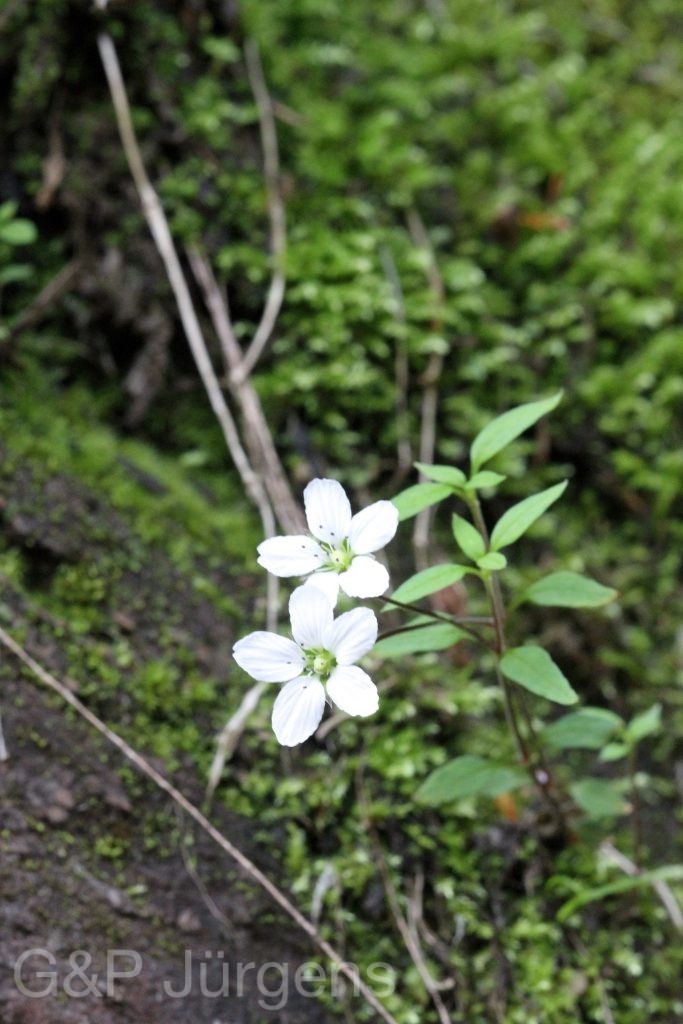
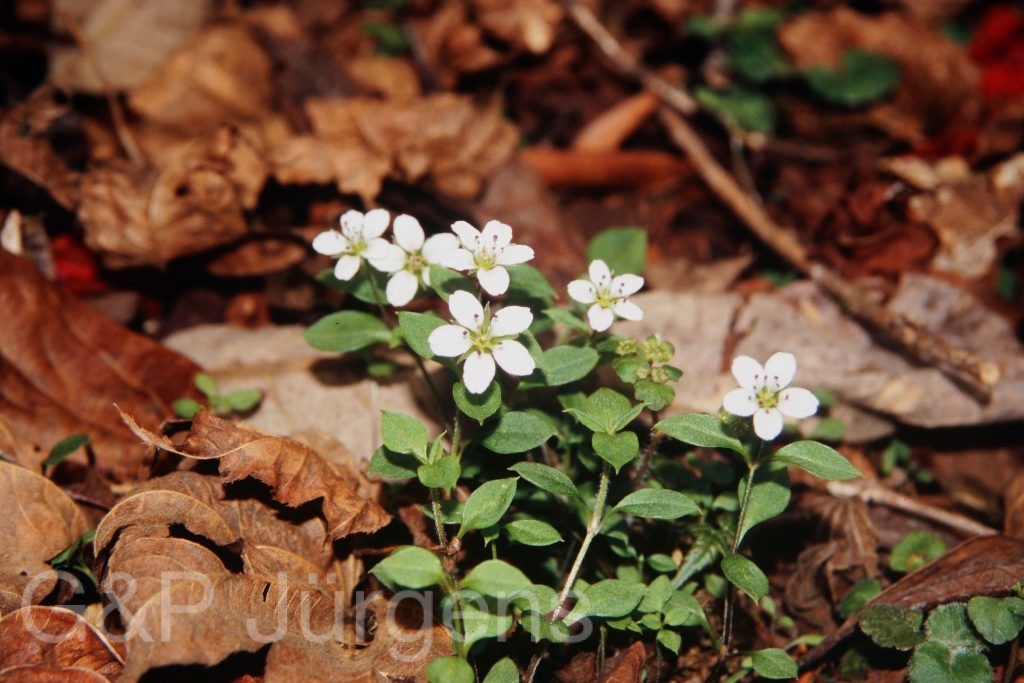
Pseudostellaria himalaica (Franch.) Pax is a small woodland perennial of the Himalaya and adjacent ranges, distributed through Bhutan, India, Nepal, Pakistan, Afghanistan and south-western China, with a comparatively modest GBIF record of about 118 occurrences reflecting its inconspicuous habit. It grows in cool, shaded, humus-rich conditions: the floor of temperate broadleaf and conifer forest, mossy banks, Rhododendron understorey and damp rocky slopes. The illustrated material spans three localities and seasons, from Chogham in Bhutan at 3450 m in June and Dochu-La at 3000 m in April to Kalipokkri in West Bengal, India, at 3100 m in May, indicating a flowering period extending through spring and early summer in the temperate to lower subalpine zone.

The plant is a delicate, glabrous to sparsely hairy perennial arising from slender, fusiform to tuberous-thickened roots. The stems are weak, slender and ascending, bearing opposite, sessile to shortly petiolate, ovate to lanceolate leaves with entire margins. The flowers are of two kinds in the manner typical of Pseudostellaria: showy, chasmogamous flowers borne in the upper axils or terminally, with five free white petals (often bifid or notched) somewhat exceeding the five lanceolate sepals, ten stamens and a three-styled ovary; and inconspicuous, often petal-less cleistogamous flowers produced lower on the plant that self-fertilise. The fruit is a small capsule dehiscing by valves to release few seeds.

This taxon has frequently been treated as Pseudostellaria heterantha var. himalaica, reflecting its close affinity with the variable P. heterantha aggregate, and authors differ on whether to recognise it at species or varietal rank, as the source page name indicates. The combination of showy outcrossing flowers with reliably self-pollinating cleistogamous ones is a reproductive strategy that buffers seed-set in the short, cool growing season of shaded montane forest. The species is widespread if seldom abundant, and no specific conservation threat is recorded, though it depends on intact forest understorey.

Author: (Franch.) Pax · Sources: POWO (Kew), GBIF, Flora of China, Flora of Bhutan, Caryophyllaceae of the Himalaya (Majumdar)

(Rupr.) Bocquet

Nepal 99 320 ergebnis
West-Nepal Kalmura 4200m, June

Description

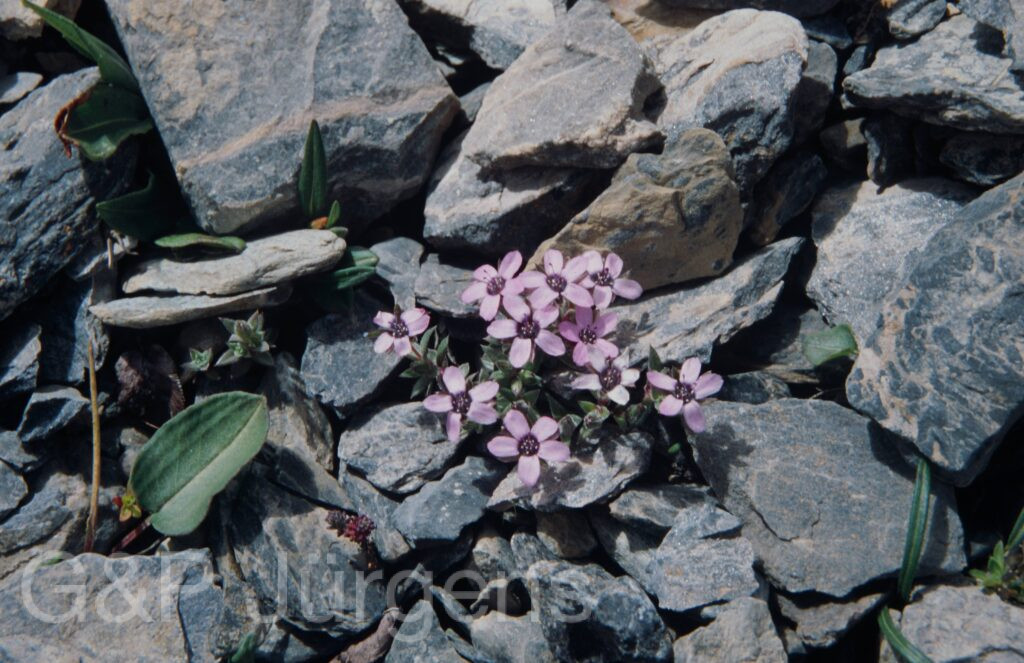
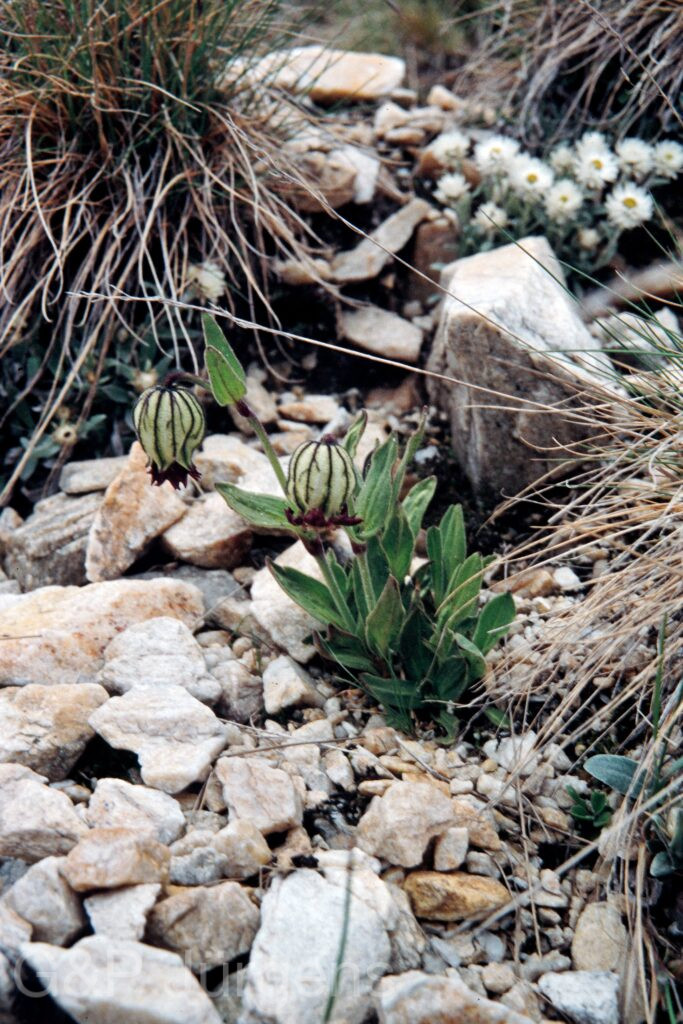
Silene gonosperma is a high-mountain perennial campion with a wide Central Asian, Himalayan and boreal distribution, recorded from Afghanistan, Tajikistan, Kyrgyzstan, Kazakhstan, Pakistan, the Himalaya (India, Nepal, Bhutan), Mongolia, Russia, China and even reaching Sweden in the broad sense. GBIF aggregates around 657 occurrences spanning this trans-Asiatic range. It is a plant of the alpine zone, growing in stony and grassy meadows, screes, moraines and exposed slopes, commonly above 3500 m and reaching well over 4000 m. The West-Nepal population photographed at Kalmura (4200 m, June) typifies its occurrence in cold, open high-alpine turf near the upper limit of flowering plants.

The species forms small tufts or cushions from a branched woody caudex, producing short, ascending, often glandular-hairy flowering stems. The leaves are opposite, linear to narrowly oblanceolate, the basal ones crowded and the cauline pairs few and reduced. The flowers are usually solitary or few, often nodding, with a tubular to inflated, many-nerved calyx frequently flushed dark purple, and five clawed petals, pink-purple to dull violet or greenish, with shallowly emarginate to bifid laminae. Ten stamens and three styles are present. The fruit is an ovoid capsule opening by six teeth and bearing the distinctive angular, often winged seeds that give the epithet.

Silene gonosperma, transferred by Bocquet from earlier placements in Melandrium and Wahlbergella, exemplifies the taxonomic flux around the boreal-alpine campions, and several subspecies and varieties have been described across its enormous range. Its cushion habit, dark calyx and angular seeds aid identification among co-occurring high-alpine Silene. As a widespread, locally frequent species of remote high-mountain habitats it faces no significant threats, though its uppermost populations may be sensitive to warming.

Author: (Rupr.) Bocquet · Sources: POWO (Kew), GBIF, Flora of China, Flora of Pakistan, Flora of USSR, Annotated Checklist of the Flowering Plants of Nepal, Caryophyllaceae monograph of Silene (Bocquet)

  • 1
  • 2