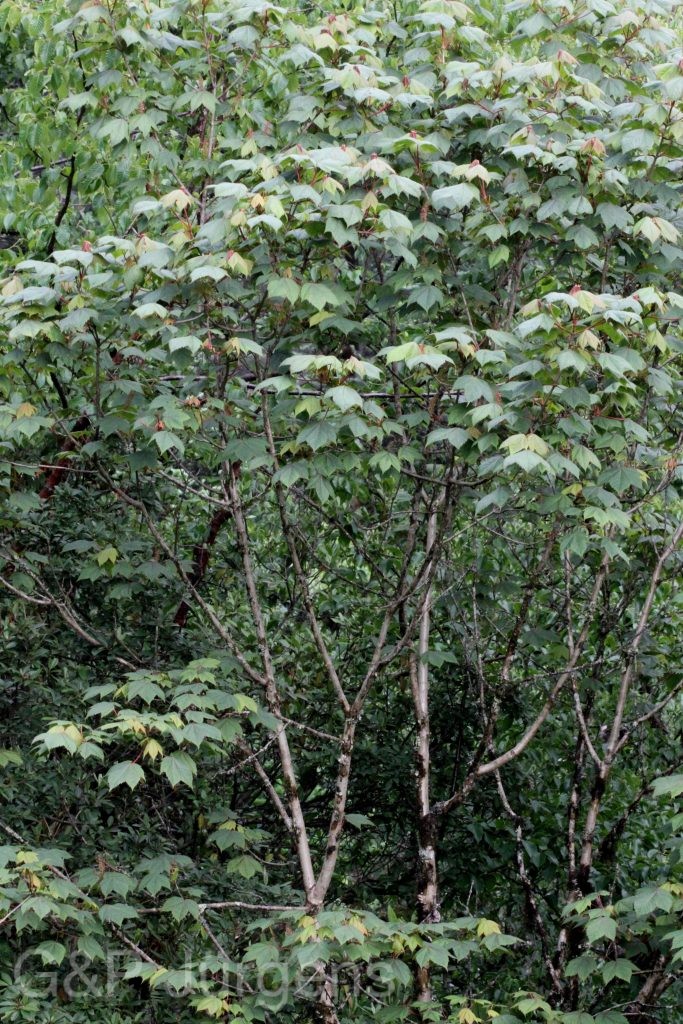
Author

G & P Jürgens

Wall.

BhutanPG2011 59
Bhutan Jakar, 2100m June
BhutanPG2011 60
Bhutan Jakar, 2100m June

Description

Acer caudatum is a deciduous maple of the Himalaya and the mountains of China, distributed through China, Nepal, India, Bhutan, Myanmar, Afghanistan and into Russia, with over two thousand recorded occurrences across this broad range. It is a tree of moist temperate and subalpine forest, growing in mixed broad-leaved and conifer woodland, along ravines and on cool shaded slopes on humus-rich soils. In Bhutan it occurs in the middle montane belt, as illustrated by the collection near Jakar in the Bumthang region at about 2100 m in June, when the trees are in full leaf and flower.

The species is a small to medium-sized tree with smooth greyish bark and slender branchlets. The leaves are opposite, long-petiolate and orbicular in outline, palmately five- to seven-lobed with the lobes ovate-acuminate and the margins sharply and doubly serrate, often softly hairy on the veins beneath. The inflorescence is an erect terminal raceme or narrow panicle bearing numerous small yellowish-green flowers. The fruit is the typical maple double samara, the two nutlets each bearing a membranous wing, the wings spreading at a wide to nearly horizontal angle to enable anemochorous dispersal of the seeds.

Acer caudatum, described by Wallich and now placed in Sapindaceae following the merger of the former Aceraceae, is a variable species classified within section Spicata, the group of maples with erect spike-like inflorescences. Several geographical varieties have been recognised across its range, reflecting its wide montane distribution. The species is a normal component of Himalayan temperate forest and is not threatened, contributing to autumn colour and, through its winged fruits, to the regeneration dynamics of mid-elevation woodland.

Author: Wall. · Sources: POWO (Kew), GBIF, Flora of China Vol. 11, Flora of Bhutan Vol. 2, Flora of Nepal, Flora of Pakistan, van Gelderen et al. Maples of the World
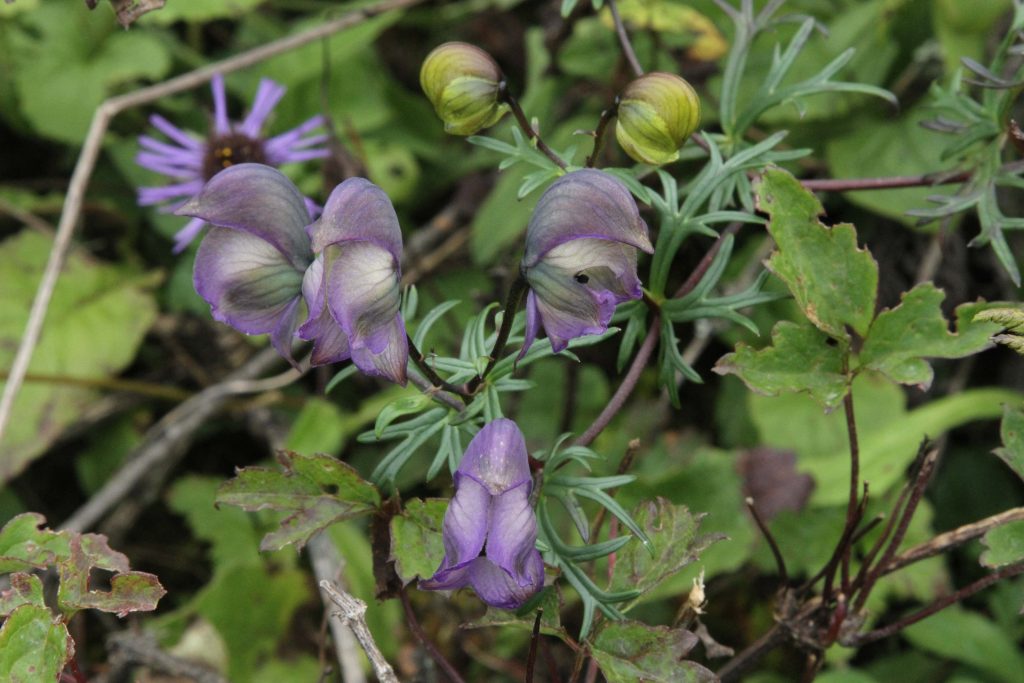
Tamura

Bhutan2012 288
Bhutan Shele-La, 4100m September

Description

Aconitum nakaoi is a high-alpine monkshood distributed across the eastern Himalaya and the south-eastern Tibetan plateau margin, recorded from Bhutan, China (Xizang and adjacent Yunnan), Nepal and northern India. Its modest documentary record of around 21 georeferenced occurrences reflects both its restricted range and the difficulty of botanizing the steep upper screes and meadows it favours. The species inhabits open alpine turf, the margins of dwarf-shrub thickets and damp stony slopes, typically between about 3,800 and 4,500 m. The photographed plant from Shele-La in Bhutan at 4,100 m, flowering in September, is characteristic of its late-season anthesis in the cool, monsoon-influenced uplands where snowmelt and persistent humidity sustain the short growing season.

The plant is a perennial herb arising from small paired tuberous roots, with slender, often decumbent to ascending stems. The leaves are palmately divided into narrow, deeply incised segments, glabrous to thinly pubescent, the basal leaves long-petiolate and the cauline ones progressively reduced. The inflorescence is a lax few-flowered raceme bearing the zygomorphic, helmet-shaped flowers typical of the genus; the upper sepal forms a high, narrowly conical to galeate hood enclosing two long-clawed nectariferous petals, the colour ranging from violet-blue to dull purplish. The fruit is a cluster of several erect follicles releasing winged seeds.

Like all Aconitum, the species contains diterpenoid alkaloids and is highly toxic. It belongs to the taxonomically intricate Himalayan radiation of section Aconitum, where narrow endemics and clinal variation complicate species delimitation. Though not formally assessed as threatened, its narrow altitudinal band makes it sensitive to upward shifts of the treeline and to grazing pressure on alpine pastures.

Author: Tamura · Sources: POWO (Kew), Flora of China Vol. 6, Flora of Bhutan Vol. 1, GBIF, Tamura: Ranunculaceae in Die natürlichen Pflanzenfamilien

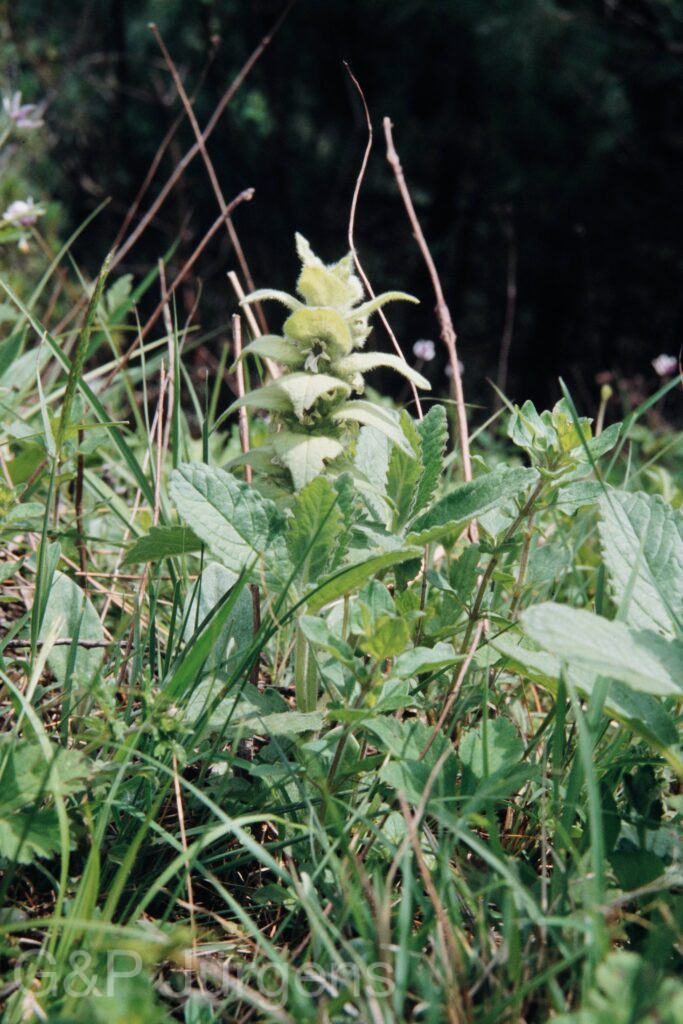
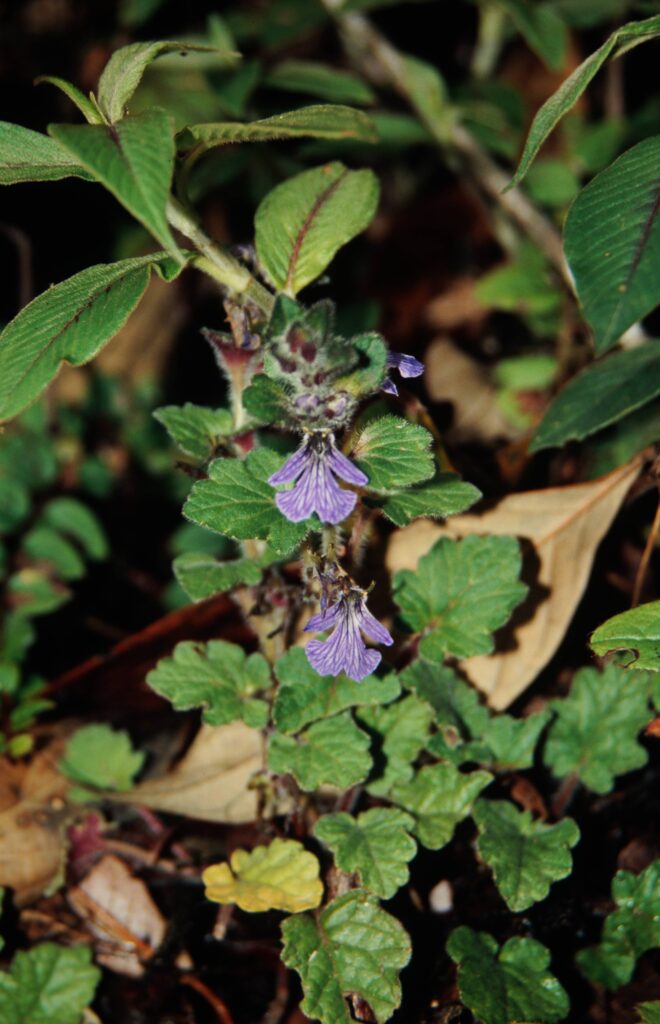
Ajuga lobata 

by G & P Jürgens

D.Don

Sikkim 2006 23 ergebnis
India West-Bengal Tonglu 3100m, May

Description

Ajuga lobata is an eastern Himalayan and Sino-Himalayan element distributed across Nepal, northern India, Bhutan, northern Myanmar and adjacent south-western China, with some 172 georeferenced occurrences documented. It is a plant of cool-temperate forest margins, mossy banks and open grassy slopes within the upper-montane to subalpine belt, typically between about 2400 and 3500 m. The population photographed at Tonglu (3100 m) on the Singalila ridge of West Bengal in May, flowering as the monsoon approaches, is characteristic: it favours humus-rich, freely draining soils in light shade beneath Rhododendron and oak.

It is a low, perennial, somewhat creeping herb arising from a slender rootstock, the quadrangular stems frequently decumbent at the base and rooting at the lower nodes before ascending. The leaves are opposite, ovate to obovate, the lamina conspicuously lobed or coarsely crenate-dentate, narrowed into a winged petiole and often tinged purplish beneath. Flowers are borne in axillary verticillasters forming a leafy terminal spike; the corolla is bluish to violet, two-lipped with a strongly reduced upper lip and a prominent, spreading three-lobed lower lip, the four didynamous stamens exserted. The fruit comprises four reticulate-rugose nutlets seated in the persistent campanulate calyx.

Within Ajuga (Ajugoideae) the species is distinguished by its markedly lobed leaves, a feature echoed in the epithet. Its montane distribution makes it a useful indicator of intact temperate forest ecosystems, and like many bugles it is visited by bees and serves as a minor nectar source. No conservation concern is presently recognised given its broad range, though it is locally restricted to suitable forest habitat.

Author: D.Don · Sources: POWO (Kew), GBIF, Flora of China Vol. 17, Flora of Bhutan Vol. 2, Flora of Nepal, A Revision of the Genus Ajuga (Labiatae)

Ajuga lupulina

by G & P Jürgens

Maxim.

Nepal 99 387 ergebnis
West-Nepal Sallibagar-Khola 3100m, June

Description

Ajuga lupulina is a robust perennial herb of the Sino-Himalayan region, distributed across China, Nepal and India and extending into Mongolia; GBIF logs about 1205 occurrences with its centre in the Tibetan Plateau borderlands and the high Himalaya. It grows on open alpine and subalpine slopes, gravelly pastures, riverbanks and stony meadows, generally between about 2500 and 4300 m. The photographed plant was found in West Nepal at Sallibagar Khola at roughly 3100 m in June, a typical setting for this conspicuous species among the early-summer flora of the western Himalayan valleys.

The species is an erect perennial arising from a stout rootstock, with quadrangular stems that are villous, especially at the nodes. The leaves are opposite, oblong-lanceolate to elliptic, toothed and softly hairy. The plant is most readily recognised by its dense, elongate, spike-like terminal inflorescence in which large, broadly ovate, often pale or purplish-tinged floral bracts overlap conspicuously and conceal the flowers, giving a hop-like aspect that explains the epithet lupulina. The flowers have a bilabiate corolla with a much-reduced upper lip and a conspicuous trilobed pale yellowish to whitish lower lip; the four stamens are didynamous and exserted. The fruit comprises four reticulate nutlets enclosed by the persistent calyx.

Ajuga lupulina Maxim. is widespread and common across its broad Sino-Himalayan range and of no conservation concern. It is valued in traditional Tibetan and Chinese herbal medicine, and the genus is known for neo-clerodane diterpenoids and ecdysteroids. Its large imbricate bracts make it one of the most recognisable Himalayan bugles and a useful field marker of alpine pastures.

Author: Maxim. · Sources: POWO (Kew), GBIF, Flora of China, Flora of Nepal, taxonomic revisions of Ajuga (Lamiaceae)

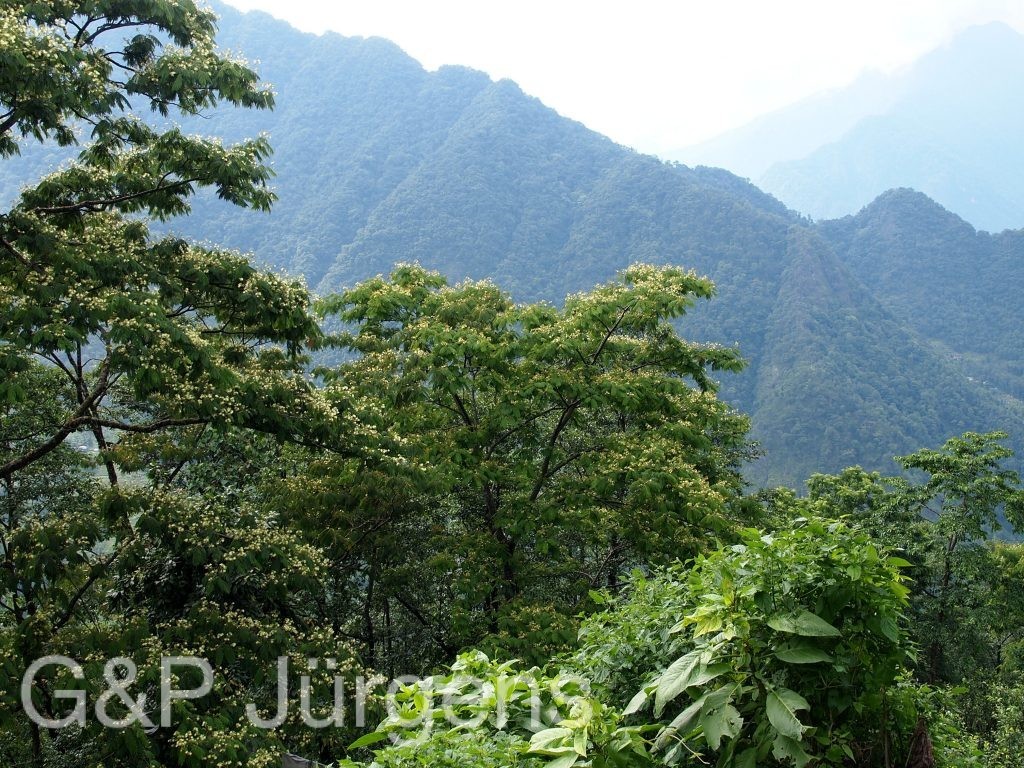
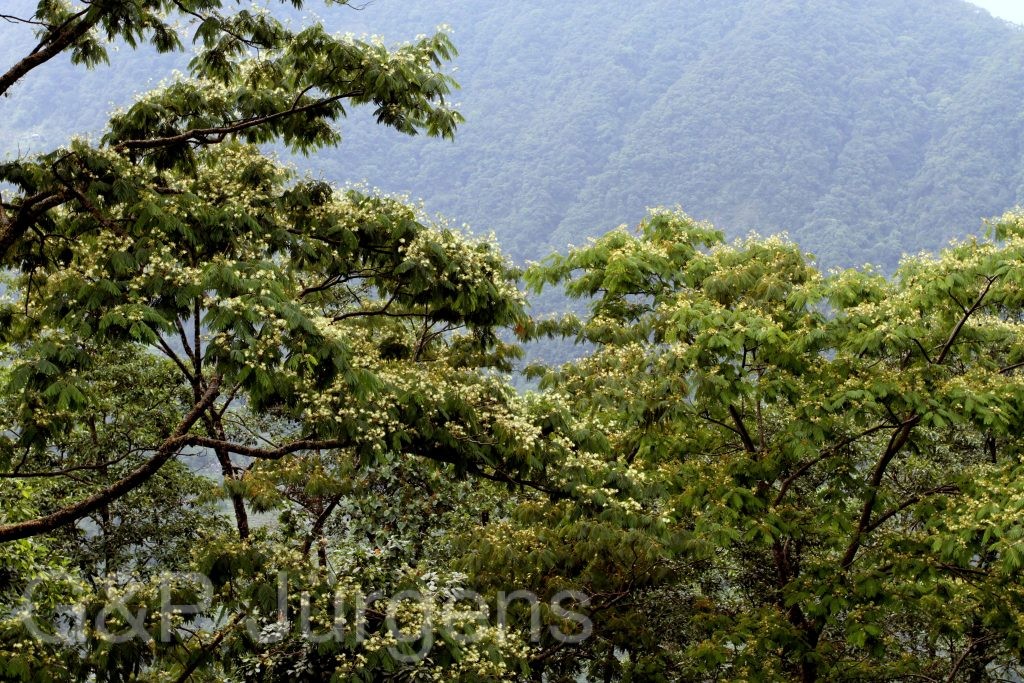
(L.f.) Benth.

Sikkim2011 12
India Sikkim Tista valley 1800m, June
Sikkim2011 13
India Sikkim Tista valley 1800m, June

Description

Albizia odoratissima is a deciduous tree of broadly tropical and subtropical distribution, ranging across the Indian subcontinent and continental Southeast Asia into southern China, with records from Nepal, Bangladesh, Myanmar, Thailand, Laos, Vietnam, Sri Lanka, Malaysia and Indonesia; it has been widely introduced elsewhere, including East Africa, Nigeria, Mozambique and the Americas, and is documented from over a thousand georeferenced collections. In the eastern Himalaya it ascends warm submontane forest, as in the Tista valley of Sikkim around 1800 m photographed in June, favouring moist deciduous and semi-evergreen forest, riverine slopes and forest margins.

The tree reaches 15-25 m, with a spreading crown, grey-brown bark and finely pubescent branchlets. The leaves are bipinnate, with 3-6 pairs of pinnae, each pinna bearing numerous small oblong-falcate leaflets oblique at the base; a gland sits on the petiole. The fragrant flowers are arranged in pedunculate globose heads grouped into terminal panicles, each with a small campanulate calyx, funnel-shaped corolla and numerous long, white to greenish-cream exserted stamens united below into a tube. The fruit is a flat, thin, oblong dehiscent legume, glabrous and reddish-brown.

A member of the mimosoid clade of Fabaceae, A. odoratissima was described as Mimosa odoratissima by the younger Linnaeus and transferred to Albizia by Bentham. It is valued as a nitrogen-fixing timber and fodder species and is widely planted for shade, agroforestry and reforestation, which accounts for its naturalised occurrences far beyond its native Asian range. Locally esteemed for its hard, durable wood, it remains common and is not regarded as threatened, though native populations are affected by selective logging and forest conversion.

Author: (L.f.) Benth. · Sources: POWO (Kew), GBIF, Flora of China, Flora of Bhutan, Flora of British India, Nielsen monograph of Asian Albizia (Mimosoideae)

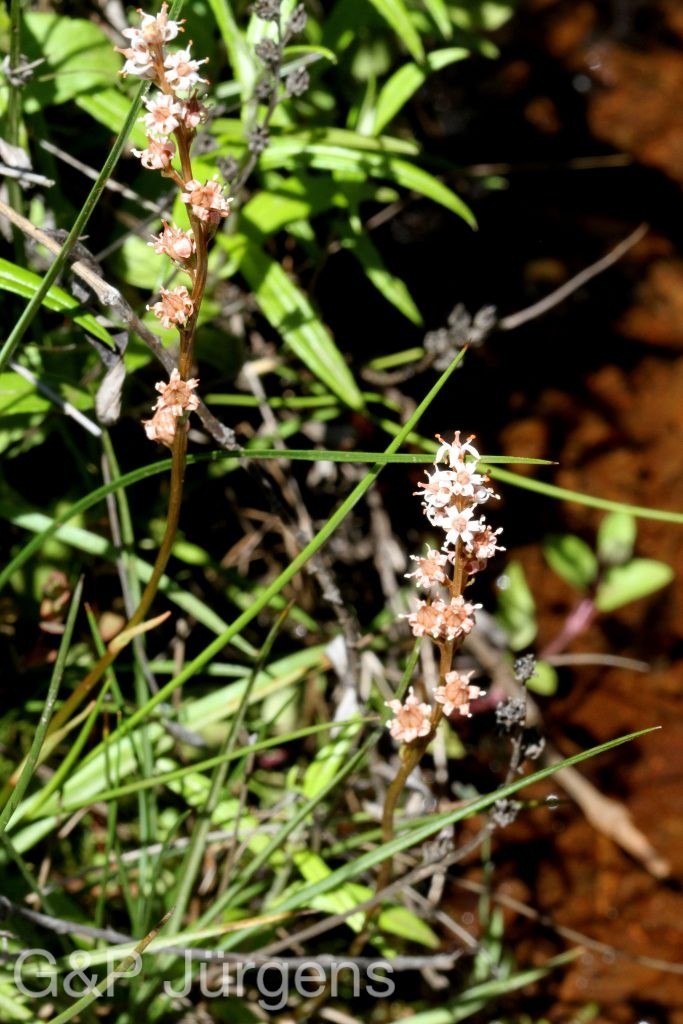
Bureau & Franch.

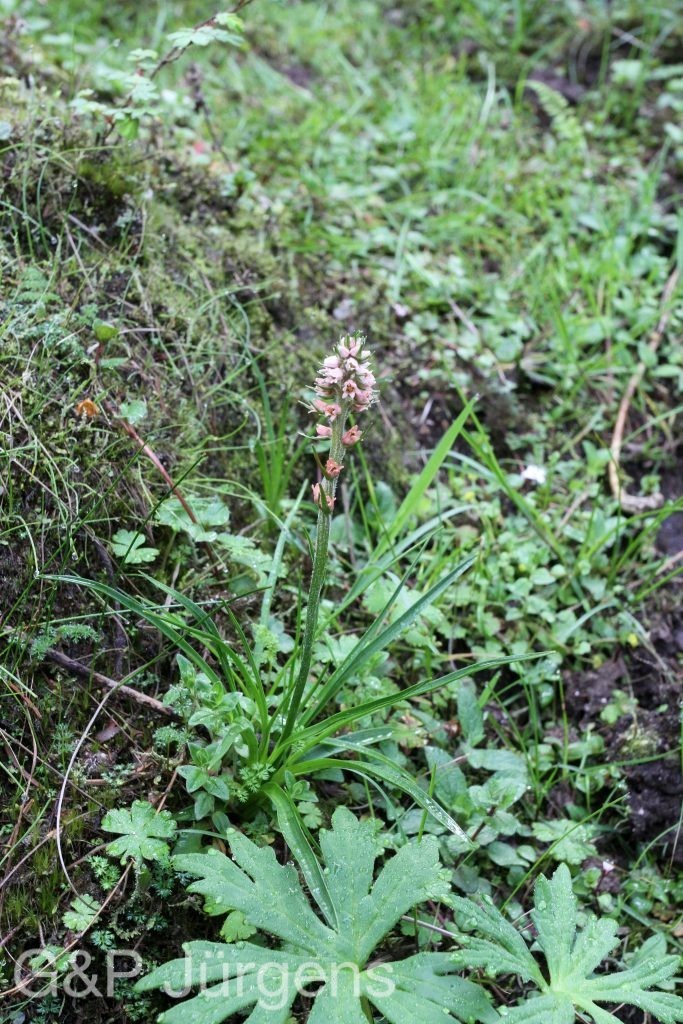
BhutanPG2011 71 ergebnis
Bhutan Menchuang, 2650m June

Description

Aletris gracilis is a small, grass-like perennial of the Himalaya and southwest China, recorded by GBIF across some 214 occurrences from China, Nepal, Bhutan and India, an accepted species of cool, open mountain habitats. It grows in alpine and subalpine meadows, damp grassy slopes, forest clearings and the margins of streams and bogs, typically between about 2400 and 4000 m, favouring moist, acidic, peaty soils. The photographed plant from Menchuang in Bhutan at 2650 m, flowering in June, falls within the lower part of this range and at the onset of the monsoon, when the species sends up its slender flowering spikes among the short turf of damp open ground in the upper-temperate to subalpine zone.

The plant forms a basal rosette of narrow, linear to lanceolate, grass-like leaves arising from a short rhizome with fibrous roots. From the rosette rises a slender, erect, glandular-pubescent scape bearing a narrow terminal raceme of small, shortly pedicellate flowers. Each flower has a tubular to narrowly campanulate, six-lobed perianth that is conspicuously roughened or mealy-glandular on the outer surface, white to pale pink and persistent, enclosing six stamens with the filaments inserted on the perianth tube. The fruit is a small ovoid to ellipsoid capsule partly enclosed by the persistent perianth, releasing numerous minute seeds.

Aletris was long placed in the Liliaceae but is now referred to the small family Nartheciaceae within the order Dioscoreales, a placement supported by molecular and morphological evidence; the genus is disjunct between eastern Asia and eastern North America. A. gracilis belongs to the Asian, glandular-perianthed assemblage and is distinguished from relatives such as A. pauciflora by stature, leaf width and the texture of the perianth. Widespread across the eastern Himalaya and frequent in suitable bog and meadow habitats, it is of no particular conservation concern.

Author: Bureau & Franch. · Sources: POWO (Kew), GBIF, Flora of China Vol. 24, Flora of Bhutan Vol. 3, Flora of Nepal, Revision of Aletris (Nartheciaceae) by Huber and collaborators

(Klotzsch) Hand.-Mazz.

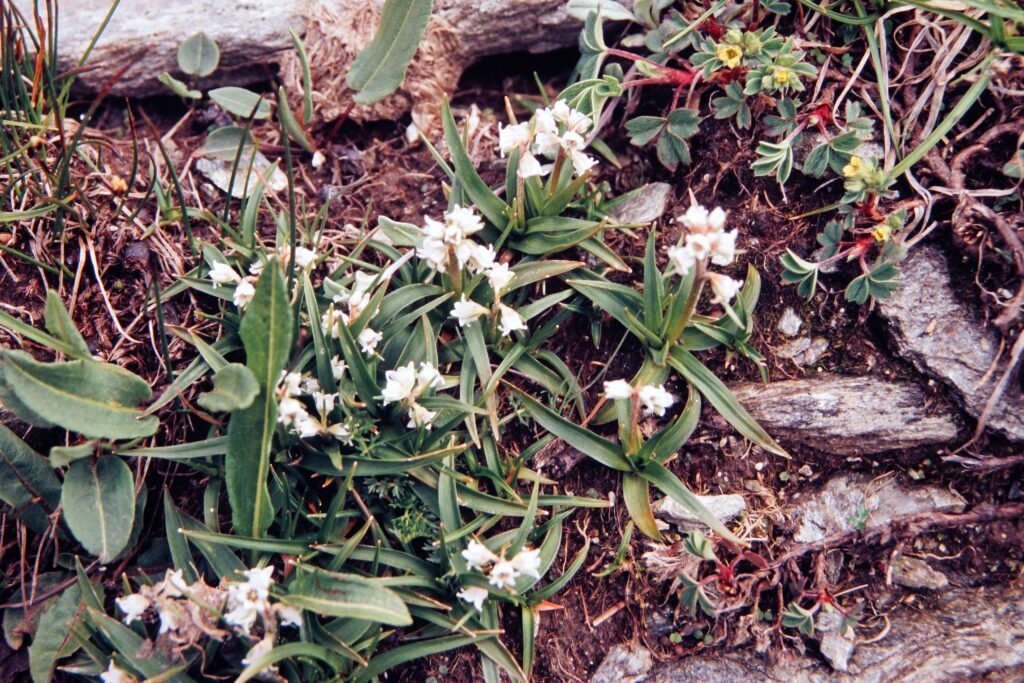
BhutanPG2011 136
Bhutan Tsochenchen, 3550m June
Garh 07 412 ergebnis
India Garhwal Khiar Kutti 4050m, June

Description

Aletris pauciflora is a small alpine colic-root distributed across the Himalaya and the south-eastern Tibetan plateau into south-western China, with GBIF records from China, Nepal, India, Bhutan, Myanmar, Bangladesh and Pakistan and a substantial 1,651 occurrences indicating it is locally common. It grows in open alpine and subalpine meadows, moist turf, peaty grassland and the margins of dwarf-shrub heath, generally between about 3,000 and 4,500 m. The two cited plants, from Tsochenchen in Bhutan at 3,550 m and from Khiar Kutti in Garhwal, India, at 4,050 m, both flowering in June, span its broad longitudinal range and confirm its early-summer anthesis across the high Himalayan grasslands.

The plant is a small tufted rhizomatous perennial herb. The leaves form a basal rosette and are narrowly lanceolate to linear, grass-like, with parallel venation. From the rosette rises a slender, usually scapose flowering stem bearing a short terminal raceme of few flowers (reflected in the epithet pauciflora). Each flower has a campanulate to urceolate, six-lobed perianth that is white to pinkish and characteristically mealy or roughened on the outer surface, with six included stamens and a superior to half-inferior ovary. The fruit is a small loculicidal capsule containing numerous minute seeds.

Aletris is now placed in the family Nartheciaceae within the monocot order Dioscoreales, a position established by molecular phylogenetics that removed it from the broadly circumscribed lily and Liliaceae groupings where it was traditionally placed. Several infraspecific variants of A. pauciflora have been recognised across its range. Widespread and abundant, it is of no conservation concern.

Author: (Klotzsch) Hand.-Mazz. · Sources: POWO (Kew), Flora of China Vol. 24, Flora of Bhutan Vol. 3, GBIF, Tamura: Nartheciaceae in The Families and Genera of Vascular Plants

C.B.Clarke

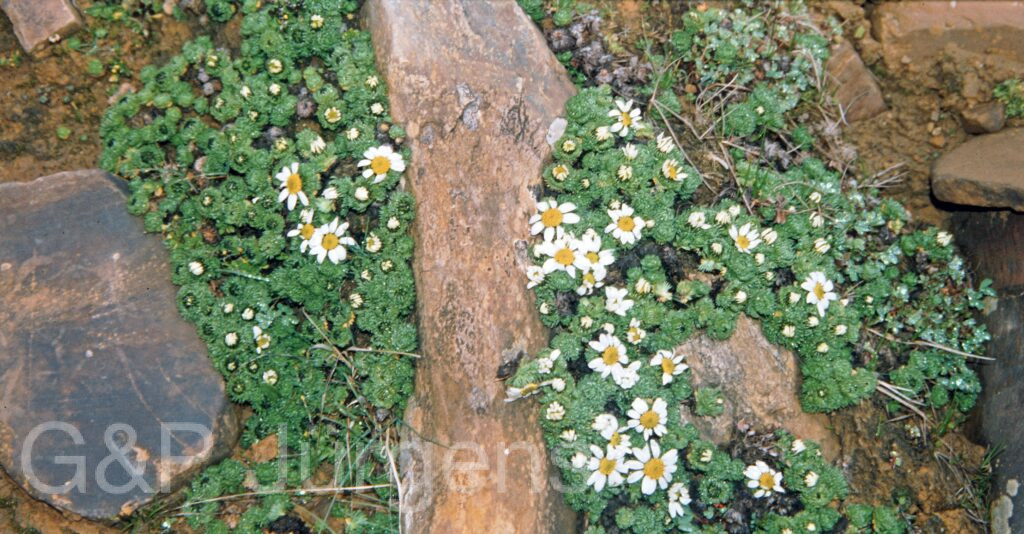
Nepal 99 659 ergebnis
Nepal Kagmara-La 5120m, July
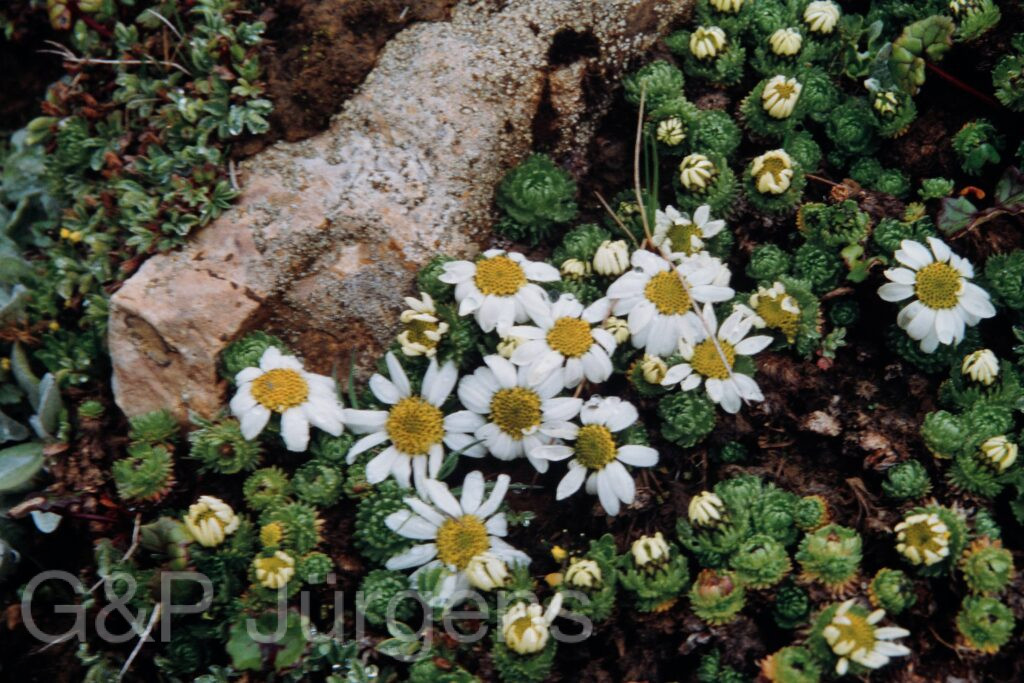
Nepal 99 660 ergebnis
Nepal Kagmara-La 5120m, July

Description

Allardia stoliczkai is a dwarf, cushion-forming composite of the high alpine and subnival zones of the western and central Himalaya and the adjacent Tibetan Plateau. GBIF records cluster across Pakistan and Tajikistan, with the broader distribution embracing Ladakh, northern India, western Tibet and Nepal; the photographed individual was collected on the Kagmara-La in western Nepal at about 5,120 m in July, near the upper limit of vascular plant life. It colonises stony alpine turf, glacial moraine, scree and frost-heaved fellfield on calcareous and schistose substrates, typically between 4,000 and 5,500 m, where it endures intense insolation, desiccating winds and a brief growing season.

The plant forms a compact, often silvery rosette arising from a stout, woody, branching taproot and short rhizome. The leaves are crowded, pinnatisect to bipinnatisect with narrow oblong lobes, and densely clothed in white woolly to silky tomentum that reduces transpiration and reflects ultraviolet radiation. The flower heads are solitary, sessile or nearly so, comparatively large and discoid to radiate, with an involucre of woolly, dark-margined phyllaries; the corollas are typically pinkish-purple to rose. The fruit is a small ribbed cypsela crowned by a short pappus of scales.

The taxon, long placed in Waldheimia, is now generally referred to Allardia, and the relatively few GBIF occurrences reflect both genuine rarity and the inaccessibility of its subnival habitat rather than threat. Its tight cushion architecture exemplifies convergent adaptation to cold deserts of High Asia. While not formally assessed as threatened, such narrowly restricted, slow-growing alpine endemics are sensitive to climate warming and the upslope contraction of suitable ground.

Author: C.B.Clarke · Sources: POWO (Kew), GBIF, Flora of Pakistan, Flora of China Vol. 20-21 (Asteraceae), Grierson & Long: Flora of Bhutan Vol. 2

Wall.

Nepal 99 596 ergebnis
West-Nepal Kagmara Phedi 3900m, July

Description

Allium blandum is a high-alpine onion of the western Himalaya, recorded by GBIF across about 52 occurrences from China, India, Pakistan, Afghanistan and Nepal, an accepted species ranging along the drier inner ranges of the mountain chain. It is a plant of open, stony alpine pastures, gravelly slopes and rock ledges, generally above 3500 m and reaching well into the 4000-4500 m band. The image from Kagmara Phedi in west Nepal at 3900 m, flowering in July, captures its typical setting and midsummer phenology, when the snow-fed alpine turf is briefly in flower; in such habitats it grows scattered among cushion plants and grasses on well-drained, sunny ground exposed to the full intensity of high-mountain light.

The plant grows from a small ovoid bulb with membranous to slightly fibrous tunics, producing a slender scape usually 10-25 cm tall. The few basal leaves are narrowly linear, channelled and shorter than to about equalling the scape, withering as flowering proceeds. The inflorescence is a hemispherical to globose umbel of relatively few, pedicellate flowers subtended by a membranous spathe; the perianth segments are pink to rose-purple, often with a deeper midvein, campanulate to stellate at anthesis, with stamens shorter than or equalling the tepals. The fruit is a small loculicidal capsule bearing several black seeds.

Allium, the largest genus of the family Amaryllidaceae (subfamily Allioideae), is richly represented in the dry western Himalaya and Central Asia, and A. blandum belongs to the pink-flowered alpine assemblage allied to species such as A. carolinianum, with which it has historically been confused. It is distinguished by bulb tunic texture, leaf width and floral proportions. As a widespread but high-elevation species occurring across several countries it is not regarded as threatened, though like other Himalayan alpines it is locally subject to grazing and trampling on summer pastures.

Author: Wall. · Sources: POWO (Kew), GBIF, Flora of Pakistan, Flora of Nepal, Flora of China Vol. 24, Stearn's revision of Himalayan and Central Asian Allium

Rendle

Nepal 99 888 ergebnis
West-Nepal Suli-Khola 2900m, July

Description

Allium fasciculatum is a Himalayan onion ranging across the central and eastern Himalaya into the south-eastern Tibetan plateau, with GBIF records from China, Nepal, India, Afghanistan and Bhutan and around 325 documented occurrences. It is a plant of open temperate to subalpine slopes, grassy meadows, rocky pastures and forest clearings, generally between about 2,400 and 3,600 m. The plant photographed at Suli Khola in West Nepal at 2,900 m, flowering in July, exemplifies its midsummer anthesis in the moist, monsoon-fed grasslands of the central Himalaya where it often grows among other alpine herbs.

The plant is a bulbous perennial with clustered, narrowly conical to cylindrical bulbs attached to a short rhizome, the outer tunics membranous to fibrous. The leaves are few, basal, linear and flat to channelled, usually shorter than the scape. The inflorescence is a terminal umbel of densely to loosely fascicled flowers borne on a slender solid scape and subtended by a membranous spathe; the small flowers have six free, white to pale pinkish or greenish tepals, exserted or included stamens, and a superior ovary. The fruit is a small loculicidal capsule producing black angular seeds.

The species belongs to Allium, now placed in an expanded Amaryllidaceae (subfamily Allioideae) following molecular systematic revisions that subsumed the former Alliaceae. Within the genus it falls among the Himalayan rhizomatous-bulbed alliums whose delimitation remains partly unresolved. Like many wild alliums it is gathered locally as a flavouring and pot-herb. It is not considered threatened, being widespread and tolerant of grazed montane grassland.

Author: Rendle · Sources: POWO (Kew), Flora of China Vol. 24, Flora of Bhutan Vol. 3, GBIF, Stearn: A Synopsis of the Asiatic species of Allium