Asteraceae

(L.) Kuntze

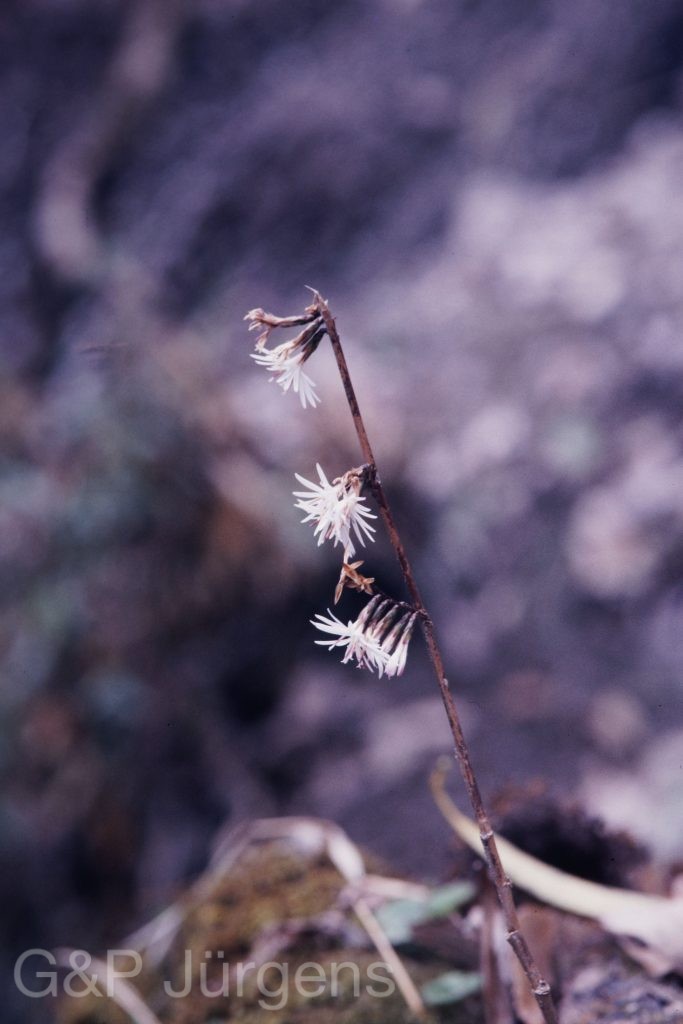
Bhutan2015 588
Bhutan Mo-Chu 1900m, October
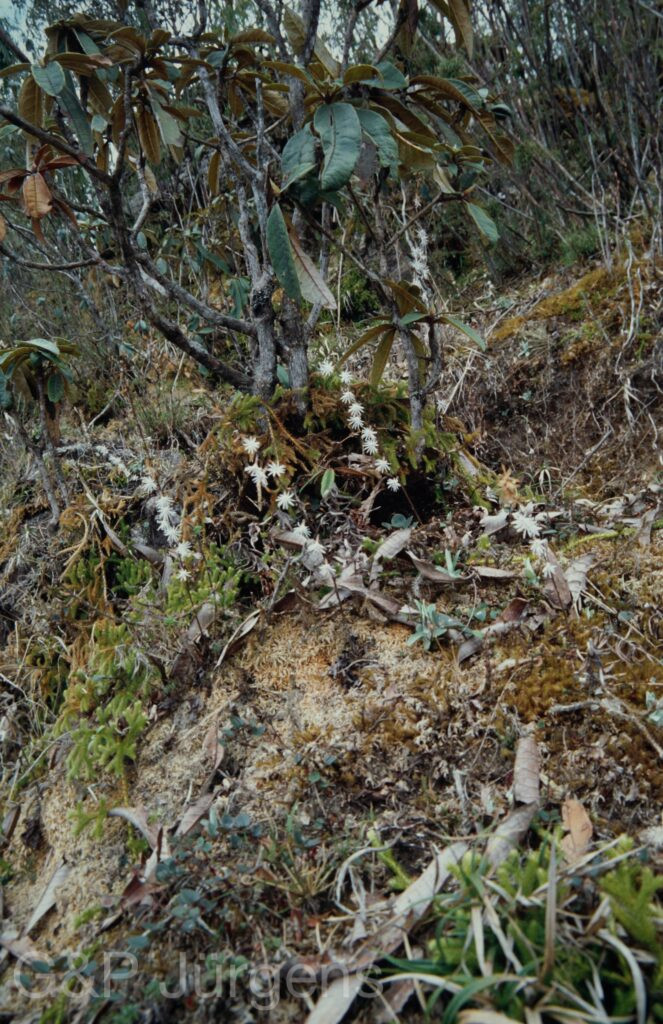
Bhutan2015 589
Bhutan Mo-Chu 1900m, October

Description

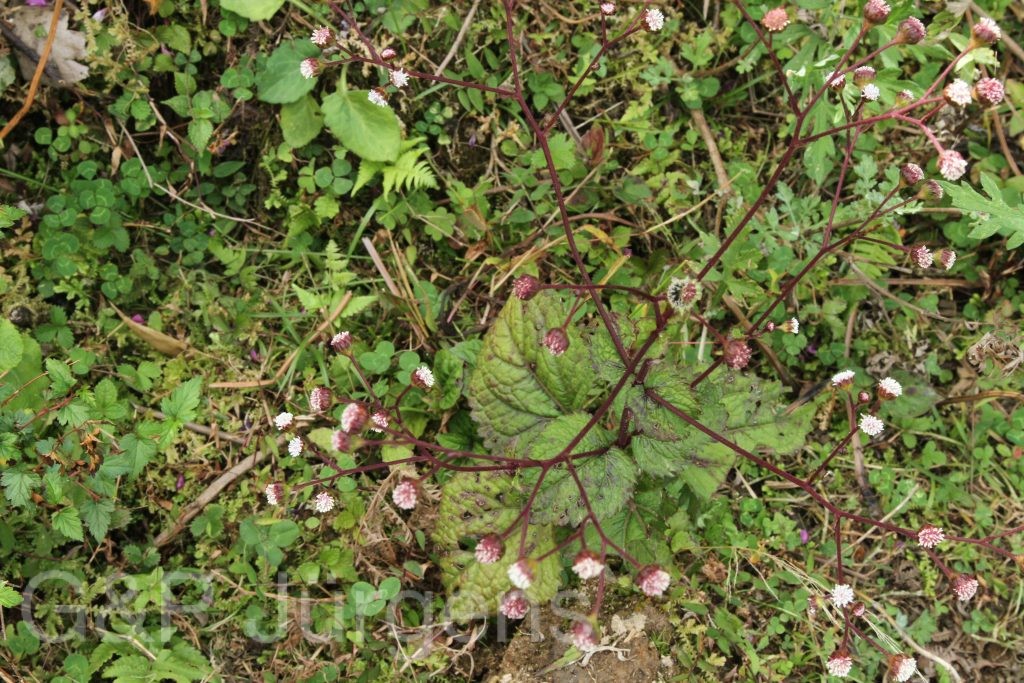
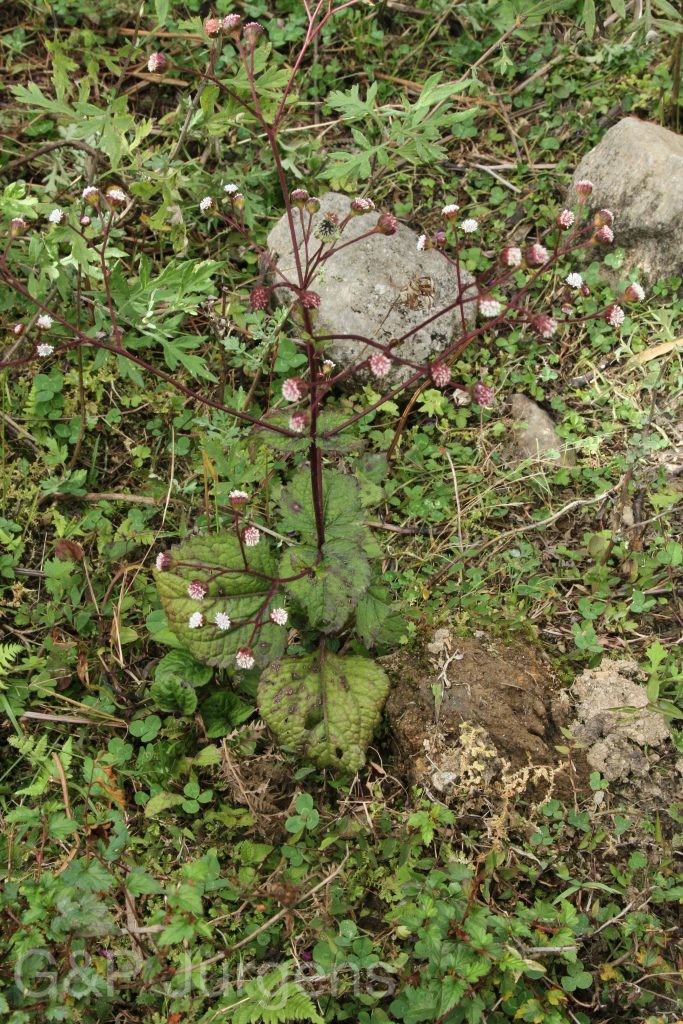
Adenostemma lavenia is a near-pantropical composite of remarkably wide distribution, with GBIF documenting some 4700 occurrences across Asia, Australasia, the Americas, Africa and the Pacific, including China, Japan, India, Nepal, Australia, the Philippines, Brazil and many other countries. It is a weed of moist, shaded habitats, favouring streambanks, wet forest margins, ditches and damp disturbed ground, mostly at low to mid elevations. The photographed plant is from the Mo-Chu valley in Bhutan at 1900 m in October, growing in humid riparian thicket within subtropical hill forest.

The species is an erect to ascending annual or short-lived perennial herb with branched, ridged, sparsely pubescent stems. The leaves are opposite, ovate to deltoid, coarsely crenate-serrate, with a cuneate to truncate base narrowing to a winged petiole. The capitula are small, discoid and white, lacking ray florets, arranged in lax terminal corymbose cymes; each holds few tubular florets within a two-seriate involucre of subequal phyllaries. The most diagnostic feature is the cypsela, which is glandular-tuberculate and crowned by a pappus reduced to a few short, stout, gland-tipped (clavate) bristles that act as a clinging burr.

Adenostemma is a small genus of the tribe Eupatorieae, and A. lavenia is the type and most cosmopolitan species, its sticky fruits readily dispersed on animals and clothing, explaining its global spread. Highly variable and broadly circumscribed, it has long been used in folk medicine. It is abundant and weedy, hence of no conservation concern.

Author: (L.) Kuntze · Sources: POWO (Kew), GBIF, Flora of China, Flora of Bhutan, Annotated Checklist of the Flowering Plants of Nepal, Revision of Adenostemma (Eupatorieae)
Mill.

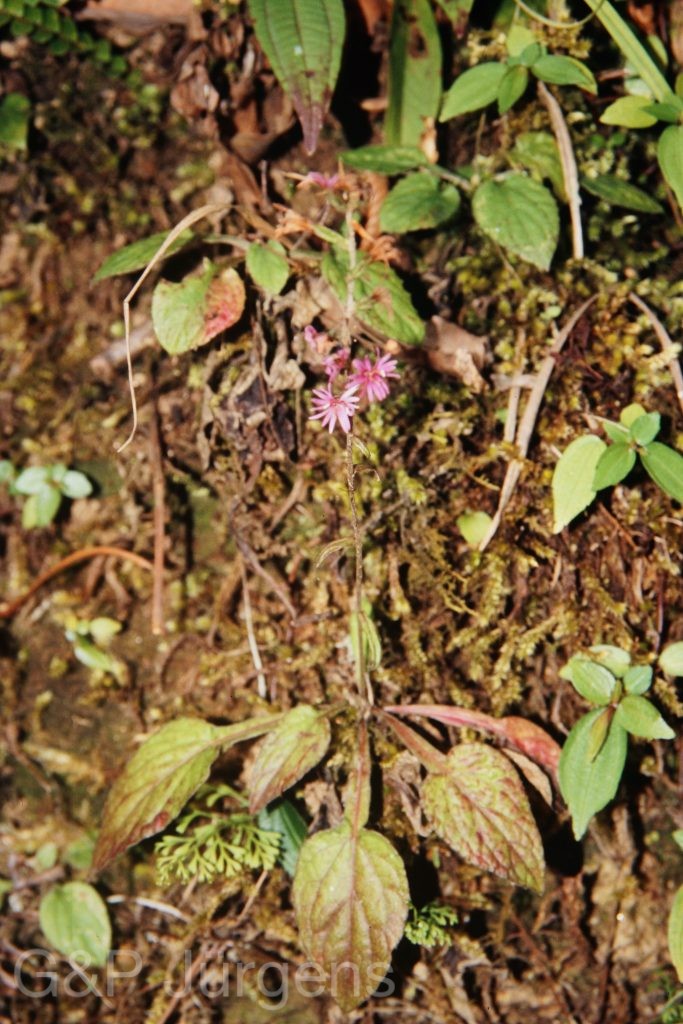
Sikkim2011 9
India Sikkim Tista valley 1800m, June

Description

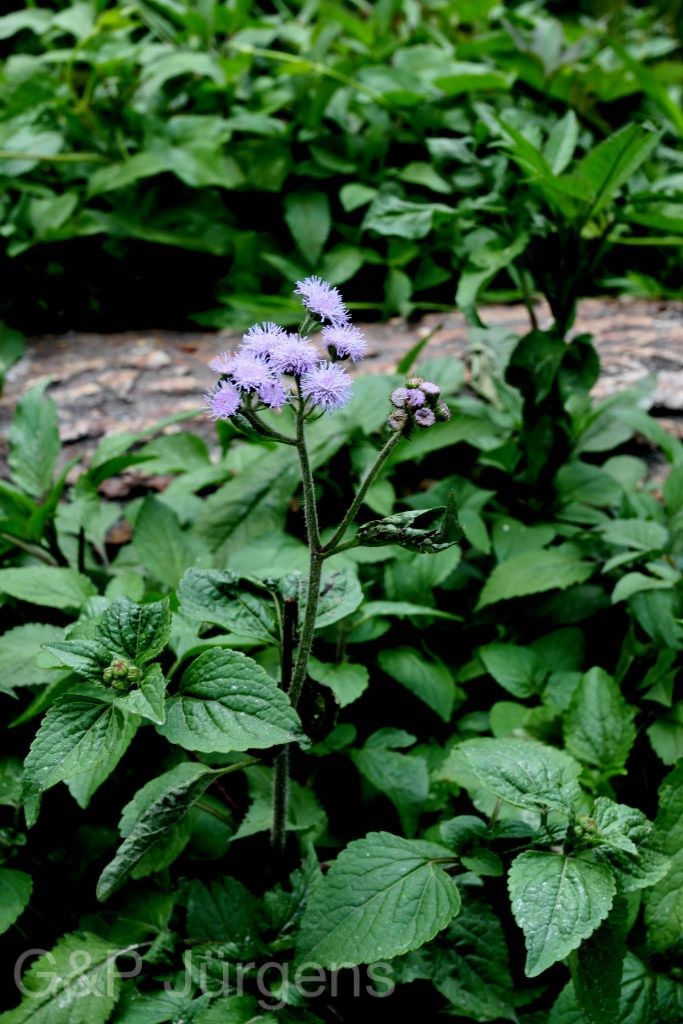
Ageratum houstonianum Mill. is native to Mexico and Central America but is now a widely naturalised tropical and subtropical weed; GBIF records over 25,000 occurrences spanning Mexico, the United States, China, Taiwan, Hong Kong, Nepal, India, South Africa, Tanzania, Malawi and much of western and central Europe. It colonises waste ground, roadsides, field margins, ditches and clearings, particularly in moist, disturbed habitats. The record from the Tista valley in Sikkim at 1800 m in June reflects its thorough naturalisation in the lower Eastern Himalaya, where it flowers through the warm, humid monsoon season.

It is an erect to ascending annual herb with stems clothed in spreading, often viscid hairs. The leaves are mostly opposite, ovate to deltoid, with a crenate-serrate margin, a truncate to cordate base and conspicuous palmate venation, and are softly pubescent. The small capitula are aggregated in dense, flat-topped corymbs; each head is wholly discoid, lacking ray florets, with an involucre of narrow phyllaries and numerous blue, lavender or occasionally white tubular florets whose long, exserted styles give the inflorescence a characteristic fluffy texture. The fruit is a black, five-angled cypsela bearing a pappus of awned scales.

Widely grown as the ornamental "floss flower", A. houstonianum has escaped cultivation throughout the warmer world and is regarded as an invasive weed in parts of Asia, Africa and Australia; like its relatives it contains pyrrolizidine alkaloids and is toxic to livestock. It is of no conservation concern and is instead managed as a weed.

Author: Mill. · Sources: POWO (Kew), GBIF, Flora of China, Flora of North America, Johnson revision of Ageratum

Ainsliaea aptera

by GP Jürgens

DC.

Bhutan2014 513
Bhutan Yatong-La 3200m, May
Nepal 1989 58
Nepal Bagachap 2300m, April
Nepal 1994 76 ergebnis
Ost-Nepal Jaljale Himal
3000m April

Description

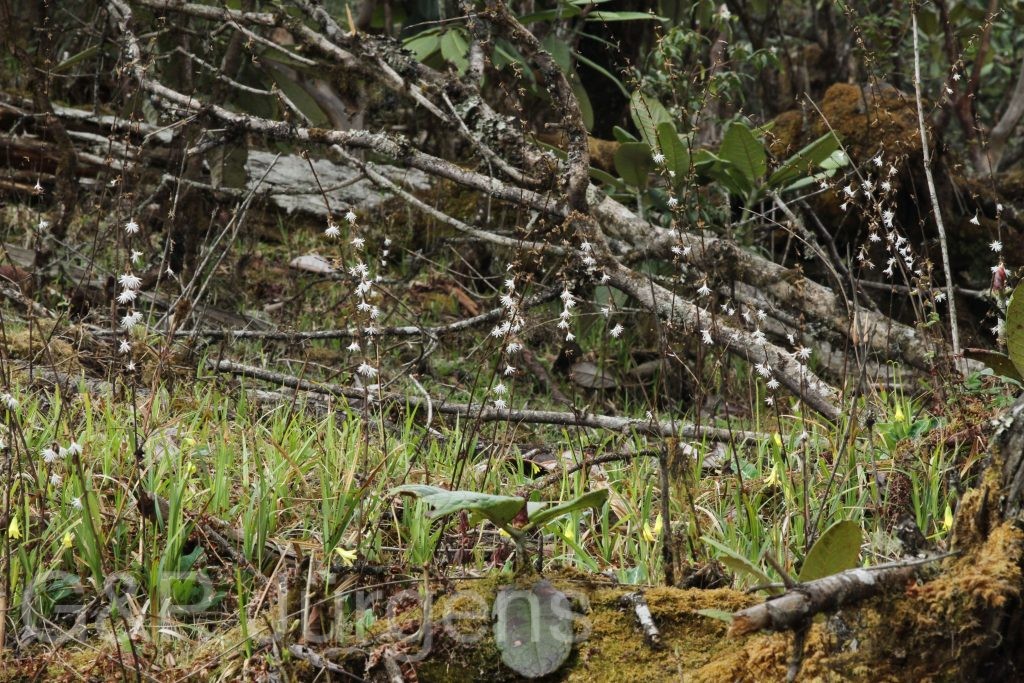
Ainsliaea aptera is a Himalayan rosette herb distributed along the range from Afghanistan and Pakistan through India, Nepal and Bhutan into China and Myanmar, with 358 GBIF occurrences. It grows in the understorey and on shaded banks of temperate broadleaved and conifer forest, on mossy slopes and rock ledges, generally between about 2000 and 3500 m. The illustrated material spans Bhutan's Yatong-La at 3200 m in May, Bagachap in central Nepal at 2300 m in April, and the Jaljale Himal of eastern Nepal at 3000 m in April, indicating a spring-flowering plant of cool, humid forest floors.

It is a perennial herb with a short rhizome bearing a basal rosette of ovate to elliptic, long-petiolate leaves that are firm, with cordate to rounded bases, entire or shallowly toothed margins, and often a sparse covering of hairs. From the centre rises a slender, nearly leafless scape carrying a narrow, spike-like or racemose arrangement of small, sessile capitula. Each head contains a few tubular florets with slender, deeply lobed, white to pinkish corollas. The cypselae are ribbed and clothed in a pappus of plumose (feathery) bristles, a diagnostic feature of the genus.

Described by de Candolle, Ainsliaea belongs to the basal asteraceous tribe Pertyeae (formerly Mutisieae), an Asian lineage notable for its plumose pappus and frequently spike-like inflorescences. The genus is centred on the Sino-Himalayan region and is of interest for the phylogeny of early-diverging Asteraceae. Widespread along the Himalayan forest belt, A. aptera is not regarded as threatened, though it depends on intact shaded forest habitat.

Author: DC. · Sources: POWO (Kew), GBIF, Flora of Bhutan, Flora of China, Revision of Ainsliaea (Mitsui & others), Flowers of the Himalaya (Polunin & Stainton)

 (D.Don) Sch.Bip.

Bh2008 62 G102
Bhutan Punaka-Chu, 1500m April

Description

Ainsliaea latifolia is a widely distributed perennial herb of the Sino-Himalayan and Southeast Asian region, recorded from China, India, Nepal, Bhutan, Pakistan, Bangladesh, Sri Lanka, Myanmar, Thailand, Vietnam, Taiwan, Malaysia and Indonesia, with over a thousand documented occurrences. It is a characteristic understorey plant of subtropical and warm-temperate broadleaved forest, growing on shaded banks, forest floors, grassy clearings and stream margins from the foothills to the middle hills. The individual shown was recorded along the Punakha Chu in western Bhutan at about 1500 m in April, a setting typical of its preference for moist, humus-rich ground beneath oak and evergreen forest.

The plant arises from a short, stout rhizome and is conspicuous for its basal rosette of broad, long-petiolate leaves; the laminae are ovate to broadly ovate or orbicular, cordate at the base, with a shortly acuminate apex and entire to denticulate margins, often purplish and pubescent beneath. From the centre of the rosette rises a slender, leafless or bracteate scape bearing an elongate, spike-like to narrowly paniculate inflorescence. The small capitula are cylindrical and characteristically three-flowered, each floret with a deeply lobed, bilabiate corolla typical of the Mutisioideae. The achenes are ribbed and pubescent, crowned by a copious pappus of plumose, reddish-brown bristles.

The species belongs to Ainsliaea, a genus of the basal asteraceous subfamily Mutisioideae centred on East Asia and the Himalaya, distinguished by its three-flowered heads and rosulate habit. It exhibits considerable variation in leaf shape and indumentum across its extensive range, and several infraspecific taxa have been recognised. Long used in regional folk medicine, it is locally common and faces no significant conservation concern across most of its distribution.

Author: (D.Don) Sch.Bip. · Sources: POWO (Kew), GBIF, Flora of China, Flora of Bhutan, Flora of British India, Revision of the genus Ainsliaea (Mutisieae)

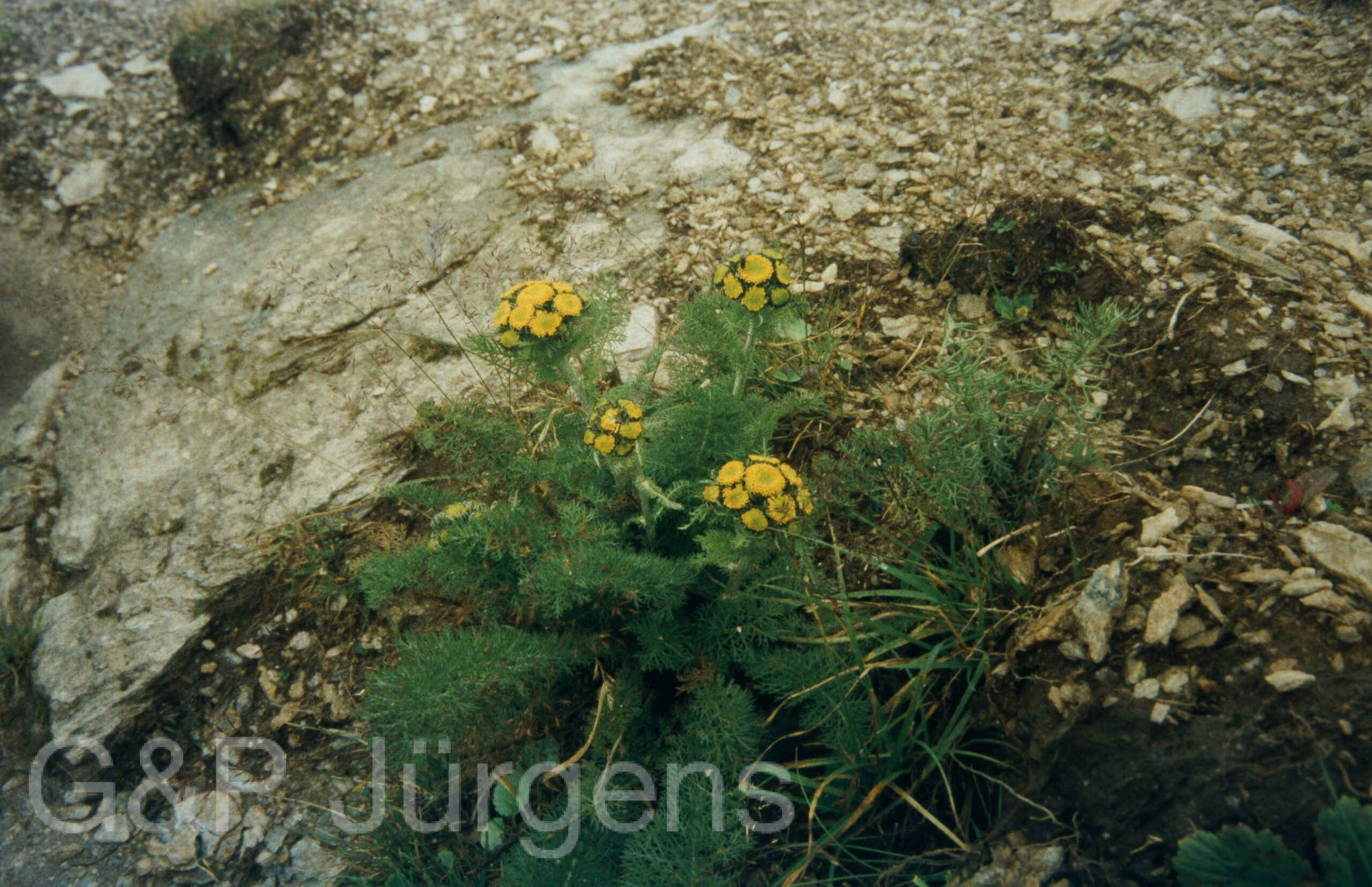
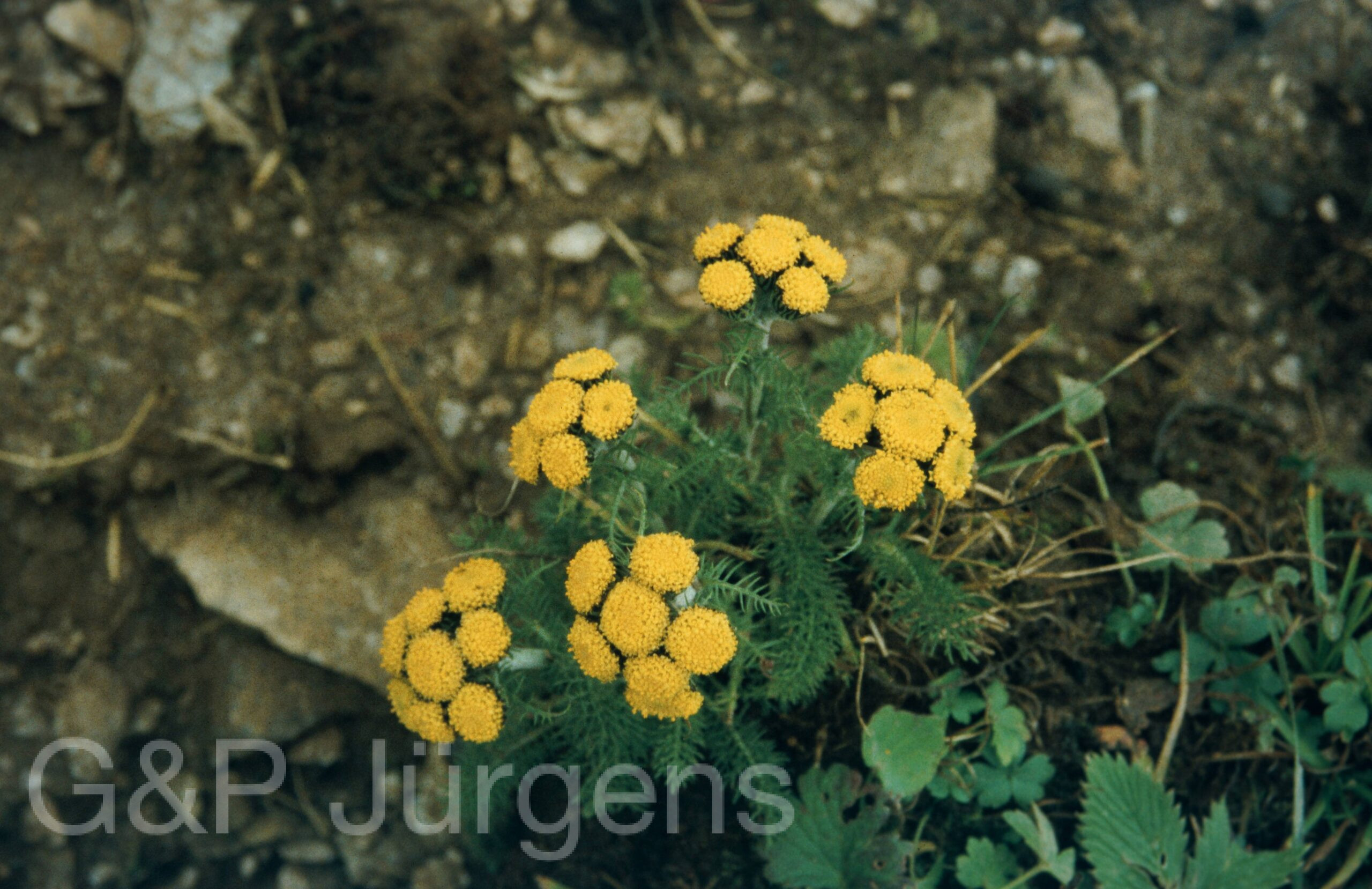
Ajania nubigena

by GP Jürgens

(Wall. ex DC.) Muldashev

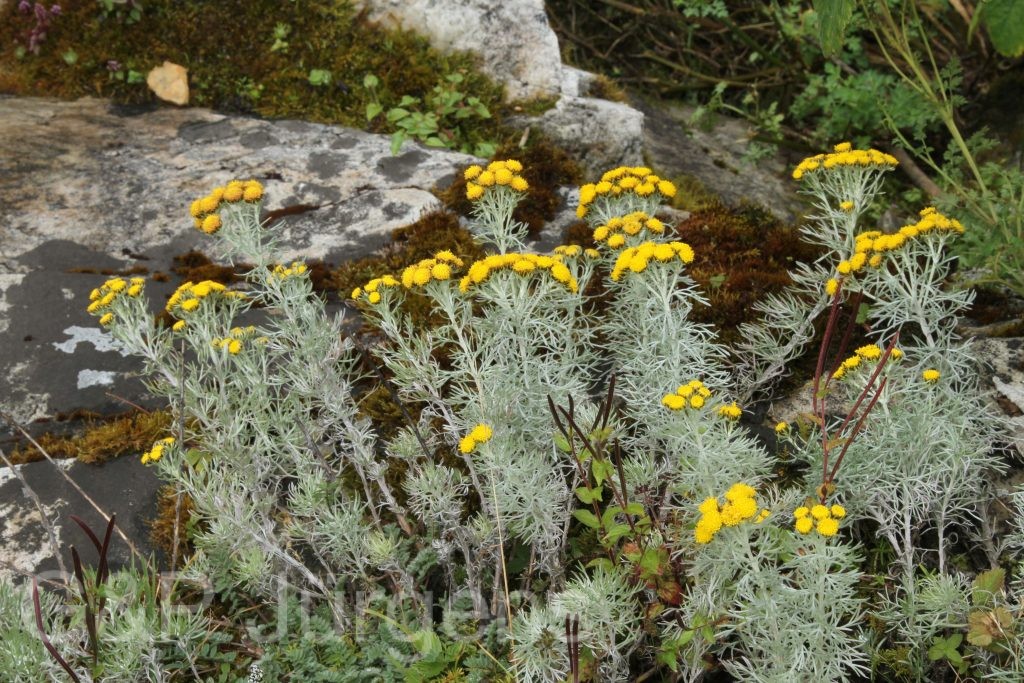
Bhutan2012 303
Bhutan Shale-La, 4300m September

Description

Ajania nubigena is a high-altitude aromatic composite of the Himalaya and Tibetan borderlands, recorded from Nepal, China (Tibet), India and Bhutan, with 266 georeferenced occurrences spanning the alpine zone of the main range. It grows on dry, stony alpine slopes, gravelly screes, rock crevices and exposed ridges, typically in the upper subalpine to alpine belt. It was photographed on the Shale-La in Bhutan at 4300 m and in Garhwal, India, at Patanathi at 3600 m, both in September, when its yellow heads flower amid the dry autumn alpine turf of these high passes.

It is a low, tufted, somewhat woody-based perennial subshrub or herb forming compact clumps, the stems and foliage clothed in dense grey to silvery appressed hairs that give a felted appearance and impart drought and frost tolerance. The leaves are small, alternate and pinnately or bipinnately dissected into narrow lobes, grey-tomentose especially beneath. The flower heads are small, discoid (lacking ray florets) and yellow, aggregated into dense terminal corymbs; each head has an involucre of imbricate, scarious-margined phyllaries and numerous tubular hermaphrodite and marginal female florets. The fruit is a small ribbed cypsela, usually lacking a pappus.

The genus Ajania, segregated from Chrysanthemum and Tanacetum within tribe Anthemideae, comprises mostly silvery-leaved, discoid-headed species of arid Central Asian and Himalayan uplands; the combination (Wall. ex DC.) Muldashev reflects this transfer. Its dense indumentum and dissected leaves are adaptations to the cold, dry, high-radiation alpine environment. Ecologically it is a xerophytic specialist of open stony ground, widespread within its altitudinal band and of no conservation concern.

Author: (Wall. ex DC.) Muldashev · Sources: POWO (Kew), GBIF, Flora of Bhutan, Flora of China, Anthemideae systematics (Bremer & Humphries monograph)

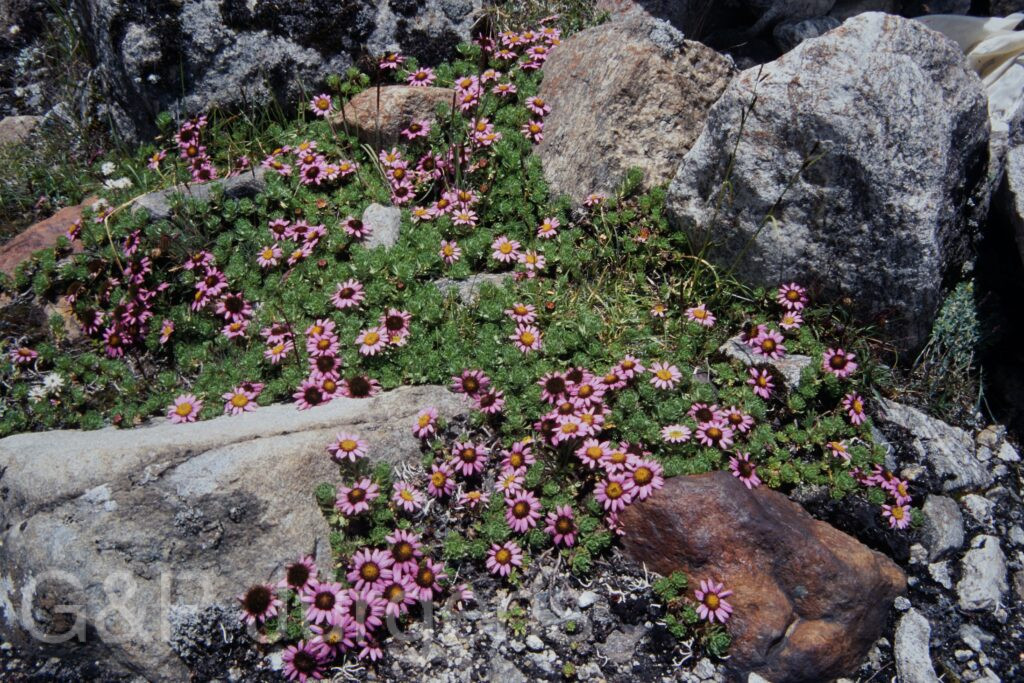
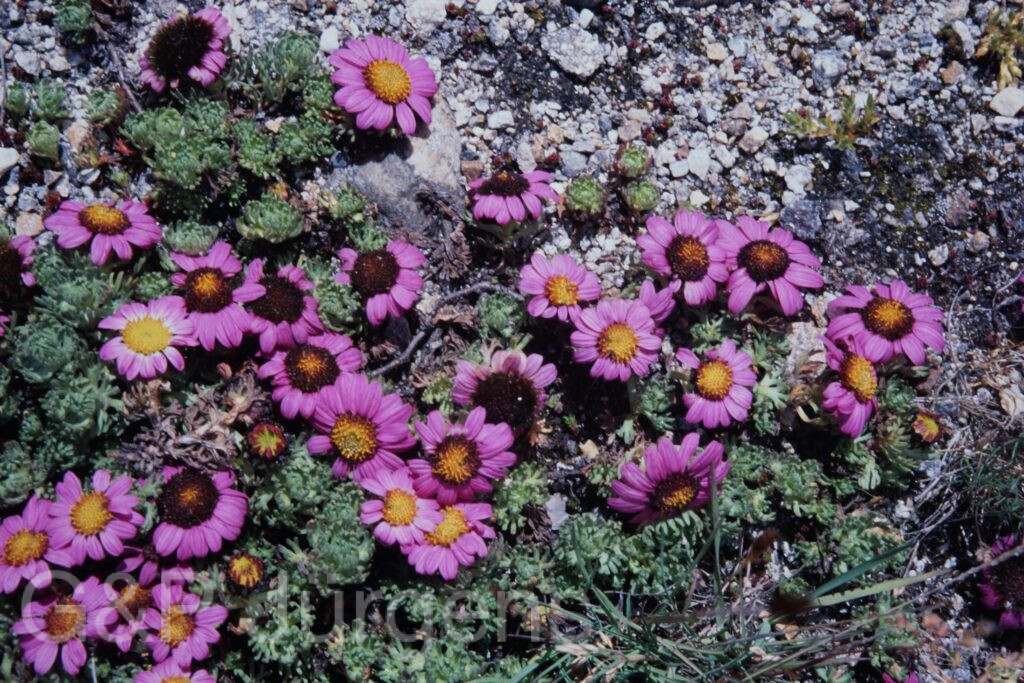
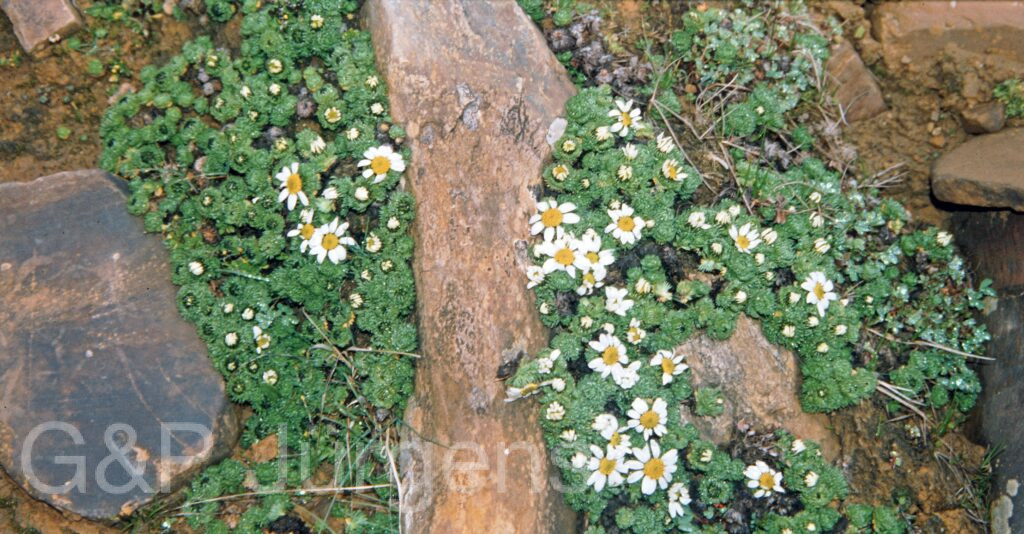
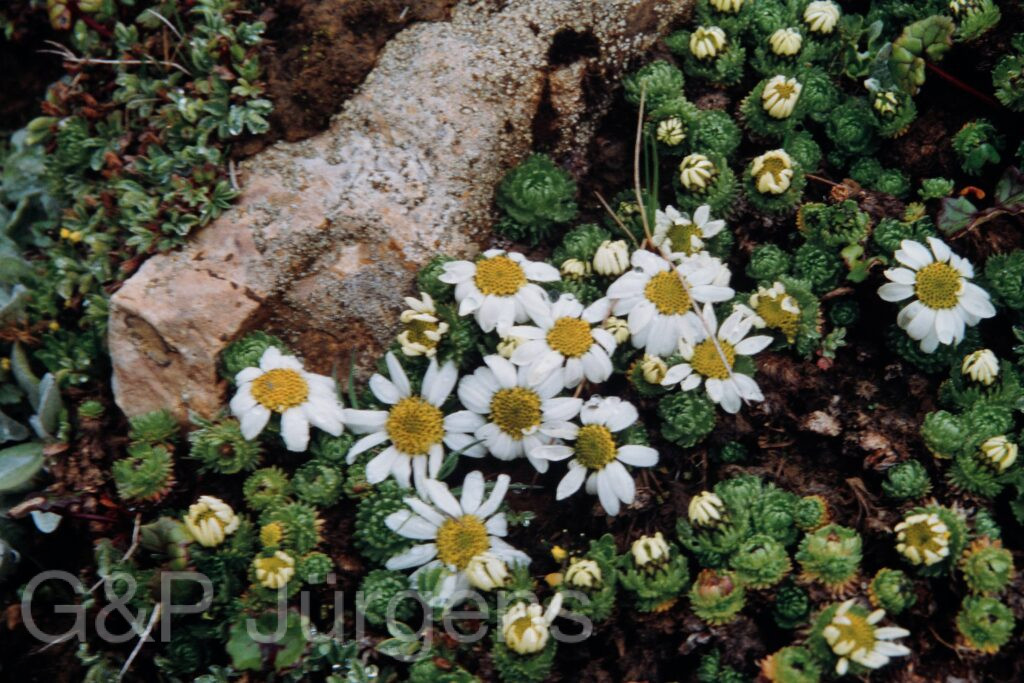
Allardia glabra

by GP Jürgens

Decne.

Sikkim2003 518 G720
Sikkim Yume Samdong 4700m August
Sikkim2003 519 P724
Sikkim Yume Samdong 4700m August

Description

Allardia glabra is a high-alpine composite of the Himalaya and central Asia, distributed across Nepal, India, China, Pakistan, Tajikistan, Bhutan, Afghanistan and Kazakhstan, with GBIF documenting about 327 occurrences. It is a plant of the uppermost alpine and subnival zones, growing on screes, moraines, gravelly flats and stony slopes at very high elevations, commonly between about 4000 and 5500 m. The photographed material from Yume Samdong in northern Sikkim at 4700 m, flowering in August, is typical of its extreme habitat, where it forms low cushions or mats on bare, frost-disturbed ground near the limit of vascular plant life, taking advantage of the short, intense growing season of the high summer.

It is a dwarf, cushion- or mat-forming perennial arising from a branched, often stout caudex clothed in the persistent remains of old leaves. The leaves are small, crowded, spathulate to obovate and entire or shallowly lobed at the tip, and, as the epithet glabra indicates, relatively glabrous compared with the woolly indumentum of related species. The flower heads are solitary, sessile or shortly stalked, nestled among the foliage, and radiate, with an involucre of imbricate, often dark-margined bracts. The pistillate ray florets are pink to lilac or whitish, surrounding numerous yellow tubular disc florets. The fruit is a small, ribbed cypsela crowned by a short pappus.

Allardia is a small genus of about half a dozen species centred on the high mountains of central Asia and the Himalaya, long included within Waldheimia, under which name (Waldheimia glabra) this taxon is frequently encountered. Its cushion habit, reduced glabrous leaves and ground-hugging capitula are classic adaptations to cold, wind-exposed, high-radiation subnival environments. As a specialist of the highest vegetated ground it is of biogeographic interest and potentially sensitive to upward shifts of the climatic snowline, though its remoteness affords protection.

Author: Decne. · Sources: POWO (Kew), GBIF, Flora of China, Flora of Pakistan, Annotated Checklist of the Flowering Plants of Nepal, Podlech and Asteraceae monographic treatments of Allardia (Waldheimia)

C.B.Clarke

Nepal 99 659 ergebnis
Nepal Kagmara-La 5120m, July
Nepal 99 660 ergebnis
Nepal Kagmara-La 5120m, July

Description

Allardia stoliczkai is a dwarf, cushion-forming composite of the high alpine and subnival zones of the western and central Himalaya and the adjacent Tibetan Plateau. GBIF records cluster across Pakistan and Tajikistan, with the broader distribution embracing Ladakh, northern India, western Tibet and Nepal; the photographed individual was collected on the Kagmara-La in western Nepal at about 5,120 m in July, near the upper limit of vascular plant life. It colonises stony alpine turf, glacial moraine, scree and frost-heaved fellfield on calcareous and schistose substrates, typically between 4,000 and 5,500 m, where it endures intense insolation, desiccating winds and a brief growing season.

The plant forms a compact, often silvery rosette arising from a stout, woody, branching taproot and short rhizome. The leaves are crowded, pinnatisect to bipinnatisect with narrow oblong lobes, and densely clothed in white woolly to silky tomentum that reduces transpiration and reflects ultraviolet radiation. The flower heads are solitary, sessile or nearly so, comparatively large and discoid to radiate, with an involucre of woolly, dark-margined phyllaries; the corollas are typically pinkish-purple to rose. The fruit is a small ribbed cypsela crowned by a short pappus of scales.

The taxon, long placed in Waldheimia, is now generally referred to Allardia, and the relatively few GBIF occurrences reflect both genuine rarity and the inaccessibility of its subnival habitat rather than threat. Its tight cushion architecture exemplifies convergent adaptation to cold deserts of High Asia. While not formally assessed as threatened, such narrowly restricted, slow-growing alpine endemics are sensitive to climate warming and the upslope contraction of suitable ground.

Author: C.B.Clarke · Sources: POWO (Kew), GBIF, Flora of Pakistan, Flora of China Vol. 20-21 (Asteraceae), Grierson & Long: Flora of Bhutan Vol. 2

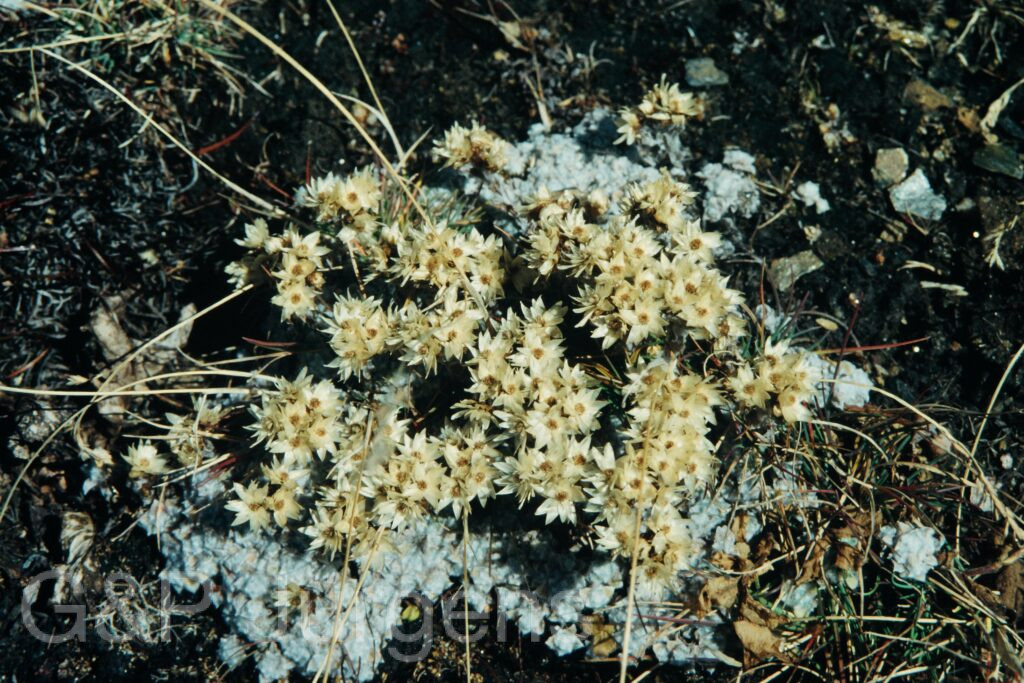
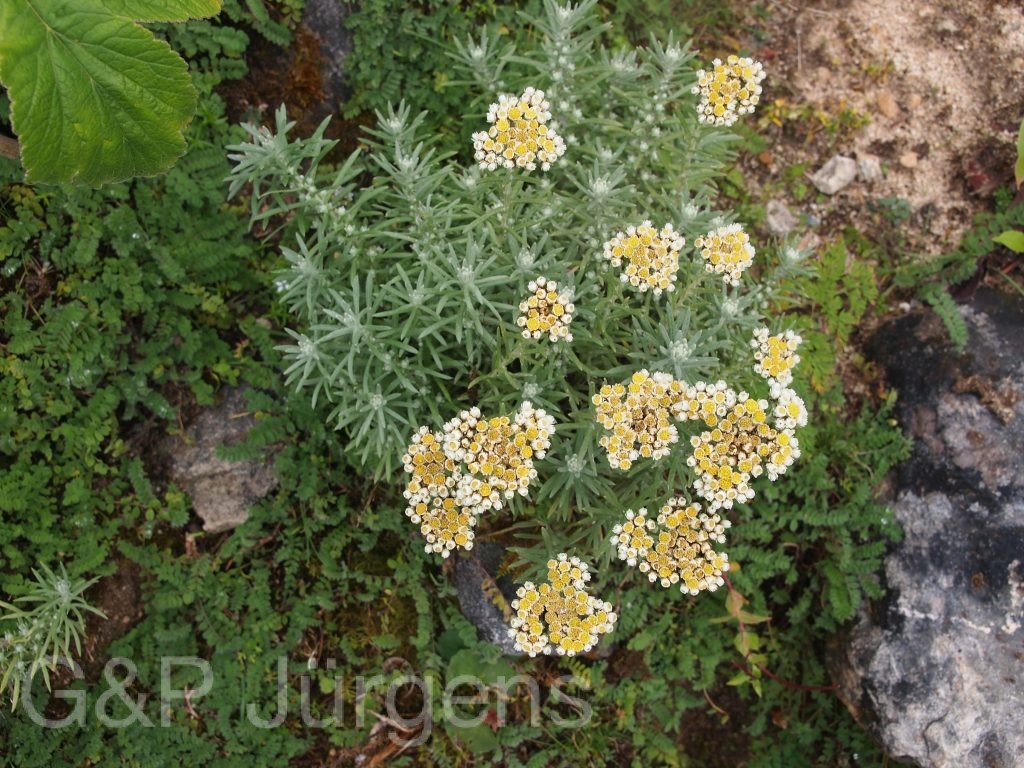
Anaphalis cavei

by GP Jürgens

Chatterjee

Nepal 95 418 W728 ergebnis
Nepal Jaisuli Kund 4200m, October

Description

Anaphalis cavei is a Himalayan high-alpine species recorded from Nepal, northern India, Bhutan and southwestern China, with around 91 occurrences concentrated along the main Himalayan axis. It is a plant of the upper alpine zone, the accompanying image documenting it at Jaisuli Kund in Nepal at about 4200 m in October, as the brief autumn growing season closes. It inhabits open stony slopes, alpine meadow turf, moraine and rocky ground near and above the treeline, growing in well-drained, often gravelly substrates exposed to intense insolation and cold, where its dense indumentum mitigates desiccation and ultraviolet stress.

It is a small, perennial, white-woolly herb forming low tufts or mats from a branched, somewhat woody caudex. The stems and leaves are densely covered in appressed lanate-tomentose hairs giving a silvery-grey aspect; the leaves are narrowly oblanceolate to spathulate, often with margins revolute and bases decurrent or semi-amplexicaul. The capitula are aggregated into a compact terminal corymb; each head is surrounded by several rows of dry, papery, pearly-white involucral bracts characteristic of the genus. The plants are functionally dioecious, with female and male florets borne predominantly on separate heads, and the cypselae are small, glabrous and crowned by a deciduous capillary pappus.

The species, described by Chatterjee, belongs to tribe Gnaphalieae, the genus Anaphalis being a taxonomically intricate group of "everlasting" daisies whose papery bracts persist long after flowering. Its restricted high-elevation range, dense wool and cushion-like habit are adaptations to the harsh alpine environment, and seed dispersal is anemochorous via the pappus. Owing to its narrow, remote montane distribution it has not been formally assessed, but it appears locally frequent within suitable alpine habitat.

Author: Chatterjee · Sources: POWO (Kew), GBIF, Flora of China, Annotated Checklist of the Flowering Plants of Nepal, Gnaphalieae monograph (Asteraceae)

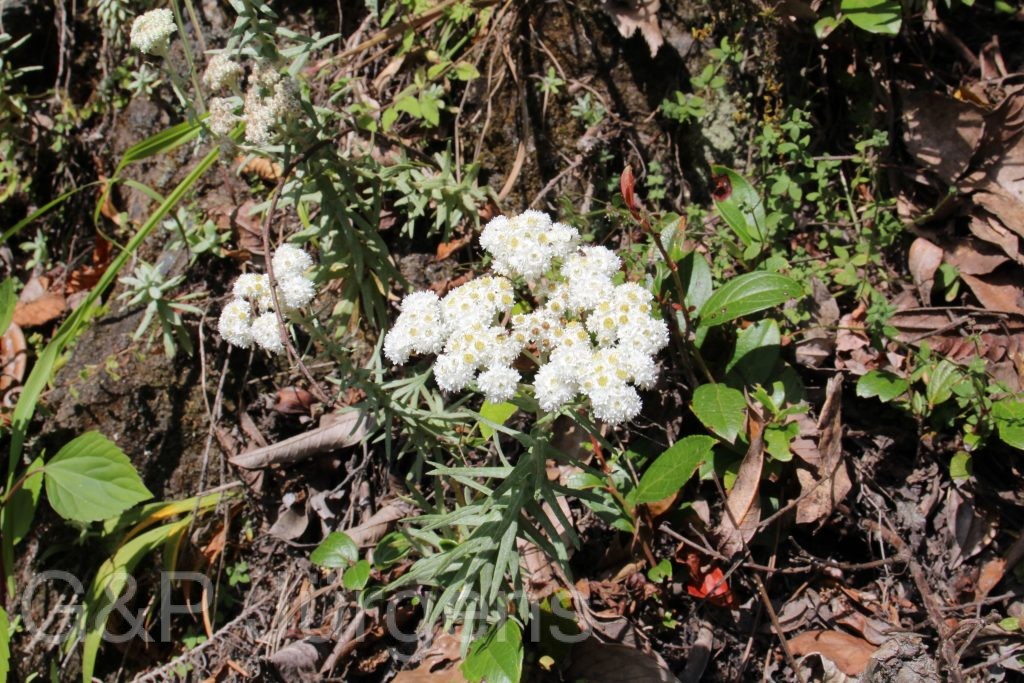
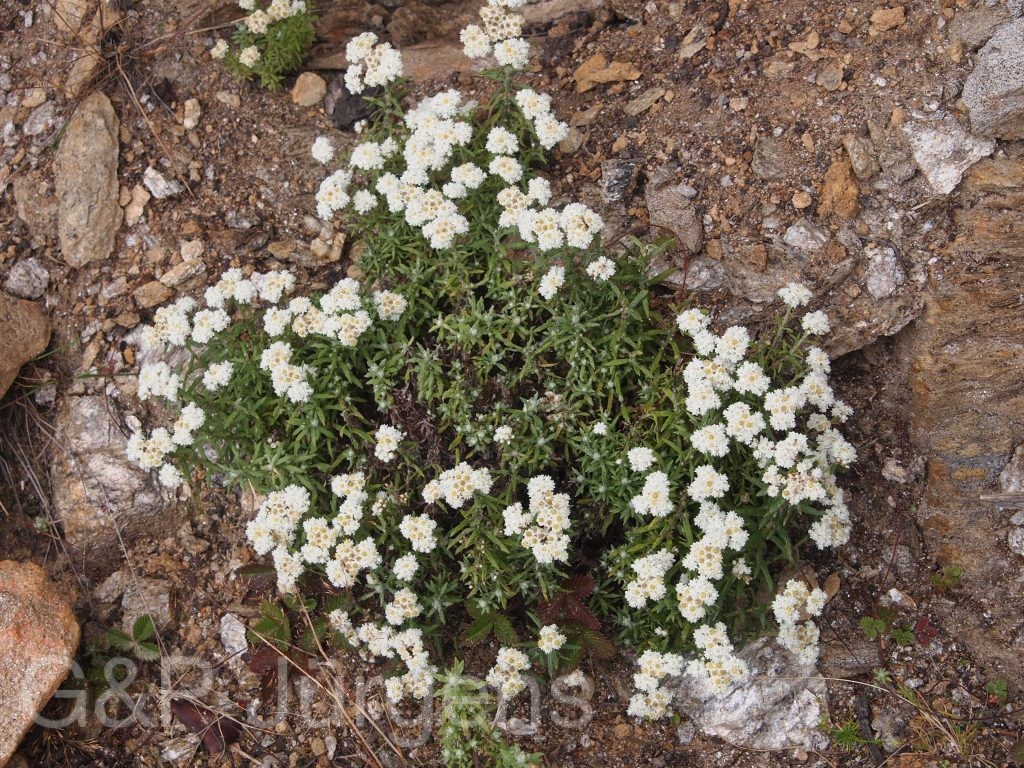
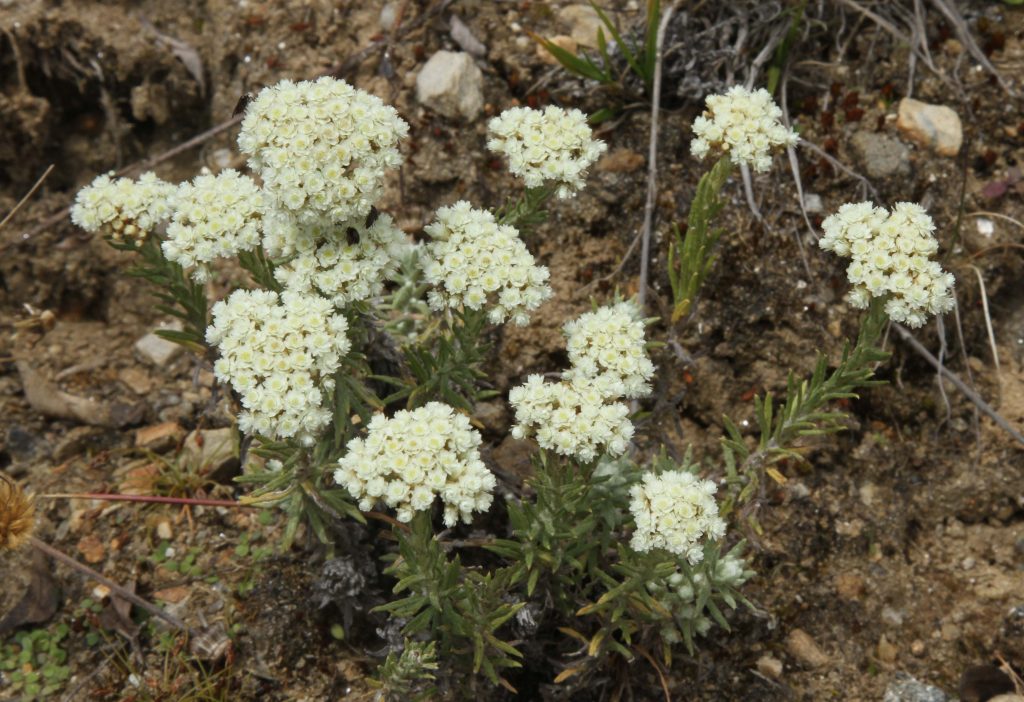
Hook.f.

Bhutan2015 325
Bhutan Trongsa 2000m, October
Bhutan2012 294
Bhutan Shele-La, 3900m September
Bhutan2012 892
Bhutan Tumching-La, 3700m October
Bhutan2012 893
Bhutan Tumching-La, 3700m October

Description

Anaphalis contorta is a widespread Asian everlasting distributed from Nepal, India and Bhutan through China to the Philippines, Taiwan, Pakistan, Bangladesh and Afghanistan, with GBIF recording over 1280 occurrences across this broad range. It is a plant of open, sunny, often dry and stony ground, favouring grassy slopes, banks, rocky pasture, trackside verges and forest margins from the temperate zone up into the subalpine. The cited Bhutanese localities span this breadth, from Trongsa at 2000 m in October to the Shele-La at 3900 m in September and the Tumching-La at 3700 m in October, demonstrating its occurrence from mid-montane forest country to high subalpine passes where it persists and flowers into the autumn.

It is a perennial herb forming tufts from a woody rootstock, the erect stems and the linear to narrowly lanceolate leaves clothed in dense white or greyish woolly tomentum, the leaf margins frequently revolute and somewhat contorted, a feature alluded to in the epithet. The capitula are small and numerous, aggregated into dense terminal corymbose clusters. Each head is surrounded by an involucre of dry, papery, persistent white phyllaries that constitute the showy part of the inflorescence, the plant being functionally dioecious with male and female heads on separate individuals. The minute tubular florets give rise to tiny cypselae bearing a pappus of slender barbellate bristles.

A member of tribe Gnaphalieae, Anaphalis comprises numerous Himalayan and East Asian species whose papery white "everlasting" bracts are an adaptation to exposed, drought-prone montane habitats and aid in attracting pollinators to the small florets. The dried inflorescences are long-lasting and locally gathered for decoration. Tolerant of poor soils and disturbance and very widely distributed, A. contorta is a secure species of no conservation concern.

Author: Hook.f. · Sources: POWO (Kew), GBIF, Flora of Bhutan, Flora of China, Annotated Checklist of the Flowering Plants of Nepal, Hilliard's revision of Anaphalis (Gnaphalieae)

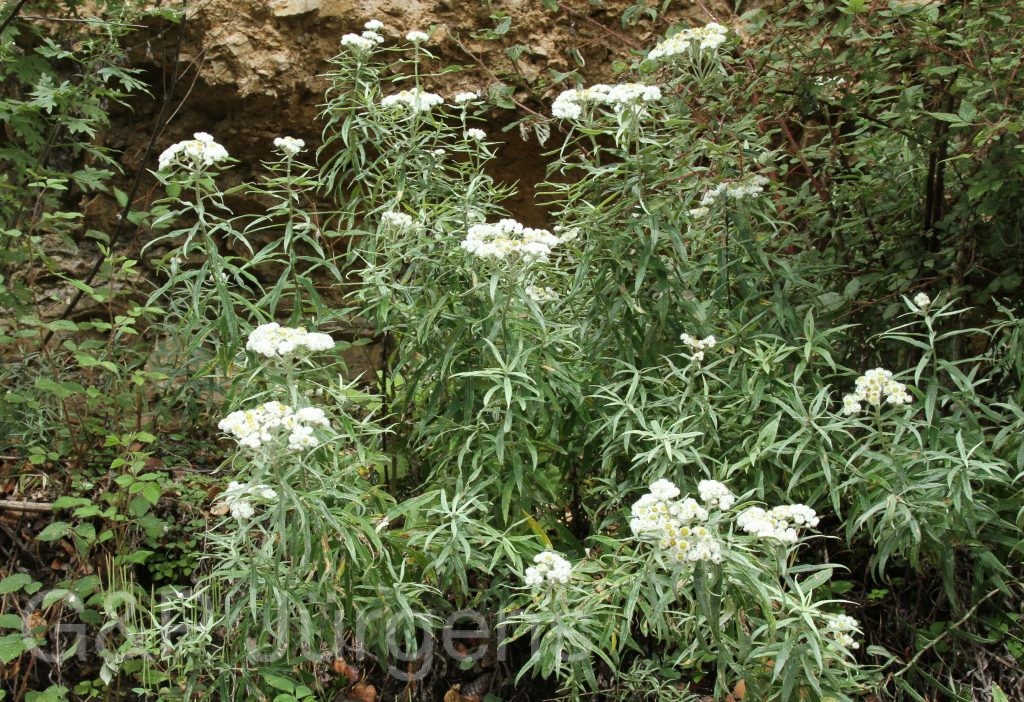
(L.) Benth. & Hook.f.

Bhutan2012 98
Bhutan Shele-La, 3600m September

Description

Among the most widely distributed of all Asteraceae, Anaphalis margaritacea spans a remarkable circumboreal and montane range, documented from North America (US, CA) and eastern Asia (CN, JP, TW) across the Himalaya (NP, IN) to a broad swathe of temperate Europe (GB, SE, DE, CZ, FR, AT, NL, CH, DK, NO, FI) and Russia, with more than 62,000 GBIF occurrences attesting to its abundance and partly naturalised status in the Old World. It favours open, well-drained sunny situations: grassy slopes, forest margins, roadsides, screes and subalpine meadows. In the eastern Himalaya it ascends well into the high mountains, as seen in the photographed population on the Shele-La in Bhutan at around 3600 m in September, where it flowers late in the season on stony alpine turf.

A perennial herb arising from a creeping rhizome, it forms erect, simple stems 20–60 cm tall, densely clothed throughout in white woolly-tomentose indumentum. The leaves are alternate, sessile, linear to linear-lanceolate, often somewhat decurrent, green and thinly arachnoid above and persistently white-tomentose beneath, with revolute margins. The inflorescence is a dense terminal corymb of numerous small capitula; each head is surrounded by several series of pearly-white, papery, radiating involucral bracts that give the plant its lasting ornamental quality. The florets are functionally unisexual, the species being largely dioecious, with tubular yellowish disc florets. The fruit is a small oblong cypsela bearing a pappus of slender barbellate bristles aiding wind dispersal.

The pearly everlasting is the type species of Anaphalis, a genus of the tribe Gnaphalieae centred on Asia, and its papery bracts retain form when dried, long valuing it in floristry. Ecologically it is a colonist of disturbed and pioneer ground, behaving as a weakly invasive naturalised plant in parts of Europe. Of least conservation concern given its vast range and ecological tolerance, it nonetheless provides a useful nectar source for late-season pollinators and larval food for certain lepidoptera.

Author: (L.) Benth. & Hook.f. · Sources: POWO (Kew), GBIF, Flora of China Vol. 20-21, Flora of Bhutan, Flora of Nepal, Anaphalis monograph (Hilliard & Burtt, Gnaphalieae)