
DC.
Description
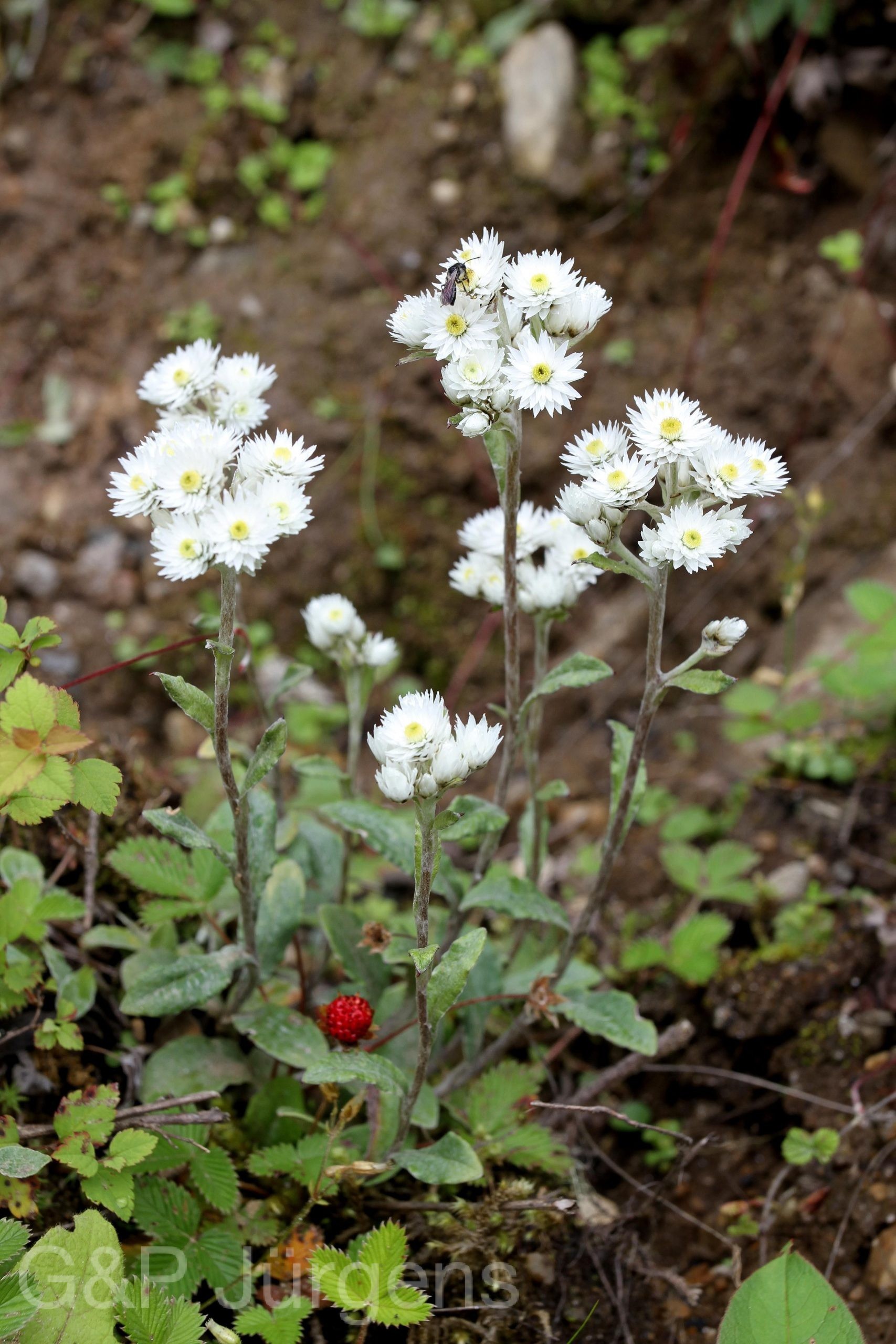
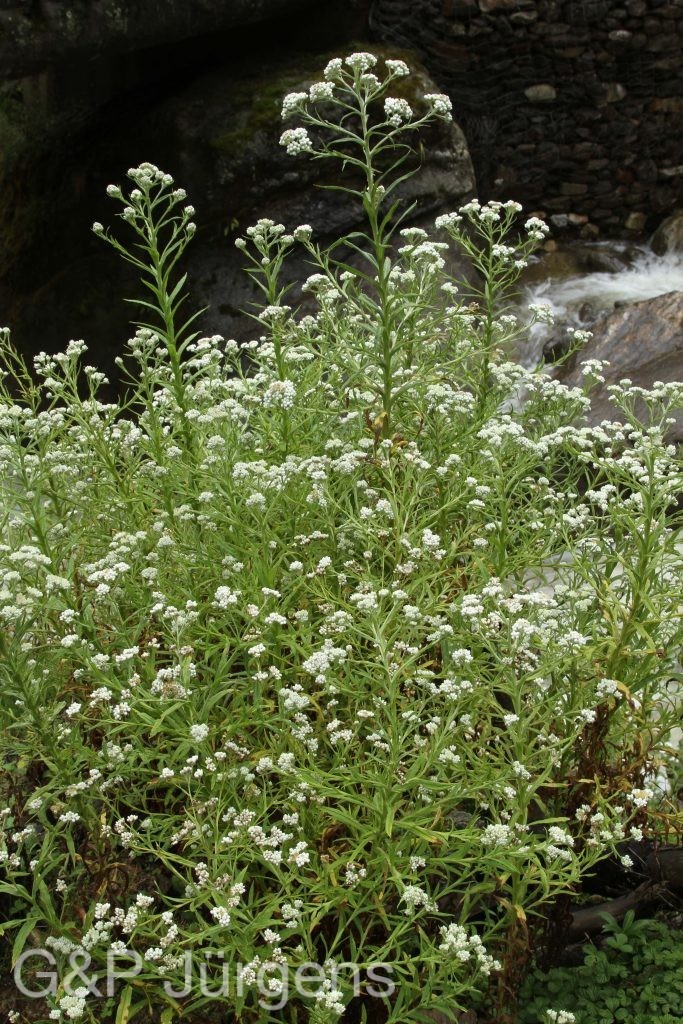
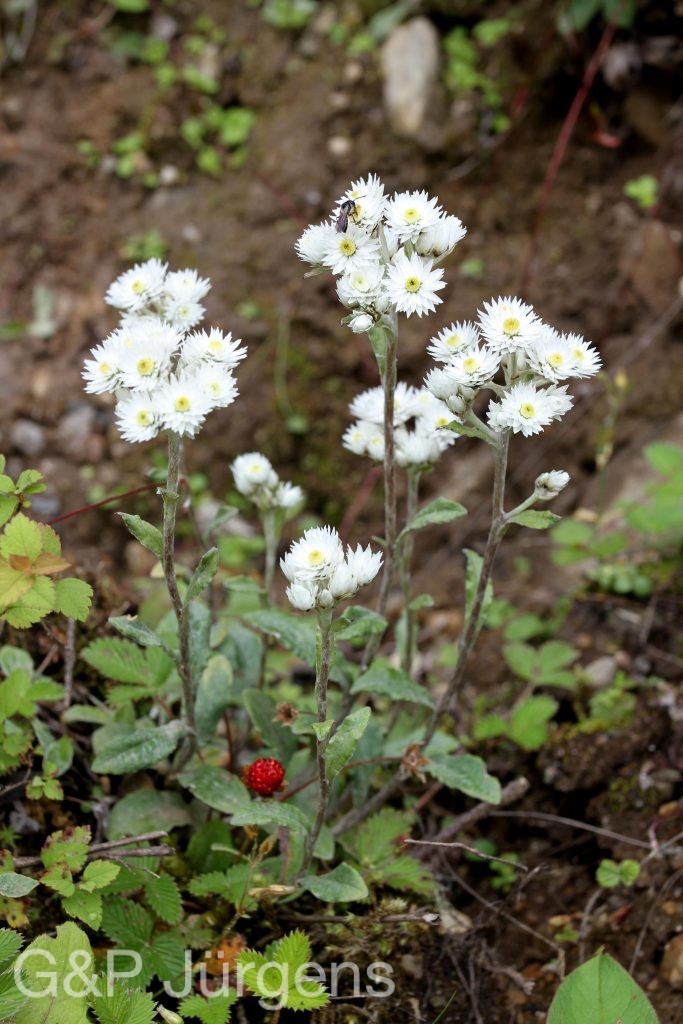
Anaphalis busua is a Himalayan everlasting widespread from Pakistan and India through Nepal, Bhutan and Myanmar into south-western China, with additional records from Sri Lanka; the 619 occurrences confirm a broad montane range, while points labelled Belgium represent cultivated or erroneous data. It occupies open grassy slopes, forest clearings, banks and disturbed ground from roughly 1500 to 3600 m. The documented Bhutanese material from the Haa Valley at about 3200 m in September and from the Chele-La at 3400 m in July illustrates its long flowering season across the temperate and lower subalpine zones of the eastern Himalaya.
The species is a perennial herb with a woody rootstock producing erect, white-woolly stems. The leaves are sessile, linear to oblong-lanceolate, somewhat decurrent, green and thinly arachnoid above and densely white-tomentose beneath, with revolute margins. The capitula are small and numerous, aggregated into dense terminal corymbs; each head is heterogamous and functionally dioecious, with the involucre of papery, pearly-white, radiating phyllaries that give the genus its everlasting quality. The florets are tubular and whitish, the outer female and filiform, the inner mostly functionally male. The cypselae are minute and oblong, crowned by a pappus of slender, barbellate, basally free bristles.
Anaphalis is a large genus of the Gnaphalieae especially diverse in the Sino-Himalayan region, distinguished from Helichrysum and Gnaphalium by its scarious involucres and predominantly dioecious heads. A. busua belongs to the broad-leaved Himalayan group and is taxonomically variable, with several related forms intergrading. The dry chaffy phyllaries persist long after flowering, favouring wind dispersal of the small achenes. The species is common and weedy in disturbed montane habitats and is of no conservation concern.
Author: DC. · Sources: POWO (Kew), GBIF, Flora of China Vol. 20-21, Flora of Bhutan, Flora of Nepal, Hilliard & Burtt Gnaphalieae studies