Hydrangeaceae

R.Br. ex Wall.

Nepal 97 304 P605
Nepal Honggaon 2360m, May

Description

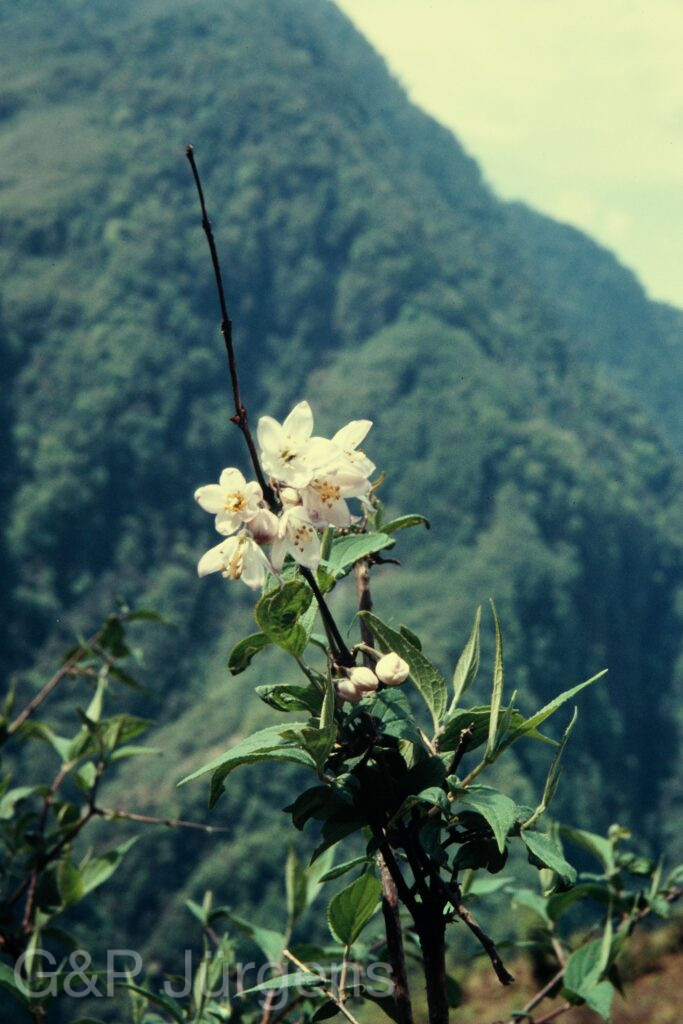
Deutzia staminea is a deciduous shrub distributed across the western and central Himalayas, from Pakistan through northern India and Nepal to Bhutan, with populations extending into southwest China and northern Myanmar. GBIF records approximately 390 occurrences, with the majority from India and Nepal. The species occupies dry to mesic slopes, open forests, scrublands, and rocky hillsides at elevations of 1,500–3,200 m. At Honggaon in central Nepal at 2,360 m, it inhabits open Pinus–Quercus forests and rocky banks, where it flowers prolifically in May during the pre-monsoon season.
Deutzia staminea is a deciduous shrub reaching 1.5–4 m in height, with greyish-brown bark that exfoliates in thin flakes on older stems. Leaves are opposite, ovate to lanceolate, 3–8 cm long, with serrate margins and a rough texture from stellate trichomes on both surfaces. The inflorescence is a terminal corymb or panicle of 5–20 flowers. Flowers are pentamerous, 12–18 mm in diameter, with white petals that are oblong-elliptic and spreading. The stamens, 10 in number, are distinctive: the filaments are broadly winged and toothed at the apex, exceeding the petals — a character reflected in the specific epithet 'staminea.' The fruit is a hemispheric capsule, 4–6 mm across, dehiscing by 3–4 valves and releasing numerous small seeds.
Deutzia staminea is the most widespread Himalayan representative of the genus and is distinguished from the closely related D. compacta by its prominently toothed stamen filaments and generally laxer inflorescences. The species serves as an important early-season nectar resource for pollinators in mid-elevation Himalayan landscapes, where relatively few shrubs are in flower during the pre-monsoon period. It is occasionally cultivated in European gardens and has been in cultivation since its introduction by Wallich in the early nineteenth century.

Author: R.Br. ex Wall. · Sources: POWO (Kew), GBIF, Flora of China Vol. 8, Flora of Pakistan Vol. 192, Polunin & Stainton: Flowers of the Himalaya (1984)

D. Don

Sikkim2011 179
Sikkim Lachen 2760m, June

Description

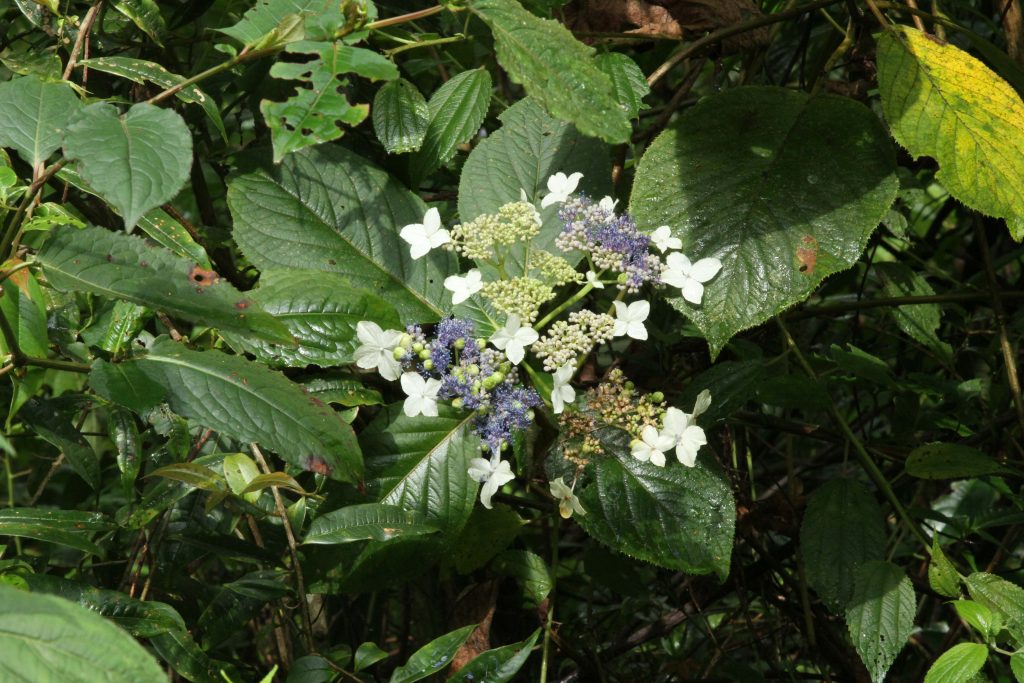
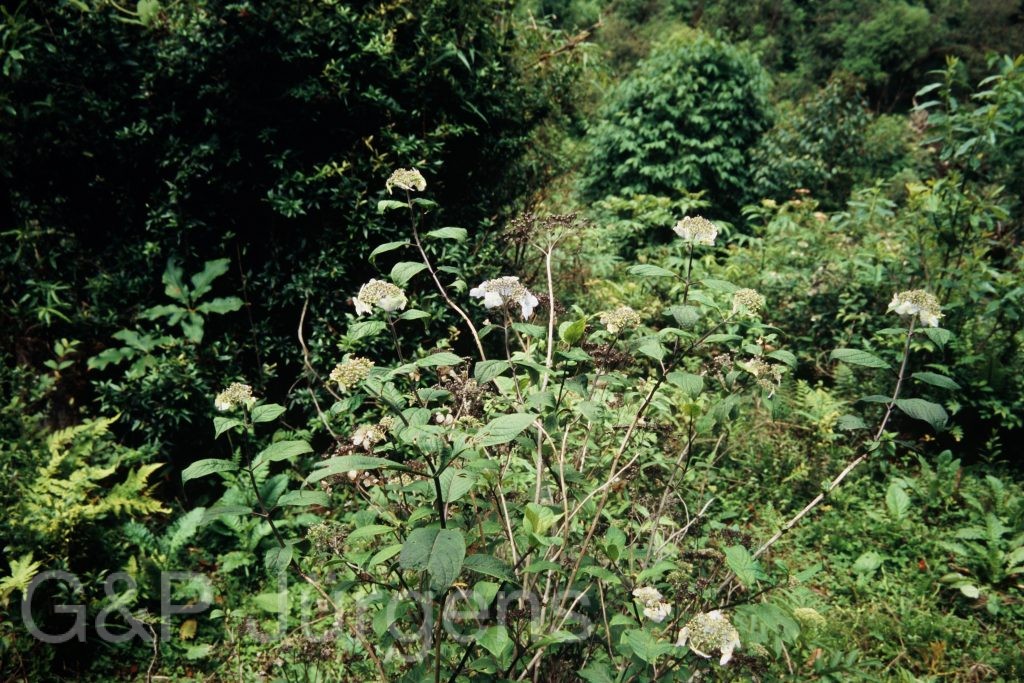
Hydrangea heteromalla is a deciduous shrub or small tree of the Himalaya and central China, with GBIF returning over 1600 occurrences spanning its native range in China, Nepal, India, Bhutan and Myanmar as well as numerous cultivated and naturalised records from Europe and North America. In the wild it grows in cool temperate forest, on open slopes, forest margins, ravines and shrubberies, typically between about 1500 and 3500 m. The plant photographed near Lachen in northern Sikkim at about 2760 m, flowering in June, occupies the moist temperate montane belt where the species is a frequent understorey and edge shrub.

The plant has stout, spreading branches with peeling bark and opposite leaves that are ovate to elliptic, acuminate, finely serrate, and characteristically discolorous, dark green above and densely pale-tomentose to whitish beneath, the indumentum giving the epithet heteromalla. The inflorescence is a broad, flat-topped to slightly domed corymb bearing many small fertile flowers surrounded at the margin by larger, showy, sterile ray-florets with four enlarged white sepaloid segments. The fertile flowers are small, white, with five petals and numerous stamens. The fruit is a small ribbed capsule opening at the apex to release numerous tiny seeds.

Hydrangea heteromalla is a variable and widespread species, the subject of much horticultural selection and the source of cultivated forms grown for their lacecap inflorescences, which explains its scattered records across temperate gardens worldwide. Within Hydrangea section Hydrangea it represents the principal Himalayan-Chinese montane lineage. Ecologically the marginal sterile florets serve to attract pollinators to the inconspicuous fertile flowers. The species is common and not threatened, and its wide ecological amplitude and ornamental value have ensured both its persistence in the wild and its global cultivation.

Author: D. Don · Sources: POWO (Kew), GBIF, Flora of China, Flora of Bhutan, McClintock "A Monograph of the Genus Hydrangea", Annotated Checklist of the Flowering Plants of Nepal

(Thunb.) Ser.

Bhutan2015 285
Bhutan Zhemgang 910m, October

Description

Hydrangea macrophylla is a deciduous shrub of East Asian origin, now among the most widely cultivated ornamental hydrangeas worldwide; this is reflected in its very large GBIF record (over 16,000 occurrences) spanning Japan, China, Korea, much of Europe, the Americas, Australasia and beyond, where most points represent garden or naturalised plants. In the Himalaya it occurs chiefly in cultivation and around settlements, growing in moist, humus-rich, partially shaded ground at low to mid elevations. The documented plant from Zhemgang in Bhutan at 910 m in October indicates such a subtropical montane setting, flowering and fruiting late in the season in the warm-temperate belt.

The species is a rounded, much-branched shrub with stout, glabrous stems and large, opposite, broadly ovate to elliptic leaves that are coarsely serrate, glossy and somewhat fleshy. The inflorescence is a broad, flattened to globose terminal corymb; in wild and lacecap forms the small fertile flowers occupy the centre while showy sterile flowers with four enlarged, petaloid sepals form the margin, whereas cultivated mopheads are dominated by sterile flowers. Corolla colour ranges from white through pink to blue, the latter influenced by soil acidity and available aluminium. The fruit is a small ribbed capsule with numerous minute seeds.

Within Hydrangeaceae the species belongs to the mophead and lacecap group and has given rise to innumerable cultivars. Its sterile marginal flowers act as visual attractants for pollinators of the inner fertile florets, and its pigment chemistry makes flower colour a notable indicator of substrate pH. Wild populations are restricted to coastal Japan, while elsewhere occurrence is overwhelmingly anthropogenic.

Author: (Thunb.) Ser. · Sources: POWO (Kew), GBIF, Flora of China Vol. 8, Flora of Bhutan Vol. 1, McClintock A Monograph of the Genus Hydrangea

Hook. f. & Thomson

Bhutan2012 692
Bhutan Galephu, 850m September
Bh09 216 G363
Bhutan Dochu-La, 3000m June
Bh09 217 P364 2
Bhutan Dochu-La, 3000m June

Description

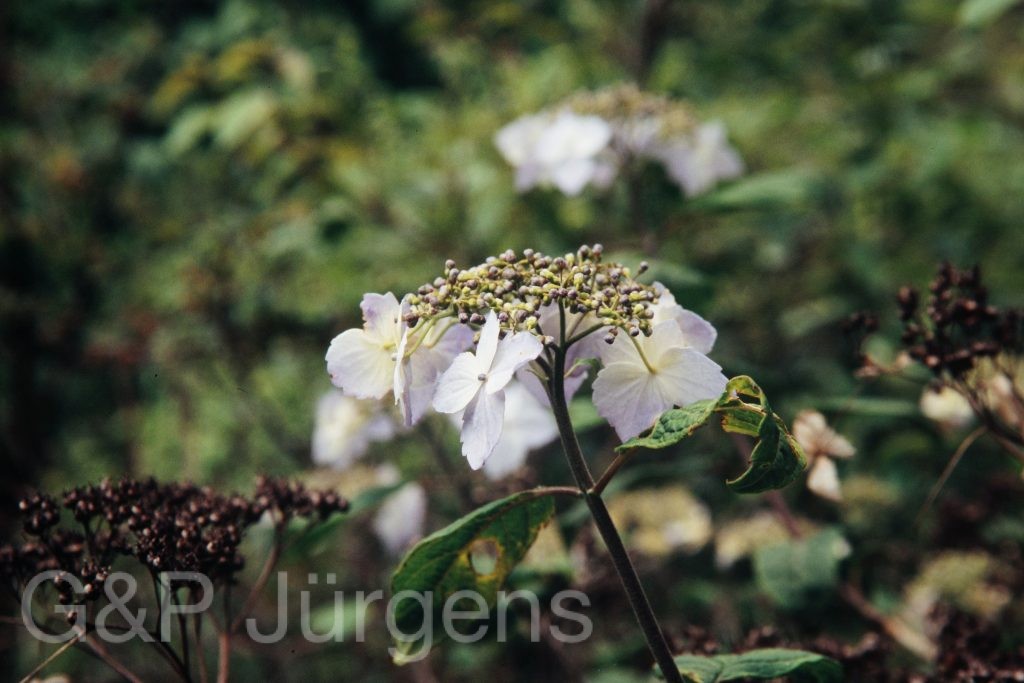
Hydrangea stylosa Hook.f. & Thomson is a Sino-Himalayan shrub recorded by GBIF from China, Bhutan, India, Vietnam and Japan, with cultivated occurrences from Canada and New Zealand, totalling about 85 records. It occupies a broad altitudinal range in moist broad-leaved and mixed forest, thickets and forest margins, on shaded slopes and along ravines. The Bhutanese material spans this amplitude strikingly, with collections from Galephu at 850 m in September and from the Dochu-La at 3000 m in June, showing occurrence from low submontane forest up into the cool temperate zone.

It is a deciduous shrub with terete branches, the young growth often pubescent and the bark exfoliating on older stems. The leaves are opposite, ovate to oblong-lanceolate, with a serrate margin, an acuminate apex and pinnate venation, pilose along the veins beneath. The inflorescence is a terminal corymbose cyme bearing two kinds of flowers: numerous small fertile flowers with minute petals, and a marginal ring of showy sterile flowers whose enlarged, petaloid white to pinkish sepals attract pollinators. The fertile flowers are notable for their elongate, persistent styles, emphasised by the epithet stylosa; the fruit is a small ribbed capsule opening between the styles.

Within Hydrangea, H. stylosa belongs to the lacecap-type species, in which marginal sterile flowers advertise the fertile centre to insects. Its distribution forms part of the eastern Himalayan to Sino-Japanese floristic continuum, and the species is of horticultural interest, accounting for the cultivated records beyond its native range. As a forest understorey shrub it depends on humid montane woodland.

Author: Hook. f. & Thomson · Sources: POWO (Kew), GBIF, Flora of Bhutan Vol. 1, Flora of China Vol. 8, McClintock monograph of the genus Hydrangea, Flora of Nepal