
(Thunb.) Ser.

Description
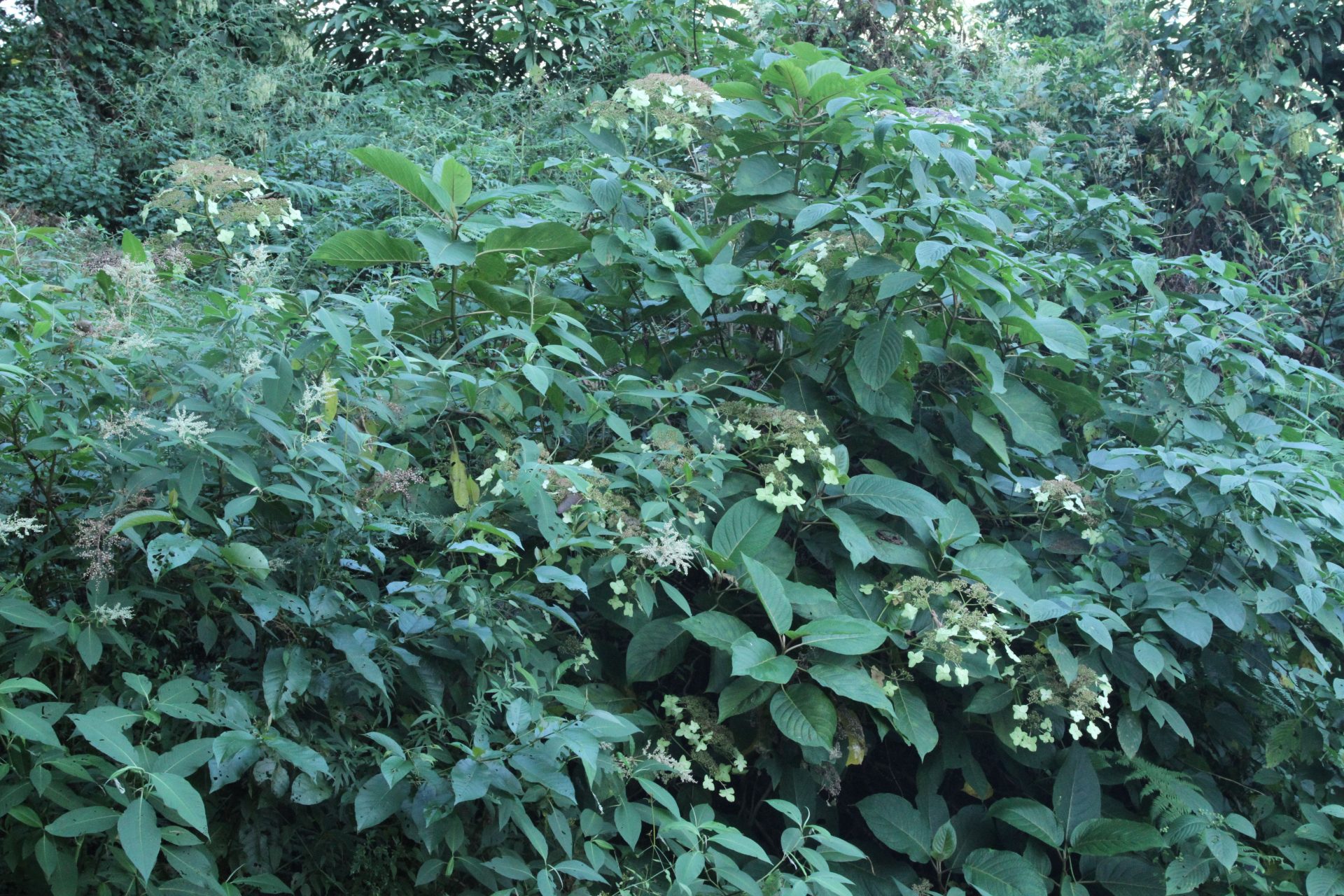
Hydrangea macrophylla is a deciduous shrub of East Asian origin, now among the most widely cultivated ornamental hydrangeas worldwide; this is reflected in its very large GBIF record (over 16,000 occurrences) spanning Japan, China, Korea, much of Europe, the Americas, Australasia and beyond, where most points represent garden or naturalised plants. In the Himalaya it occurs chiefly in cultivation and around settlements, growing in moist, humus-rich, partially shaded ground at low to mid elevations. The documented plant from Zhemgang in Bhutan at 910 m in October indicates such a subtropical montane setting, flowering and fruiting late in the season in the warm-temperate belt.
The species is a rounded, much-branched shrub with stout, glabrous stems and large, opposite, broadly ovate to elliptic leaves that are coarsely serrate, glossy and somewhat fleshy. The inflorescence is a broad, flattened to globose terminal corymb; in wild and lacecap forms the small fertile flowers occupy the centre while showy sterile flowers with four enlarged, petaloid sepals form the margin, whereas cultivated mopheads are dominated by sterile flowers. Corolla colour ranges from white through pink to blue, the latter influenced by soil acidity and available aluminium. The fruit is a small ribbed capsule with numerous minute seeds.
Within Hydrangeaceae the species belongs to the mophead and lacecap group and has given rise to innumerable cultivars. Its sterile marginal flowers act as visual attractants for pollinators of the inner fertile florets, and its pigment chemistry makes flower colour a notable indicator of substrate pH. Wild populations are restricted to coastal Japan, while elsewhere occurrence is overwhelmingly anthropogenic.
Author: (Thunb.) Ser. · Sources: POWO (Kew), GBIF, Flora of China Vol. 8, Flora of Bhutan Vol. 1, McClintock A Monograph of the Genus Hydrangea