Fagaceae

Castanopsis indica

by GP Jürgens

(Roxb. ex Lindl.) A.DC.
Bhutan2015 191
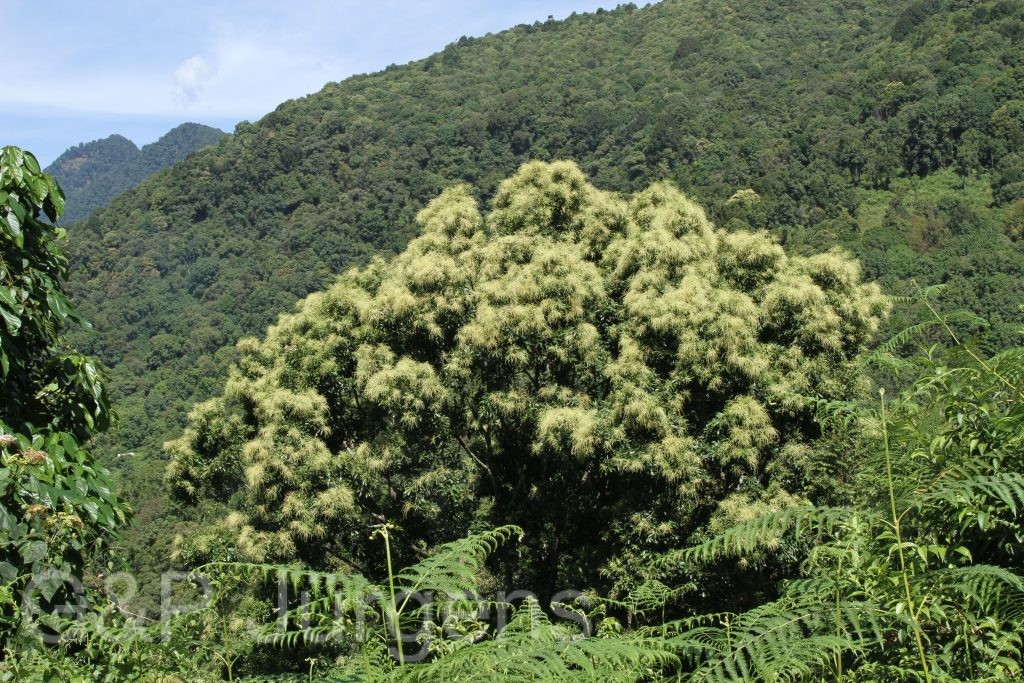
Bhutan Mo-Chu 1400m, October
Bhutan2015 192
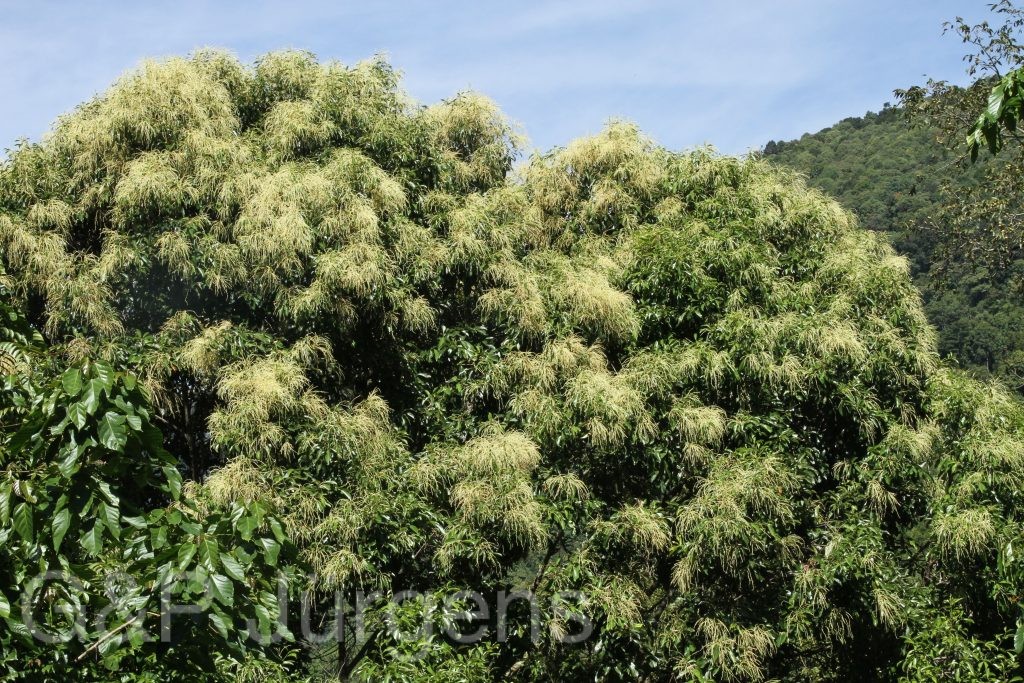
Bhutan Mo-Chu 1400m, October
Bhutan2015 649 scaled
Bhutan Mo-Chu 1400m, October

Description

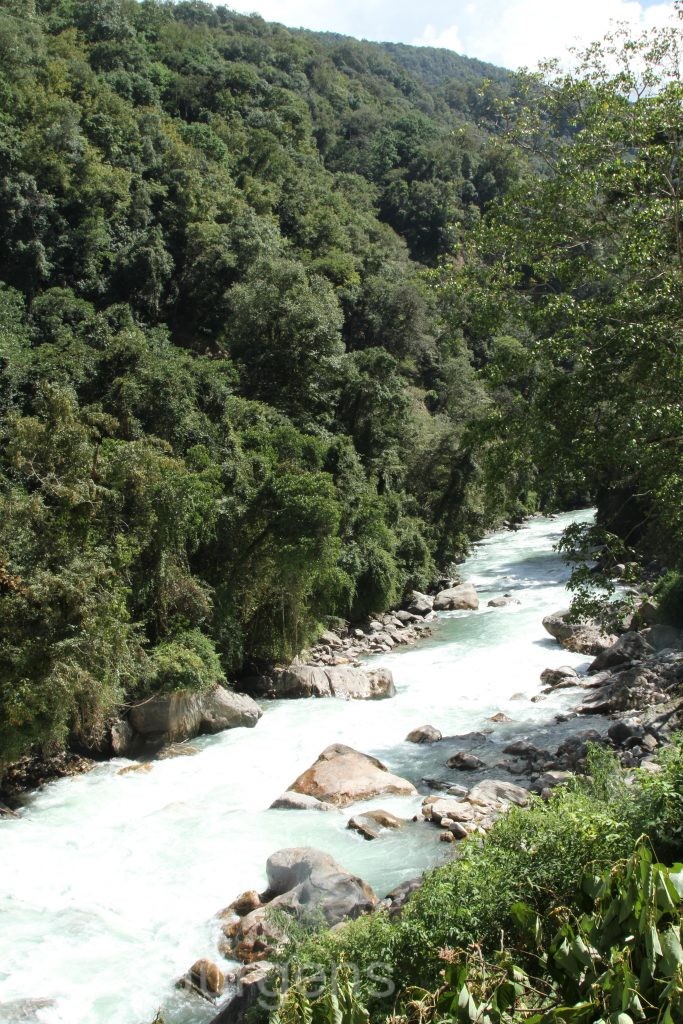
Castanopsis indica is a large evergreen tree of the subtropical and lower temperate forests of the Himalaya and Southeast Asia, abundantly recorded with around 1680 GBIF occurrences across India, China, Myanmar, Vietnam, Laos, Thailand, Nepal, Bhutan and Bangladesh. The photographed tree was found along the Mo-Chu in Bhutan at 1400 m in October. The species is a dominant or co-dominant canopy element of mid-elevation broad-leaved forest, typically between 800 and 2000 m, often forming Castanopsis-Schima associations on humid, well-drained hill slopes.

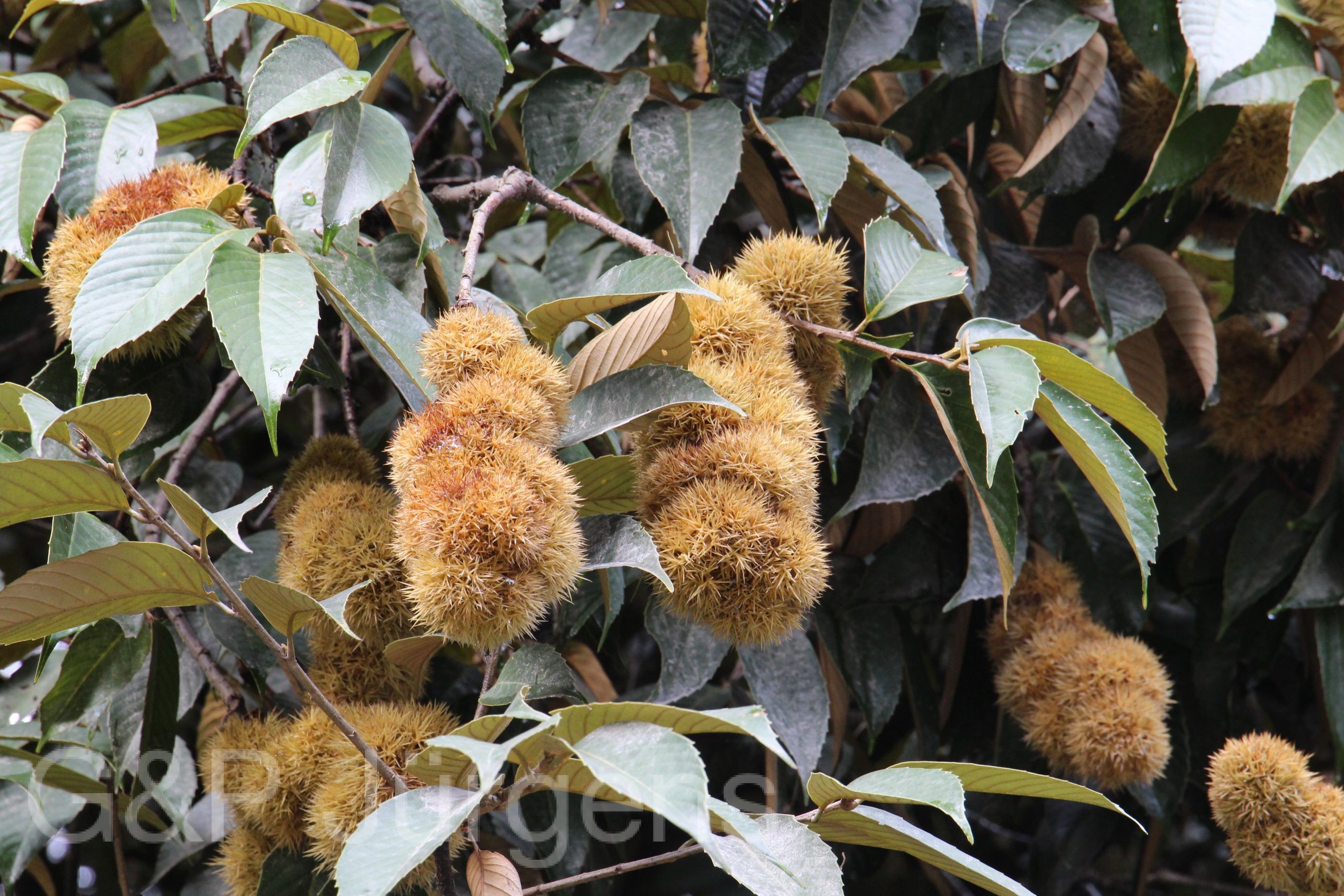
It is a stout tree with a broad crown and greyish, somewhat fissured bark. The leaves are alternate, leathery, oblong to elliptic-lanceolate, with a coarsely serrate margin bearing spinose-tipped teeth, glabrous and dark green above. Like other chestnut relatives the flowers are unisexual, the males borne in erect catkin-like spikes and the females clustered at their base, producing a strong scent at anthesis. The fruit is a hard nut wholly enclosed in a globose cupule densely armed with branched, spiny processes; the cupules split irregularly to release the edible nuts.

The genus Castanopsis (chinquapins) belongs to the Fagaceae and is a keystone group in Asian evergreen oak forests. The nutritious nuts are eaten locally and dispersed by rodents and birds, while the timber is valued for construction and the trees provide important habitat structure. Although the species is widespread and not globally threatened, the Castanopsis-dominated forests it characterises are under pressure from logging, fuelwood collection and agricultural conversion.

Author: (Roxb. ex Lindl.) A.DC. · Sources: POWO (Kew), GBIF, Flora of China, Flora of Bhutan, Flora of Nepal, Camus – Les Chenes: Monographie du genre Castanopsis
A.DC.

Bhutan2014 87
Bhutan Trashigang 1400m, May
Bhutan2014 167
Bhutan Trashigang 1400m, May
Bhutan2014 165
Bhutan Trashigang 1400m, May

Description

Castanopsis tribuloides is an evergreen chinquapin widely distributed across the eastern Himalaya and Indo-Burma into southern China and Japan, recorded from Nepal, Bhutan, north-eastern India, Bangladesh, Myanmar, Thailand, Indochina and the Sino-Japanese region. GBIF aggregates some 766 occurrences, concentrated in the montane forests of the eastern Himalaya and South-East Asia. It is a canopy or sub-canopy tree of subtropical and warm-temperate evergreen broad-leaved forest, often in mixed oak-laurel associations on hill slopes, typically between about 1000 and 2500 m. The tree photographed near Trashigang in eastern Bhutan (1400 m, May) reflects its place in the moist mid-elevation forests of the eastern Himalayan belt, flowering in the pre-monsoon season.

The species is a medium-sized tree with greyish bark and slender twigs. The leaves are simple, alternate, coriaceous, lanceolate to oblong-lanceolate, entire or finely serrate toward the apex, glabrous and glossy above and often thinly scaly or coppery beneath when young. The flowers are unisexual, borne in erect catkin-like spikes, the staminate inflorescences slender and the pistillate flowers in few-flowered clusters. The diagnostic fruit is a small nut enclosed in a globose cupule densely covered with slender, spreading, often branched spines, recalling a Tribulus burr and giving the epithet; the spiny involucres are borne in dense infructescences and dehisce to release the nut.

Castanopsis is a large genus of Asian Fagaceae distinguished from Castanea and Lithocarpus by its evergreen habit and persistently spiny cupules. C. tribuloides, described by Alphonse de Candolle, is variable in leaf form and cupule spininess, and is closely allied to other Himalayan chinquapins with which it can intergrade. As a widespread, often common forest dominant it is not threatened, while being ecologically valuable as wildlife mast and locally used for timber and fuelwood.

Author: A.DC. · Sources: POWO (Kew), GBIF, Flora of China, Flora of Bhutan, Flora of Thailand, Annotated Checklist of the Flowering Plants of Nepal, monograph of Asian Fagaceae (Camus)

Rehder

Description

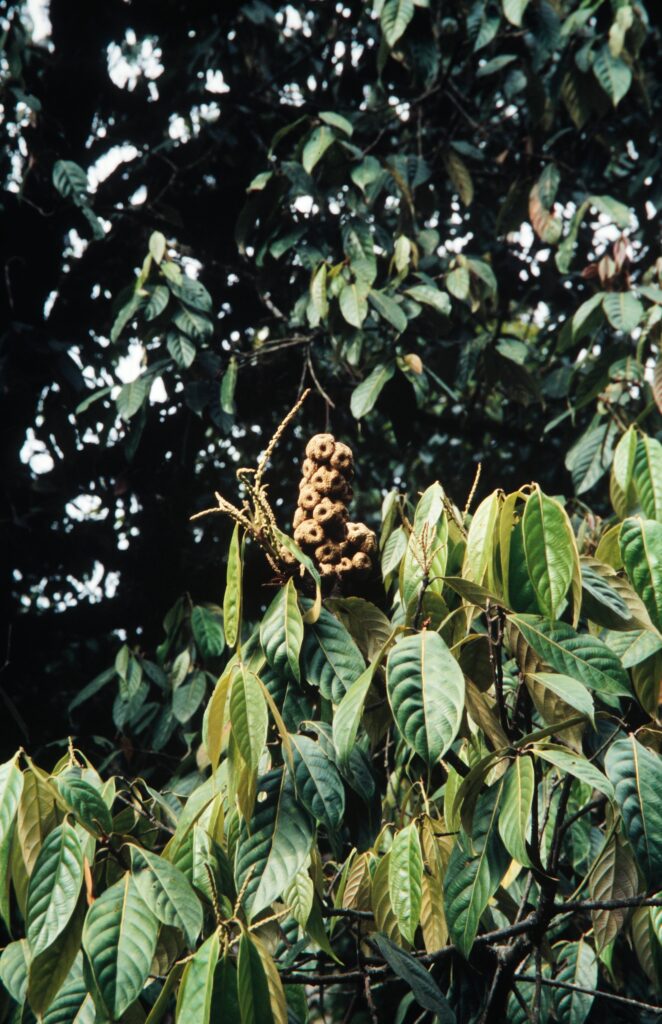
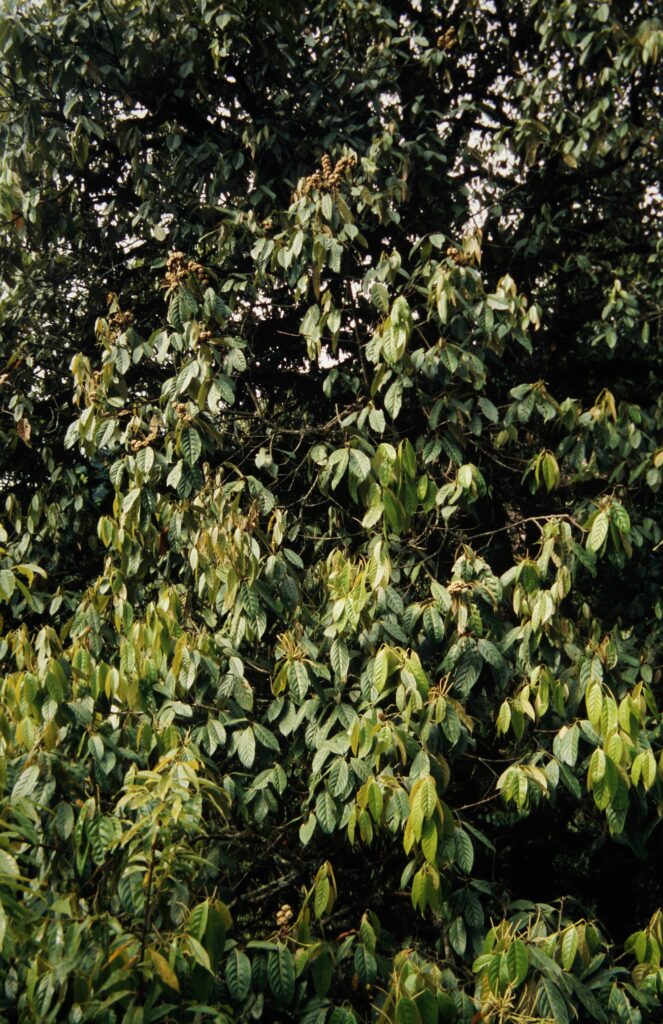
Lithocarpus pachyphyllus is a stone oak widely distributed across the eastern Himalaya and adjacent Southeast Asia, with records from China, India, Nepal, Myanmar, Bhutan, Thailand and Vietnam and a substantial occurrence base of around 229 georeferenced collections. It is a canopy and subcanopy tree of montane evergreen broadleaved forest, forming a conspicuous element of the laurophyllous oak-laurel belt on humid, well-drained slopes. The tree photographed at Ramman in West Bengal (India) at about 2250 m in May represents its characteristic position in the mid-montane cloud-forest zone, where Lithocarpus and Quercus species dominate the wet temperate forests of the southern Himalayan front.

It is an evergreen tree with a dense, rounded crown and grey, finely fissured bark. The leaves are coriaceous and pachyphyllous (thick-textured, as the epithet indicates), elliptic to oblong-lanceolate, entire-margined, glabrous and glossy above and dull beneath, with a prominent midrib and arcuate lateral veins. As in all Lithocarpus, the staminate flowers are borne in erect, rigid catkins rather than the pendulous catkins of true oaks, while the pistillate flowers are clustered at the base of the inflorescence axis. The fruit is a thick-walled nut seated in a woody cupule whose scales are typically arranged in concentric rings; the acorns are often densely aggregated along the rachis.

Lithocarpus is distinguished from Quercus chiefly by its erect staminate catkins and frequently aggregated, sessile fruits, features expressed clearly in this species. Its heavy, animal-dispersed acorns provide an important mast resource for montane wildlife, while the species contributes substantially to the structure and carbon stock of Himalayan oak forest. Although not currently of conservation concern across its broad range, local populations are reduced by timber extraction and the conversion of mid-elevation forest, making it a key indicator of intact wet temperate woodland.

Author: Rehder · Sources: POWO (Kew), GBIF, Flora of China Vol. 4, Flora of Bhutan Vol. 1, Flora of Nepal, Camus Les Chênes: Monographie du genre Lithocarpus

Lindl. ex A.Camus

Garh 07 97 ergebnis
India Garhwal Trijugi Narayan 2250m, June
Garh 07 98 ergebnis
India Garhwal Trijugi Narayan 2250m, June

Description

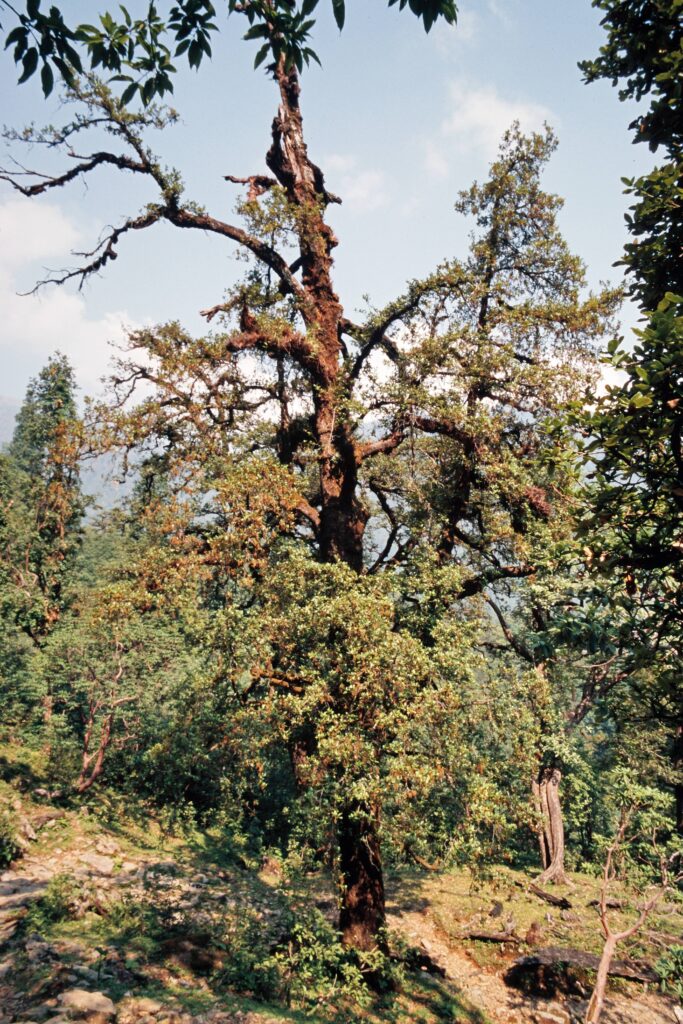
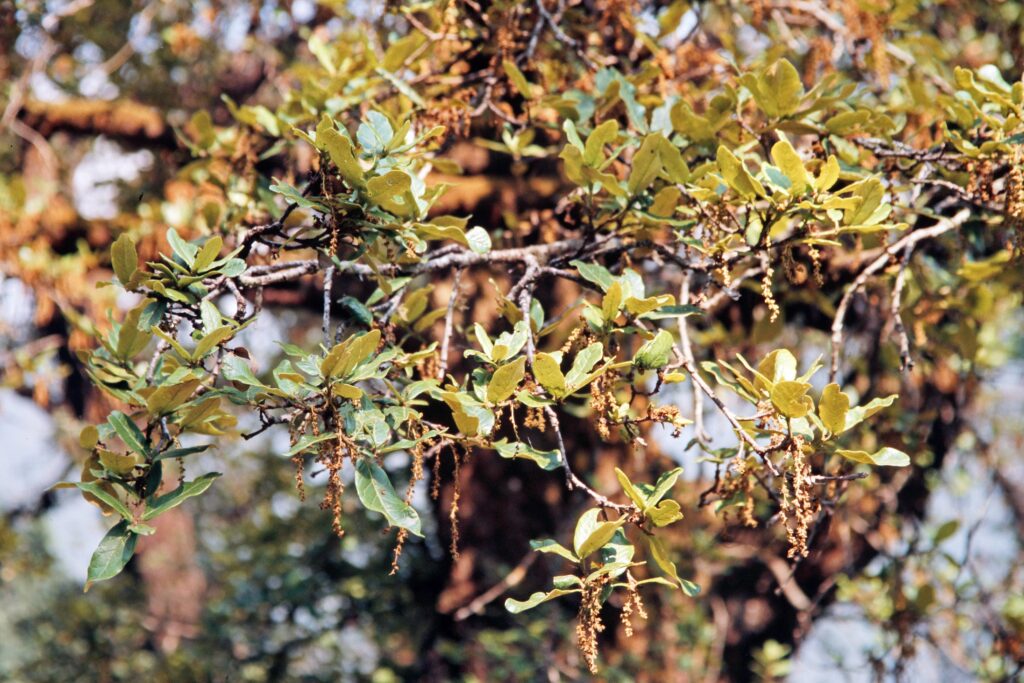
Quercus floribunda Lindl. ex A.Camus, the moru or green oak, is an evergreen tree of the Fagaceae forming a major element of the temperate forests of the western and central Himalaya. GBIF records, totalling 278 occurrences, span India, Nepal, China, Pakistan and Afghanistan, with peripheral reports. The species dominates moist, cool-temperate slopes typically between 2,000 and 2,700 m, often in association with Quercus leucotrichophora, Rhododendron arboreum and Lyonia. The photographed tree from Trijugi Narayan in Garhwal at 2,250 m, in June, is representative of these mid-altitude oak forests that are climatically and hydrologically critical to the Himalayan watershed.

The plant is a large evergreen tree reaching 25–30 m, with a rounded crown and greyish, fissured bark. The leaves are coriaceous, oblong-lanceolate to elliptic, glossy dark green above and glaucous-pubescent or glabrescent beneath, the margins entire to spinulose-serrate especially on young foliage. The species is monoecious: the staminate flowers are borne in slender pendulous catkins, while the pistillate flowers are few and inconspicuous. As the name suggests, flowering is profuse. The fruit is an ovoid acorn seated in a shallow, scaly cupule, maturing in the second year.

Quercus floribunda has long been confused with Q. dilatata and other Himalayan oaks, and its nomenclature reflects a tangled taxonomic history within the ring-cupped oak group (subgenus Cerris / section Ilex). Ecologically these oak forests are keystone communities, regulating spring discharge and supporting rich epiphyte and lichen assemblages, yet they are heavily exploited for fuelwood, fodder and leaf-litter, making mature stands increasingly fragmented and locally threatened.

Author: Lindl. ex A.Camus · Sources: POWO (Kew), GBIF, Flora of China Vol. 4, Flora of Pakistan (Fagaceae), Flora of British India Vol. 5, Menitsky: Oaks of Asia

Quercus glauca

by GP Jürgens

Thunb.

Bhutan2015 571
Bhutan Mo-Chu 1550m, October
Bhutan2015 572
Bhutan Mo-Chu 1550m, October

Description

Quercus glauca, the ring-cupped or Japanese blue oak, is one of the most widespread evergreen oaks of East and South Asia. GBIF documents nearly 14,910 occurrences spanning Japan, China, Taiwan, Korea, Nepal, India, Bhutan, Myanmar, Laos and Pakistan, with numerous introduced records in Europe and North America. It is a dominant or co-dominant of subtropical and warm-temperate broadleaved evergreen forest, frequently on hill slopes, ravines and along watercourses at low to mid elevations. The photographed tree grew in Bhutan along the Mo-Chu at 1550 m in October, a typical mid-montane riparian situation within the species' Himalayan range.

It is an evergreen tree with smooth greyish bark and alternate, coriaceous, oblong-lanceolate leaves whose upper half is conspicuously serrate while the lower margin is entire; the lamina is glossy dark green above and glaucous, often whitish-waxy and pubescent beneath, giving the species its epithet. Young shoots are silky-villous. As a member of subgenus Cerris, section Cyclobalanopsis, it bears its acorns in a distinctive cupule formed of concentric, ring-like fused bracts rather than separate scales; the ovoid nut ripens in a single season. Flowers are unisexual, the staminate in slender pendent catkins, the pistillate few in short spikes.

GBIF accepts the name. Its placement in section Cyclobalanopsis, sometimes treated as a separate genus, unites the Asian ring-cupped oaks. Quercus glauca is an important timber and afforestation tree, widely planted and naturalised, and ecologically central to evergreen oak forests. It is abundant and assessed as of least conservation concern.

Author: Thunb. · Sources: POWO (Kew), GBIF, Flora of China, Flora of Bhutan, monograph of Asian Quercus (Cyclobalanopsis)

A.Camus

Garh 07 580 ergebnis
India Garhwal Seena 3350m, June

Description

Quercus leucotrichophora, commonly known as banj oak, is a dominant broadleaved tree of the western and central Himalaya, distributed from northern Pakistan through India (Jammu & Kashmir, Himachal Pradesh, Uttarakhand) to Nepal, Bhutan, and adjacent parts of Myanmar. It forms extensive forests on north-facing slopes and mesic sites at elevations of 1,500–3,500 m, constituting one of the most ecologically important tree species in the Himalayan mid-montane zone. The species has been documented at Seena in the Garhwal Himalaya of Uttarakhand at 3,350 m in June, representing the upper elevational margin of its range where it transitions into subalpine communities.
Quercus leucotrichophora is an evergreen tree, typically 15–25 m tall, with a stout trunk and spreading, dense crown. The bark is dark grey to blackish, deeply furrowed on mature trees. Leaves are elliptic to lanceolate, 6–15 cm long and 2–5 cm wide, with a sharply serrate margin bearing spine-tipped teeth, coriaceous in texture, dark green and glabrous above, and distinctly white-tomentose beneath — the specific epithet referring to these white (leuco-) hairs (tricho-) on the leaf (phora). Flowers are unisexual and monoecious; male catkins are pendulous, 5–10 cm long, while female flowers are borne in short, erect spikes. The acorn is ovoid, 1–1.5 cm long, seated in a shallow, scaly cupule with appressed, imbricate scales.
Quercus leucotrichophora belongs to the subgenus Cerris, section Ilex, a group of evergreen oaks centred in East and South Asia. It is a keystone species in western Himalayan forests, supporting a rich community of epiphytes, mycorrhizal fungi, and avifauna. The leaf litter is a critical source of organic matter and nutrient cycling in montane soils. Banj oak forests are widely exploited for fuelwood and fodder — the leaves being an essential winter fodder resource for livestock — and ongoing lopping pressure has led to degradation of many stands, prompting conservation and restoration efforts across Uttarakhand and Himachal Pradesh.

Author: A.Camus · Sources: POWO (Kew), GBIF, Flora of China Vol. 4, Singh & Rawat: Flora of the Great Himalayan National Park (2000), Troup: Silviculture of Indian Trees Vol. 3