
A.DC.


Description
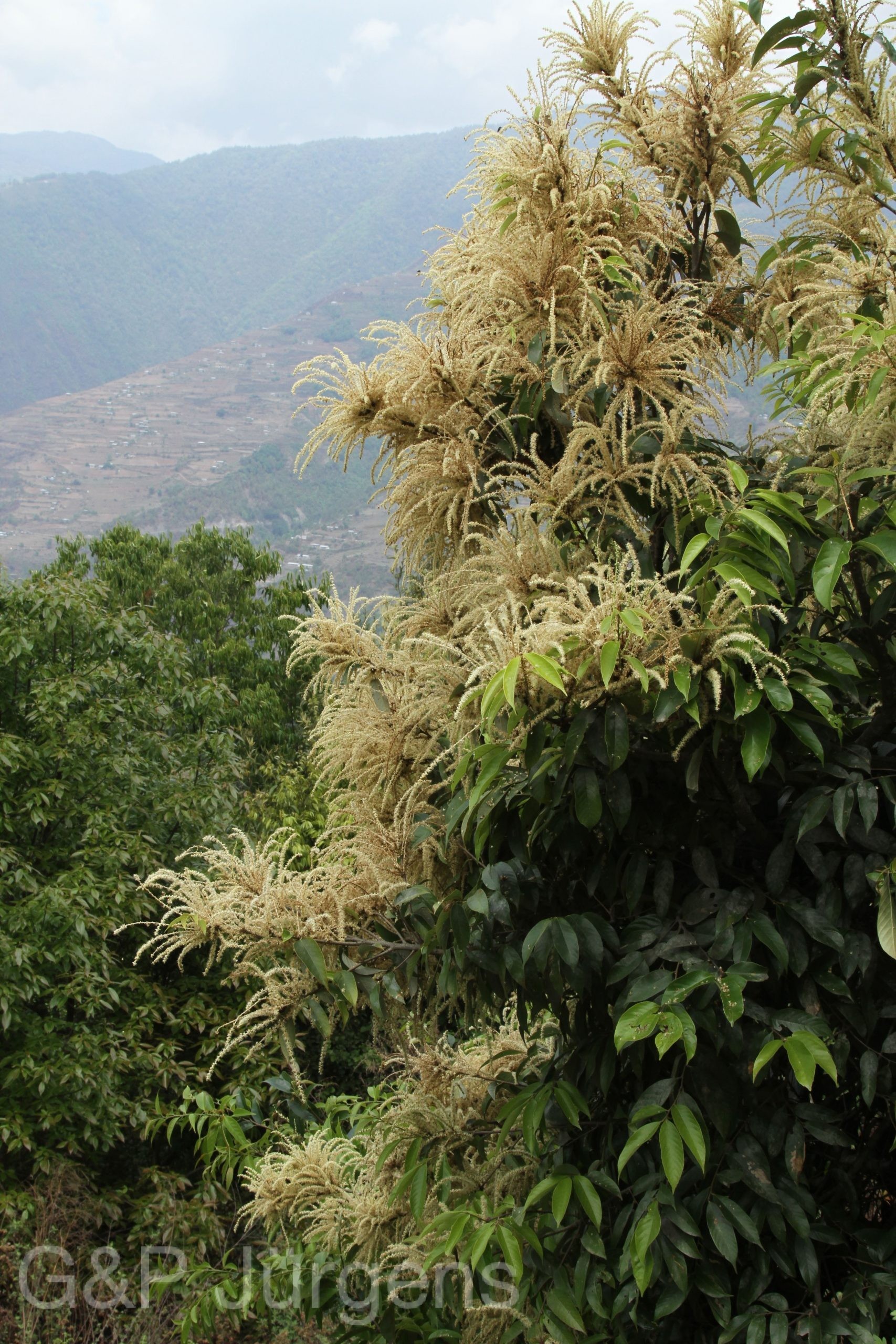
Castanopsis tribuloides is an evergreen chinquapin widely distributed across the eastern Himalaya and Indo-Burma into southern China and Japan, recorded from Nepal, Bhutan, north-eastern India, Bangladesh, Myanmar, Thailand, Indochina and the Sino-Japanese region. GBIF aggregates some 766 occurrences, concentrated in the montane forests of the eastern Himalaya and South-East Asia. It is a canopy or sub-canopy tree of subtropical and warm-temperate evergreen broad-leaved forest, often in mixed oak-laurel associations on hill slopes, typically between about 1000 and 2500 m. The tree photographed near Trashigang in eastern Bhutan (1400 m, May) reflects its place in the moist mid-elevation forests of the eastern Himalayan belt, flowering in the pre-monsoon season.
The species is a medium-sized tree with greyish bark and slender twigs. The leaves are simple, alternate, coriaceous, lanceolate to oblong-lanceolate, entire or finely serrate toward the apex, glabrous and glossy above and often thinly scaly or coppery beneath when young. The flowers are unisexual, borne in erect catkin-like spikes, the staminate inflorescences slender and the pistillate flowers in few-flowered clusters. The diagnostic fruit is a small nut enclosed in a globose cupule densely covered with slender, spreading, often branched spines, recalling a Tribulus burr and giving the epithet; the spiny involucres are borne in dense infructescences and dehisce to release the nut.
Castanopsis is a large genus of Asian Fagaceae distinguished from Castanea and Lithocarpus by its evergreen habit and persistently spiny cupules. C. tribuloides, described by Alphonse de Candolle, is variable in leaf form and cupule spininess, and is closely allied to other Himalayan chinquapins with which it can intergrade. As a widespread, often common forest dominant it is not threatened, while being ecologically valuable as wildlife mast and locally used for timber and fuelwood.
Author: A.DC. · Sources: POWO (Kew), GBIF, Flora of China, Flora of Bhutan, Flora of Thailand, Annotated Checklist of the Flowering Plants of Nepal, monograph of Asian Fagaceae (Camus)