Zingiberacaea

Roxb.

Nepal 97 57 P87
Nepal Mewa-Khola 1160m, April

Description

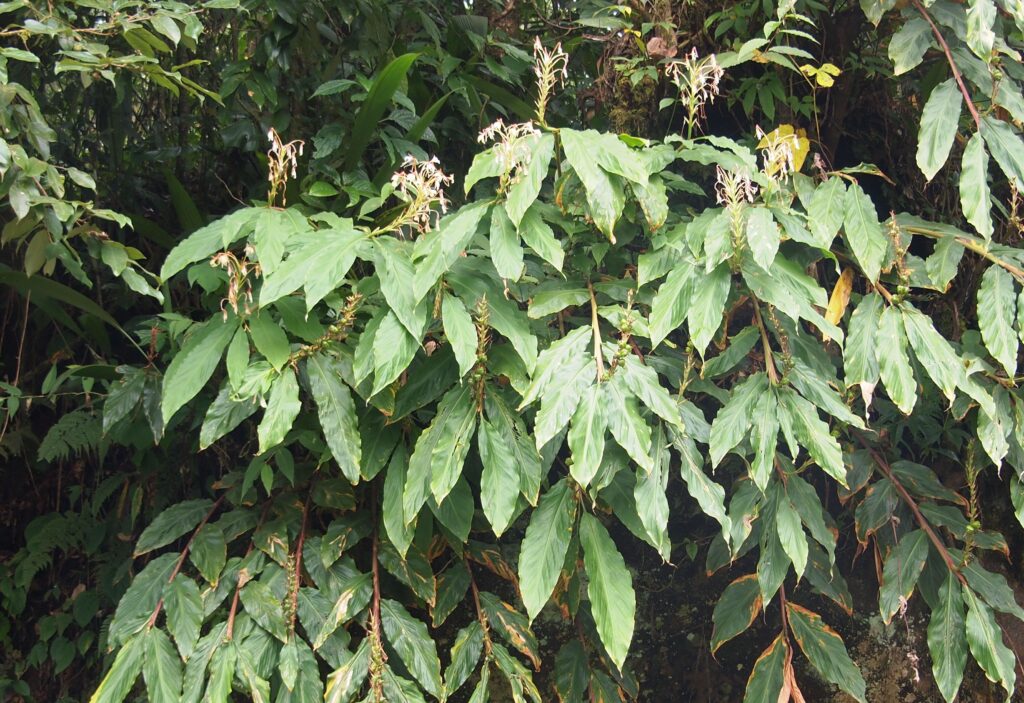
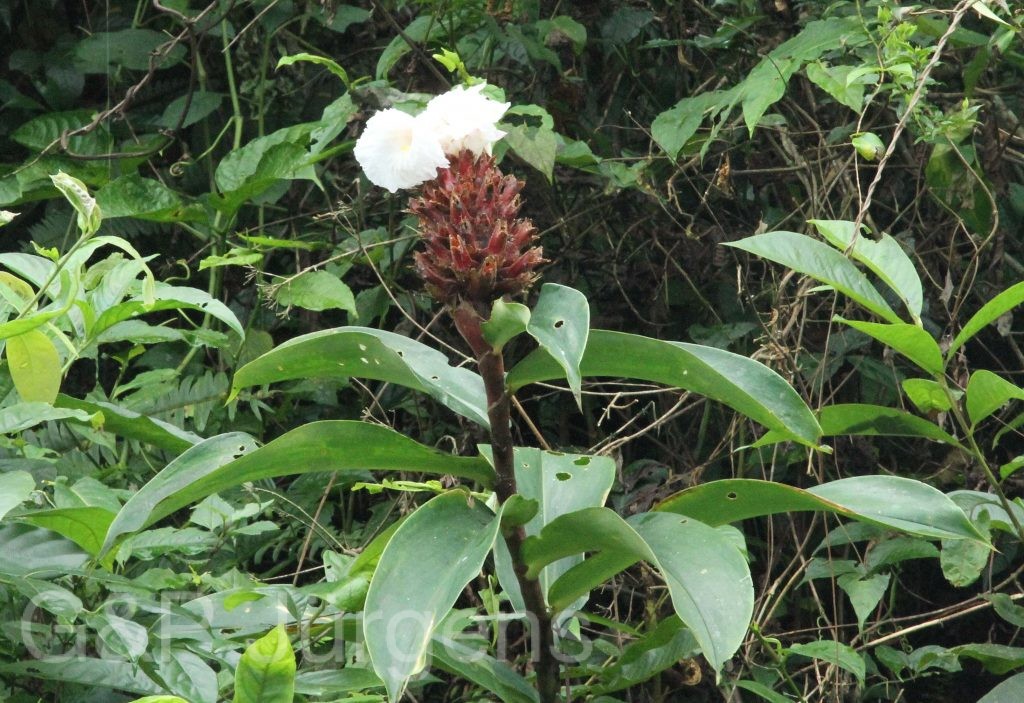
Amomum subulatum, the large or black cardamom, is native to the moist sub-Himalayan tracts of eastern Nepal, north-eastern India, Bhutan and adjacent China, the roughly 108 GBIF records reflecting both wild and extensively cultivated populations; records from the United States, Germany and Korea derive from cultivation and herbarium material. It grows in the shaded understorey of moist broad-leaved forest, along streams, ravines and damp shaded slopes, typically between about 600 and 2000 m, and is widely grown under forest shade as a cash crop. The photographed plant from the Mewa-Khola valley of Nepal at 1160 m in April is characteristic of its warm, humid lower-montane habitat.

It is a tall, tufted, rhizomatous perennial forming dense clumps of leafy pseudostems one to two metres high arising from a stout, creeping rhizome. The leaves are large, lanceolate, glabrous and distichous, with a long-acuminate (subulate) apex giving the species its name, and clasping sheaths. The inflorescence is a dense, head-like spike borne on a short scape at the base of the clump, the flowers with a yellowish, red-streaked labellum subtended by bracts. The fruit is a globose to ovoid, reddish-brown, ribbed and warty capsule containing numerous aromatic, blackish seeds.

Amomum belongs to the ginger family Zingiberaceae (here misspelled in the source) and is a major economic plant of the eastern Himalaya, the dried capsules forming the black cardamom of commerce, valued as a spice and in traditional medicine. Cultivation under natural forest canopy makes it an important agroforestry species. It is not of conservation concern, though wild genetic resources and the shade-forest systems that sustain its cultivation merit protection.

Author: Roxb. · Sources: POWO (Kew), GBIF, Flora of China, Flora of Bhutan, Annotated Checklist of the Flowering Plants of Nepal, Zingiberaceae of the Himalaya (taxonomic monograph)
(Sm.) Baker

Sikkim2003 56 P75
Sikkim above Yoksam 2650m 08.2003

Description

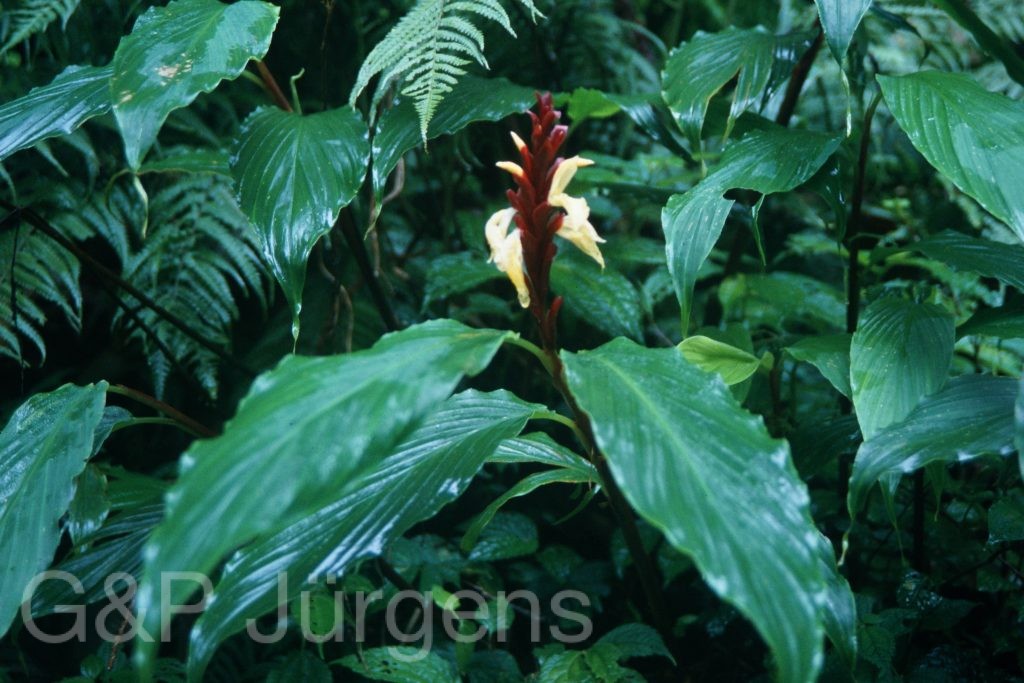
Cautleya spicata is a robust Himalayan ginger distributed through India, Nepal, China and Bhutan, with GBIF recording some 226 occurrences along the southern slopes of the range and into Myanmar. It grows in moist, shaded temperate forest, on humus-rich banks, mossy boulders and stream gullies, occasionally epiphytic but more often terrestrial in deep leaf litter. The photographed plant was found in Sikkim above Yoksam at about 2650 m in August, at the height of the monsoon flowering season; the species characteristically occupies the cool, humid 1800-3000 m belt of the eastern and central Himalaya.

The plant arises from a stout, horizontal rhizome to form leafy shoots reaching about 60-100 cm, taller and more substantial than its slender relative C. gracilis. The distichous leaves are oblong-lanceolate, acuminate and sheathing at the base, green above and often paler beneath. The inflorescence is an erect terminal spike with conspicuous, persistent red or maroon bracts subtending the bright yellow flowers; each flower has a slender corolla tube, a hooded dorsal segment, petaloid lateral staminodes, a deflexed bilobed labellum, and a single fertile stamen. The fruit is a capsule bearing arillate seeds.

Cautleya spicata is closely related to C. gracilis within a small Himalayan genus allied to Roscoea, distinguished by its larger stature, conspicuous coloured bracts and predominantly terrestrial habit. The contrasting red bracts and yellow flowers signal to long-tongued bee pollinators. It is widely cultivated as a hardy ornamental ginger, contributing extralimital GBIF records. Locally frequent and not threatened, it nonetheless depends on intact, humid montane forest for its core populations.

Author: (Sm.) Baker · Sources: POWO (Kew), GBIF, Flora of China, Flora of Bhutan, Zingiberaceae of the Indian Subcontinent (Sabu)

Salisb.

Bhutan2014 285
Bhutan Trithangebe near a farmhouse 800m, May
Nepal1992 189 P276 ergebnis
Nepal Banyang 2100m March 
Nepal1992 190 P277 ergebnis
Nepal Banyang 2100m March 
Nepal 2001 30 ergebnis ergebnis
East-Nepal Korong 1150m, April

Description

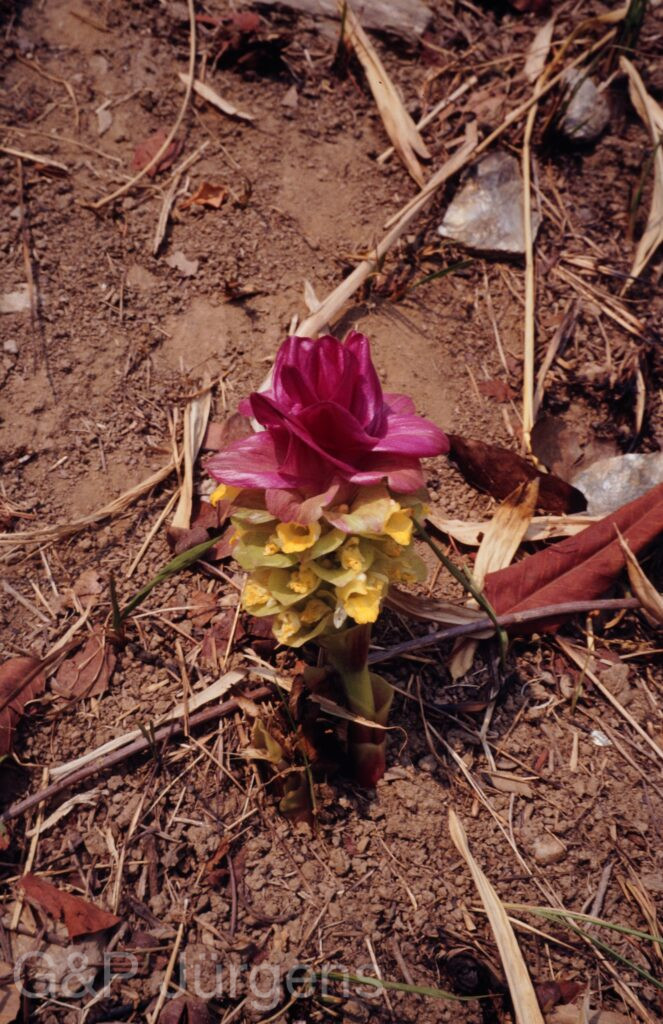
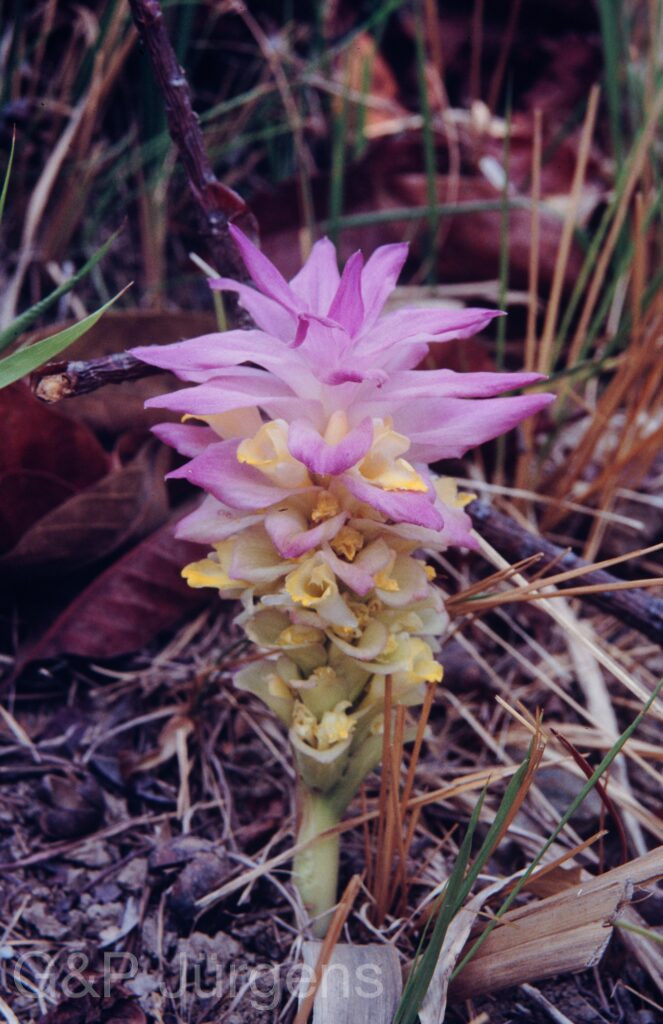
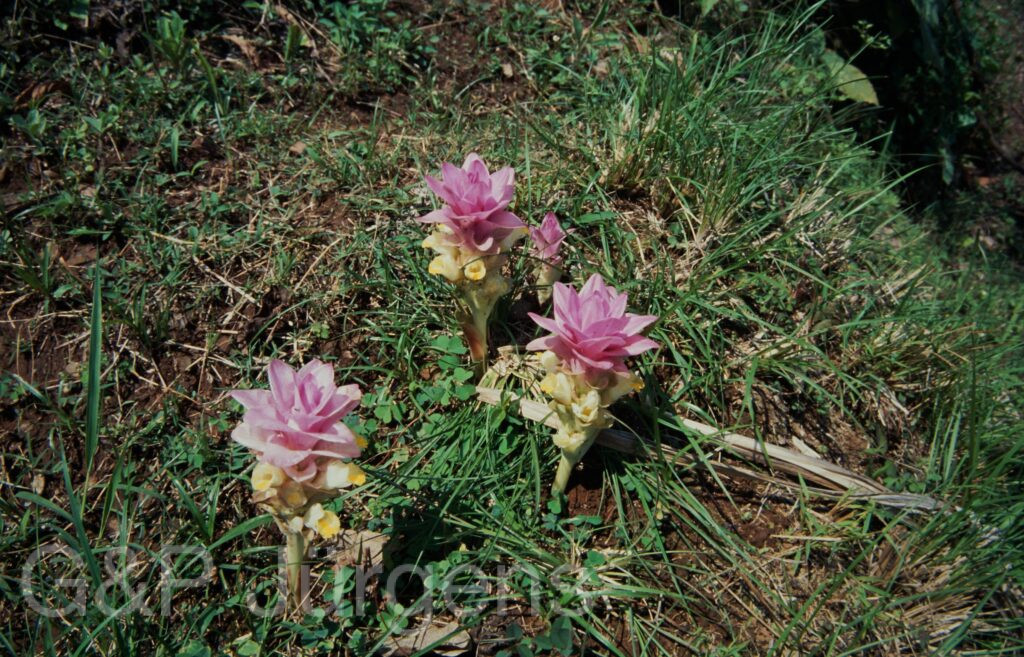
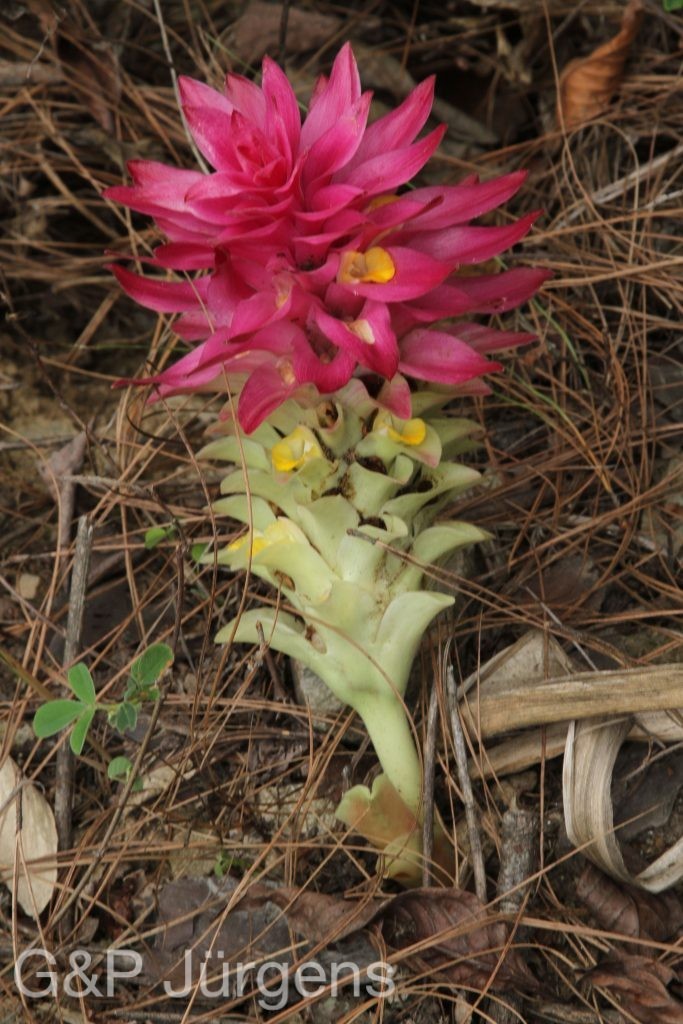
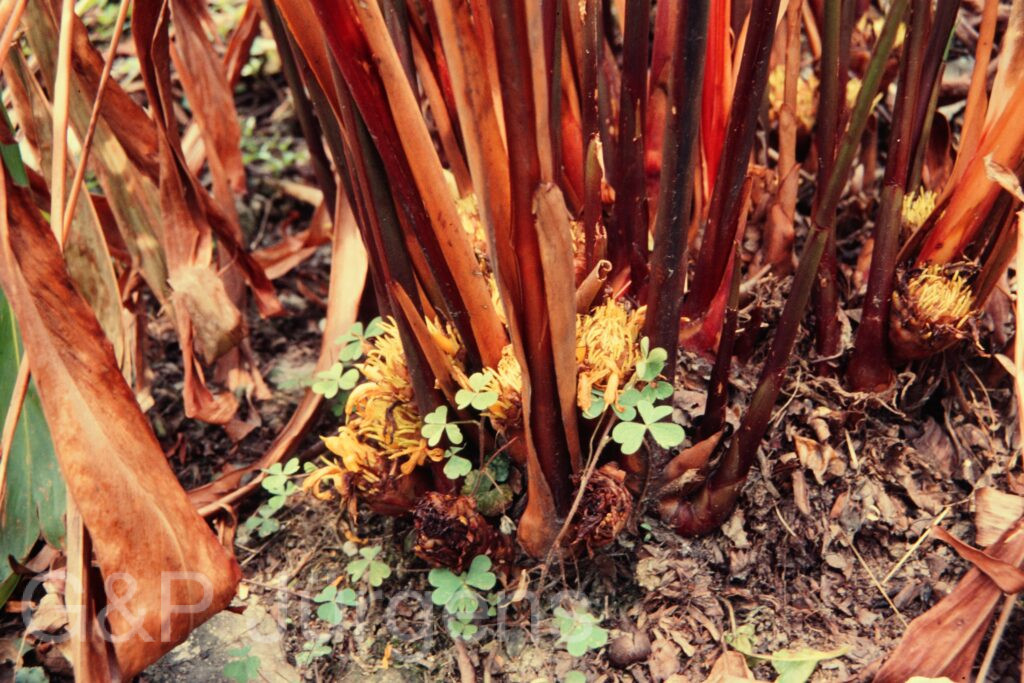
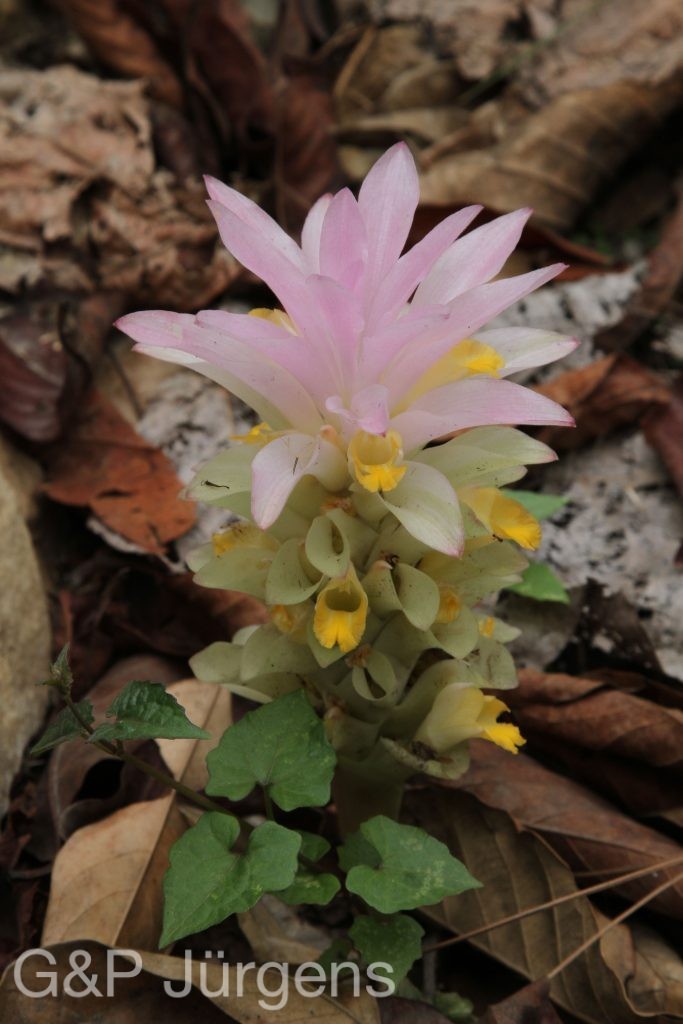
Curcuma aromatica, wild or yellow zedoary, is a South and Southeast Asian rhizomatous herb with a broad distribution documented by 490 GBIF occurrences across China (CN), India (IN), Hong Kong (HK), Bhutan (BT), Sri Lanka (LK), Myanmar (MM), Thailand (TH), Nepal (NP), Vietnam (VN), Bangladesh (BD), Laos (LA), Pakistan (PK), Indonesia (ID), Korea (KR), Malaysia (MY) and Taiwan (TW), with cultivated records in Japan (JP), Colombia (CO) and Britain (GB). It grows in moist deciduous and semi-evergreen forest, scrub and forest margins, often near habitation as a semi-cultivated medicinal plant. The illustrated collections span Bhutan at Trithangebe near a farmhouse at 800 m in May and the Nepalese sites of Banyang at 2100 m in March and Korong in East-Nepal at 1150 m in April.

It is a stout perennial arising from a fleshy, aromatic, internally orange-yellow rhizome bearing sessile and stalked tubers. The pseudostem supports large oblong to oblong-lanceolate leaves, pubescent beneath. The inflorescence appears before or with the leaves as a lateral spike, its lower fertile bracts green and the upper sterile coma bracts tinged pink to rose; the flowers are pale yellow with a tubular calyx, a hooded dorsal corolla lobe and a deflexed, emarginate yellow labellum. Fruit is a capsule, though spread is mainly clonal.

Widely employed in traditional medicine and as a cosmetic and culinary turmeric substitute, C. aromatica is rich in aromatic essential oils and curcuminoids. It is frequently confused with C. zedoaria, from which it differs in floral and rhizome characters. The family is cited verbatim as Zingiberacaea (Zingiberaceae).

Author: Salisb. · Sources: POWO (Kew), GBIF, Flora of China, Flora of Bhutan, Flora of British India, Revision of the genus Curcuma (Skornickova et al.)

(Christm.) Roscoe

Bhutan2014 287

Description

Curcuma zedoaria, white turmeric or zedoary, is a tropical and subtropical species of probable northeast Indian and Southeast Asian origin that is now pantropically cultivated and naturalised. Its 694 GBIF occurrences span an extensive range including India (IN), China (CN), Thailand (TH), the Philippines (PH), Taiwan (TW), Indonesia (ID), Bangladesh (BD), Vietnam (VN), Malaysia (MY), Myanmar (MM), Sri Lanka (LK) and Japan (JP), alongside introductions to the Neotropics in Costa Rica (CR), Brazil (BR), Colombia (CO), French Guiana (GF), Panama (PA) and Ecuador (EC), and the United States (US). It thrives in warm, humid lowland and lower-montane situations, in moist forest understorey, clearings and as a cultivated medicinal and ornamental rhizomatous herb.

It is a robust herbaceous perennial arising from a large, fleshy, aromatic, yellowish-internally rhizome with cylindrical tuberous roots. The pseudostem is formed by the sheathing leaf bases, bearing oblong-lanceolate leaves that often display a characteristic reddish-purple midrib stripe. The inflorescence emerges separately from the rhizome, a spike of imbricate green and pink coma bracts subtending small pale-yellow flowers; each flower has a tubular calyx, a corolla with a hooded dorsal lobe, and a showy three-lobed labellum derived from staminodes. The fruit is a trilocular capsule, though propagation is chiefly vegetative.

Long used in traditional Asian medicine for its bitter, camphoraceous rhizome, zedoary is valued as a digestive and source of essential oils. Its taxonomy within the variable genus Curcuma has been complicated by sterile triploid cultivated clones and by confusion with allies such as C. aromatica and C. caesia. The family is given verbatim as Zingiberacaea (Zingiberaceae).

Author: (Christm.) Roscoe · Sources: POWO (Kew), GBIF, Flora of China, Flora of Bhutan, Flora of Thailand, Revision of the genus Curcuma (Skornickova et al.)

J.Koenig

Bhutan2012 677 ergebnis
Hedychium coronarium

Description

Hedychium coronarium is a robust ginger lily native to the eastern Himalaya and adjoining regions of South and Southeast Asia, including Nepal, Bhutan, northeastern India, and southern China. It has been widely introduced and naturalised throughout the tropics and subtropics, with GBIF recording over 12,600 occurrences from countries spanning South America, Central America, the Caribbean, East Asia, and Oceania. In its native Himalayan range, the species grows along stream margins, in moist ravines, on forest floors, and at the edges of subtropical and warm temperate forests, at elevations from 200 to 2,000 m. It thrives in humid, semi-shaded conditions with consistently moist soils.
The plant is a large, rhizomatous perennial herb, 1–2 m tall, with erect, cane-like pseudostems formed by tightly clasping leaf sheaths. Leaves are distichous, oblong-lanceolate, 30–60 cm long and 5–10 cm wide, acuminate, glabrous above, pubescent beneath, with a prominent midrib. The inflorescence is a dense, terminal, ellipsoid spike, 10–20 cm long, bearing numerous flowers subtended by large, green, imbricate bracts. Flowers are large and highly fragrant, with a white, deeply bilobed labellum 4–6 cm long forming the showy part of the flower. The lateral staminodes are petaloid, white, spatulate. The single fertile stamen bears a linear anther. The fruit is a trigonous capsule, orange when ripe, dehiscing to reveal numerous seeds enveloped in a red aril.
Hedychium coronarium is one of the most widely cultivated ornamental gingers in the world and is the national flower of Cuba, where it was introduced. In many tropical regions outside its native range, it has become invasive, forming dense monodominant stands along waterways that exclude native vegetation; it is listed as invasive in Hawaii, Brazil, and several Pacific islands. In its native Himalayan habitat, however, it is an ecologically integrated component of riparian and forest-edge communities. The genus Hedychium comprises approximately 80 species centred on the Sino-Himalayan region, and H. coronarium remains one of its most recognisable and taxonomically stable members.

Author: J.Koenig · Sources: POWO (Kew), GBIF, Wu & Larsen: Zingiberaceae in Flora of China Vol. 24, Grierson & Long: Flora of Bhutan Vol. 3

Wall.

Sikkim2003 54 P73
Sikkim avove Yoksam 2600m 08.2003

Description

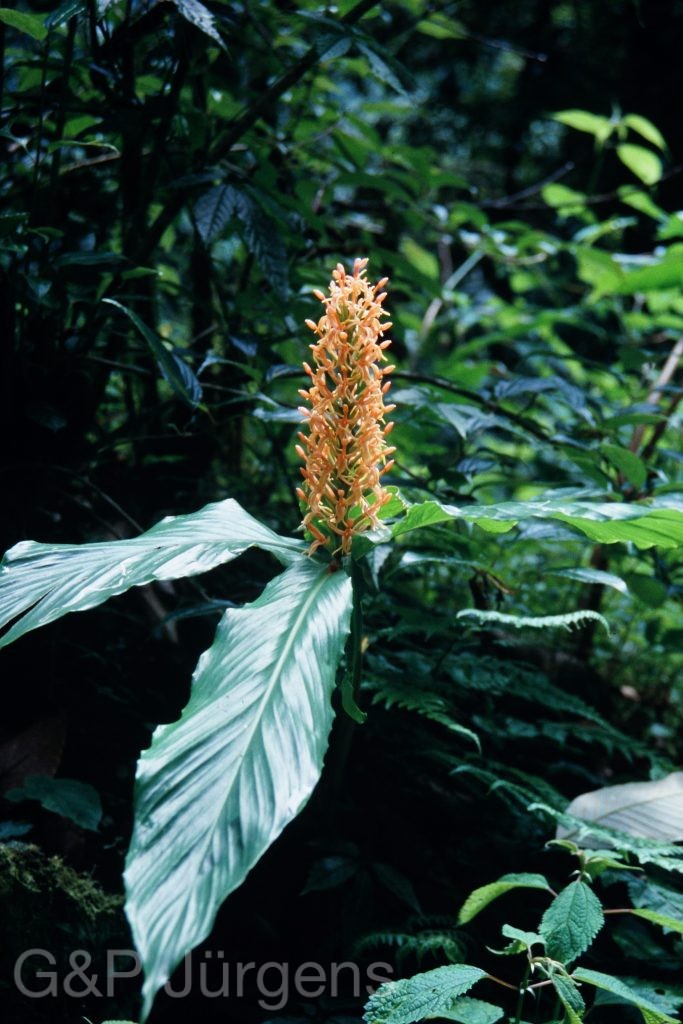
Hedychium densiflorum Wall. is a robust rhizomatous ginger native to the eastern Himalaya, ranging through China (CN), India (IN), Nepal (NP), Bhutan (BT) and Myanmar (MM); GBIF records 255 occurrences, with additional points from cultivation in Britain, North America and elsewhere reflecting its popularity as a hardy ornamental. In the wild it grows in moist temperate forest, shaded banks and clearings, frequently as an epilithic or terrestrial herb among rocks. It was photographed in Sikkim above Yoksam at 2600 m in August, in the cool, monsoon-drenched broadleaf forest belt that typifies its habitat.

The plant grows from a stout, aromatic, creeping rhizome, producing tall leafy pseudostems formed by overlapping leaf-sheaths. The leaves are distichous, oblong-lanceolate, acuminate and shortly petiolate, with a conspicuous membranous ligule. The inflorescence is a dense, narrowly cylindrical terminal spike, much denser than in most congeners, from which the epithet derives; the bracts are imbricate and each subtends one or more flowers. The flowers are slender and orange to soft yellow, with a long corolla tube, narrow petals, a prominent exserted filament bearing the anther, and a bilobed or entire labellum. The fruit is a globose capsule splitting to reveal seeds enclosed in a bright arillus.

Hedychium belongs to tribe Zingibereae and is centred on the Indo-Malayan and Himalayan region, where many species are pollinated by moths and butterflies attracted to the long-tubed, often fragrant flowers. H. densiflorum and its selections such as 'Assam Orange' and 'Stephen' are widely grown for their hardiness. The original family field, spelled "Zingiberacaea", is retained verbatim though the correct orthography is Zingiberaceae. The species faces localised pressure from forest disturbance but remains common across its range.

Author: Wall. · Sources: POWO (Kew), GBIF, Flora of Bhutan, Flora of China, Zingiberaceae monograph (Schumann; T. L. Wu & K. Larsen)

Buch.-Ham. ex Sm.

Bhutan2012 469
Bhutan Wangdi 2500m, September

Description

Hedychium ellipticum is a rhizomatous perennial of the family Zingiberaceae, one of the ornamental ginger lilies native to the eastern Himalaya and adjacent Southeast Asia. GBIF data document its occurrence across Bhutan, Nepal, northeast India, Myanmar, Thailand and southern China, with additional records reflecting cultivated material outside its native range. It grows in moist, shaded broad-leaved and evergreen forest, on humus-rich banks, ravine sides and rocky slopes, typically between about 1,000 and 2,400 m. The plant photographed near Wangdue Phodrang (Wangdi) in Bhutan at around 2,500 m in September represents the upper part of this altitudinal band, where flowering coincides with the late monsoon.

The species develops a stout, horizontally creeping rhizome from which arise erect, leafy pseudostems up to 1–1.5 m tall. The leaves are distichous, sessile or shortly petiolate, with elliptic to oblong-elliptic blades that are glabrous above and may be pubescent beneath, tapering to an acuminate apex, with a conspicuous ligule at the leaf sheath. The inflorescence is a dense terminal spike bearing imbricate green bracts, each subtending one or more flowers. The flowers are showy and fragrant, white with a long, slender corolla tube; the labellum is broad and bilobed and the filament conspicuously exserted, the whole flower built on the characteristic Hedychium plan with a single fertile stamen. The fruit is a globose capsule splitting to reveal seeds enveloped in a bright orange-red aril.

Hedychium is a horticulturally important genus, and several Himalayan species including H. ellipticum and the related H. spicatum are used in traditional medicine and as a source of aromatic rhizomes. The flowers are adapted to pollination by long-tongued insects and hawkmoths, attracted by scent and the slender nectar tube. Within the genus the elliptic leaf form and white, exserted-stamen flowers distinguish this species; care is needed in herbarium identification because it has frequently been confused with allied taxa of the H. spicatum complex.

Author: Buch.-Ham. ex Sm. · Sources: POWO (Kew), GBIF, Flora of Bhutan Vol. 3, Flora of China Vol. 24, Flora of Nepal, Wood: A Revision of Hedychium (Zingiberaceae)

Sheph. ex Ker Gawl.

Bhutan2012 668
Bhutan Tserang 1100m, September
Sikkim2003 45 P60
Sikkim above Yoksam 200m 08.2003

Description

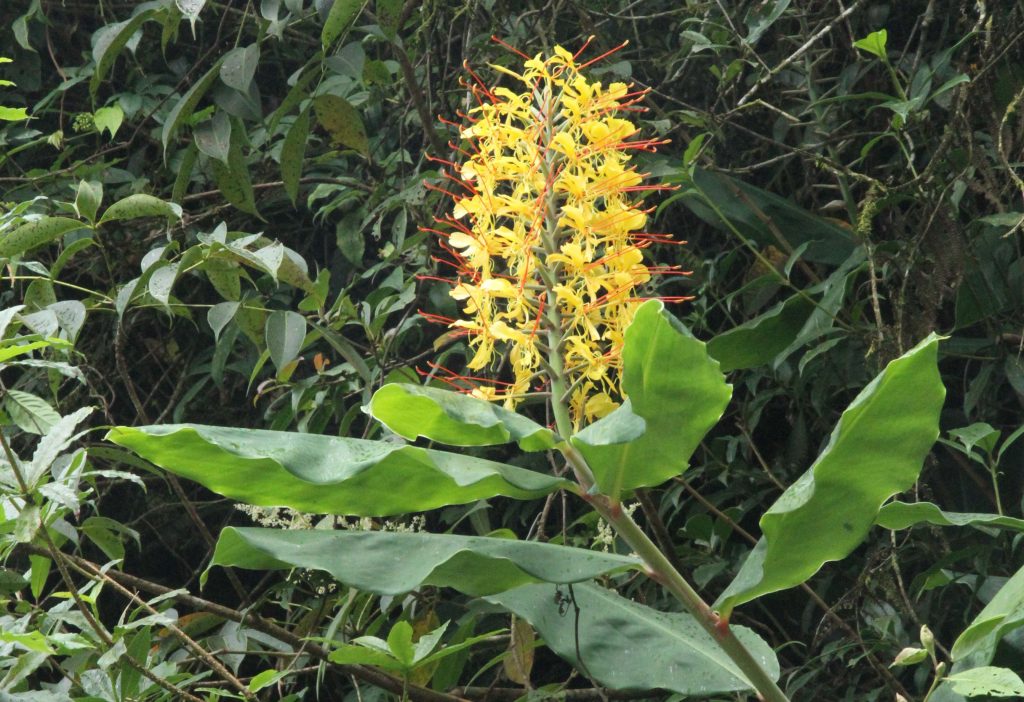
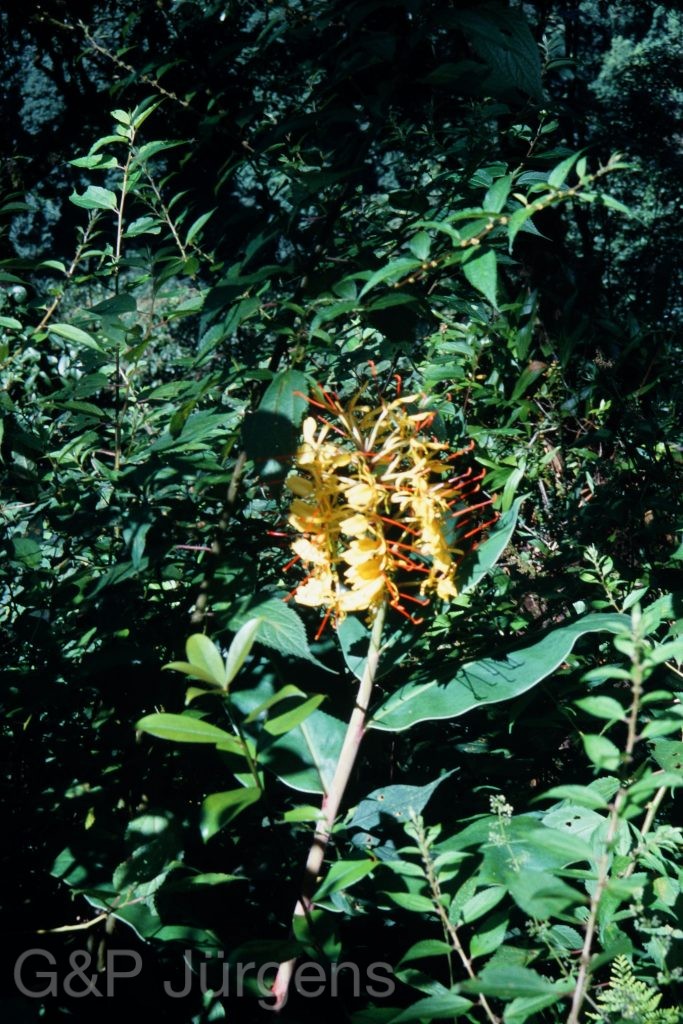
Hedychium gardnerianum, the Kahili ginger, is native to the eastern Himalaya of India, Nepal and Bhutan but has been very widely introduced and naturalised worldwide; GBIF records over 20,000 occurrences, the great majority from naturalised populations in Hawaii, New Zealand, the Azores, South Africa and Australia far outside its native range. In its homeland it grows in moist subtropical and lower temperate forest, on shaded banks, ravines and clearings. The images from Tserang in Bhutan at about 1100 m in September and above Yoksam in Sikkim show it flowering in late summer in its native warm, humid foothill forest belt.

It is a robust, clump-forming perennial herb arising from a stout, fleshy, branching rhizome and reaching two metres or more, with erect, leafy pseudostems formed by overlapping leaf sheaths. The leaves are large, oblong-lanceolate, glabrous above and shortly pubescent beneath, with a sheathing base and prominent midrib. The inflorescence is a dense, showy terminal cylindrical spike of many bracteate flowers; each is fragrant and lemon-yellow with a long-exserted bright red filament bearing the anther, the floral tube slender and the lip and lateral staminodes petaloid. The fruit is a fleshy capsule splitting to reveal numerous seeds enclosed in a bright orange-red aril.

Within Hedychium this species is notable for its conspicuous red stamens and is among the most ornamental gingers. The same vigour, rhizomatous spread and bird-dispersed arillate seeds make it a serious invasive in island and oceanic-climate floras, where it forms dense monocultures that suppress native regeneration, and it is listed among the world's worst invasive plants. Conservation concern thus relates not to its survival but to its impact where introduced.

Author: Sheph. ex Ker Gawl. · Sources: POWO (Kew), GBIF, Flora of Bhutan, Flora of China (Zingiberaceae), Branney Hardy Gingers including Hedychium, Roscoea and Zingiber

(J.Koenig) Govaerts

Bhutan2012 720
Bhutan Galephu 850m, October

Description

Hellenia speciosa is a robust rhizomatous herb of tropical and subtropical Asia, very widely distributed from India and Sri Lanka through Myanmar, Thailand, Malaysia, Indonesia, the Philippines and southern China to New Guinea and Australia, and widely cultivated and naturalised in the Neotropics and Pacific; its more than 6600 georeferenced records reflect this broad range and horticultural spread. It grows in moist forest understorey, forest margins, stream banks and disturbed ground, generally from near sea level to about 1200 m. The plant photographed at Galephu in southern Bhutan at 850 m in October grows in the warm subtropical foothill forest at the Himalaya's lowland fringe.

It is a tall, leafy herb 1-3 m high with a creeping fleshy rhizome and stout, characteristically spirally twisted leafy stems. The leaves are large, oblong-lanceolate, spirally arranged, with conspicuous sheaths. The inflorescence is a dense terminal cone-like spike of bright red, imbricate bracts from which emerge the showy flowers; each has a large, crinkled, funnel-shaped white labellum with a yellowish centre, subtended by a single fertile stamen with a petaloid filament. The fruit is a globose to ovoid red capsule containing numerous black, arillate seeds.

Formerly placed in Costus as Costus speciosus, the species was transferred to Hellenia by Govaerts; the input labels the family "Zingiberacaea" (Zingiberaceae), retained here verbatim, though the spiral-leaved costaceous gingers are now usually treated as a distinct family. The rhizome, rich in diosgenin, is widely used in traditional medicine and as a steroid precursor. The flowers are bee-pollinated and the bright capsules attract birds. Widespread, weedy and frequently cultivated, H. speciosa is of no conservation concern.

Author: (J.Koenig) Govaerts · Sources: POWO (Kew), GBIF, Flora of Bhutan, Flora of China, Flora of British India, Specht's monograph of Costus and allied genera (Costaceae)

L.

Nepal 97 410 P792
Nepal Tashigaon 3000m May
Nepal 2001 173 ergebnis ergebnis
East-Nepal Sabha-Khola 2100m, April

Description

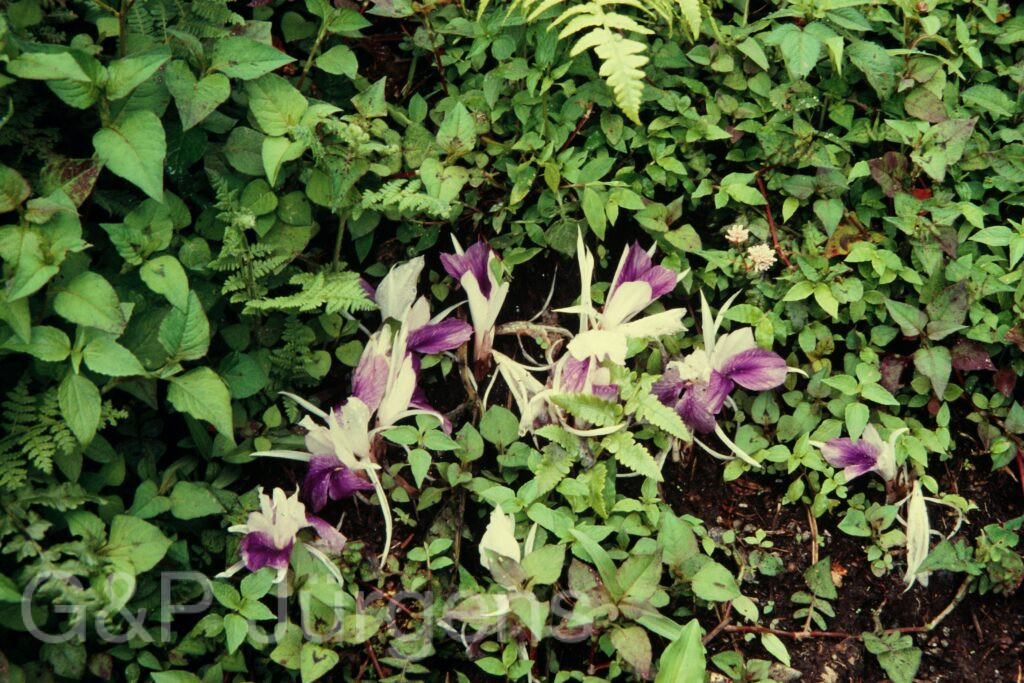
Kaempferia rotunda L. is a tuberous, rhizomatous herb of the ginger family native to tropical and subtropical Asia and very widely cultivated, so that its GBIF record (586 occurrences) spans India, Myanmar, China, Thailand, Bangladesh, Cambodia, Laos, Vietnam, Indonesia and the Philippines alongside many introduced localities in the Neotropics, North America and the Pacific. In the Himalayan foothills it grows in warm, shaded forest, scrub and disturbed ground; it was recorded in eastern Nepal at Sabha-Khola near 2100 m in April and at Tashigaon around 3000 m in May, the latter elevation being unusually high and probably reflecting sheltered, low-frost microsites or local cultivation.

The plant arises from a clustered, aromatic rhizome bearing fleshy tuberous roots. The leaves, two to four per shoot, are oblong-lanceolate, often handsomely variegated with dark and silvery-green zones above and purplish beneath, and appear after or with flowering. The inflorescence is hysteranthous, emerging directly from the rhizome at ground level before the leaves expand: a cluster of short-lived flowers with white, narrowly oblong corolla lobes, two petaloid white staminodes, and a conspicuous, deeply bilobed lilac to violet labellum. The fruit is a three-valved capsule, though propagation is largely vegetative.

Kaempferia rotunda is the type species of its genus and is grown ornamentally as 'peacock ginger' and used in traditional medicine across South and Southeast Asia, its rhizomes valued for fragrant essential oils. Its enormous naturalised range testifies to long human movement of the species. Pollination of the showy ephemeral flowers is by bees and other insects attracted to the labellar nectar guides, while persistence in cultivation buffers it against any wild conservation concern.

Author: L. · Sources: POWO (Kew), GBIF, Flora of China, Flora of Bhutan, Flora of British India, Zingiberaceae monograph (Larsen & Larsen; K. Schumann Zingiberaceae)

  • 1
  • 2