
Buch.-Ham. ex Sm.

Description
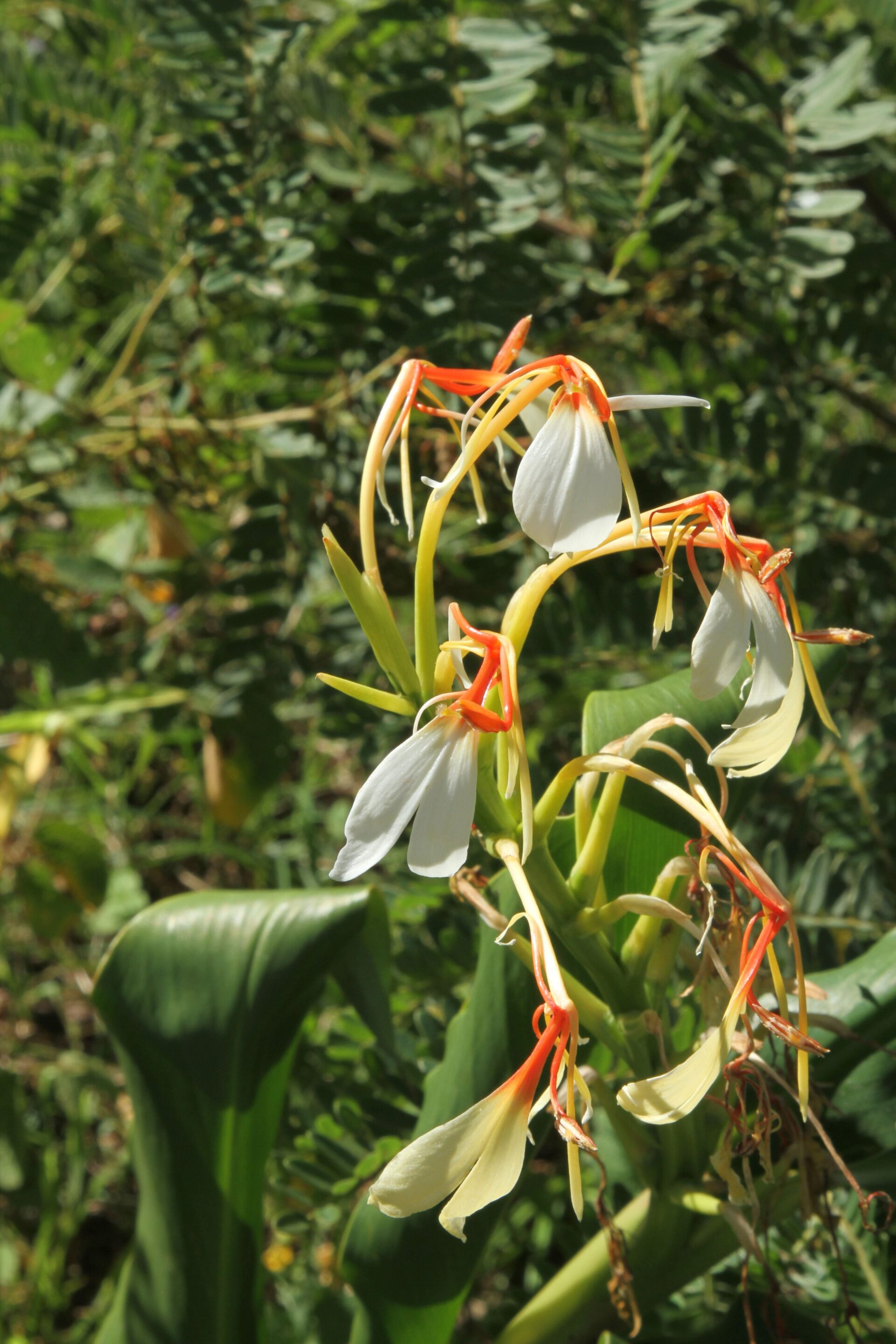
Hedychium ellipticum is a rhizomatous perennial of the family Zingiberaceae, one of the ornamental ginger lilies native to the eastern Himalaya and adjacent Southeast Asia. GBIF data document its occurrence across Bhutan, Nepal, northeast India, Myanmar, Thailand and southern China, with additional records reflecting cultivated material outside its native range. It grows in moist, shaded broad-leaved and evergreen forest, on humus-rich banks, ravine sides and rocky slopes, typically between about 1,000 and 2,400 m. The plant photographed near Wangdue Phodrang (Wangdi) in Bhutan at around 2,500 m in September represents the upper part of this altitudinal band, where flowering coincides with the late monsoon.
The species develops a stout, horizontally creeping rhizome from which arise erect, leafy pseudostems up to 1–1.5 m tall. The leaves are distichous, sessile or shortly petiolate, with elliptic to oblong-elliptic blades that are glabrous above and may be pubescent beneath, tapering to an acuminate apex, with a conspicuous ligule at the leaf sheath. The inflorescence is a dense terminal spike bearing imbricate green bracts, each subtending one or more flowers. The flowers are showy and fragrant, white with a long, slender corolla tube; the labellum is broad and bilobed and the filament conspicuously exserted, the whole flower built on the characteristic Hedychium plan with a single fertile stamen. The fruit is a globose capsule splitting to reveal seeds enveloped in a bright orange-red aril.
Hedychium is a horticulturally important genus, and several Himalayan species including H. ellipticum and the related H. spicatum are used in traditional medicine and as a source of aromatic rhizomes. The flowers are adapted to pollination by long-tongued insects and hawkmoths, attracted by scent and the slender nectar tube. Within the genus the elliptic leaf form and white, exserted-stamen flowers distinguish this species; care is needed in herbarium identification because it has frequently been confused with allied taxa of the H. spicatum complex.
Author: Buch.-Ham. ex Sm. · Sources: POWO (Kew), GBIF, Flora of Bhutan Vol. 3, Flora of China Vol. 24, Flora of Nepal, Wood: A Revision of Hedychium (Zingiberaceae)