
(H.Lév.) Grierson
Description
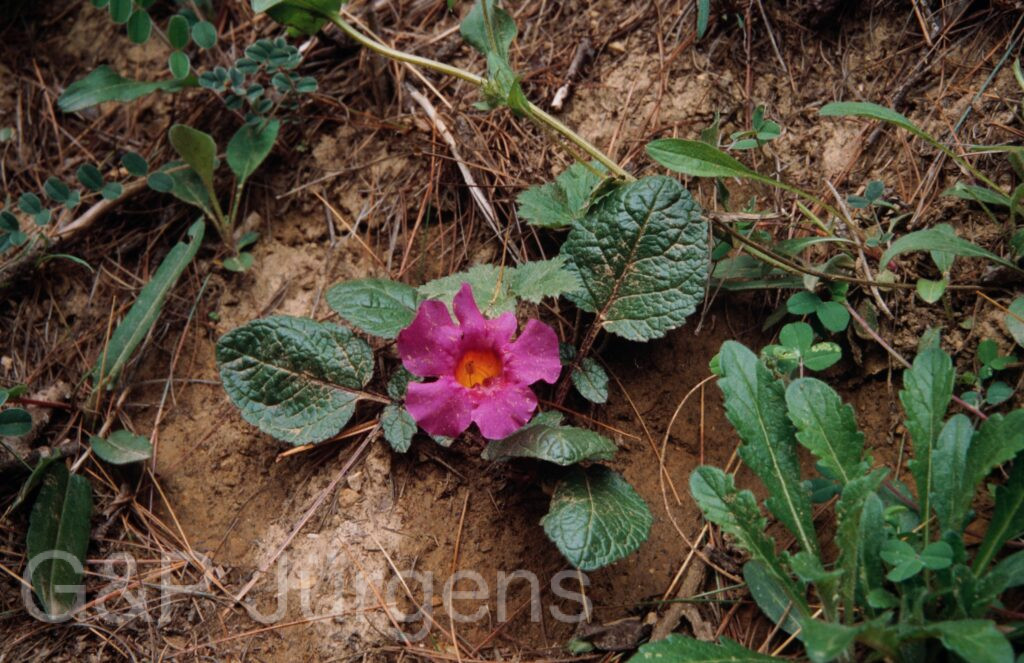
Incarvillea mairei is a stemless, rosette-forming alpine perennial of the Bignoniaceae, distributed across the high mountains of the Sino-Himalayan region. GBIF data (over 450 occurrences) document its native range in China and Nepal, with additional herbarium material in European collections. It is a plant of open alpine and subalpine slopes, stony pastures, grassland and rocky ground, generally between about 2,500 and 4,500 m. The collection from near Phoksundo Lake in West Nepal at 3,650 m in July reflects its preference for sunny, well-drained high-altitude meadows where it flowers during the summer monsoon.
Unlike the woody, climbing members of its family, I. mairei is a low herb with a stout, fleshy taproot and a basal rosette of pinnately divided to lyrate-pinnatifid leaves with crenate leaflets. The flowers are borne on a short, leafless scape and are among the most striking of any alpine herb: large, trumpet-shaped and showy, with a broadly campanulate corolla 5–8 cm long, deep rose-pink to magenta with a paler or yellow-marked throat. The corolla is weakly two-lipped with five spreading lobes, enclosing four didynamous stamens. The fruit is an elongate, woody, more or less terete capsule that splits to release numerous flat, winged seeds.
Incarvillea is a primarily Sino-Himalayan and Central Asian genus that is anomalous within the largely tropical and woody Bignoniaceae for its herbaceous, frost-tolerant alpine species. The genus is of considerable horticultural interest, I. mairei being prized in rock gardens for its outsized blooms. As a showy alpine endemic to the region, it is locally vulnerable to collection and to the degradation of high-altitude pasture, though it remains widespread within its native range.
Author: (H.Lév.) Grierson · Sources: POWO (Kew), Flora of China Vol. 18, Flora of Nepal, GBIF, Grierson: Notes on the Genus Incarvillea (Bignoniaceae)