Acanthaceae

(Forssk.) I.Darbysh.
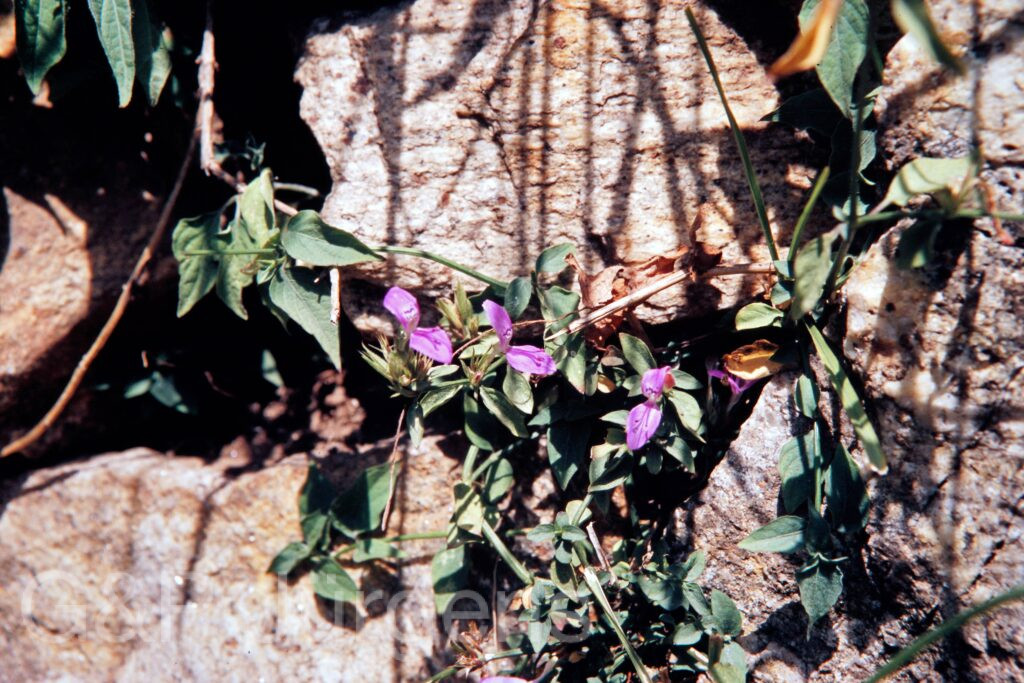
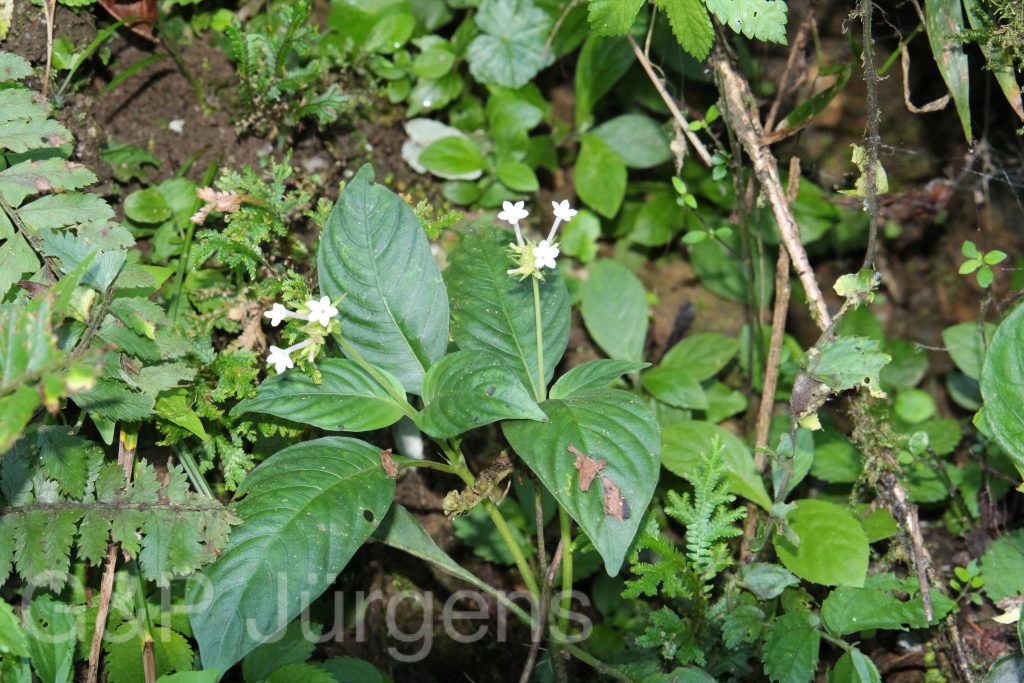
Garh 07 15 ergebnis
India Garhwal Uniana at Mandakini 1300m, June

Description

Dicliptera paniculata (Forssk.) I.Darbysh. is a widespread herb of the Acanthaceae with a remarkably broad palaeotropical distribution spanning Africa and southern Asia. Its more than two thousand georeferenced records extend from West and East Africa and the Arabian Peninsula across Pakistan, India and into China, with strong representation in arid and seasonally dry tropical environments. It is a plant of disturbed ground, scrub, dry hillsides, roadsides and the margins of cultivation, generally at low to moderate elevations. The population shown at Uniana on the Mandakini in Garhwal, photographed at 1,300 m in June, marks the foothill Himalayan extension of its range, where it flowers with the onset of the monsoon.

The plant is an erect to ascending annual or short-lived perennial herb with quadrangular, somewhat swollen-noded stems that are often sparsely pubescent. The leaves are opposite, ovate to lanceolate, entire and shortly petiolate, with the characteristic cystoliths of the family visible as fine streaks. The inflorescence is a lax, paniculately branched arrangement of cymose clusters, each subtended by paired bracts; the flowers have a slender, bilabiate corolla, typically pink to pinkish-purple, with two stamens. The fruit is the explosively dehiscent, clavate capsule typical of the family, ejecting seeds borne on hooked retinacula.

The species was long known under Forsskål's basionym and other generic placements before its current combination, reflecting ongoing reassessment of Dicliptera and allied genera within tribe Justicieae. Its wide ecological amplitude and tolerance of disturbance make it a successful colonist of human-modified landscapes, and it is nowhere considered at risk. As a nectar source it is visited by a range of insects, and within the Himalayan foothills it forms part of the seasonal weedy flora of the monsoon months.

Author: (Forssk.) I.Darbysh. · Sources: POWO (Kew), GBIF, Flora of China Vol. 19, Flora of Pakistan, Darbyshire et al.: Acanthaceae (Flora of Tropical East Africa)
Wight ex Nees

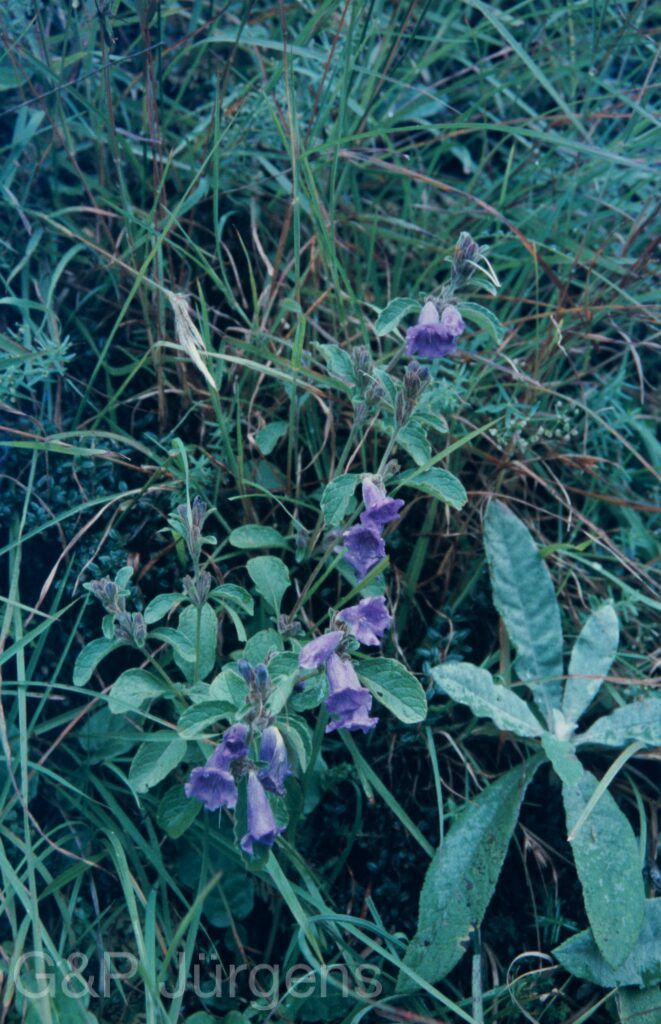
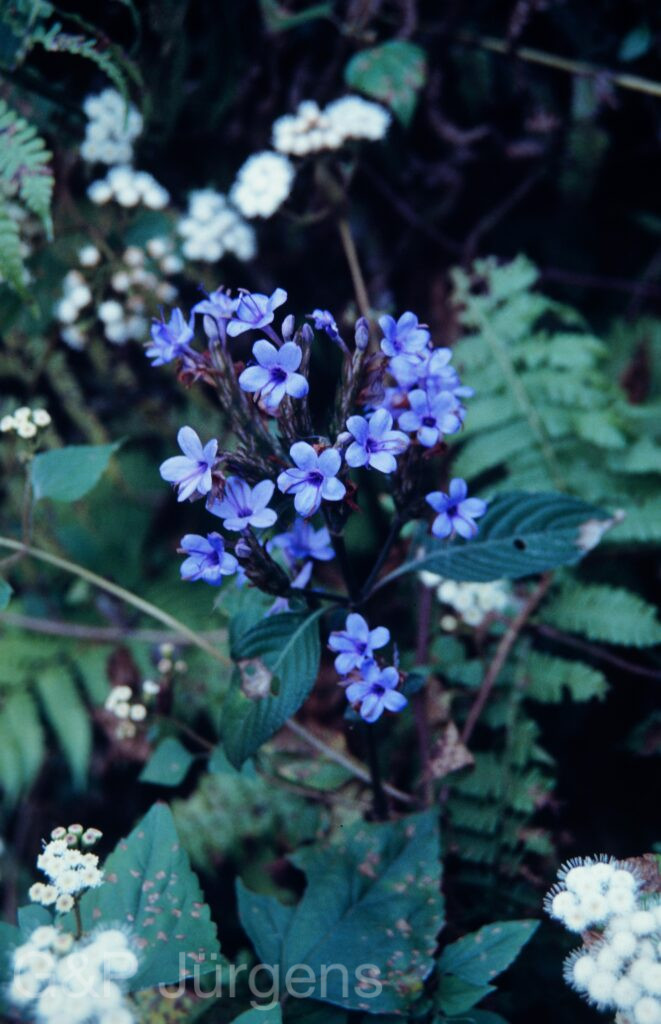
Nepal1992 81 P114 ergebnis
Nepal Sokathum1650m, March 

Description

Eranthemum purpurascens is a subtropical understorey shrub of the Himalayan foothills and adjacent Indian subcontinent, recorded principally from India and Nepal, with cultivated and naturalised occurrences in China, Indonesia, Jamaica, the Dominican Republic and the United States reflecting its ornamental use. It grows in the shaded understorey of moist subtropical and lower temperate forest, along streambanks and shaded ravines, generally between about 600 and 1800 m. The photographed plant from Sokathum, Nepal, at roughly 1650 m and flowering in March, exemplifies its early-spring blooming in warm, sheltered hill forest before the onset of the monsoon.

The plant is an erect, soft-wooded shrub with quadrangular, often swollen-nodal stems. The leaves are opposite, ovate to elliptic, acuminate, entire to obscurely crenate, and frequently bear cystoliths visible as fine streaks on the lamina. The flowers are borne in dense terminal and axillary spikes subtended by conspicuous, often purple-tinged bracts. Each flower has a slender corolla tube expanding into a spreading five-lobed limb of pale blue to violet, with two exserted stamens; the fruit is a clavate, explosively dehiscent capsule bearing seeds on hooked retinacula typical of the Acanthaceae.

The epithet purpurascens refers to the purplish bracts and flushed foliage. Eranthemum is a tropical Asian genus allied to Pseuderanthemum and Daedalacanthus, several members of which, including this species, are cultivated for their winter and spring colour. The conspicuous bracts and tubular blue corollas are adapted to insect pollination, while the cystolith-bearing leaves are a diagnostic family feature. The species is locally common and not regarded as threatened.

Author: Wight ex Nees · Sources: POWO (Kew), GBIF, Flora of China Vol. 19, Flora of Bhutan Vol. 2, Flora of Nepal, Acanthaceae of the Indian Subcontinent

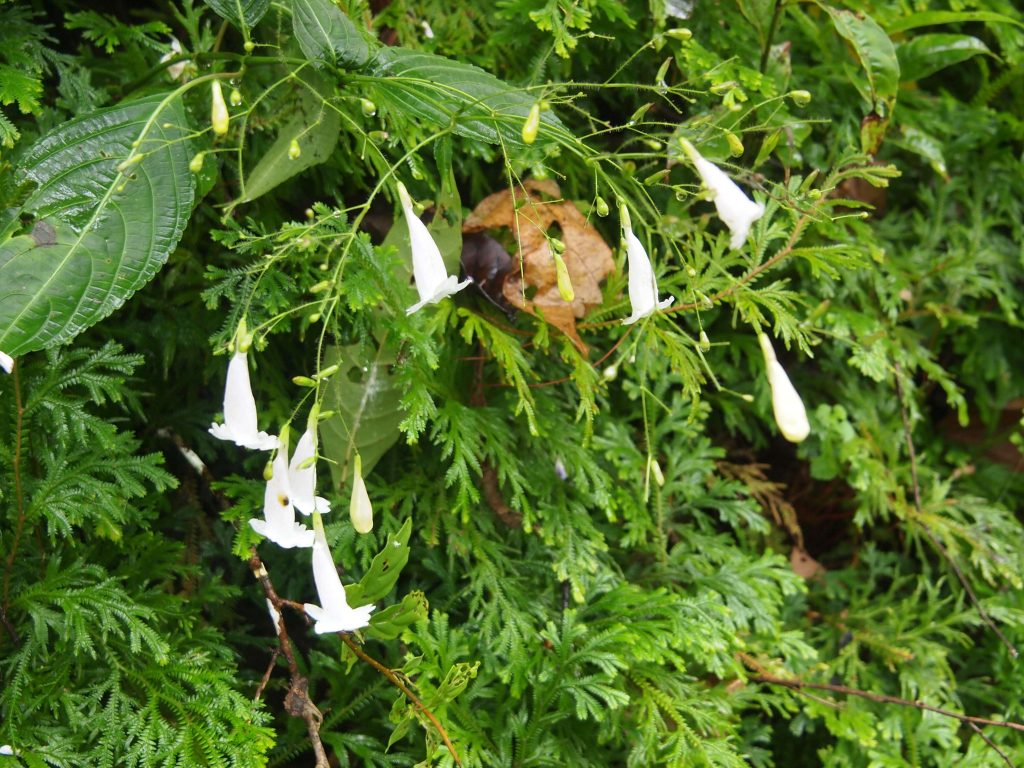
(Forssk.) Sweet

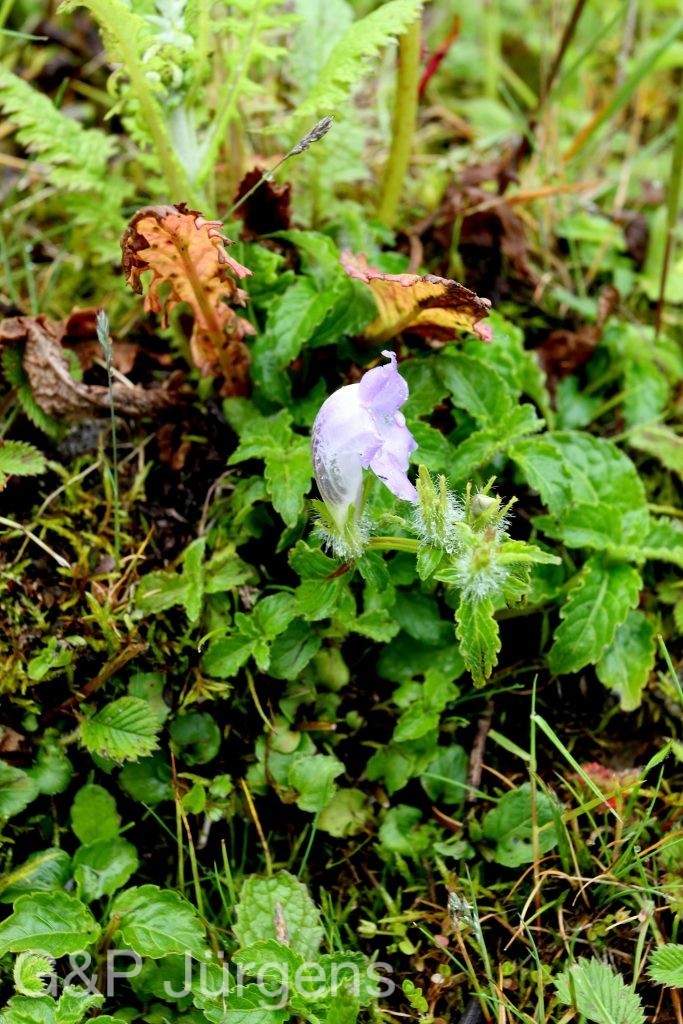
Bhutan2015 104
Bhutan Galephug 600m, October
Bhutan2015 107
Bhutan Galephug 600m, October

Description

Phaulopsis imbricata is a widespread tropical herb whose principal range lies across sub-Saharan Africa and Madagascar, GBIF recording over 2700 occurrences from countries including South Africa, Tanzania, Ethiopia, Kenya, Cameroon, Uganda, Zambia, Zimbabwe, Mozambique and Madagascar. The Himalayan material represented here, photographed in Bhutan at Galephug at 600 m in October, lies at the lowland subtropical margin of its distribution, where it occurs in the warm, humid foothill belt. Throughout its range it grows in shaded, moist forest understorey, along streambanks, forest margins and disturbed ground.

It is a soft, decumbent to ascending perennial or annual herb with quadrangular, often rooting stems. The leaves are opposite and frequently markedly anisophyllous (unequal in each pair), ovate to elliptic, with entire to undulate margins and pinnate venation. The flowers are borne in dense, secund, imbricate, spike-like cymes subtended by conspicuous, overlapping, often whitish or pale bracts, from which the epithet derives. Each flower has a small, white to pale bluish, two-lipped tubular corolla, two or four stamens, and a bilocular ovary. The fruit is the characteristic acanthaceous loculicidal capsule with a retinaculate (jaculator) seed-ejection mechanism.

The species belongs to the Acanthaceae (subfamily Acanthoideae) and is the type and most variable member of the small Old World genus Phaulopsis. Its enormous geographic and ecological amplitude has generated considerable infraspecific variation and a long synonymy. As a tolerant colonist of forest edges and disturbed sites it is not of conservation concern; its disjunct presence in the eastern Himalaya illustrates the Afro-Asian links of moist tropical floras.

Author: (Forssk.) Sweet · Sources: POWO (Kew), GBIF, Flora Zambesiaca, Flora of Tropical East Africa, Flora of Bhutan, monograph of Phaulopsis (Manktelow)

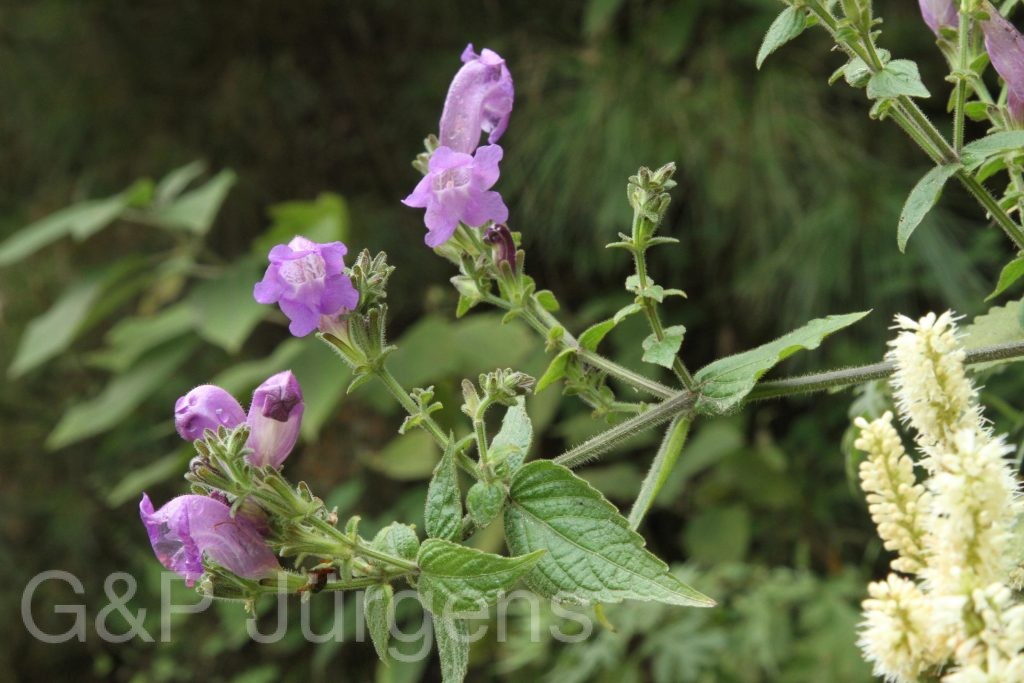
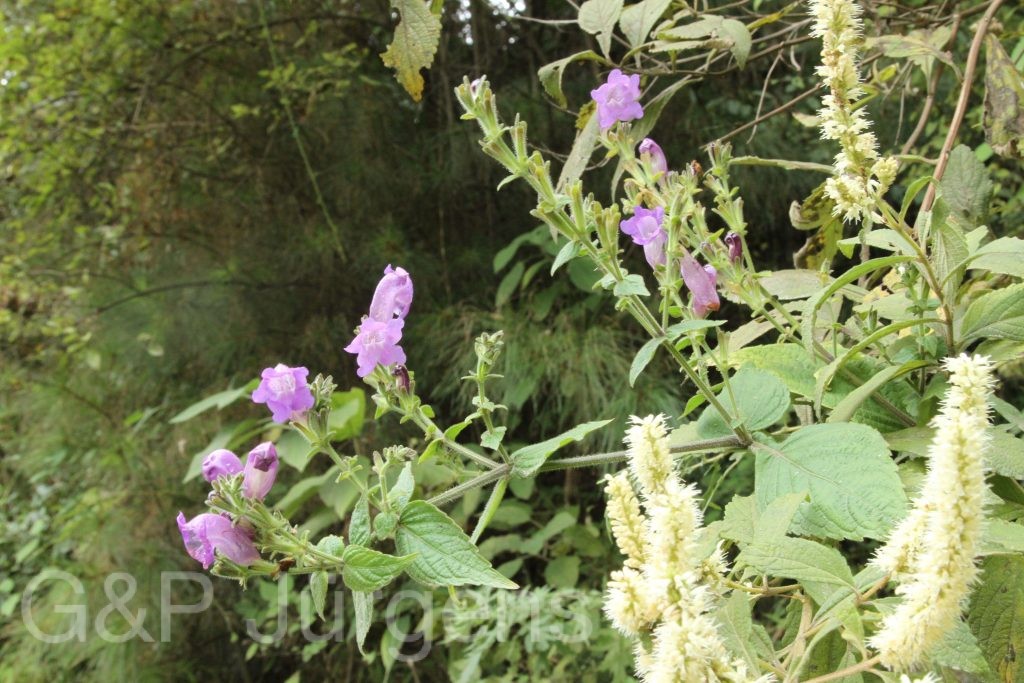
Nees

Garw 2005 247 ergebnis ergebnis
India Garhwal Sitel 1850m, September

Description

Strobilanthes atropurpurea Nees is a robust perennial herb of the Acanthaceae, distributed along the Himalaya from Pakistan and India through Nepal and Bhutan to southwestern China, with further records reaching Myanmar and Vietnam (GBIF: c. 328 occurrences). It is a characteristic understorey and forest-margin plant of moist temperate broad-leaved and mixed forests, favouring shaded, humid ravines and stream banks. The illustrated plant from Sitel in Garhwal, western India, at about 1,850 m and flowering in September, reflects its typical late-monsoon flowering in the mid-montane forest belt.

The plant is an erect, branched herb or subshrub reaching 0.5–1.5 m, with quadrangular stems often swollen at the nodes. The leaves are opposite and decussate, the pairs frequently unequal (anisophyllous), ovate to elliptic, acuminate, with crenate-serrate margins and prominent venation; cystoliths are usually visible as fine streaks on the leaf surface. The inflorescence is a terminal or axillary spike or panicle of cymose clusters subtended by bracts. The flowers have a tubular-funnelform corolla that is deep violet to purple, five-lobed and slightly two-lipped, with four didynamous stamens. The fruit is an explosively dehiscent capsule bearing few seeds on hooked retinacula.

Strobilanthes is a large, taxonomically difficult genus noted for gregarious, often plietesial (mast) flowering, in which many individuals bloom synchronously after several years and then die. Such cohort dynamics complicate field identification and herbarium representation. The species is locally common and not considered threatened, though its forest habitat is subject to regional degradation.

Author: Nees · Sources: POWO (Kew), Flora of China Vol. 19, Flora of Bhutan Vol. 2, Flora of Nepal, GBIF, Wood & Scotland: Strobilanthes monograph

Nees

BhutanPG2011 806 01 01
Bhutan Chele-La, 3800m July

Description

Strobilanthes echinata Nees is a shrubby herb of the acanthus family widely distributed through tropical and subtropical Asia, with GBIF documenting 319 occurrences from India (IN), Bhutan (BT), China (CN), Myanmar (MM), Thailand (TH), Vietnam (VN), Indonesia (ID), Malaysia (MY), Laos, Cambodia and Bangladesh. It is a plant of moist forest understorey, shaded slopes, ravines and clearings ranging from the warm lowlands to high temperate elevations. It was photographed in Bhutan on the Chele-La at 3800 m in July, near the upper limit of its range, where it grows in the cool, humid forest belt. The source URL references Strobilanthes wallichii, indicating a synonymous or closely allied treatment.

The plant is a perennial herb or soft shrub with quadrangular, often anisophyllous-leaved stems. The leaves are opposite and decussate, ovate to elliptic, acuminate and toothed, with cystoliths visible as fine streaks, the paired leaves of a node frequently unequal in size as is characteristic of the genus. The flowers are borne in dense, often spiciform or capitate inflorescences subtended by conspicuous, sometimes spiny-tipped or bristly bracts, the epithet echinata alluding to this prickly aspect. The corolla is tubular and curved, five-lobed and blue to violet or pale lilac. The fruit is an elongate, two-valved, explosively dehiscent capsule bearing a few flattened seeds.

Strobilanthes is a large and taxonomically difficult Asian genus famous for its mass-flowering, plietesial life cycle in which whole populations bloom synchronously after several years and then die. Its centre of diversity lies in the Indo-Burmese and Sino-Himalayan region, making it an important element of Asian forest floras. The bird- and insect-pollinated flowers and explosively dispersed seeds aid colonisation of forest gaps. While many species are narrow endemics of conservation concern, S. echinata is comparatively widespread.

Author: Nees · Sources: POWO (Kew), GBIF, Flora of Bhutan, Flora of China, Strobilanthes monograph (Y. F. Deng & J. R. I. Wood revision)

(Steud.) Bosser & Heine

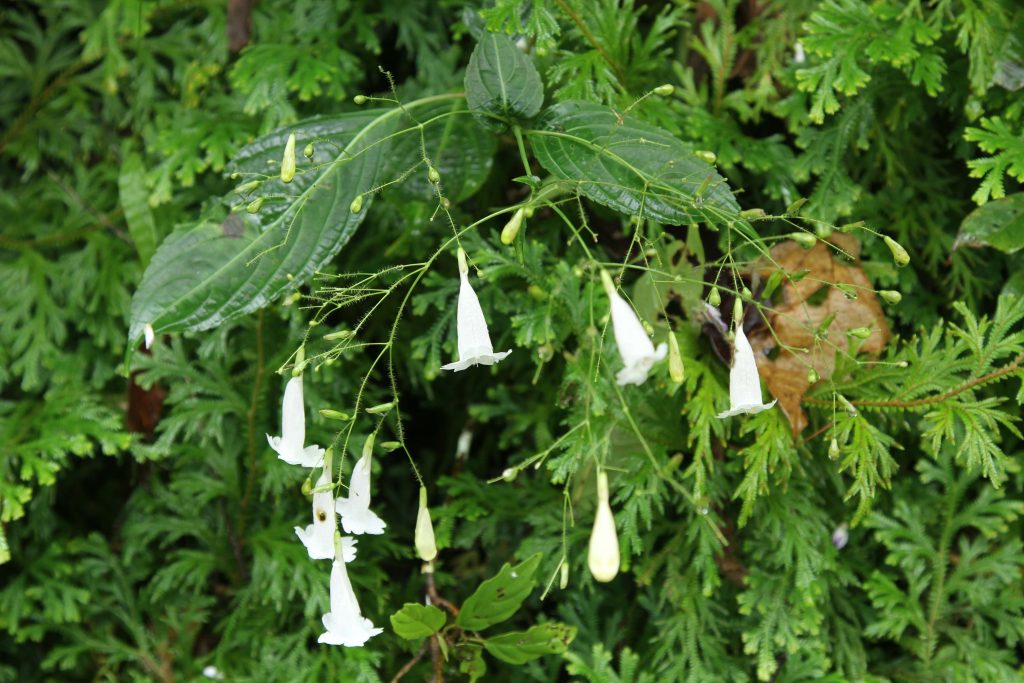
Bhutan2012 992
Bhutan Trithangebe 1100m, October
Bhutan2012 993
Bhutan Trithangebe 1100m, October

Description

Strobilanthes hamiltoniana (Steud.) Bosser & Heine is a shrubby Acanthaceae of the eastern Himalaya and Indo-Burmese region, native to India, Bhutan, Nepal, Myanmar and China, but widely naturalised and cultivated, as reflected in its GBIF total of nearly 779 occurrences spanning many tropical islands and the Americas. In its native range it grows along forest margins, streamsides, ravines and shaded roadbanks in the warm subtropical hill zone, flowering in the late monsoon and autumn. The illustrated plant from Trithangebe in Bhutan at 1100 m in October shows it in its characteristic low-elevation forest-edge habitat at the onset of its flowering season.

The species is an erect, much-branched perennial shrub with four-angled stems and opposite, petiolate, ovate-lanceolate leaves that are acuminate and finely toothed, the pairs typically anisophyllous. The inflorescences are slender, lax, often drooping panicles bearing numerous flowers; each corolla is tubular and gracefully curved, pale violet to mauve-blue with a paler tube, the limb shortly five-lobed, and the androecium of four stamens. The fruit is the typical acanthaceous club-shaped capsule that dehisces explosively to disperse the seeds, which are borne on hooked retinacula.

Strobilanthes is a large and taxonomically difficult Asian genus famed for the gregarious, mast (plietesial) flowering of many species, in which whole populations bloom synchronously after a span of years and then die. S. hamiltoniana is popular in ornamental horticulture for its arching sprays of bloom and consequently appears far beyond its native limits. It is not of conservation concern, being common and readily cultivated.

Author: (Steud.) Bosser & Heine · Sources: POWO (Kew), GBIF, Flora of Bhutan, Flora of China, Acanthaceae of the Indian Subcontinent, Carine & Scotland revision of Strobilanthes

C.B.Clarke

Bhutan2015 654
Bhutan Semkota 2000m, October
Bhutan2015 653
Bhutan Semkota 2000m, October

Description

Strobilanthes lachenensis C.B.Clarke is a shrubby herb of the Acanthaceae endemic to the eastern Himalaya and adjacent ranges, recorded from China, Nepal, India and Bhutan, with about 125 GBIF occurrences. It grows in the understorey and along the margins of temperate broad-leaved and mixed forest, on shaded slopes, banks and forest clearings, mainly between about 1800 and 2800 m. It was documented in Bhutan at Semkota near 2000 m in October, an autumn flowering that accords with the often gregarious, plietesial flowering behaviour characteristic of many Himalayan Strobilanthes, in which populations bloom synchronously after several years of vegetative growth.

It is an erect, branched perennial or subshrub with quadrangular stems that are swollen at the nodes. The leaves are opposite and conspicuously anisophyllous, the pair unequal, elliptic to lanceolate, acuminate, with crenate-serrate margins and cystoliths visible as fine streaks on the surface. The flowers are borne in spike-like or capitate inflorescences subtended by bracts; the bilabiate, funnel-shaped corolla is blue to pale violet, curved and slightly inflated at the throat, enclosing four didynamous stamens. The fruit is an elongate, two-valved capsule that dehisces explosively, ejecting a few flattened seeds borne on hooked retinacula.

Strobilanthes is a large and taxonomically complex genus centred on tropical and subtropical Asia, and the Sino-Himalayan species such as S. lachenensis form part of an intricate, much-revised assemblage. Its mass-flowering, bee-pollinated reproductive strategy and the type locality at Lachen in Sikkim, from which the epithet derives, anchor it in the eastern Himalayan flora. The species is forest-dependent and locally distributed, making it potentially sensitive to habitat disturbance, though it is not formally assessed.

Author: C.B.Clarke · Sources: POWO (Kew), GBIF, Flora of China, Flora of Bhutan, Flora of British India, Strobilanthes monograph (Wood; Carine & Scotland revision of Strobilanthes)

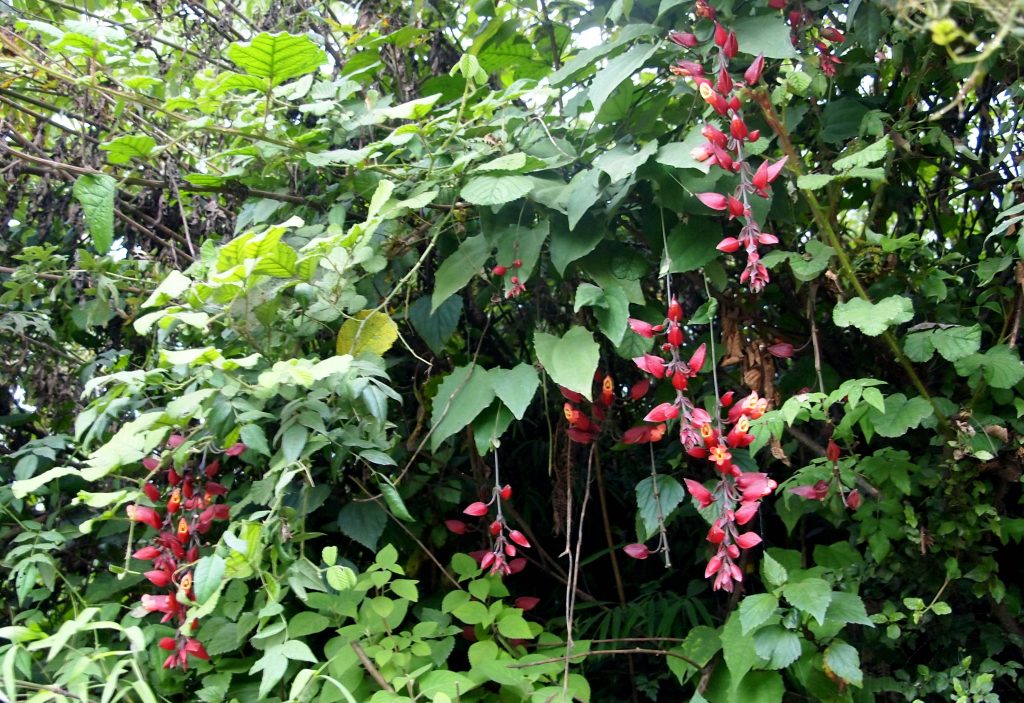
Wall. ex. D.Don.

Bhutan2012 363
Bhutan Wangdi 2500m, September

Description

Thunbergia coccinea Wall. ex D.Don is a vigorous woody climber of the eastern Himalaya and Indo-Burmese region, with GBIF documenting nearly 692 occurrences across India, China, Nepal, Bhutan, Myanmar, Thailand, Laos, Sri Lanka and Bangladesh, alongside numerous cultivated records in tropical and subtropical gardens worldwide. In the wild it scrambles through the canopy of moist broadleaved and subtropical forest, along streamsides and forest margins, flowering in the post-monsoon months. The illustrated plant from Wangdi (Wangdue Phodrang) in western Bhutan at 2500 m in September captures it at the upper edge of its altitudinal range, twining over shrubs and trees in humid hill forest.

The species is a perennial liana with twining stems and opposite, petiolate leaves that are ovate to cordate, acuminate, with toothed to entire margins and palmate basal venation. The flowers hang in long, pendulous, many-flowered racemes; each scarlet to brick-red corolla is tubular and curved with a slightly oblique, shortly five-lobed limb, subtended by paired bracteoles, and contains four didynamous stamens. The fruit is the characteristic acanthaceous capsule, beaked and explosively dehiscent, ejecting a few flattened seeds borne on retinacula.

Thunbergia, sometimes segregated in Thunbergiaceae but generally placed in Acanthaceae, comprises Old World tropical climbers and shrubs, several grown ornamentally; T. coccinea is valued in horticulture for its dramatic drooping red flower chains. Its bird- and insect-visited blooms point to a mixed pollination syndrome. The species is widespread and not of conservation concern, though as a forest liana it depends on the persistence of intact moist montane and submontane woodland.

Author: Wall. ex. D.Don. · Sources: POWO (Kew), GBIF, Flora of Bhutan, Flora of China, Acanthaceae of the Indian Subcontinent, Bremekamp studies on Thunbergia