Convolvulaceae

Roxb.

Bhutan2012 1238
Bhutan Trashigang 1150m, October

Description

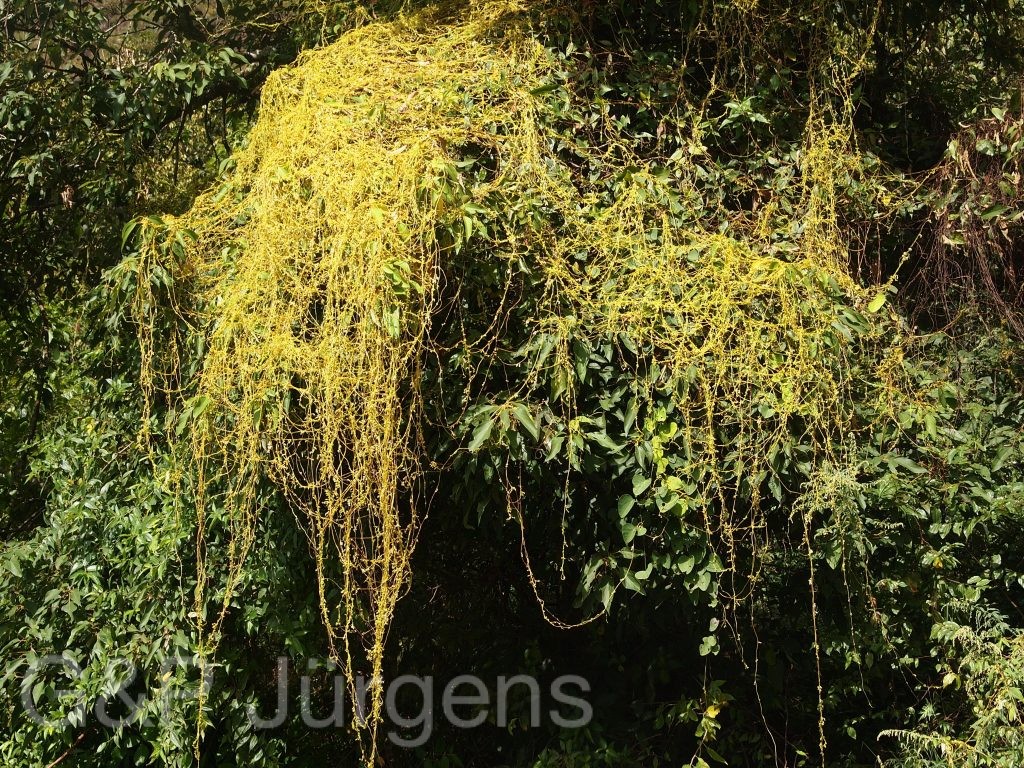
Cuscuta reflexa, the giant or Asian dodder, is a widely distributed parasitic vine ranging across South, Central and Southeast Asia and beyond, with GBIF documenting more than 1000 occurrences from India, Pakistan, Nepal, China, Afghanistan, Sri Lanka, Bangladesh, Bhutan, Thailand and Myanmar among others. It occurs from the plains into the lower hills, the photographed plant deriving from Trashigang in eastern Bhutan at 1150 m in October. As an obligate stem holoparasite it has no true habitat preference of its own but follows that of its hosts, smothering shrubs, hedges and trees along forest margins, scrub, roadsides and cultivated ground in warm subtropical settings.

The plant is a leafless, rootless twining parasite with stout, fleshy, glabrous stems coloured yellow, orange or reddish, attaching to hosts by means of haustoria that penetrate the vascular tissue. Leaves are reduced to minute scales and chlorophyll is largely absent. The flowers are comparatively large for the genus, white to creamy, fragrant, and crowded in dense lateral racemes; the campanulate corolla has reflexed lobes (hence the epithet) and bears characteristic infrastaminal scales within the tube. The fruit is a globose capsule capped by the persistent corolla and opening circumscissily to release several seeds.

Cuscuta (now placed within an enlarged Convolvulaceae rather than a segregate Cuscutaceae) comprises around 200 holoparasitic species. C. reflexa is economically significant as a pest of cultivated and ornamental plants, yet is simultaneously valued in traditional South Asian medicine. Far from threatened, it is locally abundant and weedy; its parasitism exerts measurable effects on host vigour and on plant-community structure where it proliferates.

Author: Roxb. · Sources: POWO (Kew), GBIF, Flora of China, Flora of Bhutan, Flora of Pakistan, Flora of British India (Hooker), Yuncker Monograph of the Genus Cuscuta
(Roxb.) Sweet

Bhutan2012 1212
Bhutan Mo-Chu 1500m, October
Bhutan2015 565
Bhutan Mo-Chu 1500m, October
Bhutan2015 566
Bhutan Mo-Chu 1500m, October

Description

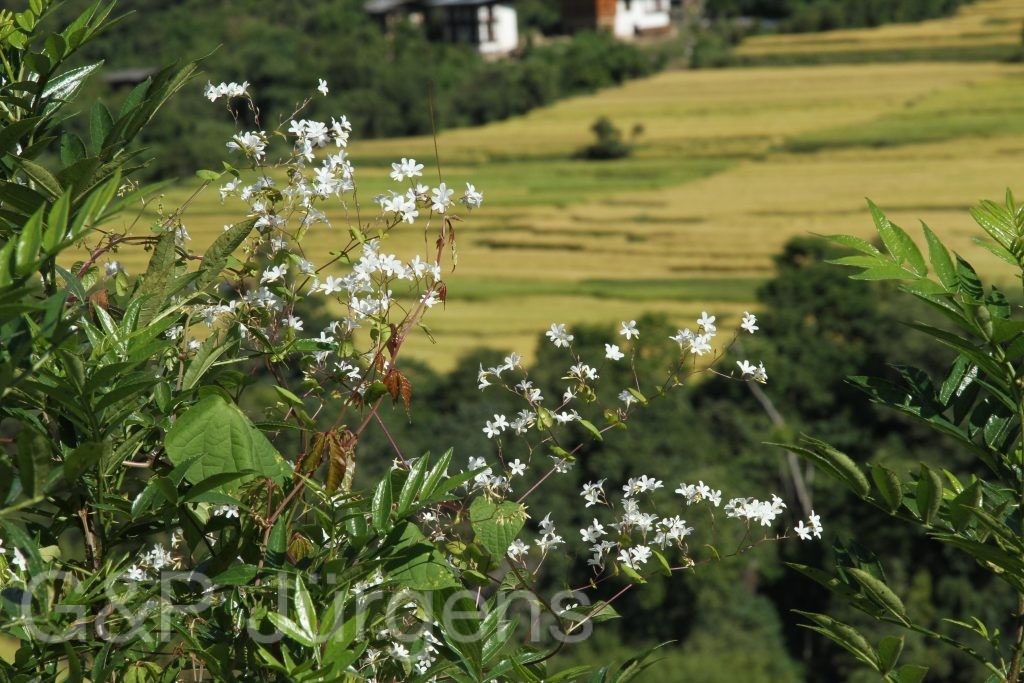
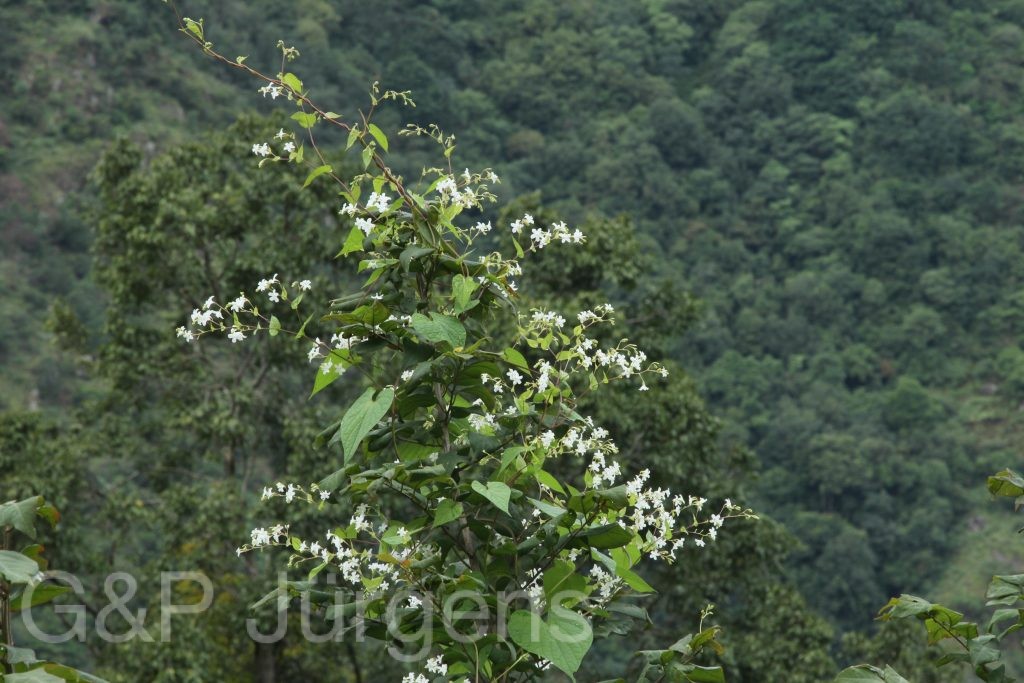
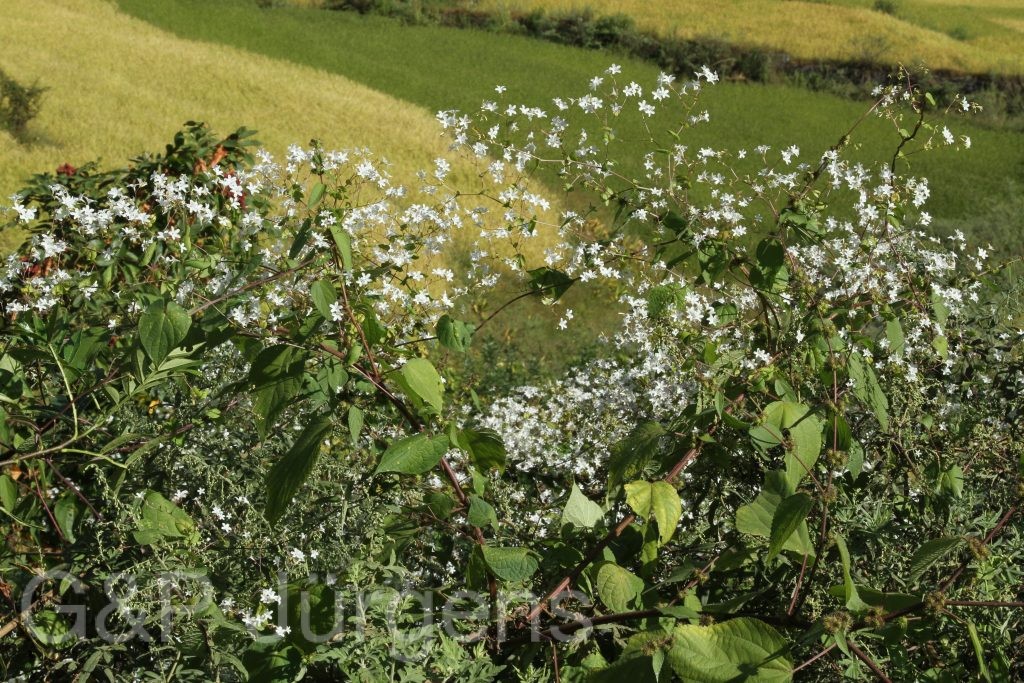
Dinetus racemosus is a twining climber of the morning-glory family widely distributed across the Himalaya, Indo-Burma and South-East Asia. GBIF records, numbering over 900, place it in India, Nepal, Bhutan and China through Myanmar, Thailand, Laos, Vietnam and Malaysia to Indonesia and Timor-Leste, with cultivated or naturalised records elsewhere. It occupies forest margins, thickets, hedgerows, scrubby roadsides and clearings in subtropical to warm-temperate zones, where it scrambles vigorously over shrubs and small trees. The photographed plant from the Mo Chu valley in Bhutan, at about 1500 m and flowering in October, illustrates its autumn-flowering habit in mid-elevation valley vegetation, where its conspicuous white inflorescences appear after the monsoon.

The species is a perennial, herbaceous to slightly woody, left-twining liana with slender, often pubescent stems. The leaves are alternate, long-petiolate, broadly ovate to ovate-cordate with a deeply cordate base and acuminate apex, the lamina entire and softly hairy. The flowers are borne in elongate, many-flowered, axillary and terminal racemes or panicles, a distinctive feature in a family more usually cymose. Each flower is small, with a five-lobed calyx and a white, broadly funnelform to subcampanulate, five-angled corolla. After flowering the calyx lobes enlarge markedly and become membranous, accrescent wings that surround the small, indehiscent, one- to few-seeded fruit, serving as a wind-dispersal organ.

Dinetus belongs to the tribe Poraneae of Convolvulaceae, a group characterised by racemose inflorescences and accrescent, wing-like fruiting sepals, and the species has long been known under the synonyms Porana racemosa and Porana grandiflora; modern treatments recognise the segregate genus Dinetus. The accrescent calyx wings are a clear adaptation to anemochory, dispersing the light fruits on the wind. The plant is common and ecologically resilient across its broad range and is of no conservation concern; it is locally appreciated as an ornamental for its profuse white autumn flowering and is occasionally used in traditional medicine.

Author: (Roxb.) Sweet · Sources: POWO (Kew), GBIF, Flora of China Vol. 16, Flora of Bhutan Vol. 2, Flora of Nepal, Flora of Pakistan, Staples' systematics of Convolvulaceae (Poraneae)

(L.) Roth

Bhutan2015 304
Bhutan between Zhemgang-Trongsa 1700m, October

Description

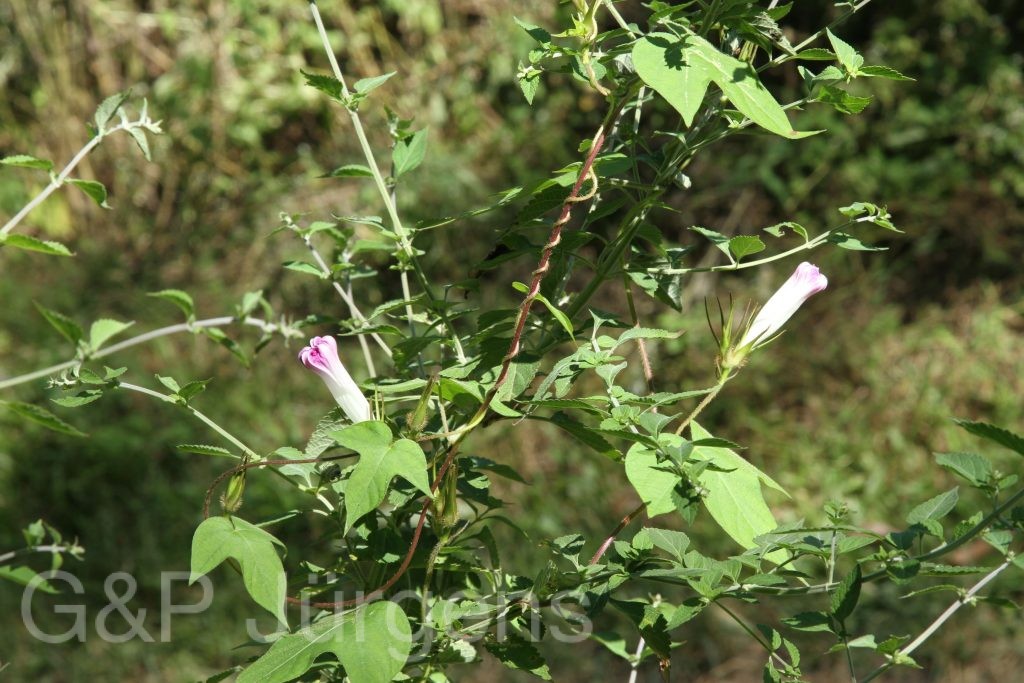
Ipomoea nil is a pantropical annual morning glory of uncertain native origin, most likely originating in tropical America but now cosmopolitan in warm regions worldwide. It occurs throughout South and Southeast Asia, East Asia, Africa, and the Americas, with over 13,000 occurrence records in GBIF spanning more than 70 countries. The species thrives in disturbed habitats, field margins, roadsides, waste ground, and forest edges from lowland areas up to approximately 2,500 m elevation. In Bhutan, it has been documented along the road between Zhemgang and Trongsa at 1,700 m, flowering in October during the late monsoon season.
Ipomoea nil is a twining or scrambling annual herb with stems 1–3 m long, retrorsely hispid with spreading, tawny hairs. Leaves are alternate, broadly ovate to orbicular in outline, 5–15 cm long, typically three-lobed (occasionally entire or five-lobed), with a cordate base and hispid indumentum on both surfaces. The inflorescence consists of one to three flowers on axillary peduncles. The calyx is deeply divided into five lanceolate, densely hispid sepals with long, spreading basal hairs — a key diagnostic character. The corolla is funnelform, 3–5 cm long, typically blue to purple, occasionally red, pink, or white, with a paler tube. Stamens are five, included. The fruit is a globose, trilocular capsule 8–10 mm in diameter, enclosed by the persistent calyx, containing four to six seeds that are dark brown to black and finely pubescent.
Ipomoea nil holds exceptional cultural significance in East Asia, particularly in Japan, where it has been cultivated since the Nara period (eighth century) and subjected to intensive selection that has produced hundreds of ornamental cultivars (asagao) with extraordinary floral diversity in form, colour, and patterning. It has also become a model organism in molecular genetics for the study of transposable elements controlling flower pigmentation. Taxonomically, I. nil belongs to Ipomoea section Pharbitis and is distinguished from the closely related I. purpurea by its densely hispid, long-awned calyx lobes.

Author: (L.) Roth · Sources: POWO (Kew), GBIF, Flora of China Vol. 16, Flora of Bhutan Vol. 2, Austin: Convolvulaceae of the Southeastern United States (1978)

(L.) Roth

Garh 07 250 ergebnis
India Garhwal Barron Chatti 2300m, June
Bhutan2015 563
Bhutan Mo-Chu 1550m, October

Description

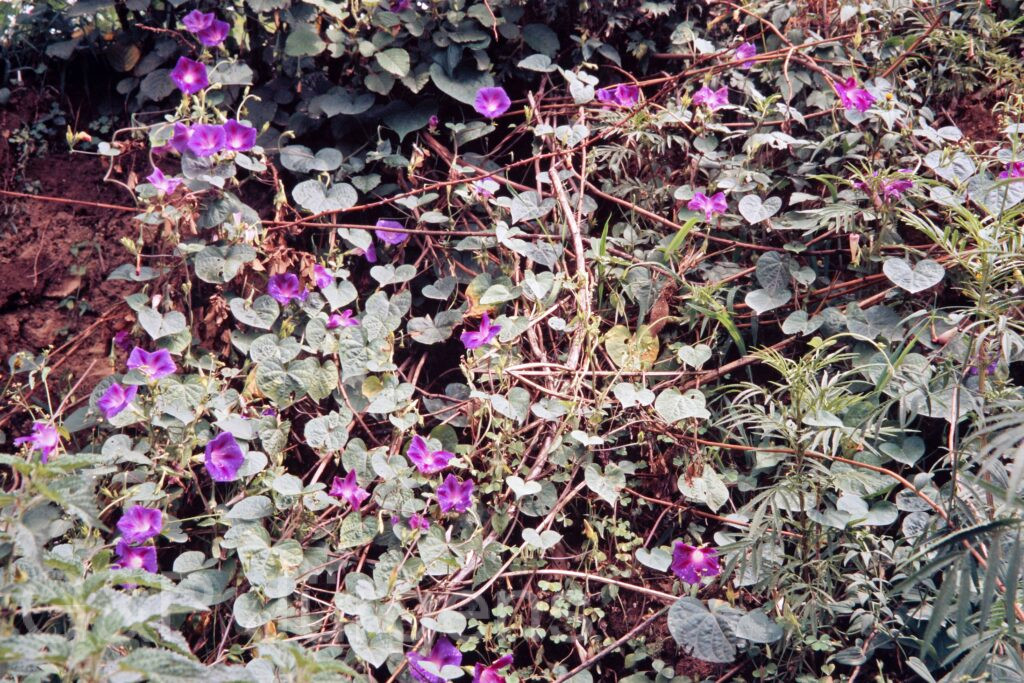
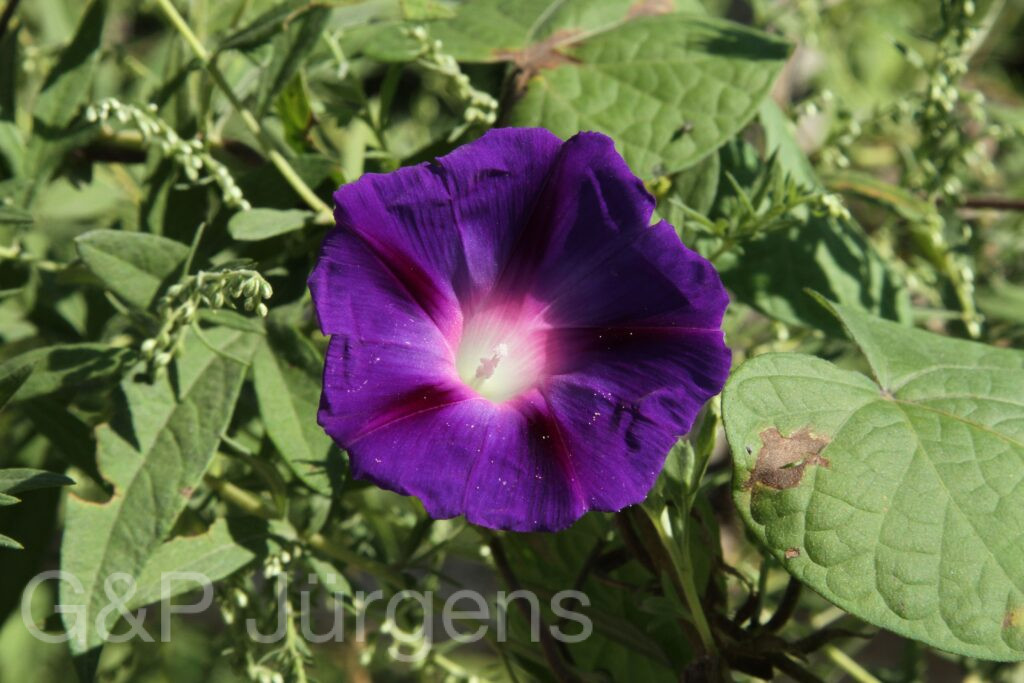
Ipomoea purpurea, the common morning glory, is a neotropical species of Mexican and Central American origin now thoroughly naturalised worldwide; GBIF records exceed 36,000 occurrences spanning the Americas (US, MX, BR, EC, PE, AR, BO, CO), Europe, southern Africa, eastern Asia and Australia. In the Himalaya it persists as an escaped ornamental and weed of disturbed ground, hedgerows, field margins and roadsides. The plants noted at Barron Chatti in Garhwal at 2300 m in June and along the Mo-Chu in Bhutan at 1550 m in October illustrate its tolerance of a broad warm-temperate to subtropical elevation range and its long, monsoon-spanning flowering season.

It is an annual twining herb with slender, retrorsely hairy stems climbing by means of left-handed coiling. The leaves are alternate, long-petiolate, broadly ovate-cordate and usually entire, acuminate at the apex with a deep basal sinus. Flowers arise in axillary cymes of one to several; each has a hairy, lanceolate-lobed calyx and a showy funnelform corolla 4 to 6 cm across, varying from purple and violet-blue to pink, magenta and white, with a paler throat and five faint interplical bands. The five stamens are unequal and included; the superior ovary ripens into a globose, three-locular capsule releasing several glabrous, dark trigonous seeds.

The species is taxonomically straightforward within Ipomoea but horticulturally polymorphic, with numerous colour cultivars. Its self-compatible, bee-pollinated flowers and prolific hard-coated seed make it a successful colonist and, in warm regions, an agricultural weed. It is of no conservation concern; rather, its capacity to naturalise warrants monitoring in ruderal habitats.

Author: (L.) Roth · Sources: POWO (Kew), GBIF, Flora of China Vol. 16, Flora of Bhutan Vol. 2, Flora of Pakistan, A Monograph of the Convolvulaceae (Ipomoea)

L.

Nepal 1994 231 ergebnis
Ost-Nepal Mewa-Khola 1800m April 

Description

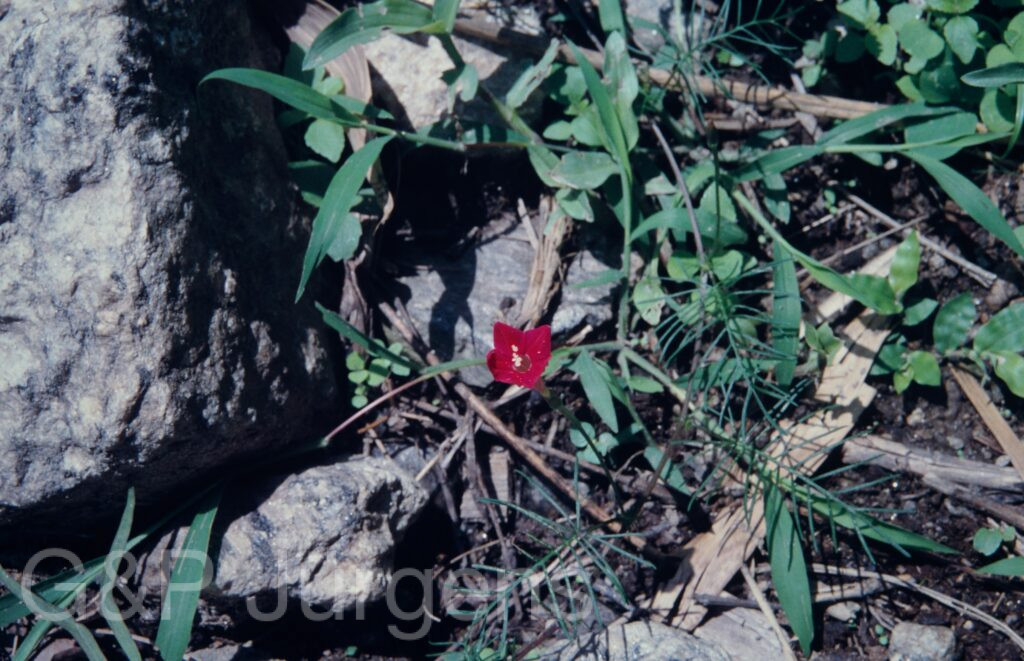
Ipomoea quamoclit, the cypress vine, is a twining annual of Neotropical origin now pantropically naturalised, with over 11,650 GBIF occurrences spanning the Americas (USA, Mexico, Brazil, Colombia, Ecuador, Peru, Venezuela), Asia (India, China, Taiwan, Korea, Japan, Indonesia, Thailand, Nepal), Australia and Africa. In its adventive Asian range it occupies disturbed ground, hedgerows, field margins, riverbanks and village thickets, frequently escaping from cultivation as an ornamental. The collection from the Mewa Khola in eastern Nepal at about 1,800 m in April reflects its establishment in warm low- to mid-montane situations.

It is a slender, glabrous, herbaceous climber to several metres. Its most distinctive feature is the foliage: the leaves are alternate, ovate in outline but pinnately divided almost to the midrib into numerous fine, filiform, parallel segments, giving a delicate feathery appearance. The flowers are solitary or few in axillary cymes, with a long, slender corolla tube expanding into a flat, five-angled, salverform limb about 1.5–2 cm across, brilliant scarlet (rarely white), with exserted stamens and style. The fruit is a small ovoid capsule containing few blackish, ovoid seeds.

The species, sometimes segregated as Quamoclit pinnata, is firmly placed within an enlarged Ipomoea, and GBIF treats the name as accepted. Its salverform red corolla and long tube reflect specialisation for pollination by hummingbirds in its native America and by butterflies and sunbirds elsewhere. Widely grown and self-seeding, it is locally weedy but of no conservation concern.

Author: L. · Sources: POWO (Kew), Flora of China Vol. 16, Flora of Nepal, GBIF, Austin & Huáman: A Synopsis of Ipomoea in the Americas (1996)