Oleaceae

(L.) Banfi

Bhutan2014 1028
Bhutan Paro 2400m, May
Nepal 97 73 P115
Nepal above Meta-Khola 1600m April

Description

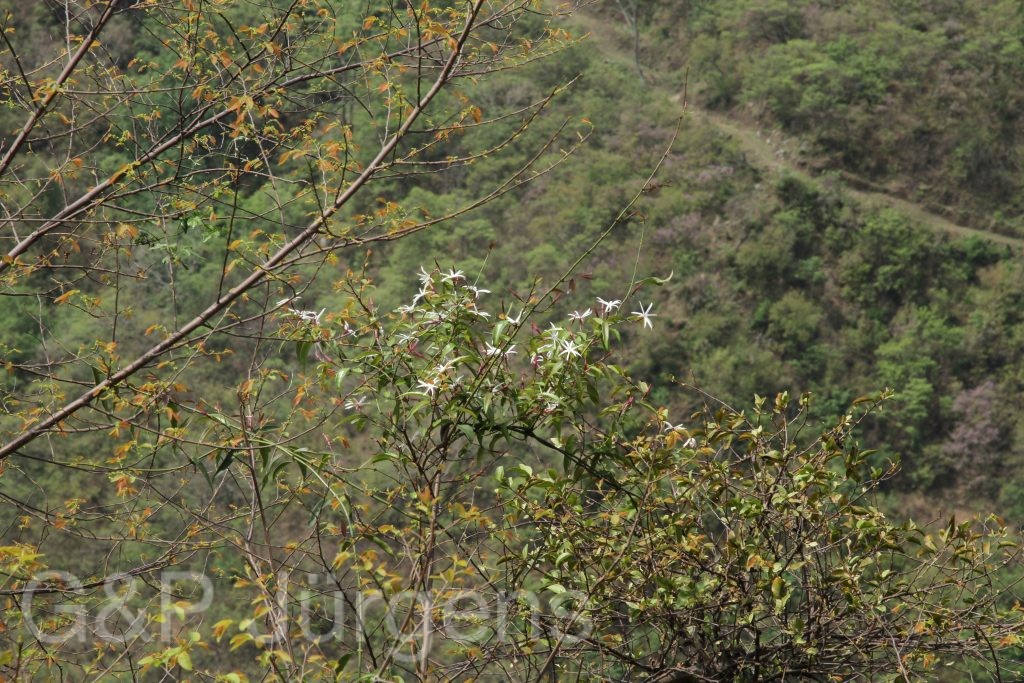
Chrysojasminum humile, the yellow Italian jasmine, is a shrub native from the Mediterranean and Southwest Asia eastward through the Himalaya into China, with GBIF recording about 1850 occurrences and many cultivated or naturalised collections worldwide. In its Asian range it grows on open hillsides, forest edges, dry rocky slopes and scrub on calcareous or well-drained soils. The illustrated material comes from Bhutan at Paro near 2400 m, flowering in May, and from Nepal above Meta-Khola at about 1600 m in April; across the Himalaya the species typically occupies the warm-temperate zone between roughly 1200 and 2800 m.

The plant is an erect or somewhat sprawling, evergreen to semi-evergreen shrub with green, angled, glabrous twigs. The leaves are alternate and pinnately compound with three to seven (sometimes more) leaflets, the terminal leaflet largest, elliptic to ovate, glabrous and shining. The flowers are borne in terminal cymes and are bright yellow, fragrant, with a slender corolla tube expanding into five spreading lobes; the calyx is small with short teeth. The fruit is a shining black, ellipsoid to globose berry, two-lobed when both carpels develop.

Long treated within Jasminum, this species and its allies were segregated into Chrysojasminum on molecular and morphological grounds, the yellow-flowered jasmines forming a distinct lineage within Oleaceae. Highly variable, it encompasses numerous named forms and is much grown as an ornamental, accounting for its scattered records far outside the native range. Widespread and adaptable, it is of no conservation concern, and its nectar-rich flowers attract bees and butterflies.

Author: (L.) Banfi · Sources: POWO (Kew), GBIF, Flora of China, Flora of Bhutan, Oleaceae revision (Green)
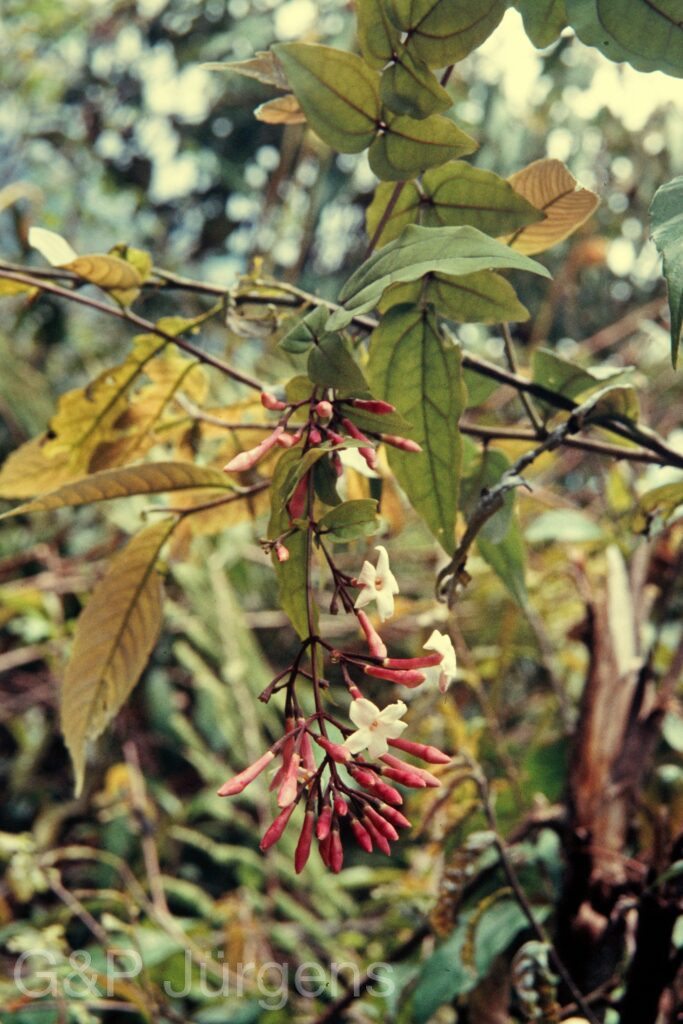
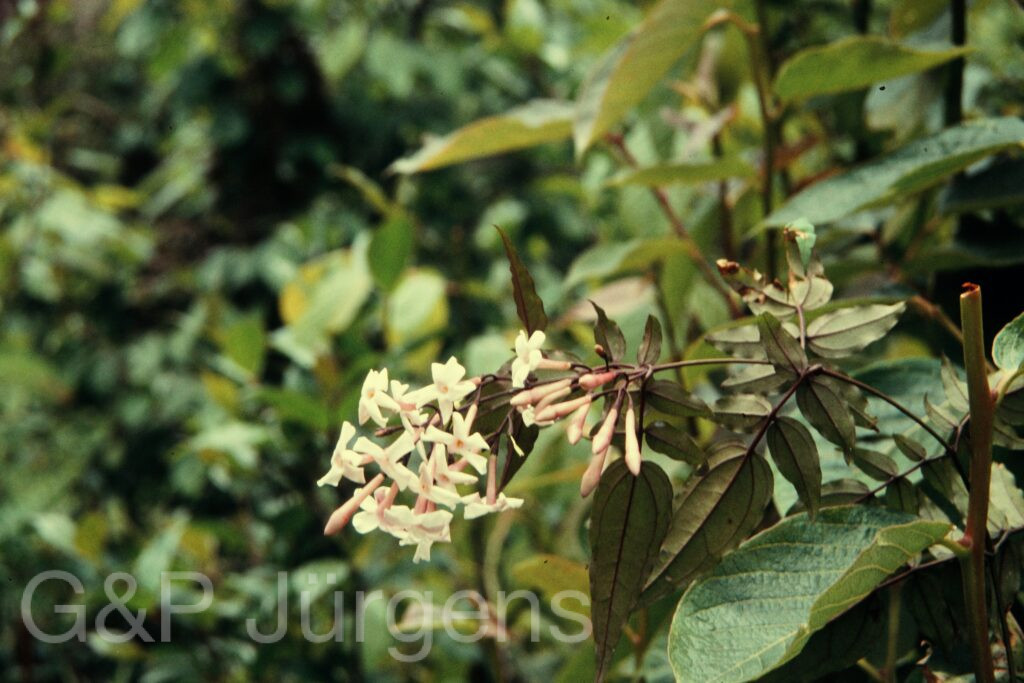
Wall.

Nepal 97 92 P153
Nepal above Meta-Khola 2250m April
Nepal 97 312 P616
Nepal above Meta-Khola 2250m April

Description

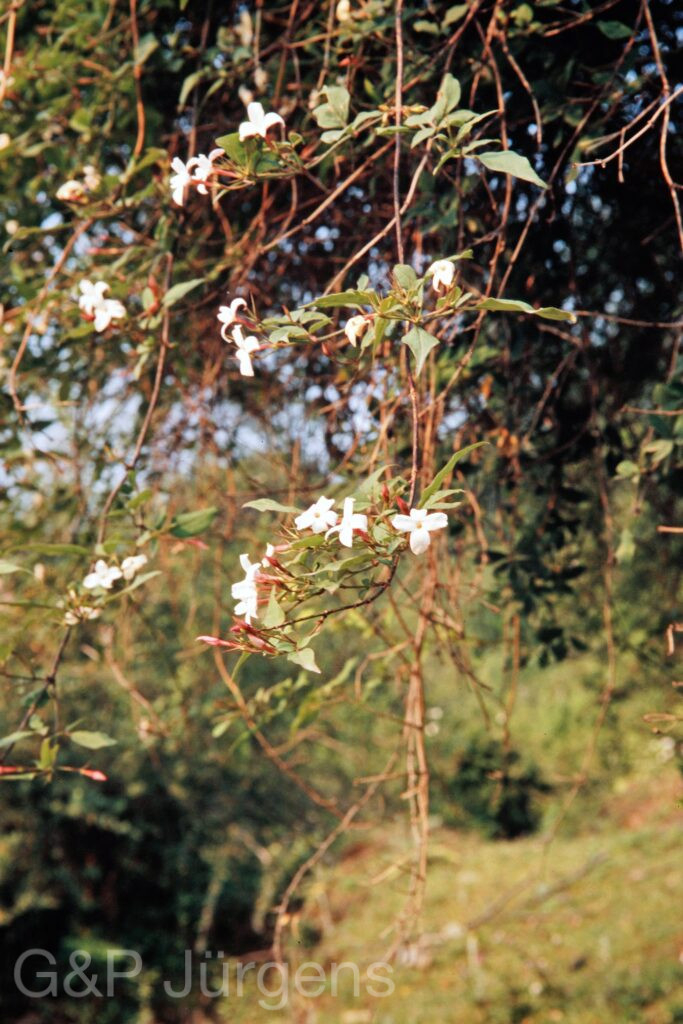
Jasminum dispermum is a scandent or climbing jasmine widely distributed across the Himalaya and montane south-east Asia, recorded from China, India, Nepal, Myanmar, Thailand and Bhutan, with outlying records (ID, KR, RU, ZZ) reflecting cultivation and herbarium material. Of more than 400 georeferenced collections, the core range lies along the subtropical-to-temperate forest belt of the Himalayan foothills. It grows in forest margins, scrub, ravines and along streams, scrambling over rocks and shrubs in the warm-temperate zone. The photographed plant from above the Meta-Khola in Nepal at 2250 m, flowering in April, is typical of its lower montane habitat and its spring flowering ahead of the monsoon.

It is a woody, twining shrub or liana with terete, often pubescent branchlets. The leaves are opposite and pinnately compound, usually with five to seven leaflets (sometimes reduced to three or trifoliolate uppermost ones), the leaflets ovate to lanceolate, acuminate and entire. The fragrant flowers are borne in terminal and axillary cymose panicles; each has a small, toothed calyx and a salverform corolla with a slender tube and spreading lobes, white within and frequently flushed pink or rose-purple on the outside in bud. Two stamens are inserted in the corolla tube. The fruit, reflected in the epithet dispermum, is a paired or two-seeded berry that ripens black.

Jasminum is a large Old World genus of the olive family centred on tropical and warm-temperate Asia and Africa, many species prized for their scent. J. dispermum is a vigorous, ornamentally attractive climber, occasionally cultivated, and remains common throughout its native range with no conservation concern. Its nocturnally fragrant, pale flowers suggest pollination by long-tongued moths and other nectar-seeking insects.

Author: Wall. · Sources: POWO (Kew), GBIF, Flora of China Vol. 15, Flora of Bhutan Vol. 2, Flora of Nepal, Green's Synopsis of the Oleaceae

Roxb. ex Hornem.

Bhutan2014 149
Bhutan Trashigang 2000m, May

Description

Jasminum laurifolium is a climbing jasmine native to the eastern Himalaya and South-East Asia, occurring in north-eastern India, Bhutan, Nepal, Myanmar, Thailand and southern China, and widely cultivated as an ornamental; its GBIF records (over 440) span this native range together with numerous cultivated occurrences in the Americas, the Pacific and the West Indies that account for the scattered records in Brazil, Colombia, Mexico, French Polynesia and the Caribbean. It grows in evergreen and mixed forest, on forest margins, thickets and shrubby slopes, generally up to about 2000 m. The photographed plant from Trashigang in eastern Bhutan at 2000 m in May reflects its occurrence in warm, humid mid-elevation forest.

It is an evergreen, woody twining shrub or liana with slender, glabrous, terete branchlets. The opposite, simple leaves are leathery and glossy, ovate-lanceolate to elliptic and laurel-like (whence laurifolium), with an entire margin, a long-acuminate apex and prominent pinnate venation. The fragrant flowers are borne in terminal and axillary cymes; each has a small, toothed calyx and a salverform white corolla with a slender tube and several narrow, spreading lobes. The fruit is a small, two-lobed black berry, often only one lobe maturing.

Jasminum is a large genus of the olive family Oleaceae, well represented in tropical Asia. J. laurifolium, sometimes treated with the variety brachylobum, is grown for its fragrant white flowers and is a familiar ornamental and source of perfume. Widespread in the wild and broadly cultivated, it is not of conservation concern, and its escape and naturalisation in warm regions outside its native range account for many of the extralimital records.

Author: Roxb. ex Hornem. · Sources: POWO (Kew), GBIF, Flora of China, Flora of Bhutan, Flora of Thailand, Jasminum (Oleaceae) revision (Green monograph)

L.

Garh 07 94 ergebnis
India Garhwal Meggu Kichatti 3100m, June
Garh 07 309 ergebnis
India Garhwal Bebra 2400m, June

Description

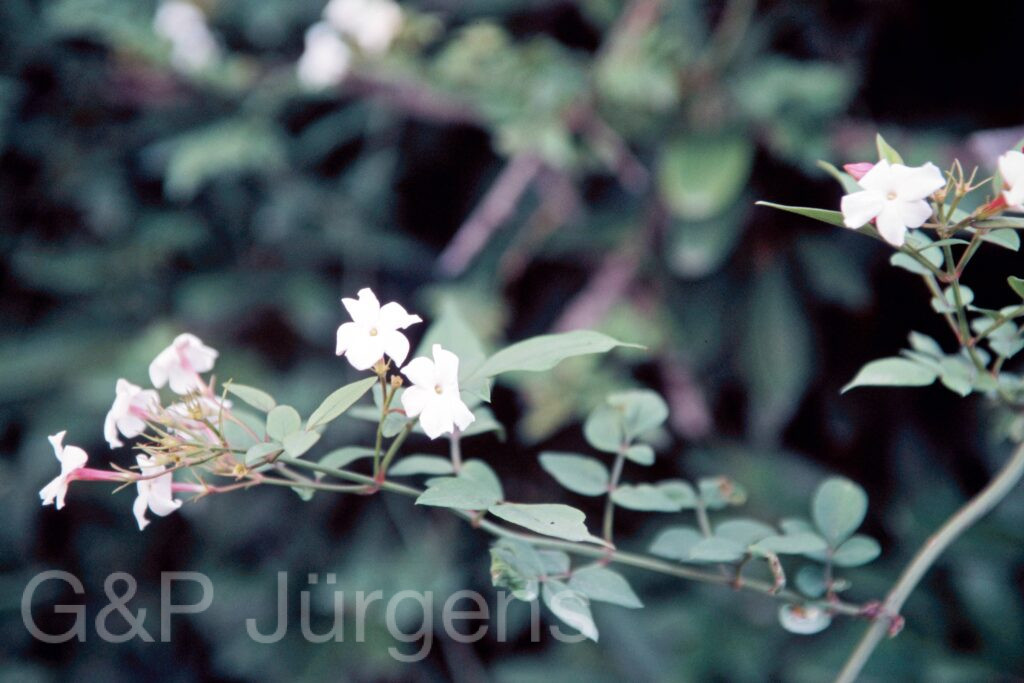
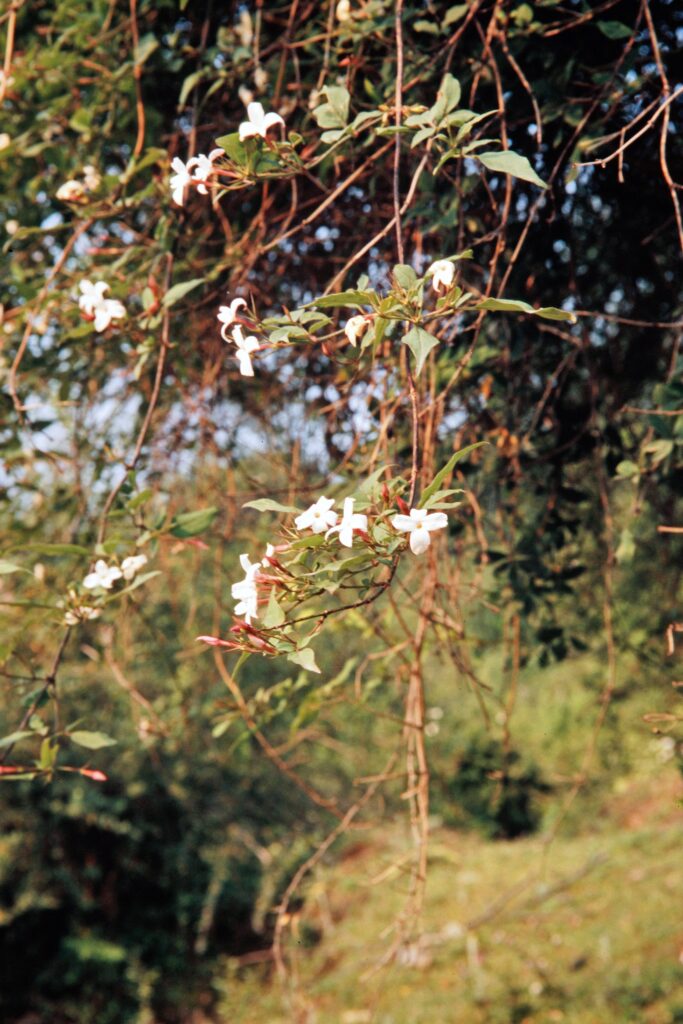
Jasminum officinale, the common or poet's jasmine, is native to the Caucasus, Central Asia and the Himalaya through Afghanistan, Pakistan, N India, Nepal and SW China, but is so widely cultivated that GBIF's 3,200-plus records span France, Britain, Spain, Italy, the United States, Australia and beyond, reflecting naturalisation far outside its native range. In its Himalayan homeland it is a plant of open forest, scrub, thickets and rocky slopes. The photographed material from Garhwal in the Indian Himalaya, at Meggu Kichatti (3,100 m) and Bebra (2,400 m) in June, illustrates its occurrence on warm temperate to subalpine slopes between roughly 1,500 and 3,100 m.

It is a deciduous or semi-evergreen scrambling shrub with slender, angular, twining green branches. The leaves are opposite and imparipinnate, with usually five to nine ovate-lanceolate, acuminate leaflets, the terminal leaflet longer and stalked. The fragrant flowers are borne in terminal and axillary cymes; each has a slender corolla tube expanding into four to five spreading white lobes, often flushed pink in bud. The fruit is a black, two-lobed berry, though fruiting is uncommon in cultivated clones.

The intense evening fragrance, produced by volatile esters and indole, attracts moths and other long-tongued nocturnal pollinators and underlies the long economic history of the species in the perfume and tea-scenting industries. Numerous cultivars and forms exist, including the hardy var. affine. As an extensively cultivated and locally naturalising species it is of no conservation concern, and indeed can behave as a garden escape in mild-climate regions worldwide.

Author: L. · Sources: POWO (Kew), Flora of Pakistan, GBIF, Flora of China Vol. 15, Green: A Revision of the Genus Jasminum (Kew Bulletin)

L. (Aiton)

Garh 07 94 ergebnis
India Garhwal Trijugi Narayan 2250m, June

Description

Jasminum sambac, the Arabian jasmine, is believed to be native to a broad region extending from the Indian subcontinent through Southeast Asia, though its precise original range is obscured by millennia of cultivation. It is now widely grown and naturalized throughout the tropics and subtropics, with GBIF records from over 40 countries including India, China, Indonesia, the Philippines, Thailand, and numerous Pacific islands. The species typically occurs at low to moderate elevations in warm, humid climates, though it has been documented at Trijugi Narayan in the Garhwal Himalaya of Uttarakhand at 2,250 m in June, likely in a cultivated or semi-naturalized context near this important pilgrimage site, representing an unusually high-elevation occurrence.
Jasminum sambac is an evergreen or semi-deciduous scandent shrub or vine, 0.5–3 m tall, with terete, pubescent young branches. Leaves are opposite, simple (unusual in Jasminum, where most species have compound leaves), broadly ovate to elliptic, 4–12 cm long and 2–7 cm wide, with an obtuse to rounded apex, entire margins, and a glossy, dark green upper surface. The inflorescence is a terminal or axillary cyme bearing three to twelve flowers. Flowers are highly fragrant, with a tubular calyx bearing eight to ten linear lobes and a salverform corolla with a slender tube 10–15 mm long and typically eight to nine oblong, spreading, pure white lobes. In cultivated double-flowered forms, the petals are greatly multiplied. The fruit is a globose, two-lobed berry approximately 8 mm in diameter, black when ripe, though fruiting is rare in cultivated plants.
Jasminum sambac holds profound cultural, religious, and economic significance across Asia. It is the national flower of the Philippines (sampaguita) and one of three national flowers of Indonesia (melati putih), used extensively in religious ceremonies, garlands, and traditional medicine throughout South and Southeast Asia. The flowers are a major source of jasmine absolute and essential oil used in the perfume industry and are the traditional scenting agent for jasmine tea in China. Taxonomically, J. sambac is placed in Jasminum section Unifoliolata, reflecting its simple (unifoliolate) leaves. The species was first described by Linnaeus as Nyctanthes sambac and later transferred to Jasminum by Aiton in 1789.

Author: L. (Aiton) · Sources: POWO (Kew), GBIF, Flora of China Vol. 15, Green: A Revision of Jasminum in Asia and Australia (2003), Mabberley: Mabberley's Plant-Book (2017)