
Roxb. ex Hornem.
Description
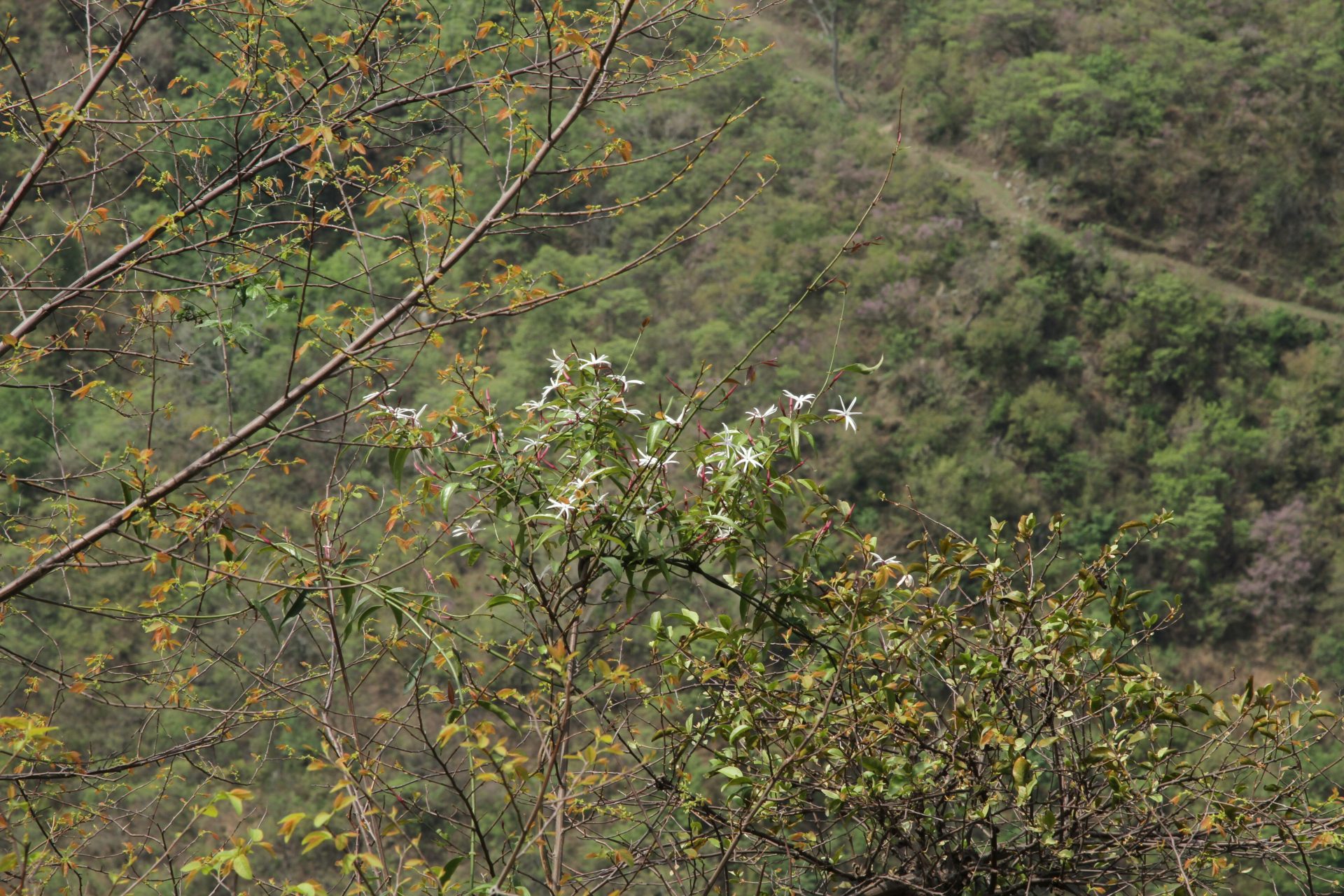
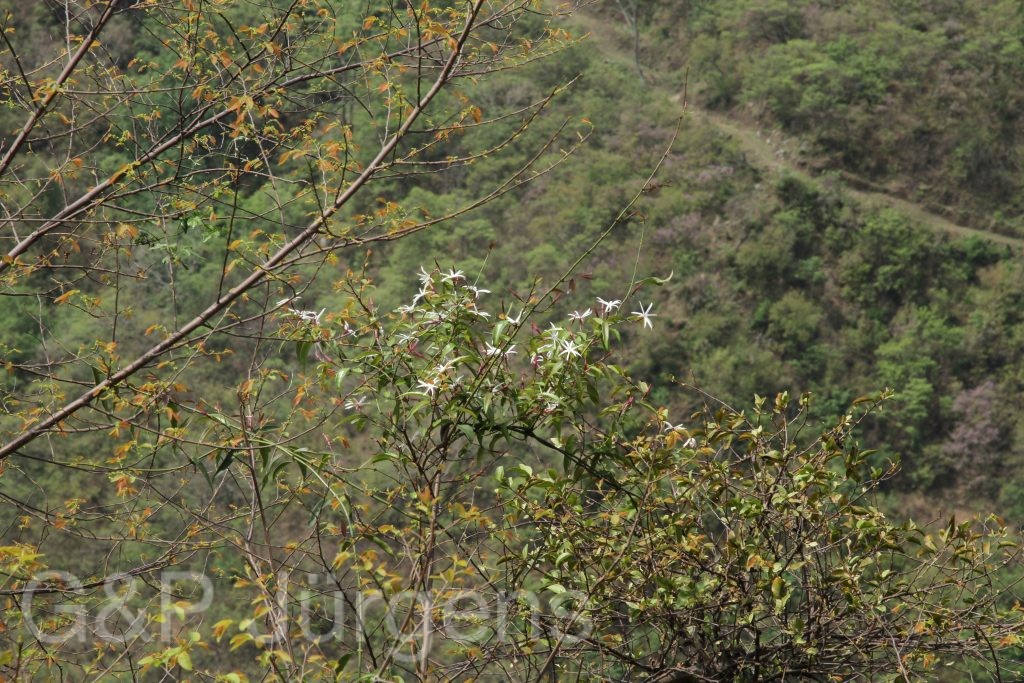
Jasminum laurifolium is a climbing jasmine native to the eastern Himalaya and South-East Asia, occurring in north-eastern India, Bhutan, Nepal, Myanmar, Thailand and southern China, and widely cultivated as an ornamental; its GBIF records (over 440) span this native range together with numerous cultivated occurrences in the Americas, the Pacific and the West Indies that account for the scattered records in Brazil, Colombia, Mexico, French Polynesia and the Caribbean. It grows in evergreen and mixed forest, on forest margins, thickets and shrubby slopes, generally up to about 2000 m. The photographed plant from Trashigang in eastern Bhutan at 2000 m in May reflects its occurrence in warm, humid mid-elevation forest.
It is an evergreen, woody twining shrub or liana with slender, glabrous, terete branchlets. The opposite, simple leaves are leathery and glossy, ovate-lanceolate to elliptic and laurel-like (whence laurifolium), with an entire margin, a long-acuminate apex and prominent pinnate venation. The fragrant flowers are borne in terminal and axillary cymes; each has a small, toothed calyx and a salverform white corolla with a slender tube and several narrow, spreading lobes. The fruit is a small, two-lobed black berry, often only one lobe maturing.
Jasminum is a large genus of the olive family Oleaceae, well represented in tropical Asia. J. laurifolium, sometimes treated with the variety brachylobum, is grown for its fragrant white flowers and is a familiar ornamental and source of perfume. Widespread in the wild and broadly cultivated, it is not of conservation concern, and its escape and naturalisation in warm regions outside its native range account for many of the extralimital records.
Author: Roxb. ex Hornem. · Sources: POWO (Kew), GBIF, Flora of China, Flora of Bhutan, Flora of Thailand, Jasminum (Oleaceae) revision (Green monograph)