Primulaceae

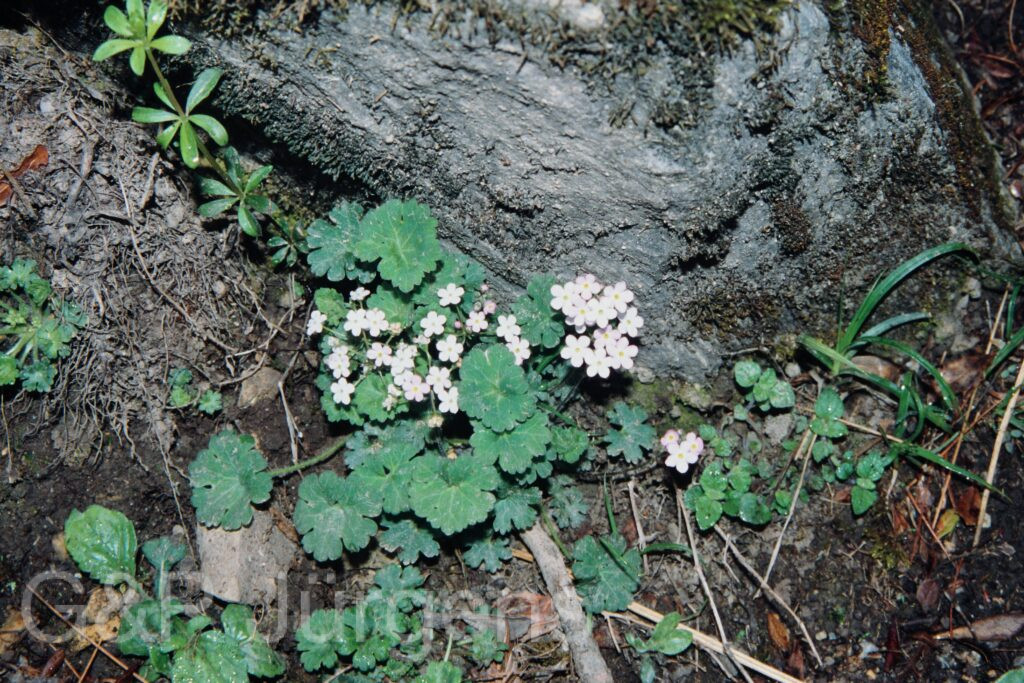
Wall.

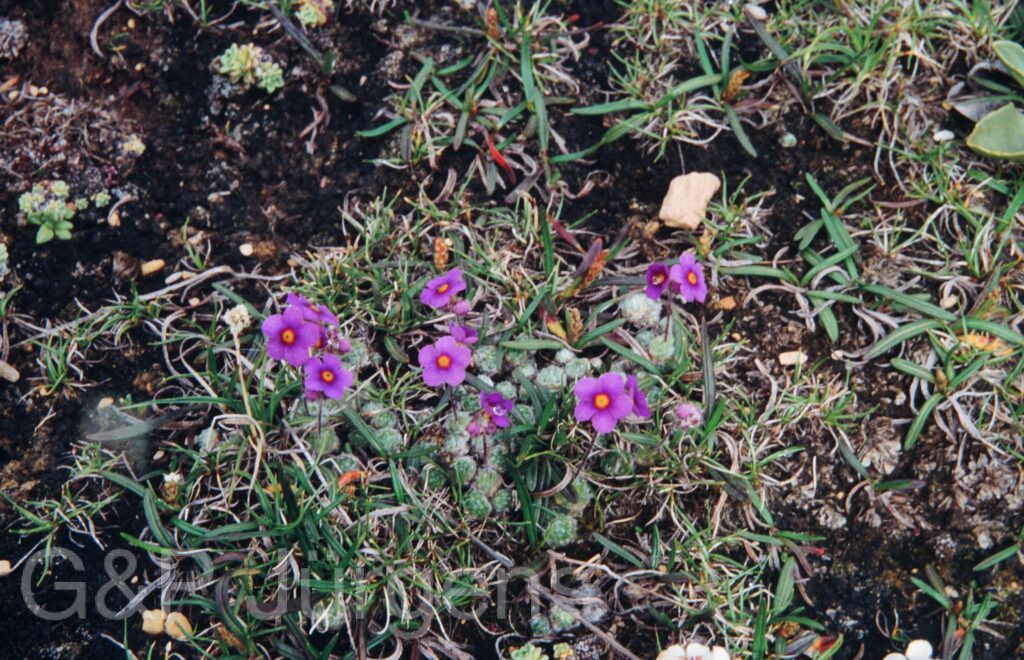
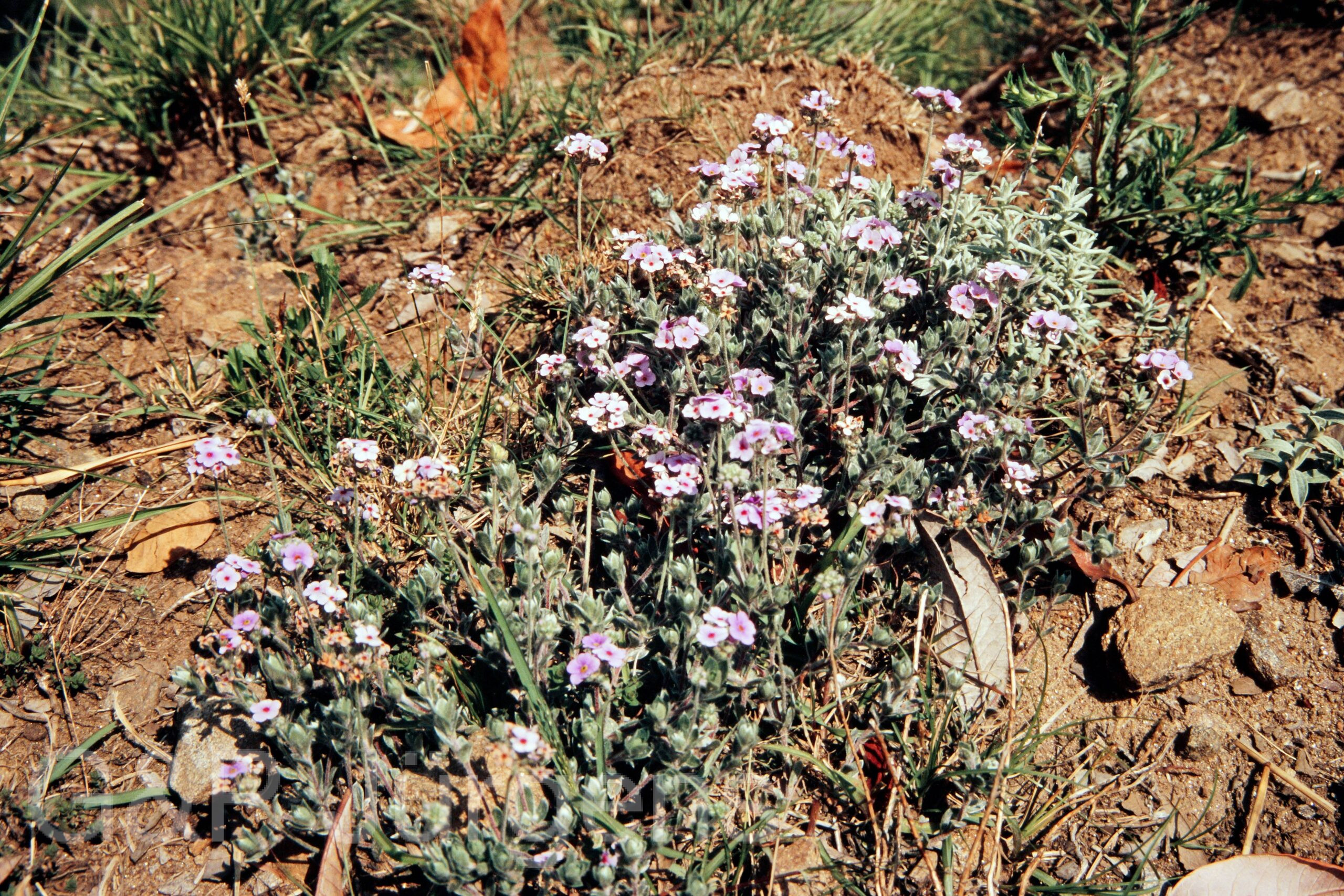
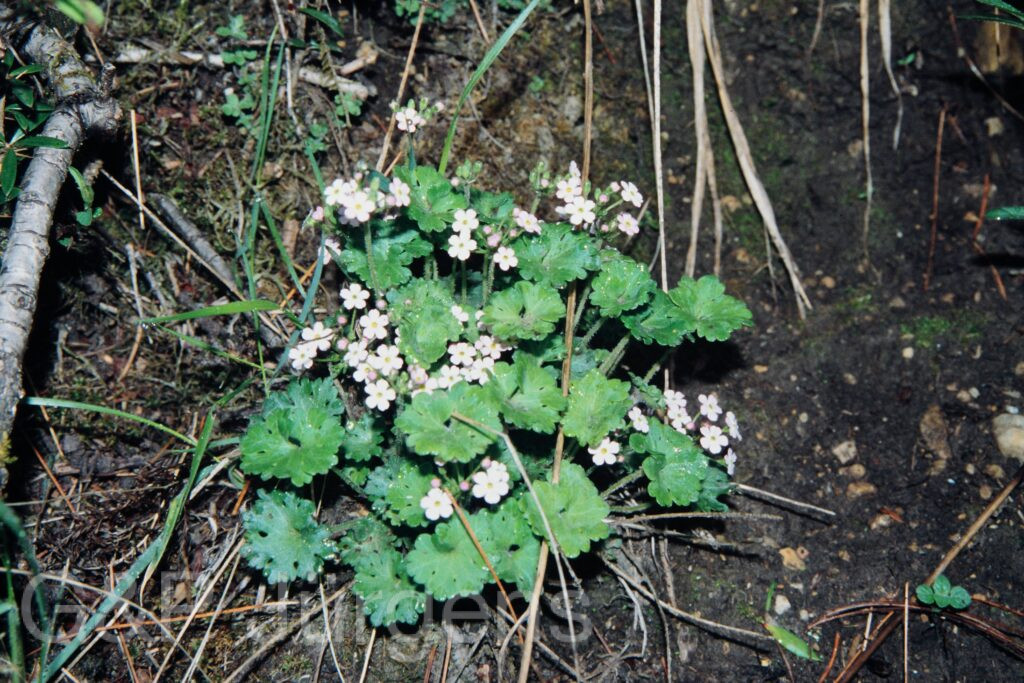
Bhutan2014 822
Bhutan Chele-La 3100m, May
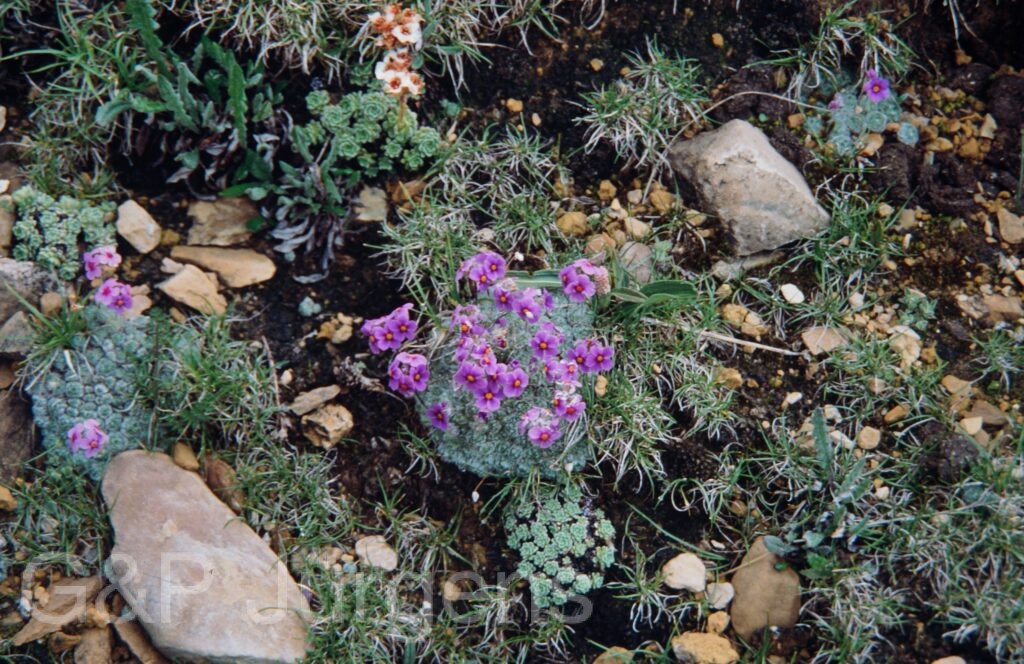
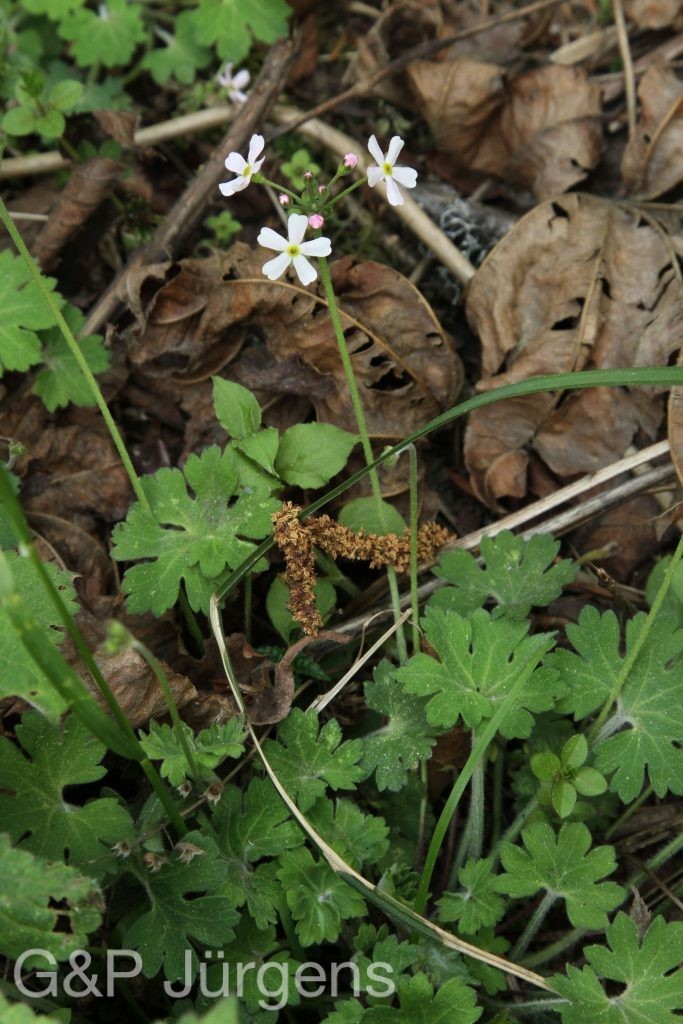
Bhutan2014 1019
Bhutan Chele-La 3100m, May
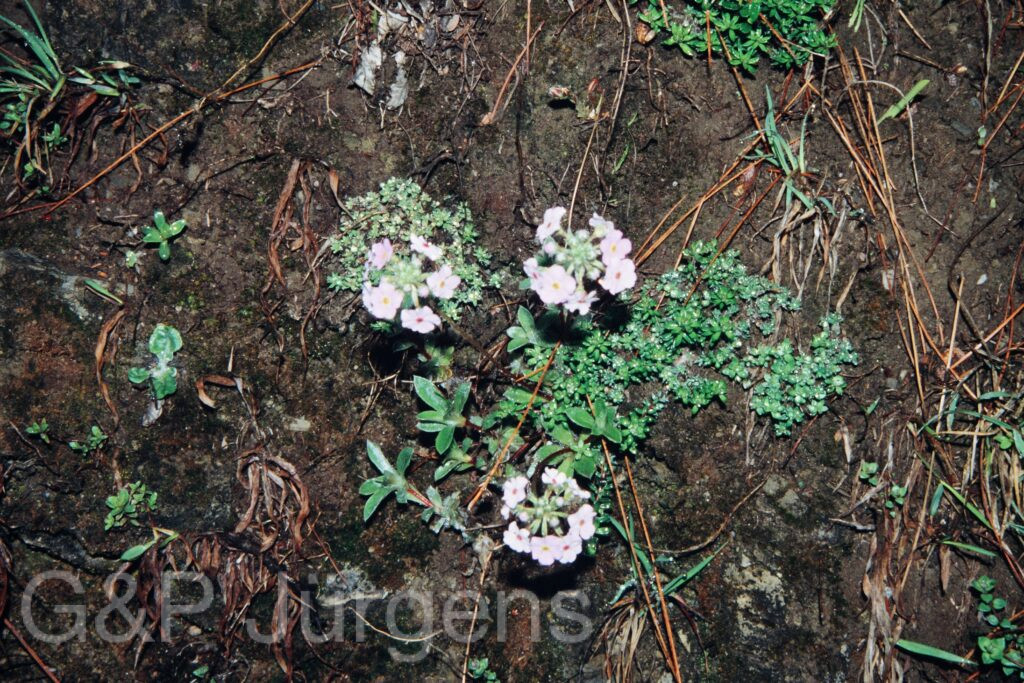
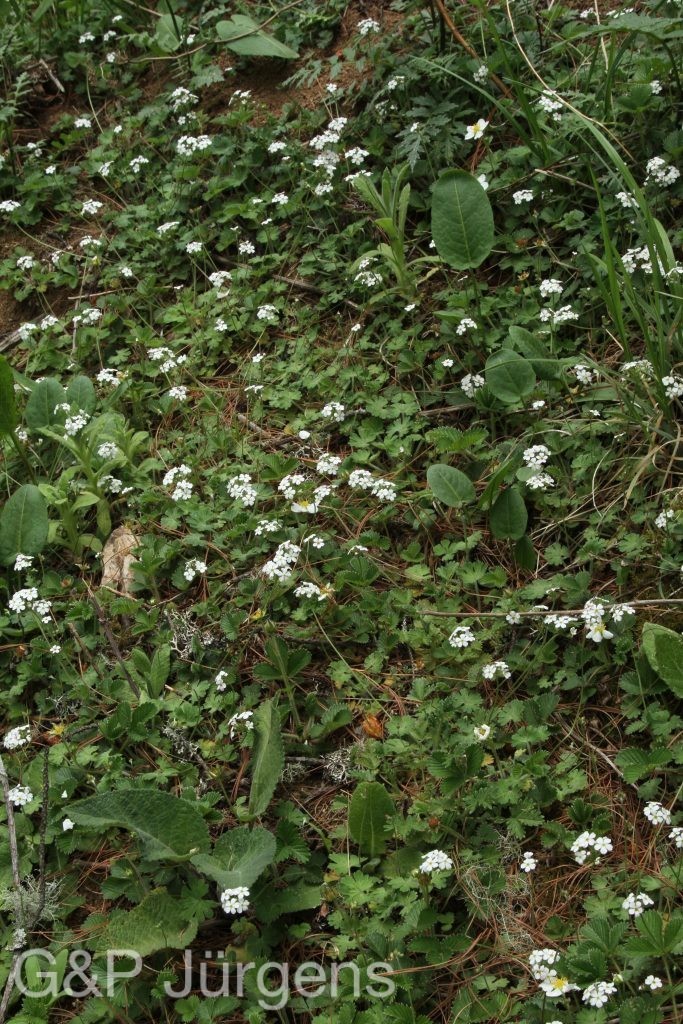
Sikkim2004 376 P653
Sikkim/India Lachung 2800m May

Description

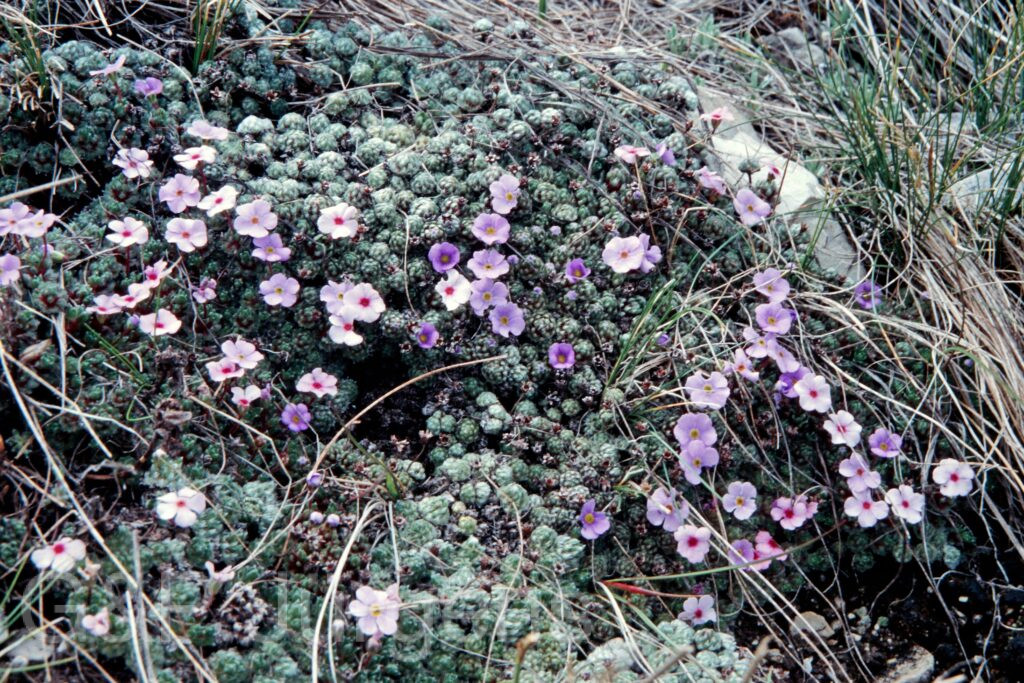
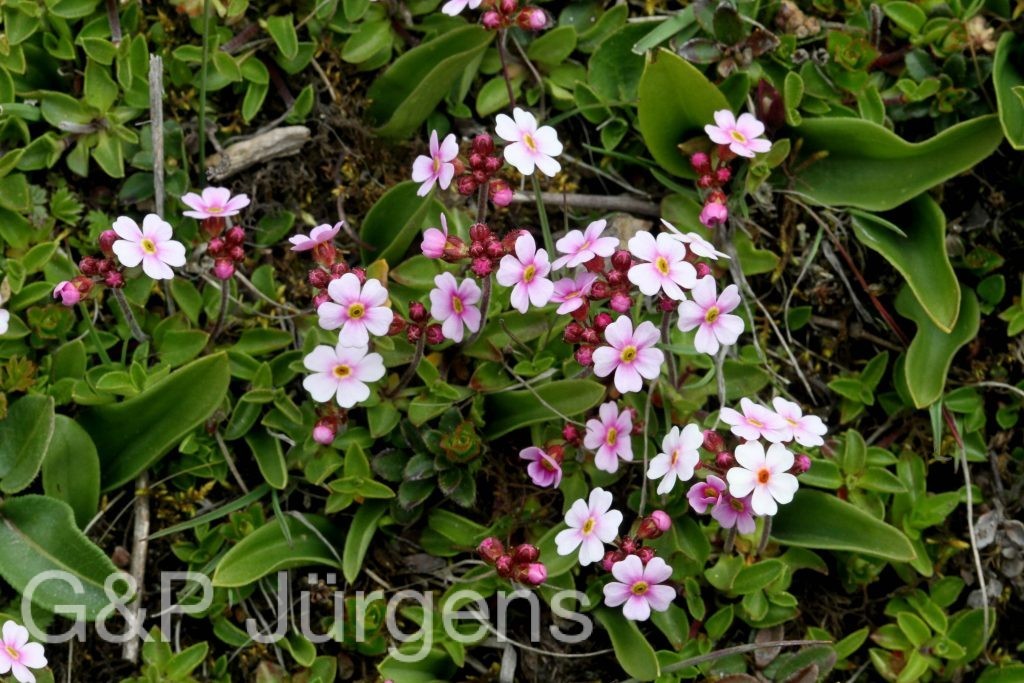
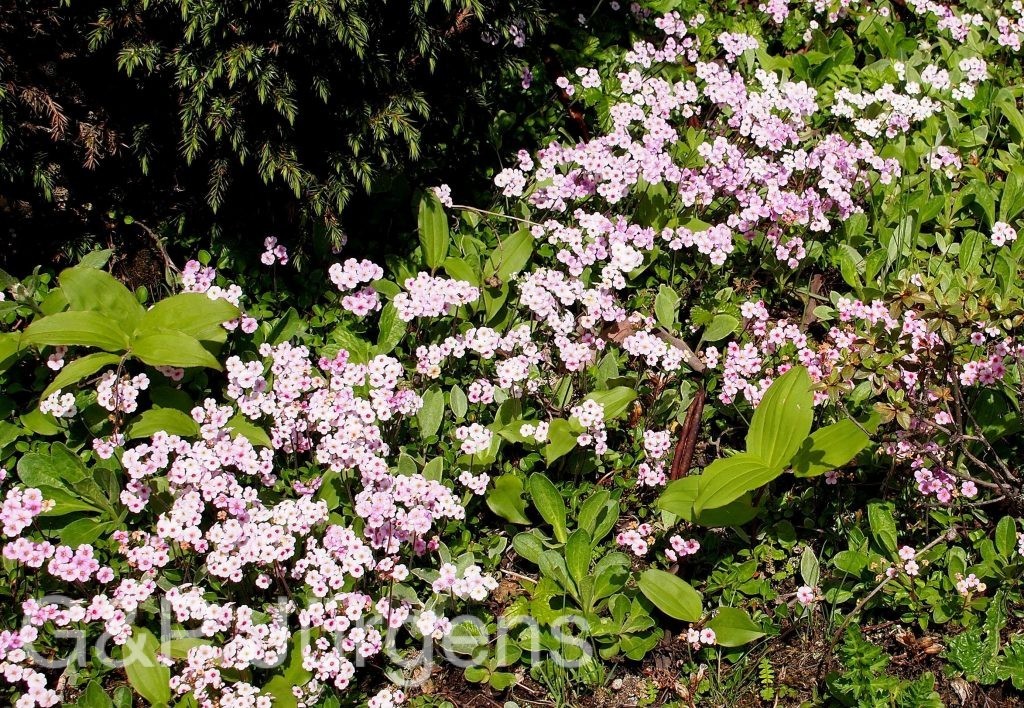
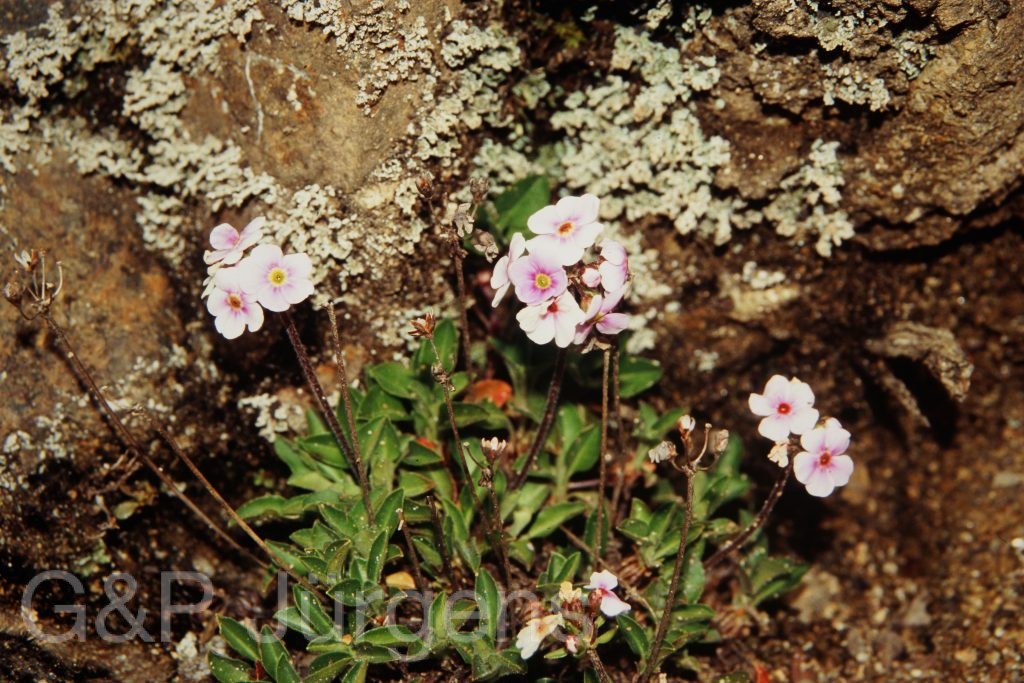
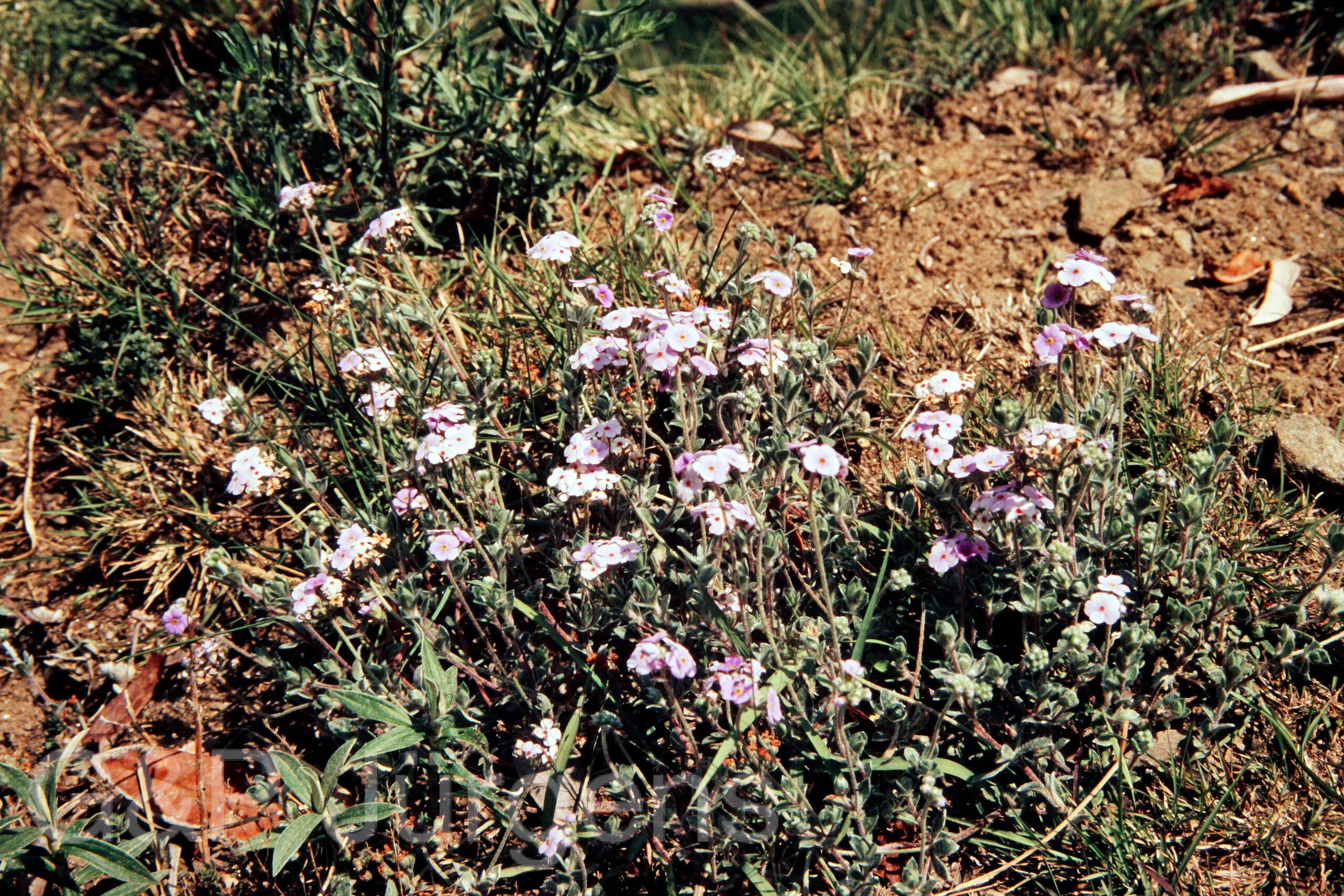
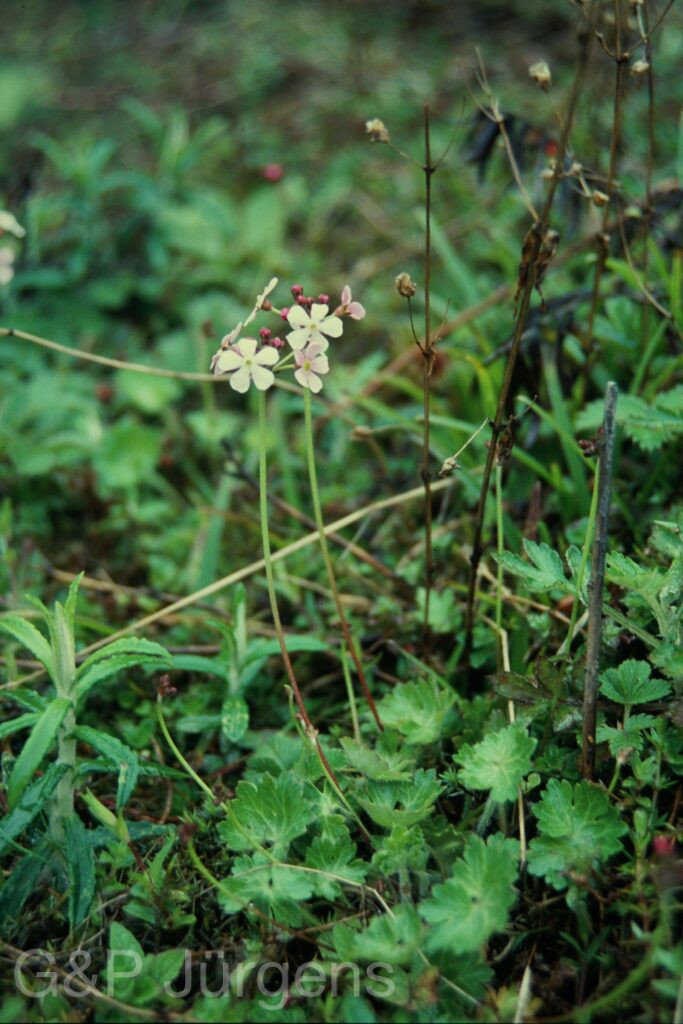
Androsace geranifolia is a Himalayan rock-jasmine of the temperate to subalpine zone, ranging through the central and eastern Himalaya from Nepal through Sikkim and India into Bhutan. GBIF currently holds no georeferenced occurrences and treats the name as doubtful at present, so its distribution is best inferred from herbarium and floristic records, which place it in moist, shaded forest, mossy banks, rock ledges and stream gullies between roughly 2500 and 3500 m. The documented sites at Chele-La in Bhutan at 3100 m and at Lachung in Sikkim, India, at 2800 m, both flowering in May, illustrate its preference for cool, humid, partly shaded montane habitats in spring.

It is a soft, herbaceous perennial, distinct among Himalayan Androsace in its conspicuously geranium-like foliage. The leaves are long-petiolate with orbicular to reniform, palmately lobed and toothed blades, forming a loose basal rosette or tuft rather than the tight cushion of many congeners. From the rosette arise slender, hairy scapes bearing an umbel of several small flowers subtended by leafy bracts. Each flower has a campanulate calyx and a salver-shaped white to pale pink corolla with five spreading lobes and a small yellow eye at the constricted throat. The fruit is a small, few- to several-seeded globose capsule.

Androsace is a large genus of Primulaceae centred on the mountains of central Asia, and A. geranifolia represents the broad-leaved, woodland-dwelling rather than cushion-forming element of the genus, allied to A. sarmentosa and A. rotundifolia. Its dissected foliage reflects adaptation to shaded forest understorey rather than the exposed screes typical of the section. As a narrowly distributed, seldom-collected Himalayan endemic, its conservation status remains formally unassessed and warrants further field documentation.

Author: Wall. · Sources: POWO (Kew), GBIF, Flora of Bhutan, Annotated Checklist of the Flowering Plants of Nepal, Smith & Lowe revision of Androsace, Flora of British India
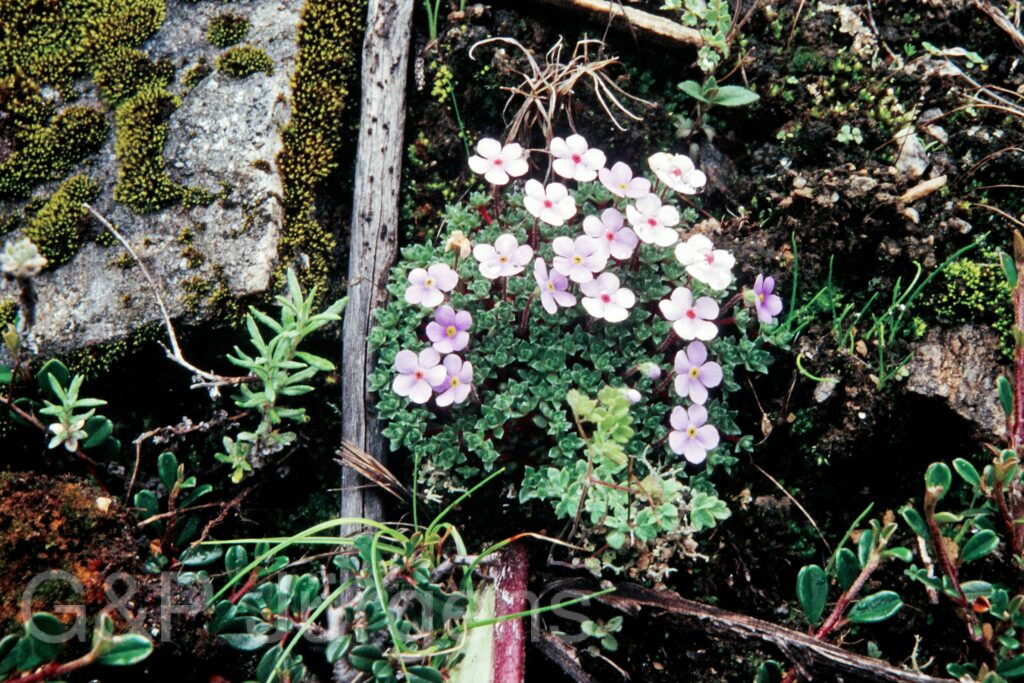
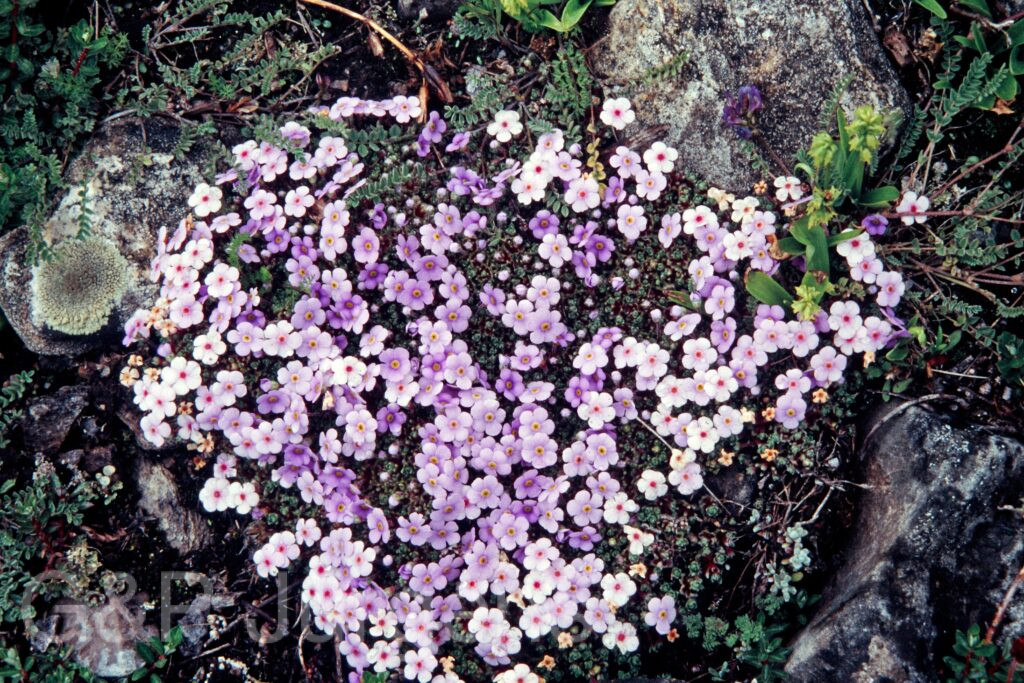
Duby

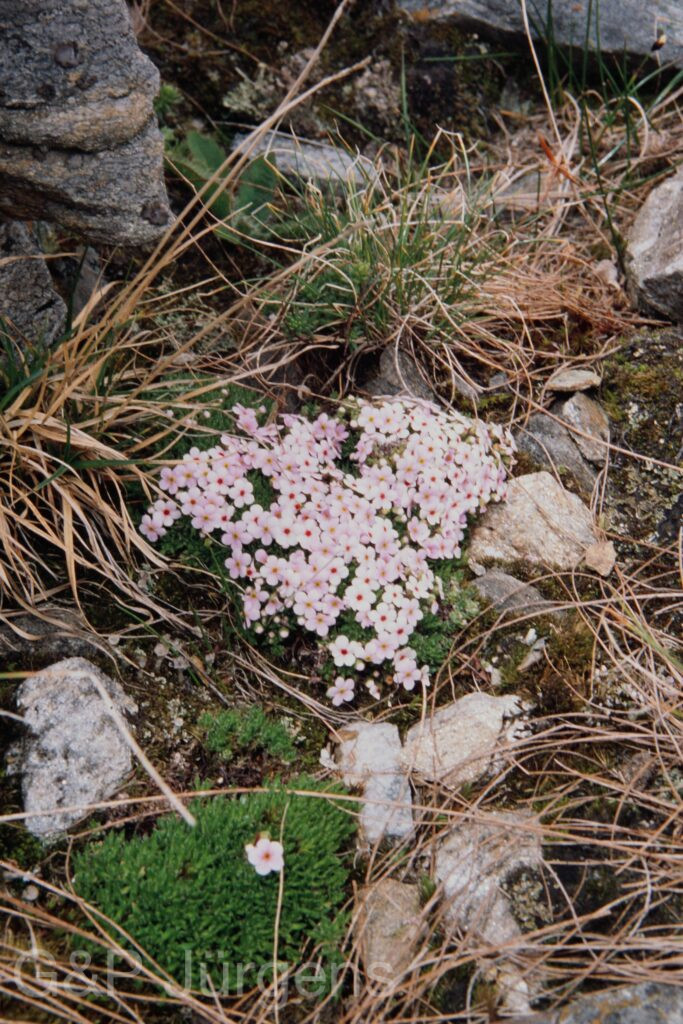
BhutanPG2011 669 scaled
Bhutan Ludlow-Sherriff-Trail Thitha-Tso, 4300m July
Sikkim2004 163 G276
Sikkim/India Singalila 4100m May
Nepal 99 138 ergebnis
West-Nepal South of Rara-Lake 3800m, June

Description

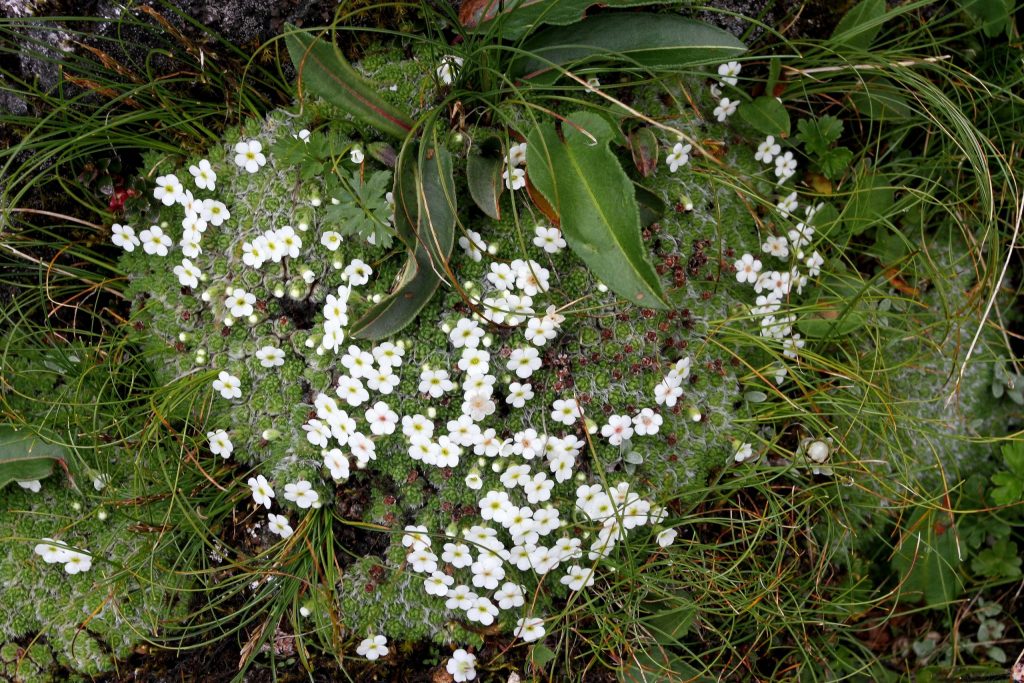
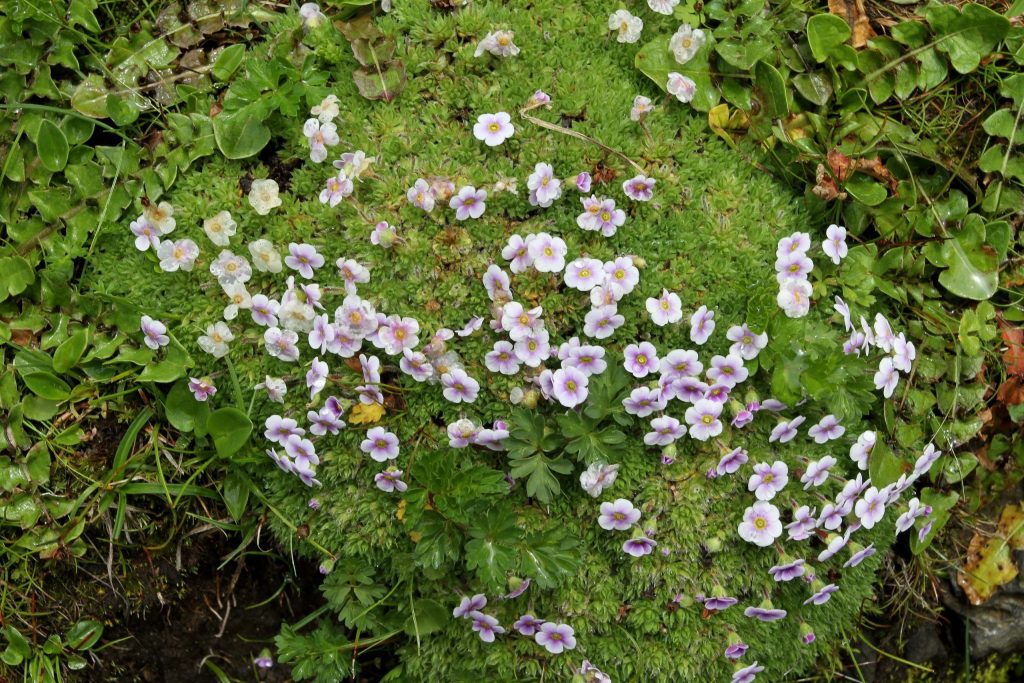
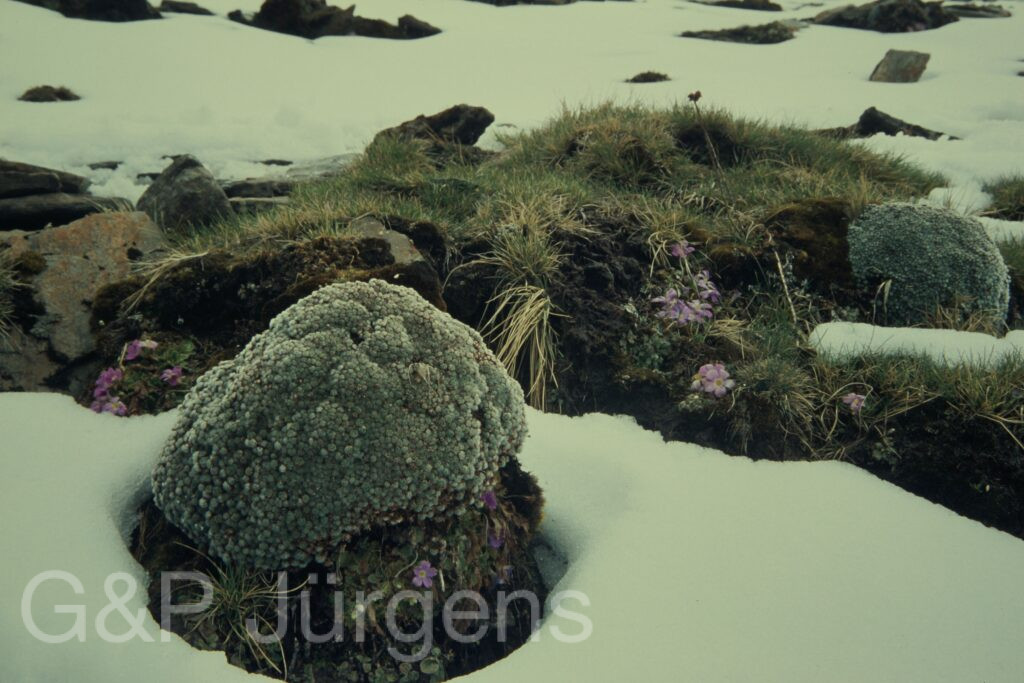
Androsace globifera is a high-alpine cushion-forming perennial distributed along the central and eastern Himalaya, recorded by GBIF (103 occurrences) from Nepal, India, Bhutan and adjacent Tibetan China. It occupies open, often wind-exposed alpine turf, gravel slopes, moraine margins and the rocky surrounds of glacial tarns, typically between 3800 and 4500 m. The documented gatherings illustrate this range well: dense colonies were found beside Thitha-Tso on the Ludlow-Sherriff Trail in Bhutan at 4300 m in July, on the Singalila ridge of Sikkim at 4100 m in May, and south of Rara Lake in West Nepal at 3800 m in June, flowering as the snow recedes.

The plant forms compact, hemispherical cushions or low mats built from numerous crowded, columnar shoots clothed in persistent, imbricate, withered leaf-remains. The leaves are small, sessile, oblong to spathulate, and gathered into dense terminal rosettes, their margins ciliate with simple and branched hairs. Solitary, sessile or shortly pedicellate flowers nestle among the leaves; the calyx is campanulate and lobed to about the middle, and the rotate corolla is white to pink with a yellow throat, the five obovate lobes spreading from a short tube. The fruit is a small globose capsule that splits by five valves to release angular seeds.

A member of the cushion-forming androsaces, the species is diagnosed by its globular, tightly packed habit and short-tubed flowers. Ecologically it is a pioneer of frost-disturbed, well-drained substrates, the cushion architecture buffering temperature extremes and trapping wind-blown detritus. Though locally frequent and not currently threatened, such narrowly stenothermic alpines are sensitive to warming and shifting snow regimes.

Author: Duby · Sources: POWO (Kew), GBIF, Flora of China Vol. 15, Flora of Bhutan Vol. 2, Flora of Nepal, Smith & Lowe Androsace monograph (Genus Androsace)

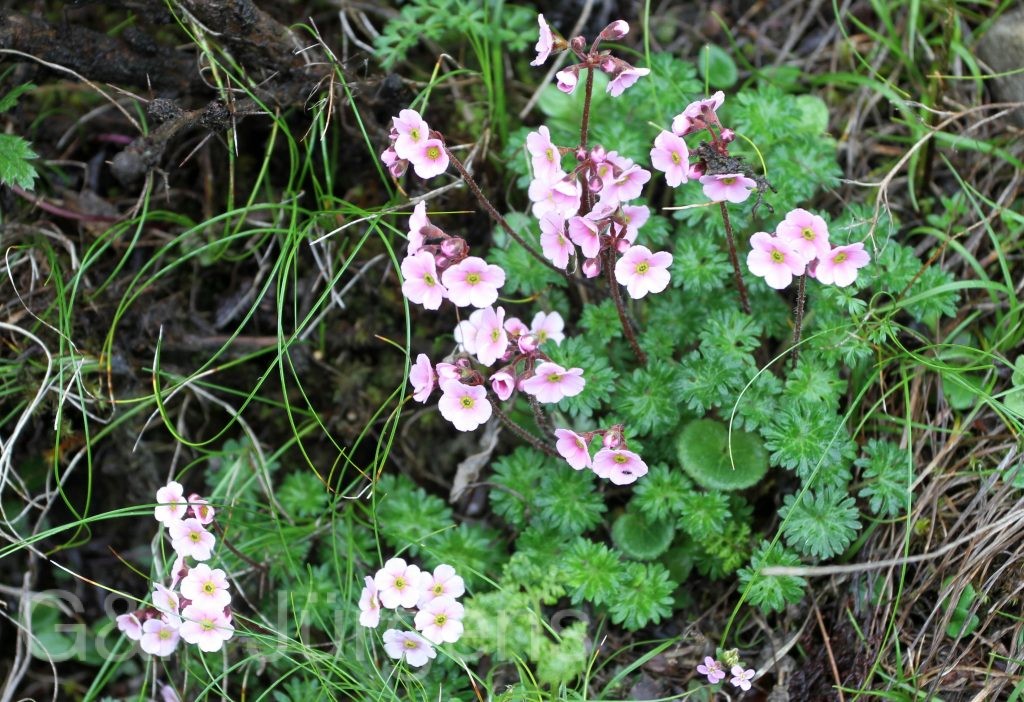
Klatt

Sikkim2011 54
Sikkim Vista-valley 3800m, June
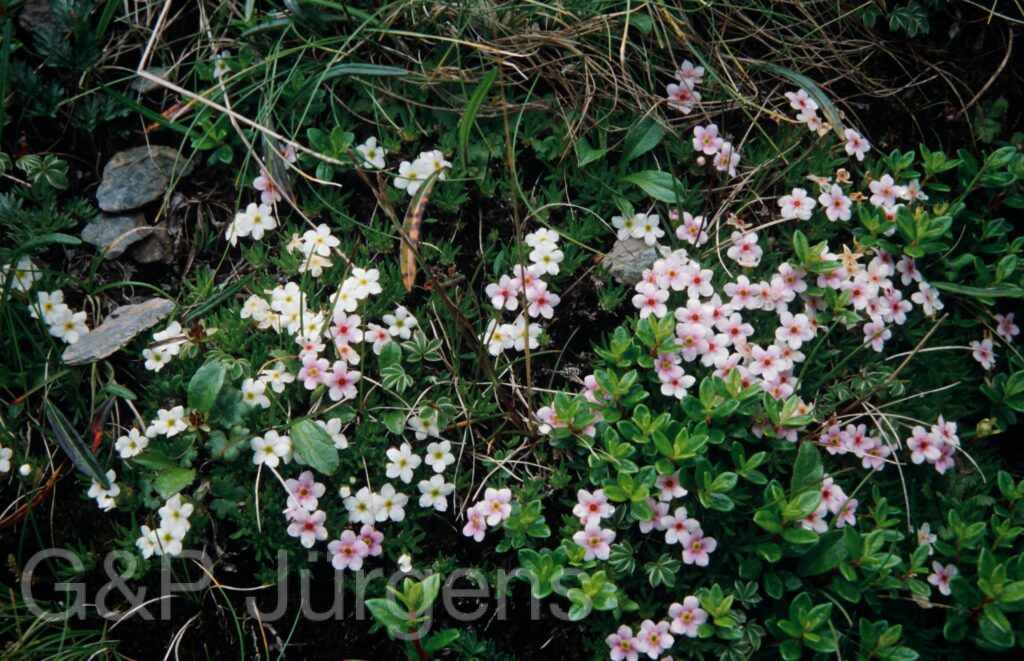
BhutanPG2011 784 01 01
Bhutan Chele-La, 3800m June
Bh09 175 G200
Bhutan Labana, 4000m June

Description

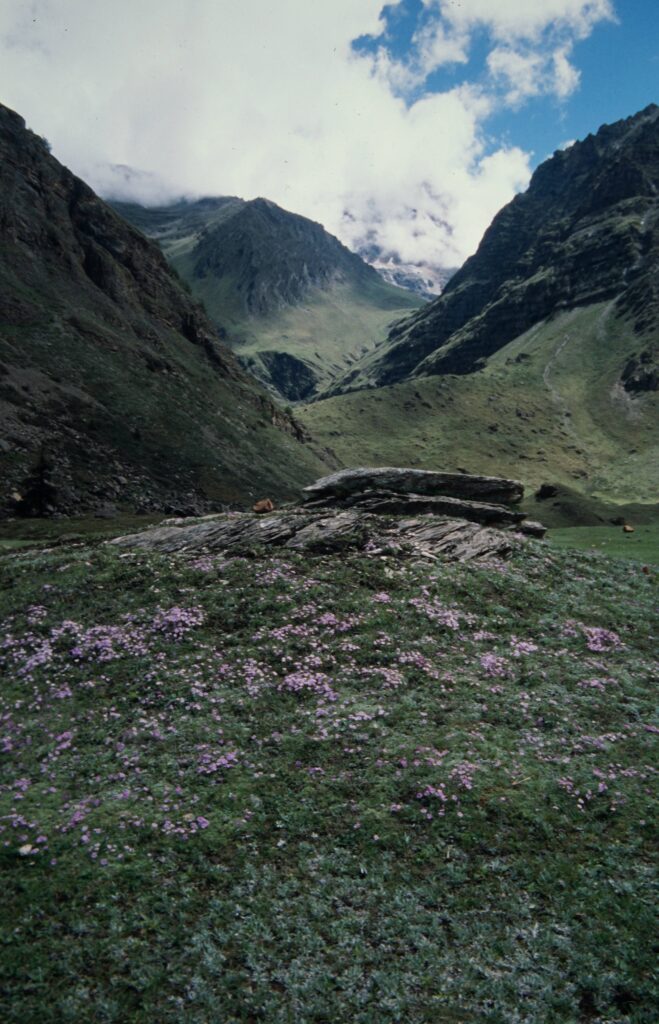
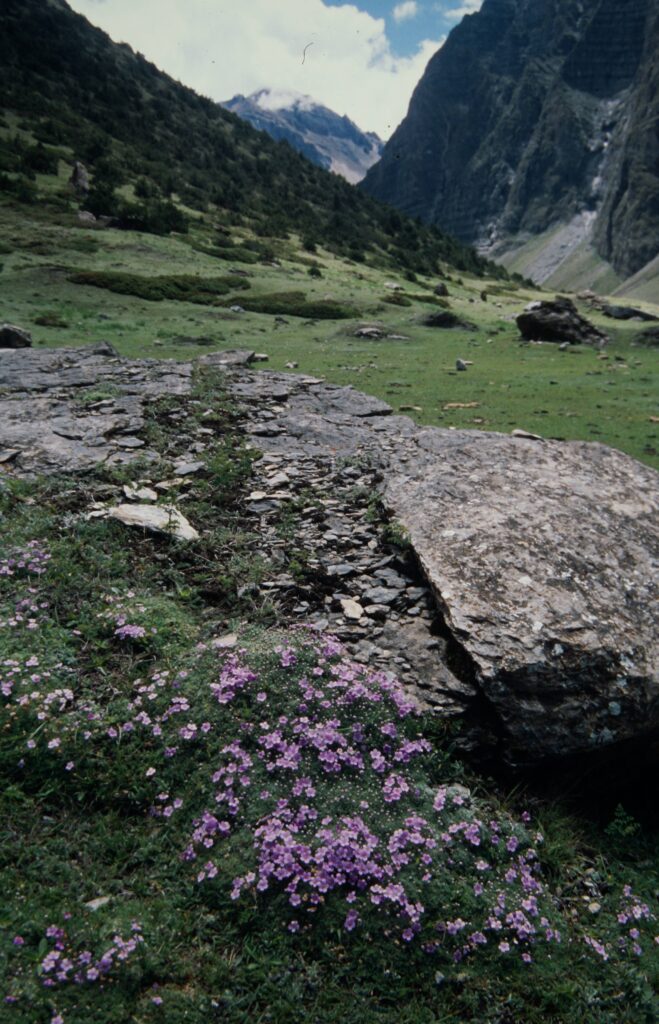
Androsace hookeriana is an eastern Himalayan rock-jasmine recorded in GBIF from Nepal, China, Bhutan and India across 120 occurrences. It grows in moist alpine meadows, grassy slopes, seepage flushes and among rocks, generally between 3500 and 4300 m. The cited collections span Sikkim's Vista valley at about 3800 m, Chele-La in Bhutan at 3800 m, and Labana in Bhutan at 4000 m, all flowering in June, indicating an early-summer alpine species that exploits damp, freshly snow-freed turf. Named for the botanist J. D. Hooker, it is a characteristic component of high eastern Himalayan herbfields.

It is a small rosette-forming perennial, the basal leaves spathulate to oblanceolate, narrowed to the base, with a sparse to dense covering of fine hairs. From the rosette rises a slender, hairy scape a few centimetres to about 15 cm tall, bearing a terminal umbel of several flowers subtended by an involucre of narrow bracts; the pedicels are hairy. Each flower has a campanulate, hairy calyx divided to about the middle and a salverform white to pale pink corolla with a yellow or pinkish eye and five rounded lobes. The fruit is a small, valvate capsule containing a few angular seeds.

As a member of Androsace (Primulaceae), the species belongs to a genus of predominantly arctic-alpine herbs richly diversified across the Himalaya and Tibetan Plateau. Its scapose, umbellate habit aligns it with the meadow-dwelling rosette species rather than the tight cushion-formers of higher scree. Pollination is by small dipterans and other insects drawn to the eye-ring, and seeds are dispersed by gravity and wind. It is locally frequent and of no recognised conservation concern.

Author: Klatt · Sources: POWO (Kew), GBIF, Flora of China, Flora of Bhutan, Annotated Checklist of the Flowering Plants of Nepal, Smith and Lowe Monograph of Androsace

(R.Knuth) Govaerts

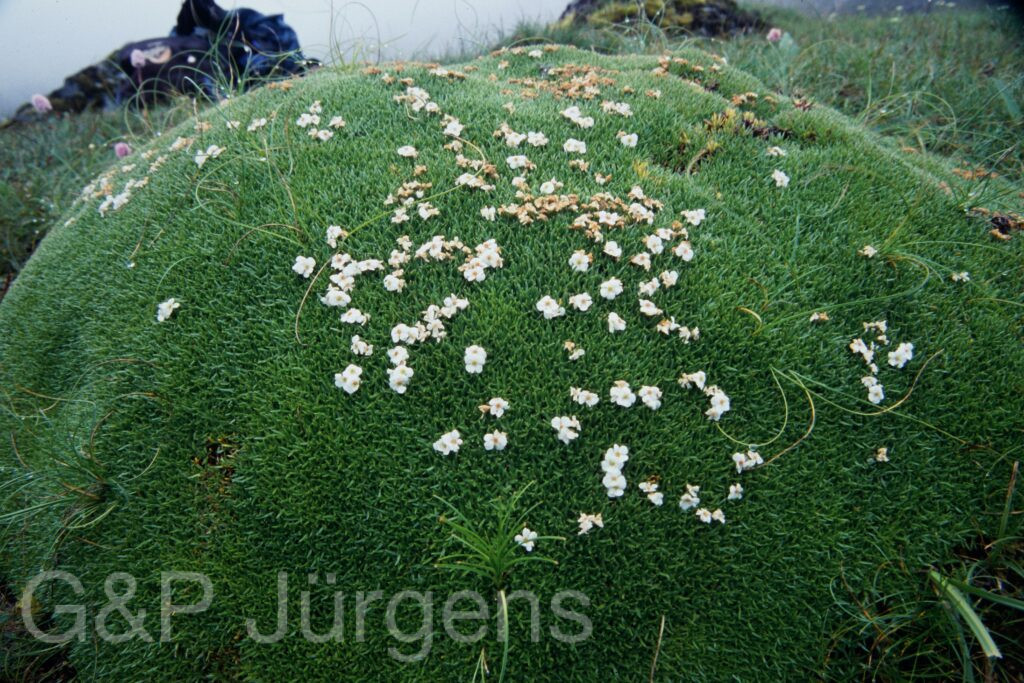
Nepal 99 674 ergebnis
West-Nepal, Kagmara-La 4800m, July
Nepal 99 673 2 ergebnis
West-Nepal, Kagmara-La 4800m, July

Description

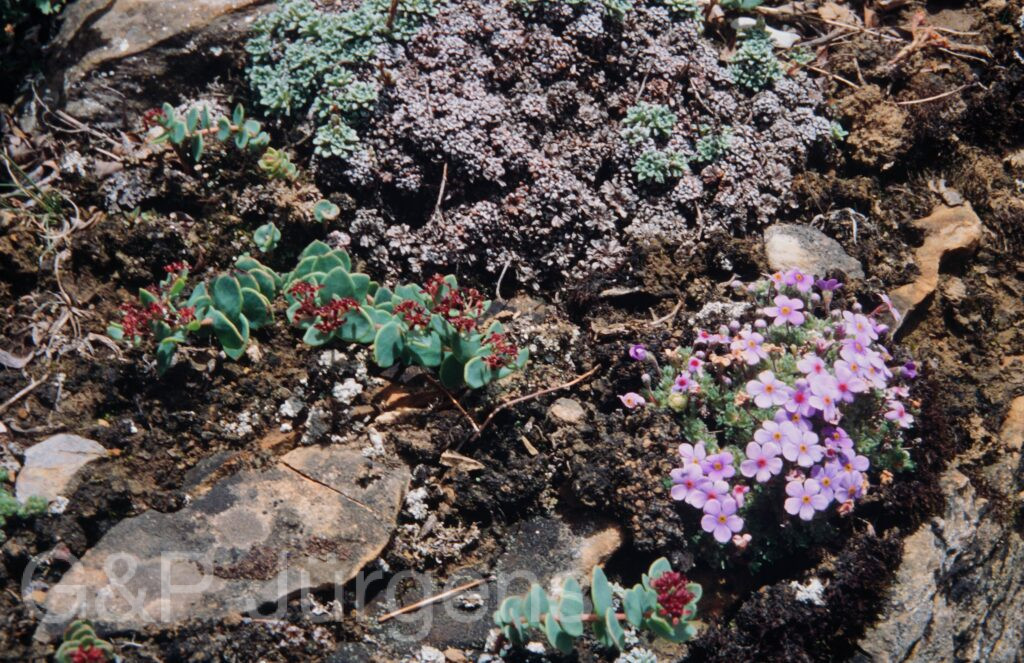
Androsace jacquemontii var. robusta is a high-alpine cushion plant of the western and central Himalaya and the Tibetan borderlands, recorded from China, India, Nepal and Pakistan among its roughly 212 documented occurrences. It is a denizen of the upper alpine zone, growing on stony slopes, fine moraine, gravelly flats and rock crevices where drainage is sharp and exposure severe. The photographed population at the Kagmara-La in West Nepal, at about 4800 m and flowering in July, is characteristic of its elevational ceiling, where the brief snow-free season concentrates flowering into the early summer weeks following snowmelt.

The plant forms dense, compact cushions or low mats built from numerous crowded rosettes of small, imbricate, linear to oblanceolate leaves, often somewhat fleshy and ciliate at the margins, an adaptation conserving heat and moisture in the windswept environment. From the rosettes arise short scapes bearing solitary flowers or small few-flowered umbels; each flower has a five-lobed campanulate calyx and a salverform corolla with a constricted throat marked by a yellow or pinkish eye, the spreading lobes usually pink to lilac or white. The fruit is a small, few-seeded capsule dehiscing by valves at the apex, the var. robusta distinguished by its more vigorous, larger habit relative to typical A. jacquemontii.

Androsace is the classic genus of Himalayan rock-jasmines within Primulaceae, and the cushion-forming alpines exemplify convergent adaptation to cold, high-radiation environments shared with Saxifraga and Arenaria. The recombination of this taxon, originally a Knuth name, by Govaerts reflects ongoing nomenclatural refinement of the infraspecific entities. Cushion plants of this kind are long-lived, slow-growing and act as nurse plants facilitating other seedlings; while not individually threatened given their remote habitat, they are recognised as sensitive sentinels of warming-driven change in high-mountain vegetation.

Author: (R.Knuth) Govaerts · Sources: POWO (Kew), GBIF, Flora of Pakistan, Flora of China, Annotated Checklist of the Flowering Plants of Nepal, Smith and Lowe's monograph of Androsace (Primulaceae)

Wall.

Nepal 99 60 ergebnis
West-Nepal Nyor Gaad 2800m, June

Description

Androsace lanuginosa is a Western and Central Himalayan endemic distributed from Pakistan and the Indian states of the Garhwal and Kumaon Himalaya eastward through Nepal, with collections also referred to adjoining Chinese territory. The species occupies open, rocky slopes, grassy banks and the margins of moist forest at montane to lower-subalpine elevations, generally between roughly 2300 and 3600 m. The photographed populations were recorded in West Nepal at Nyor Gaad around 2800 m and in Indian Garhwal at Nanu Mandakini near 2360 m, both flowering in June; the GBIF dataset records 277 occurrences across IN, NP, CN, PK and several countries (US, CA, DE) reflecting its cultivation as a rock-garden ornamental.

The plant is a mat-forming or trailing perennial with slender, prostrate to ascending stems radiating from a central rosette and rooting at the nodes. The leaves are crowded, oblong-lanceolate to obovate, entire, and densely clothed on both surfaces with long, soft, silky-villous hairs that give the foliage a silvery-grey, lanuginose aspect. Inflorescences are few-flowered umbels borne on softly hairy peduncles, subtended by an involucre of small bracts. Each flower has a hairy, lobed calyx and a salverform corolla, pink to rose-lilac with a yellow to greenish eye, the five obcordate lobes spreading from a short tube. The fruit is a small, few-seeded globose capsule.

Within the large genus Androsace, the species belongs to the perennial, stoloniferous rock-jasmines allied to A. sarmentosa, distinguished by its conspicuously woolly indumentum and trailing habit. It is an indicator of well-drained, sunny Himalayan slopes and is widely grown in temperate rock gardens, where several cultivars exist. Though locally common and not assessed as threatened, populations are sensitive to overgrazing and trampling at accessible elevations.

Author: Wall. · Sources: POWO (Kew), GBIF, Flora of Pakistan, Annotated Checklist of the Flowering Plants of Nepal, Smith & Lowe monograph of Androsace (Primulaceae)

Wall. ex Duby

Nepal 99 304 ergebnis
West-Nepal Kalmura 4200m, June
Nepal 99 802 ergebnis
West-Nepal Baga-La-Phedi 4500m, July
Sikkim2003 304 G425
Sikkim Saniti-Lake 4200m, August
BhutanPG2011 451 scaled
Bhutan Ludlow-Sherriff-Trail Warrthang-Tso, 4400m July

Description

Androsace lehmannii Wall. ex Duby is a cushion-forming alpine of the high Himalaya, distributed through Nepal, India, China and Bhutan, with outlying records reported from further across temperate Asia. It is documented from West-Nepal at Kalmura (4200 m) and Baga-La-Phedi (4500 m), from Sikkim at Saniti Lake (4200 m) and from Bhutan along the Ludlow-Sherriff trail near Warrthang-Tso (4400 m), flowering from June to August. The species inhabits open alpine turf, rocky slopes, moraine and gravelly flats, typically between 4000 and 5000 m, where it forms low cushions adapted to wind exposure, intense radiation and a short, cool growing season. Its roughly 158 GBIF records mark it as a genuine high-alpine specialist.

The plant builds a dense, hemispherical cushion of crowded rosettes borne on branched, columnar shoots packed with the marcescent remains of old leaves. The living leaves are small, oblong to spathulate, entire, often ciliate-margined and frequently bearing whitish hairs that reduce water loss and radiation damage. Solitary, almost sessile flowers nestle among the leaves, each with a campanulate calyx and a salver-shaped, five-lobed corolla in white to pale pink, the throat marked by a contrasting yellow or pinkish eye. The fruit is a small, few-seeded capsule dehiscing by valves.

Androsace lehmannii belongs to the section of cushion androsaces (allied to sect. Aretia), a growth form that has evolved repeatedly in cold, high-mountain floras as a thermal and mechanical adaptation, the compact canopy trapping warmth and moisture within the cushion. Such plants are slow-growing, long-lived and pioneer-like on unstable substrates. Though not currently threatened, cushion androsaces are recognised as climate-sensitive sentinels, vulnerable to warming, altered snow cover and trampling along increasingly frequented high-altitude routes.

Author: Wall. ex Duby · Sources: POWO (Kew), GBIF, Flora of Nepal, Flora of China, Flora of Bhutan, Androsace monograph (Smith & Lowe)

Watt

Nepal 99 781 ergebnis
Nepal Paga La Phidi 3400m, July
see also: Rhodiola upleuroides

Description

Androsace mucronifolia Watt is a cushion-forming alpine of the western and central Himalaya, distributed across Pakistan, India, China, Afghanistan and Nepal (gbif_countries: PK, IN, CN, AF, NP) with 153 occurrences in GBIF. It is a plant of dry, open, stony alpine slopes, rock crevices, gravelly ridges and exposed turf, generally in the drier inner ranges, occurring up to around 4500 m. The image data from Paga La Phidi in Nepal at 3400 m, flowering in July (noted alongside Rhodiola upleuroides), place it in the high-summer alpine zone where compact perennials exploit brief favourable conditions.

It is a low, mat- or cushion-forming perennial composed of dense leaf rosettes. The leaves are small, imbricate and characteristically mucronate, the firm cuspidate tips giving rise to the epithet mucronifolia, with margins often ciliate. From the rosettes arise short scapes bearing solitary flowers or small few-flowered umbels subtended by an involucre of bracts. The flowers have a campanulate five-lobed calyx and a salverform corolla with a short tube and five spreading lobes, white to pale pink with a contrasting yellow to reddish throat (the annulus). The fruit is a small globose capsule dehiscing by valves to release few seeds.

Androsace (Primulaceae, closely allied to Primula) comprises many high-altitude cushion species whose tight growth form is an adaptation to cold, wind and desiccation, trapping warmth and moisture at the rosette surface. The species belongs to the perennial cushion group centred on the western Himalaya and Central Asian mountains. Widespread across several countries and tolerant of harsh exposed sites, it is not considered threatened.

Author: Watt · Sources: POWO (Kew), GBIF, Flora of Pakistan (Primulaceae), Annotated checklist of the flowering plants of Nepal, Smith & Lowe monograph The Genus Androsace

Duby

Nepal 99 591 ergebnis
West-Nepal Garpung-Khola 3300m, July
Nepal 99 605 ergebnis
West-Nepal Kagmara Phedi 3900m, July

Description

Androsace muscoidea is a cushion-forming rock-jasmine widely distributed along the Himalaya and into the adjoining mountains of Pakistan, Afghanistan, India, Nepal and China, with around 120 georeferenced records reflecting its frequency across the high ranges. It is a true alpine, growing on stony slopes, gravelly flats, moraines and in rock crevices of the subalpine and alpine zones, often where snow lies late. The photographed material from West Nepal, gathered at Garpung-Khola around 3300 m and at Kagmara Phedi near 3900 m in July, illustrates the broad altitudinal band over which the species flowers during the brief high-mountain summer.

The plant forms dense, moss-like cushions or low mats, the epithet muscoidea aptly evoking its moss-like habit. Numerous tightly packed rosettes are composed of small, narrowly oblong to spathulate, imbricate leaves that are often densely hairy and somewhat fleshy, giving the cushion a hoary, grey-green appearance. The flowers are solitary or borne few together on very short, hairy scapes scarcely exceeding the foliage; each has a campanulate calyx and a salver-shaped corolla of five spreading lobes, white to pink with a contrasting yellow to reddish eye at the throat. The fruit is a small, few-seeded capsule dehiscing by valves.

Androsace is a large genus of mostly arctic and alpine Primulaceae, and the compact, cushion species such as A. muscoidea represent classic adaptations to cold, wind-exposed, drought-prone high-altitude environments, the densely packed rosettes conserving heat and moisture. Variable across its range, the species has given rise to several named forms and varieties. It is not regarded as threatened given its wide distribution, though localised alpine populations are sensitive to grazing, trampling and the warming of Himalayan high-mountain habitats.

Author: Duby · Sources: POWO (Kew), GBIF, Flora of Pakistan, Flora of China (Primulaceae), Smith & Lowe: The Genus Androsace (monograph)

Hand.-Mazz.

BhutanPG2011 362
Bhutan Jule-Tso, 4400m June

Description

Androsace rhizomatosa is a high-alpine cushion plant of the eastern Himalaya, known in GBIF from a single Bhutanese record, an emphatic indication of its rarity and very restricted distribution. It is a plant of exposed alpine screes, rocky ridges, gravelly flushes and turf at the upper limits of vegetation. The collection at Jule-Tso in Bhutan at about 4400 m in June is consistent with the cold, windswept, well-drained high-alpine habitat the species occupies, flowering in early summer as the snow retreats from these stony slopes well above the treeline.

The species is a small perennial herb of the genus that, as its epithet rhizomatosa indicates, spreads by slender rhizomes or stolons to form loose mats or low cushions of leaf rosettes rather than tight hemispherical domes. The leaves are small, narrow and crowded into basal rosettes, often grey-green and clothed with fine hairs that reduce desiccation and ultraviolet damage. The flowers are borne singly or in small few-flowered umbels on short scapes; each has a salver-shaped corolla with five spreading lobes, white to pale pink with a contrasting yellow or pinkish eye at the constricted throat, and the stamens inserted within the corolla tube. The fruit is a small few-seeded capsule.

Androsace (Primulaceae) is a large Holarctic genus richly developed in the Himalaya and Tibetan Plateau, where rosette- and cushion-forming species are repeatedly adapted to cold, arid, high-irradiance alpine conditions; A. rhizomatosa belongs to the rhizomatous, mat-forming element rather than the dense-cushion section. Its compact growth conserves heat and moisture, and pollination is by alpine insects. Given that it is documented from essentially a single locality and confined to a fragile high-alpine niche, the species is of considerable conservation concern and merits dedicated field survey and assessment.

Author: Hand.-Mazz. · Sources: POWO (Kew), GBIF, Flora of Bhutan, Smith and Lowe Androsaces, Annotated Checklist of the Flowering Plants of Nepal

Hardw.

Nepal 99 26 ergebnis
West-Nepal Chere 2850m June
Nepal 99 27 ergebnis
West-Nepal Chere 2850m June

Description

A perennial rock-jasmine distributed along the Himalaya and into south-western China, with verified records from Pakistan, India, Nepal, China and Afghanistan among nearly 600 GBIF occurrences (several extra-range entries reflect cultivation or misregistration). It favours shaded, humus-rich banks, mossy boulders, forest margins and damp cliff faces in the temperate and subalpine zones, generally between about 2000 and 3500 m. The illustrated plant was recorded in June at Chere in western Nepal at around 2850 m, a moist, partly shaded montane setting characteristic of the species.

Unlike the tight cushion androsaces, A. rotundifolia is a softly hairy, loosely tufted herb with a slender creeping or ascending rootstock. The leaves form a basal rosette and are distinctive in the genus: long-petiolate with a rounded to reniform, palmately lobed and crenate-toothed blade, sparsely pilose on both surfaces. From the rosette arises a slender, hairy scape bearing an umbel of several flowers, each subtended by small bracts. The corolla is salverform with a short tube and five spreading pink to rose lobes constricted at a small throat eye; five stamens are included, and the superior ovary ripens into a small globose, few-seeded capsule dehiscing by valves.

The broad, rounded, lobed leaves separate this species from most relatives and align it with a small group of woodland-dwelling rock-jasmines. As an accepted species (per GBIF and POWO) it is taxonomically stable. Ecologically it is an indicator of moist, sheltered montane habitats and contributes to early-summer flowering at forest edges. Widespread and locally frequent across its Himalayan range, it is of no particular conservation concern, though dependent on the persistence of undisturbed shaded substrates.

Author: Hardw. · Sources: POWO (Kew), GBIF, Flora of Nepal, Flora of Pakistan, Smith and Lowe monograph of Androsace