
Hardw.
Description
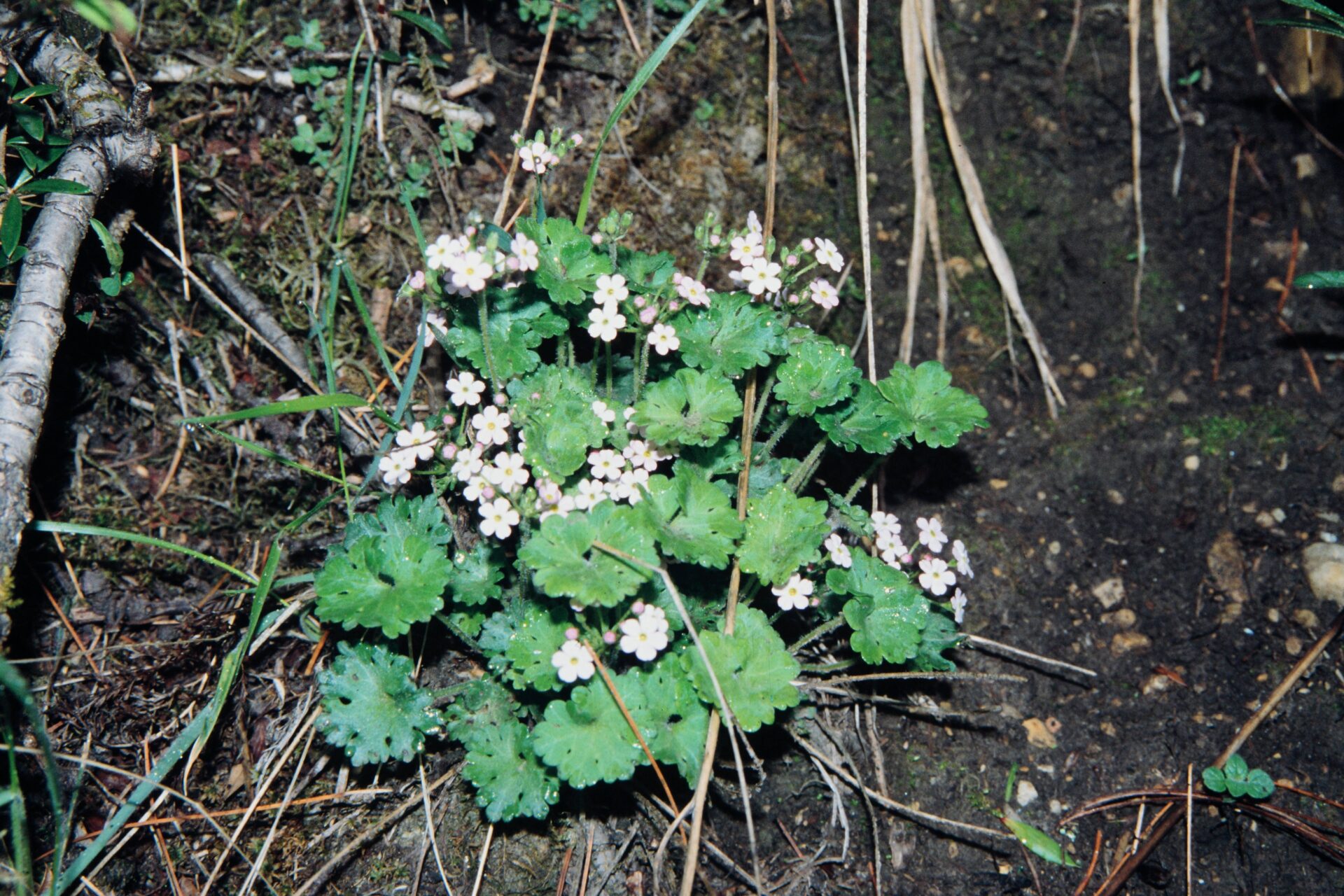
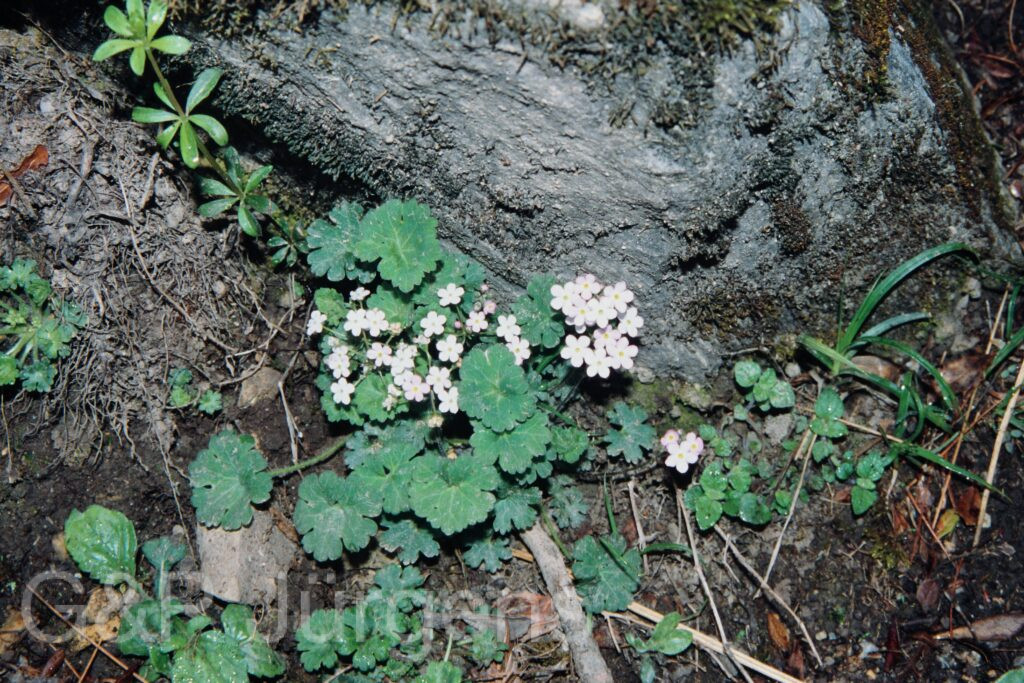
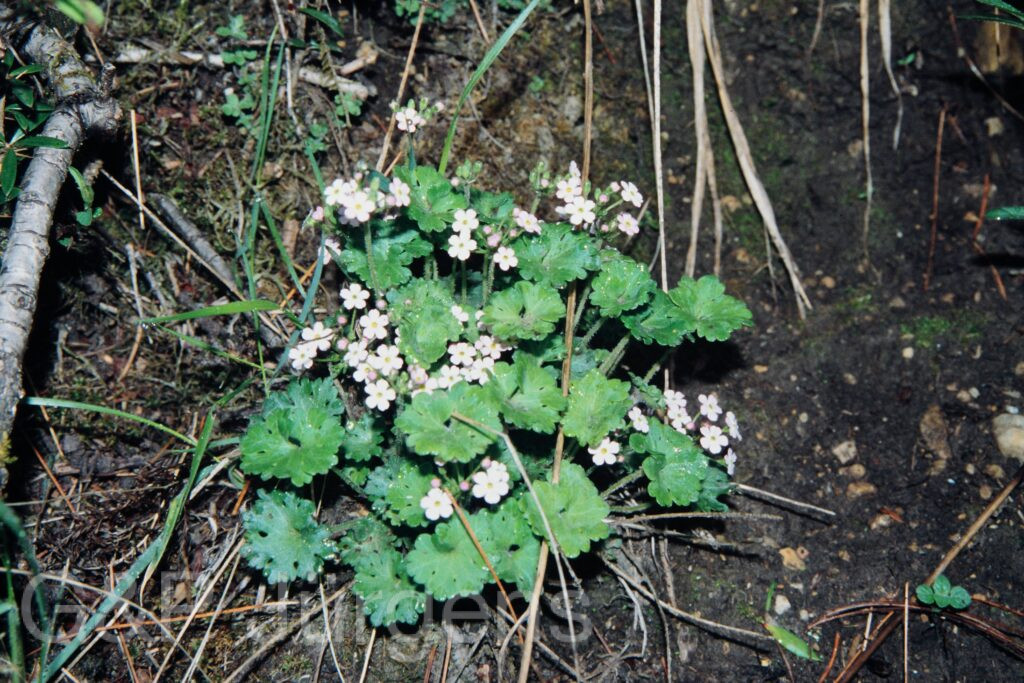
A perennial rock-jasmine distributed along the Himalaya and into south-western China, with verified records from Pakistan, India, Nepal, China and Afghanistan among nearly 600 GBIF occurrences (several extra-range entries reflect cultivation or misregistration). It favours shaded, humus-rich banks, mossy boulders, forest margins and damp cliff faces in the temperate and subalpine zones, generally between about 2000 and 3500 m. The illustrated plant was recorded in June at Chere in western Nepal at around 2850 m, a moist, partly shaded montane setting characteristic of the species.
Unlike the tight cushion androsaces, A. rotundifolia is a softly hairy, loosely tufted herb with a slender creeping or ascending rootstock. The leaves form a basal rosette and are distinctive in the genus: long-petiolate with a rounded to reniform, palmately lobed and crenate-toothed blade, sparsely pilose on both surfaces. From the rosette arises a slender, hairy scape bearing an umbel of several flowers, each subtended by small bracts. The corolla is salverform with a short tube and five spreading pink to rose lobes constricted at a small throat eye; five stamens are included, and the superior ovary ripens into a small globose, few-seeded capsule dehiscing by valves.
The broad, rounded, lobed leaves separate this species from most relatives and align it with a small group of woodland-dwelling rock-jasmines. As an accepted species (per GBIF and POWO) it is taxonomically stable. Ecologically it is an indicator of moist, sheltered montane habitats and contributes to early-summer flowering at forest edges. Widespread and locally frequent across its Himalayan range, it is of no particular conservation concern, though dependent on the persistence of undisturbed shaded substrates.
Author: Hardw. · Sources: POWO (Kew), GBIF, Flora of Nepal, Flora of Pakistan, Smith and Lowe monograph of Androsace