
Balf.f. & W.W.Sm.
Description
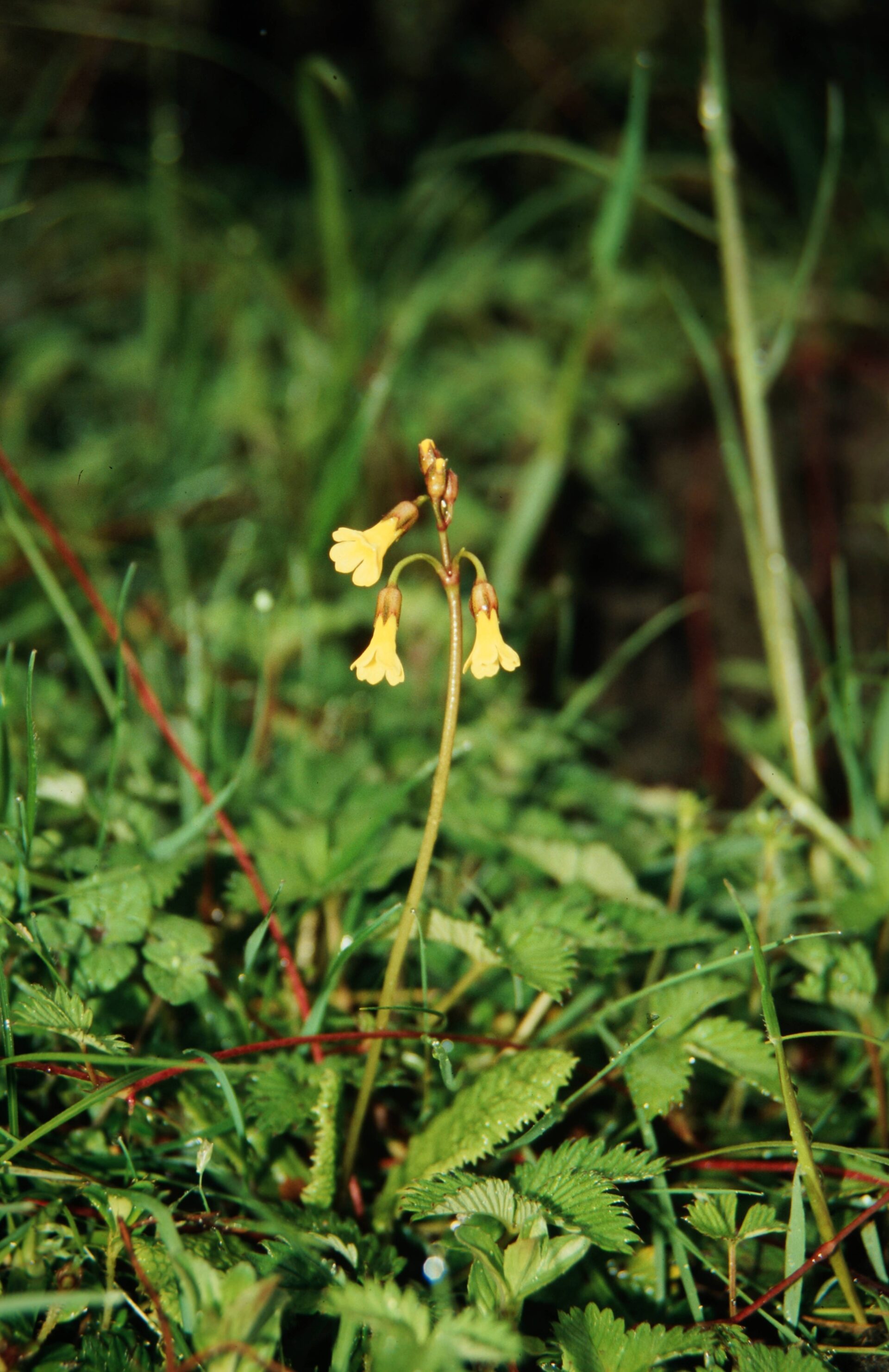
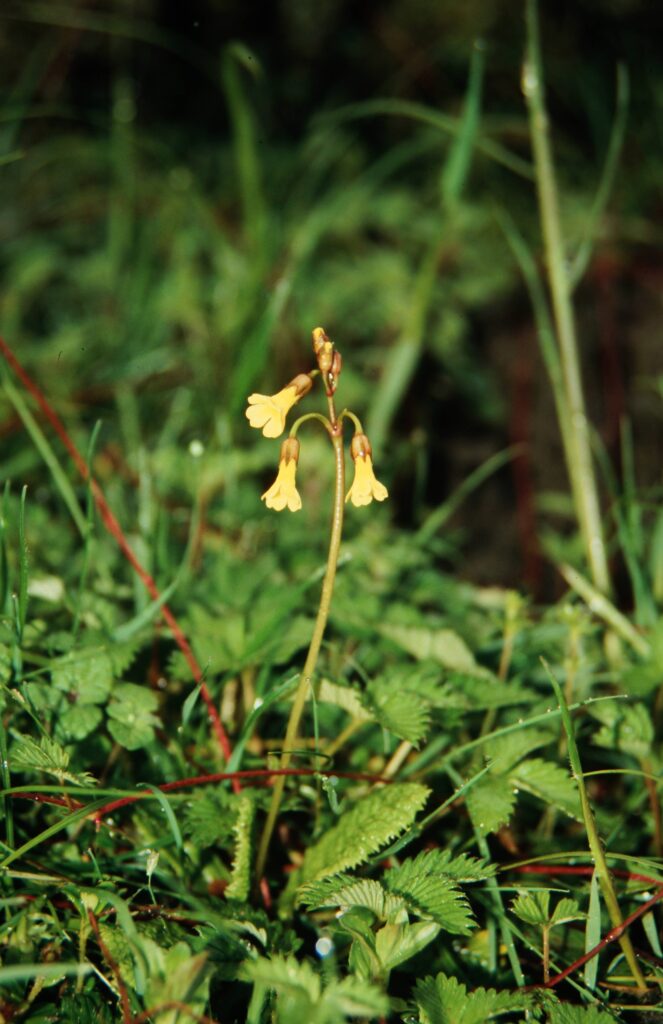
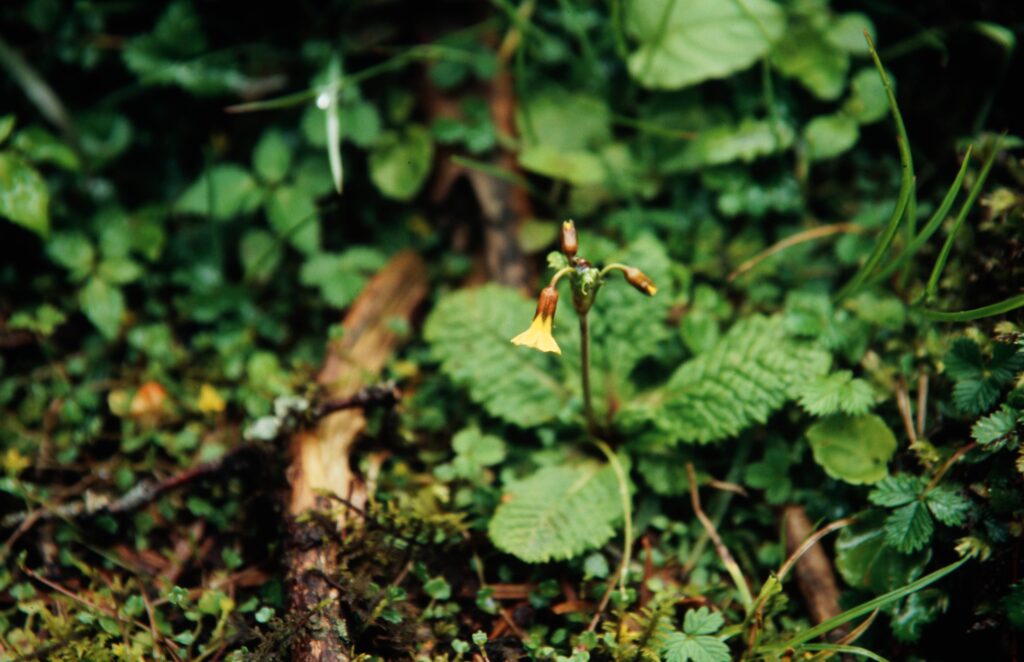
Primula prenantha is a small perennial herb distributed across the eastern Himalaya and adjacent mountains, with GBIF recording it from China, India, Myanmar, Nepal and Bhutan across some 93 georeferenced occurrences. It is a plant of moist, cool montane habitats, favouring stream margins, seepage slopes, wet meadows and the edges of evergreen and mixed broad-leaved forest, typically between about 2400 and 3600 m. The photographed population at Tamrong in West Bengal, at roughly 2750 m, flowering in May, is characteristic of this damp temperate belt where snowmelt keeps the ground saturated through the early growing season.
The plant forms a small basal rosette arising from a short rhizome with fibrous roots. The leaves are obovate to oblong-spathulate, narrowing gradually into a winged petiole, with a crenate to denticulate margin and an obtuse apex; the lamina is thin, glabrous and not farinose. From the rosette rises a slender erect scape bearing a terminal umbel of few to several nodding flowers subtended by small linear bracts. The flowers are heterostylous; the calyx is tubular-campanulate and lobed, and the corolla is yellow with a narrow tube and spreading, often emarginate lobes forming a flat or slightly cupped limb. The fruit is a small cylindrical capsule that dehisces by apical valves to release numerous minute seeds.
The species belongs to Primula section Sikkimensis (in the broad sense, allied to the yellow-flowered Petiolares-Sikkimensis assemblage), a group centred on the Sino-Himalayan region whose diversification tracks the uplift of the Himalaya and the associated humid monsoon gradients. Its dependence on cool, perennially moist microhabitats makes it sensitive to changes in snowpack and montane hydrology, and like many Sino-Himalayan primulas it is locally rather than broadly distributed. It is not currently regarded as globally threatened, but its narrow ecological tolerance warrants attention under warming and drying climatic scenarios.
Author: Balf.f. & W.W.Sm. · Sources: POWO (Kew), GBIF, Flora of China, Flora of Bhutan, Annotated Checklist of the Flowering Plants of Nepal, John Richards "Primula" (monograph)