Euphorbiaceae

Müll.Arg.

Bhutan2012 684
Bhutan Tserang 850m, September

Description

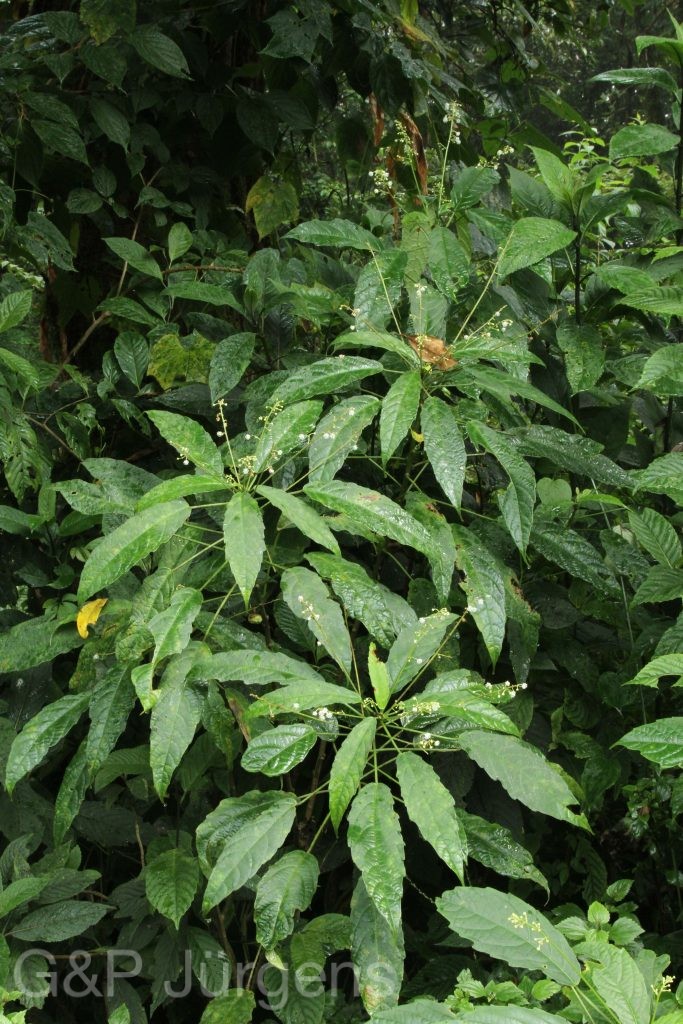
Baliospermum calycinum is a broadly distributed spurge of the Indo-Himalayan and Southeast Asian region, with more than 550 georeferenced occurrences across China, Thailand, India, Myanmar, Nepal, Vietnam, Bhutan, Laos and Bangladesh. It is a plant of warm, subtropical forest margins, scrub, ravines and disturbed ground at low to moderate elevations. The specimen recorded near Tsirang (Tserang) in southern Bhutan at about 850 m in September reflects its typical lowland habitat, fruiting toward the end of the monsoon on moist, fertile soils in partly shaded settings.

It is a monoecious, somewhat woody undershrub or robust herb exuding a watery to milky sap typical of the Euphorbiaceae. The leaves are alternate, large, the lower ones often broadly ovate and palmately lobed while the upper become narrower and merely toothed, with glandular teeth and a serrate margin. The small, apetalous unisexual flowers are borne in axillary racemiform inflorescences, with female flowers below and numerous male flowers above; the species is distinguished by its conspicuously developed, persistent calyx. The fruit is a three-lobed schizocarpic capsule splitting into three two-valved cocci that eject the smooth, mottled seeds.

Within Euphorbiaceae the genus Baliospermum comprises a small number of Asian species long valued in traditional medicine for the purgative and irritant properties of the seed oil. Taxonomic confusion with related taxa such as B. montanum has historically obscured its limits, and modern treatments rely on calyx, leaf-lobing and capsule characters for separation. Common and weedy across its wide range, it is of least conservation concern.

Author: Müll.Arg. · Sources: POWO (Kew), GBIF, Flora of Bhutan, Flora of China, Flora of British India, Radcliffe-Smith's account of Euphorbiaceae
Hook.f.

Bhutan2014 976
Bhutan Chele-La 3400m, May
Bhutan2014 397
Bhutan Chele-La 3400m, May
Bh09 245 P408
Bhutan 2009

Description

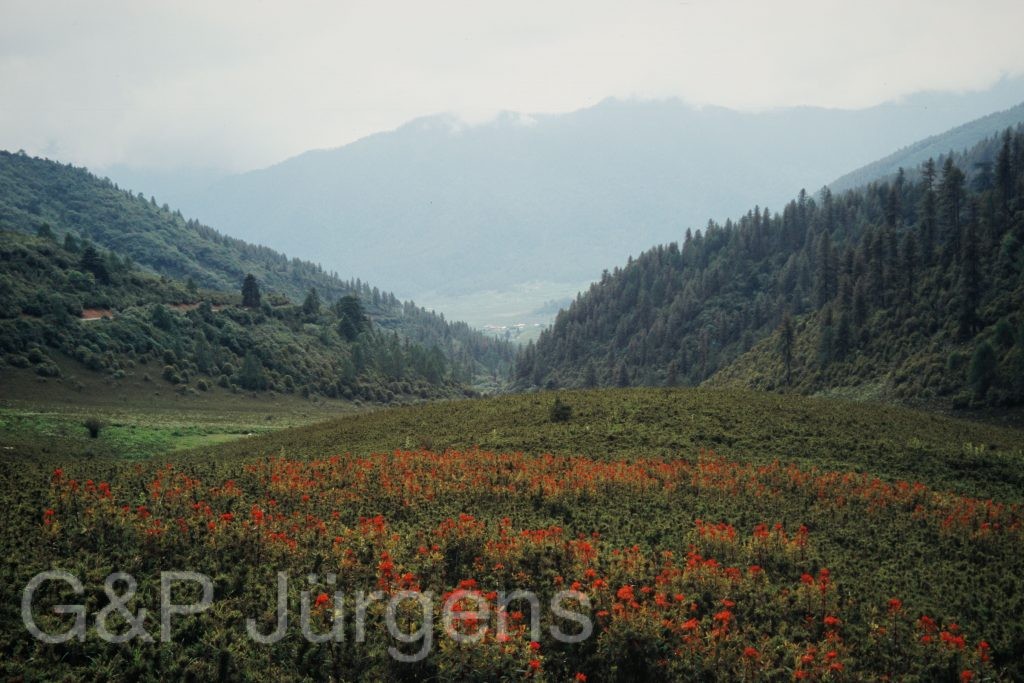
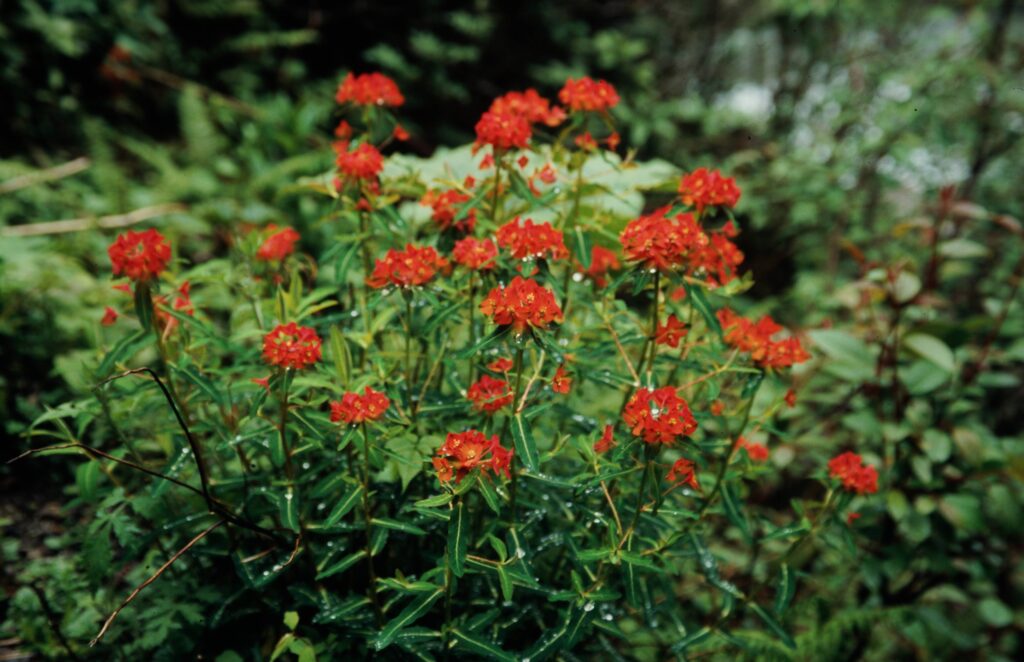
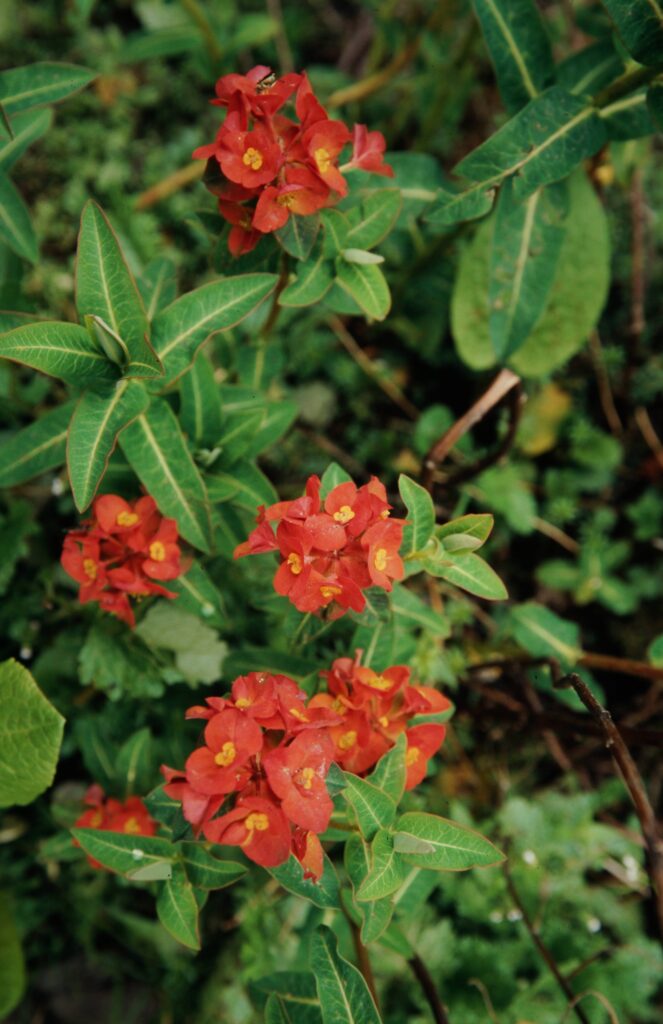
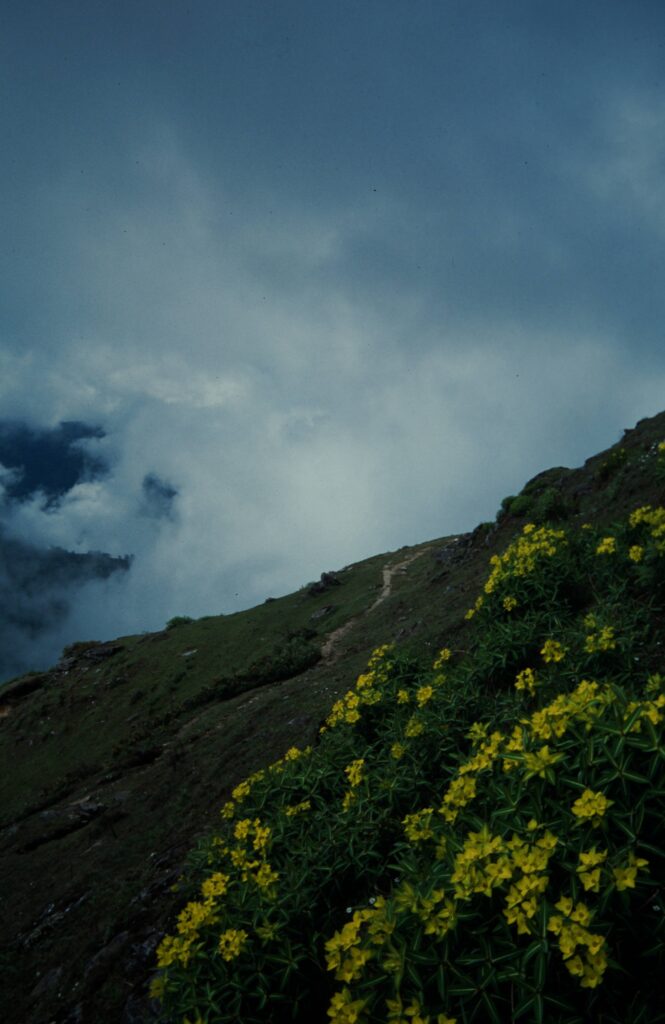
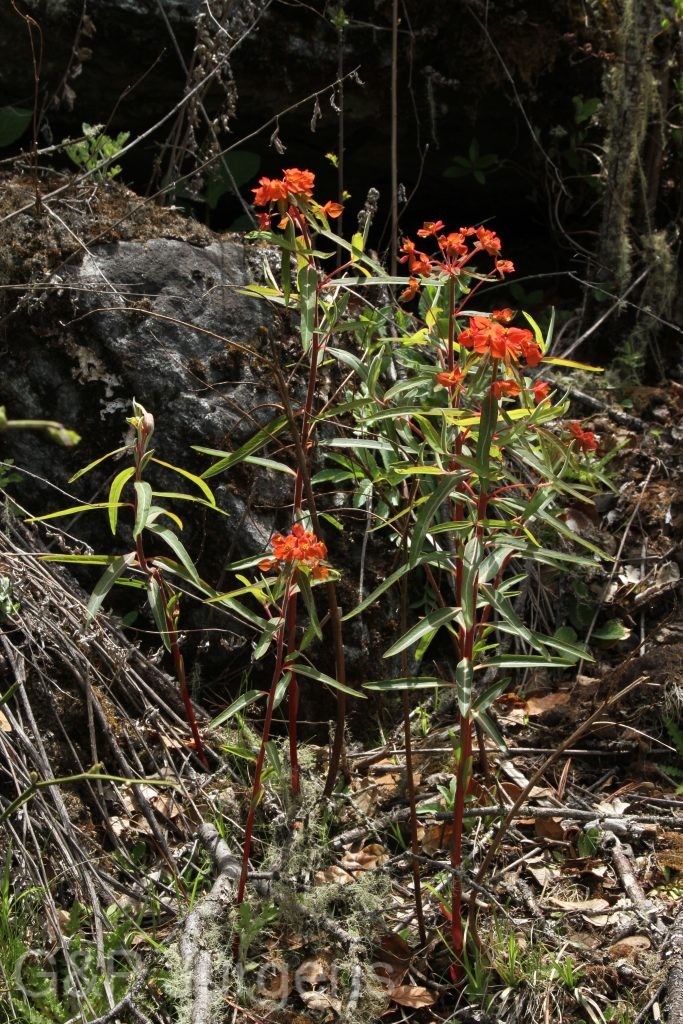
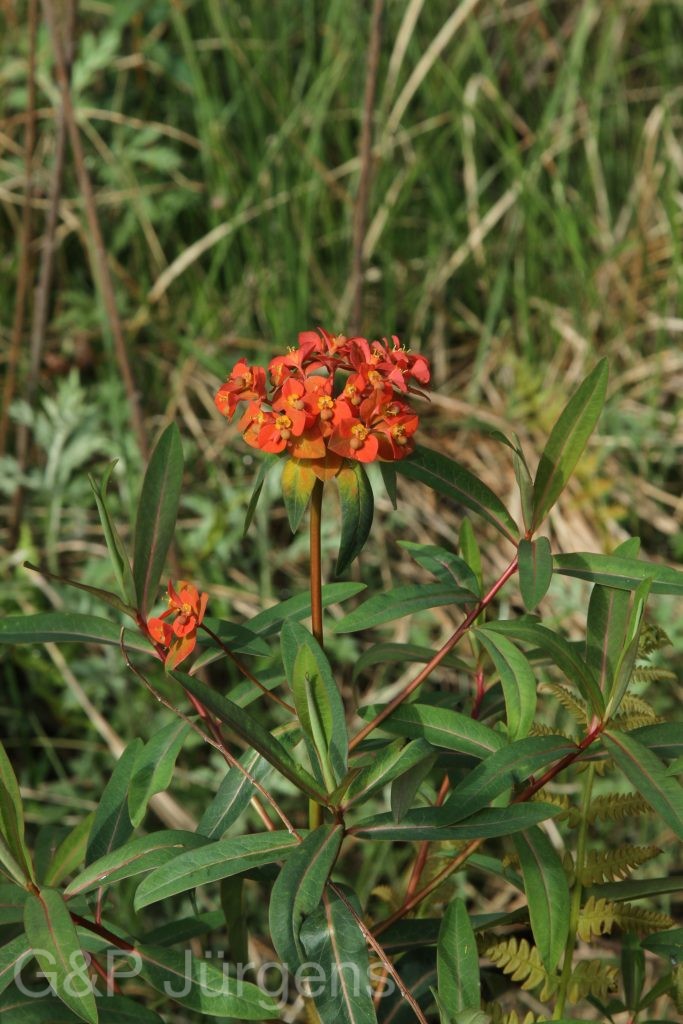
Euphorbia griffithii is a herbaceous perennial spurge of the eastern Himalayan mountains, with 538 GBIF occurrences spanning China, Bhutan, Myanmar, India and Nepal, alongside numerous cultivated records from Britain, Germany, France and North America, reflecting its popularity as a hardy garden perennial. It grows in open subalpine meadows, forest clearings, scrub and grassy slopes in the upper temperate to subalpine zone. It was recorded on the Chele-La in Bhutan at about 3400 m and at Tamrong in West Bengal, India, at about 2650 m, both in May, when the bracts colour vividly at the start of the growing season.

It is an erect, clump-forming herb arising from a creeping rhizome, the unbranched or sparingly branched stems exuding white latex when cut. The leaves are alternate, oblong to oblanceolate, entire, often flushed reddish and frequently with a pale midrib. The inflorescence is a terminal umbel-like cyme of cyathia, each cyathium a cup of fused bracts enclosing reduced flowers; the floral leaves and bracts beneath the cyathia turn fiery orange-red, providing the conspicuous display, while the involucral glands are typically yellowish. The fruit is a three-lobed capsule splitting into mericarps.

Euphorbia (Euphorbiaceae) is one of the largest plant genera, and E. griffithii belongs to its temperate, rhizomatous, herbaceous element rather than the succulent xerophytes. Long in cultivation, with selections such as the well-known coloured-bracted cultivars, it is widespread and secure across its native range. Its brilliant bract colouration and montane meadow habitat make it both a horticulturally important and biogeographically representative member of the eastern Himalayan herbaceous flora.

Author: Hook.f. · Sources: POWO (Kew), GBIF, Flora of China, Flora of Bhutan, Annotated Checklist of the Flowering Plants of Nepal, Radcliffe-Smith's treatment of Euphorbia (Euphorbiaceae)

(Hurus. & Tanaka) Radcl.-Sm.

Sikkim 2006 323 ergebnis
India Sikkim Ringi-Chu 2250m, May
Sikkim 2006 464 ergebnis
India Sikkim Ringi-Chu 2250m, May
Sikkim 2006 324 ergebnis
India Sikkim Ringi-Chu 2250m, May

Description

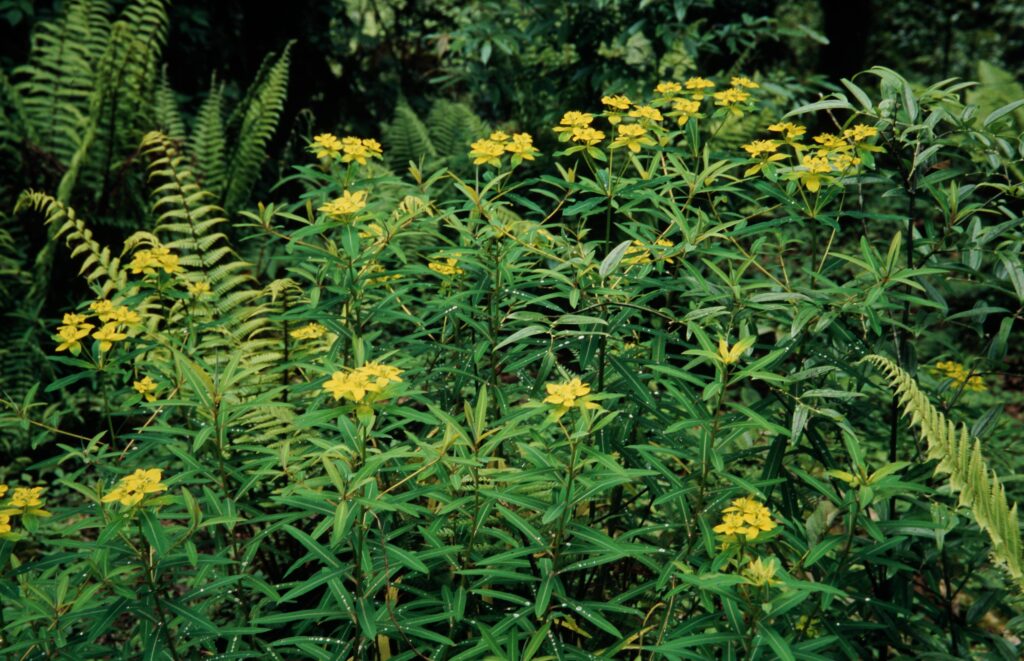
Euphorbia pseudosikkimensis is a robust perennial spurge native to the eastern Himalayas, occurring in Nepal, Sikkim, Bhutan, and adjacent parts of China. It inhabits moist forests, forest clearings, and stream banks at 1,800–3,000 m.

The plant forms tall, erect stems up to 1.5 m high, with whorled, oblong-lanceolate leaves that are dark green above and paler beneath. The inflorescence is a large, showy cyathium with conspicuous bright yellow-green glands, giving the impression of striking yellow flowers in spring. Like all Euphorbia species, it exudes a milky white latex when stems or leaves are broken.

In traditional medicine of the region, the latex has been used cautiously as a purgative, though it is irritant and toxic in larger quantities. The species is sometimes confused with E. sikkimensis, from which it differs in leaf shape and gland morphology.

Author: (Hurus. & Tanaka) Radcl.-Sm. · Sources: POWO (Kew), Flora of Bhutan, eFlora of China

Boiss.

Bhutan2014 202
Bhutan Trashyangtse 2100m, May
Bhutan2014 203
Bhutan Trashyangtse 2100m, May
Nepal 2001 516 ergebnis ergebnis
Nepal (Gorkha) Mulabari 1340m, May

Description

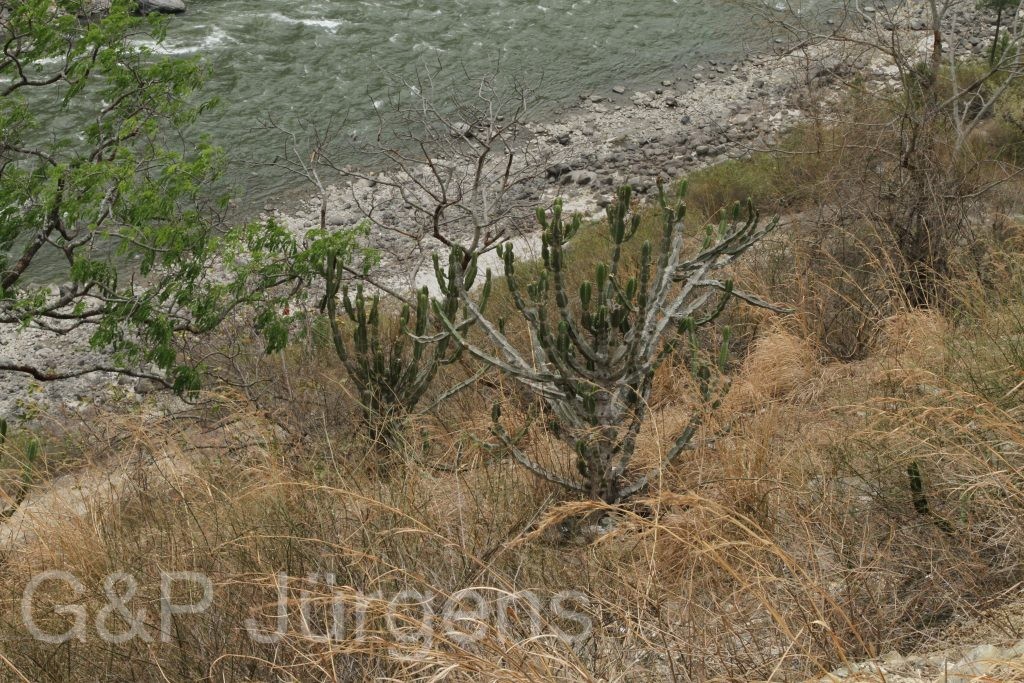
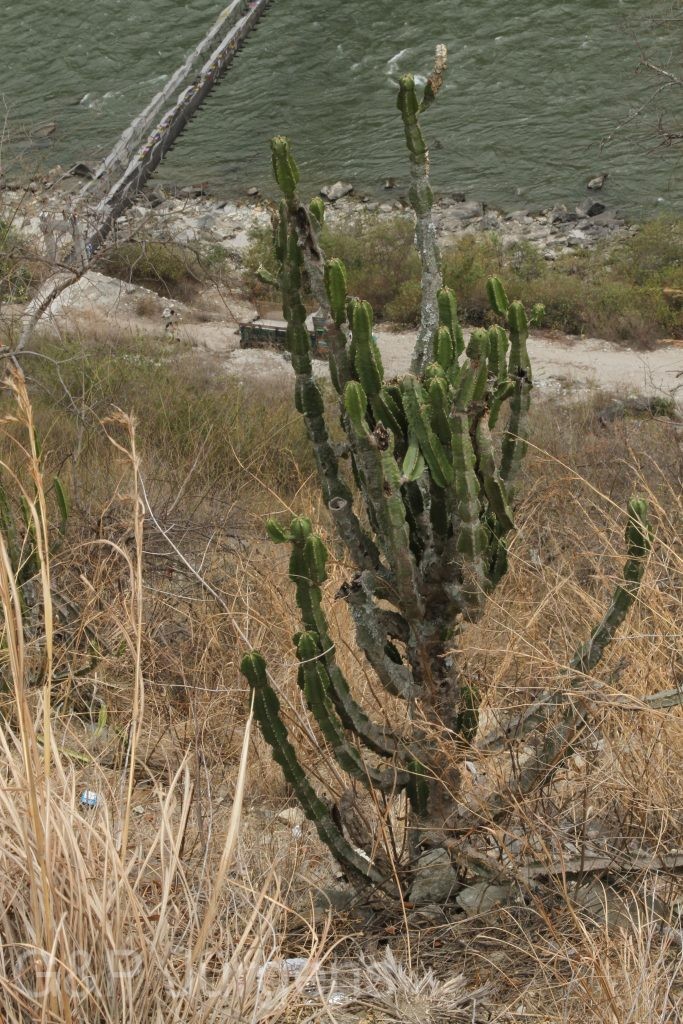
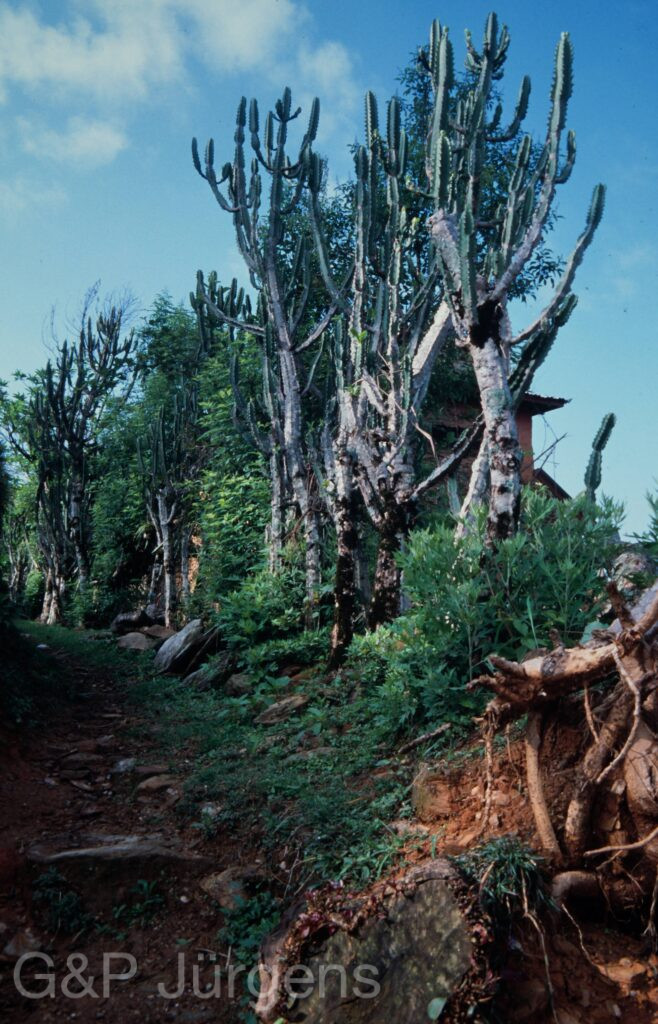
Euphorbia royleana is a succulent, tree-like spurge of warm, dry valleys across the Himalaya and adjacent regions. With 148 GBIF occurrences, it ranges through Nepal, India, China, Pakistan and Bhutan, with cultivated or introduced records noted elsewhere including Belgium, Egypt and the United States, reflecting its use as an ornamental and hedge plant. It is characteristic of hot, semi-arid slopes, rocky hillsides and degraded scrub in the subtropical to lower temperate zone, often on south-facing rain-shadow exposures. It was recorded at Trashyangtse in Bhutan at about 2100 m and at Mulabari in Gorkha, Nepal, at about 1340 m, both in May.

It is a stout, cactus-like succulent shrub or small tree with a short woody trunk and erect, candelabriform branches that are fleshy, grey-green and obtusely five- to seven-angled. Paired, short stipular spines arise on the angles, subtending small, fugacious leaves clustered near the branch tips. As in all Euphorbia the inflorescence is a cyathium: cup-like involucres bearing nectar glands enclose the reduced unisexual flowers, here borne in small cymose clusters and yielding the abundant caustic white latex typical of the genus. The fruit is a three-lobed capsule splitting into three mericarps.

Euphorbia (Euphorbiaceae) is among the largest of all plant genera, and E. royleana belongs to its succulent, xerophytic Old World element adapted to seasonal aridity. Long valued in the region for living fences and traditional medicine, it is widely planted, and its milky latex is irritant and toxic. The species is not of conservation concern, being common and frequently cultivated, but it is an important structural and biogeographic component of dry inner-Himalayan valley vegetation.

Author: Boiss. · Sources: POWO (Kew), GBIF, Flora of China, Flora of Pakistan, Annotated Checklist of the Flowering Plants of Nepal, Boissier's monograph of Euphorbia in de Candolle's Prodromus

Boiss.

Nepal 2001 302 ergebnis ergebnis
Nepal (Gorkha) Lambra Kharka 3100m, May
Nepal 2001 301 ergebnis
Nepal (Gorkha) Lambra Kharka 3100m, May
Nepal 97 86 P146
Nepal Tankhu 2100m April

Description

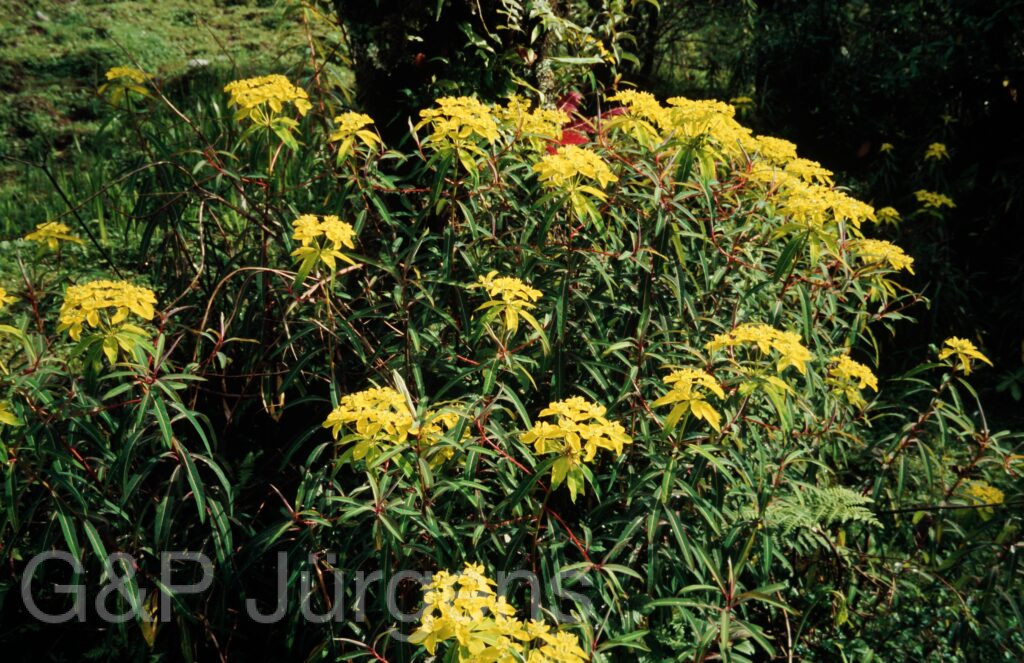
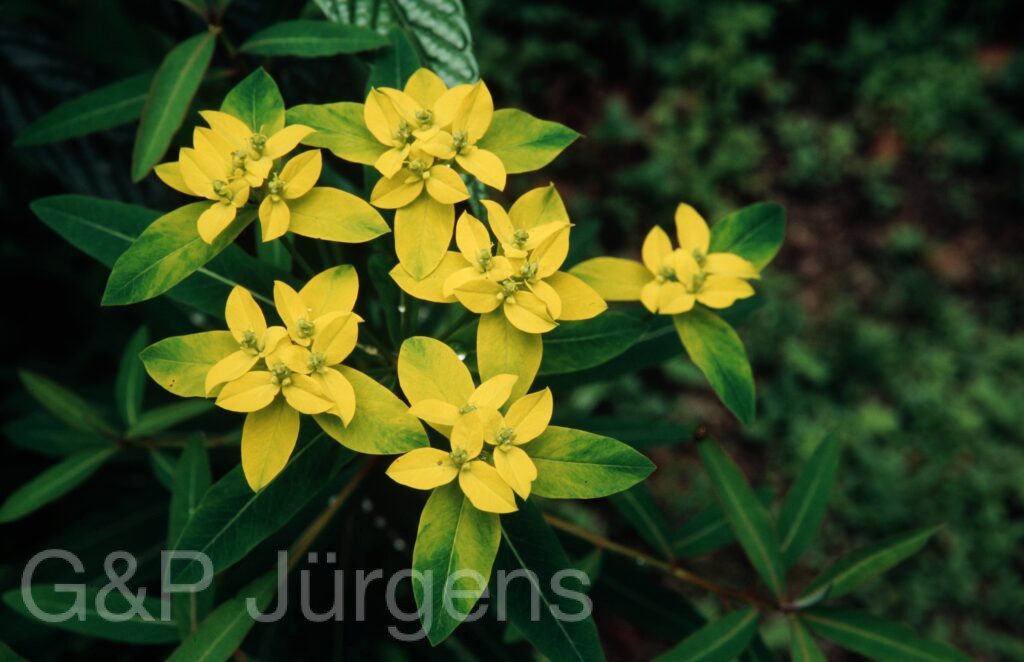
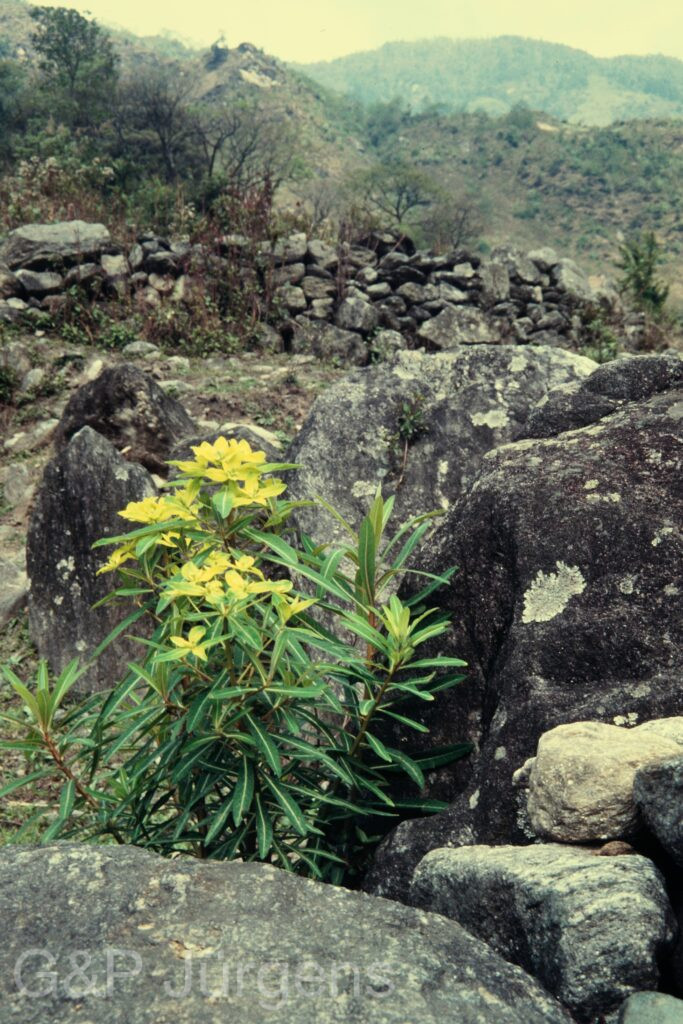
Euphorbia sikkimensis is a robust herbaceous spurge distributed across the eastern and central Himalaya, from central Nepal through Sikkim, Bhutan, and northeast India into southern China (Xizang, Yunnan), with peripheral records from Myanmar, Laos, and Vietnam. It occurs in subalpine meadows, forest clearings, scrub margins, and open hillsides at elevations of 1,800–3,500 m. The species has been documented from the Gorkha district of Nepal at Lambra Kharka at 3,100 m in May and near Tankhu at 2,100 m in April, indicating a broad elevational amplitude and early-season phenology at lower altitudes.
The plant is a stout, erect perennial herb, 30–80 cm tall, with thick, fleshy rootstock and unbranched or sparingly branched stems that exude copious white latex when cut. Leaves are alternate, sessile, linear-lanceolate to oblanceolate, 8–15 cm long and 1–2.5 cm wide, with a prominent pale midrib, entire margins, and a glaucous undersurface. The inflorescence is a terminal, compound cyathium typical of the genus, with a broad umbel of 4–8 primary rays, each ray subtended by obovate, yellowish-green floral bracts. The cyathia bear crescent-shaped glands with short horns. The fruit is a smooth, trilocular capsule approximately 6–8 mm in diameter, explosively dehiscent at maturity, with carunculate seeds.
Euphorbia sikkimensis was described by Boissier from Sikkim collections and belongs to Euphorbia subgenus Esula, a predominantly Eurasian clade of herbaceous spurges. It is notable for its striking appearance in early spring, when the bright red or pink-tinged new stems contrast with the yellowish-green inflorescences. The species has gained horticultural recognition in temperate gardens and is increasingly cultivated as an ornamental perennial in Europe. Ecologically, its copious latex deters herbivory, and it plays a role in early-season pollinator support in montane grassland ecosystems.

Author: Boiss. · Sources: POWO (Kew), GBIF, Flora of China Vol. 11, Annotated Checklist of the Flowering Plants of Nepal

Müll.Arg.

Bhutan2015 199
Bhutan, Zhemgang 910m, October
Bhutan2015 557
Bhutan, Punaka 1240m, October
Bhutan2015 556
Bhutan, Punaka 1240m, October

Description

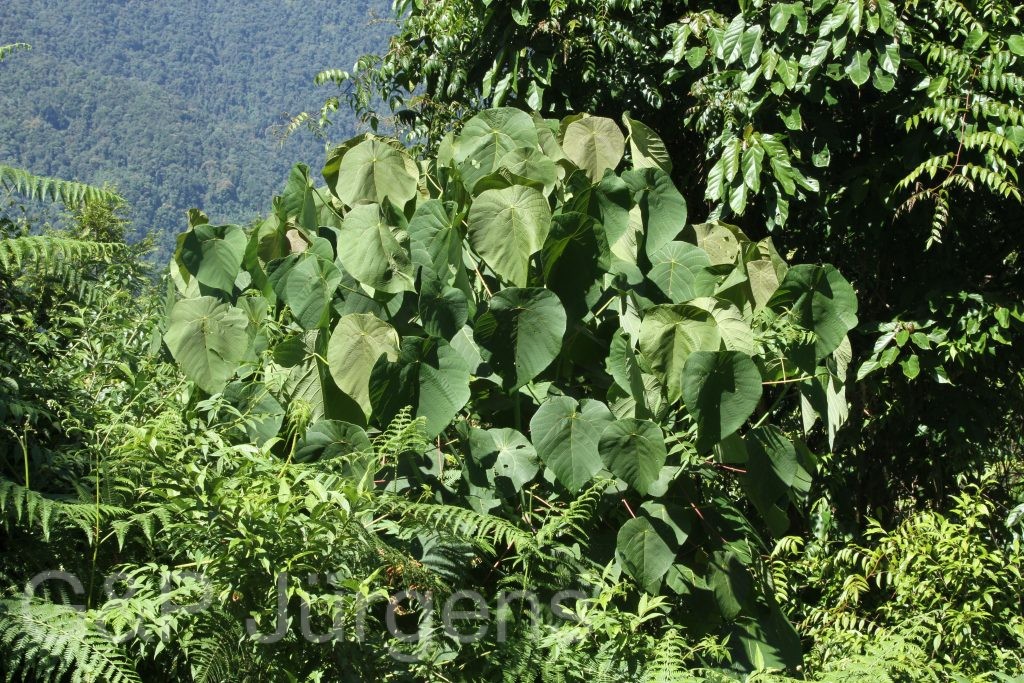
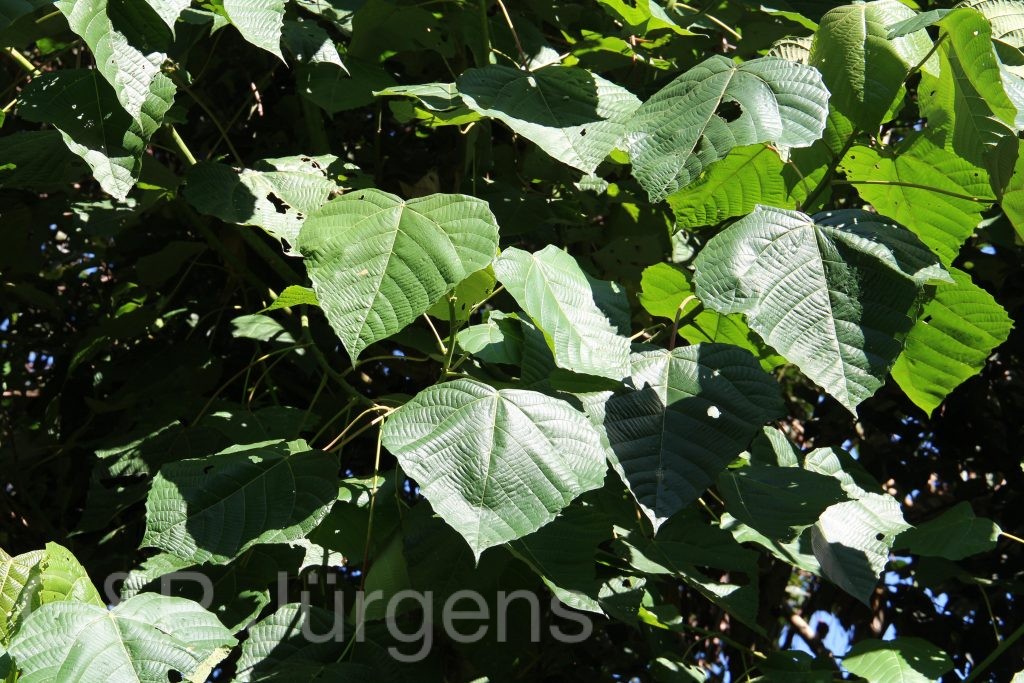
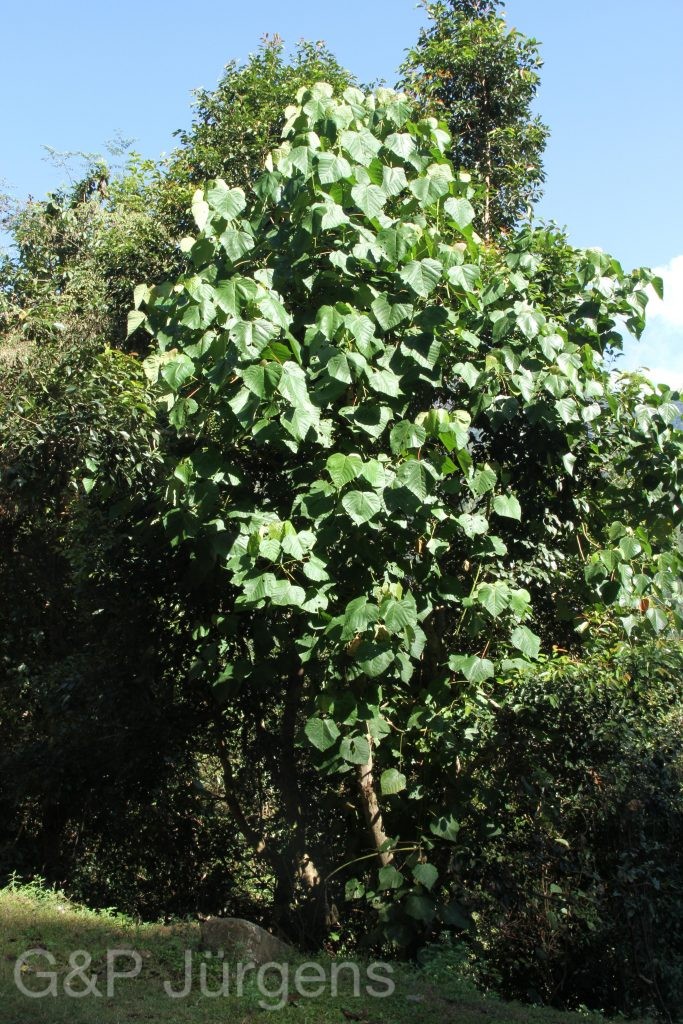
Macaranga denticulata is a fast-growing pioneer tree with a wide tropical and subtropical Asian distribution, its 1451 georeferenced occurrences spanning China, India, Nepal, Bhutan, Bangladesh, Myanmar, Thailand, Vietnam, Laos, Cambodia, Malaysia, Indonesia, the Philippines and beyond. It is a characteristic colonist of disturbed ground, forest gaps, road cuttings, secondary forest and abandoned swidden plots in warm, humid foothill country. The records from Zhemgang at 910 m and Punakha at 1240 m in Bhutan in October place it firmly in the low-elevation subtropical zone where it regenerates rapidly after disturbance and forms early-successional thickets and woodland.

The plant is a small to medium evergreen tree with smooth bark and somewhat whorled, spreading branches. The leaves are large, alternate, peltate or subpeltate, broadly ovate to triangular with a denticulate margin reflected in the epithet, palmately veined, and often bearing glands and pale tomentum beneath. As a member of the Euphorbiaceae it is dioecious, the small apetalous flowers borne in branched axillary inflorescences subtended by toothed or glandular bracts; male and female flowers occur on separate trees. The fruit is a small two-lobed capsule, the seeds often associated with a fleshy aril attractive to birds and ants.

Macaranga is a large palaeotropical genus famous for its myrmecophytic (ant-associated) species and its ecological role as a pioneer. M. denticulata is a non-myrmecophytic but ecologically important coloniser, valued for rapid biomass accumulation, soil stabilisation and as a nurse species in fallows. Its enormous range, abundance and affinity for disturbed habitats make it among the most secure and widespread trees in its family across tropical Asia.

Author: Müll.Arg. · Sources: POWO (Kew), GBIF, Flora of China, Flora of Bhutan, Revision of Macaranga (Euphorbiaceae) (Whitmore and successors), Trees of tropical Asia

Blume

Bhutan2015 194
Bhutan Zhemgang 1000m, October
Bhutan2015 195
Bhutan Zhemgang 1000m, October

Description

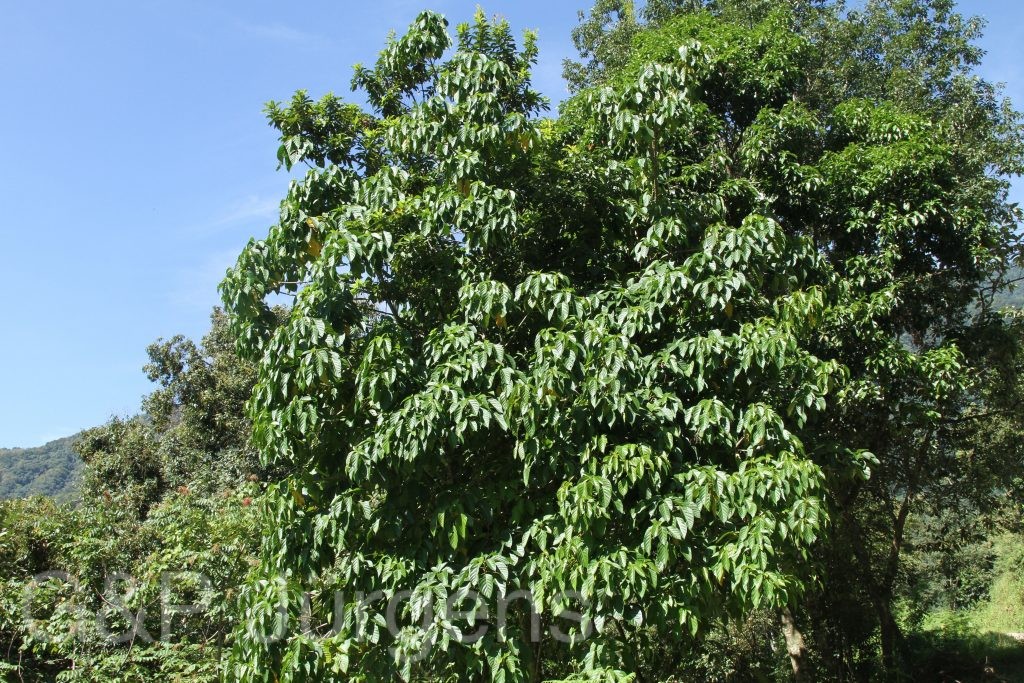
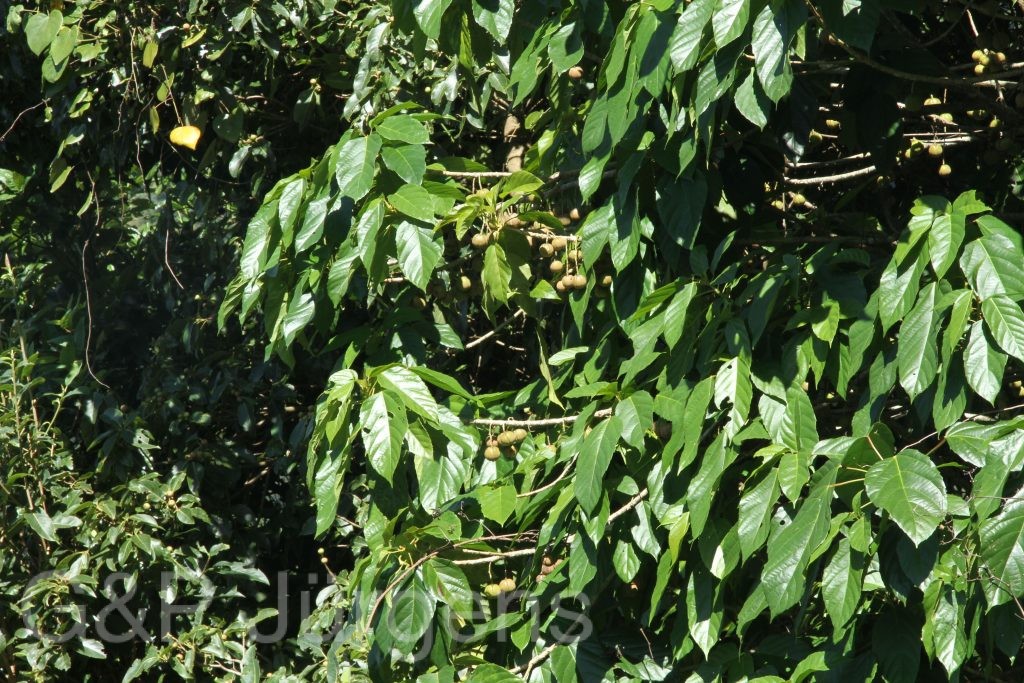
Ostodes paniculata is a tree or large shrub widely distributed through tropical and subtropical Asia, recorded by GBIF from China, Indonesia, Thailand, India, Myanmar, Vietnam, Nepal, Bhutan, Laos, Cambodia, Malaysia and Korea across more than 1100 occurrences. It is a component of evergreen and semi-evergreen broad-leaved forest in warm, humid lowland and lower montane settings, usually below about 1500 m, often on hillslopes and in valley forest. The photographed individual from Zhemgang in southern Bhutan at about 1000 m, in October, reflects this warm-temperate to subtropical foothill habitat where the species reaches the northern margin of its range along the Himalayan front.

The plant is a monoecious, evergreen tree with smooth bark and a milky or watery exudate. The leaves are alternate, simple, broadly elliptic to ovate, long-petiolate with a pair of glands at the petiole apex, the margin serrate to glandular-toothed and the base often with a few prominent basal nerves. The inflorescences are terminal panicles bearing numerous small white to creamy flowers, the staminate and pistillate flowers separate, with five petals and conspicuous disk glands; staminate flowers have numerous stamens. The fruit is a globose, three-locular capsule, somewhat woody, that splits septicidally to release the large smooth seeds.

Ostodes is a small genus of the Euphorbiaceae (subfamily Crotonoideae) centred on tropical Asia, and O. paniculata is its most widespread and well-known species, valued locally for its timber and seed oil. Its broad range and tolerance of secondary forest mean it is not of conservation concern, and it is frequent across much of Indo-Malaya. Phytogeographically it exemplifies the Indo-Malayan element that penetrates the Himalaya through the warm, wet foothill forests of Bhutan and northeast India.

Author: Blume · Sources: POWO (Kew), GBIF, Flora of China, Flora of Bhutan, Flora of Thailand, Radcliffe-Smith Euphorbiaceae treatments