
Boiss.

Description
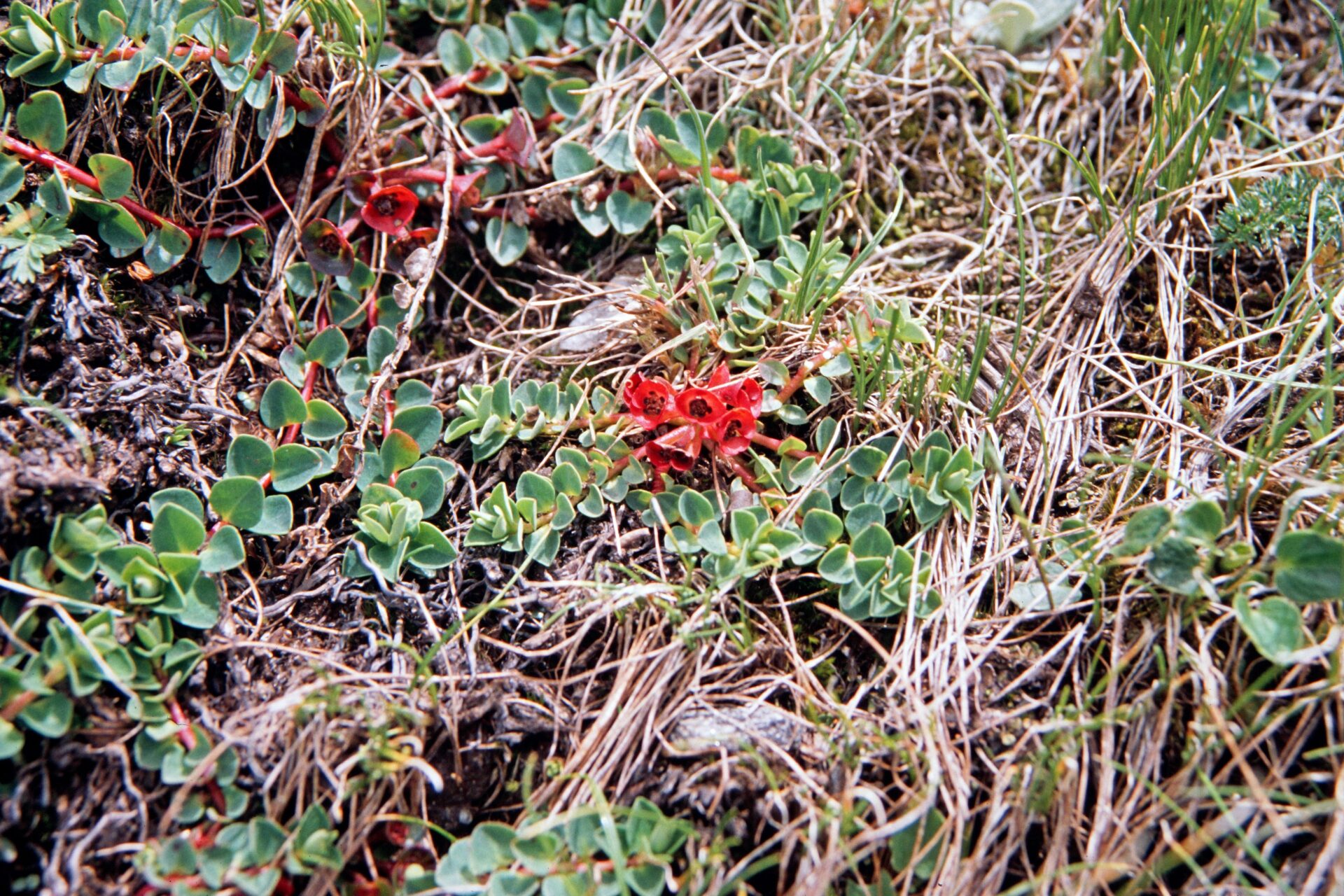
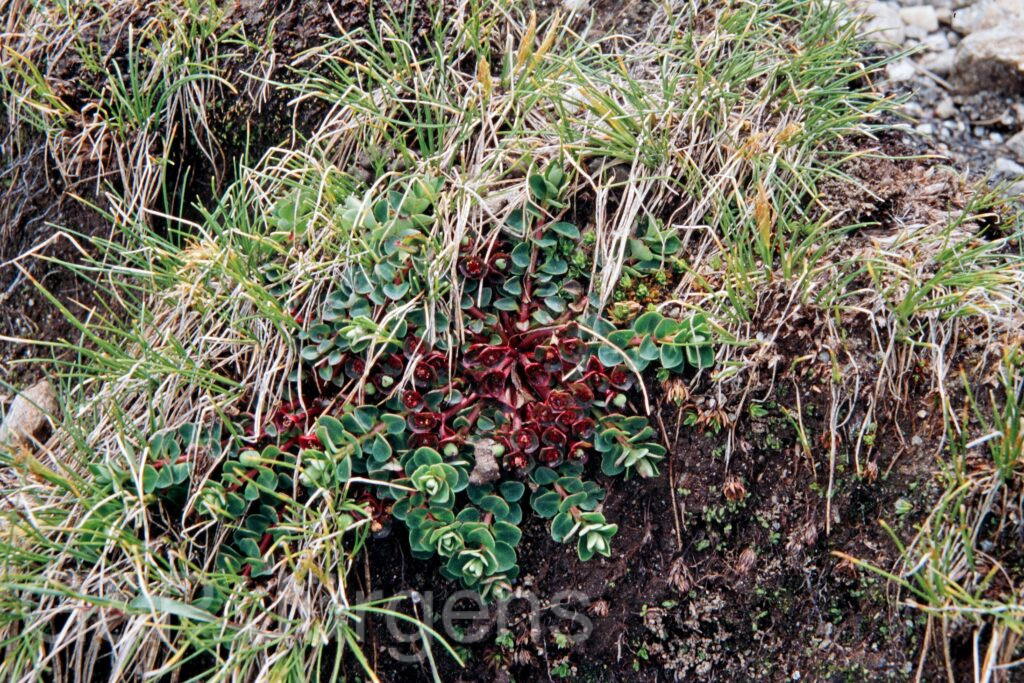
Euphorbia stracheyi is a widespread high-altitude spurge of the Himalaya and the Tibetan Plateau, distributed from Nepal, northern India and Bhutan eastward into SW China, with outlying records southeast to Laos and Vietnam. The GBIF dataset, with around 946 occurrences across CN, NP, IN, BT, LA and VN, confirms this broad Sino-Himalayan range. The plant shown was photographed in western Nepal at Kalmura at about 4,200 m in June. It is a true alpine, growing on open stony slopes, gravelly pastures, moraine and turf between roughly 3,000 and 4,800 m, where its prostrate, mat-forming habit suits the cold, exposed and seasonally snow-covered ground.
The species arises from a slender, often elongate creeping rhizome bearing numerous decumbent to ascending reddish stems. The leaves are small, alternate, obovate to oblong and entire. As in all Euphorbia, the inflorescence is a cyathium: the apparent flowers are condensed pseudanthia in which crescent-shaped or transversely elliptic nectar glands surround reduced unisexual flowers, the female reduced to a single stalked tricarpellate ovary and the males to single stamens, the whole subtended by leafy, often reddish-tinged bracts. The fruit is a smooth three-lobed schizocarpic capsule that splits into three mericarps, releasing ovoid seeds; the plant exudes the milky latex typical of the genus.
Euphorbia stracheyi belongs to the subgenus Esula, a group of herbaceous spurges well represented at high elevations across central Asia. Its dwarf, cushion-like form and reddish coloration are adaptations to intense radiation and short growing seasons. The caustic latex deters herbivory and the species is locally common; it is not considered threatened, though like all Euphorbia it falls under CITES listing of the genus for trade-monitoring purposes.
Author: Boiss. · Sources: POWO (Kew), Flora of China Vol. 11, Flora of Bhutan Vol. 1, GBIF, Radcliffe-Smith: Euphorbia in the Flora of Pakistan