Orobanchaceae

L.

Bhutan2012 456
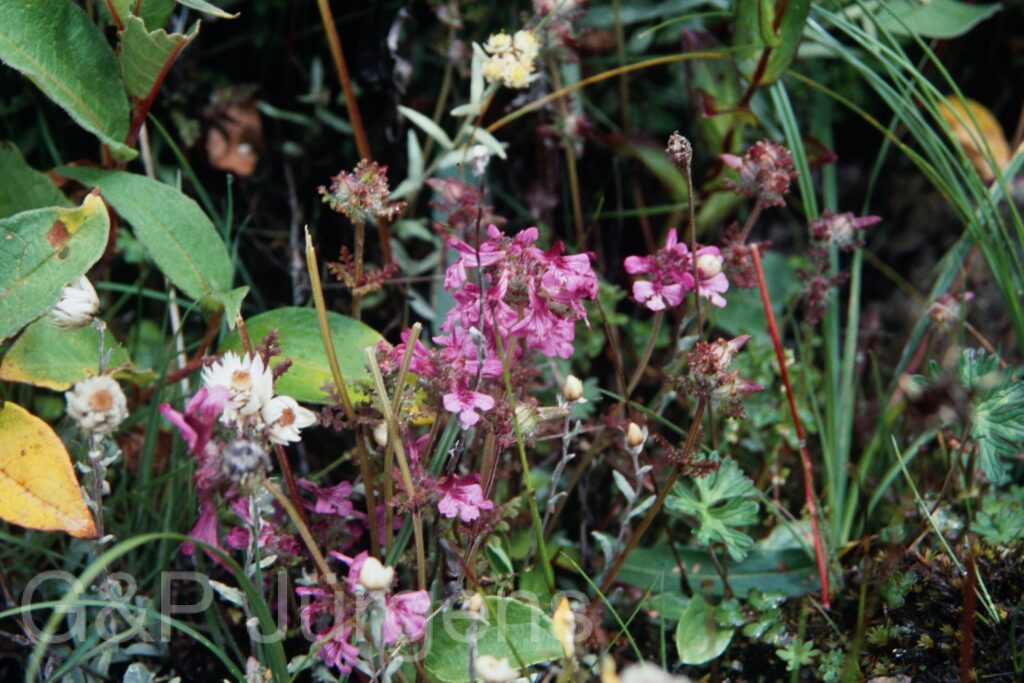
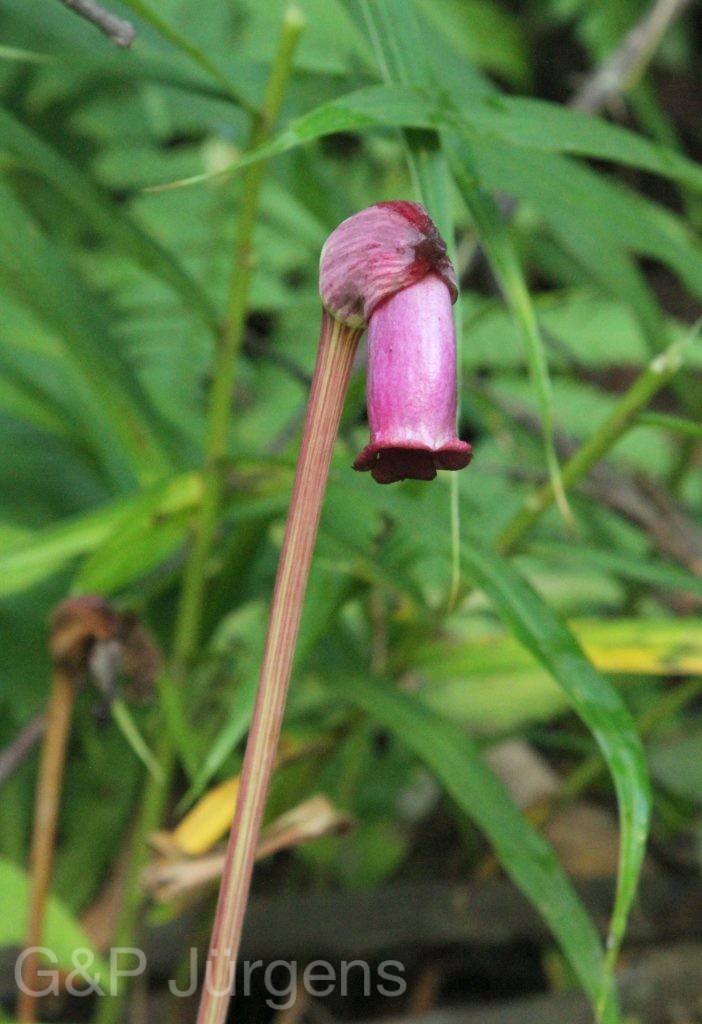
Bhutan Wangdi 2500m, September
Nepal 95 63 P106 ergebnis
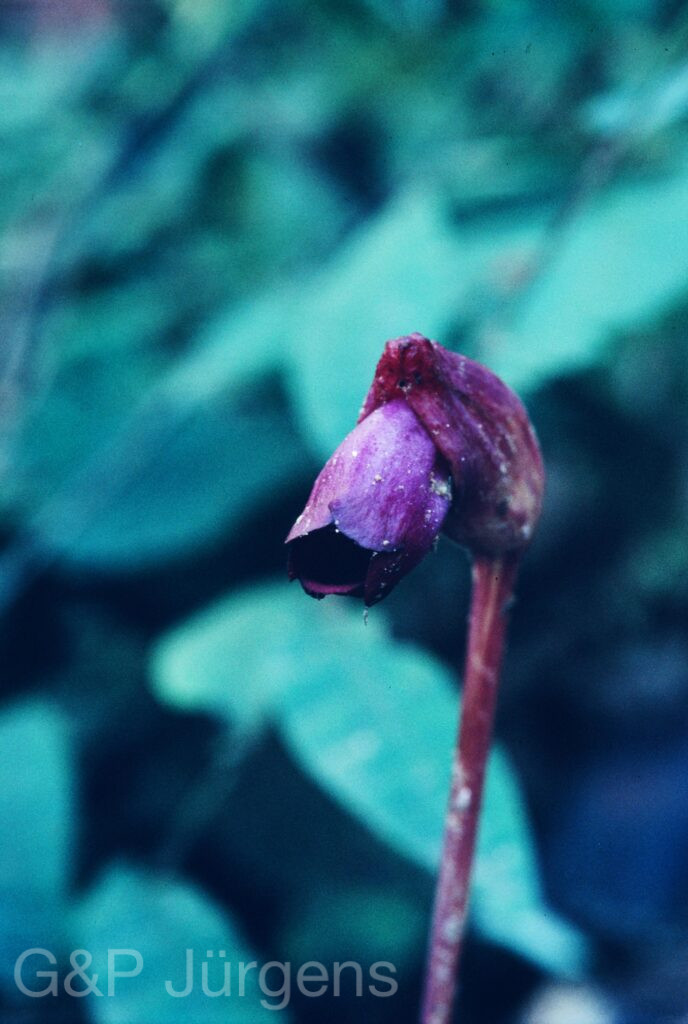
Nepal below Barphak 1400m October

Description

Aeginetia indica is a widespread holoparasitic herb of tropical and subtropical Asia, recorded from Japan, China, Taiwan, Korea and across South and Southeast Asia including India, Nepal, Bhutan, Sri Lanka, Myanmar, Thailand, the Malesian region and beyond; with about 3514 GBIF records it is by far the most frequently collected species in this group. It is a root parasite of grasses and other monocots, occurring in moist forest, grassland, scrub, plantations and field margins from the lowlands up into the lower hills, generally below about 2500 m. The plants illustrated, from Wangdi in Bhutan at around 2500 m in September and below Barphak in Nepal at about 1400 m in October, span this elevational range.

Lacking chlorophyll, the plant is reduced to fleshy, scale-like leaves on a very short underground stem attached to the host roots. The conspicuous part is the flower, borne singly atop a long, stout, purplish or yellowish scape; it is a large, tubular, somewhat curved corolla coloured deep purple to magenta with a paler throat, the five lobes short and the mouth oblique, subtended by a boat-shaped spathe-like calyx. There are four stamens and a superior ovary that ripens into a many-seeded capsule shedding the dust-like seeds characteristic of parasitic plants.

Now placed in the broadened Orobanchaceae following the merger of the old Scrophulariaceae-derived parasites, Aeginetia is an Asian genus of obligate root parasites, and A. indica is notable as a parasite of sugarcane and other grasses, where it can be a minor agricultural pest. Its enormous seed output and broad host and geographic range make it ecologically successful and of no conservation concern. The species is also used in traditional medicine across parts of its range.

Author: L. · Sources: POWO (Kew), GBIF, Flora of China, Flora of Bhutan, Annotated Checklist of the Flowering Plants of Nepal, Nickrent Parasitic Plant Genera of the World
J. D. Hooker et Thomson

BhutanPG2011 101
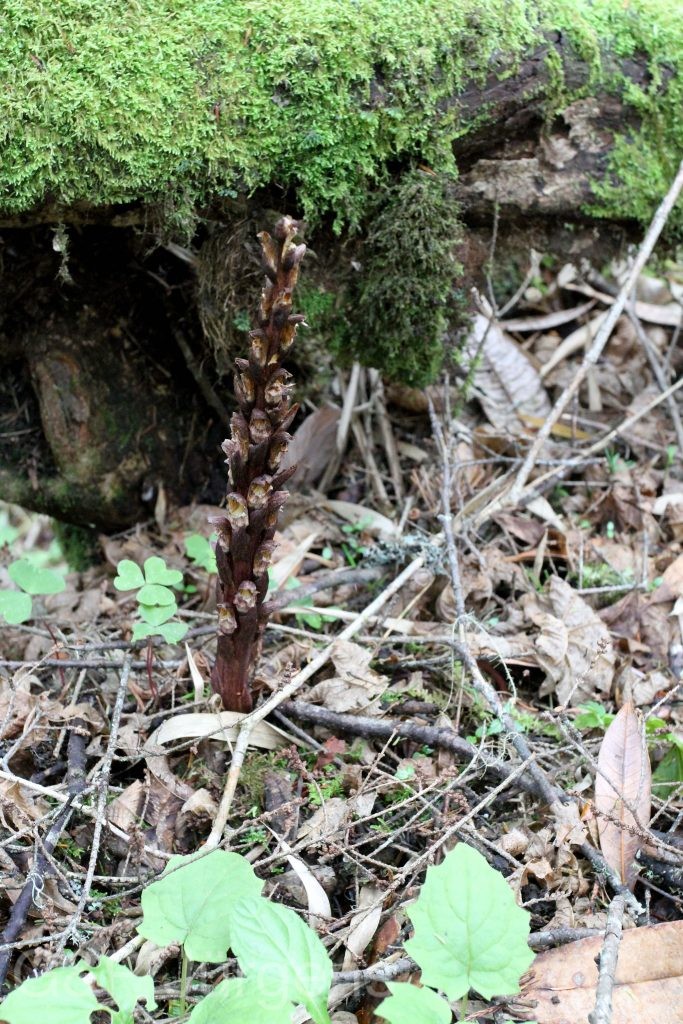
Bhutan Chognam 3240m, June

Description

A non-photosynthetic, root-parasitic herb of the eastern Himalaya and East Asia, recorded from China, Taiwan, Nepal, India, Bhutan, Japan and Myanmar, with about 711 GBIF occurrences (a few outlying entries reflect data errors). It parasitises the roots of woody Ericaceae, particularly Rhododendron and Gaultheria, and is found in subalpine shrubberies, forest margins and moist thicket floors, generally between about 2700 and 4000 m. The illustrated plant was photographed in June at Chognam in Bhutan at around 3240 m, a typical rhododendron-dominated montane habitat.

Lacking chlorophyll, the plant draws all nutrition from its host. It arises from a swollen, tuberous, scale-covered basal organ attached to the host root, from which emerge fleshy, erect, unbranched stems coloured purplish-brown, yellowish or reddish and clothed only in small scale-leaves. The inflorescence is a dense, cylindrical, many-flowered terminal spike. Each flower is subtended by a bract and has a short cup-like calyx and a two-lipped, tubular corolla in dull purple to brownish-yellow, with a hooded upper lip and a shorter spreading lower lip; four didynamous stamens are inserted in the tube. The superior ovary ripens into a capsule packed with numerous minute, dust-like seeds adapted to wind dispersal.

Accepted by POWO and GBIF, B. himalaica is one of a small genus of broomrape relatives specialised on ericaceous hosts. Its life cycle is intimately governed by host availability and the germination of its tiny seeds in response to host-root chemical cues. Because it depends entirely on healthy Rhododendron-rich communities, it serves as an indicator of intact subalpine ericaceous vegetation. It is widespread but inconspicuous and locally sporadic; no significant conservation concern is recognised at present.

Author: J. D. Hooker et Thomson · Sources: POWO (Kew), GBIF, Flora of China, Flora of Bhutan, Beck monograph of Orobanchaceae

(Buch.-Ham.) Pennell

Nepal 99 901 ergebnis
West-Nepal Sepka 2700m, July

Description

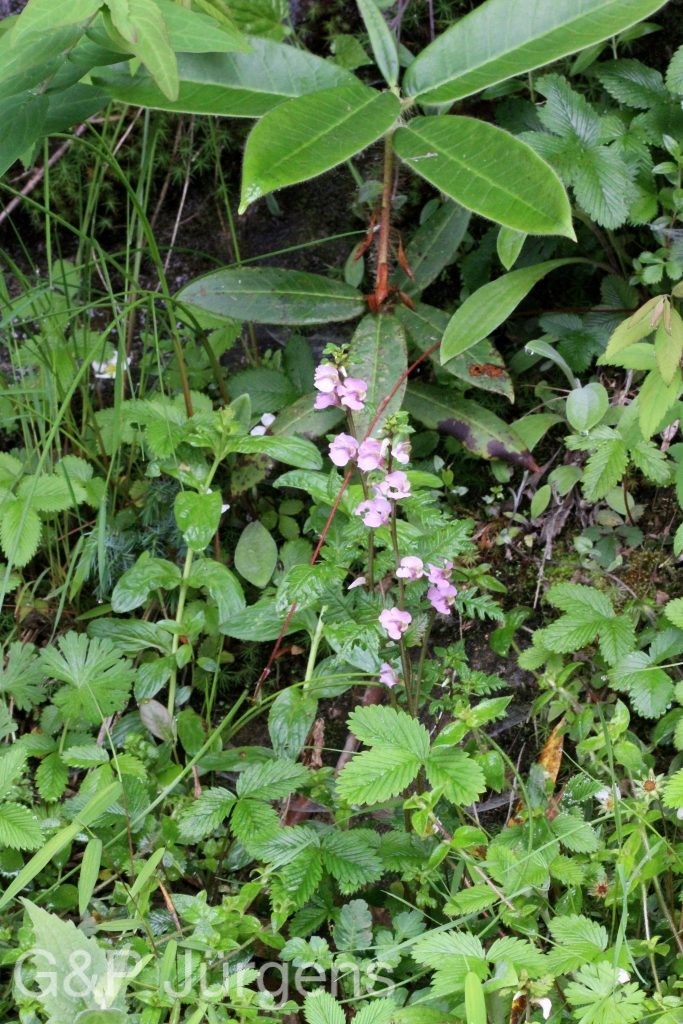
Pedicularis bifida is a hemiparasitic perennial herb of the temperate and subalpine Himalaya, distributed through Nepal, India, Bhutan, China and Myanmar across some 250 documented records. It grows in moist meadows, forest clearings, shrubberies and along streamsides, generally between 2400 and 3800 m, flowering with the summer monsoon. The illustrated plant was collected at Sepka in West Nepal at 2700 m in July, within the typical mid-montane band where the species is most frequently encountered among tall-herb vegetation.

Like all lousewort, the plant is a root-parasite drawing water and nutrients from neighbouring hosts via haustoria. It forms erect, sometimes branched stems clothed with alternate to subopposite, pinnately lobed leaves bearing toothed segments. The flowers are aggregated into terminal leafy-bracted spikes or racemes; the calyx is tubular and toothed, and the strongly zygomorphic corolla is pink to rose-purple with a tube and a galeate upper lip whose apex is conspicuously bifid or beaked, the feature giving the epithet, and a spreading three-lobed lower lip. The four didynamous stamens lie within the galea and the fruit is an oblique, beaked loculicidal capsule.

The genus Pedicularis, transferred from Scrophulariaceae to Orobanchaceae on molecular grounds, reaches extraordinary diversity in the Sino-Himalaya, where elaborate corolla architecture promotes specialised pollination by long-tongued bumblebees. The bifid galea of this species reflects such floral specialisation. As a widespread, locally common meadow component, P. bifida is not considered threatened, though it depends on intact host-rich grassland communities.

Author: (Buch.-Ham.) Pennell · Sources: POWO (Kew), GBIF, Flora of China, Annotated Checklist of the Flowering Plants of Nepal, Flowers of the Himalaya, Prain & Pennell revisions of Pedicularis

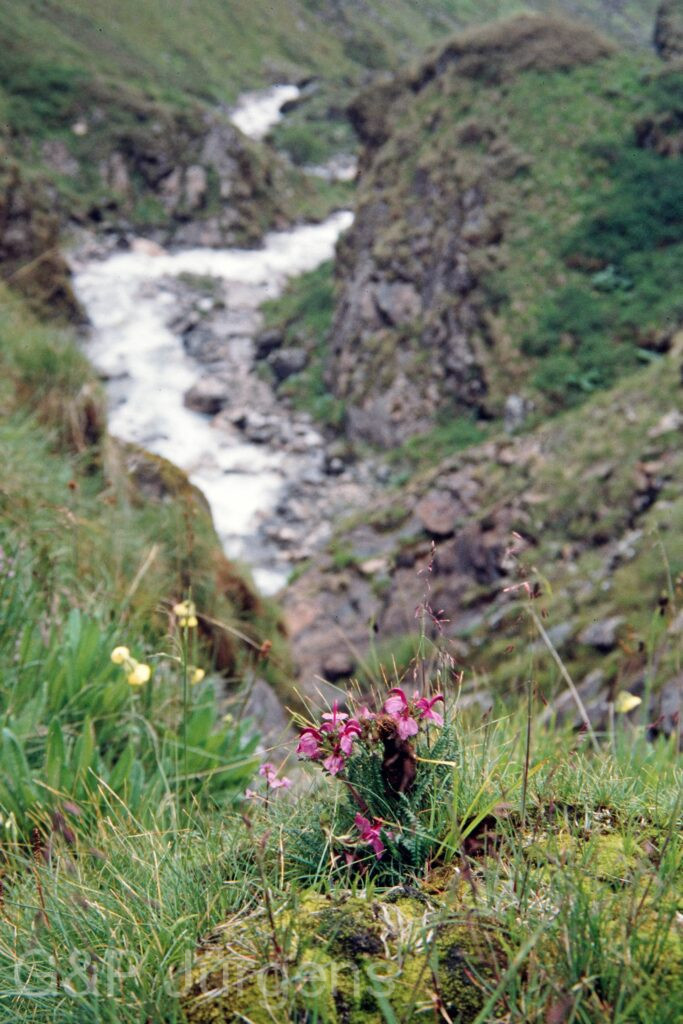
Prain

Nepal 99 510 ergebnis
West-Nepal Churta-Khola 3800m, June

Description

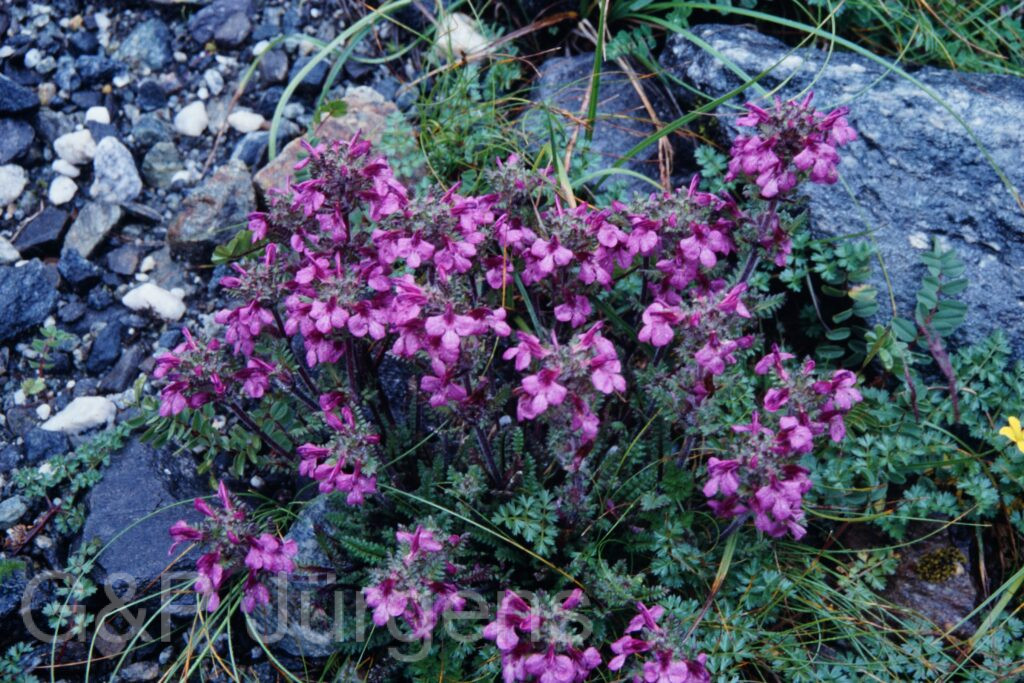
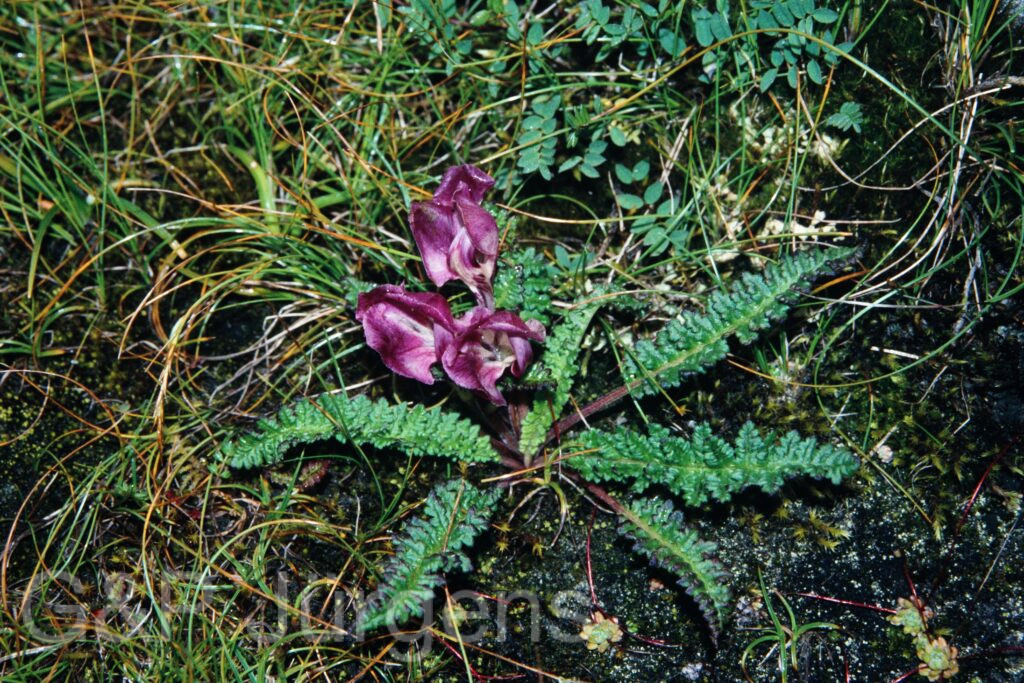
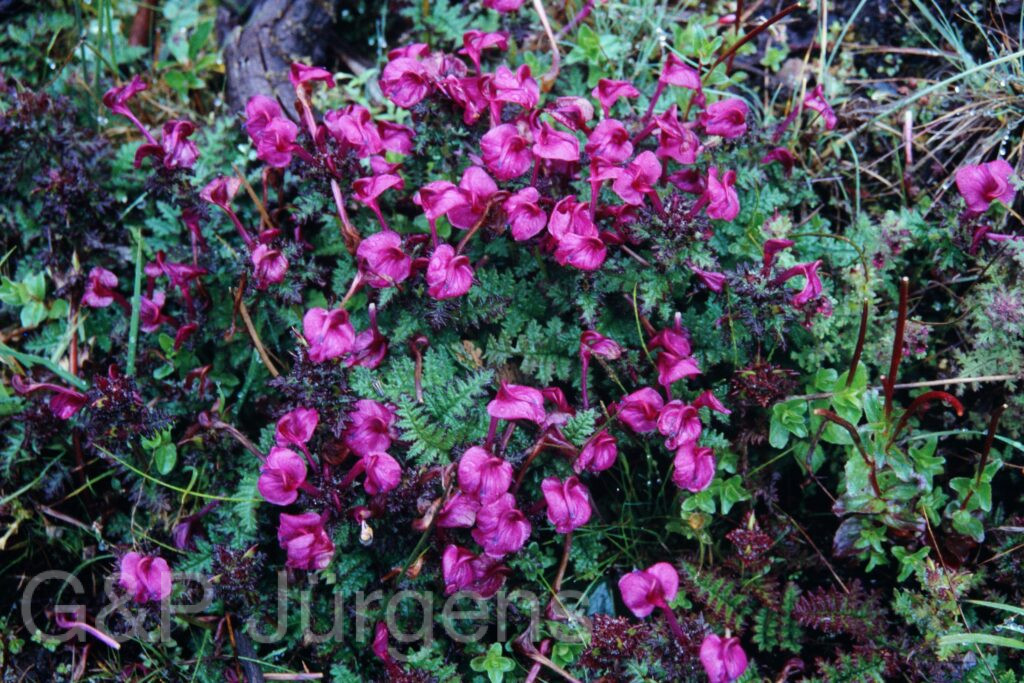
Pedicularis confertiflora is a hemiparasitic herb of the high Himalaya and Tibetan borderlands, documented by GBIF from China, Nepal, Bhutan, India, Mongolia and Korea, with around 378 occurrences concentrated in the central and eastern alpine zone. It grows in open alpine meadows, moist turf, rocky slopes and the margins of grazed pastures, where it taps the roots of surrounding herbs and grasses. The illustrated population grows in West Nepal at Churta-Khola at about 3800 m, flowering in June; the species generally occupies the 3500-4500 m belt where short-statured alpine vegetation prevails.

The plant forms low, often clustered stems from a slender rootstock, bearing pinnatisect leaves whose narrow segments are deeply incised and toothed, sometimes tinged purple. As the epithet confertiflora implies, the flowers are crowded into a dense, capitate to short-spicate inflorescence near the stem apex, each subtended by a pinnatifid bract. The calyx is tubular and lobed, while the bilabiate corolla, in shades of pink to purplish-red, bears a galeate, often beaked upper lip and a spreading three-lobed lower lip. The capsule is oblique and laterally compressed, releasing few flattened seeds.

The Himalayan species of Pedicularis exhibit remarkable corolla diversity, with beak length and curvature finely adapted to bumblebee pollinators that partition resources among co-flowering taxa; the dense, beaked flowers of P. confertiflora fit this syndrome. As an alpine hemiparasite it can suppress competitive grasses and so shape meadow diversity. No formal threat assessment exists, but its specialised high-elevation habitat is sensitive to climate warming and heavy grazing.

Author: Prain · Sources: POWO (Kew), GBIF, Flora of Nepal, Flora of China, Pedicularis monograph (Tsoong)

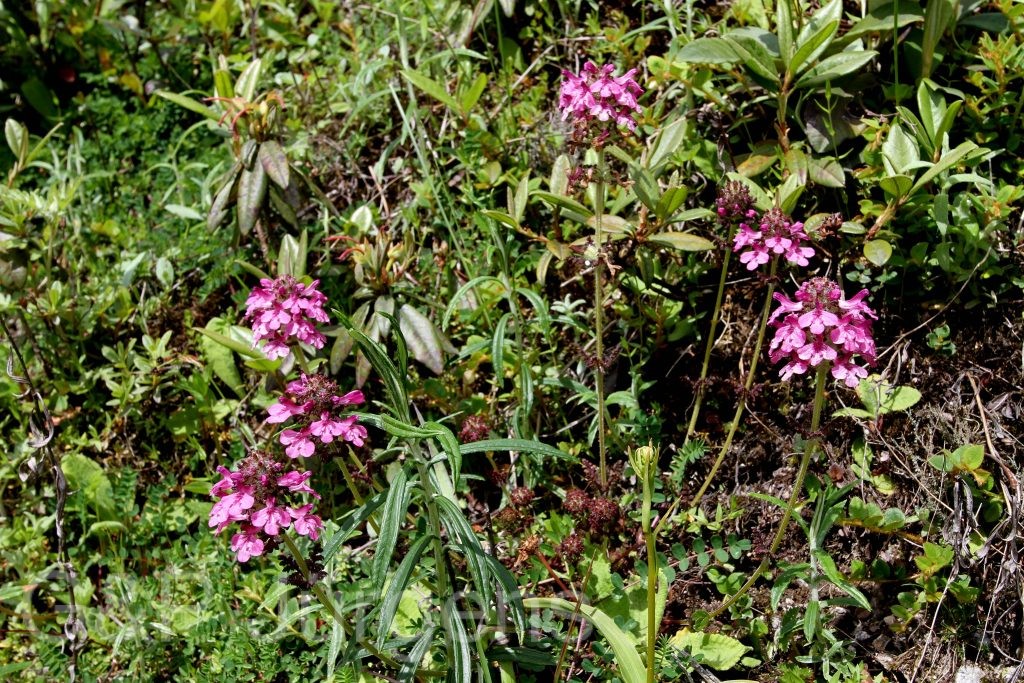
Prain

Sikkim2011 197
Sikkim Lachung 3000m, June
Sikkim2011 230
Sikkim Lachung 3000m, June
Sikkim2003 261 P360
Sikkim Dzongri 4200m August
Sikkim2003 273 P376
Sikkim Dzongri 4100m, August

Description

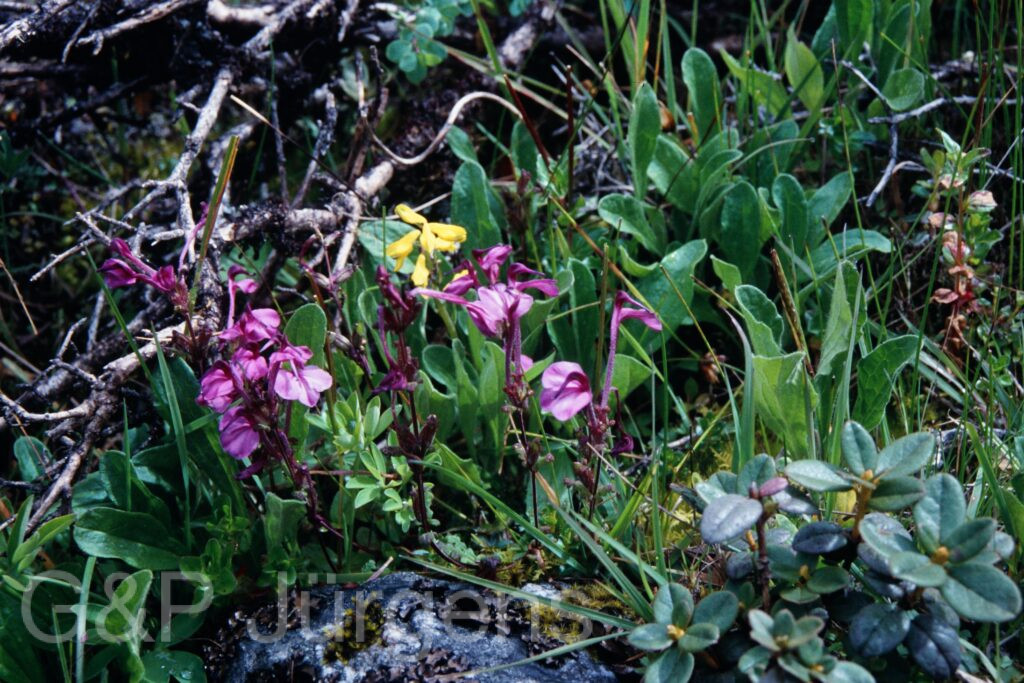
Pedicularis diffusa is a hemiparasitic alpine herb of the eastern Himalaya and adjacent Tibetan region, recorded from China, Bhutan, India, Nepal, Myanmar and Mongolia, with about 92 occurrences in GBIF. It inhabits subalpine and alpine meadows, open grassy slopes, scrub and the margins of forest, typically between about 3000 and 4500 m. The photographed populations come from Sikkim, at Lachung (3000 m, June) and at the high alpine site of Dzongri (4100-4200 m, August), spanning the species' altitudinal range and flowering from early summer into the late monsoon at the higher stations.

The plant forms loose clumps from a fibrous or somewhat thickened rootstock, with ascending to diffusely spreading stems, the habit reflected in the epithet diffusa. The leaves are pinnately divided into oblong, toothed segments and are arranged along the stems as well as basally. The flowers are borne in lax, leafy, often elongate and interrupted racemes; the corolla is pink to purplish-red, two-lipped, with a galea (hooded upper lip) and a broad three-lobed lower lip, the galea typically beaked or toothed at its apex. The fruit is an oblique, laterally compressed capsule containing few seeds.

Like all Pedicularis, the species is a root hemiparasite, photosynthetic but tapping neighbouring plants via haustoria for water and minerals, an adaptation well suited to nutrient-poor alpine turf. The genus is extraordinarily diverse in the Sino-Himalayan mountains, and corolla architecture, particularly the form of the galea and beak, underpins species delimitation. Its tubular two-lipped flowers are adapted to bumblebee pollination. Restricted alpine specialists of this kind are potentially sensitive to climate warming and grazing pressure on high pastures.

Author: Prain · Sources: POWO (Kew), GBIF, Flora of China, Flora of Bhutan, Pedicularis monograph (Tsoong)

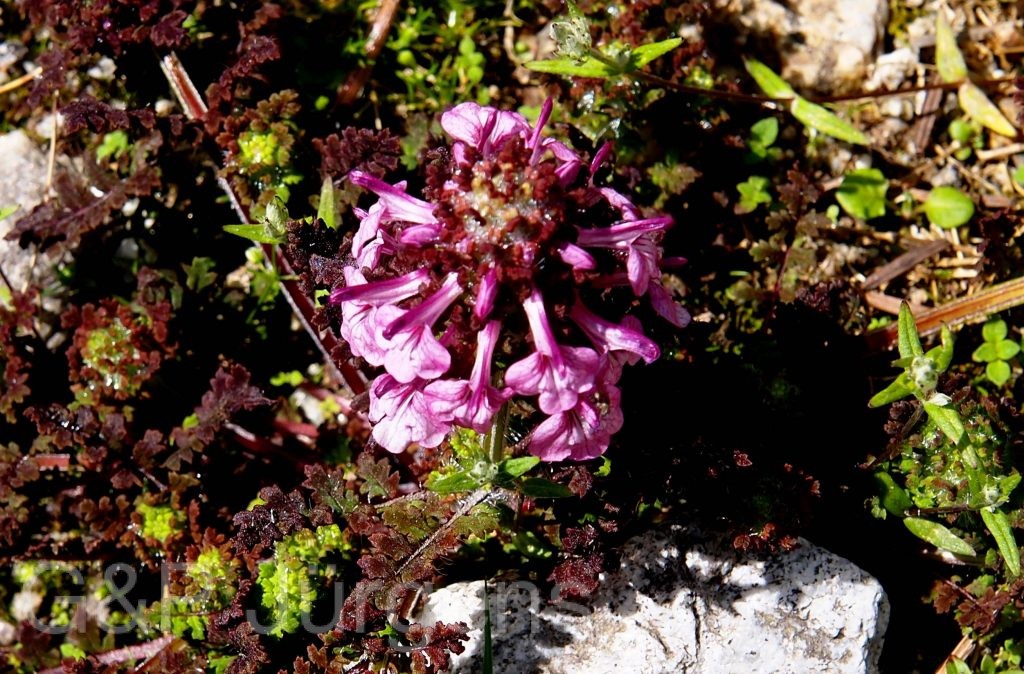
Hook. f.

Sikkim2003 276 G379
Sikkim Dzongri 4300m, August

Description

Pedicularis elwesii is a hemiparasitic herb of the eastern Himalaya and adjacent high mountains of southwestern China, with a distribution spanning China, Nepal, India, Bhutan and Myanmar and some 532 georeferenced records compiled by GBIF. It is a plant of the alpine zone, characteristically inhabiting moist meadows, open turf, streamsides and stony slopes above the treeline, generally between about 3500 and 4500 m. The photographed material from Sikkim, on the Dzongri ridge at 4300 m in August, typifies its preferred habitat among short alpine grassland during the summer flowering peak that follows snowmelt and coincides with the monsoon.

It is a perennial forming a tuft of erect to ascending stems from a stout rootstock, with chiefly basal and cauline pinnatisect to pinnatipartite leaves whose oblong segments are toothed and crenate. The showy inflorescence is a dense terminal spike subtended by leaf-like bracts. As in many Himalayan louseworts the corolla is strongly two-lipped: a hooded galea formed by the upper lip, here often produced into a slender beak, encloses the anthers, while the broad three-lobed lower lip serves as a landing platform. Flowers are typically rose-pink to purplish; the fruit is an oblique, beaked loculicidal capsule.

The species belongs to the large, taxonomically intricate genus Pedicularis, exceptionally diversified in the Sino-Himalayan region where floral specialisation reflects coevolution with long-tongued bumblebee pollinators. Like its congeners it is a root hemiparasite, drawing water and nutrients through haustorial connections to neighbouring alpine plants while retaining functional chlorophyll. No major conservation concern is recognised given its wide range, though its meadows are sensitive to grazing and climatic shifts.

Author: Hook. f. · Sources: POWO (Kew), GBIF, Flora of China, Flora of Bhutan, Pedicularis monograph (Tsoong / Prain)

Hook. f.

Sikkim2003 486 P678
Sikkim Lachung Valley 3600m August

Description

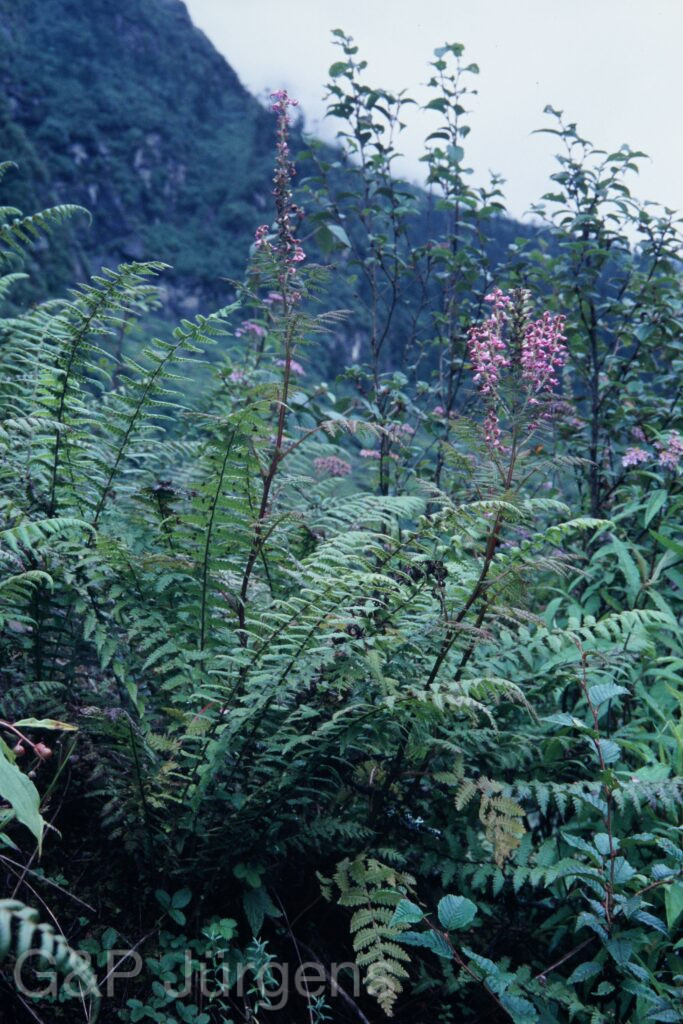
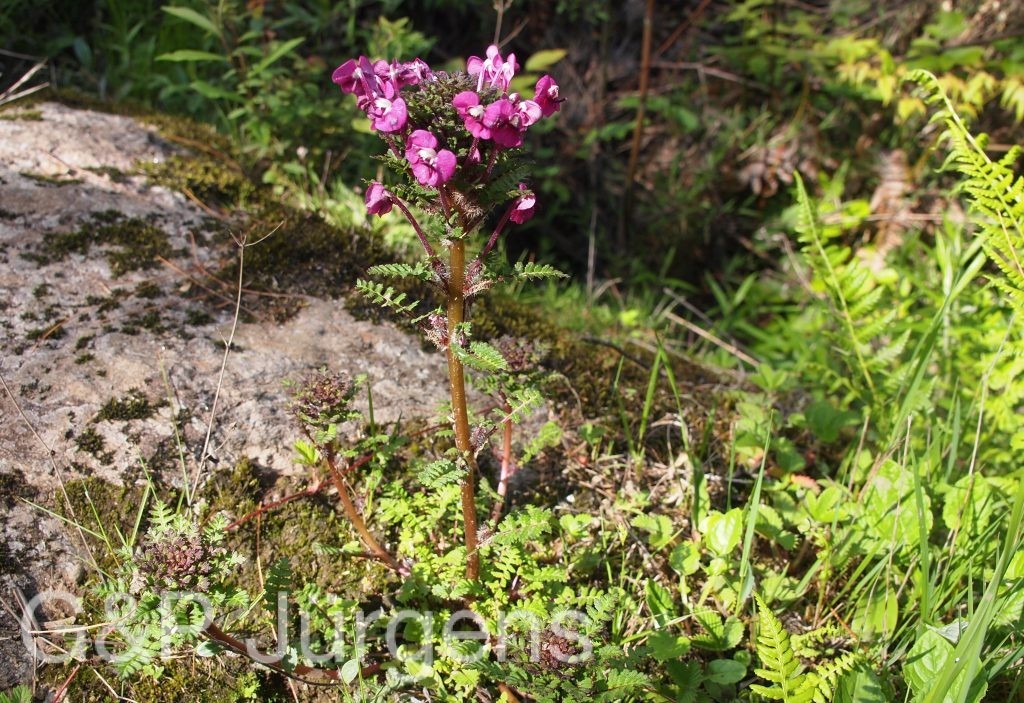
Pedicularis excelsa is a tall hemiparasitic herb of the eastern Himalaya, recorded from Bhutan, India, Nepal, China and Mongolia; with only about 42 georeferenced records it is a regionally restricted subalpine to alpine species. It grows in open subalpine meadows, moist grassy slopes, forest clearings and streamsides, typically between 3000 and 4200 m. The plant photographed in the Lachung Valley of Sikkim at 3600 m in August occupies the monsoon-flushed alpine meadow zone, flowering at the height of the short Himalayan summer alongside other tall meadow herbs.

As the epithet "excelsa" suggests, it is among the taller lousteworts, an erect herb 40-100 cm tall with a stout taproot that forms haustorial connections to neighbouring plant roots. The stem bears pinnatisect leaves with toothed segments, partly basal and partly cauline. The flowers are crowded into a dense, elongate terminal spike; each corolla is strongly bilabiate, pink to purplish-red, with the upper lip (galea) compressed and beaked, enclosing the four didynamous stamens, and a broad spreading three-lobed lower lip. The calyx is tubular and toothed. The fruit is an oblique, beaked capsule containing several seeds.

Described by Hooker f. (Hook. f.), P. excelsa belongs to the large genus Pedicularis, now placed in the Orobanchaceae (formerly Scrophulariaceae), which reaches extraordinary diversity in the Sino-Himalaya. As a root hemiparasite it supplements its own photosynthesis by tapping host roots. The beaked galea is adapted to pollination by long-tongued bumblebees, which the Himalayan Pedicularis radiation has exploited through diverse corolla forms. Its restricted range and meadow habitat make it sensitive to overgrazing, though no formal threat status is assigned.

Author: Hook. f. · Sources: POWO (Kew), GBIF, Flora of Bhutan, Flora of China, Flora of Sikkim Himalaya, Prain's revision of Indian Pedicularis (Orobanchaceae)

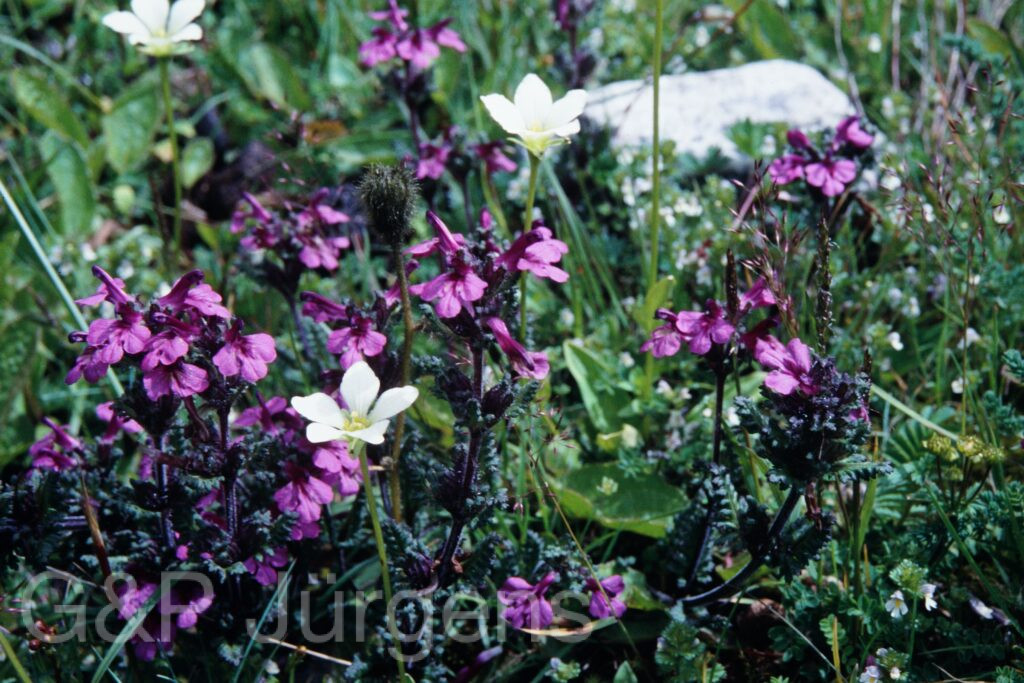
Hook.f.

BhutanPG2011 88
Bhutan Chogcham, 3100m June
Sikkim2003 434 P603
Sikkim Dzongri 4100m, August
Sikkim2003 248 P341
Sikkim Dzongri 4100m, August

Description

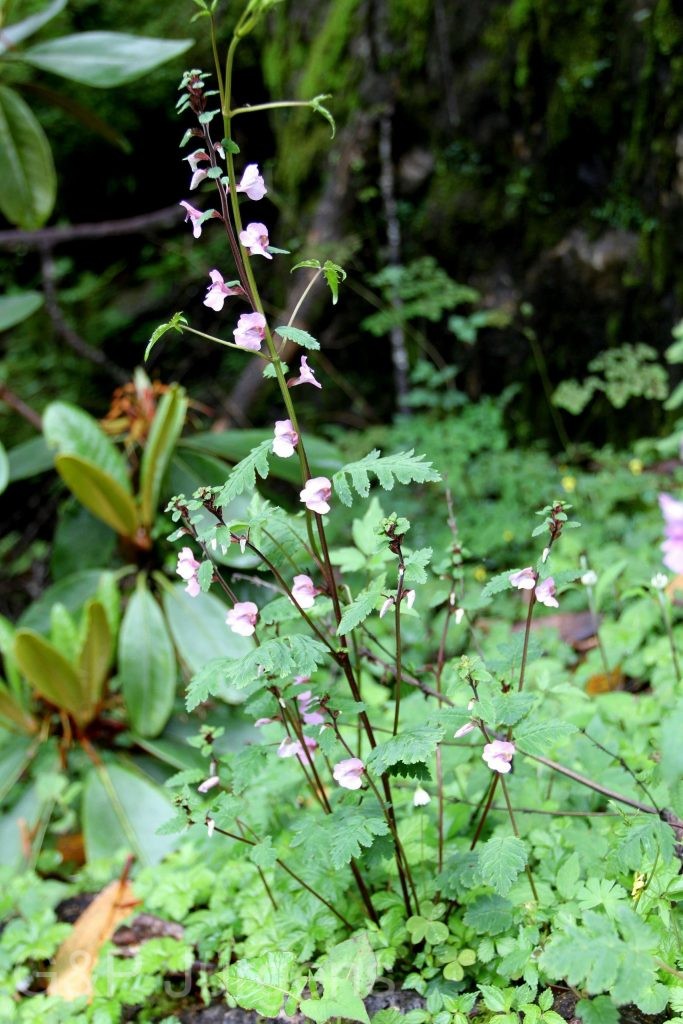
Pedicularis flexuosa is an Eastern Himalayan louseword recorded from Nepal, northern India, Bhutan, southwestern China and Mongolia, with around 202 occurrences distributed along the high Himalaya and adjacent Tibetan plateau margins. It spans the upper montane to alpine zone, the images documenting it at Chogcham in Bhutan at about 3100 m in June and at Dzongri in Sikkim at about 4100 m in August during the monsoon. It grows in alpine and subalpine meadow, open grassy slopes, scrub margins and damp turf on moist, well-drained ground, behaving as a hemiparasite drawing water and nutrients from the roots of surrounding grasses and herbs through haustorial connections.

It is an erect perennial herb arising from a short rootstock, with simple or sparingly branched stems that are often somewhat flexuous, as the epithet implies. The leaves are alternate to subopposite and pinnatisect, the segments toothed, giving the characteristic fern-like foliage of the genus. The flowers are borne in a terminal spike or interrupted raceme; the corolla is strongly two-lipped and pinkish-purple to rose, the galea (upper lip) hooded and often beaked, enclosing the four didynamous stamens, while the lower lip is three-lobed and spreading. The fruit is an oblique, laterally compressed capsule containing several seeds.

The species, described by J.D. Hooker, belongs to the large and taxonomically complex genus Pedicularis within the Orobanchaceae, a clade of green root-hemiparasites. The elaborate galeate corolla is adapted to pollination by long-tongued bumblebees, and the diverse corolla architecture across the genus underpins striking floral radiation in the Sino-Himalayan region. Locally frequent in suitable alpine grassland, P. flexuosa has not been formally assessed but is not regarded as threatened across its montane range.

Author: Hook.f. · Sources: POWO (Kew), GBIF, Flora of China, Flora of Bhutan, Pedicularis revision (Sino-Himalayan species, after Tsoong)

Wall. ex Benth.

Pedicularis furfuraceae ergebnis
Bhutan Pele-La, 2800m June
BhutanPG2011 688 01 01 scaled
Bhutan Pele-La, 2800m June

Description

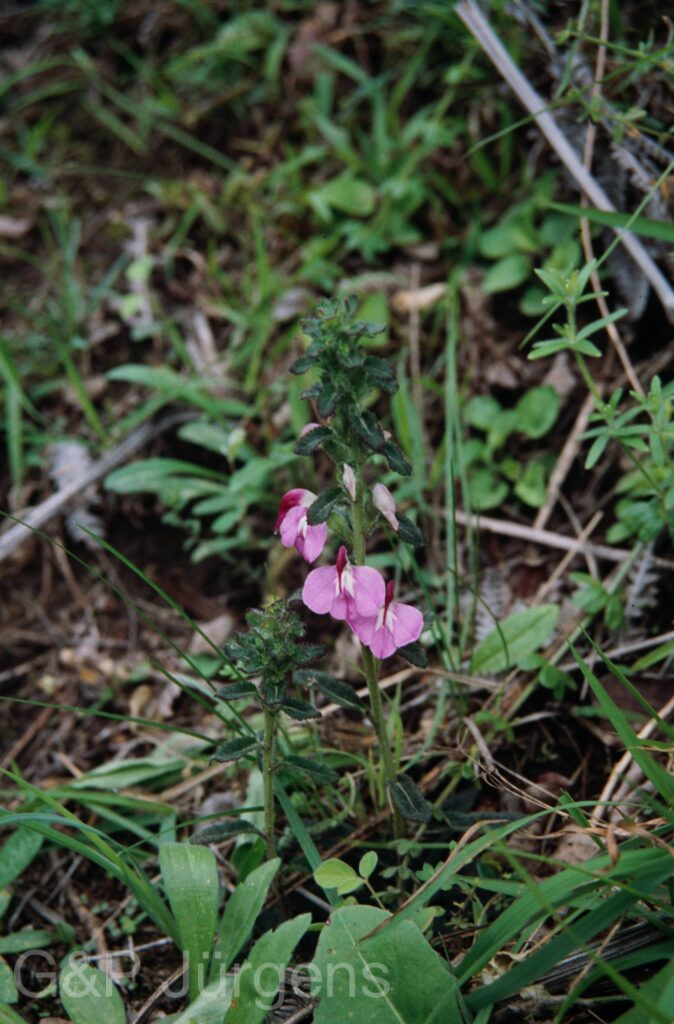
Pedicularis furfuracea is a Himalayan louseword distributed across Nepal, northern India, Bhutan and southwestern China, with around 223 records following the southern slopes of the central and eastern Himalaya. It occupies the temperate to subalpine zone, the image documenting it on the Pele-La in Bhutan at about 2800 m in June. It grows in open forest, forest margins, subalpine scrub, grassy slopes and meadow on moist, humus-rich soils, where, like its congeners, it lives as a facultative root-hemiparasite tapping neighbouring plants for water and minerals while retaining green, photosynthetic foliage.

It is an erect perennial herb with simple or branched stems bearing alternate, pinnately divided leaves whose lobes are toothed, the whole plant often appearing scurfy or mealy, a feature reflected in the epithet furfuracea ("bran-like"). The flowers are crowded in a terminal spike or raceme; the corolla is conspicuously two-lipped and yellow to pale yellow, the galea forming an arched, beaked hood that shelters the four didynamous stamens, with a spreading three-lobed lower lip serving as a landing platform. The calyx is tubular and toothed, and the fruit is an oblique, compressed capsule containing several seeds.

Described by Wallich and Bentham, the species belongs to the immense genus Pedicularis (Orobanchaceae), a hemiparasitic lineage that has radiated spectacularly in the Sino-Himalayan mountains, producing great diversity in corolla form and beak length tied to bumblebee pollination. The yellow galeate flowers of P. furfuracea are visited by long-tongued bees, and its hemiparasitism allows it to thrive in nutrient-limited montane soils. Locally common within its elevational band, it is not considered threatened.

Author: Wall. ex Benth. · Sources: POWO (Kew), GBIF, Flora of China, Flora of Bhutan, Pedicularis revision (Sino-Himalayan species, after Tsoong)

Hook. f.

Sikkim2003 496 G694
Sikkim Lachung Valley 3600m August

Description

Pedicularis globifera is a Sino-Himalayan hemiparasite distributed across China (CN), Nepal (NP), India (IN) and Bhutan (BT), with 293 GBIF occurrences indicating it is reasonably frequent through the central and eastern Himalaya. It inhabits open alpine meadows, damp grassy slopes and the margins of seepages and streams in the high subalpine to alpine zone, commonly between about 3500 and 4500 m. The figured plant was photographed in the Lachung Valley of Sikkim at around 3600 m in August, at the height of the monsoon flowering period when alpine Pedicularis are most conspicuous.

It is a perennial herb with a thickened rootstock, the parasitic roots forming haustoria on host grasses and sedges. Stems are erect, bearing leaves that are pinnately lobed to pinnatisect with crenate-toothed segments. The flowers are arranged in a dense, head-like or globose terminal cluster, the feature evoked by the epithet globifera. The calyx is tubular and lobed; the corolla is bilabiate, with an arched, beakless or shortly beaked galea forming the upper lip and a broad three-lobed lower lip. The four didynamous stamens lie within the galea. Fruit is an oblique, compressed capsule enclosing several seeds.

Pedicularis reaches its global diversity peak in the high mountains of western China and the Himalaya, and species such as P. globifera contribute to the spectacular alpine displays of these grasslands while playing an ecological role as bumblebee-pollinated hemiparasites that influence community structure. The genus is now firmly placed in Orobanchaceae following recognition of its parasitic biology and phylogenetic position.

Author: Hook. f. · Sources: POWO (Kew), GBIF, Flora of China, Flora of Nepal, Flora of Bhutan, Tsoong's Monograph of the genus Pedicularis