
Hook. f.
Description
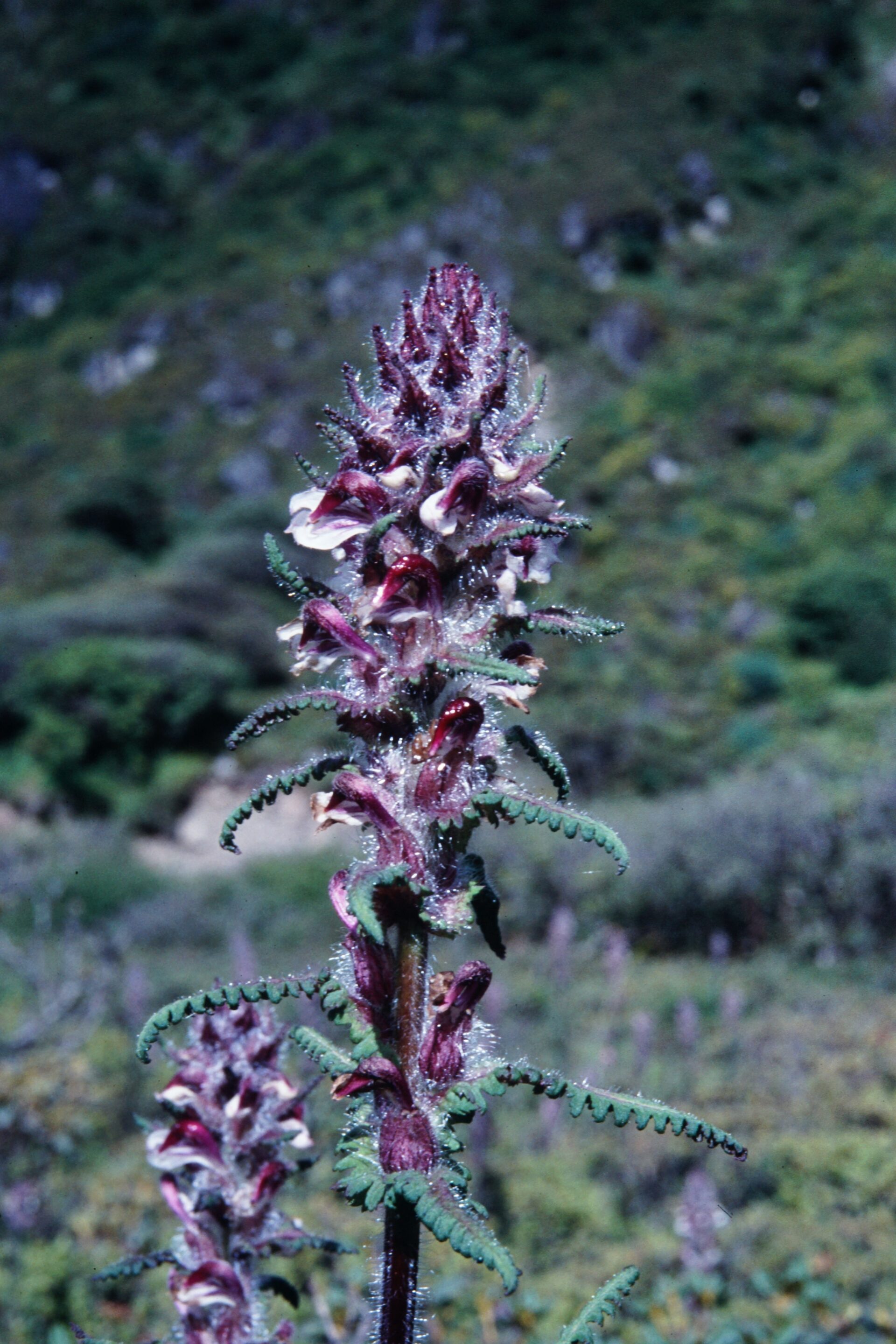
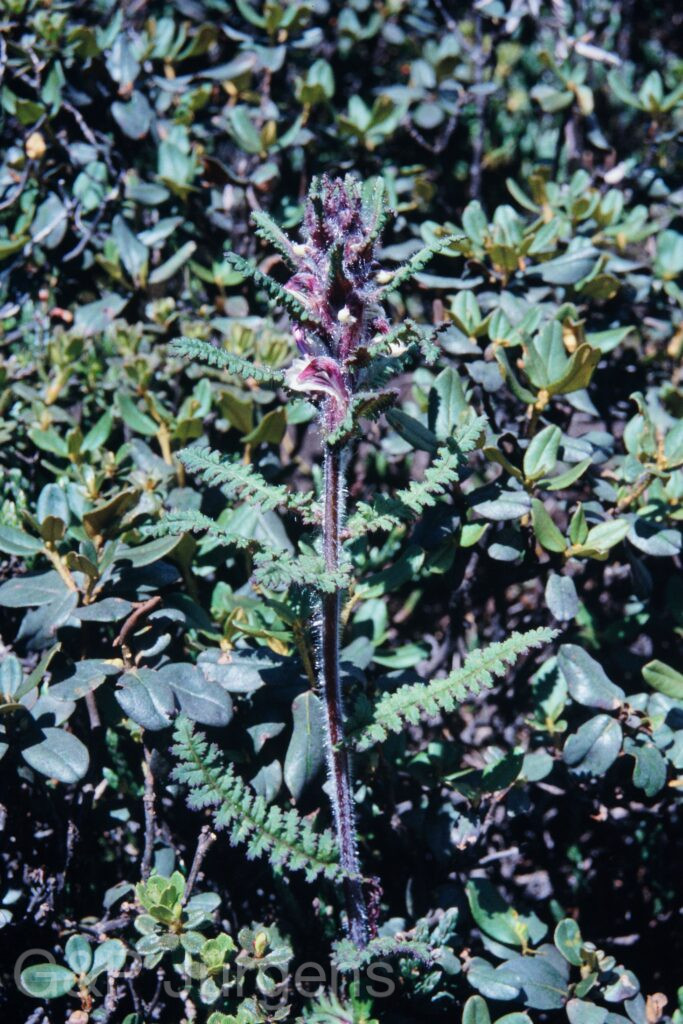
Pedicularis clarkei is a hemiparasitic perennial lousewort of the eastern Himalaya, distributed through Nepal, China, India and Bhutan, with about 127 documented records and scattered cultivated or vouchered occurrences in France and Spain. It is an alpine plant of open meadows, moist turf, rocky slopes and snow-flush communities, growing predominantly between 3500 and 4500 m. The illustrated material was collected at Dzongri in Sikkim at 3920 m in August, a classic high-alpine ridge locality where the species flowers at the height of the short growing season.
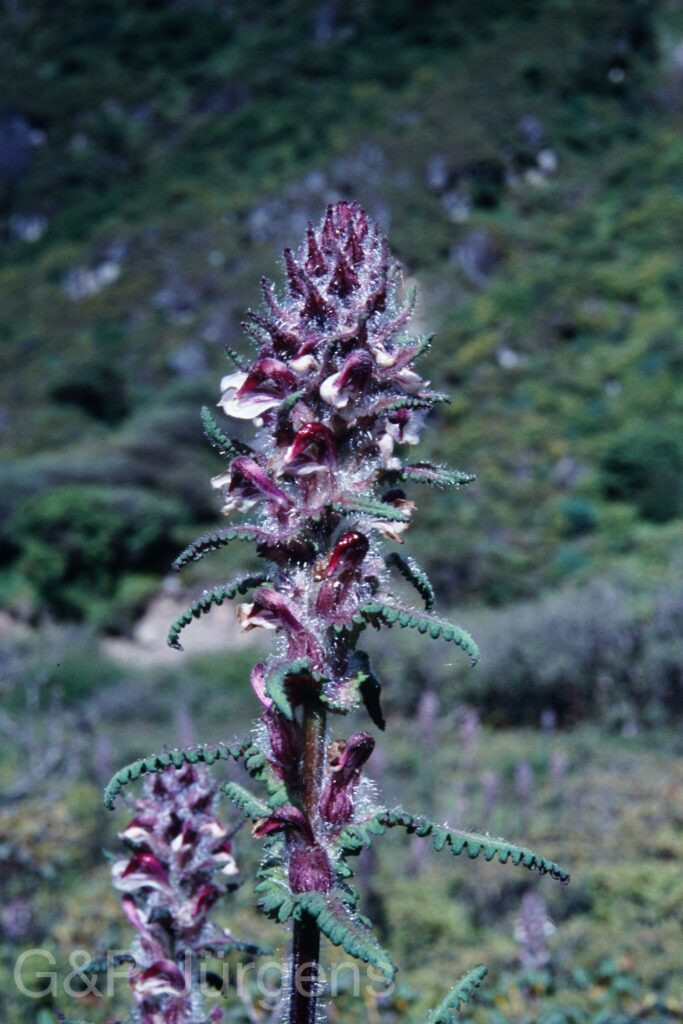
As a root-hemiparasite the plant attaches to neighbouring hosts by haustoria while retaining green, photosynthetic foliage. It forms low tufted stems bearing alternate, pinnately divided leaves whose segments are toothed or further lobed. The flowers are crowded in terminal leafy-bracted spikes; the calyx is tubular and cleft, and the strongly zygomorphic corolla, pink to rose-purple, has a curved tube and a beaked, hooded galea (the upper lip) opposed by a broad three-lobed lower lip that serves as a landing platform. The four didynamous stamens are enclosed within the galea, and the fruit is an oblique, flattened capsule containing few seeds.
Named in honour of the botanist C.B. Clarke, the species belongs to the immensely diverse Sino-Himalayan radiation of Pedicularis, now placed in Orobanchaceae following molecular reclassification from the Scrophulariaceae. Its tubular, beaked corolla is adapted to pollination by long-tongued bumblebees active in the cool alpine climate. Though geographically restricted to high elevations, it is locally frequent within suitable habitat and is not presently regarded as threatened.
Author: Hook. f. · Sources: POWO (Kew), GBIF, Flora of China, Annotated Checklist of the Flowering Plants of Nepal, Flowers of the Himalaya, Prain & Pennell revisions of Pedicularis