Tag:

Sikkim

Flowers of Sikkim — 350 species from the Sikkim Himalaya in northeast India, a compact yet botanically extraordinary region that climbs from subtropical valleys to the alpine zone beneath Kangchenjunga. Sikkim is a classic centre of Himalayan plant diversity, celebrated for its rhododendrons, primulas, orchids and gentians. Each entry provides a botanical description, distribution, habitat and flowering season with the original field photograph.

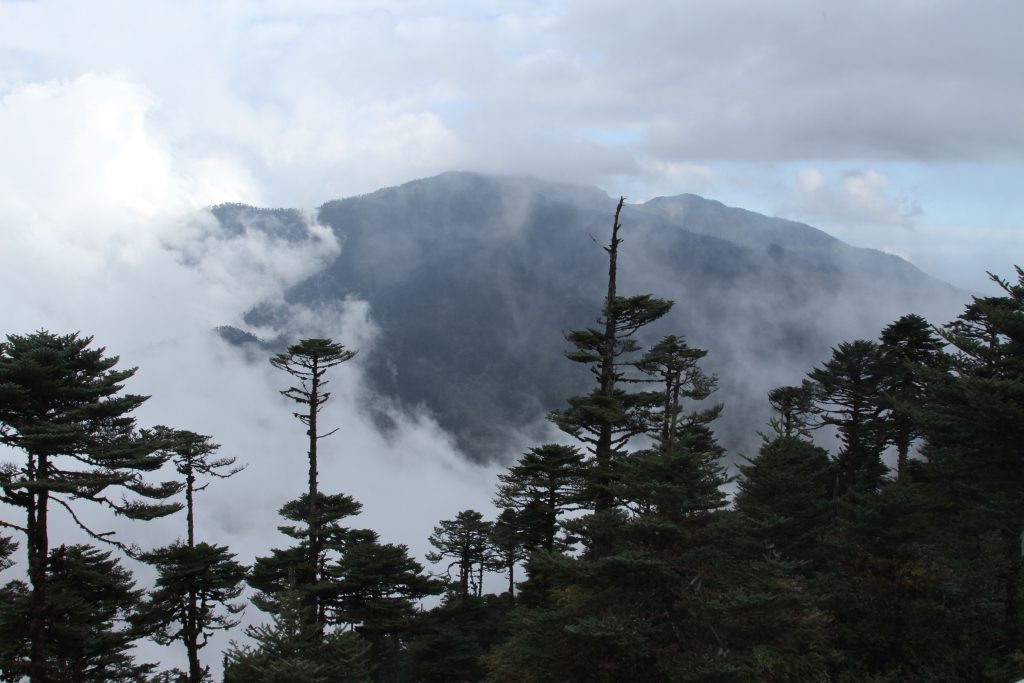
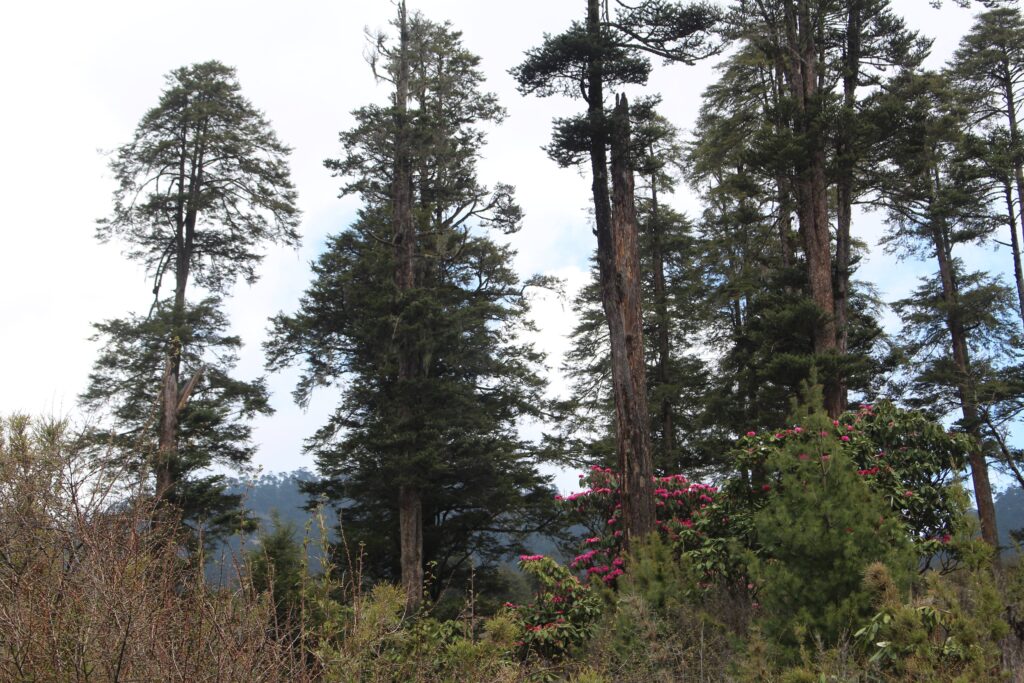
Abies densa

by GP Jürgens

Griff.

Bhutan2015 402
Bhutan Tumching-La 4000m, October
Bhutan2014 420 ergebnis
Bhutan Jakar 2400m, May
Sikkim 2006 82 ergebnis
Sikkim, West-Bengal Kalipokhri 3100m, May

Description

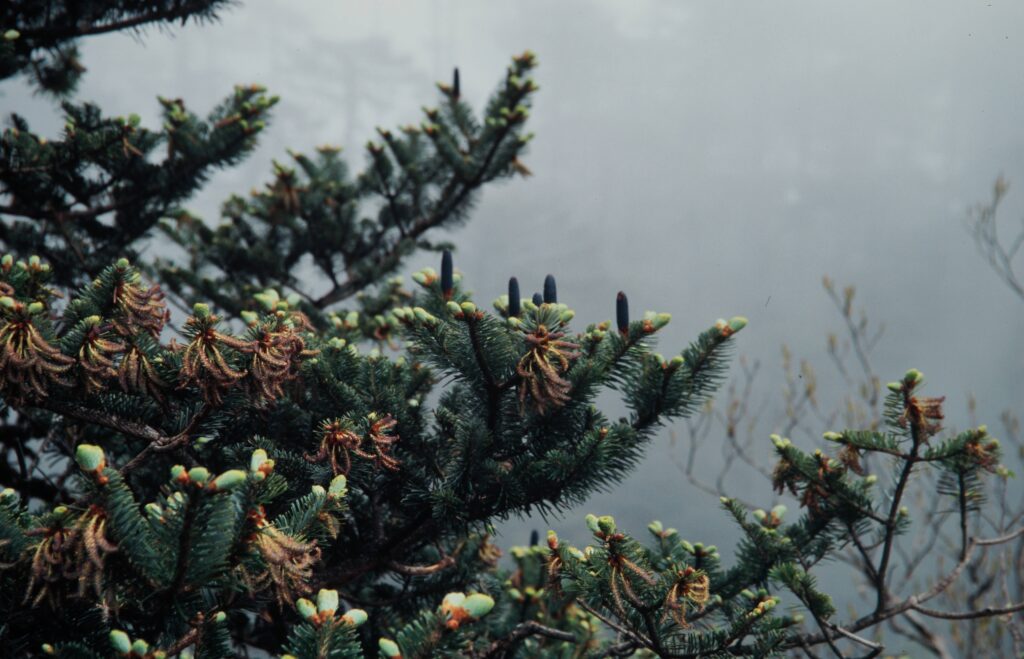
Abies densa, the Bhutan or eastern Himalayan fir, is a large evergreen conifer of the eastern Himalaya, ranging through Bhutan, Sikkim and adjacent India, eastern Nepal, southern China and northern Myanmar (gbif_countries: BT, IN, CN, NP, MM, CA, ZZ, BE), with about 192 GBIF occurrences. It is the dominant tree of the upper subalpine forest belt, forming dense stands often mixed with Rhododendron, birch and juniper and grading into the treeline krummholz. The illustrated records span Jakar in Bhutan at about 2400 m up to Tumching-La near 4000 m and Kalipokhri in the Sikkim–West Bengal borderland at about 3100 m, documenting its occupation of the cool, humid, high-montane to subalpine zone.

The tree reaches considerable height with a straight bole and conical crown, bearing horizontally spreading branches. The needle-like leaves are arranged spirally but pectinately spread, linear and flattened, dark green and glossy above with two whitish stomatal bands beneath, and notched or rounded at the apex. The pollen cones are small and lateral; the seed cones are erect, cylindrical, dark violet to blue-black when young, and, as in all firs, disintegrate on the tree at maturity to release winged seeds, leaving the persistent central axis standing.

Closely allied to Abies spectabilis of the western Himalaya, A. densa is sometimes treated as its eastern vicariant, the two replacing one another along the range. It is an ecologically important timber and watershed species and a keystone of subalpine forest. Though still locally abundant, its treeline populations are sensitive to climate shifts and grazing, and it is assessed as of Least Concern overall while warranting monitoring at range margins.

Author: Griff. · Sources: POWO (Kew), GBIF, Flora of Bhutan, Flora of China, Farjon's A Handbook of the World's Conifers, IUCN Red List conifer assessments
Stapf

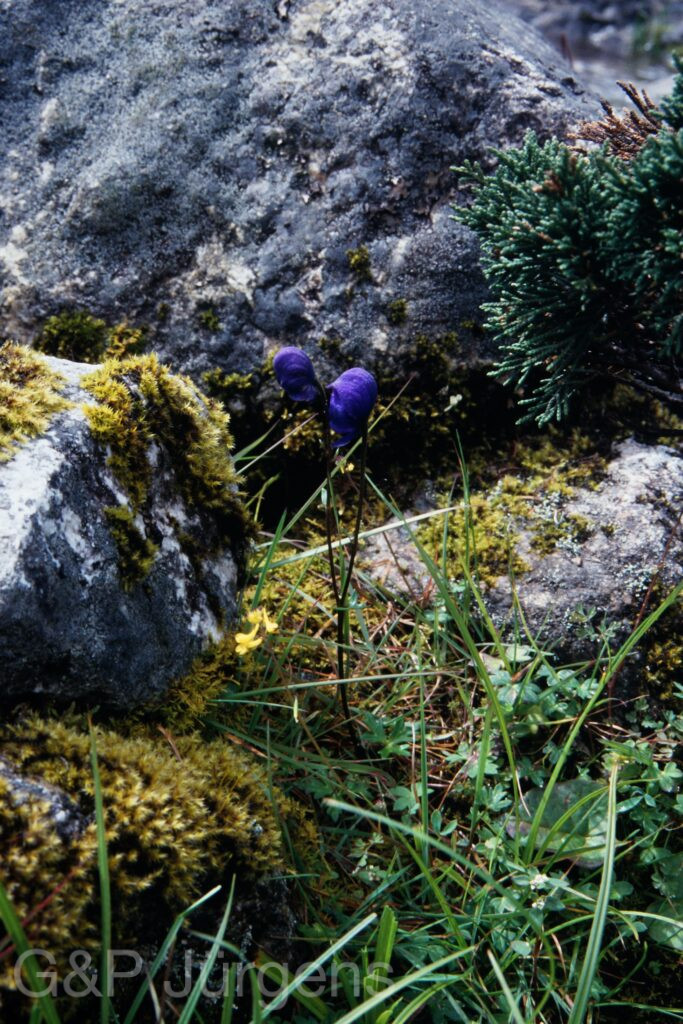
Sikkim2003 249 P343
Sikkim Dzongri 4300m, August
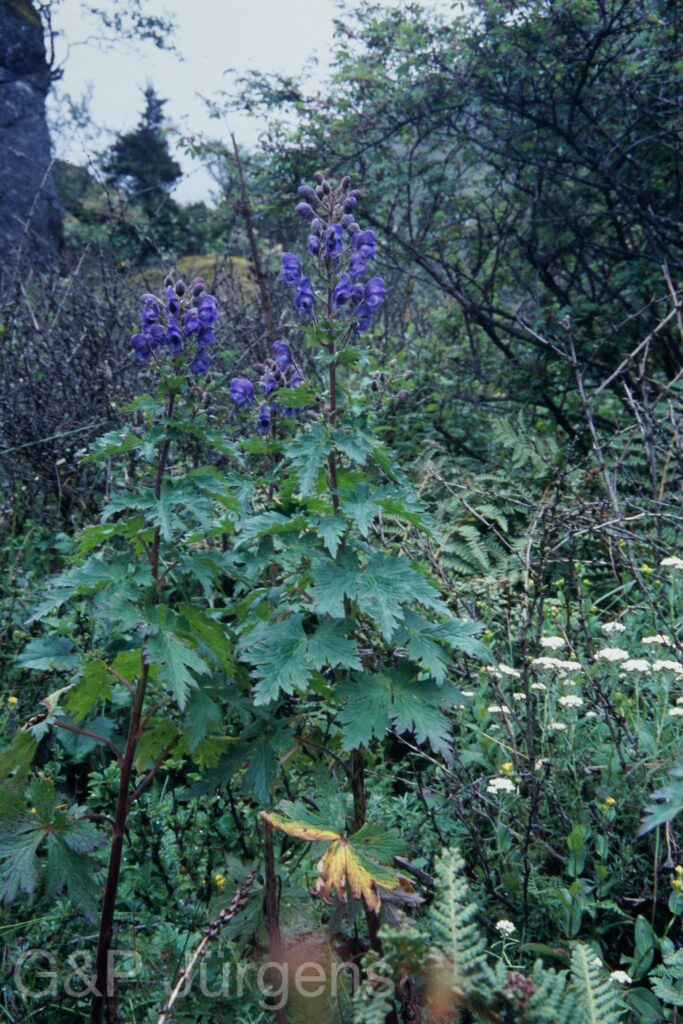
Sikkim2003 251 G345
Sikkim Dzongri 4300m 08.2003
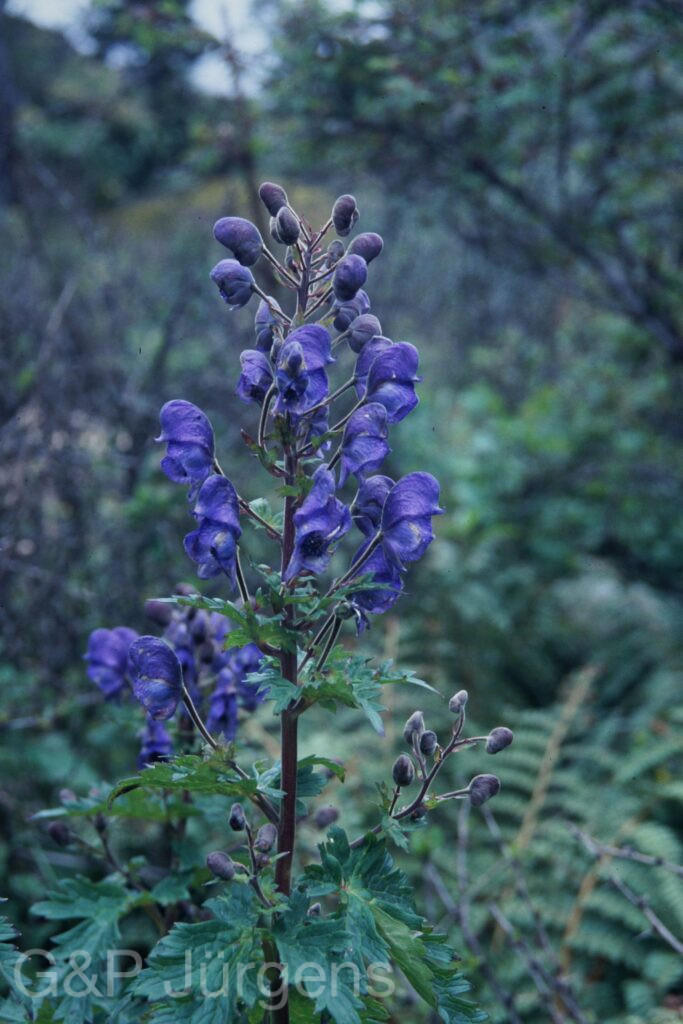
Sikkim2003 250 G344
Sikkim Dzongri 4200m, August

Description

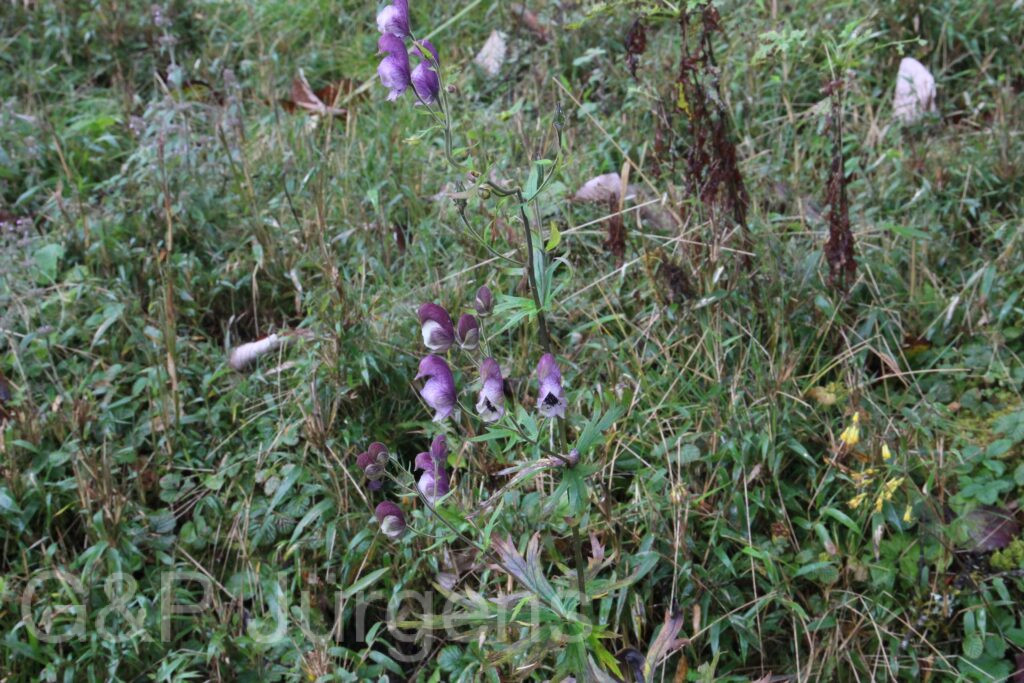
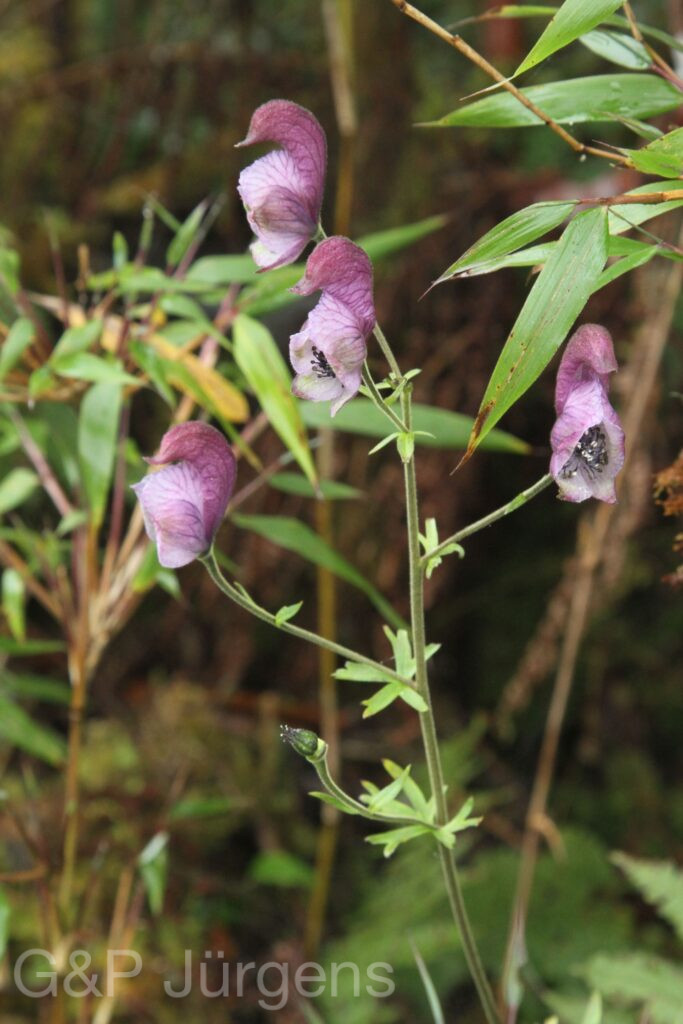
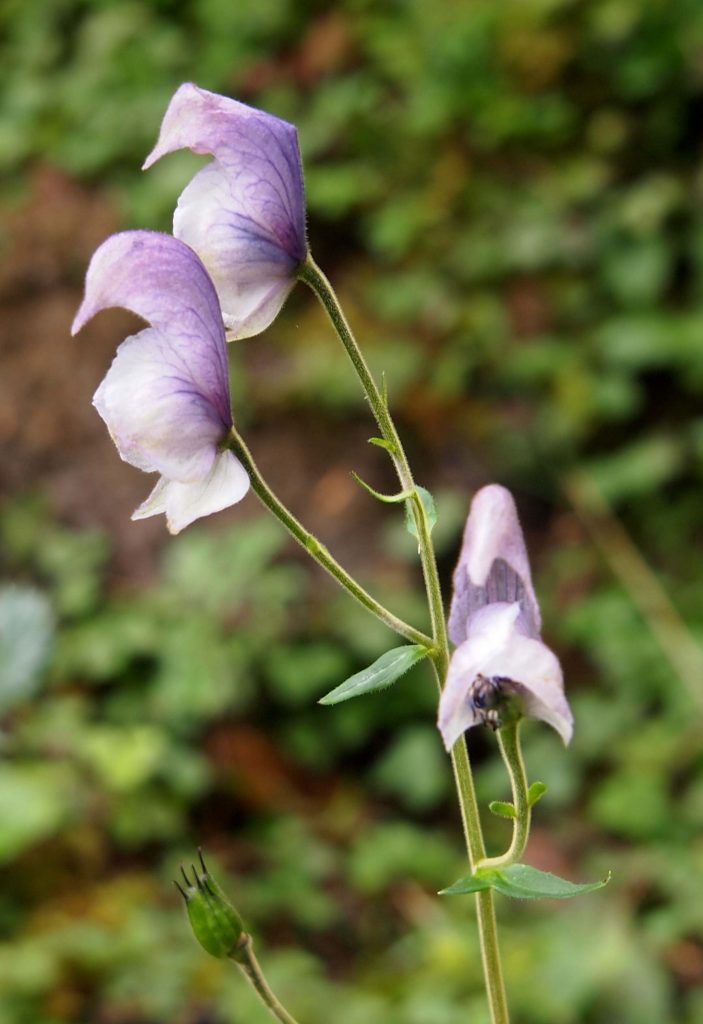
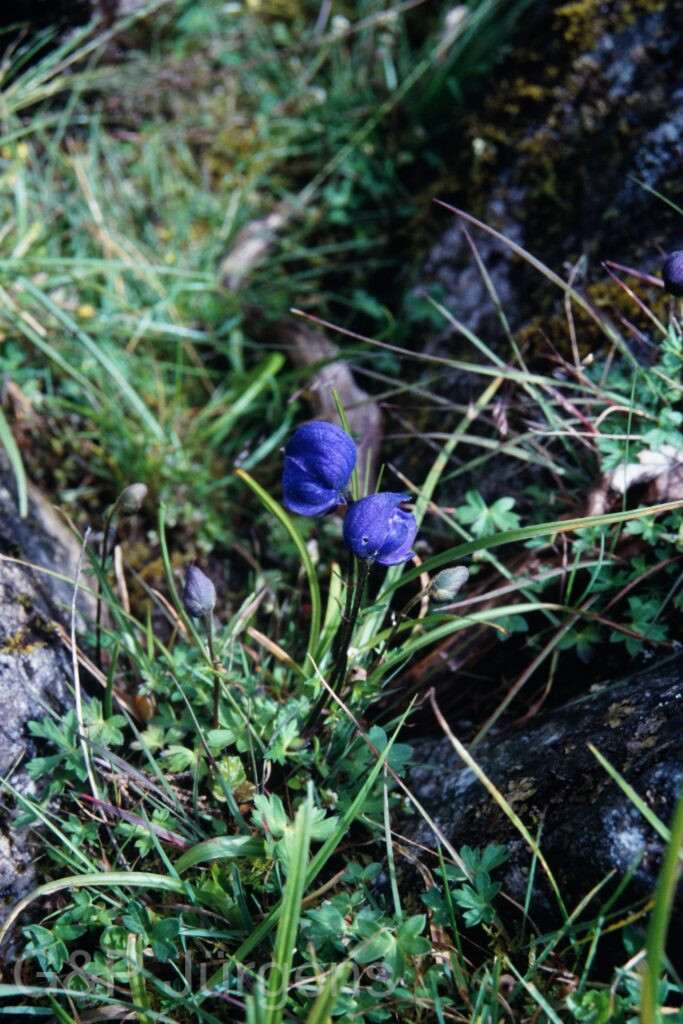
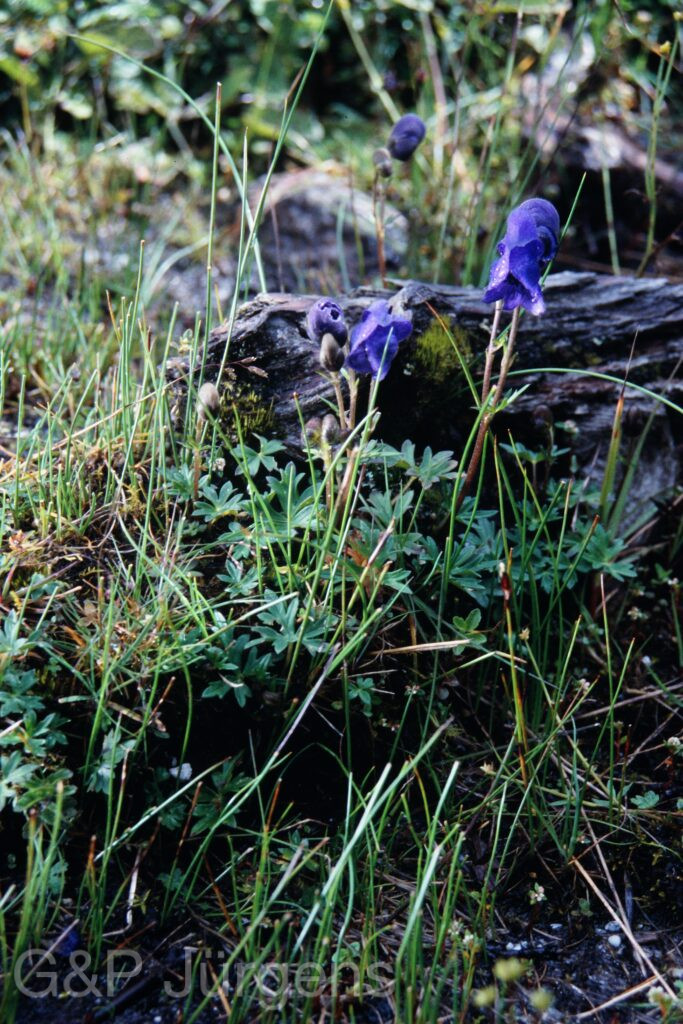
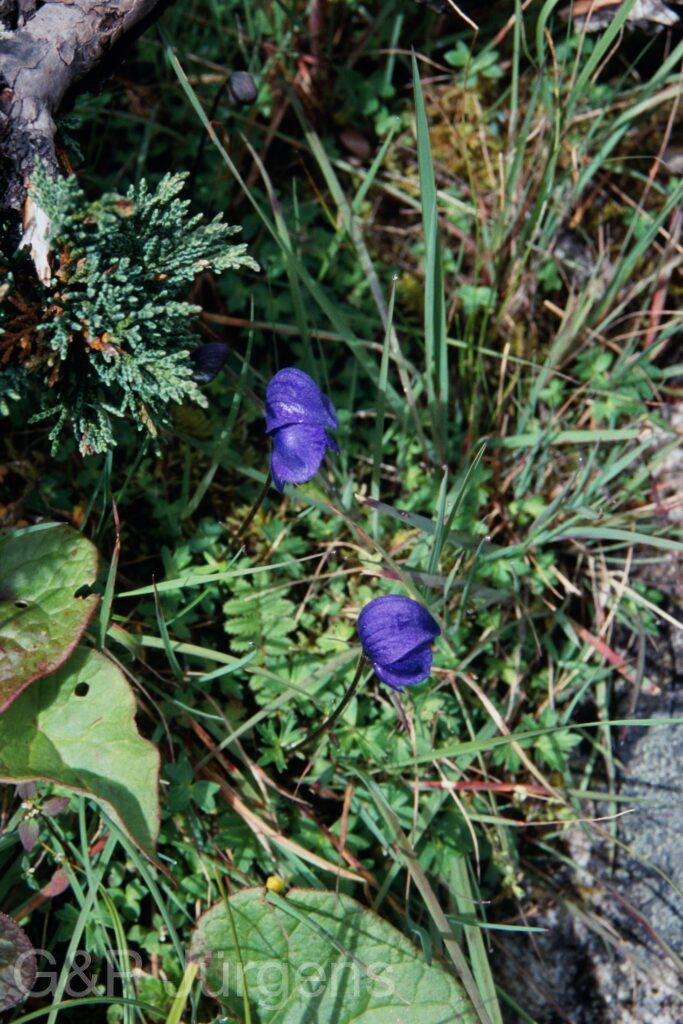
Aconitum hookeri is an alpine perennial of the eastern Himalaya, recorded from Nepal, China and India (NP, CN, IN, with further records), with around 96 documented occurrences. It inhabits open alpine meadows, grassy slopes, stony pastures and the margins of dwarf scrub in the high alpine zone, generally between about 4000 and 4800 m. The collections cited were all made at Dzongri in Sikkim, at 4200 to 4300 m in August, an elevation and late-summer flowering season fully characteristic of the species, where it grows in herb-rich turf above the treeline among the rolling alpine pastures of the upper Rathong valley.

The plant is a low, erect to ascending perennial herb arising from a tuberous, paired rootstock. The leaves are deeply palmately divided into narrow, again-lobed segments, dark green and mostly basal or on the lower stem. The inflorescence is a few-flowered terminal raceme of large, showy, deep blue to violet flowers. As in all Aconitum the flowers are strongly zygomorphic: the uppermost of the five petaloid sepals is enlarged into a tall, helmet-shaped hood (the galea) arching over two long-clawed nectariferous petals concealed within, the remaining sepals spreading. The numerous stamens surround several free carpels that mature into a cluster of follicles releasing winged or angled seeds.

Aconitum (monkshood; subfamily Ranunculoideae of the Ranunculaceae) is a large genus of the northern temperate and alpine zones, richly represented in the Sino-Himalaya. The hooded flowers are specialised for pollination by long-tongued bumblebees, which alone can reach the nectaries within the galea. Like its congeners A. hookeri contains highly toxic diterpenoid alkaloids of the aconitine type, rendering the whole plant dangerously poisonous yet of interest in traditional medicine. Restricted to high alpine grassland, it is locally frequent and not presently of conservation concern.

Author: Stapf · Sources: POWO (Kew), GBIF, Flora of Bhutan, Flora of China, Aconitum monograph (Tamura/Rapaics, Ranunculaceae)

Griff.

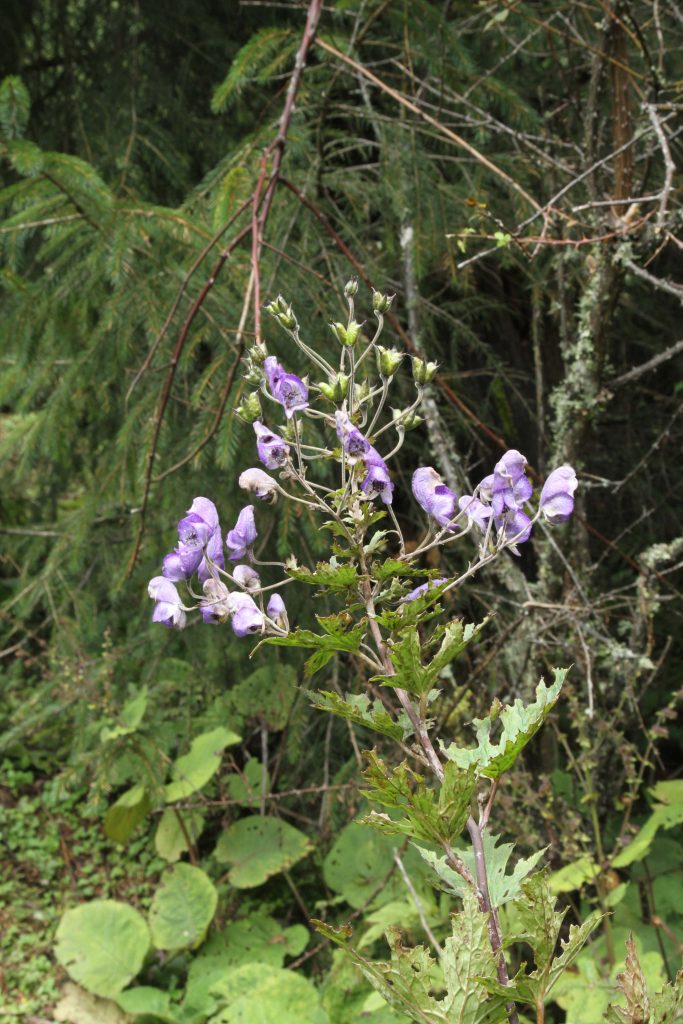
Sikkim2003 440 P612
Sikkim Chopta Valley 3900m August
Sikkim2003 441 P613
Sikkim Chopta Valley 3900m August
Bhutan2012 39
Bhutan Shele-La, 3600m September
Bhutan2012 176
Bhutan Haar-Valley 3500m, September

Description

Aconitum lethale is an eastern Himalayan monkshood restricted to Nepal, India and Bhutan, with about 176 GBIF records concentrated in Sikkim and Bhutan. It is a plant of the upper subalpine and alpine zone, growing among tall-herb meadows, rhododendron and juniper scrub, and along moist, open slopes. The cited collections trace its habitat closely: the Chopta Valley in Sikkim at around 3900 m in August, and several Bhutanese sites including Shele-La at about 3600 m, the Haar Valley at 3500 m and Dochu-La near 3000 m, flowering from late summer into October. It favours cool, humid, well-drained mountain soils where the monsoon sustains lush herbaceous growth.

The plant is an erect perennial herb arising from tuberous roots, with a leafy stem bearing palmately divided, deeply lobed leaves whose segments are further incised. The inflorescence is a terminal raceme or panicle of the characteristic zygomorphic flowers, in which the upper sepal is enlarged into a tall, helmet-shaped or hooded galea concealing two long-clawed nectaries; the flowers are typically deep blue to violet. Numerous stamens surround several free carpels, which ripen into a cluster of dehiscent follicles releasing winged or angular seeds.

Described by Griffith, A. lethale is, as both its epithet and generic affinity warn, intensely poisonous, containing diterpenoid alkaloids of the aconitine type throughout the plant and especially in its tubers. Such alkaloids underlie the cautious medicinal use of Himalayan aconites in traditional pharmacopoeias. As a narrow-range endemic of the eastern Himalaya, it warrants attention to grazing pressure and habitat change, though it remains locally frequent within its restricted distribution.

Author: Griff. · Sources: POWO (Kew), GBIF, Flora of Bhutan, Annotated Checklist of the Flowering Plants of Nepal, Tamura's treatment of Aconitum

Stapf

Sikkim2003 256 P351
Sikkim Dzongri 4200m August

Description

Aconitum naviculare is a high-alpine monkshood of the eastern and central Himalaya, ranging from Nepal through Sikkim and northern India into Bhutan, south-western China (Xizang) and northern Myanmar; its modest tally of around 110 georeferenced occurrences (CN, NP, BT, IN, MM) reflects its specialised montane niche. It occupies open alpine meadows, screes, moist turf and rocky slopes at high elevation, typically between about 3500 and 4800 m. The plant photographed at Dzongri in Sikkim at 4200 m in August, flowering at the height of the monsoon-influenced alpine summer, exemplifies its cold, exposed habitat near the upper limit of vascular plant growth.

It is a small perennial herb arising from a slender tuberous rootstock, with an erect or somewhat flexuous stem usually under 30 cm. The leaves are palmately divided into narrow, deeply cut segments. The flowers are few and borne in a lax terminal raceme; as in all Aconitum the five petaloid sepals are zygomorphic, the uppermost forming the characteristic helmet or hood (galea), here narrowly boat-shaped (navicular, whence the epithet), bluish-purple and often paler within. Two long-clawed nectariferous petals are concealed beneath the hood, with numerous stamens and three to five free carpels ripening into a cluster of follicles containing winged seeds.

Aconitum naviculare belongs to subgenus Aconitum and is a noted constituent of Himalayan alpine flora, valued and harvested in Tibetan and folk medicine as "Bonga" for its diterpenoid alkaloids, which render the whole plant highly toxic. Such harvesting, combined with its restricted high-altitude range, raises local conservation concern, although it remains frequent within intact alpine grassland.

Author: Stapf · Sources: POWO (Kew), GBIF, Flora of China, Flora of Bhutan, Flora of Nepal, Stapf's monograph of the Asiatic species of Aconitum

(Hook.f.) H.Hara

Sikkim2003 70 P95
Sikkim Choka 2900m, August

Description

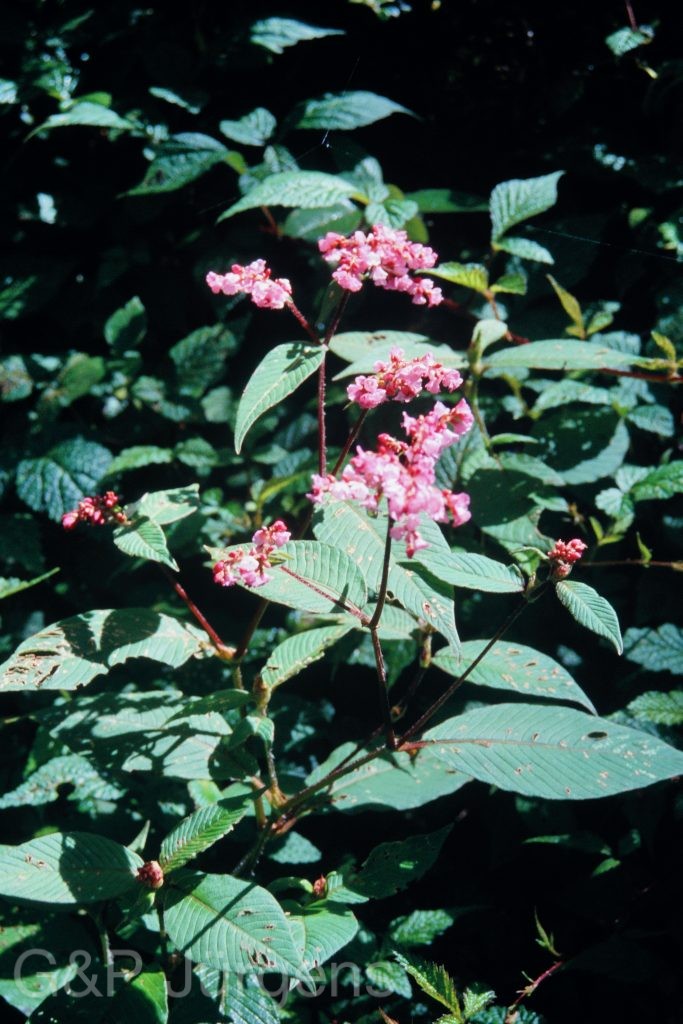
Aconogonum campanulatum, treated by GBIF as a synonym of the accepted Aconogonon campanulatum, is a Sino-Himalayan perennial herb distributed from Nepal and northern India through Sikkim and Bhutan into Myanmar and south-western China. Its 372 GBIF records lie mostly within this native range, with scattered European, North and South American and New Zealand points reflecting cultivated and herbarium material. It grows in subalpine and alpine meadows, forest clearings, shrubberies and along streamsides and banks, commonly between about 2700 and 4000 m. The plant photographed at Choka in Sikkim at 2900 m in August captures it flowering in moist, herb-rich montane vegetation during the monsoon.

It is a robust, branching perennial arising from a woody rootstock, with erect leafy stems. The leaves are alternate, ovate to ovate-lanceolate, often somewhat cordate to rounded at the base and acuminate at the apex, frequently white-tomentose beneath, with membranous sheathing ochreae at the nodes. The flowers are borne in lax, branched, paniculate inflorescences; each has a five-parted, campanulate, white to pinkish perianth (the source of the epithet), with eight stamens and a trifid style. The fruit is a small, trigonous, shining brown nut.

The species belongs to Aconogonon (often spelled Aconogonum), a segregate of the broadly defined Polygonum embracing the alpine knotweeds, and the accepted name is Aconogonon campanulatum. Its woody rootstock and tall leafy habit suit the tall-herb communities of moist Himalayan slopes. Widely distributed and locally abundant, it is of no conservation concern and forms a conspicuous element of subalpine meadow vegetation.

Author: (Hook.f.) H.Hara · Sources: POWO (Kew), GBIF, Flora of Bhutan, Flora of China, Annotated Checklist of the Flowering Plants of Nepal

Actaea elata

by GP Jürgens

Prantl

Sikkim2003 477 P662
Sikkim Lachung Valley 3300m, August

Description

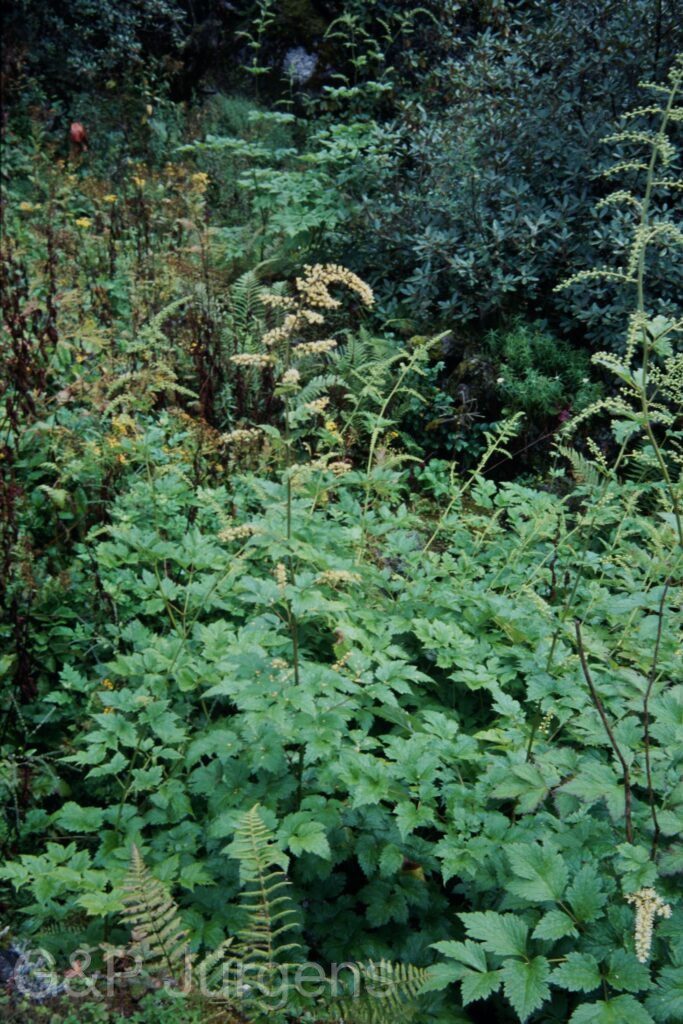
Actaea elata Prantl is a tall woodland perennial of cool-temperate forests. The GBIF record (CN, IN and several extralimital codes including US, CA, RU, CO and ZZ, totalling 844 occurrences) reflects a mixture of Asian native material and considerable confusion with the North American A. elata (Nutt.) Prantl, a name applied on both continents; in the Himalayan context the plant occupies shaded, humus-rich Abies–Betula and mixed broad-leaved forest, streamsides and tall-herb communities. The illustrated specimen from the Lachung Valley in northern Sikkim at 3300 m, in August, sits squarely within this moist montane forest zone, flowering and fruiting during the late monsoon.

The species grows from a stout rhizome, producing erect stems to well over a metre. The leaves are large, alternate and 2–3-ternately compound, the ultimate leaflets ovate, acuminate and sharply serrate to incised. Flowers are borne in elongate terminal and axillary racemes; they are small, white and apetalous in effect, the petaloid sepals soon caducous and the conspicuous part being the numerous slender white stamens, giving a fluffy aspect typical of baneberries. The pistils mature into several-seeded follicles or, in the strict baneberry sense, fleshy berries, the dispersal unit varying with the taxonomic circumscription applied.

Actaea, here treated to include the segregate Cimicifuga, belongs to subfamily Ranunculoideae; the inclusion of Cimicifuga within Actaea is supported by molecular phylogenetics. As in many Ranunculaceae the plants contain bioactive triterpene glycosides, conferring toxicity and underpinning medicinal use. The taxon is widespread and not threatened, though the transcontinental nomenclatural overlap means GBIF distributional data require critical evaluation.

Author: Prantl · Sources: POWO (Kew), GBIF, Flora of China (Ranunculaceae), Flora of Bhutan, Compton & Culham monograph of Actaea s.l. (incl. Cimicifuga)

Simonov.

Sikkim2004 168 P284
Sikkim/India Singalila 4200m May

Description

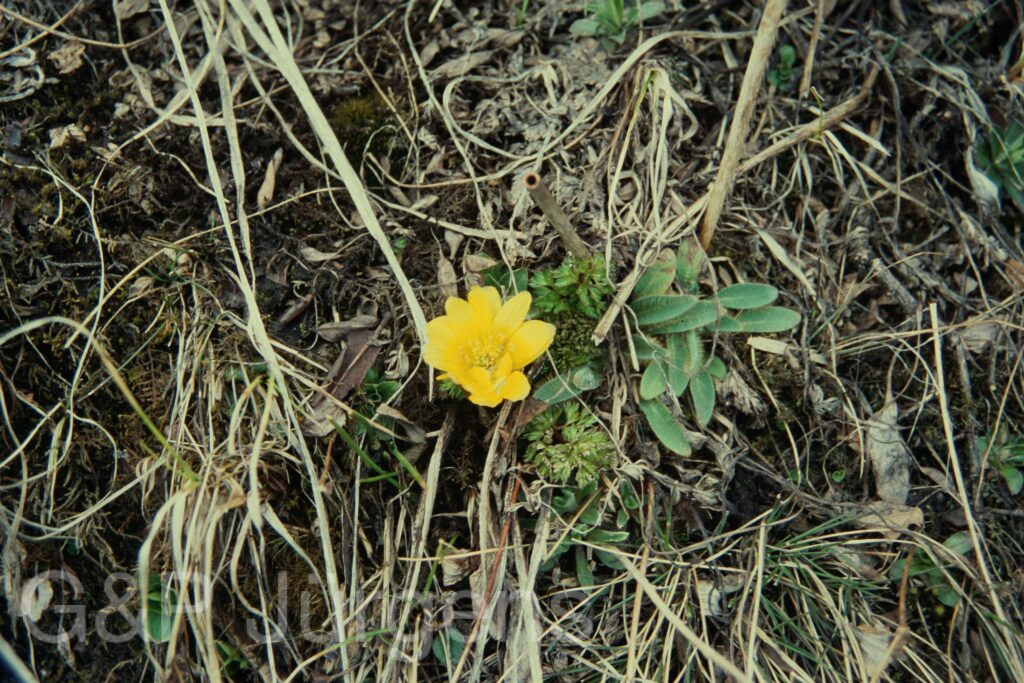
Adonis nepalensis is an alpine perennial herb of the central and eastern Himalaya, recorded from Nepal, India and Bhutan (the additional scattered GBIF records from Hungary and Morocco almost certainly representing cultivated or misattributed material), with a small total of 28 occurrences in GBIF. It is a plant of high open habitats, growing in alpine meadows, grassy and rocky slopes and the margins of dwarf scrub near and above the treeline. The photographed plant was collected on the Singalila ridge on the Sikkim/India border at about 4200 m in May, a high-altitude spring-flowering station typical of the species, which blooms soon after snowmelt.

The plant grows from a short, stout rootstock and produces erect, leafy stems. The leaves are alternate and finely dissected, repeatedly divided into narrow, linear ultimate segments, giving them a feathery aspect characteristic of the genus. The flowers are solitary and terminal, fairly large and showy, with numerous spreading petals that are yellow (the usual colour in the Himalayan species), subtended by a green, dissected involucre of leaf-like bracts; the numerous stamens and free carpels are borne on a slightly elongate receptacle. The fruit is a head of small, dry, one-seeded achenes.

Adonis belongs to the Ranunculaceae and, like many genera of the family, contains cardiac glycosides and other toxic compounds. Adonis nepalensis is the principal Himalayan representative, distinguished by its alpine habit and yellow flowers, and is a relatively narrow-ranged montane species. Its high-elevation, snowmelt-dependent populations make it of biogeographic interest as part of the specialised Himalayan alpine flora and potentially sensitive to warming and to the disturbance of fragile alpine turf.

Author: Simonov. · Sources: POWO (Kew), GBIF, Flora of Bhutan, Annotated Checklist of the Flowering Plants of Nepal, Ranunculaceae of the Himalaya

Roxb.

Sikkim2004 445 G776
Sikkim/India Tista-Valley 2000m May

Description

Aerides multiflora is an epiphytic orchid of the subtribe Aeridinae, native to the eastern Himalayas and extending into Southeast Asia. Its natural range encompasses Nepal, northeast India (Sikkim, Assam, Meghalaya, Arunachal Pradesh), Bhutan, Myanmar, Thailand, and southwest China (Yunnan). The species inhabits humid, semi-deciduous and evergreen forests at elevations of 200–2,000 m, typically growing on mossy tree trunks and branches in well-lit positions.

The plant produces stout, terete stems 20–40 cm long, clothed with distichous, coriaceous, strap-shaped leaves that are 15–25 cm long and unequally bilobed at the apex. The inflorescence is a densely many-flowered, pendent raceme 15–30 cm long, bearing 20–40 fragrant flowers. Individual flowers are 2–2.5 cm across, white to pale rose-pink with purple spots, the lip trilobed with a prominent forward-pointing spur. The mid-lobe is fleshy and tongue-shaped. Flowering occurs from April to June.

Aerides multiflora is valued in horticulture for its abundant, sweetly fragrant blooms. The species is under pressure from overcollection and habitat degradation across its range. Like all orchids, it is listed under CITES Appendix II, regulating international trade.

Author: Roxb. · Sources: POWO (Kew), Flora of Bhutan Vol. 3, GBIF, Pearce & Cribb: The Orchids of Bhutan (2002)

Mill.

Sikkim2011 9
India Sikkim Tista valley 1800m, June

Description

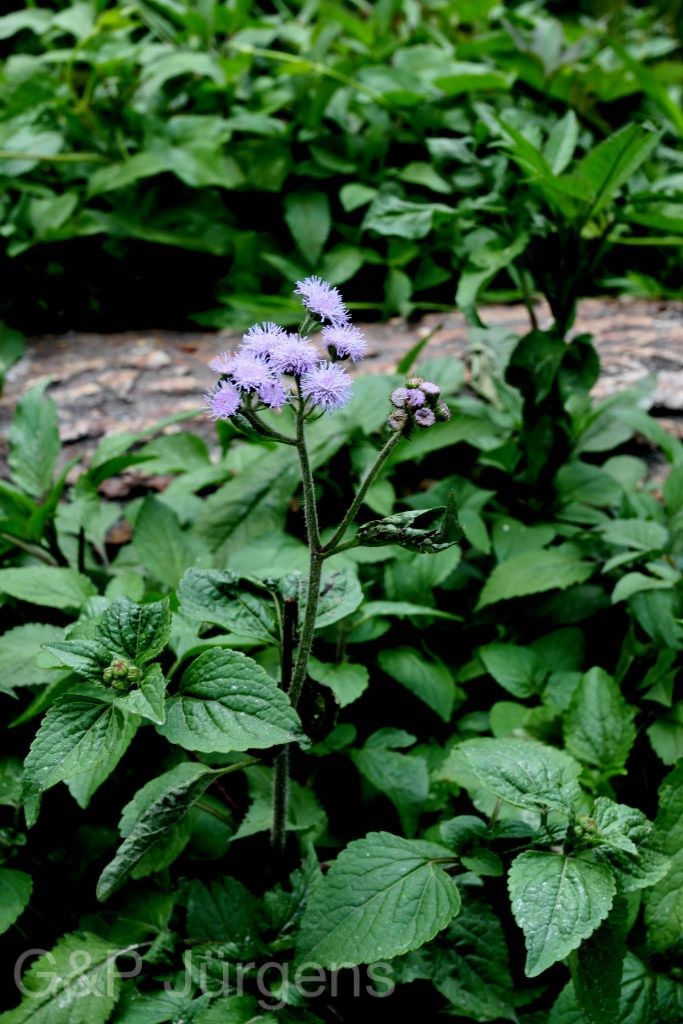
Ageratum houstonianum Mill. is native to Mexico and Central America but is now a widely naturalised tropical and subtropical weed; GBIF records over 25,000 occurrences spanning Mexico, the United States, China, Taiwan, Hong Kong, Nepal, India, South Africa, Tanzania, Malawi and much of western and central Europe. It colonises waste ground, roadsides, field margins, ditches and clearings, particularly in moist, disturbed habitats. The record from the Tista valley in Sikkim at 1800 m in June reflects its thorough naturalisation in the lower Eastern Himalaya, where it flowers through the warm, humid monsoon season.

It is an erect to ascending annual herb with stems clothed in spreading, often viscid hairs. The leaves are mostly opposite, ovate to deltoid, with a crenate-serrate margin, a truncate to cordate base and conspicuous palmate venation, and are softly pubescent. The small capitula are aggregated in dense, flat-topped corymbs; each head is wholly discoid, lacking ray florets, with an involucre of narrow phyllaries and numerous blue, lavender or occasionally white tubular florets whose long, exserted styles give the inflorescence a characteristic fluffy texture. The fruit is a black, five-angled cypsela bearing a pappus of awned scales.

Widely grown as the ornamental "floss flower", A. houstonianum has escaped cultivation throughout the warmer world and is regarded as an invasive weed in parts of Asia, Africa and Australia; like its relatives it contains pyrrolizidine alkaloids and is toxic to livestock. It is of no conservation concern and is instead managed as a weed.

Author: Mill. · Sources: POWO (Kew), GBIF, Flora of China, Flora of North America, Johnson revision of Ageratum

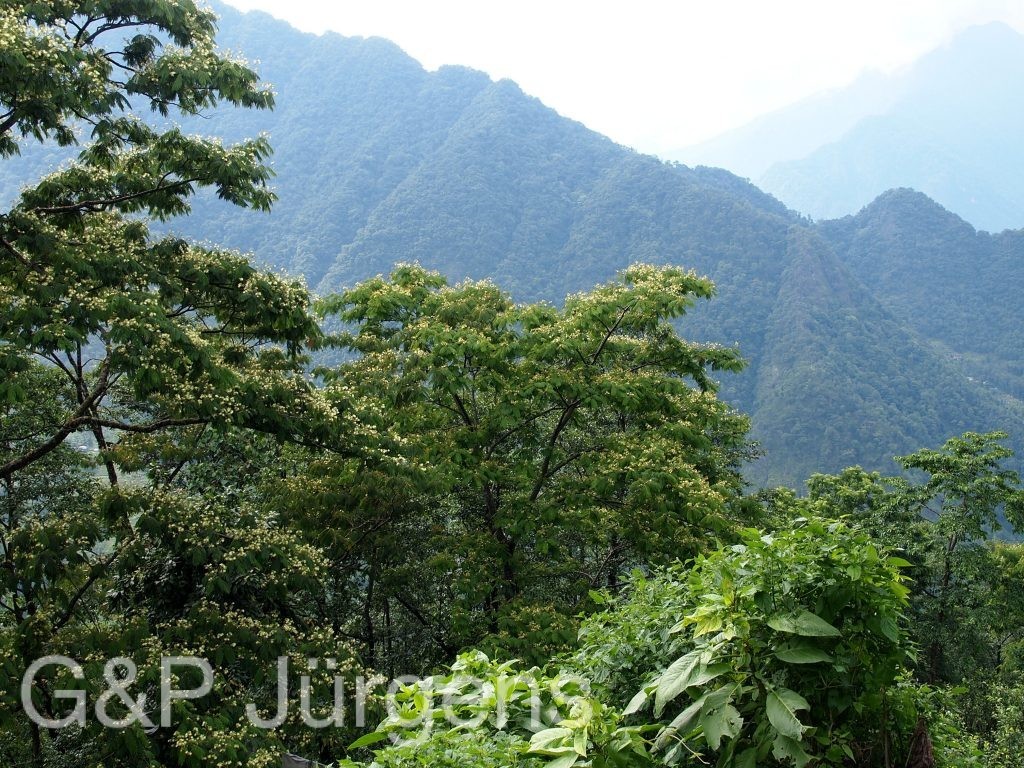
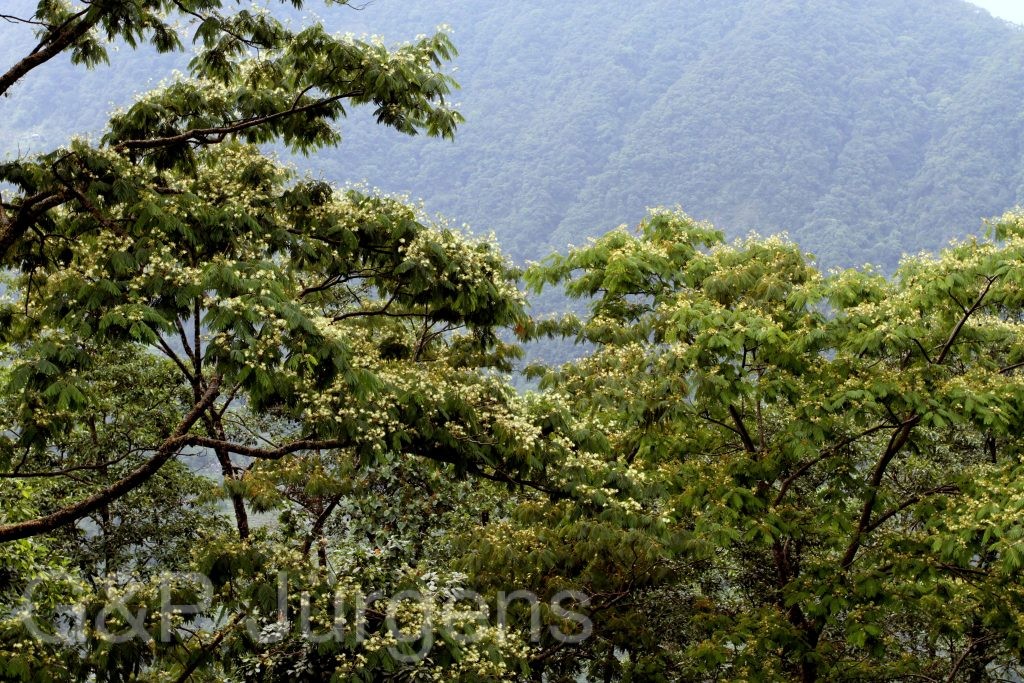
(L.f.) Benth.

Sikkim2011 12
India Sikkim Tista valley 1800m, June
Sikkim2011 13
India Sikkim Tista valley 1800m, June

Description

Albizia odoratissima is a deciduous tree of broadly tropical and subtropical distribution, ranging across the Indian subcontinent and continental Southeast Asia into southern China, with records from Nepal, Bangladesh, Myanmar, Thailand, Laos, Vietnam, Sri Lanka, Malaysia and Indonesia; it has been widely introduced elsewhere, including East Africa, Nigeria, Mozambique and the Americas, and is documented from over a thousand georeferenced collections. In the eastern Himalaya it ascends warm submontane forest, as in the Tista valley of Sikkim around 1800 m photographed in June, favouring moist deciduous and semi-evergreen forest, riverine slopes and forest margins.

The tree reaches 15-25 m, with a spreading crown, grey-brown bark and finely pubescent branchlets. The leaves are bipinnate, with 3-6 pairs of pinnae, each pinna bearing numerous small oblong-falcate leaflets oblique at the base; a gland sits on the petiole. The fragrant flowers are arranged in pedunculate globose heads grouped into terminal panicles, each with a small campanulate calyx, funnel-shaped corolla and numerous long, white to greenish-cream exserted stamens united below into a tube. The fruit is a flat, thin, oblong dehiscent legume, glabrous and reddish-brown.

A member of the mimosoid clade of Fabaceae, A. odoratissima was described as Mimosa odoratissima by the younger Linnaeus and transferred to Albizia by Bentham. It is valued as a nitrogen-fixing timber and fodder species and is widely planted for shade, agroforestry and reforestation, which accounts for its naturalised occurrences far beyond its native Asian range. Locally esteemed for its hard, durable wood, it remains common and is not regarded as threatened, though native populations are affected by selective logging and forest conversion.

Author: (L.f.) Benth. · Sources: POWO (Kew), GBIF, Flora of China, Flora of Bhutan, Flora of British India, Nielsen monograph of Asian Albizia (Mimosoideae)