Tag:

Sikkim

Flowers of Sikkim — 350 species from the Sikkim Himalaya in northeast India, a compact yet botanically extraordinary region that climbs from subtropical valleys to the alpine zone beneath Kangchenjunga. Sikkim is a classic centre of Himalayan plant diversity, celebrated for its rhododendrons, primulas, orchids and gentians. Each entry provides a botanical description, distribution, habitat and flowering season with the original field photograph.

Bureau & Franch.

Sikkim2011 29
Sikkim Lachen 2760m, June

Description

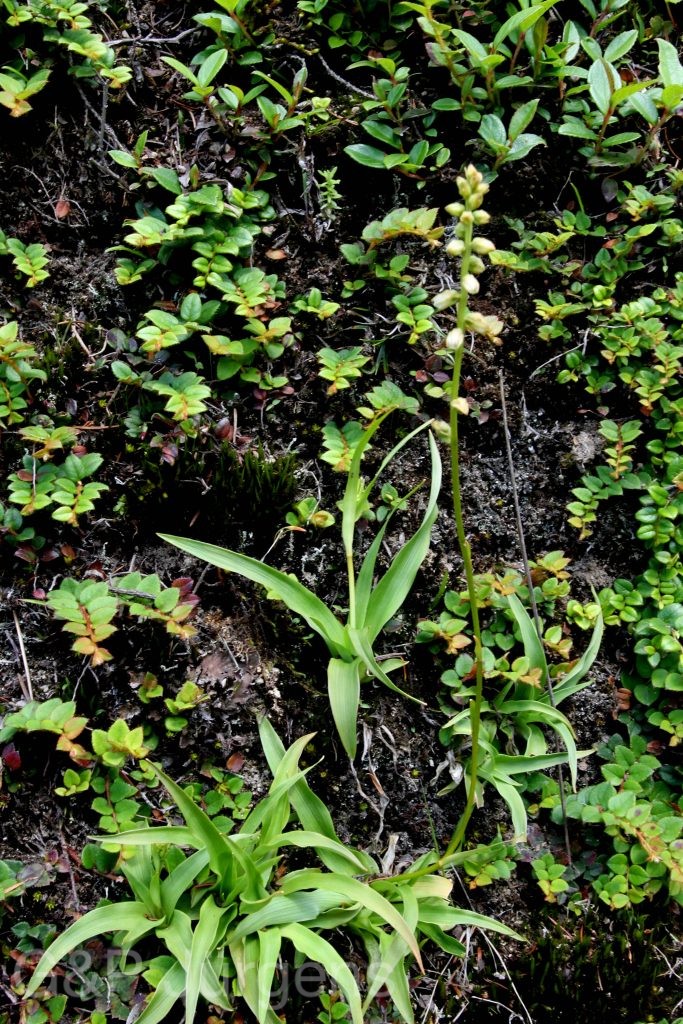
Aletris glabra is a rosette-forming perennial herb of the Nartheciaceae, distributed across the eastern Himalaya and East Asia. GBIF data (nearly 1,300 occurrences) confirm a native range spanning China, Taiwan, Korea, Japan, the Korean peninsula, India, Nepal and Bhutan. The species grows in moist, open habitats including subalpine and alpine meadows, grassy slopes, marshy ground, bog margins and forest clearings, typically in the temperate to subalpine belt. The collection from Lachen in northern Sikkim at 2,760 m in June reflects its occurrence in damp montane grassland and meadow flushes in the early summer flowering season.

The plant forms a basal rosette of narrowly lanceolate to linear, soft, grass-like leaves. From the centre arises a slender, erect flowering scape bearing a narrow, elongate raceme of small flowers. The flowers are campanulate to narrowly tubular, white to greenish-white, with six perianth lobes united below into a tube; unlike the mealy or warty-flowered relatives, the perianth of A. glabra is comparatively smooth, the epithet glabra denoting this glabrous character. There are six stamens inserted on the tube, and a superior to half-inferior, three-locular ovary. The fruit is a small, ovoid to ellipsoid loculicidal capsule containing numerous minute seeds.

The genus Aletris was long placed in the Liliaceae or Melanthiaceae but is now referred, with Narthecium, to the small monocot family Nartheciaceae within the Dioscoreales. The group is of phylogenetic interest as an early-diverging lineage of the order. As a plant of wet meadows and bog margins, A. glabra is an indicator of intact damp grassland; though widely distributed and secure overall, such wetland habitats are locally threatened by drainage and grazing.

Author: Bureau & Franch. · Sources: POWO (Kew), Flora of China Vol. 24, Flora of Bhutan Vol. 3, GBIF, Tamura: The Families and Genera of Vascular Plants – Nartheciaceae
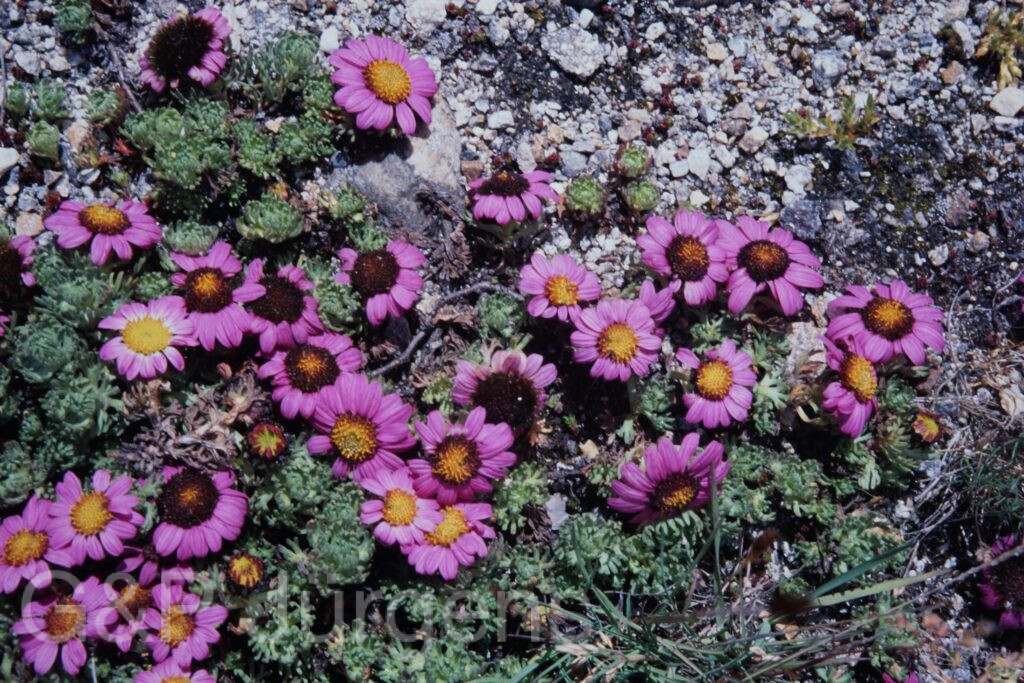
Allardia glabra

by GP Jürgens

Decne.

Sikkim2003 518 G720
Sikkim Yume Samdong 4700m August
Sikkim2003 519 P724
Sikkim Yume Samdong 4700m August

Description

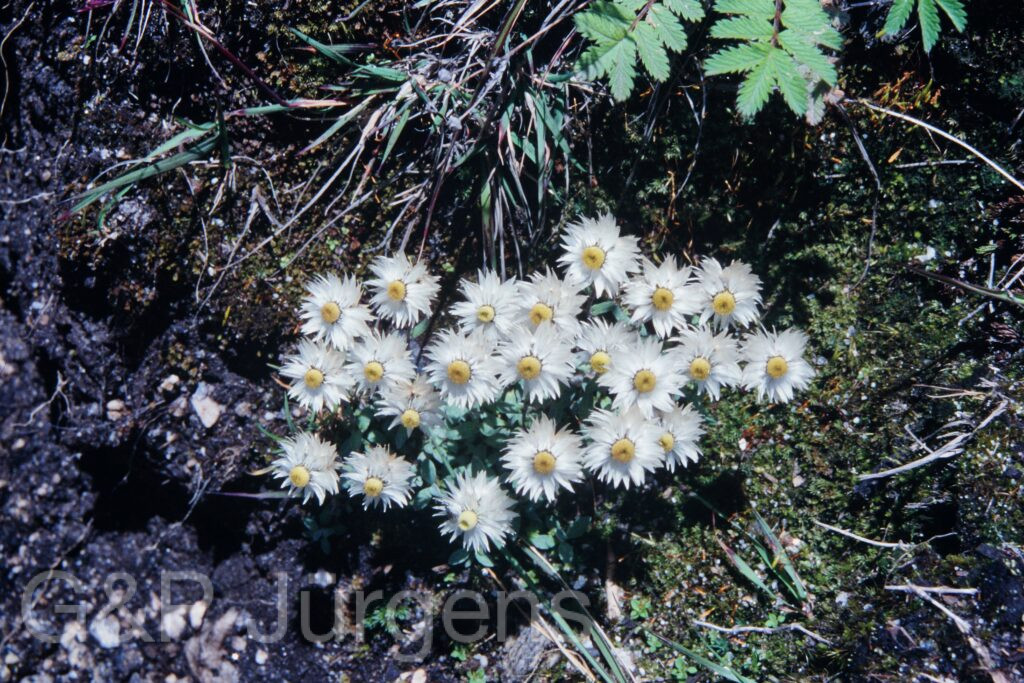
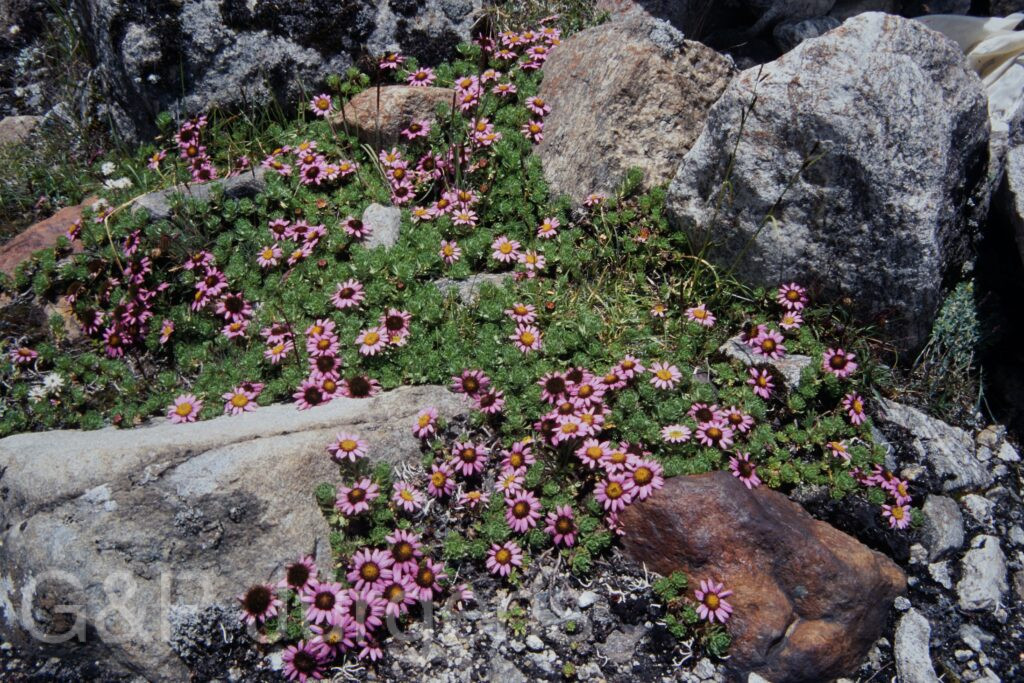
Allardia glabra is a high-alpine composite of the Himalaya and central Asia, distributed across Nepal, India, China, Pakistan, Tajikistan, Bhutan, Afghanistan and Kazakhstan, with GBIF documenting about 327 occurrences. It is a plant of the uppermost alpine and subnival zones, growing on screes, moraines, gravelly flats and stony slopes at very high elevations, commonly between about 4000 and 5500 m. The photographed material from Yume Samdong in northern Sikkim at 4700 m, flowering in August, is typical of its extreme habitat, where it forms low cushions or mats on bare, frost-disturbed ground near the limit of vascular plant life, taking advantage of the short, intense growing season of the high summer.

It is a dwarf, cushion- or mat-forming perennial arising from a branched, often stout caudex clothed in the persistent remains of old leaves. The leaves are small, crowded, spathulate to obovate and entire or shallowly lobed at the tip, and, as the epithet glabra indicates, relatively glabrous compared with the woolly indumentum of related species. The flower heads are solitary, sessile or shortly stalked, nestled among the foliage, and radiate, with an involucre of imbricate, often dark-margined bracts. The pistillate ray florets are pink to lilac or whitish, surrounding numerous yellow tubular disc florets. The fruit is a small, ribbed cypsela crowned by a short pappus.

Allardia is a small genus of about half a dozen species centred on the high mountains of central Asia and the Himalaya, long included within Waldheimia, under which name (Waldheimia glabra) this taxon is frequently encountered. Its cushion habit, reduced glabrous leaves and ground-hugging capitula are classic adaptations to cold, wind-exposed, high-radiation subnival environments. As a specialist of the highest vegetated ground it is of biogeographic interest and potentially sensitive to upward shifts of the climatic snowline, though its remoteness affords protection.

Author: Decne. · Sources: POWO (Kew), GBIF, Flora of China, Flora of Pakistan, Annotated Checklist of the Flowering Plants of Nepal, Podlech and Asteraceae monographic treatments of Allardia (Waldheimia)

C.H.Wright

Sikkim2003 206 P288
Sikkim Dzongri 4000m, August

Description

Allium prattii is a widespread alpine onion of the Himalaya and adjacent ranges, distributed across China, Nepal, Bhutan, India, Afghanistan, Myanmar and Mongolia, and is among the better-documented species in this set with nearly 1500 georeferenced records in GBIF. It grows in subalpine and alpine meadows, forest clearings, scrub and damp grassy slopes, generally between about 2500 and 4500 m. The plant illustrated was photographed at Dzongri in Sikkim at 4000 m in August, a characteristic high-alpine setting where it flowers during the summer monsoon.

The species is a bulbous perennial with a narrowly cylindrical to ovoid bulb sheathed in fibrous to membranous tunics. It typically bears two flat, lanceolate to elliptic basal leaves that are shorter than to about equalling the scape. The leafless flowering stem is erect and terete, bearing a terminal, more or less hemispherical umbel subtended by a persistent papery spathe. The flowers are stellate to campanulate, with six purplish-red, rose to lilac tepals, exserted stamens and a superior ovary; the fruit is a small loculicidal capsule containing black seeds.

Allium prattii is placed in Allium (Amaryllidaceae, subfamily Allioideae), a very large genus whose Himalayan and Central Asian members form a notable centre of diversity. Like several relatives it is edible, gathered locally as a wild vegetable and seasoning, and grazed by livestock. Its broad geographic and altitudinal range and large population base make it secure overall, and it is not regarded as threatened, though particular alpine stands are subject to heavy collection and grazing pressure in well-frequented high-pasture areas.

Author: C.H.Wright · Sources: POWO (Kew), GBIF, Flora of China, Flora of Bhutan, Annotated Checklist of the Flowering Plants of Nepal, Stearn Monograph of the Genus Allium

(Van Heurck & Müll.Arg.) Monach.

Bh2008 497 P766
Bhutan Samtengang, 2200m April

Description

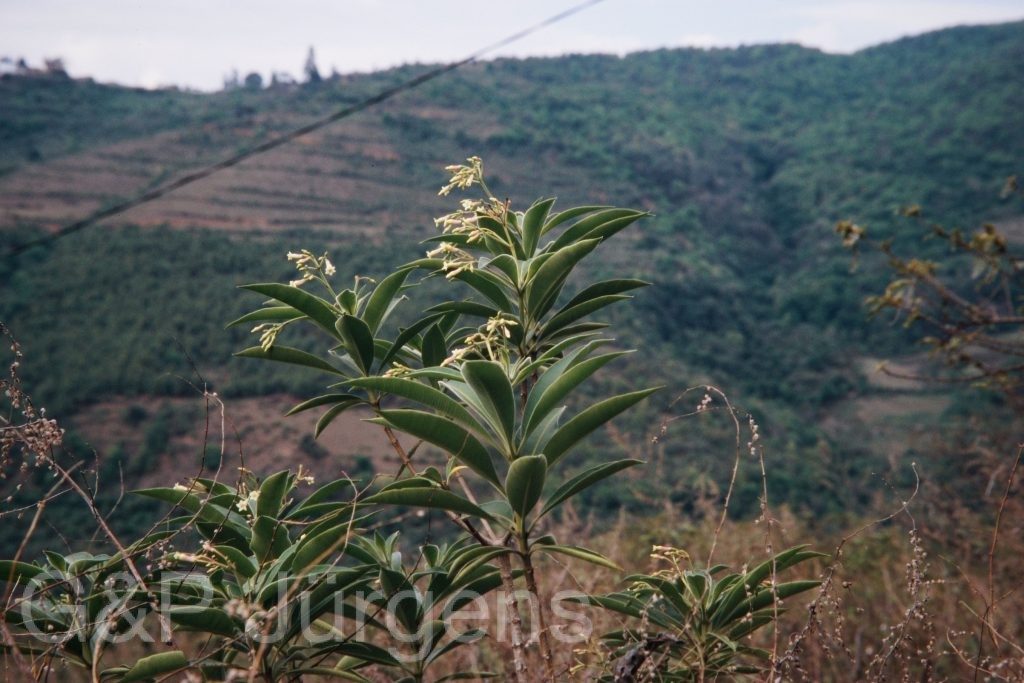
Alstonia sebusi (the accepted spelling being Alstonia sebusii) is a tree of montane forests in the eastern Himalaya and adjacent Southeast Asia, recorded from Bhutan, India, China (Yunnan), Myanmar and Japan, with about 50 georeferenced occurrences in GBIF. It occurs in broadleaved evergreen and mixed montane forest, typically on slopes within the warm- to cool-temperate belt. The specimen illustrated was photographed at Samtengang in Bhutan at about 2200 m in April; across its range it generally favours humid, well-drained forest soils where it grows as a canopy or sub-canopy tree.

The species is a small to medium-sized evergreen tree exuding milky latex when cut, as is characteristic of the genus. The leaves are arranged in whorls of three to several at the nodes, simple, entire, leathery and elliptic to oblong, with numerous closely parallel lateral veins. The flowers are small, white to cream, borne in terminal cymose clusters, with a salverform corolla whose tube bears overlapping lobes; the gynoecium consists of two carpels. The fruit comprises a pair of slender, pendulous follicles that split to release numerous flattened seeds bearing tufts of hair at each end, adapted for wind dispersal.

Alstonia (Apocynaceae, subfamily Rauvolfioideae) is a pantropical genus of latex-bearing trees rich in indole alkaloids, several of which have medicinal and pharmacological interest. The whorled leaves and paired follicles with comose seeds are diagnostic. Like other Alstonia species it provides soft, light timber locally used for carving and utility purposes. No major conservation threat is documented, though the species is dependent on the continued integrity of mid-elevation montane forest, which faces pressure from logging and land conversion in parts of its range.

Author: (Van Heurck & Müll.Arg.) Monach. · Sources: POWO (Kew), GBIF, Flora of China, Flora of Bhutan, Flora of Bhutan and Sikkim, Sidiyasa Revision of the Genus Alstonia

(DC.) Hand.-Mazz.

Sikkim2003 187 P255
Sikkim Dzongri 4000m 08.2003
Nepal 99 274 ergebnis
West-Nepal Loccu 3800m, June
Garw 2005 150 ergebnis ergebnis
India Garhwal Kuari-Pass 3900m, September

Description

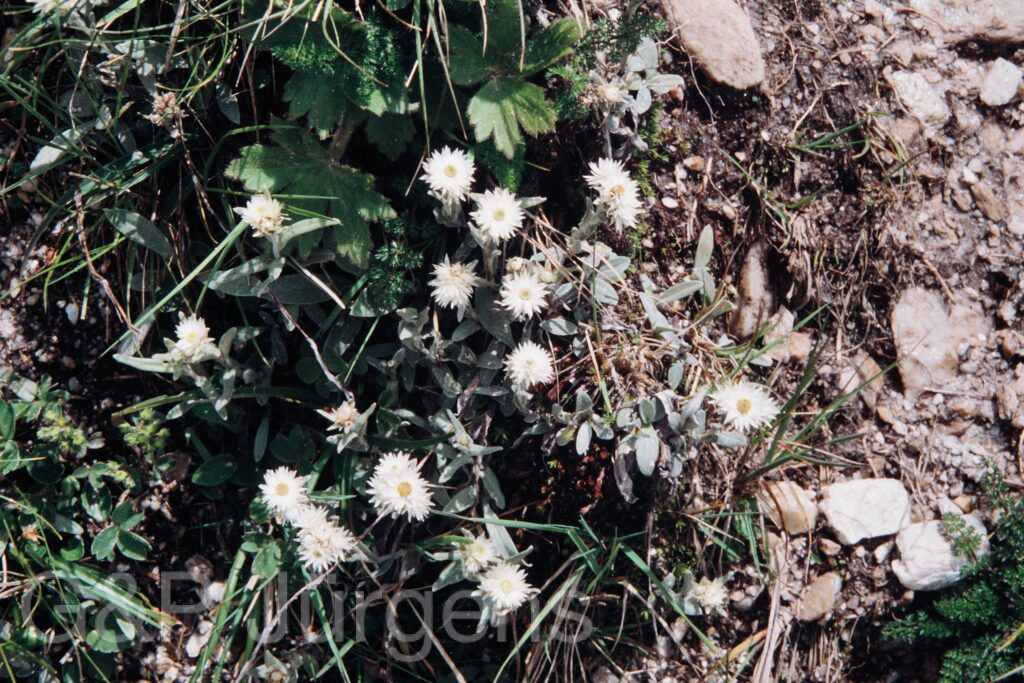
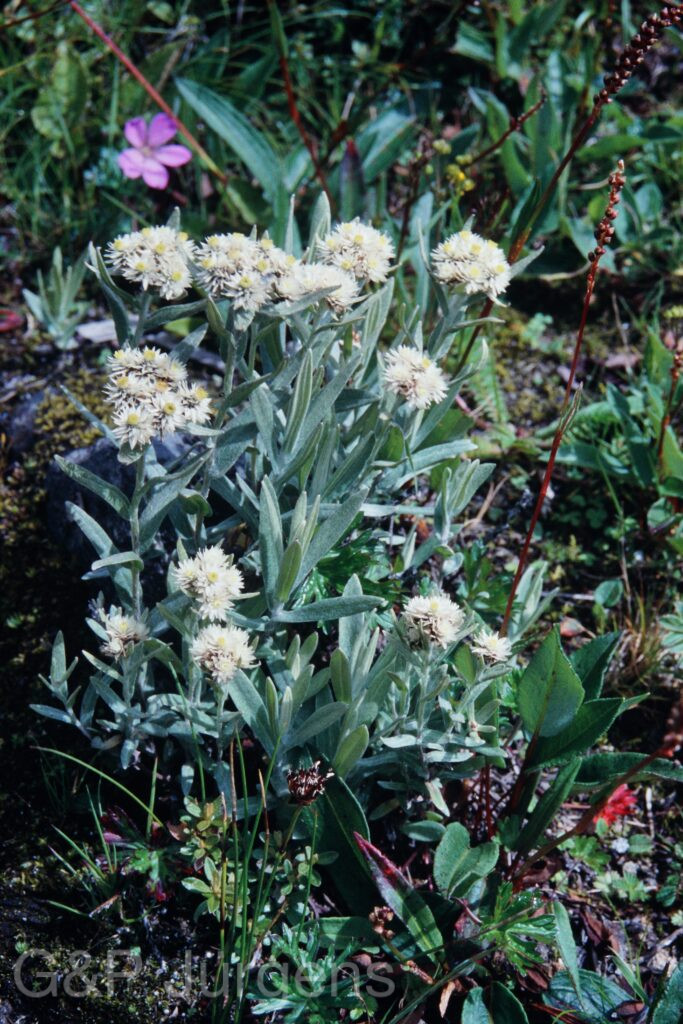
Anaphalis nepalensis var. monocephala is a high-alpine pearly everlasting of the Himalaya and adjacent China, recorded from Nepal, India, Bhutan, Pakistan, Taiwan and south-west China across 426 georeferenced occurrences. It occupies open alpine turf, screes, rocky slopes and gravelly moraine in the upper alpine zone. The cited collections at Dzongri in Sikkim (4000 m), Loccu in west Nepal (3800 m) and the Kuari Pass in Garhwal (3900 m) confirm its preference for elevations of roughly 3500-4800 m, where it flowers through the short summer and into early autumn. The variety is distinguished from typical A. nepalensis chiefly by its solitary or few terminal capitula on dwarf, cushion-forming stems.

It is a low, mat- or cushion-forming perennial herb with a branched woody caudex and short, white-woolly (lanate) stems and foliage. The leaves are spathulate to oblanceolate, crowded toward the base, densely grey-tomentose and frequently bearing a tuft of wool at the apex. The capitula are usually solitary (monocephalous), comparatively large, and surrounded by numerous papery, pearly-white, radiating involucral bracts that simulate ray florets; the true florets are small and yellowish, the plant being functionally dioecious. The fruit is a tiny cypsela crowned by a pappus of barbellate bristles.

The genus Anaphalis belongs to tribe Gnaphalieae (the cudweeds and everlastings), in which dry, persistent scarious bracts give the inflorescences their lasting quality. The white bracts and clustered florets attract small flies and bees, while the plumed cypselae are wind-dispersed. The variety is locally frequent in high Himalayan pastures and is not considered threatened, though sensitive to heavy grazing and trampling.

Author: (DC.) Hand.-Mazz. · Sources: POWO (Kew), GBIF, Flora of Bhutan, Flora of China, Flora of Nepal, Hilliard & Burtt Gnaphalieae studies

Sch.Bip. ex Hook.f.

Sikkim2003 260 P358
Sikkim Dzongri 4000m, July

Description

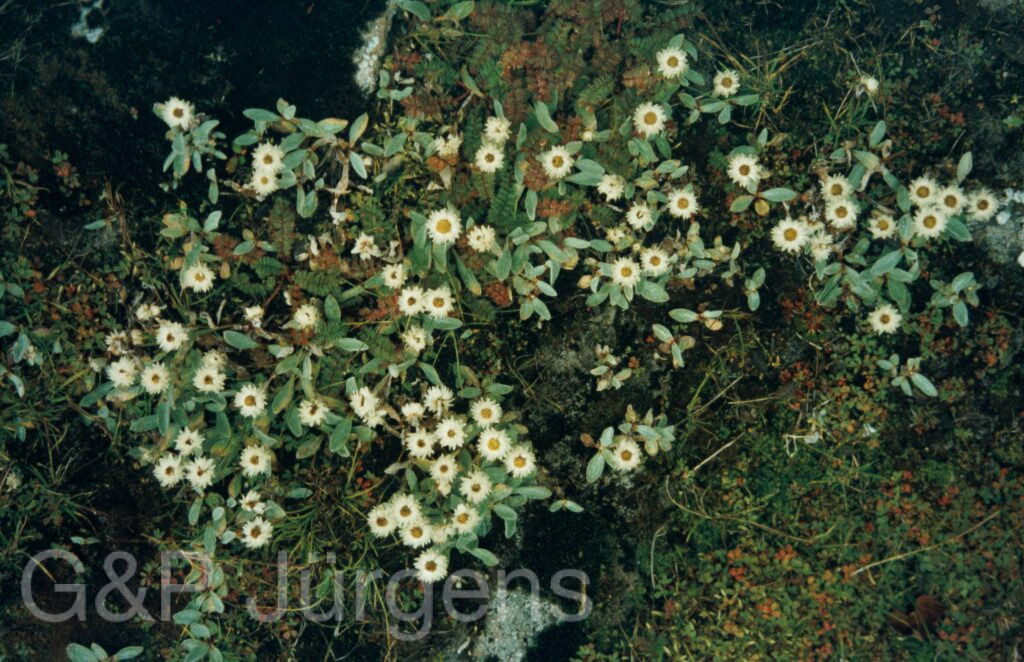
Anaphalis xylorhiza is a high-alpine pearly-everlasting of the eastern Himalaya, recorded from China, Nepal, India and Bhutan, with about 416 georeferenced occurrences indicating a fairly frequent species along the inner high ranges. It grows in alpine meadows, on stony slopes, screes and rocky ridges above the treeline, typically between roughly 3500 and 4800 m. The plant was photographed at Dzongri in Sikkim at 4000 m in July, a setting representative of its ecology, flowering at the height of the monsoon on open, well-drained, frequently grazed alpine ground.

As the epithet xylorhiza indicates, it is a perennial herb with a thick, woody rootstock from which arise low, white-woolly stems. The leaves are linear to narrowly oblong or spathulate, often crowded toward the base, grey-green and clothed in a dense persistent felt of appressed hairs on both surfaces, the bases sometimes decurrent. The capitula are small and aggregated into compact terminal corymbose clusters; each head is surrounded by dry, papery, pearly-white involucral bracts that give the genus its everlasting quality. The plants are essentially dioecious, with male and female heads on separate individuals, and the fruit is a minute cypsela bearing a pappus of slender bristles.

Anaphalis (tribe Gnaphalieae) is centred in Asia and is distinguished from the closely allied Antennaria and Helichrysum by its corymbose, scarious-bracted heads and its functionally dioecious breeding system; A. xylorhiza belongs to the woody-rooted, high-elevation Himalayan group. Its dense indumentum and persistent papery bracts are adaptations to cold, irradiation and desiccation in the alpine zone. Widespread and locally abundant, it is not considered threatened, although heavy summer grazing affects accessible populations.

Author: Sch.Bip. ex Hook.f. · Sources: POWO (Kew), GBIF, Flora of China, Annotated Checklist of the Flowering Plants of Nepal, Hooker Flora of British India (Asteraceae)

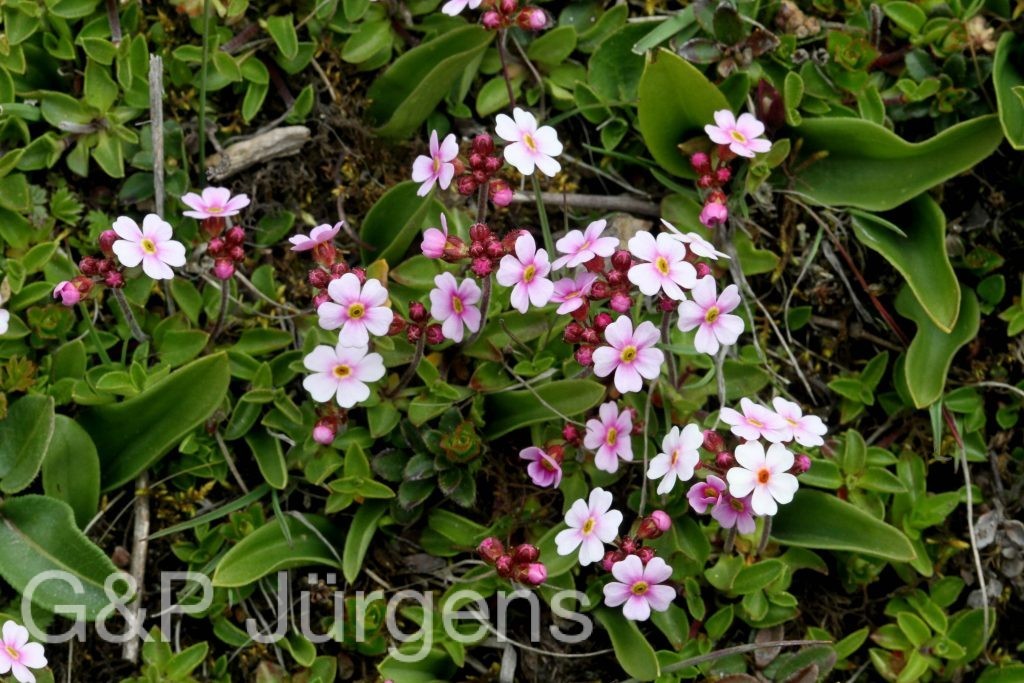
Wall.

Bhutan2014 822
Bhutan Chele-La 3100m, May
Bhutan2014 1019
Bhutan Chele-La 3100m, May
Sikkim2004 376 P653
Sikkim/India Lachung 2800m May

Description

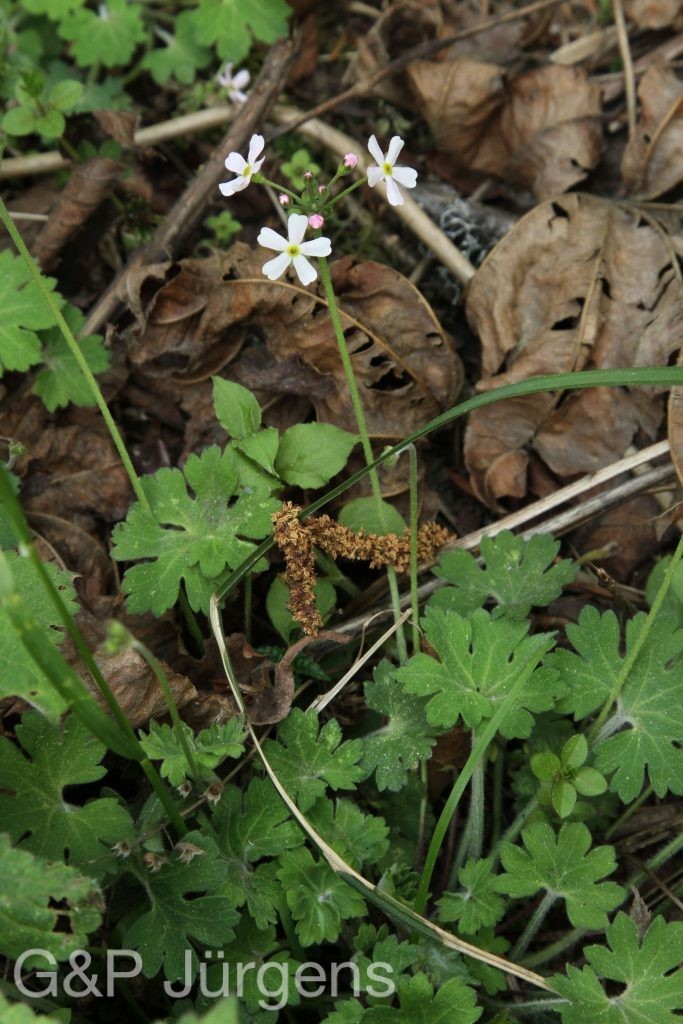
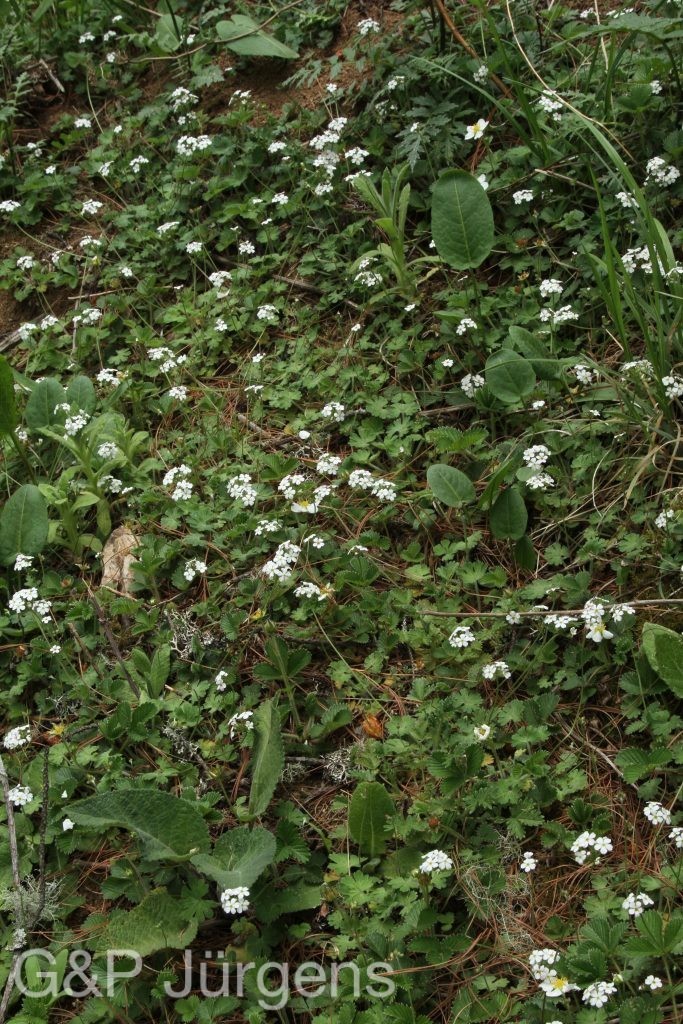
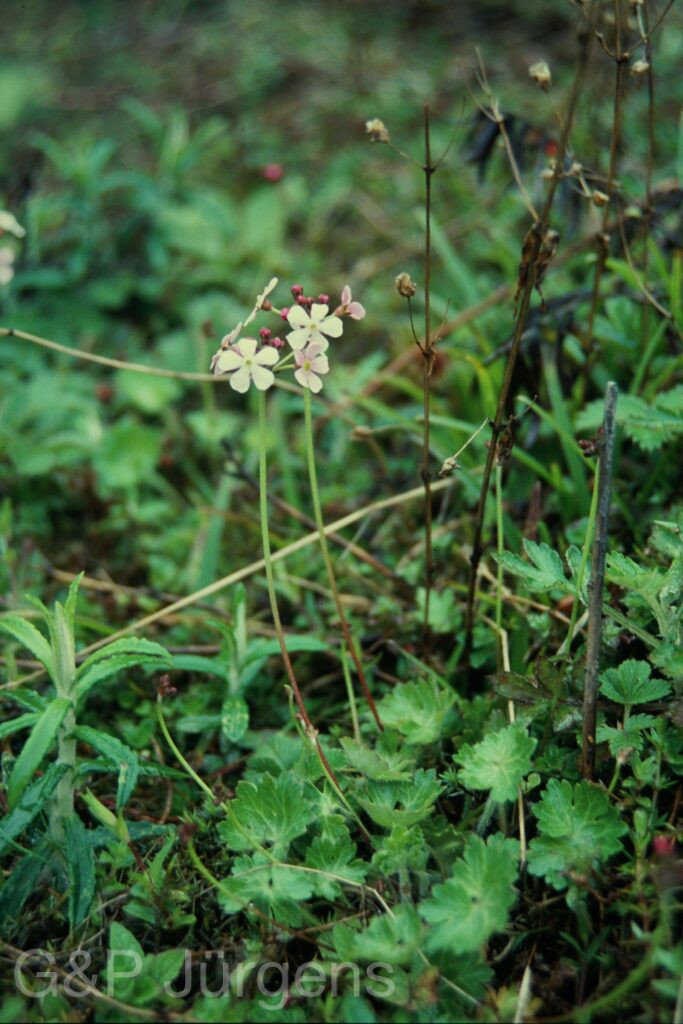
Androsace geranifolia is a Himalayan rock-jasmine of the temperate to subalpine zone, ranging through the central and eastern Himalaya from Nepal through Sikkim and India into Bhutan. GBIF currently holds no georeferenced occurrences and treats the name as doubtful at present, so its distribution is best inferred from herbarium and floristic records, which place it in moist, shaded forest, mossy banks, rock ledges and stream gullies between roughly 2500 and 3500 m. The documented sites at Chele-La in Bhutan at 3100 m and at Lachung in Sikkim, India, at 2800 m, both flowering in May, illustrate its preference for cool, humid, partly shaded montane habitats in spring.

It is a soft, herbaceous perennial, distinct among Himalayan Androsace in its conspicuously geranium-like foliage. The leaves are long-petiolate with orbicular to reniform, palmately lobed and toothed blades, forming a loose basal rosette or tuft rather than the tight cushion of many congeners. From the rosette arise slender, hairy scapes bearing an umbel of several small flowers subtended by leafy bracts. Each flower has a campanulate calyx and a salver-shaped white to pale pink corolla with five spreading lobes and a small yellow eye at the constricted throat. The fruit is a small, few- to several-seeded globose capsule.

Androsace is a large genus of Primulaceae centred on the mountains of central Asia, and A. geranifolia represents the broad-leaved, woodland-dwelling rather than cushion-forming element of the genus, allied to A. sarmentosa and A. rotundifolia. Its dissected foliage reflects adaptation to shaded forest understorey rather than the exposed screes typical of the section. As a narrowly distributed, seldom-collected Himalayan endemic, its conservation status remains formally unassessed and warrants further field documentation.

Author: Wall. · Sources: POWO (Kew), GBIF, Flora of Bhutan, Annotated Checklist of the Flowering Plants of Nepal, Smith & Lowe revision of Androsace, Flora of British India

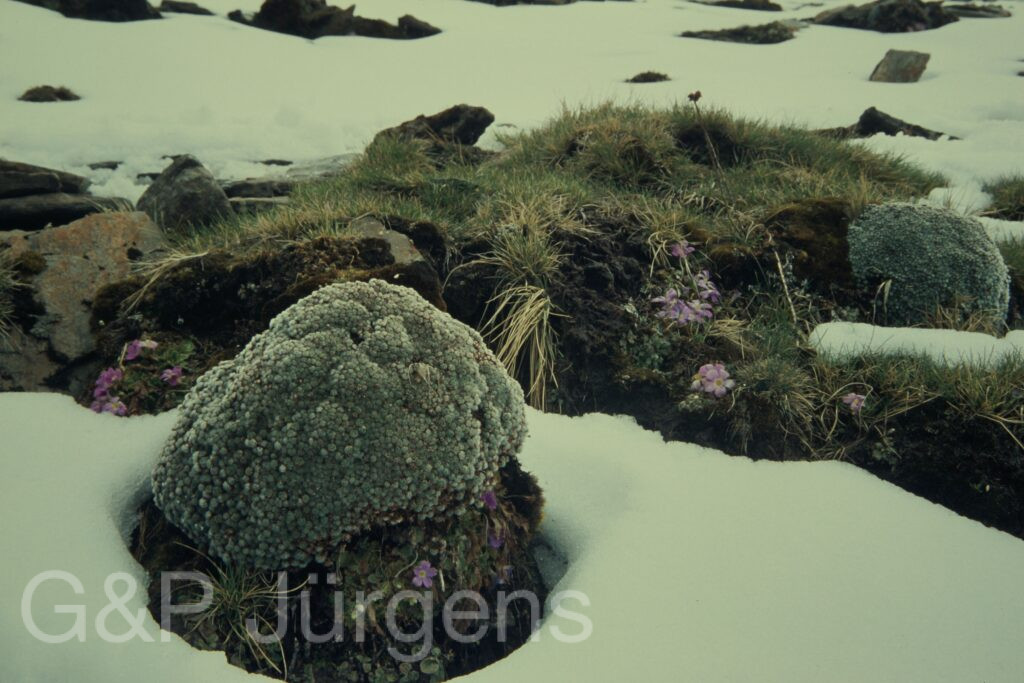
Duby

BhutanPG2011 669 scaled
Bhutan Ludlow-Sherriff-Trail Thitha-Tso, 4300m July
Sikkim2004 163 G276
Sikkim/India Singalila 4100m May
Nepal 99 138 ergebnis
West-Nepal South of Rara-Lake 3800m, June

Description

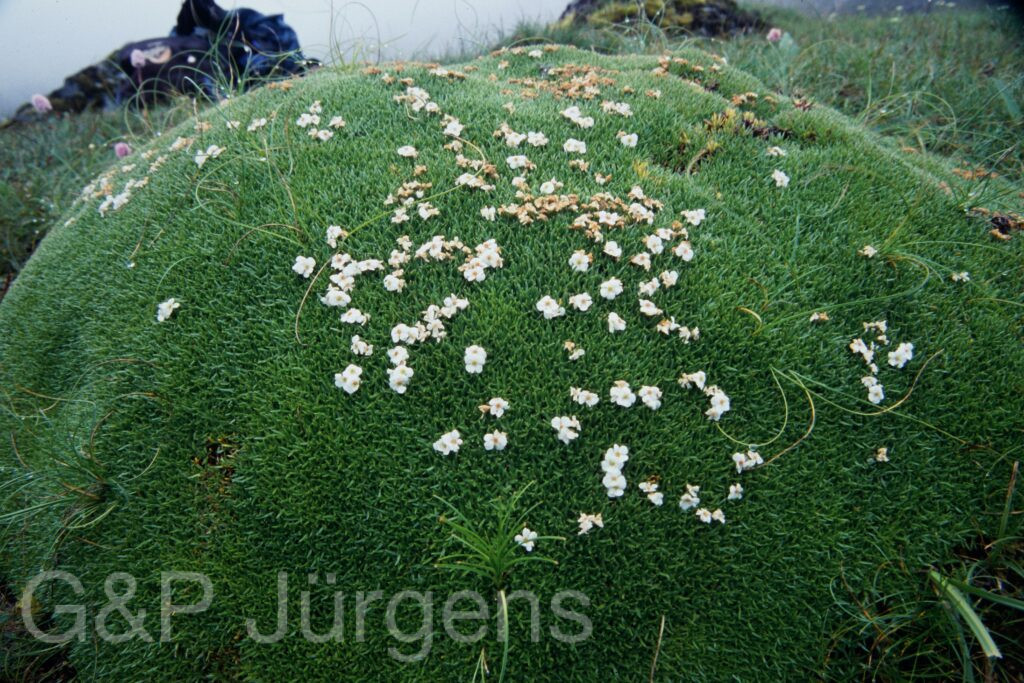
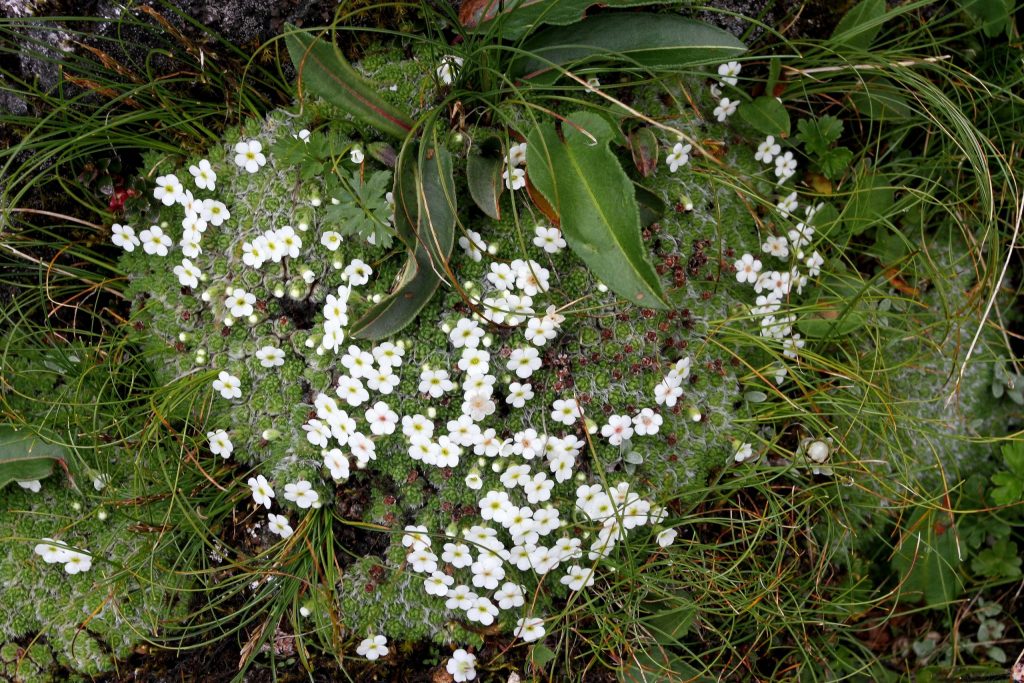
Androsace globifera is a high-alpine cushion-forming perennial distributed along the central and eastern Himalaya, recorded by GBIF (103 occurrences) from Nepal, India, Bhutan and adjacent Tibetan China. It occupies open, often wind-exposed alpine turf, gravel slopes, moraine margins and the rocky surrounds of glacial tarns, typically between 3800 and 4500 m. The documented gatherings illustrate this range well: dense colonies were found beside Thitha-Tso on the Ludlow-Sherriff Trail in Bhutan at 4300 m in July, on the Singalila ridge of Sikkim at 4100 m in May, and south of Rara Lake in West Nepal at 3800 m in June, flowering as the snow recedes.

The plant forms compact, hemispherical cushions or low mats built from numerous crowded, columnar shoots clothed in persistent, imbricate, withered leaf-remains. The leaves are small, sessile, oblong to spathulate, and gathered into dense terminal rosettes, their margins ciliate with simple and branched hairs. Solitary, sessile or shortly pedicellate flowers nestle among the leaves; the calyx is campanulate and lobed to about the middle, and the rotate corolla is white to pink with a yellow throat, the five obovate lobes spreading from a short tube. The fruit is a small globose capsule that splits by five valves to release angular seeds.

A member of the cushion-forming androsaces, the species is diagnosed by its globular, tightly packed habit and short-tubed flowers. Ecologically it is a pioneer of frost-disturbed, well-drained substrates, the cushion architecture buffering temperature extremes and trapping wind-blown detritus. Though locally frequent and not currently threatened, such narrowly stenothermic alpines are sensitive to warming and shifting snow regimes.

Author: Duby · Sources: POWO (Kew), GBIF, Flora of China Vol. 15, Flora of Bhutan Vol. 2, Flora of Nepal, Smith & Lowe Androsace monograph (Genus Androsace)

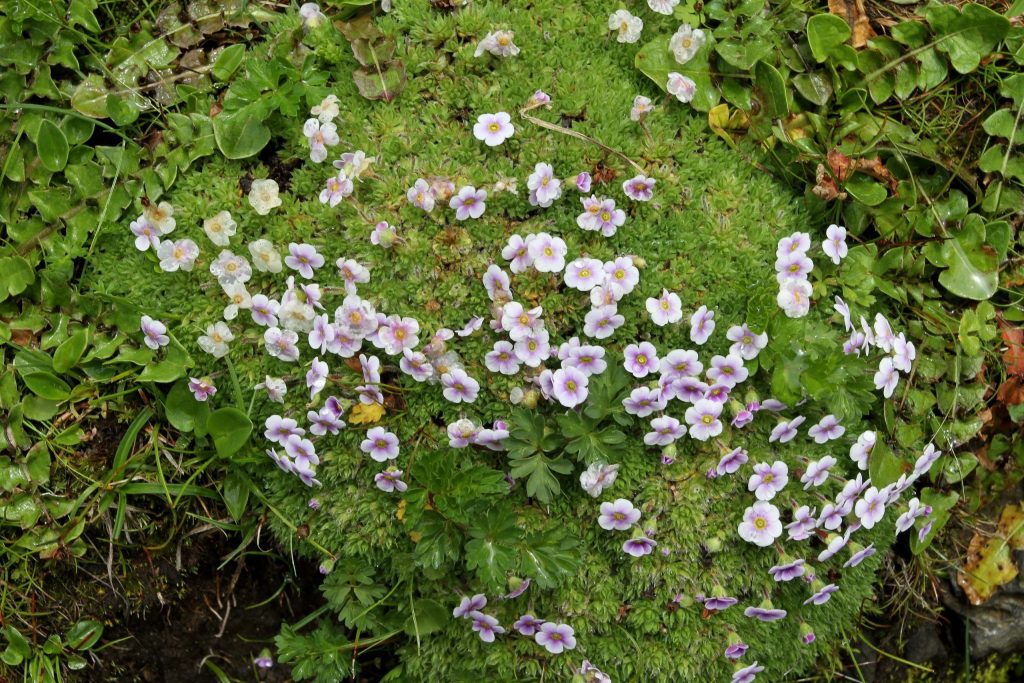
Klatt

Sikkim2011 54
Sikkim Vista-valley 3800m, June
BhutanPG2011 784 01 01
Bhutan Chele-La, 3800m June
Bh09 175 G200
Bhutan Labana, 4000m June

Description

Androsace hookeriana is an eastern Himalayan rock-jasmine recorded in GBIF from Nepal, China, Bhutan and India across 120 occurrences. It grows in moist alpine meadows, grassy slopes, seepage flushes and among rocks, generally between 3500 and 4300 m. The cited collections span Sikkim's Vista valley at about 3800 m, Chele-La in Bhutan at 3800 m, and Labana in Bhutan at 4000 m, all flowering in June, indicating an early-summer alpine species that exploits damp, freshly snow-freed turf. Named for the botanist J. D. Hooker, it is a characteristic component of high eastern Himalayan herbfields.

It is a small rosette-forming perennial, the basal leaves spathulate to oblanceolate, narrowed to the base, with a sparse to dense covering of fine hairs. From the rosette rises a slender, hairy scape a few centimetres to about 15 cm tall, bearing a terminal umbel of several flowers subtended by an involucre of narrow bracts; the pedicels are hairy. Each flower has a campanulate, hairy calyx divided to about the middle and a salverform white to pale pink corolla with a yellow or pinkish eye and five rounded lobes. The fruit is a small, valvate capsule containing a few angular seeds.

As a member of Androsace (Primulaceae), the species belongs to a genus of predominantly arctic-alpine herbs richly diversified across the Himalaya and Tibetan Plateau. Its scapose, umbellate habit aligns it with the meadow-dwelling rosette species rather than the tight cushion-formers of higher scree. Pollination is by small dipterans and other insects drawn to the eye-ring, and seeds are dispersed by gravity and wind. It is locally frequent and of no recognised conservation concern.

Author: Klatt · Sources: POWO (Kew), GBIF, Flora of China, Flora of Bhutan, Annotated Checklist of the Flowering Plants of Nepal, Smith and Lowe Monograph of Androsace

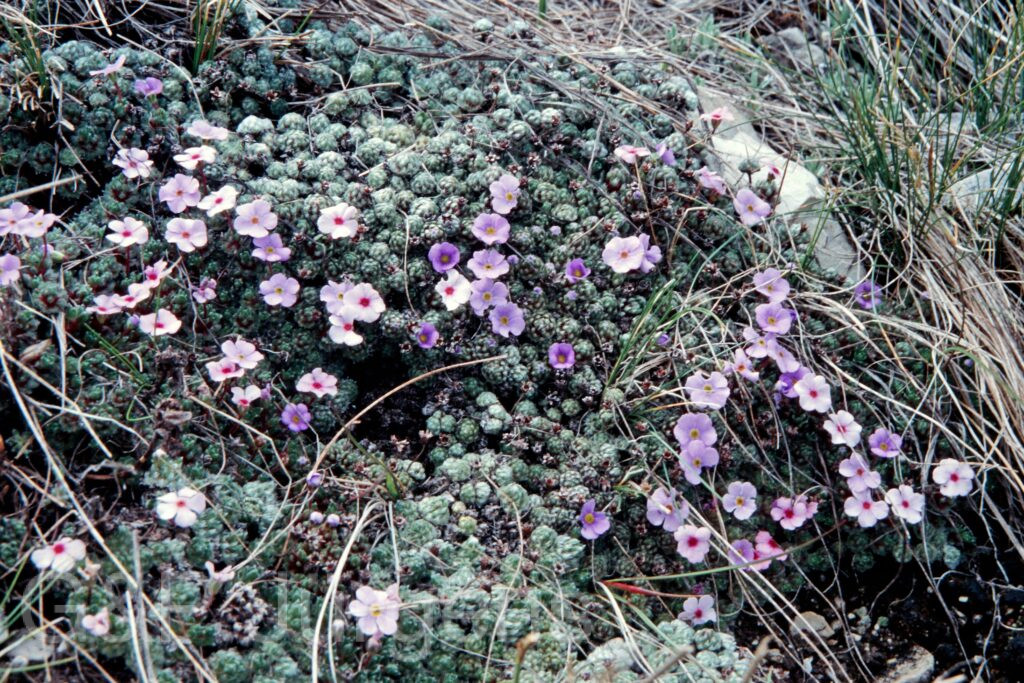
Wall. ex Duby

Nepal 99 304 ergebnis
West-Nepal Kalmura 4200m, June
Nepal 99 802 ergebnis
West-Nepal Baga-La-Phedi 4500m, July
Sikkim2003 304 G425
Sikkim Saniti-Lake 4200m, August
BhutanPG2011 451 scaled
Bhutan Ludlow-Sherriff-Trail Warrthang-Tso, 4400m July

Description

Androsace lehmannii Wall. ex Duby is a cushion-forming alpine of the high Himalaya, distributed through Nepal, India, China and Bhutan, with outlying records reported from further across temperate Asia. It is documented from West-Nepal at Kalmura (4200 m) and Baga-La-Phedi (4500 m), from Sikkim at Saniti Lake (4200 m) and from Bhutan along the Ludlow-Sherriff trail near Warrthang-Tso (4400 m), flowering from June to August. The species inhabits open alpine turf, rocky slopes, moraine and gravelly flats, typically between 4000 and 5000 m, where it forms low cushions adapted to wind exposure, intense radiation and a short, cool growing season. Its roughly 158 GBIF records mark it as a genuine high-alpine specialist.

The plant builds a dense, hemispherical cushion of crowded rosettes borne on branched, columnar shoots packed with the marcescent remains of old leaves. The living leaves are small, oblong to spathulate, entire, often ciliate-margined and frequently bearing whitish hairs that reduce water loss and radiation damage. Solitary, almost sessile flowers nestle among the leaves, each with a campanulate calyx and a salver-shaped, five-lobed corolla in white to pale pink, the throat marked by a contrasting yellow or pinkish eye. The fruit is a small, few-seeded capsule dehiscing by valves.

Androsace lehmannii belongs to the section of cushion androsaces (allied to sect. Aretia), a growth form that has evolved repeatedly in cold, high-mountain floras as a thermal and mechanical adaptation, the compact canopy trapping warmth and moisture within the cushion. Such plants are slow-growing, long-lived and pioneer-like on unstable substrates. Though not currently threatened, cushion androsaces are recognised as climate-sensitive sentinels, vulnerable to warming, altered snow cover and trampling along increasingly frequented high-altitude routes.

Author: Wall. ex Duby · Sources: POWO (Kew), GBIF, Flora of Nepal, Flora of China, Flora of Bhutan, Androsace monograph (Smith & Lowe)