
Sch.Bip. ex Hook.f.
Description
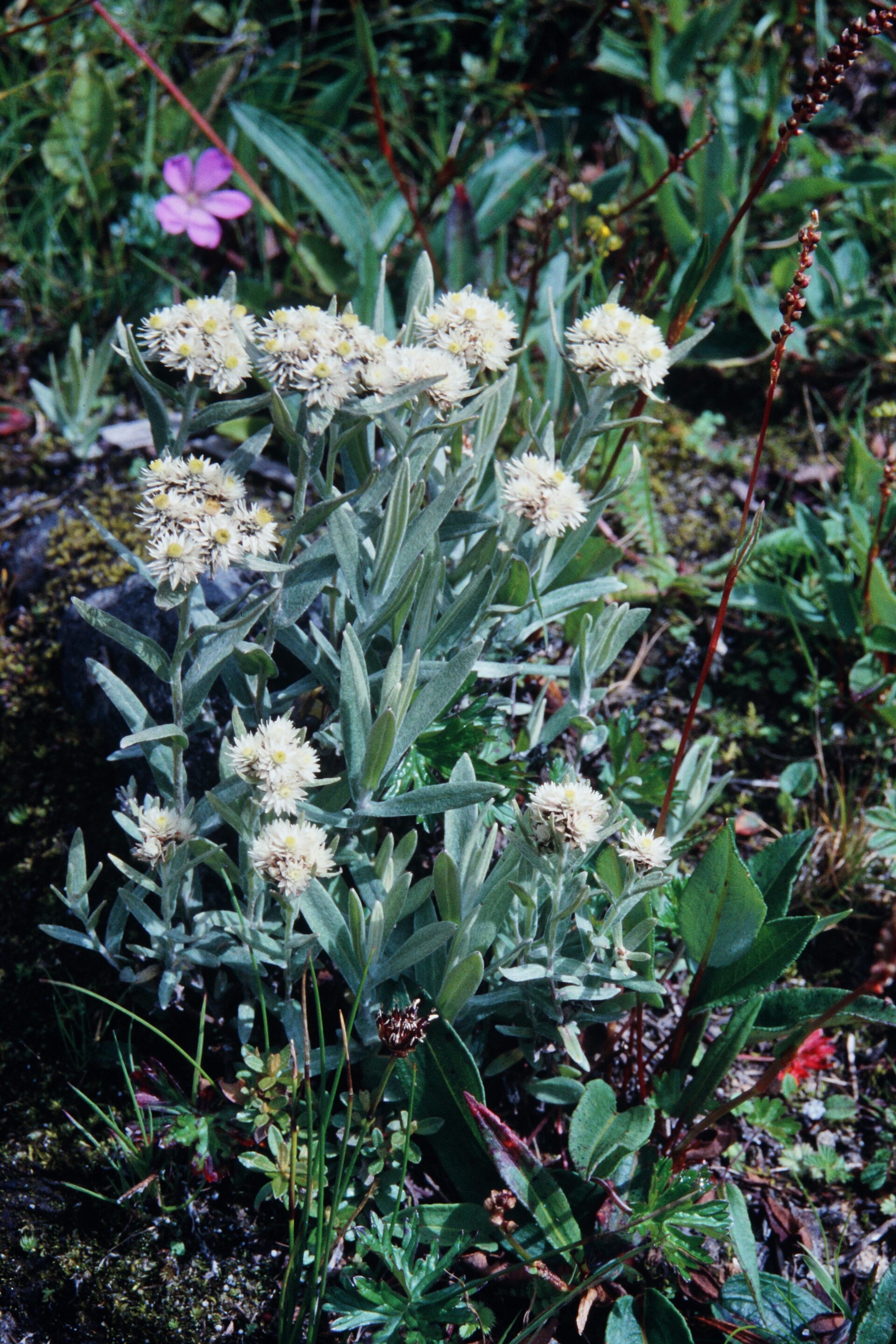
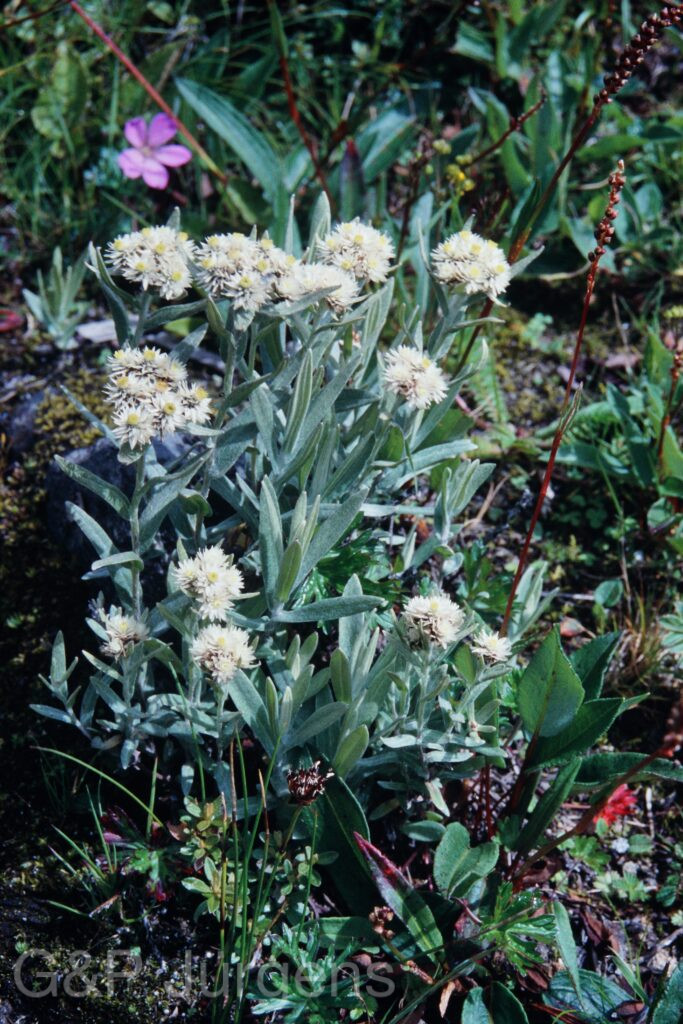
Anaphalis xylorhiza is a high-alpine pearly-everlasting of the eastern Himalaya, recorded from China, Nepal, India and Bhutan, with about 416 georeferenced occurrences indicating a fairly frequent species along the inner high ranges. It grows in alpine meadows, on stony slopes, screes and rocky ridges above the treeline, typically between roughly 3500 and 4800 m. The plant was photographed at Dzongri in Sikkim at 4000 m in July, a setting representative of its ecology, flowering at the height of the monsoon on open, well-drained, frequently grazed alpine ground.
As the epithet xylorhiza indicates, it is a perennial herb with a thick, woody rootstock from which arise low, white-woolly stems. The leaves are linear to narrowly oblong or spathulate, often crowded toward the base, grey-green and clothed in a dense persistent felt of appressed hairs on both surfaces, the bases sometimes decurrent. The capitula are small and aggregated into compact terminal corymbose clusters; each head is surrounded by dry, papery, pearly-white involucral bracts that give the genus its everlasting quality. The plants are essentially dioecious, with male and female heads on separate individuals, and the fruit is a minute cypsela bearing a pappus of slender bristles.
Anaphalis (tribe Gnaphalieae) is centred in Asia and is distinguished from the closely allied Antennaria and Helichrysum by its corymbose, scarious-bracted heads and its functionally dioecious breeding system; A. xylorhiza belongs to the woody-rooted, high-elevation Himalayan group. Its dense indumentum and persistent papery bracts are adaptations to cold, irradiation and desiccation in the alpine zone. Widespread and locally abundant, it is not considered threatened, although heavy summer grazing affects accessible populations.
Author: Sch.Bip. ex Hook.f. · Sources: POWO (Kew), GBIF, Flora of China, Annotated Checklist of the Flowering Plants of Nepal, Hooker Flora of British India (Asteraceae)