Boraginaceae

(Wall. ex G.Don) I.M.Johnst.
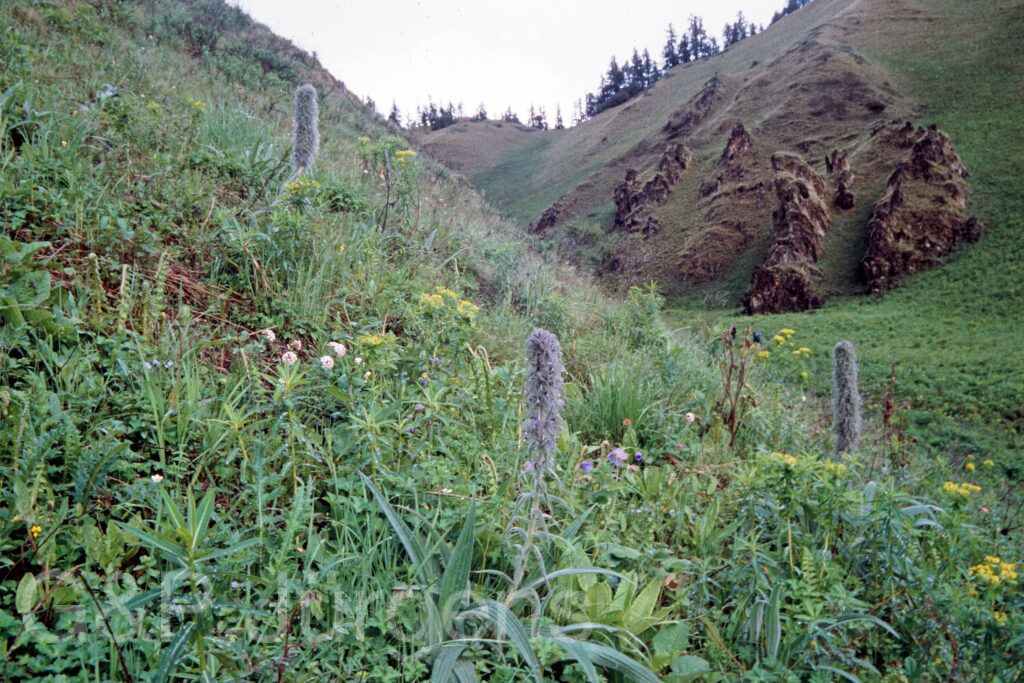
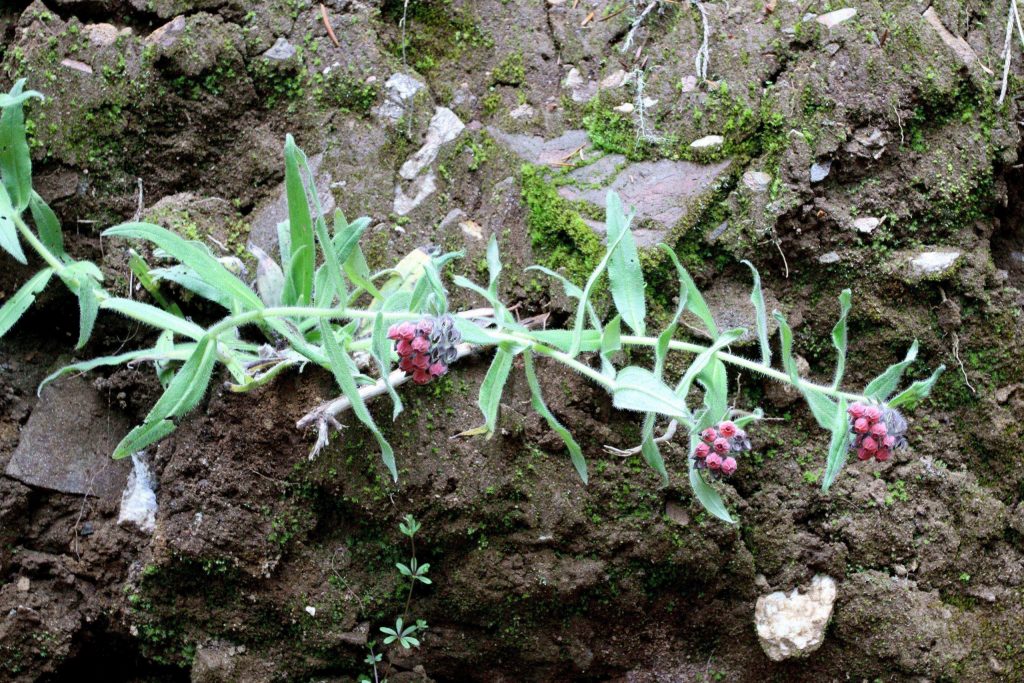
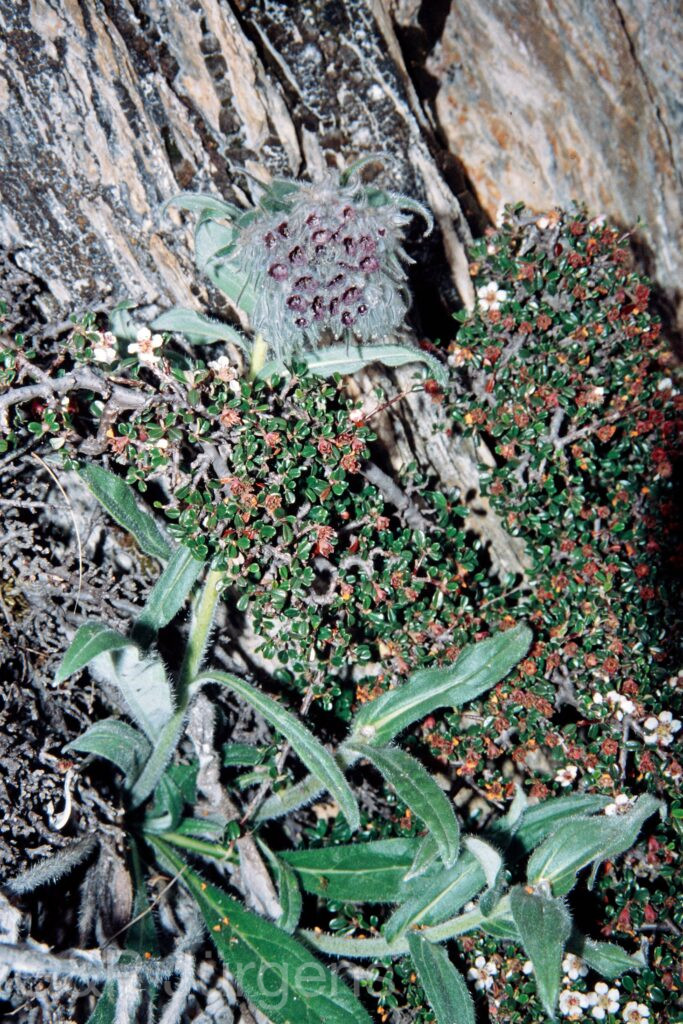
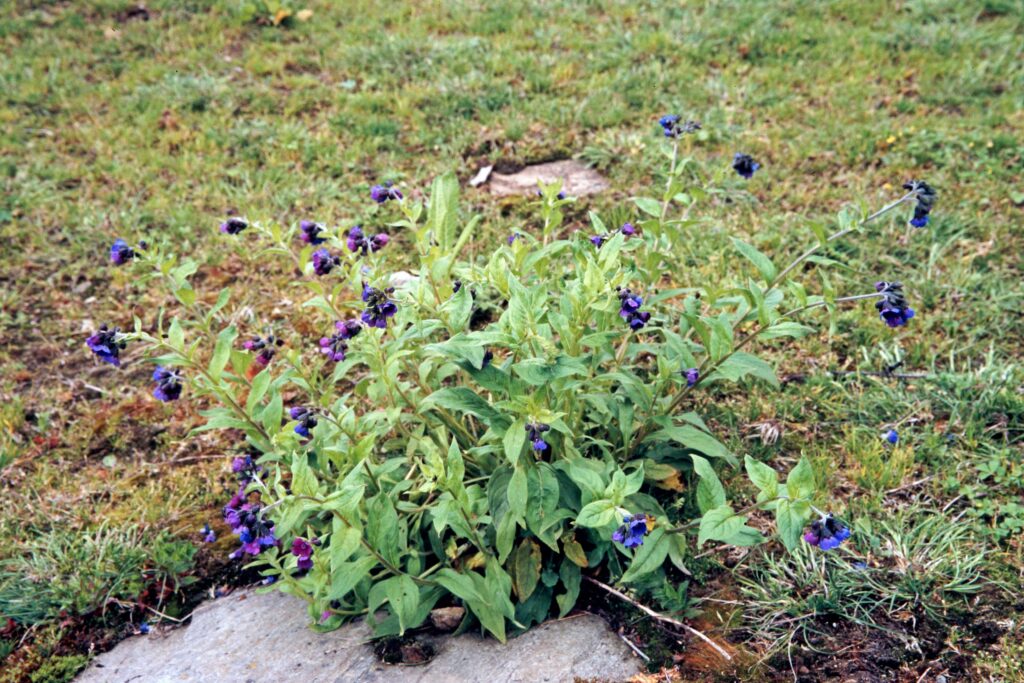
Nepal 99 91 ergebnis
West-Nepal Bhulbhule 3500m, June
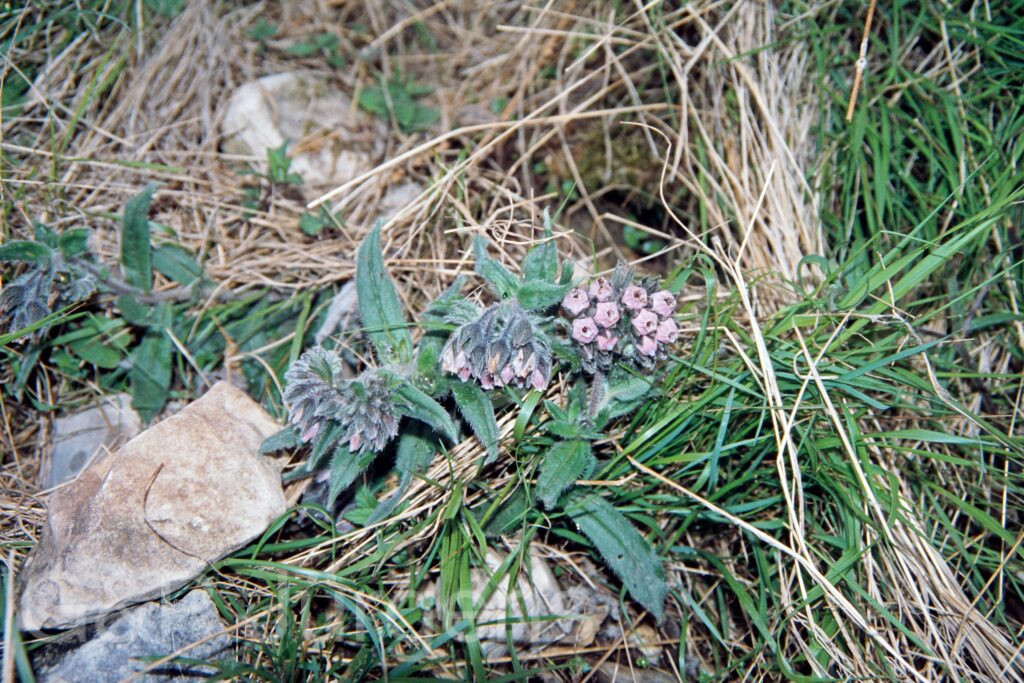
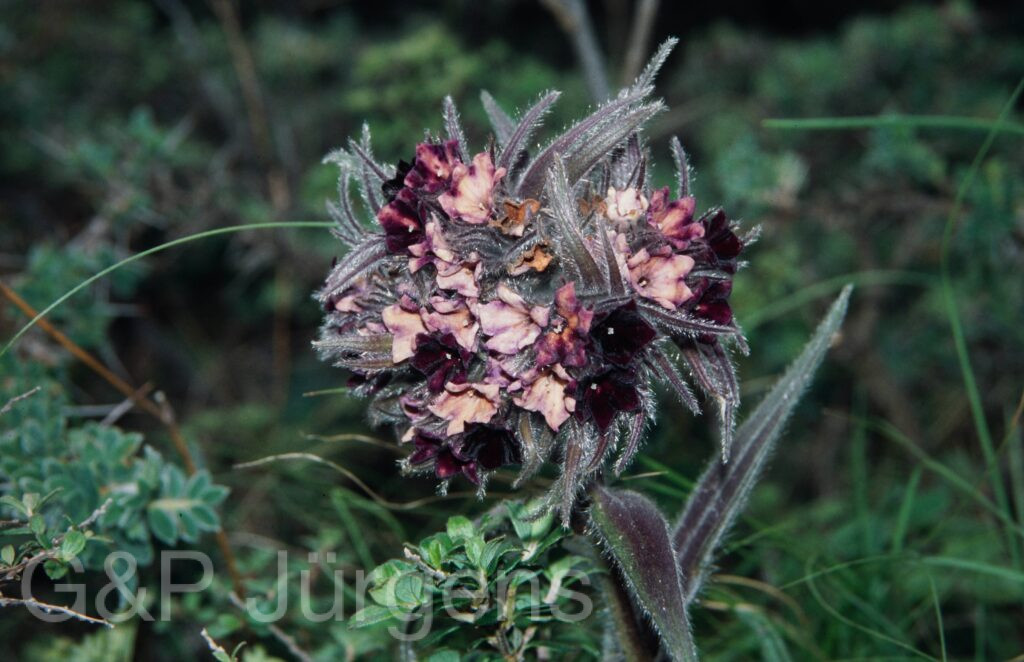
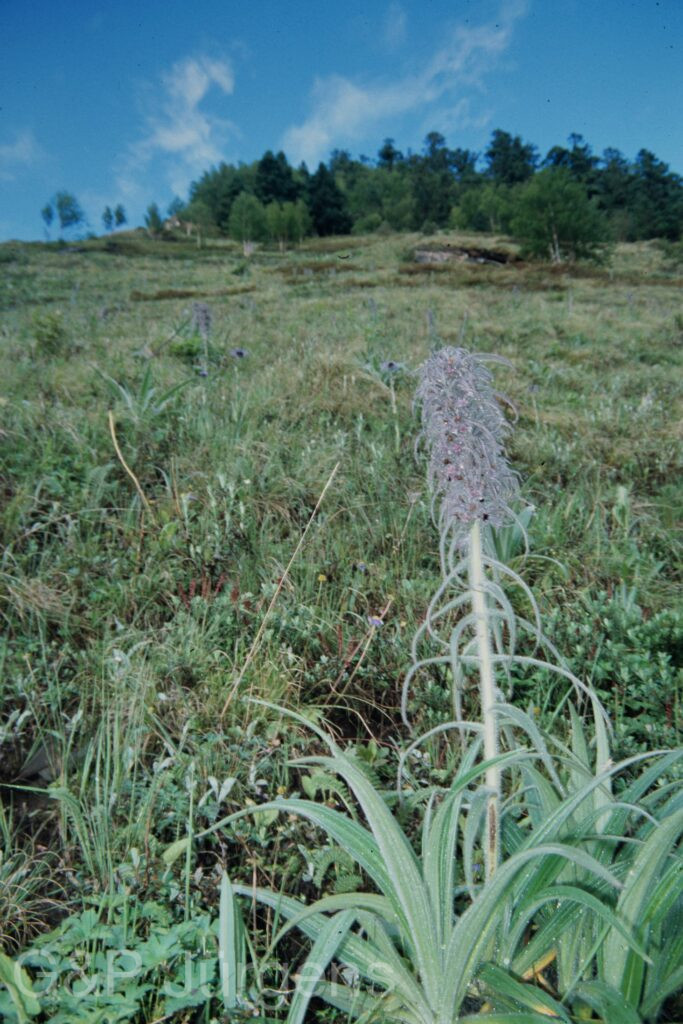
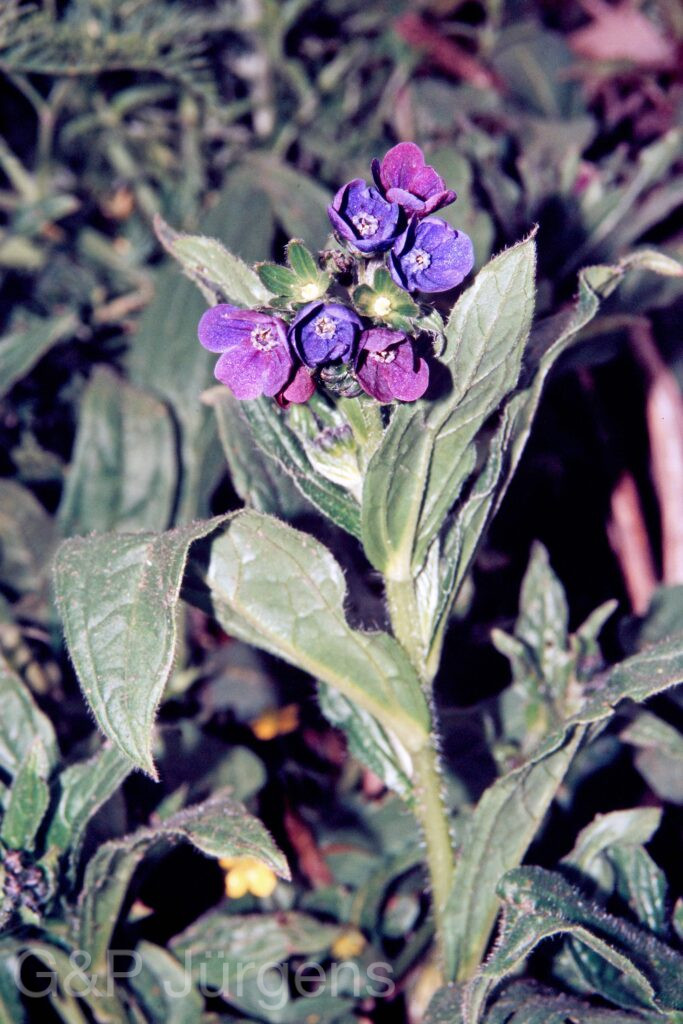
Nepal 99 92 ergebnis
West-Nepal Bhulbhule 3500m, June

Description

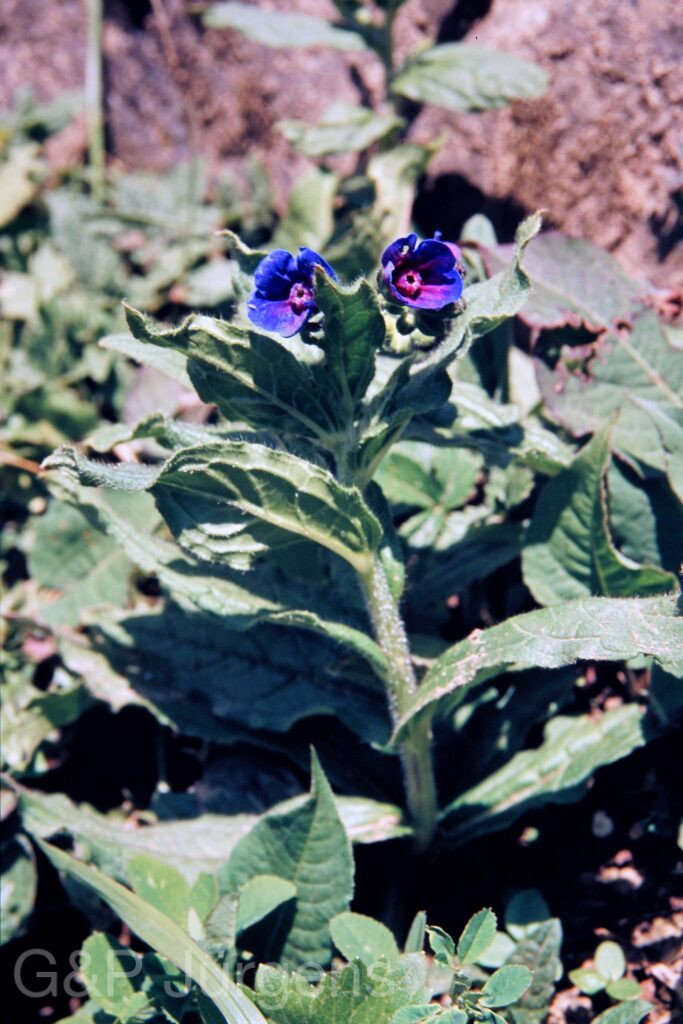
Arnebia benthamii is a stout alpine herb of the western and central Himalaya, distributed through India, Pakistan and Nepal, with GBIF recording roughly 167 occurrences. It inhabits open alpine meadows, grassy and rocky slopes, and stabilised scree in the subalpine and alpine zones, typically from 3000 to 4200 m. The photographed plant grew in West Nepal near Bhulbhule at 3500 m in June, when the species comes into flower as the snow recedes, forming conspicuous erect spikes among the early-summer alpine sward.

The plant is a robust, densely hispid perennial arising from a thick woody rootstock that yields a purple dye. The stems are erect, unbranched and bristly, clothed with sessile, oblong to lanceolate, rough-hairy leaves. The inflorescence is a dense, elongate, cylindrical thyrse of crowded scorpioid cymes subtended by leafy bracts. The flowers are tubular-funnelform, the corolla bluish-purple to violet (drying darker), five-lobed with a hairy throat; the calyx is deeply five-parted and bristly. There are five included stamens and a deeply four-lobed ovary, the gynobasic style producing four hard nutlets at maturity.

The species is referable to genus Arnebia (subfamily Boraginoideae). It is of considerable ethnobotanical importance: the dye-yielding roots, known regionally as "Kahzaban" or "gaozaban," are widely used in Unani and folk medicine, driving substantial wild harvesting. This pressure, combined with grazing and a slow-maturing perennial habit, has caused local declines, and the species is regarded as conservation-sensitive in parts of the western Himalaya, prompting calls for sustainable collection and cultivation.

Author: (Wall. ex G.Don) I.M.Johnst. · Sources: POWO (Kew), GBIF, Flora of Pakistan, Flora of Nepal, Flowers of the Himalaya (Polunin & Stainton)
Benth.

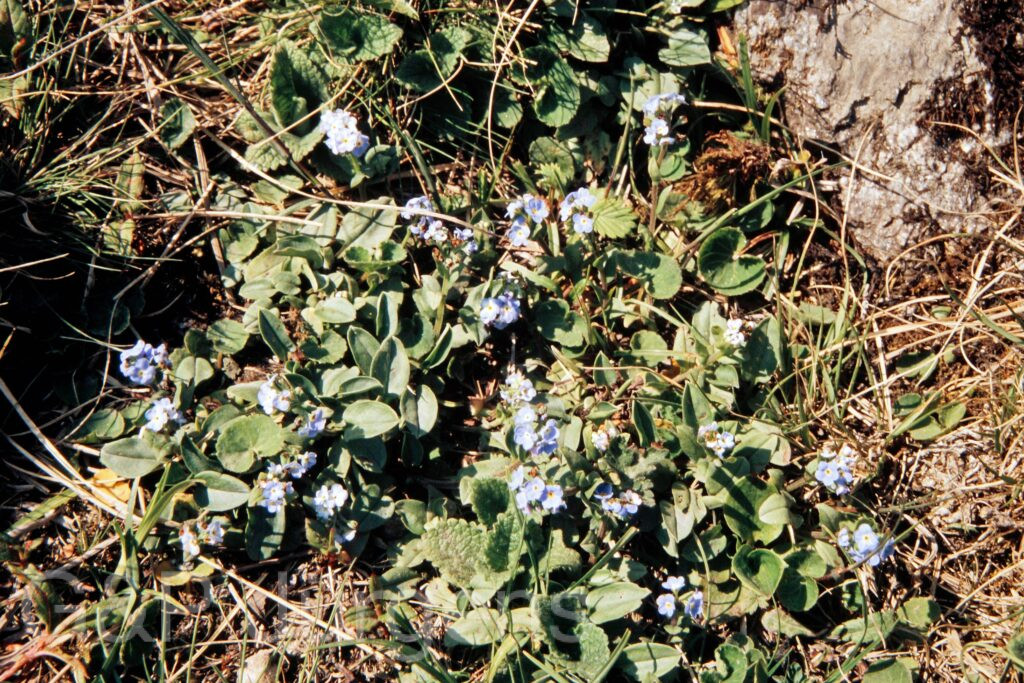
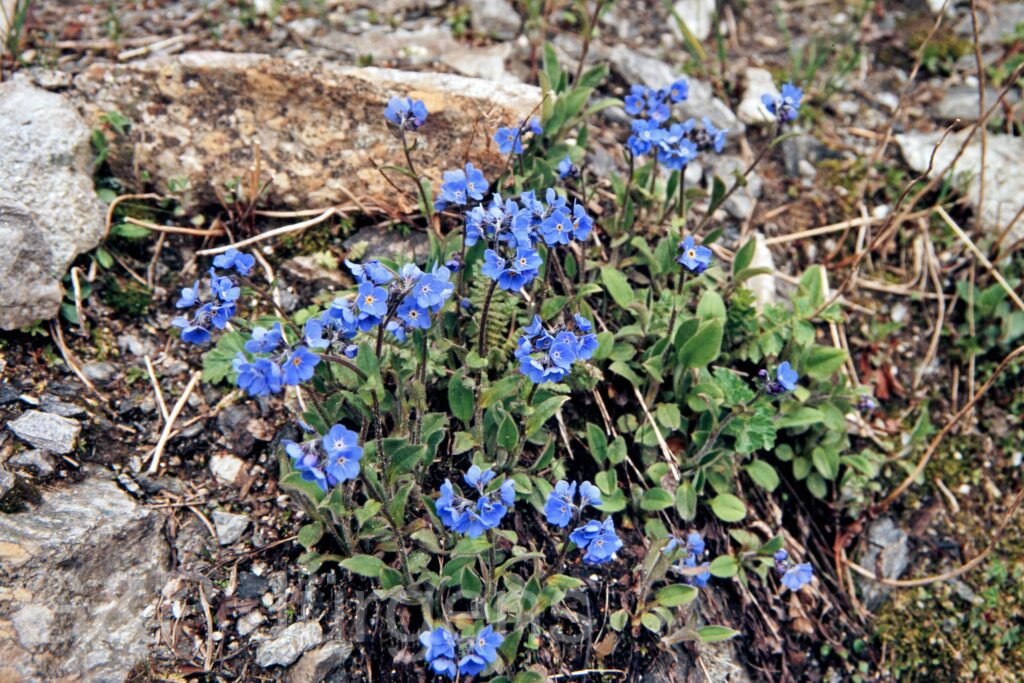
Garh 07 558 ergebnis
India Garhwal Sena 3760m,

Description

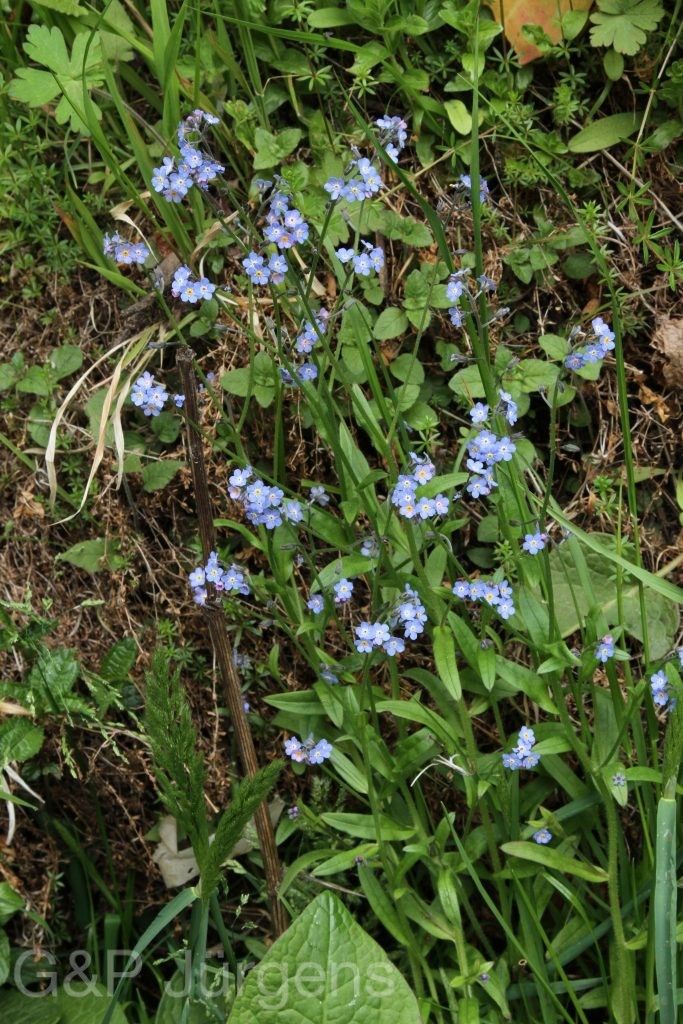
Cynoglossum microglochin is a high-altitude species of hound's-tongue distributed across the western and central Himalayas, from Afghanistan and Pakistan through northwest India (Kashmir, Himachal Pradesh, Uttarakhand) to Nepal, Bhutan, and into southwestern China. GBIF records document 209 occurrences across its range. The species typically inhabits open alpine meadows, grassy slopes, and disturbed ground along trails at elevations of 2,800–4,200 m, where it grows in well-drained, often stony soils among other subalpine and alpine herbaceous communities.
The plant is an erect or ascending perennial herb, 20–50 cm tall, with stems covered in appressed or spreading hairs. Basal leaves are oblanceolate to spatulate, 5–15 cm long, petiolate, with entire margins and a dense indumentum of short, stiff hairs on both surfaces. Cauline leaves are progressively smaller, sessile, and semi-amplexicaul. The inflorescence consists of terminal, ebracteate, scorpioid cymes that elongate considerably in fruit. Flowers are small, 3–5 mm in diameter, with blue to violet corollas; the tube is short, with rounded fornices closing the throat. The nutlets, typically four per flower, are ovoid, 2–3 mm long, and densely covered with short, glochidiate (barbed) prickles — notably smaller than those of congeners such as C. zeylanicum, a character reflected in the epithet 'microglochin' (small barb).
This species is distinguished from the widespread Cynoglossum glochidiatum by its smaller nutlet spines and generally more compact inflorescence. It was photographed at Sena in Garhwal at 3,760 m, near the upper limit of its elevational range. Though not currently assessed by the IUCN, its preference for undisturbed alpine habitats makes it potentially sensitive to grazing pressure and climate-driven upward shifts in vegetation zones. Its biogeographical range, extending from the Hindu Kush to the eastern Himalayas, indicates a broadly adapted yet montane-restricted taxon.

Author: Benth. · Sources: POWO (Kew), GBIF, Flora of British India Vol. 4, Flora of Pakistan (Boraginaceae), Kazmi (1970) — Revision of Boraginaceae

G.Don

Garh 07 107 ergebnis
India Garhwal Mandakini 2900m, June
Garh 07 56 ergebnis
India Garhwal Mandakini 2900m, June

Description

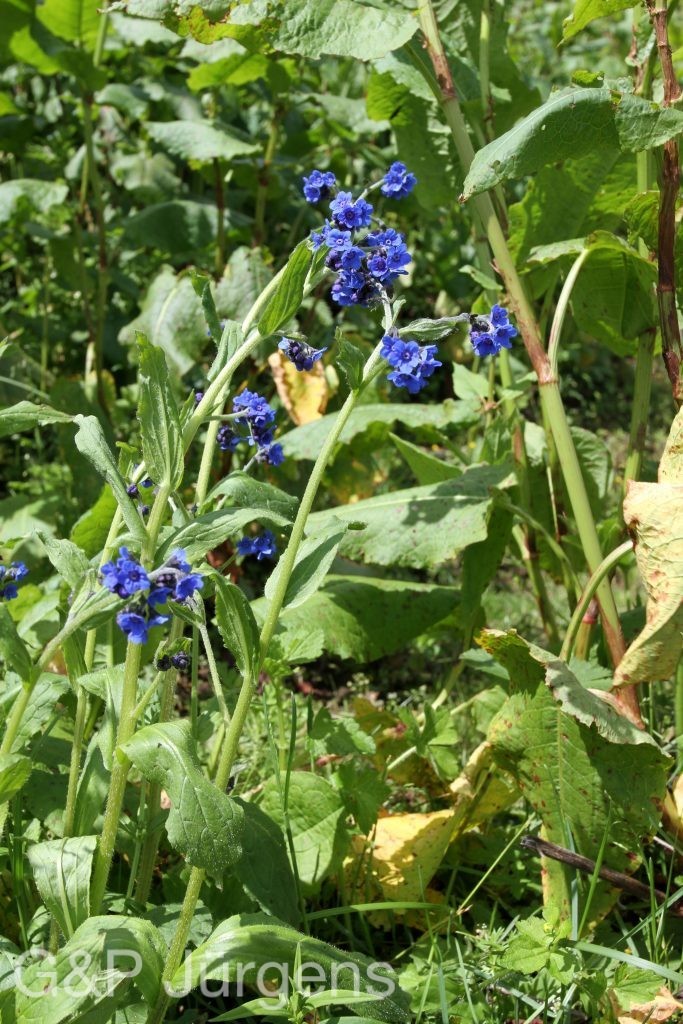
Cynoglossum wallichii is a widespread Asian herb recorded across China, India, Nepal, Pakistan, Bhutan and Afghanistan, with naturalised or casual occurrences in the United States and parts of Europe. GBIF treats the name as a synonym, with Cynoglossum wallichii accepted under that combination. It occupies open hill slopes, forest margins, grassy clearings, fallow ground and roadside banks from about 1500 to 3500 m. The depicted plant from the Mandakini valley in Garhwal, India, at around 2900 m and flowering in June, is characteristic of its preference for disturbed, sunny temperate slopes during the early monsoon.

The plant is an erect annual or biennial herb, the stems simple or branched above and clothed, like the foliage, in appressed to spreading hispid hairs. The leaves are alternate, the lower oblanceolate and narrowed to a petiole, the upper sessile, lanceolate and somewhat clasping. The inflorescence consists of elongating, ebracteate scorpioid cymes bearing small, pale to bright blue, salverform to funnelform flowers with prominent fornices closing the throat. The fruit separates into four ovoid nutlets densely covered with glochidiate (barbed) bristles, an epizoochorous adaptation that promotes dispersal on animal fur.

The epithet honours Nathaniel Wallich, the Danish botanist whose Himalayan collections underpin much early taxonomy of the region. Within Cynoglossum the species belongs to a critical complex whose delimitation has prompted segregation into related genera such as Lindelofia and Paracaryum. The barbed nutlets account for its readiness to colonise trampled and grazed ground, and its weedy tendencies explain the scattered extra-Asian records; it is of no conservation concern.

Author: G.Don · Sources: POWO (Kew), GBIF, Flora of China Vol. 16, Flora of Pakistan, Flora of Nepal, A Revision of Cynoglossum (Boraginaceae) (Brand)

R.R.Mill

Bhutan2014 1055
Bhutan Takthsang 2900m, May
BhutanPG2011 766
Bhutan Chele-La, 3800m July

Description

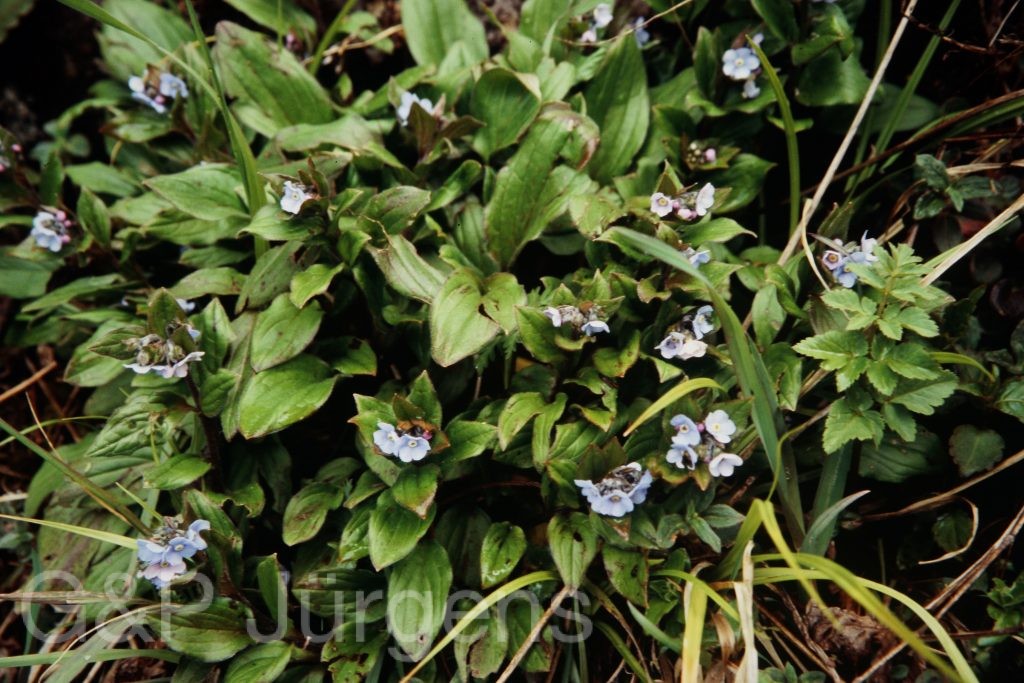
Hackelia bhutanica is a forget-me-not relative of the eastern Himalaya, described from Bhutan and also recorded from India and Nepal, with a comparatively small number of occurrences (31 georeferenced records) consistent with a localised eastern Himalayan range. It grows on shaded banks, forest margins, open slopes and among rocks in the temperate to subalpine zones. The illustrated plants from Bhutan — at Takthsang around 2900 m in May and at Chele-La near 3800 m in July — span a broad altitudinal range and show the species flowering from late spring at lower elevations into mid-summer at higher ones, tracking the seasonal advance of conditions up the mountain.

The plant is an erect biennial or perennial herb, more or less roughly hairy throughout, with a leafy stem arising from a basal cluster of leaves. The leaves are alternate, narrowly lanceolate to oblong, entire and hispid. The flowers are borne in elongating, scorpioid (coiled) cymes typical of the Boraginaceae; each has a five-lobed calyx and a small, salver-shaped, blue corolla with a short tube and five spreading lobes closed at the throat by raised scales (fornices). The fruit characteristic of Hackelia consists of four nutlets whose margins bear glochidiate (barbed, hooked) prickles, an adaptation for dispersal by attachment to passing animals.

Hackelia is segregated from the closely allied Lappula and the broader stickseed group within Boraginaceae, distinguished largely by nutlet ornamentation; the species was described by R. R. Mill, a specialist in the Bhutanese and Himalayan flora. As a restricted eastern Himalayan endemic known from relatively few localities, H. bhutanica warrants attention from a conservation standpoint, its persistence depending on the maintenance of the temperate forest and open subalpine habitats it occupies.

Author: R.R.Mill · Sources: POWO (Kew), GBIF, Flora of Bhutan, Flora of China (Boraginaceae), Mill: revisionary studies of Himalayan Boraginaceae

R.R.Mill

Bh09 180 P312
Bhutan Phajoding, 3600m June

Description

Hackelia obtusifolia is a Himalayan stickseed of restricted distribution, recorded from northern India, Bhutan and Nepal. GBIF documents only 14 occurrences across these three countries, indicating a localised and seldom-gathered species of the inner ranges. It grows on subalpine and alpine slopes, in open forest clearings, on rocky banks and among shrubberies on moist, humus-rich soils, broadly between about 3000 and 4000 m. The plant illustrated here was found in Bhutan at Phajoding at 3600 m in June, a high meadow and rhododendron-shrubland setting characteristic of its early-summer flowering in the eastern Himalaya.

The plant is an erect perennial herb with one or more branching, hispid stems arising from a woody rootstock. The leaves are alternate, the basal ones petiolate and the cauline ones sessile, oblong to obovate with an obtuse apex—the feature underlying the epithet—and clothed in stiff, appressed hairs. The inflorescence consists of lax, scorpioid cymes that elongate in fruit; the small flowers have a five-lobed calyx and a blue, rotate to shortly funnelform corolla with five conspicuous papillate scales (fornices) closing the throat. The fruit separates into four nutlets, each armed around the margin with glochidiate (barbed) prickles that effect epizoochorous dispersal.

Hackelia is distinguished within the tribe Cynoglosseae by its bordering of marginal glochids on the nutlets, contrasting with the wholly bristly nutlets of Cynoglossum. The barbed fruits cling readily to fur and clothing, an effective dispersal strategy in alpine grazing habitats. As a narrow Himalayan endemic known from very few collections, H. obtusifolia is poorly understood ecologically; its limited records suggest it warrants further survey, though its remote montane habitat affords some natural protection.

Author: R.R.Mill · Sources: POWO (Kew), GBIF, Flora of Bhutan, Flora of China, An Annotated Checklist of the Flowering Plants of Nepal, A Revision of the Asiatic Species of Hackelia (Boraginaceae)

(Royle ex Benth.) C.E.C.Fisch.

Nepal 99 112 ergebnis
West-Nepal South of Rara-Lake 3600m, June
Garh 07 336 ergebnis
India Garhwal Mahji 2650m, June

Description

Hackelia uncinata (Royle ex Benth.) C.E.C.Fisch. is a perennial herb of the Himalaya and Central Asian mountains, with GBIF recording some 417 occurrences across China, India, Nepal, Pakistan, Bhutan, Myanmar, Mongolia and Russia. It grows in forest clearings, on shaded banks, among subalpine scrub and in moist meadow on the cooler slopes of the temperate to subalpine zone, flowering in early summer. The cited collections, from south of Rara Lake in west Nepal at 3600 m in June and from Mahji in Garhwal (Indian Himalaya) at 2650 m in June, illustrate its preference for partly shaded, humus-rich montane sites where it forms loose stands.

The plant produces erect to ascending, pubescent stems from a perennial rootstock, bearing alternate, ovate-lanceolate to elliptic leaves that are softly hairy, the lower ones petiolate and the upper sessile. The small flowers are arranged in lax, branched, scorpioid cymes; the corolla is rotate to shortly funnelform, pale blue to violet, with five lobes and prominent throat appendages (fornices). The diagnostic feature, reflected in the epithet uncinata, lies in the four nutlets, whose margins bear a row of glochidiate (hooked, barbed) prickles that catch on fur and clothing, effecting epizoochorous dispersal.

Hackelia, segregated from Lappula and the broader stickseed assemblage, is distinguished by nutlet ornamentation and is centred on the temperate mountains of Asia and the Americas. The hooked nutlets are an effective adaptation for animal-mediated dispersal across open montane terrain. The species is widespread and not of conservation concern, occurring frequently in both natural and lightly disturbed habitats throughout its broad Himalayan and Central Asian range.

Author: (Royle ex Benth.) C.E.C.Fisch. · Sources: POWO (Kew), GBIF, Flora of Nepal, Flora of China, Boraginaceae of the Western Himalaya, Brand monograph on Hackelia and Lappula

(Wall. ex G. Don) A. DC.

BhutanPG2011 846
Bhutan Paro-Chu 2400m, July
Nepal 99 477 ergebnis
West-Nepal Churta-Khola 3300m, June

Description

Maharanga bicolor (Wall. ex G. Don) A. DC. is a Himalayan herb of the borage family, recorded by GBIF in 64 occurrences from China (CN), Nepal (NP), Bhutan (BT) and India (IN). It grows on open grassy slopes, rocky banks, forest margins and alpine meadows of the temperate to subalpine zone. The image documents two populations: the Paro-Chu valley in Bhutan at 2400 m in July and the Churta-Khola in West Nepal at 3300 m in June, illustrating the species' typical mid- to high-elevation Himalayan range during the early monsoon.

The plant is a perennial herb arising from a thickened, often reddish rootstock, with erect or ascending stems clothed, like the whole plant, in stiff bristly hairs typical of the family. The leaves are alternate, oblong to lanceolate, sessile or shortly stalked and hispid on both surfaces. The flowers are nodding, borne in terminal scorpioid cymes; the corolla is tubular to narrowly campanulate or urceolate, contracted at the mouth and often bicoloured in yellow and dark purple or maroon, with the anthers conspicuously exserted in a connivent cone, a feature distinguishing Maharanga from the closely related Onosma. The fruit comprises up to four hard, ovoid nutlets.

Maharanga is a small Sino-Himalayan genus segregated from Onosma chiefly by its connate, exserted anthers and pendent flowers, and its species are characteristic elements of the open Himalayan flora. The bristly indumentum and reddish roots, which yield dyes in some relatives, are shared features of the Lithospermeae. The pendent tubular flowers are adapted to insect, probably bumblebee, pollination. With a restricted Himalayan range and dependence on open montane habitats, the genus is of biogeographic interest, though M. bicolor remains locally frequent and is not regarded as threatened.

Author: (Wall. ex G. Don) A. DC. · Sources: POWO (Kew), GBIF, Flora of Bhutan, Flora of China, Boraginaceae revision (Maharanga; I. M. Johnston, Onosma and allied genera)

DC.

BhutanPG2011 99 scaled
Bhutan Chogcham, 3400m June
Nepal 99 42 ergebnis
West-Nepal Nyor Gaad 2800m, June

Description

Maharanga emodi is a striking bristly herb of the Himalaya and adjacent China, recorded from Nepal, India, China and Bhutan, with GBIF documenting 170 occurrences. It grows on open alpine and subalpine slopes, rocky banks, grazed meadows and cliff ledges. The images derive from Chogcham in Bhutan at about 3400 m and from Nyor Gaad in West Nepal at about 2800 m, both flowering in June, illustrating its mid- to high-montane range across the chain.

The plant is a perennial with a stout rootstock and erect to ascending stems densely clothed in stiff, often pustular-based hairs. The leaves are oblong to oblanceolate, rough-hairy and crowded below. The flowers are pendent in nodding, branched cymes; the corolla is tubular and somewhat inflated or urceolate, contracted at the mouth, typically yellow flushed with purple or wine-red, with the anthers connivent around the exserted style, a floral form distinctive of the genus.

GBIF treats this binomial as a synonym while listing Maharanga emodi as the accepted name, reflecting nomenclatural movement between Maharanga and Onosma. Maharanga is a small Himalayan segregate of Onosma defined largely by its inflated corolla and connate stamens, and its taxonomic independence has been debated; some authors subsume it within Onosma. Like its relatives the roots contain red dye pigments. Its showy flowers and montane habitat make it a conspicuous element of Himalayan slope vegetation.

Author: DC. · Sources: POWO (Kew), GBIF, Flora of Nepal, Flora of Bhutan, Riedl's treatment of Boraginaceae

Hoffm.

Garh 07 196 ergebnis
India Garhwal Panwali 3250m, June
Garh 07 391 ergebnis
India Garhwal Kia-Kutti 3950m, June

Description

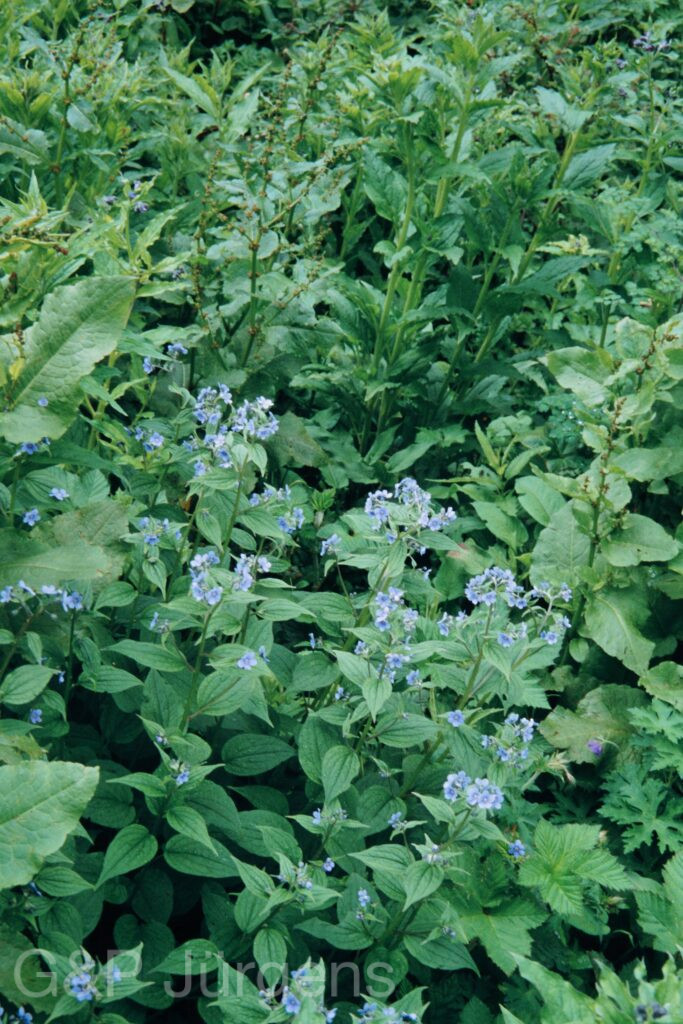
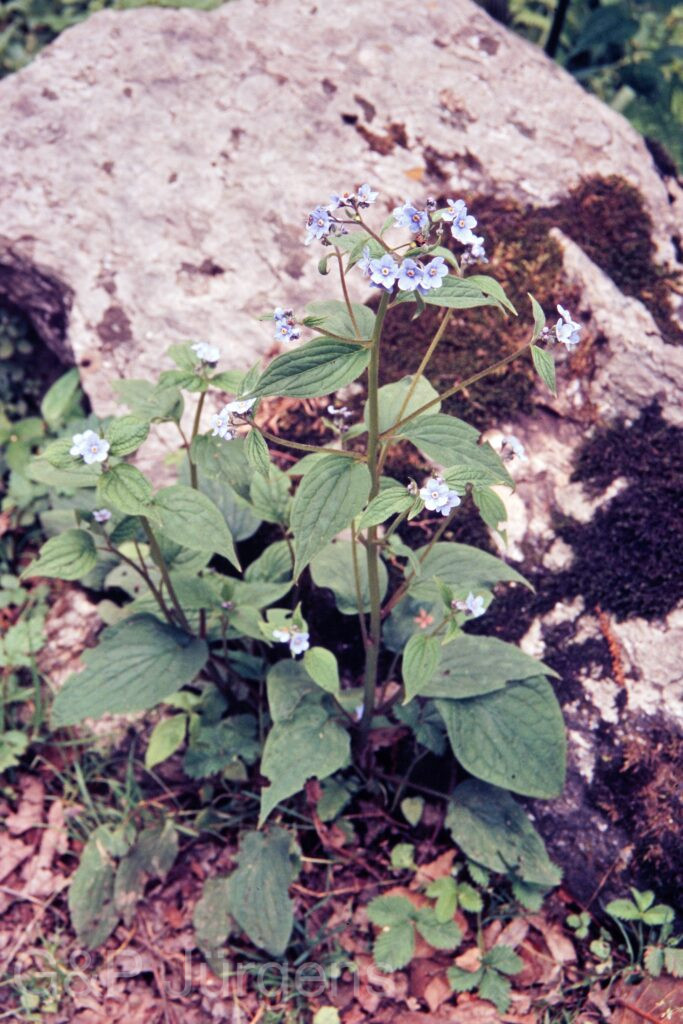
Myosotis sylvatica, the wood forget-me-not, is a widespread temperate herb whose native core lies across Europe and western Asia, with very large GBIF representation (over 171,000 records) from Britain, Germany, France, Scandinavia and the Alpine countries, plus naturalised populations in North America, Australia and New Zealand. In the western Himalaya it occurs as a montane element, as shown by the Garhwal collections at Panwali around 3250 m and Kia-Kutti near 3950 m, both in June. There it grows in moist meadows, along streamsides and on grassy alpine slopes, favouring cool, humus-rich soils with reliable seasonal moisture.

The plant is a softly hairy biennial or short-lived perennial forming a basal rosette from which arise erect to ascending leafy stems. The lower leaves are oblanceolate and stalked, the upper sessile and oblong. The inflorescence is the characteristic scorpioid cyme of the genus, uncoiling as the flowers open. Each flower has a five-lobed hairy calyx and a salverform corolla with a short tube and flat, usually sky-blue limb of five rounded lobes, the throat closed by yellow scales. The gynoecium develops into four smooth, shining, dark nutlets seated on the persistent calyx.

Myosotis is a taxonomically intricate genus in which M. sylvatica is distinguished from the annual field forget-me-nots by its larger, flat-faced flowers and from M. scorpioides by its drier habitats and hooked-haired calyx. Widely grown as a cottage-garden ornamental, it self-seeds freely and has escaped cultivation across several continents. The species is globally secure and of least concern, its abundance contrasting with the restricted ranges of many Himalayan congeners.

Author: Hoffm. · Sources: POWO (Kew), GBIF, Flora of China Vol. 16, Flora of Pakistan, Flora of Nepal, Flora Europaea (Tutin et al.)

Wall.

Nepal 99 147 ergebnis
West-Nepal South of Rara-Lake 3700m, June
Nepal 99 724 ergebnis
West-Nepal, Bauli.Khola 3600m, July

Description

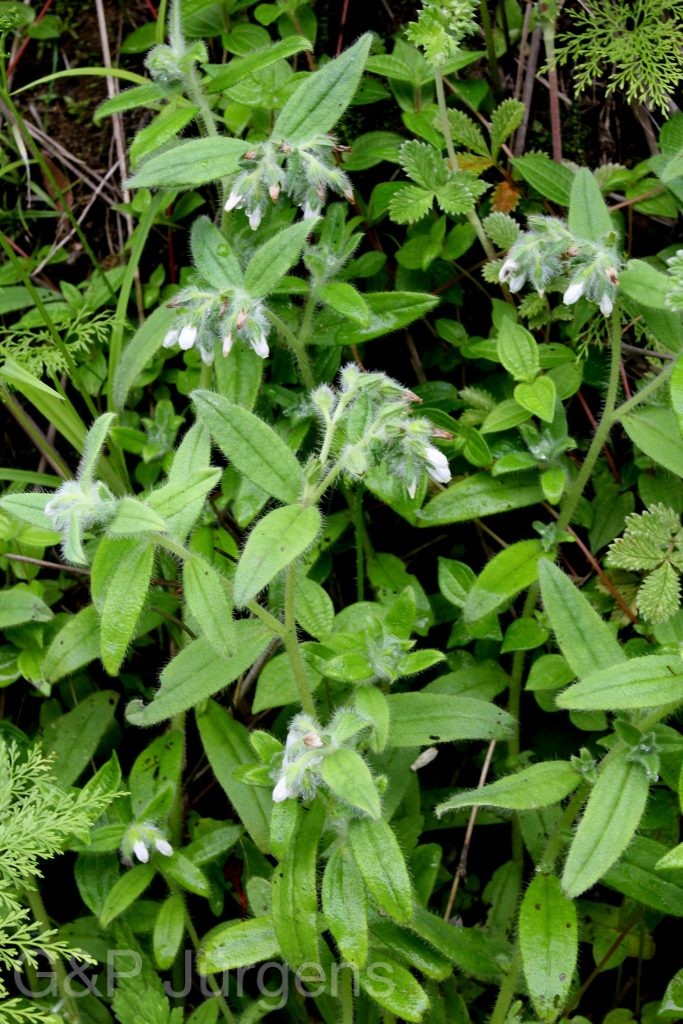
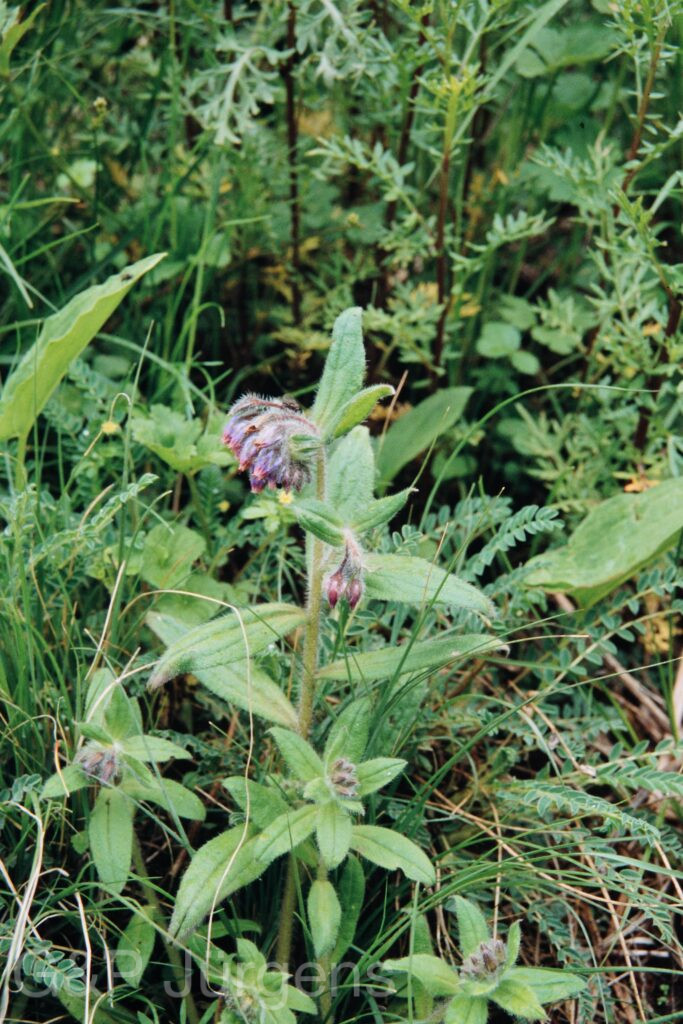
Onosma bracteata Wall. is a bristly perennial herb of the western and central Himalaya, recorded by GBIF (83 occurrences) from Nepal, India and Turkey, though its core range lies along the high inner-Himalayan valleys. It occupies dry, open, stony slopes, rocky pasture and the margins of subalpine scrub on calcareous or schistose substrates, flowering through the early monsoon. The cited collections from west Nepal, south of Rara Lake at 3700 m in June and at Bauli Khola at 3600 m in July, place it firmly in the high-altitude steppe and meadow zone where it forms scattered clumps on sun-exposed ground. The name is treated here as a synonym, with Onosma bracteata recognised as the accepted name.

The plant forms tufted, ascending to erect stems clothed throughout in stiff, spreading, tuberculate-based setae that give a harsh, hispid texture. The leaves are sessile, oblong-lanceolate to linear, entire and likewise bristly on both surfaces. Flowers are aggregated in terminal, scorpioid cymes subtended by conspicuous leafy bracts, from which the epithet derives; the corolla is tubular-campanulate, yellow, with a five-toothed limb and exserted anthers, and the gynoecium develops into four smooth nutlets enclosed by the persistent calyx.

Within the large Old World genus Onosma, the bracteate, yellow-flowered Himalayan species form a taxonomically intricate complex requiring careful comparison of indumentum and bract characters. Several Onosma yield a red dye (alkannin-type pigments) from their roots and have ethnobotanical and medicinal uses across the region. The species is not assessed as threatened, but its restriction to specialised dry montane habitats makes local populations vulnerable to grazing pressure and trampling.

Author: Wall. · Sources: POWO (Kew), GBIF, Flora of Nepal, Flora of British India (Hooker), Boraginaceae of the Western Himalaya, Riedl monograph on Onosma

  • 1
  • 2