Boraginaceae

R.R.Mill

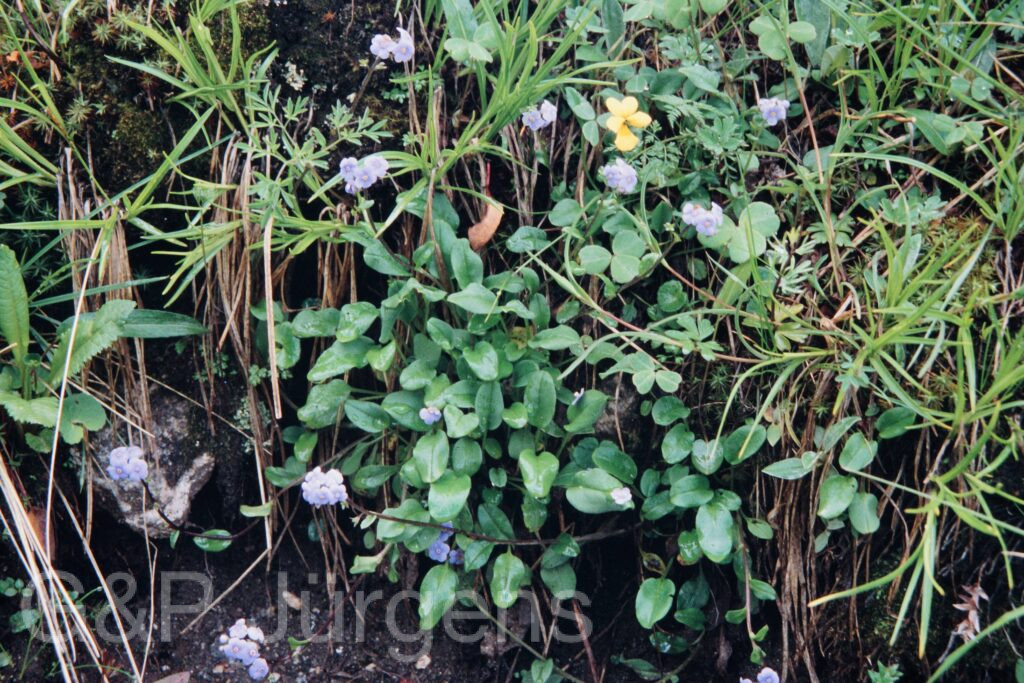
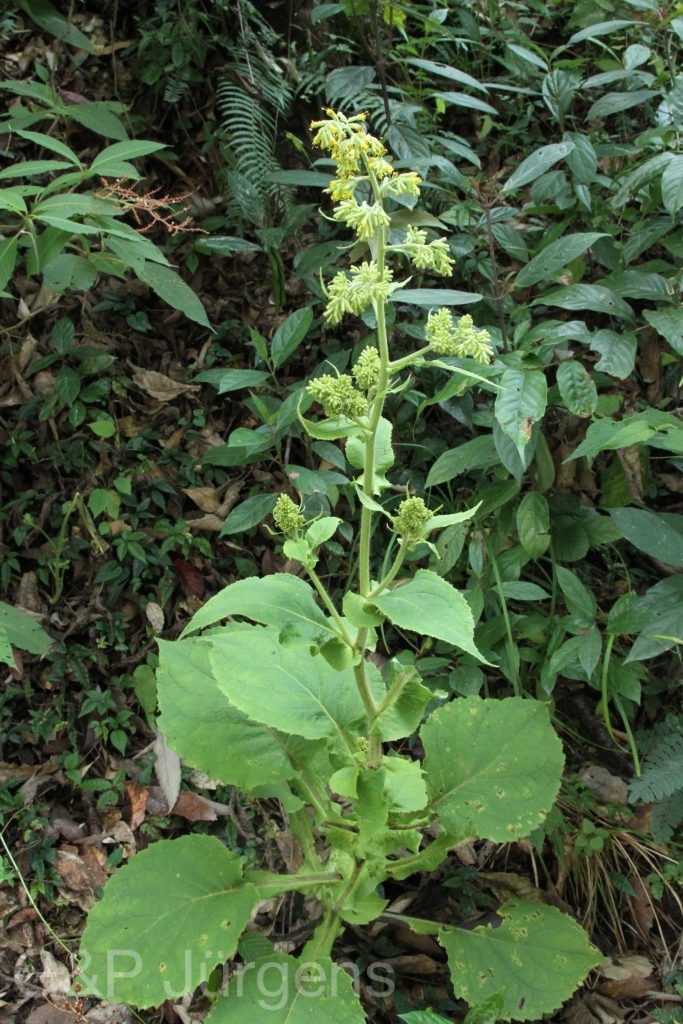
BhutanPG2011 712 01 01
Bhutan Phobjika 2800m July

Description

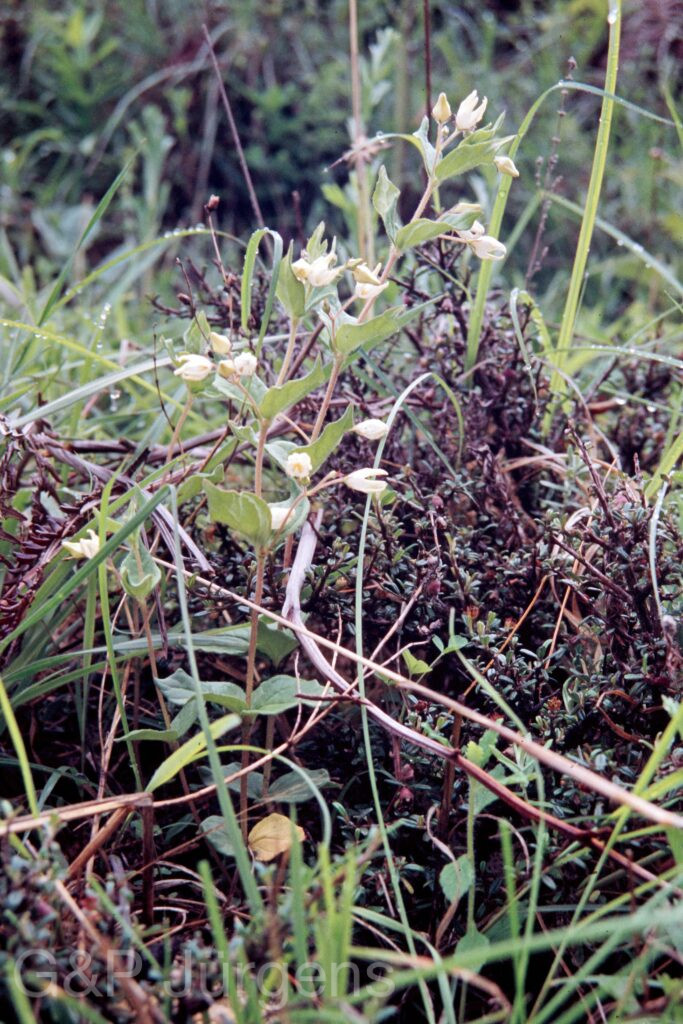
Onosma griersonii is a narrowly distributed Himalayan herb known from the temperate mountains of Bhutan, the only country from which it is recorded in GBIF, where its three occurrences reflect the rarity of collections of this localised taxon. It is a plant of open, dry, sunny banks, grassy slopes and stony ground in the inner valleys of the central Himalaya, favouring well-drained sites in the broad montane belt. The photographed plant from the Phobjika valley in Bhutan at 2800 m, flowering in July, typifies its occurrence in the cool-temperate mid-elevation zone, where it blooms during the summer monsoon. Though GBIF treats the name as a synonym, current taxonomic opinion accepts Onosma griersonii as the correct name for the entity.

Like other members of its genus it is a coarse, bristly-hairy perennial or biennial herb, the whole plant clothed in stiff, often tubercle-based setae that give it a harsh texture. The leaves are narrowly oblong to linear-lanceolate, entire and sessile, the basal ones forming a rosette. The flowers are borne in terminal scorpioid cymes that uncoil as they open; each flower has a tubular to narrowly campanulate corolla, typically yellow, with included or shortly exserted stamens and a deeply five-lobed calyx. The fruit comprises four hard, smooth nutlets.

Onosma is a large Old World genus centred on the mountains of Central and Southwest Asia, with a number of restricted endemics in the Himalaya. O. griersonii, named for the botanist A. J. C. Grierson, co-author of the Flora of Bhutan, is one such local endemic. Its bristly indumentum and tap-rooted habit are adaptations to dry, exposed montane microhabitats, while its tubular corollas suit pollination by long-tongued bees. As a narrow-range endemic it warrants conservation attention.

Author: R.R.Mill · Sources: POWO (Kew), GBIF, Flora of Bhutan, Boraginaceae of the Sino-Himalaya, Revision of Onosma (Riedl & Mill)
Bureau & Franch.

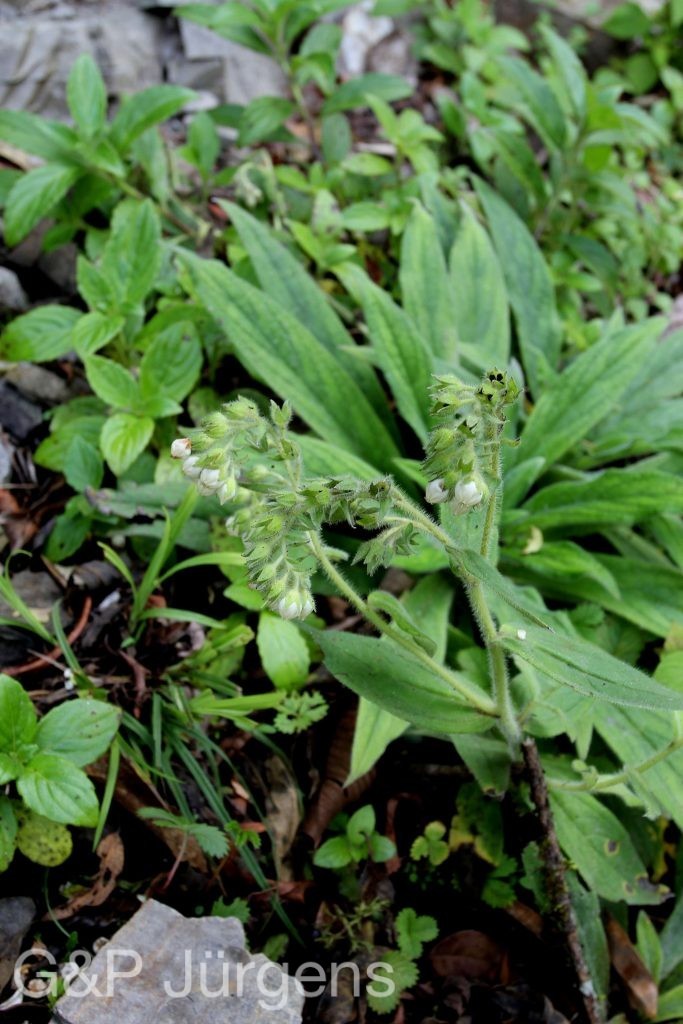
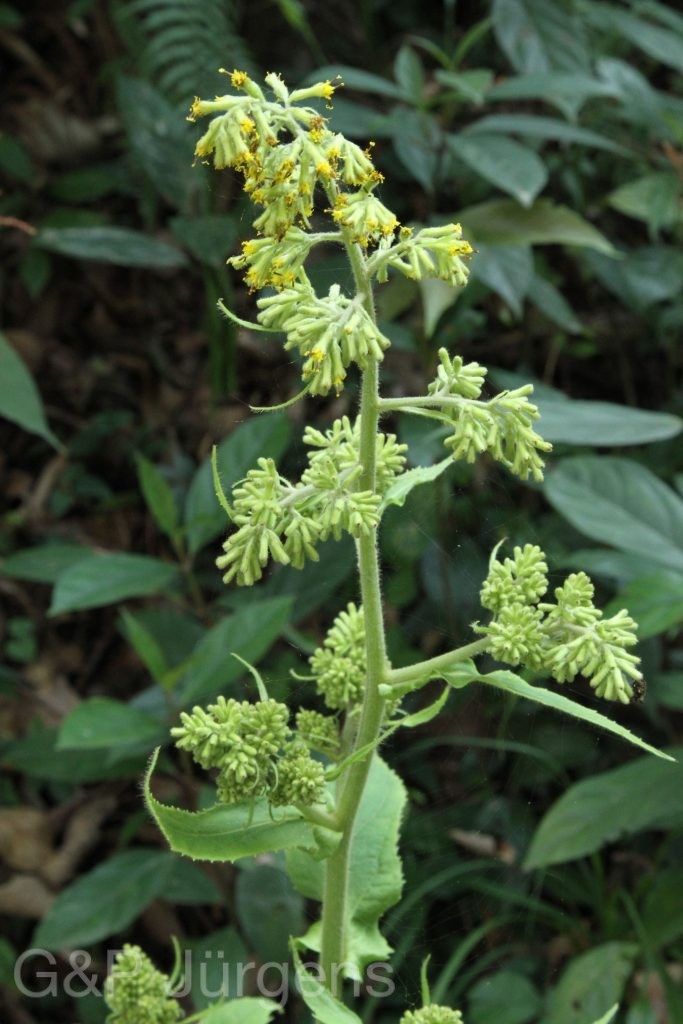
Bhutan2015 458
Bhutan Trongsa 2100m, October
Bhutan2015 457
Bhutan Trongsa 2100m, October

Description

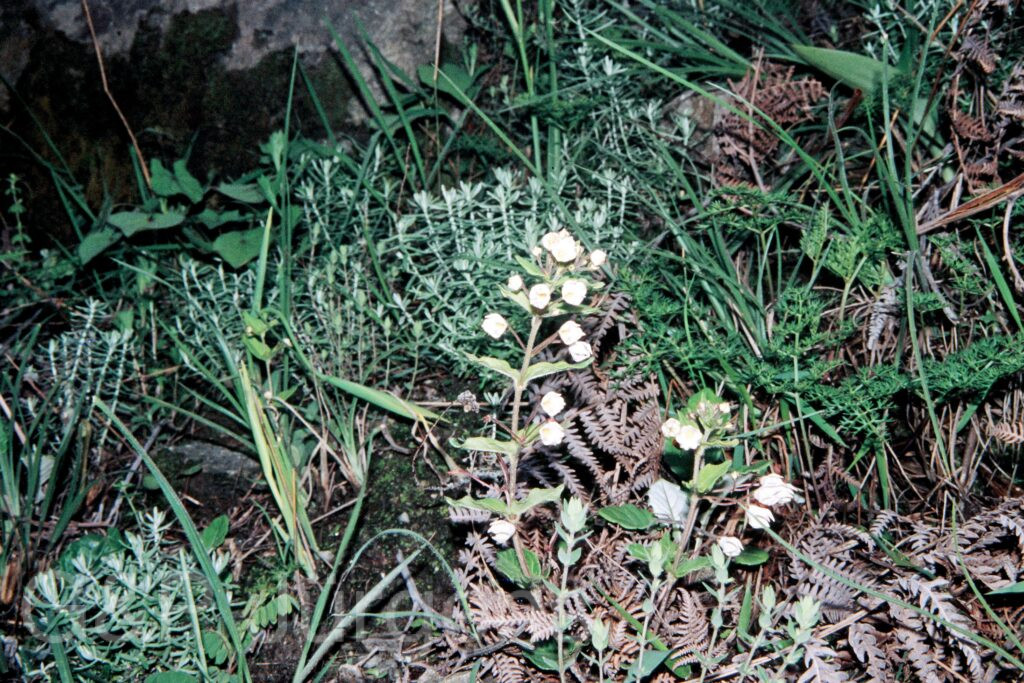
Onosma paniculatum is a robust, bristly-hairy herb of the eastern Himalaya and adjacent China, with GBIF documenting 255 occurrences across China and Bhutan. It favours open, sunny banks, dry rocky slopes, roadside cuttings and disturbed grassy ground in warm-temperate to montane country. The photographed plant grows at Trongsa in central Bhutan at about 2100 m, flowering in October, a relatively low and autumn-flowering station consistent with the species' tolerance of dry, exposed habitats.

The plant is a biennial or short-lived perennial with stiffly erect stems clothed in spreading, often pustular-based setae that render it harshly scabrid. The basal and lower leaves are linear to lanceolate, the cauline leaves smaller and sessile. The inflorescence is an open, branched panicle of scorpioid cymes; the flowers are pendent with a tubular-campanulate corolla, blue to violet (sometimes purplish), exserted anthers and a long, slender style. The fruit comprises four smooth, ovoid-trigonous nutlets.

GBIF treats the spelling Onosma paniculatum as a synonym, with Onosma paniculata accepted as the correct orthography. Onosma is a large Old World genus whose roots yield naphthoquinone red dyes long used locally, and several Himalayan species are gathered for traditional medicine and colouring. The genus is taxonomically difficult owing to indumentum variation and intergrading forms, so reliable identification depends on nutlet and corolla detail. Its prominence at disturbed sites makes it a familiar, weedy component of the eastern Himalayan flora.

Author: Bureau & Franch. · Sources: POWO (Kew), GBIF, Flora of China, Flora of Bhutan, Riedl's revision of Onosma (Boraginaceae)

(L.) Lehm.

Nepal 99 565 ergebnis
West-Nepal Hurikot 2700m, June
Nepal 99 564 ergebnis
West-Nepal Hurikot 2700m, June
Nepal 99 910 ergebnis
West-Nepal Hanke 2700m, July

Description

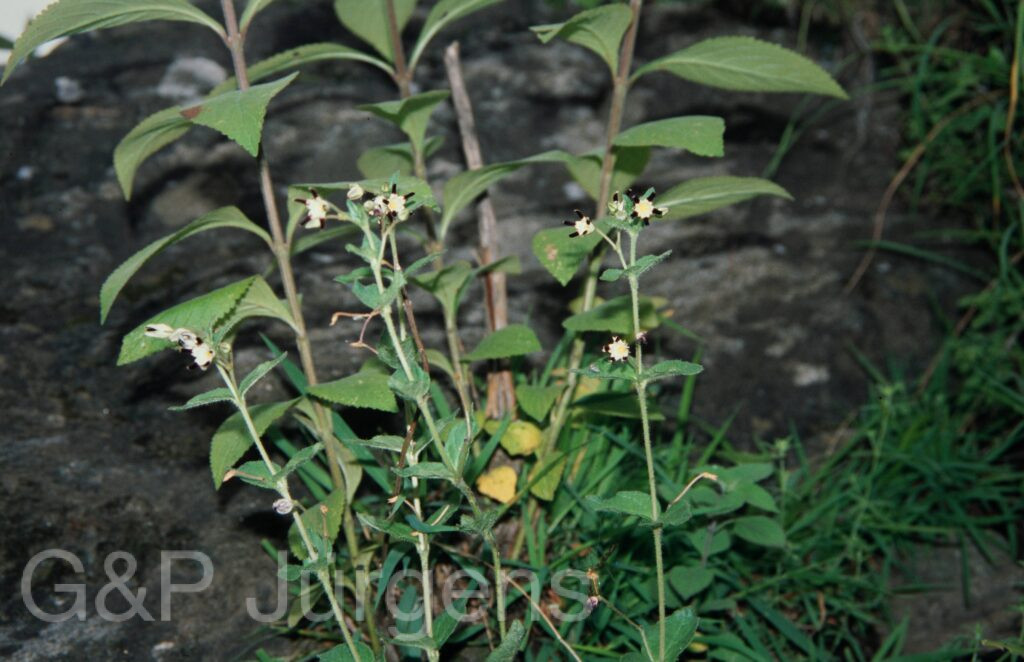
Trichodesma indicum (L.) Lehm. is a herb of the borage family widespread across the Old World tropics and subtropics, native through India, Pakistan, Nepal, Sri Lanka and Myanmar and extending to Southeast Asia, Africa and Australia, with over 1150 GBIF occurrences. It is a weedy plant of open dry ground, fallow fields, roadsides, wastelands and gravelly slopes, typically at low elevations but ascending in the inner Himalayan valleys. In western Nepal it was recorded at Hurikot at 2700 m in June and at nearby Hanke at the same elevation in July, an unusually high station reflecting warm, dry rain-shadow habitats in the upper Karnali region.

It is an erect, branching annual covered throughout with stiff, bulbous-based bristly hairs giving a harsh, scabrid texture. The leaves are mostly opposite below and alternate above, sessile, oblong to lanceolate, the margins entire and undersurface hispid. The flowers are solitary or in lax leafy cymes, nodding on recurved pedicels; the calyx is deeply lobed and sagittate at the base, and the pale blue to bluish-white corolla is rotate with a short tube and a twisted, beaked cone of connivent anthers projecting from the throat, a hallmark of the genus. The fruit separates into four ovoid, tuberculate nutlets enclosed by the enlarged, persistent calyx.

Trichodesma is distinguished within tribe Boragineae by its protruding, spirally twisted anther cone, and T. indicum is the most widely distributed species, much used in traditional South Asian medicine. Its bristly indumentum and burr-like calyx-enclosed nutlets aid epizoochorous dispersal, while its ruderal ecology has carried it far beyond its native range as an introduced weed. Common and adaptable, it is of no conservation concern.

Author: (L.) Lehm. · Sources: POWO (Kew), GBIF, Flora of China, Flora of Pakistan, Flora of British India, Boraginaceae monograph (Kazmi revision of Trichodesma)

Benth. ex C.B.Clarke

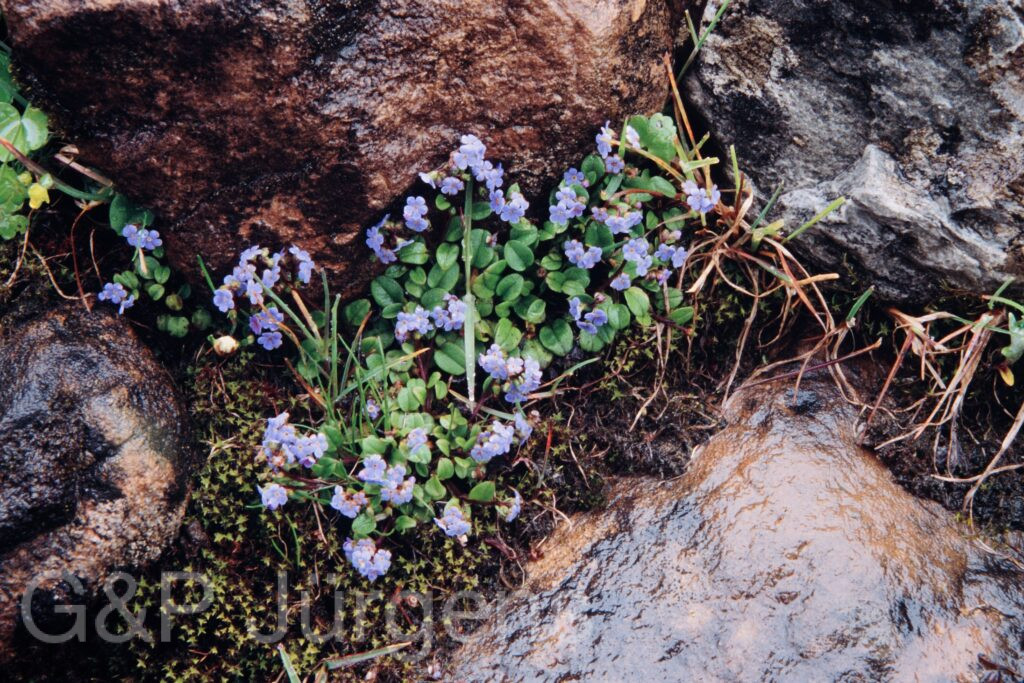
BhutanPG2011 452
Bhutan Tsochenchen, 3550m June
Nepal 99 516 ergebnis
West-Nepal Churta-Khola 3800m, June
Nepal 99 615 ergebnis
West-Nepal Kagmara-La 4100m, July

Description

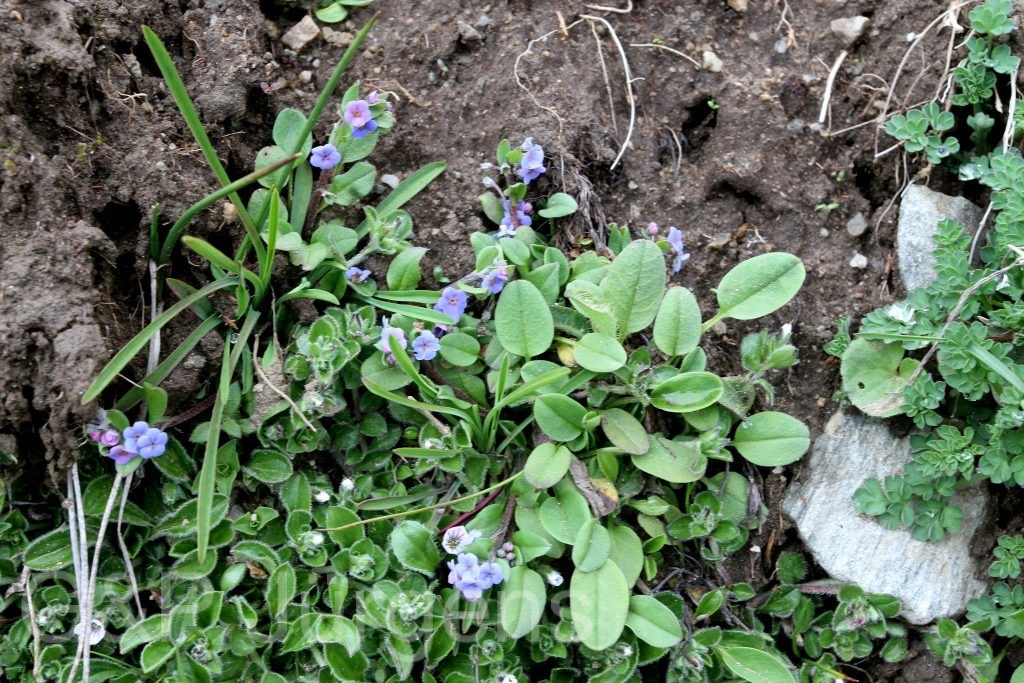
Trigonotis rotundifolia is a low-growing alpine forget-me-not relative of the Himalaya, with roughly 106 GBIF records across India, Nepal, China and Bhutan. It is a true high-alpine specialist, colonising open stony slopes, screes, moraine, rock crevices and short turf well above the treeline. The locations documented for the photographed material span a broad altitudinal band, from Tsochenchen in Bhutan at about 3550 m in June, through Churta-Khola in West Nepal at 3800 m, to the Kagmara-La at around 4100 m in July, confirming its preference for the upper subalpine to alpine zone where snow lingers and the season is brief.

It is a small, mat- or cushion-forming perennial herb with a branched rootstock and short, often prostrate or ascending stems clothed in appressed to spreading hairs. The leaves are small, crowded, and rounded to orbicular or spathulate, as the epithet indicates, narrowing into a winged petiole. The flowers are borne singly or in few-flowered leafy cymes; each has a deeply five-lobed calyx and a salverform to rotate, bright blue corolla with five yellow or white throat appendages (fornices) typical of the tribe. The fruit comprises four small, smooth, trigonous to keeled nutlets borne on short pedicels.

The genus Trigonotis is distinguished from Myosotis chiefly by nutlet morphology, the nutlets being triangular or pyramidal rather than dorsiventrally compressed. The genus is centred on the Sino-Himalayan and East Asian region, and the dwarf cushion habit of this species reflects convergent adaptation to cold, exposed, wind-pruned alpine sites. It is not formally assessed for conservation but, as a high-elevation endemic, is intrinsically sensitive to alpine habitat shifts under climate change.

Author: Benth. ex C.B.Clarke · Sources: POWO (Kew), GBIF, Flora of China, Flora of Bhutan, Flora of Nepal, Riedl Boraginaceae of the Himalaya

  • 1
  • 2