Malvaceae

L.

Bhutan2012 1230
Bhutan Trashigang 1150m, October
Bhutan2012 1231
Bhutan Trashigang 1150m, October

Description

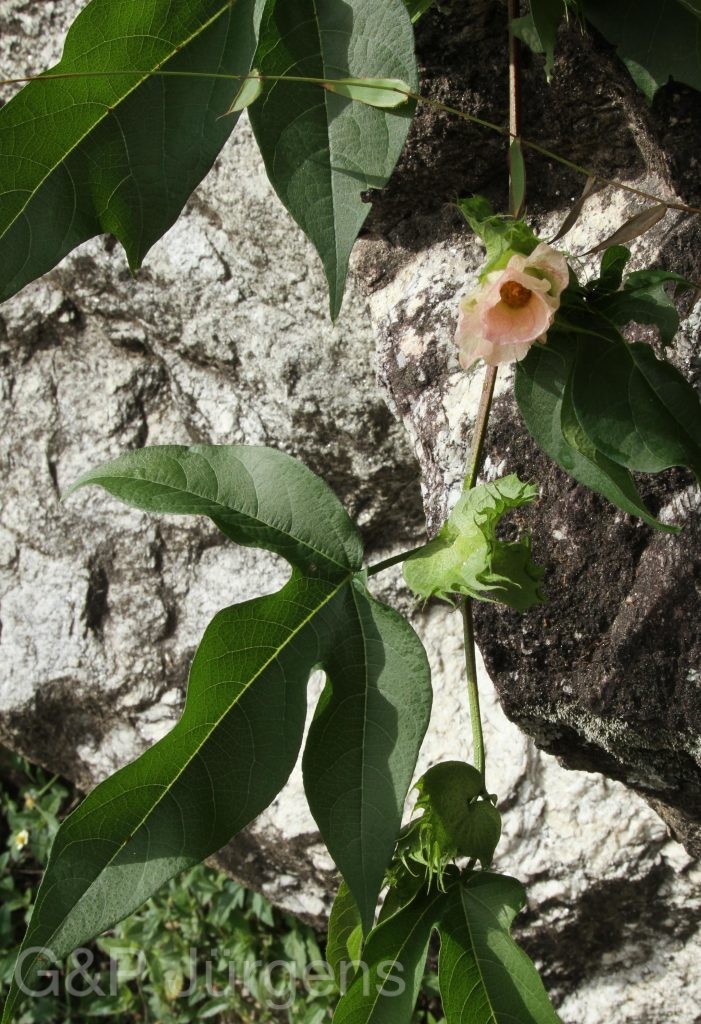
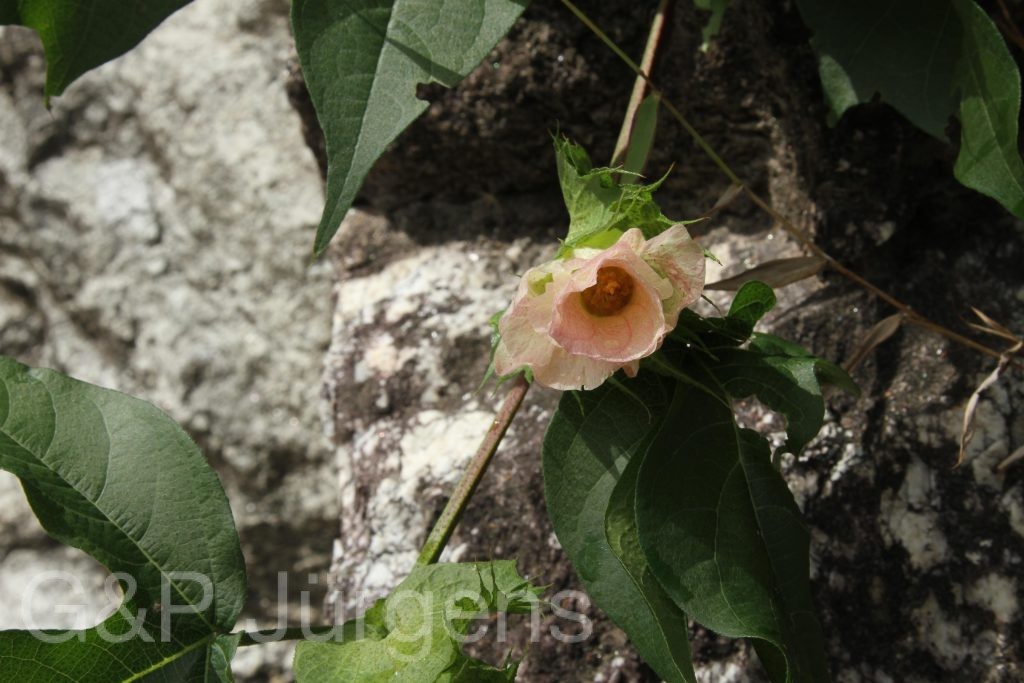
Gossypium hirsutum, Upland cotton, is native to Mesoamerica and the Caribbean but is now pantropical and warm-temperate in cultivation, accounting for the great majority of the world's cotton crop. Its 25,000-plus georeferenced records reflect this near-cosmopolitan distribution, with concentrations in the United States (US) and Mexico (MX) and naturalised or cultivated occurrences across Brazil, Uzbekistan, Australia, India, China and many other countries. In the Himalayan region it is a lowland cultigen and escape rather than a wild element; the plant photographed at Trashigang in eastern Bhutan at about 1150 m in October represents such warm subtropical valley cultivation, well below the montane flora. It thrives in hot, sunny, frost-free lowlands on deep, well-drained loams.

It is an erect, somewhat woody annual or short-lived perennial herb to shrub, with branching stems bearing scattered hairs and dark glandular dots. The leaves are alternate, broadly cordate and palmately three- to five-lobed, the lobes ovate-triangular and acuminate, with a basal nectary on the midrib beneath. The showy flowers are solitary and axillary, subtended by an epicalyx of three large, deeply incised, cordate bracts; the corolla is creamy white to pale yellow, often turning pink with age. The fruit is a three- to five-locular ovoid capsule (boll) that dehisces to reveal seeds embedded in copious white lint of elongated epidermal seed-hairs, the cotton fibre of commerce.

Gossypium (Malvaceae) is an economically pre-eminent genus whose allotetraploid New World cottons, including G. hirsutum, arose from hybridisation between Old and New World diploid lineages. The species is the foundation of global textile agriculture and a model for polyploid genomics. As a fully domesticated crop it has no conservation concern, though its wild and feral relatives are of interest for germplasm conservation and breeding.

Author: L. · Sources: POWO (Kew), GBIF, Flora of China, Flora of Pakistan, Fryxell monographic studies of Gossypium and the Malvaceae
DC.

Bhutan2014 718
Bhutan Wangdi Phodrang 2000m, May

Description

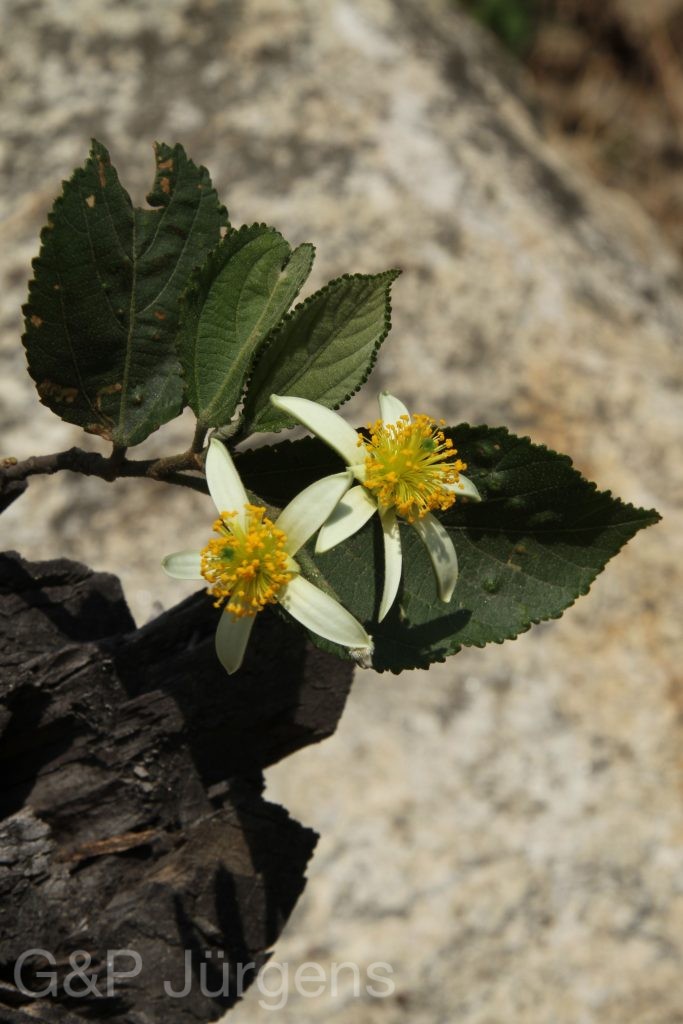
Grewia serrulata is a shrub or small tree of the Indomalayan tropics, distributed through India, Nepal, Bangladesh, Myanmar, Malaysia, Bhutan, Indonesia, the Philippines, Pakistan and Thailand, with around 382 GBIF occurrences. It is a plant of warm subtropical to tropical hill forest, growing in open woodland, forest margins, scrub, ravine slopes and along roadsides and clearings, generally on well-drained ground in the foothill and lower montane belt. The record from Wangdi Phodrang in Bhutan at about 2000 m in May illustrates its occurrence in the warm temperate to subtropical zone of the eastern Himalayan foothills, flowering in the pre-monsoon season.

The plant is a much-branched shrub or small tree with young branchlets bearing stellate pubescence. The alternate, simple leaves are ovate to oblong-lanceolate with an asymmetric, rounded to subcordate base, an acuminate apex, a finely serrulate margin (as the epithet denotes) and prominent palmate basal venation, the lower surface often paler and stellate-hairy. The flowers are borne in small axillary or leaf-opposed cymes; each has five sepals, five spreading yellow to whitish petals each with a basal nectariferous gland, and a prominent central androgynophore bearing numerous stamens around a superior ovary. The fruit is a small, lobed, fleshy drupe, becoming reddish to purplish-black at maturity and bearing few stones.

Described by de Candolle, Grewia serrulata belongs to a large genus formerly placed in Tiliaceae but now subsumed, following molecular phylogenetics, within the broadly circumscribed Malvaceae (subfamily Grewioideae); the input family is retained accordingly. The genus is well known for its tough bast fibres and edible drupes, and several species are gathered for fruit, fodder and fibre. As a widespread, adaptable component of secondary and disturbed forest, G. serrulata is not regarded as threatened, though locally valued for its useful products.

Author: DC. · Sources: POWO (Kew), GBIF, Flora of British India, Flora of Bhutan, Flora of China, Bayer & Kubitzki treatment of Malvaceae

(Dyer) Hook.f.

Nepal 1994 17 ergebnis
Ost-Nepal Kandbari 490m April

Description

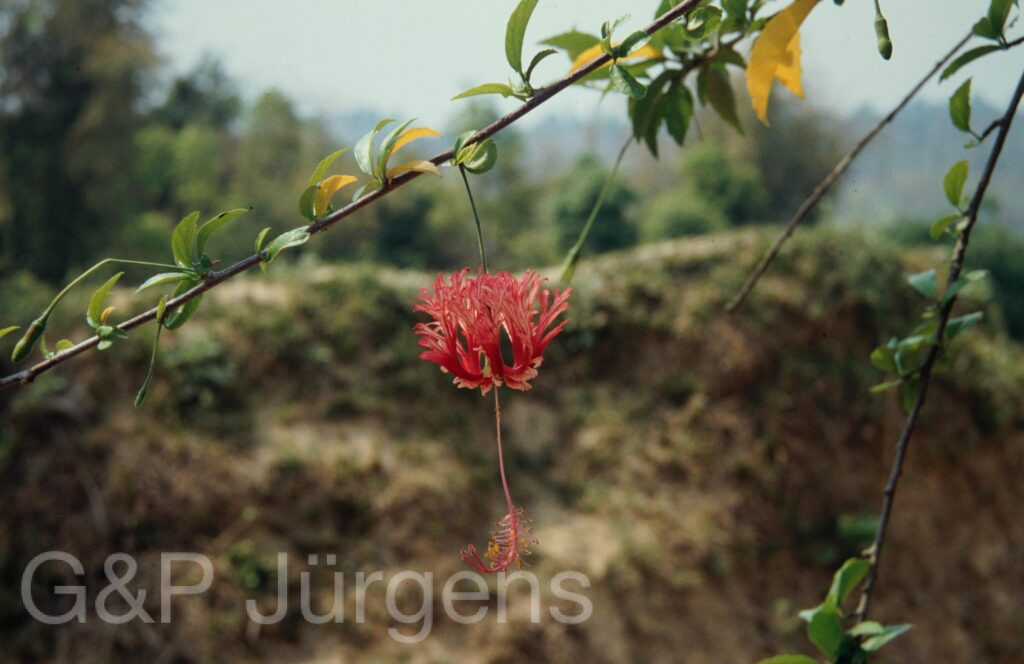
Hibiscus schizopetalus is native to coastal East Africa, particularly Kenya, Tanzania and Mozambique, but is now a pantropical ornamental, the GBIF dataset of some 2536 records spanning India, China, Hong Kong, Thailand, Indonesia, the Philippines, Japan, Fiji, French Polynesia, Réunion, and the Neotropics from Brazil and Colombia to Mexico, Costa Rica, Panama and Puerto Rico. In its introduced range it is grown as a garden and hedge shrub in warm lowland to lower-montane settings, escaping locally in disturbed and ruderal sites. The photographed plant from Khandbari in eastern Nepal at 490 m in April reflects this cultivated occurrence in the warm subtropical foothills, well outside its African origin.

It is an evergreen shrub reaching 2–3 m, with slender, often arching to pendulous glabrous branches. The leaves are alternate, ovate to elliptic, 4–7 cm long, with serrate margins, an acuminate apex and short petioles. The flowers are solitary, axillary and conspicuously pendulous on long jointed pedicels; the distinctive corolla consists of five deeply laciniate, recurved petals that are intricately fringed and pinnatifid, coloured pink to red, giving the species its common name fringed or coral hibiscus. The staminal column is long-exserted and pendent, bearing numerous anthers and a five-branched style with capitate stigmas. The fruit is a loculicidal capsule, though fruiting is sparse in cultivation.

Hibiscus schizopetalus belongs to section Lilibiscus of Hibiscus, allied to H. rosa-sinensis with which it readily hybridises and shares ornamental use. The deeply dissected, dangling flowers are an adaptation favouring sunbird and butterfly pollination in its native range. Widely propagated by cuttings, it is of no conservation concern as a cultivar, though wild African populations warrant attention.

Author: (Dyer) Hook.f. · Sources: POWO (Kew), GBIF, Flora of China Vol. 12, Flora of Tropical East Africa (Malvaceae), Flora of Nepal, Hibiscus: A Monograph

Mast.

Bhutan2012 1294
Bhutan Trashigang 1720m, October
Bhutan2012 1295
Bhutan Trashigang 1720m, October

Description

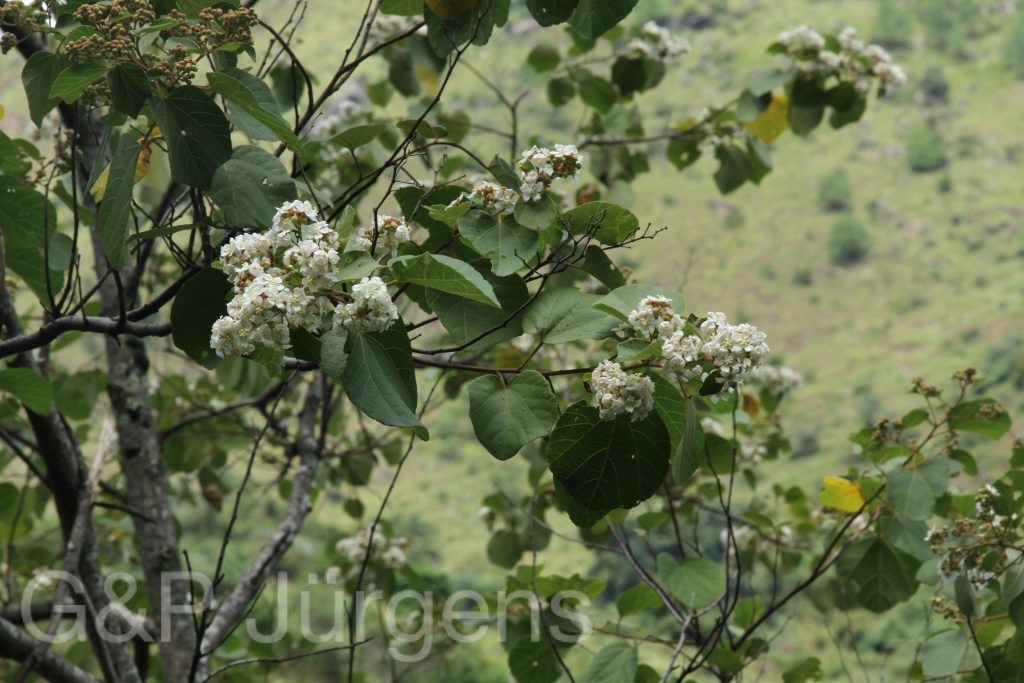
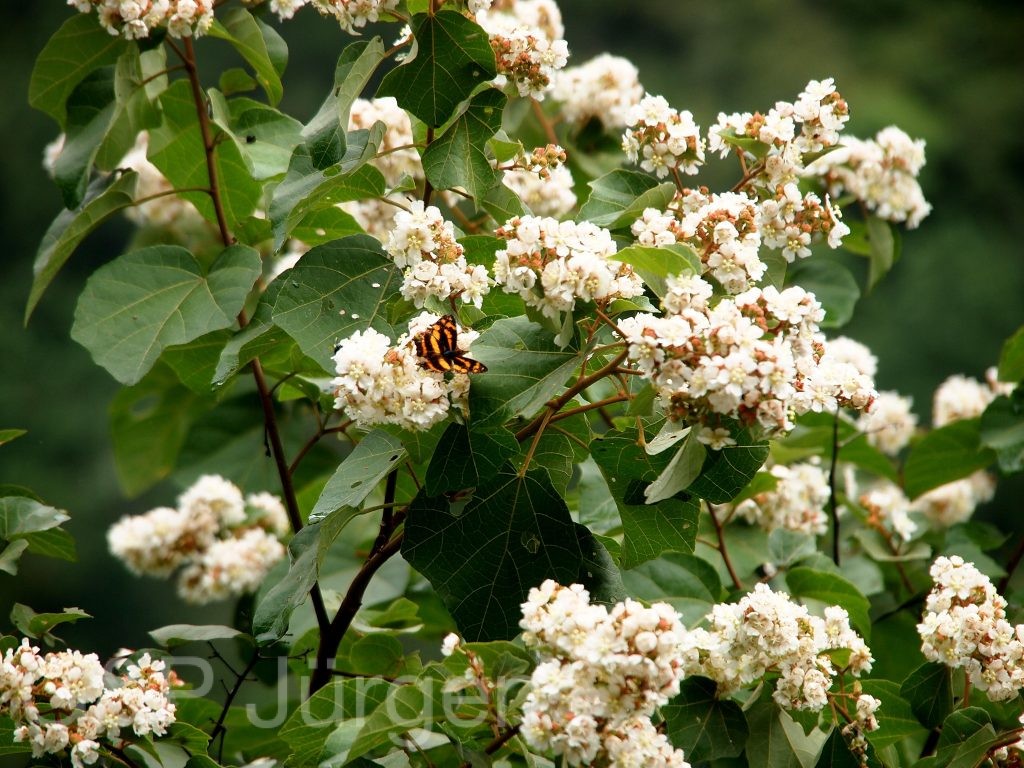
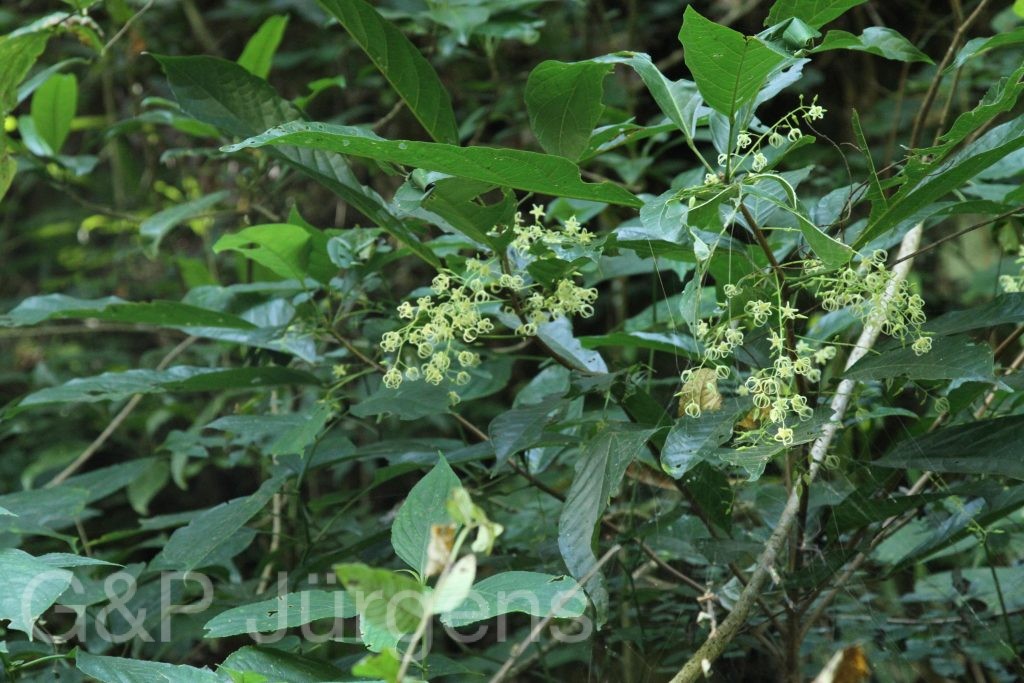
Kydia glabrescens is a small tree of the eastern Himalayan and Indo-Chinese region, recorded from China, Thailand, Nepal, Vietnam, Bhutan, India and Myanmar, with about 140 georeferenced occurrences. It occurs in subtropical and warm-temperate broadleaved forest, secondary woodland and forest margins at low to moderate elevations. The individual documented near Trashigang in eastern Bhutan at about 1720 m in October illustrates its mid-elevation habitat, flowering and fruiting in autumn on well-drained slopes within and at the edges of mixed hill forest.

The plant is a deciduous tree with grey bark whose young parts are stellate-tomentose but become more glabrescent with age, a feature underlying its epithet. The leaves are alternate, broadly ovate to suborbicular, palmately three- to five-veined and often shallowly lobed, with crenate-dentate margins. The flowers are borne in terminal and axillary panicles and are subtended by conspicuous epicalyx bracts that enlarge and become wing-like in fruit, a diagnostic feature of the genus; the small five-petalled corolla is white to pale pink, the stamens united into a staminal column typical of the Malvaceae. The fruit is a small capsule subtended by the accrescent, persistent bracts that aid wind dispersal.

Kydia is a small Asian genus traditionally placed in the Malvaceae (subfamily Grewioideae or related tribes in the broadly circumscribed family), distinguished by its enlarged fruiting epicalyx and dioecious or polygamous breeding system. The timber is used locally and the mucilaginous bark has minor traditional uses. Reasonably widespread through the eastern Himalaya and Southeast Asia, K. glabrescens is not considered threatened.

Author: Mast. · Sources: POWO (Kew), GBIF, Flora of Bhutan, Flora of China, Flora of British India, Tang, Gilbert & Dorr's account of Malvaceae

(L.) G.Don

Nepal 99 876 ergebnis
Nepal Murwa 3400m, July

Description

Modiola caroliniana is a pantropical and warm-temperate weed of American origin, now naturalized on every continent. GBIF documents over 23,700 occurrences, with the densest concentrations in the southeastern United States, southern South America, Australia, and New Zealand. While the species typically colonises disturbed lawns, roadsides, and cultivated land at low to moderate elevations, the present collection from Murwa in Nepal at 3,400 m represents a remarkably high-altitude record. In the Himalayan region it is known primarily as a casual introduction, exploiting anthropogenic disturbance along trade routes and settlement margins.
Modiola caroliniana is a prostrate to decumbent perennial herb with slender, creeping stems that root at the nodes, forming dense mats. Stems are sparsely to moderately stellate-pubescent. Leaves are alternate, palmately 5–7-lobed, 2–5 cm in diameter, with crenate margins; stipules are ovate, scarious. Flowers are solitary and axillary, small (8–12 mm across), with five salmon-pink to orange-red petals, each narrowly obovate and slightly emarginate. The staminal column is characteristic of Malvaceae. The fruit is a schizocarp, 6–8 mm in diameter, composed of 15–22 mericarps arranged in a disc; each mericarp bears two divergent, spine-like awns at the apex and contains a single reniform seed. The barbed mericarps facilitate epizoochorous dispersal.
Modiola is a monotypic genus, distinguished from related genera such as Malva and Sida by its spiny mericarps and prostrate, stoloniferous habit. Its occurrence at 3,400 m in western Nepal is biogeographically noteworthy, well above its typical altitudinal range of sea level to 1,500 m. This high-elevation record likely reflects transport along the heavily trafficked trails connecting lowland Nepal with trans-Himalayan passes. The species' ability to establish at such altitudes hints at a broader climatic tolerance than generally assumed and warrants monitoring as a potential indicator of upward weed migration under changing climate conditions.

Author: (L.) G.Don · Sources: POWO (Kew), GBIF, Flora of China Vol. 12, Fryxell: The Natural History of the Cotton Tribe (1979), Press et al.: Annotated Checklist of the Flowering Plants of Nepal (2000)

(Griff.) D.G. Long & A.G. Mill.

Bhutan2014 257
Bhutan Karu-Chu 1800m, May
Bhutan2014 258
Bhutan Karu-Chu 1800m, May

Description

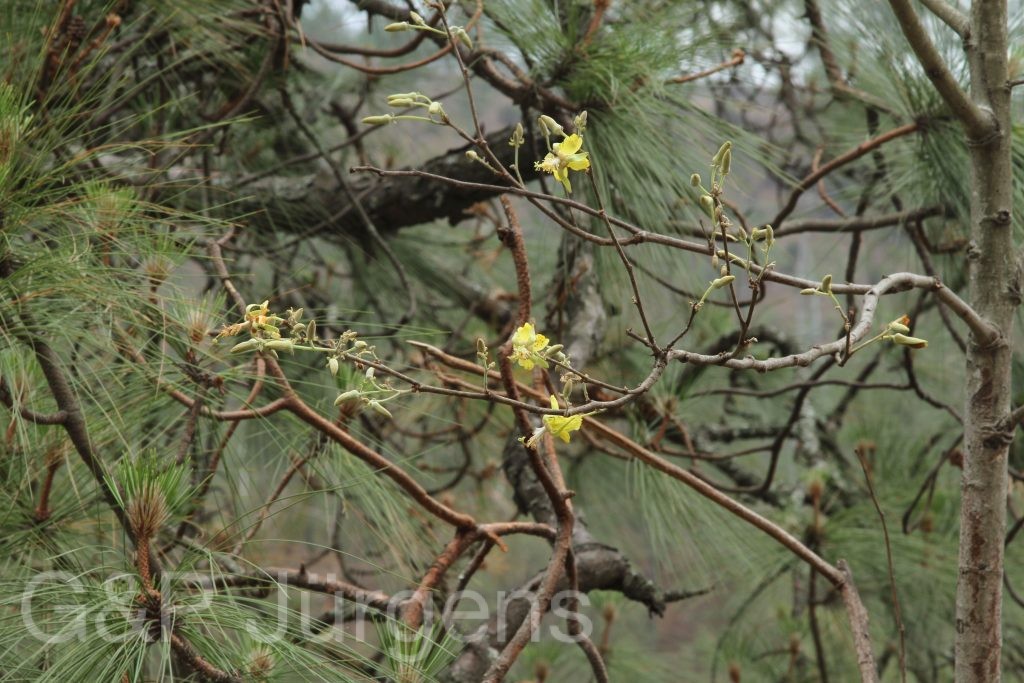
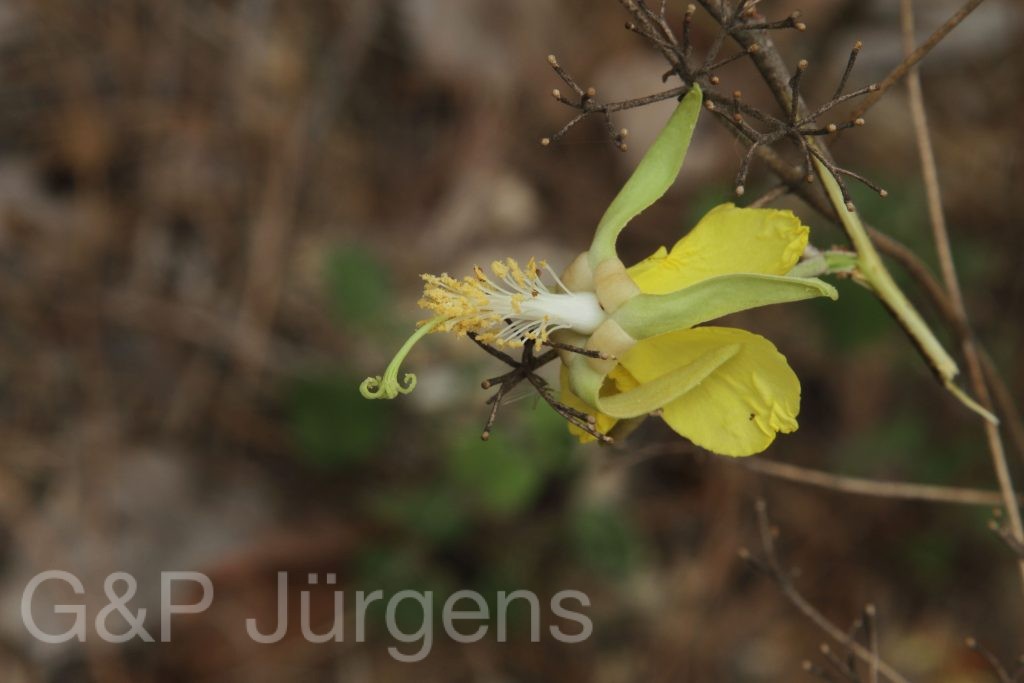
Nayariophyton zizyphifolium is a little-collected shrub of the Eastern Himalayan foothills and adjacent Indo-Burmese region, known from a modest 45 georeferenced records concentrated in India (IN), Nepal (NP) and Bhutan (BT), with a peripheral occurrence in Thailand (TH). It is a plant of warm subtropical to lower temperate valleys and hill slopes, occurring in open forest, scrub and on rocky banks at low to middle elevations. The plant photographed at Karu-Chu in Bhutan at about 1800 m in May reflects this warm, sheltered river-valley habitat, well below the alpine flora and typical of the species' restricted foothill range. Under the name used here GBIF treats the record as a synonym, with Nayariophyton zizyphifolium itself standing as the currently accepted name.

It is an erect, somewhat woody shrub with stellate-pubescent young branches. The leaves are alternate, ovate to broadly elliptic with a serrate margin and a three-veined base, recalling the foliage of Ziziphus, from which the specific epithet zizyphifolium derives; they are clothed, especially beneath, with stellate hairs typical of the Malvaceae. The flowers are axillary, subtended by an epicalyx, with five sepals and five petals in the usual mallow arrangement and a column of fused stamens surrounding the style. The fruit is a schizocarpic, several-segmented mericarp characteristic of the genus, the dry segments separating at maturity.

Nayariophyton (Malvaceae) is a small, taxonomically isolated genus of the Eastern Himalaya, and the combination here reflects the revisionary work of D.G. Long and A.G. Miller for the Flora of Bhutan. Its scant collection record and narrow foothill distribution make it of biogeographic interest as an element of the Indo-Himalayan endemic flora. Given its limited known range and the conversion of low-elevation valley habitat, the species warrants attention from a conservation standpoint, though it has not been formally assessed.

Author: (Griff.) D.G. Long & A.G. Mill. · Sources: POWO (Kew), GBIF, Flora of Bhutan, Flora of British India, Long and Miller revision of Eastern Himalayan Malvaceae

Herb.Madr. ex Wight & Arn.

Bhutan2012 976
Bhutan Trithangebe 1000m, October
Bhutan2012 806 Kopie
Bhutan Trithangebe 1000m, October
also included: Drymaria cordata

Description

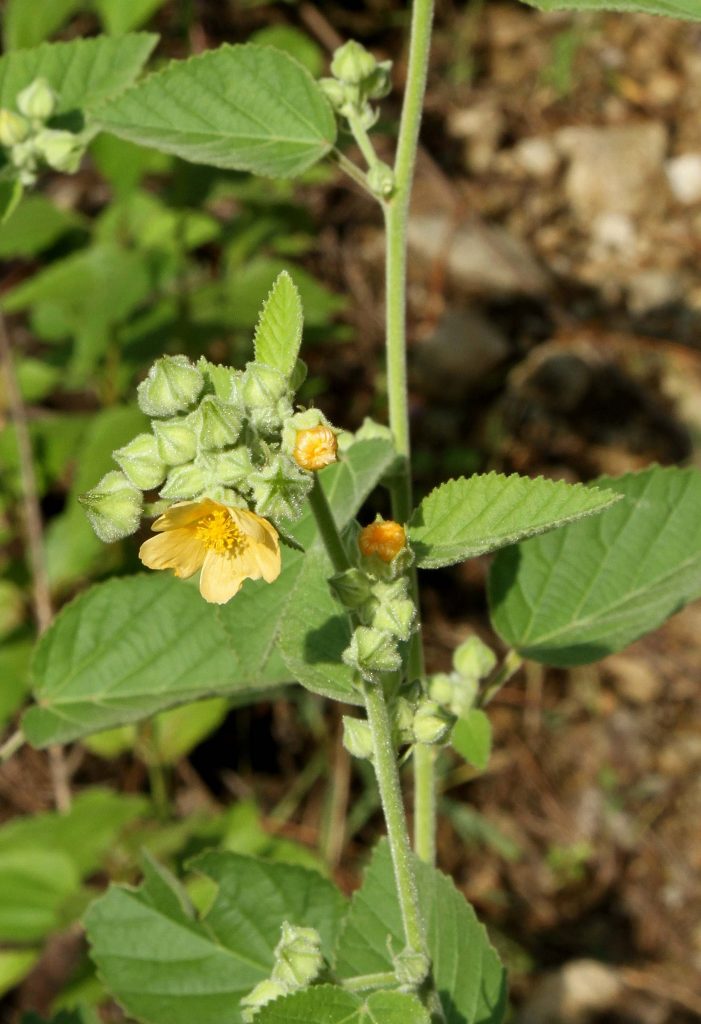
Sida mysorensis is an Old World tropical, weakly pantropical weedy herb, GBIF recording some 630 occurrences across South and Southeast Asia (India, Sri Lanka, China, Taiwan, Myanmar, Thailand, Vietnam, Cambodia, Laos, the Philippines, Indonesia), the Himalayan states (Nepal, Bhutan) and naturalised in the Neotropics (Mexico, Brazil, Colombia, Cuba, Guatemala). It is a plant of warm low to mid elevations, colonising roadsides, waste ground, fallow fields and forest margins. The Bhutanese record from Trithangebe at about 1000 m, flowering in October beside Drymaria cordata, is characteristic of its association with humid, weedy subtropical foothills after the monsoon.

It is an erect to ascending annual or short-lived perennial herb or subshrub, 30–120 cm tall, the stems and foliage softly pubescent to stellate-tomentose and often viscid. The leaves are alternate, ovate to cordate, crenate-serrate and stipulate. Flowers are small, solitary or few in the leaf axils; the corolla is yellow to pale orange, of five obovate petals around a staminal column typical of Malvaceae. The fruit is a schizocarp of several reticulate mericarps, each usually bearing short apical awns aiding dispersal.

Described from a Madras herbarium specimen by Wight and Arnott, S. mysorensis belongs to the large, taxonomically complex genus Sida, in which softly hairy, axillary-flowered species are frequently confused. It is of no conservation concern, being a widespread ruderal and minor agricultural weed, and like many Sida species has been used in folk medicine and as a bast fibre. Ecologically it is an early colonist of disturbed tropical ground.

Author: Herb.Madr. ex Wight & Arn. · Sources: POWO (Kew), GBIF, Flora of Bhutan, Flora of China, Malvaceae of the World (Bayer & Kubitzki treatment)

L.

Bhutan2012 804
Bhutan Zemgang 1950m, October

Description

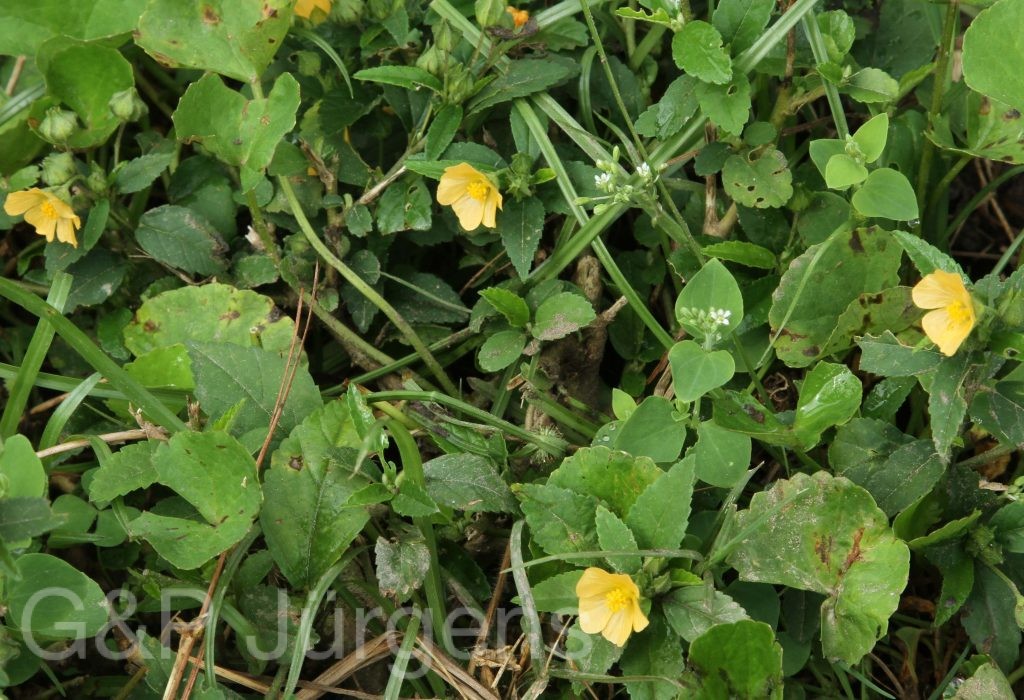
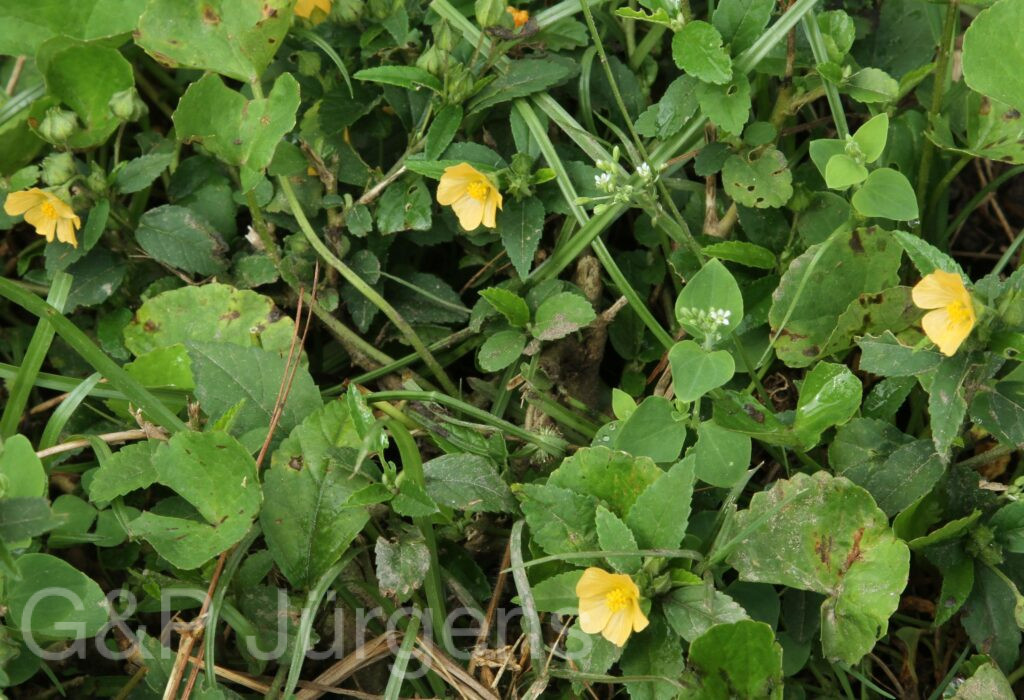
Sida rhombifolia L. is a near-cosmopolitan subshrub of tropical and warm-temperate regions, one of the most widely distributed weeds in the Malvaceae. GBIF documents over 50,000 records from every inhabited continent — Australia, the Americas (USA, Brazil, Mexico, Colombia, Argentina, Bolivia, Ecuador), Africa (South Africa, Cameroon, DR Congo), and Asia including China, India, Taiwan and Japan. In the Himalaya it occurs on roadsides, fallow fields, waste ground and open slopes; the photographed plant is from Bhutan, Zemgang, 1,950 m, in October. It thrives on disturbed, well-drained soils from sea level to around 2,000 m and is a pioneer of ruderal and pastoral habitats.

The plant is an erect, much-branched perennial subshrub 30–100 cm tall with tough, fibrous stems bearing stellate to simple appressed hairs. Leaves are alternate, shortly petiolate, rhombic to lanceolate (rhombifolia), 1.5–5 cm long, serrate in the upper half, entire toward the cuneate base, paler and pubescent beneath. Flowers are solitary in the leaf axils on slender, jointed pedicels, the corolla pale yellow to orange-yellow, 5–10 mm across, with five obovate petals; the staminal column is characteristic of the family. The schizocarpic fruit is a flattened ring of 8–12 mericarps, each with two short apical awns.

A polymorphic and taxonomically complex aggregate, S. rhombifolia has yielded numerous infraspecific taxa and segregates. The stem yields a strong bast fibre used for cordage and brooms, and the plant is widely employed in traditional medicine. Owing to its weedy vigour it is naturalised and sometimes invasive far beyond its presumed Old World tropical origin.

Author: L. · Sources: POWO (Kew), GBIF, Flora of China Vol. 12, Flora of Bhutan Vol. 2, Flora of Nepal, Borssum Waalkes: Malesian Malvaceae revised (Blumea)

(Jack) Phengklai

Bhutan2015 230
Bhutan Zhemgang 950m, October

Description

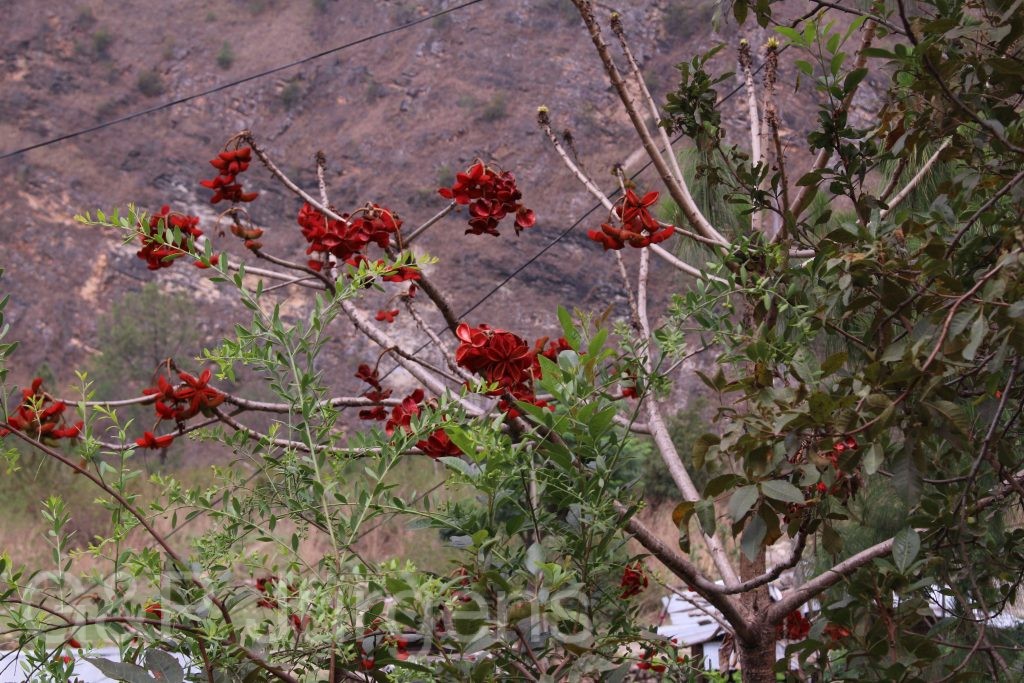
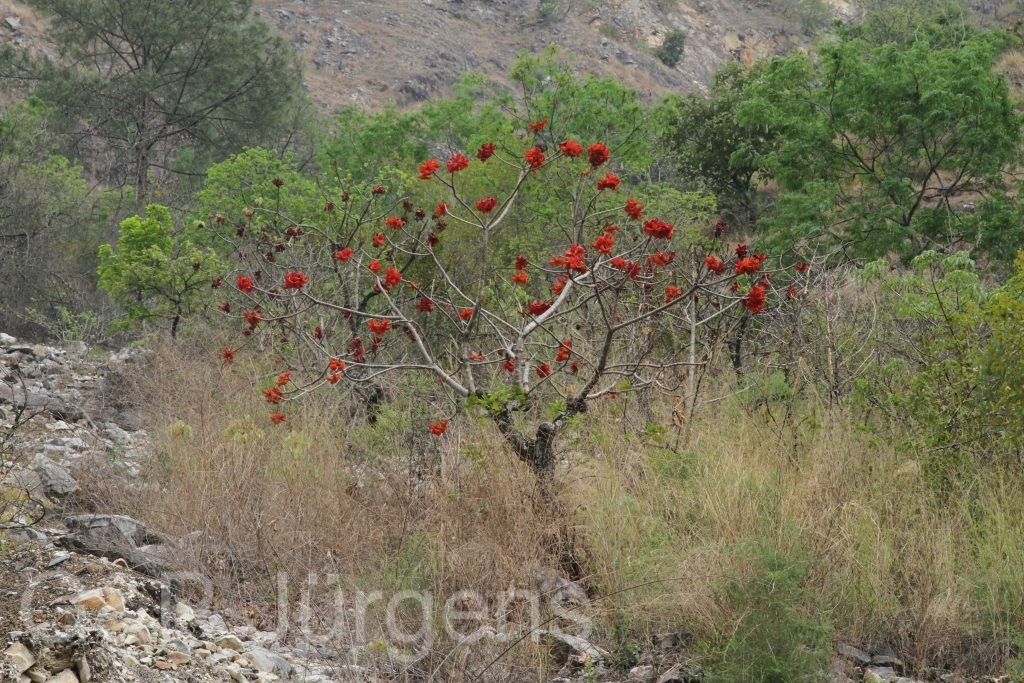
Sterculia lanceolata var. coccinea is a tree of tropical and subtropical Asia, ranging from the Indian subcontinent (India, Nepal, Sri Lanka) through Myanmar, Thailand, Indochina (Vietnam, Laos, Cambodia) and southern China into Malesia (Malaysia, Indonesia, Singapore, Brunei, Philippines), as reflected in the 322 GBIF records. It occurs in evergreen and semi-evergreen lowland to lower-montane forest, along streams and forest margins, typically below about 1500 m. The photographed tree from Zhemgang in central Bhutan at around 950 m, fruiting in October, sits at the warm-temperate northern edge of the species' range, where the bright fruiting display is conspicuous in autumn.

The variety is a small to medium tree with a slender bole and spreading crown. The leaves are alternate, simple, elliptic-lanceolate to oblong, entire, glabrescent and pinnately veined, on slender petioles — the lanceolate blade distinguishing this species from the palmately lobed S. villosa. The small flowers are apetalous with a campanulate, lobed calyx and are borne in axillary panicles; the variety coccinea is named for its scarlet colouring. The fruit is the diagnostic cluster of woody, beaked follicles that ripen a vivid red ('coccineus') and split open to reveal glossy black seeds against the crimson inner wall.

Now classified in Malvaceae subfamily Sterculioideae (formerly Sterculiaceae), Sterculia lanceolata is a variable species, and this variety, based on the basionym described by Jack and recombined by Phengklai, segregates the scarlet-fruited Malesian-Indochinese populations. The boldly coloured dehisced follicles are bird-dispersed, the contrasting red and black serving as a visual lure. Widespread and occurring in both primary and secondary forest, the taxon is not regarded as threatened.

Author: (Jack) Phengklai · Sources: POWO (Kew), GBIF, Flora of Thailand, Flora of China, Flora of British India, Kostermans Sterculiaceae monograph

Roxb.

Bhutan2014 253
Bhutan Karu-Chu 1800m, May
Bhutan2014 264
Bhutan Karu-Chu 1800m, May

Description

Sterculia villosa is a deciduous tree widely distributed across tropical and subtropical Asia, from India, Nepal, Bangladesh, Bhutan and Sri Lanka eastward through Myanmar, Thailand, Vietnam, southern China and into Malesia (Malaysia, Indonesia), with the 452 GBIF records reflecting both this native range and cultivated or naturalised occurrences elsewhere. It is a tree of monsoon and deciduous forest, riverine valleys and disturbed slopes at low to moderate elevations, generally below about 1500 m though reaching higher in warm valleys. The photographed individual from the Karu-Chu valley in Bhutan at around 1800 m, flowering in May before or with the new leaves, marks the upper, warm-temperate edge of its range.

The tree has a straight bole, grey bark and stout branches, the young parts densely clad in soft tawny villous hairs from which the epithet derives. The large, alternate leaves are palmately lobed with 5-7 broad lobes, cordate at the base and long-petioled, hairy beneath. The flowers, borne in much-branched velvety panicles, are apetalous, with a campanulate, lobed, reddish to greenish-yellow calyx; the species is andromonoecious with a central androgynophore. The fruit is the characteristic sterculiaceous group of large, woody, beaked, velvety follicles that dehisce to expose black seeds against a red interior.

Formerly placed in Sterculiaceae, the genus Sterculia is now treated within an enlarged Malvaceae (subfamily Sterculioideae), as adopted here. S. villosa is economically valued for its strong bast fibre, used for ropes and cordage, and yields a gum; its bark and seeds feature in local medicine. As a fast-growing, light-demanding species of disturbed and secondary forest it is widespread and not of conservation concern, though it is locally significant in agroforestry and as a host for lac and silk insects.

Author: Roxb. · Sources: POWO (Kew), GBIF, Flora of Bhutan, Flora of British India, Flora of China, Kostermans Sterculiaceae monograph

  • 1
  • 2