
(Dyer) Hook.f.
Description
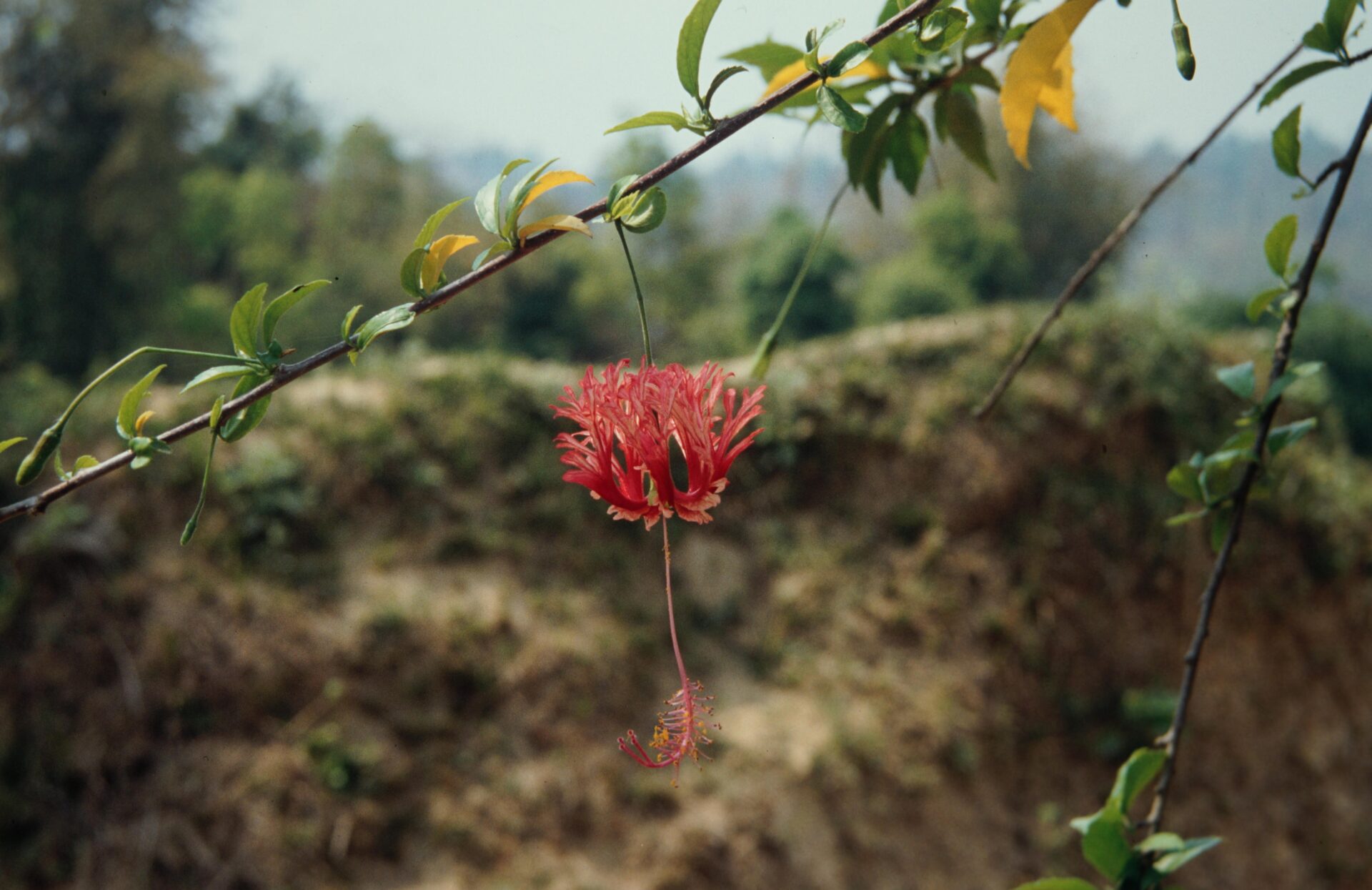
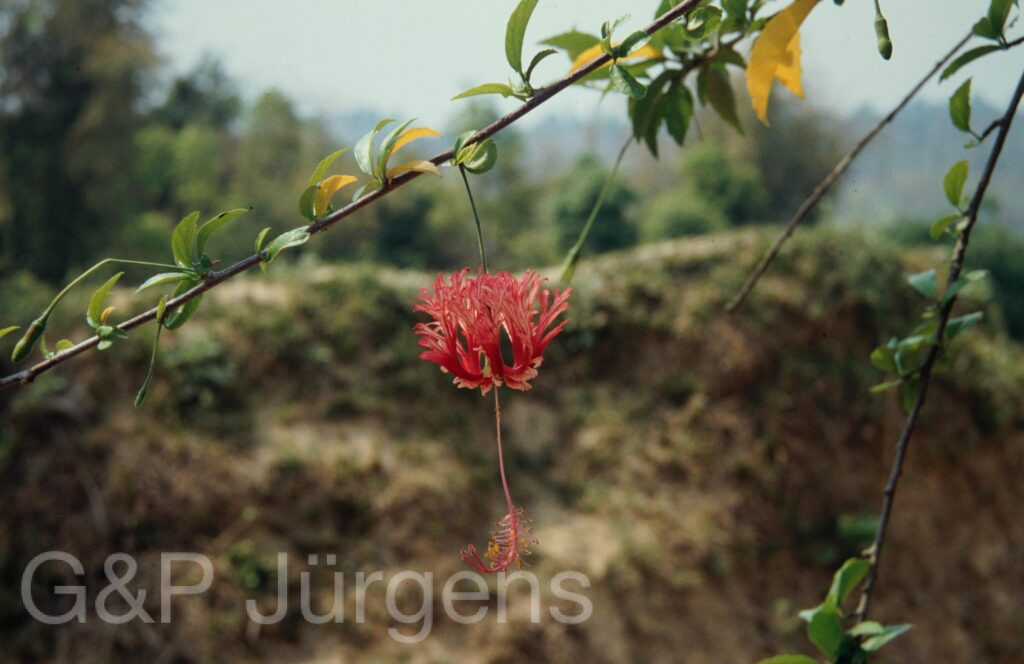
Hibiscus schizopetalus is native to coastal East Africa, particularly Kenya, Tanzania and Mozambique, but is now a pantropical ornamental, the GBIF dataset of some 2536 records spanning India, China, Hong Kong, Thailand, Indonesia, the Philippines, Japan, Fiji, French Polynesia, Réunion, and the Neotropics from Brazil and Colombia to Mexico, Costa Rica, Panama and Puerto Rico. In its introduced range it is grown as a garden and hedge shrub in warm lowland to lower-montane settings, escaping locally in disturbed and ruderal sites. The photographed plant from Khandbari in eastern Nepal at 490 m in April reflects this cultivated occurrence in the warm subtropical foothills, well outside its African origin.
It is an evergreen shrub reaching 2–3 m, with slender, often arching to pendulous glabrous branches. The leaves are alternate, ovate to elliptic, 4–7 cm long, with serrate margins, an acuminate apex and short petioles. The flowers are solitary, axillary and conspicuously pendulous on long jointed pedicels; the distinctive corolla consists of five deeply laciniate, recurved petals that are intricately fringed and pinnatifid, coloured pink to red, giving the species its common name fringed or coral hibiscus. The staminal column is long-exserted and pendent, bearing numerous anthers and a five-branched style with capitate stigmas. The fruit is a loculicidal capsule, though fruiting is sparse in cultivation.
Hibiscus schizopetalus belongs to section Lilibiscus of Hibiscus, allied to H. rosa-sinensis with which it readily hybridises and shares ornamental use. The deeply dissected, dangling flowers are an adaptation favouring sunbird and butterfly pollination in its native range. Widely propagated by cuttings, it is of no conservation concern as a cultivar, though wild African populations warrant attention.
Author: (Dyer) Hook.f. · Sources: POWO (Kew), GBIF, Flora of China Vol. 12, Flora of Tropical East Africa (Malvaceae), Flora of Nepal, Hibiscus: A Monograph