
L.
Description
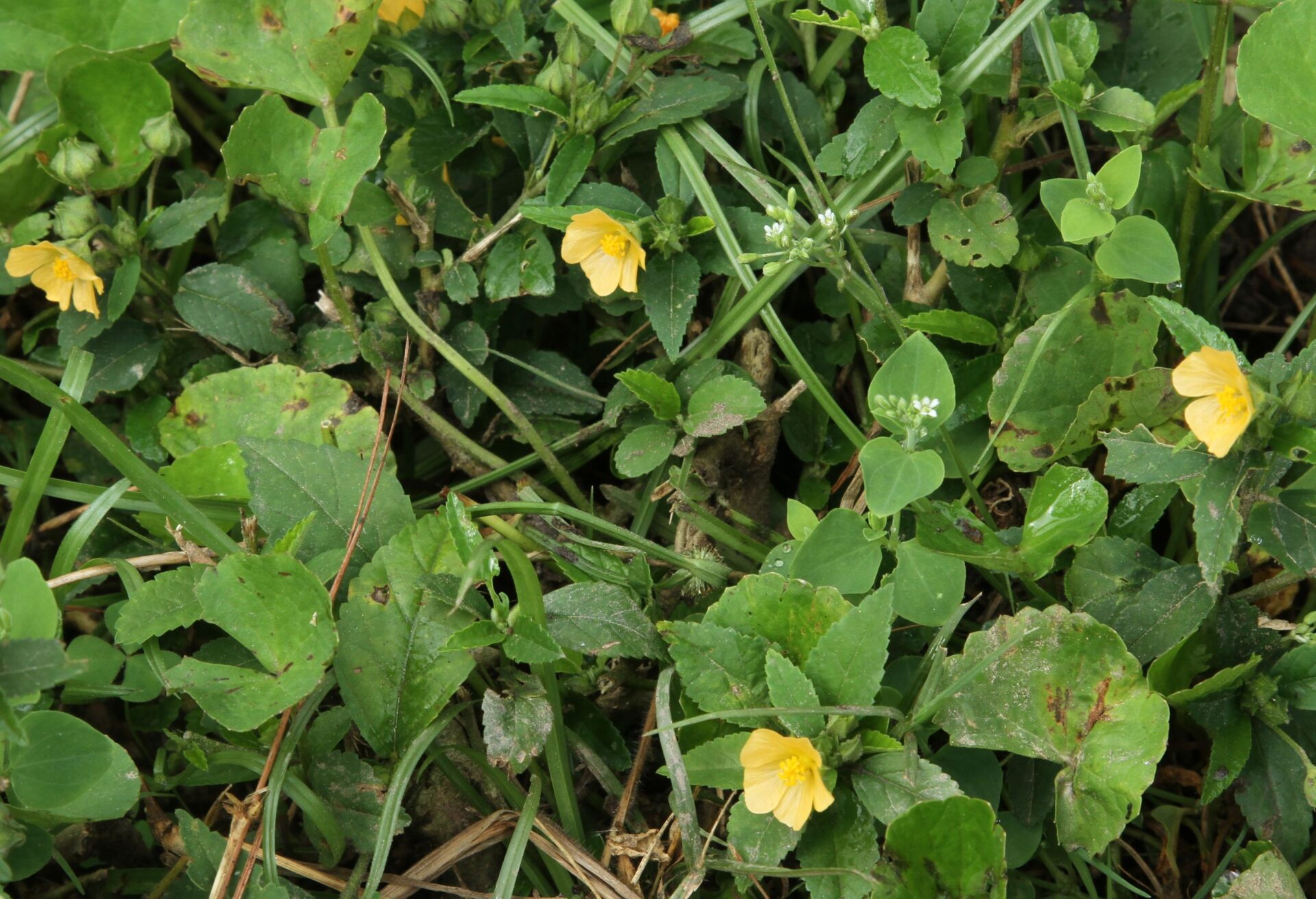
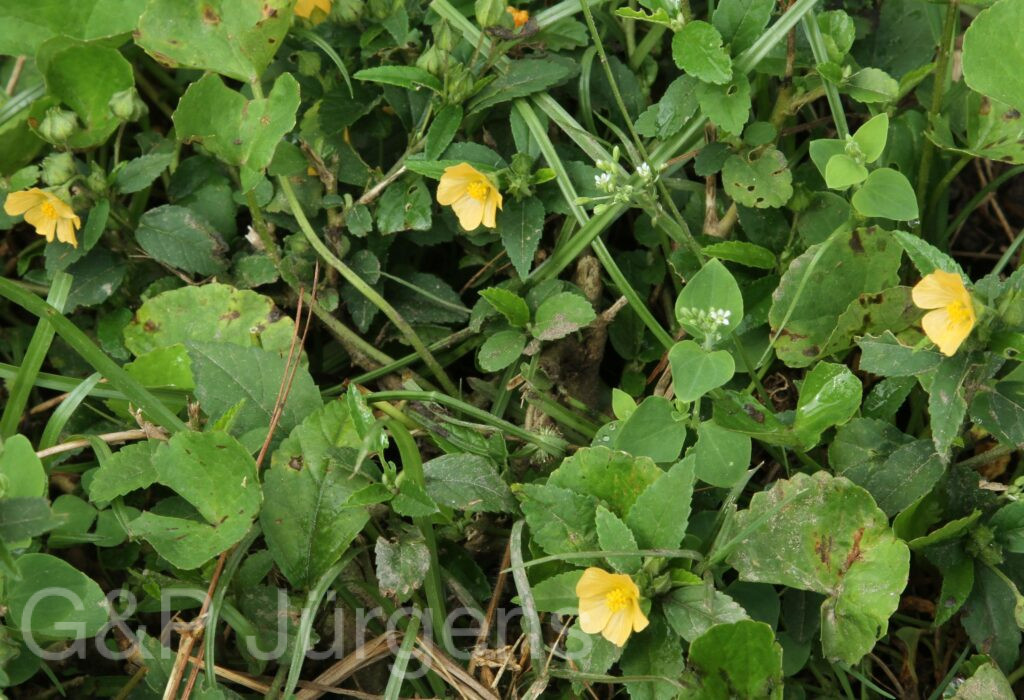
Sida rhombifolia L. is a near-cosmopolitan subshrub of tropical and warm-temperate regions, one of the most widely distributed weeds in the Malvaceae. GBIF documents over 50,000 records from every inhabited continent — Australia, the Americas (USA, Brazil, Mexico, Colombia, Argentina, Bolivia, Ecuador), Africa (South Africa, Cameroon, DR Congo), and Asia including China, India, Taiwan and Japan. In the Himalaya it occurs on roadsides, fallow fields, waste ground and open slopes; the photographed plant is from Bhutan, Zemgang, 1,950 m, in October. It thrives on disturbed, well-drained soils from sea level to around 2,000 m and is a pioneer of ruderal and pastoral habitats.
The plant is an erect, much-branched perennial subshrub 30–100 cm tall with tough, fibrous stems bearing stellate to simple appressed hairs. Leaves are alternate, shortly petiolate, rhombic to lanceolate (rhombifolia), 1.5–5 cm long, serrate in the upper half, entire toward the cuneate base, paler and pubescent beneath. Flowers are solitary in the leaf axils on slender, jointed pedicels, the corolla pale yellow to orange-yellow, 5–10 mm across, with five obovate petals; the staminal column is characteristic of the family. The schizocarpic fruit is a flattened ring of 8–12 mericarps, each with two short apical awns.
A polymorphic and taxonomically complex aggregate, S. rhombifolia has yielded numerous infraspecific taxa and segregates. The stem yields a strong bast fibre used for cordage and brooms, and the plant is widely employed in traditional medicine. Owing to its weedy vigour it is naturalised and sometimes invasive far beyond its presumed Old World tropical origin.
Author: L. · Sources: POWO (Kew), GBIF, Flora of China Vol. 12, Flora of Bhutan Vol. 2, Flora of Nepal, Borssum Waalkes: Malesian Malvaceae revised (Blumea)