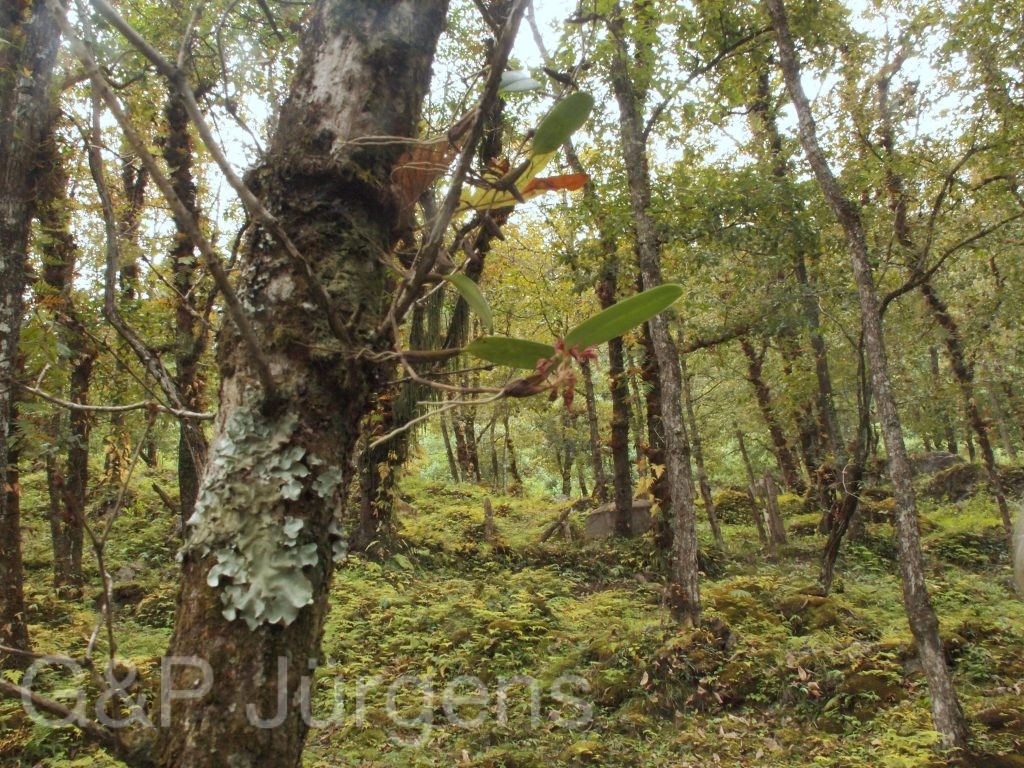
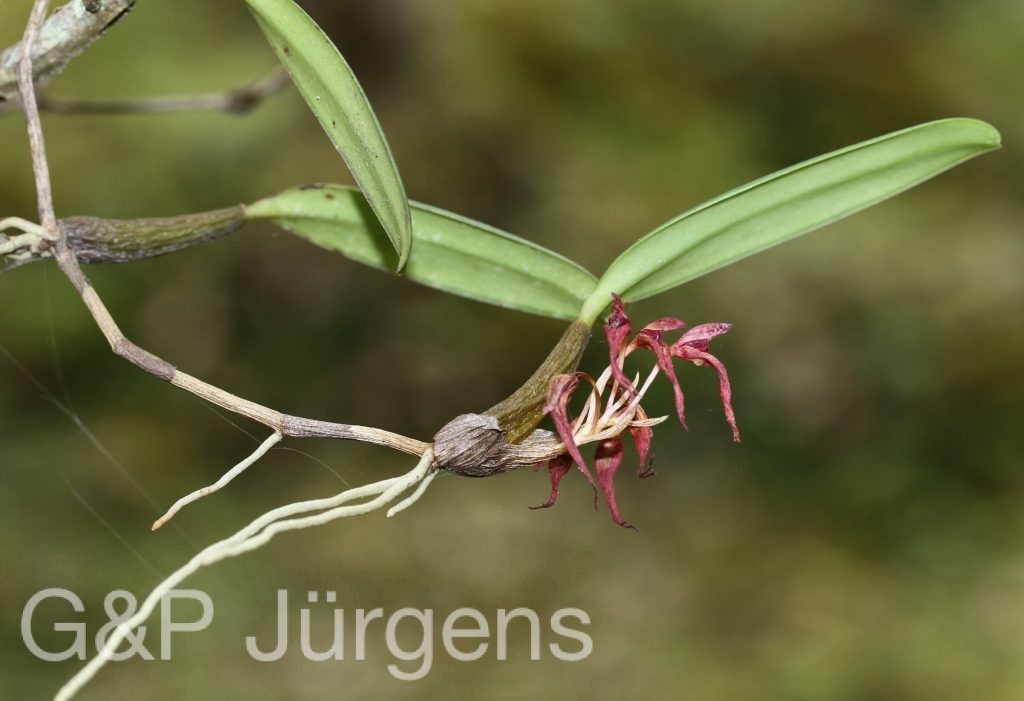
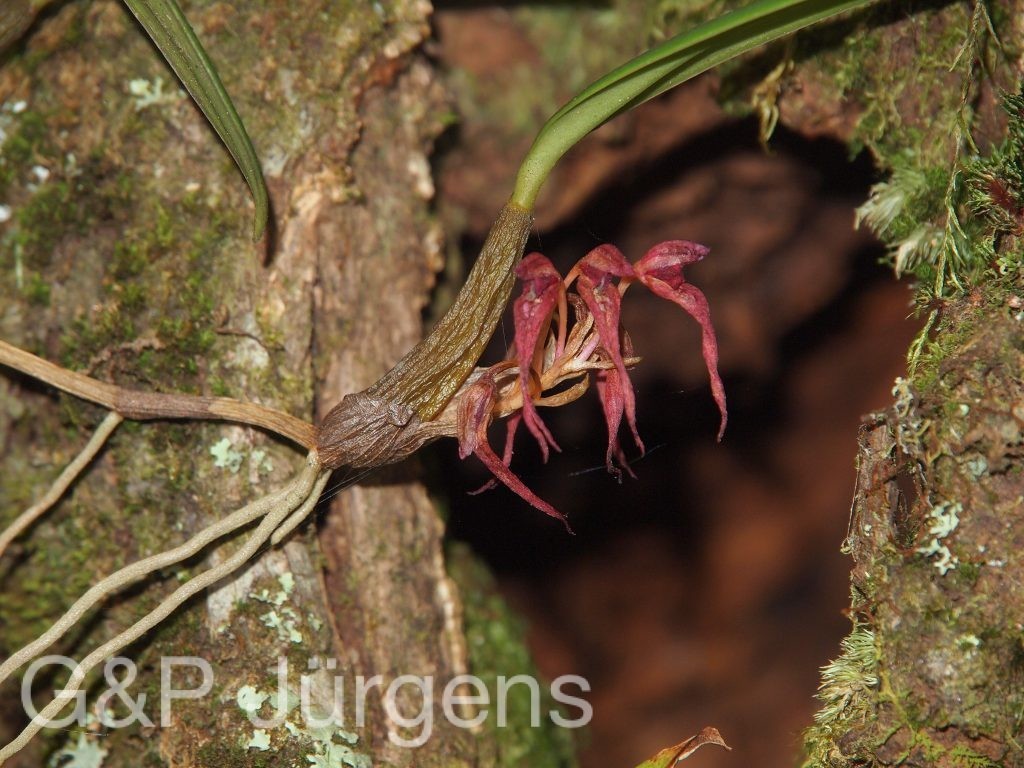
Orchideaceae

Roxb.

Sikkim2004 445 G776
Sikkim/India Tista-Valley 2000m May

Description

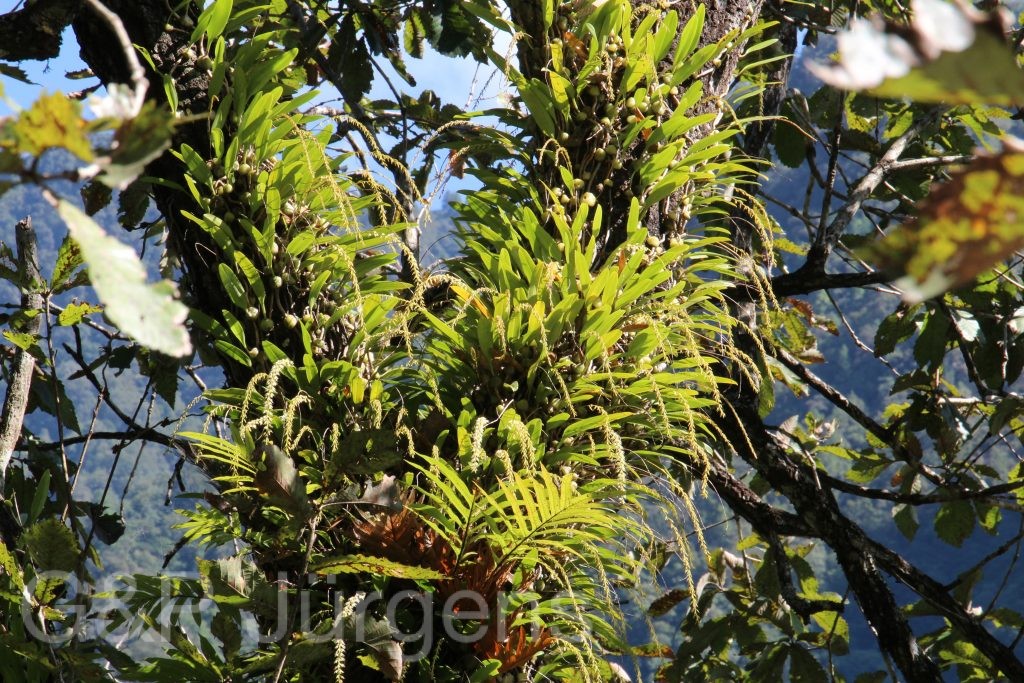
Aerides multiflora is an epiphytic orchid of the subtribe Aeridinae, native to the eastern Himalayas and extending into Southeast Asia. Its natural range encompasses Nepal, northeast India (Sikkim, Assam, Meghalaya, Arunachal Pradesh), Bhutan, Myanmar, Thailand, and southwest China (Yunnan). The species inhabits humid, semi-deciduous and evergreen forests at elevations of 200–2,000 m, typically growing on mossy tree trunks and branches in well-lit positions.

The plant produces stout, terete stems 20–40 cm long, clothed with distichous, coriaceous, strap-shaped leaves that are 15–25 cm long and unequally bilobed at the apex. The inflorescence is a densely many-flowered, pendent raceme 15–30 cm long, bearing 20–40 fragrant flowers. Individual flowers are 2–2.5 cm across, white to pale rose-pink with purple spots, the lip trilobed with a prominent forward-pointing spur. The mid-lobe is fleshy and tongue-shaped. Flowering occurs from April to June.

Aerides multiflora is valued in horticulture for its abundant, sweetly fragrant blooms. The species is under pressure from overcollection and habitat degradation across its range. Like all orchids, it is listed under CITES Appendix II, regulating international trade.

Author: Roxb. · Sources: POWO (Kew), Flora of Bhutan Vol. 3, GBIF, Pearce & Cribb: The Orchids of Bhutan (2002)
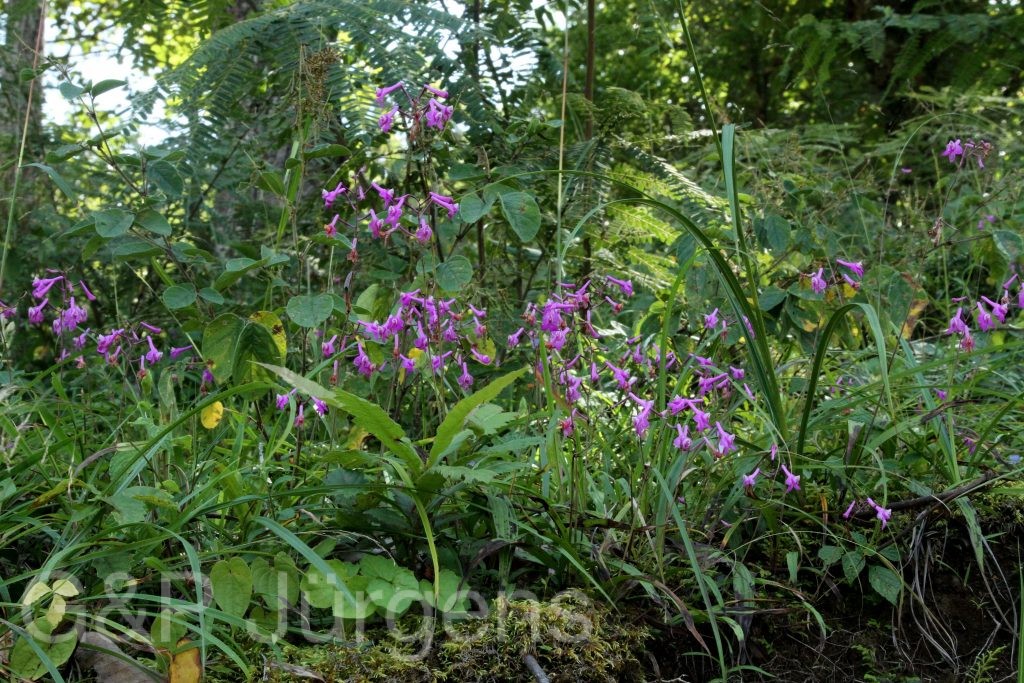
Wall.

Bhutan2012 473
Bhutan Wangdi 2500m, September
Bhutan2012 474
Bhutan Wangdi 2500m, September

Description

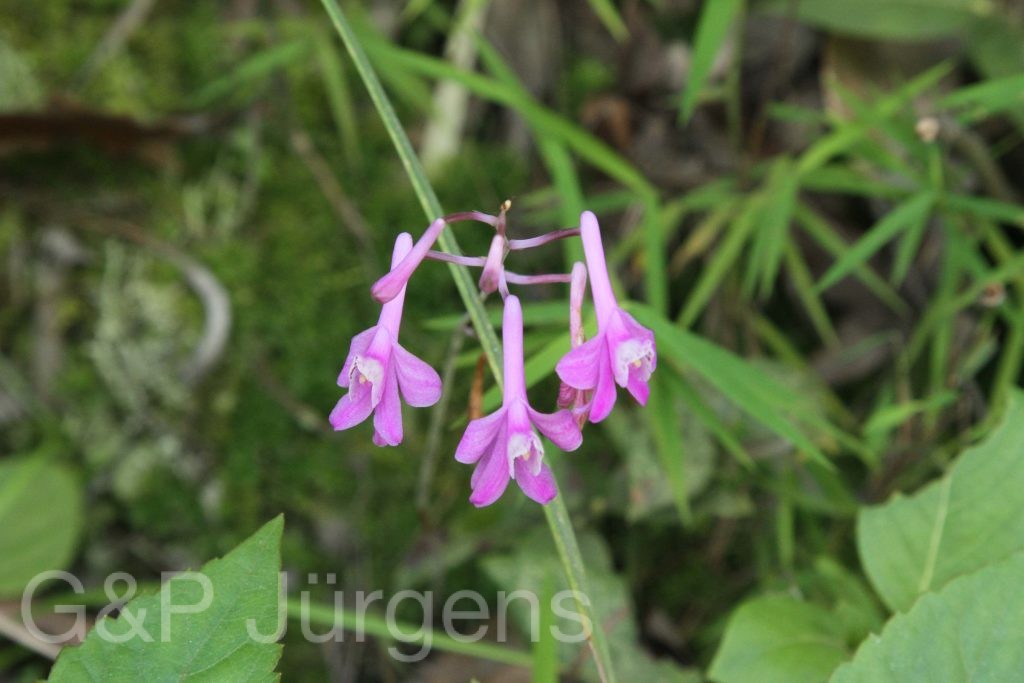
Anthogonium gracile is a terrestrial orchid and the sole species in the monotypic genus Anthogonium. It is distributed from Nepal through northeast India (Sikkim, Darjeeling, Assam, Arunachal Pradesh), Bhutan, and Myanmar into Thailand, Indochina, and southwest China (Yunnan, Guangxi). The species occurs in open, grassy hillsides, pine forests, and degraded forest margins at elevations of 1,000–3,000 m, often in seasonally moist grassland.

The plant produces slender, reed-like stems 30–80 cm tall from underground tubers, with narrow, plicate, grass-like leaves arranged along the upper portion of the stem. The inflorescence is a lax, terminal raceme bearing 5–15 flowers that open successively. Flowers are 3–4 cm across, typically rose-pink to magenta, with a broad, spreading lip that is darker pink with a yellow callus of parallel lamellae. The column is slender and gently curved. Flowering in the Himalayas occurs from August to October.

Anthogonium gracile is taxonomically isolated within the Orchidaceae, though molecular phylogenetic analyses place it close to Calanthe and Phaius. Its preference for open, fire-maintained habitats suggests adaptation to seasonal burning regimes characteristic of Himalayan montane grasslands.

Author: Wall. · Sources: POWO (Kew), Flora of Bhutan Vol. 3, GBIF, Pearce & Cribb: The Orchids of Bhutan (2002)

(D.Don) Hochr.

Bhutan2012 523
Bhutan Wangdi Phodrang 2400m, September
Bhutan2015 247
Bhutan Zhemgang 1000m, October

Description

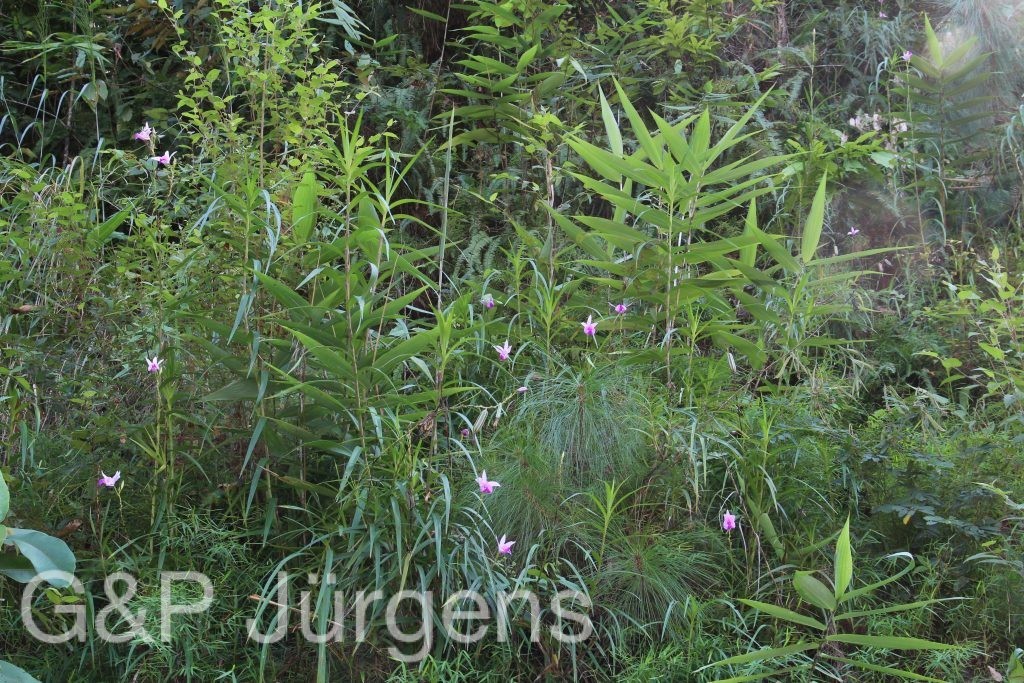
Arundina graminifolia, commonly known as the bamboo orchid, is a robust terrestrial species with a remarkably wide distribution from the Himalayas (Nepal, India, Bhutan) through Southeast Asia to southern China, the Malay Archipelago, and the Pacific Islands. It has become naturalised in parts of tropical America, Hawaii, and the Caribbean. In the Himalayas, it grows on exposed banks, road cuttings, landslide scars, and open grasslands at 200–2,800 m elevation, favoring well-drained, acidic soils with good light exposure.

The plant forms dense clumps of erect, reed-like stems 60–150 cm tall, bearing linear-lanceolate, grass-like leaves 10–20 cm long that are arranged distichously. Flowers are produced terminally, 5–8 cm across, resembling small Cattleya blooms: the sepals and petals are white to pale pink, while the lip is deep rose-purple with a tubular base and a broad, ruffled apical lobe. Flowers open successively over an extended period, with individual blooms lasting only 2–3 days. In the eastern Himalayas, flowering peaks from August to November.

Arundina graminifolia is one of very few orchids that thrives as a pioneer species on disturbed ground. Its wide ecological amplitude and capacity for rapid colonisation are facilitated by its production of numerous wind-dispersed seeds. The species exhibits considerable morphological variation across its vast range, and several subspecific taxa have been proposed.

Author: (D.Don) Hochr. · Sources: POWO (Kew), Flora of Bhutan Vol. 3, GBIF, Seidenfaden: The Orchids of Indochina (1992)

(F.M.Bailey) M.A.Clem. & D.L.Jones

Bh2008 509 G780
Bhutan Chongsakha 2200m, May

Description

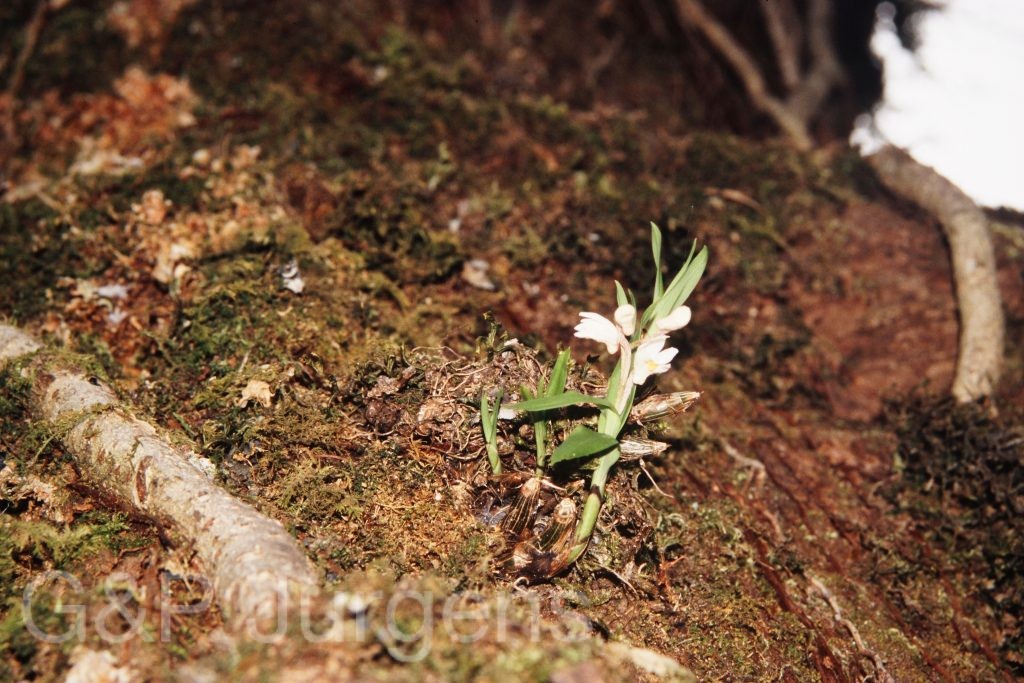
Bryobium eriaeoides is a small epiphytic orchid formerly placed in the genus Eria, transferred to Bryobium by Clements & Jones based on molecular phylogenetic evidence. The genus Bryobium comprises species previously assigned to Eria section Mycaranthes and allied sections. The species has a disjunct distribution spanning the eastern Himalayas (Bhutan, northeast India) to Southeast Asia and Australasia (Papua New Guinea, Queensland), occurring in montane cloud forests at elevations of 400–2,200 m.

The plant forms small, clustered pseudobulbs 1–3 cm tall on a creeping rhizome, each bearing 2–4 narrowly elliptic leaves 3–8 cm long. The inflorescence arises from the base of the pseudobulb, producing a short raceme of small, densely arranged flowers. Individual flowers are 4–6 mm across, white to pale cream, with a densely pubescent ovary and floral bracts. The lip is trilobed, the mid-lobe fleshy with low keels. Flowering in the Himalayas occurs from April to June.

The taxonomy of Bryobium and closely related genera remains in flux, as ongoing molecular studies continue to refine the classification of the large, polyphyletic former genus Eria. Like all orchids, the species is subject to CITES Appendix II trade regulations.

Author: (F.M.Bailey) M.A.Clem. & D.L.Jones · Sources: POWO (Kew), GBIF, Clements & Jones: Nomenclatural changes in the Eriinae (2002), Pearce & Cribb: The Orchids of Bhutan (2002)

Lindl.

Bh09 392 G619
Bhutan Mo-Chu, 1500m June

Description

Bulbophyllum affine is an epiphytic orchid widely distributed across East and Southeast Asia, from Nepal and northeast India (Sikkim, Assam) through Bhutan, Myanmar, and southern China to Taiwan, Vietnam, and Thailand. It inhabits humid broadleaved and mixed forests at 500–2,500 m elevation, growing on mossy trunks and branches, occasionally on rocks (lithophytic).

The plant produces ovoid to conical pseudobulbs 2–4 cm tall, set 3–8 cm apart on a stout, creeping rhizome. Each pseudobulb bears a single, leathery, elliptic to oblong leaf 8–15 cm long. The inflorescence is a nodding, densely many-flowered raceme 5–15 cm long, emerging from the base of the pseudobulb. The flowers are small, 5–8 mm across, yellowish-green to pale brown, densely arranged in a cylindrical spike. Sepals are lanceolate and acuminate; the lip is small, fleshy, and recurved, mobile on a thin strap connecting it to the column foot — a characteristic feature of Bulbophyllum enabling pollination by small flies.

Bulbophyllum is the largest genus in the Orchidaceae, comprising over 2,200 described species. B. affine belongs to section Cirrhopetalum and is distinguished from similar congeners by its densely flowered, cylindrical raceme and the prominent column stelidia.

Author: Lindl. · Sources: POWO (Kew), Flora of Bhutan Vol. 3, GBIF, Seidenfaden: Orchid Genera in Thailand XIV: Bulbophyllum (1979)

Rchb.f.

Bhutan2012 444
Bhutan Wangdi 2500m, September
Bhutan2012 1171 Kopie
Bhutan Tashiyangtse 2000m, October

Description

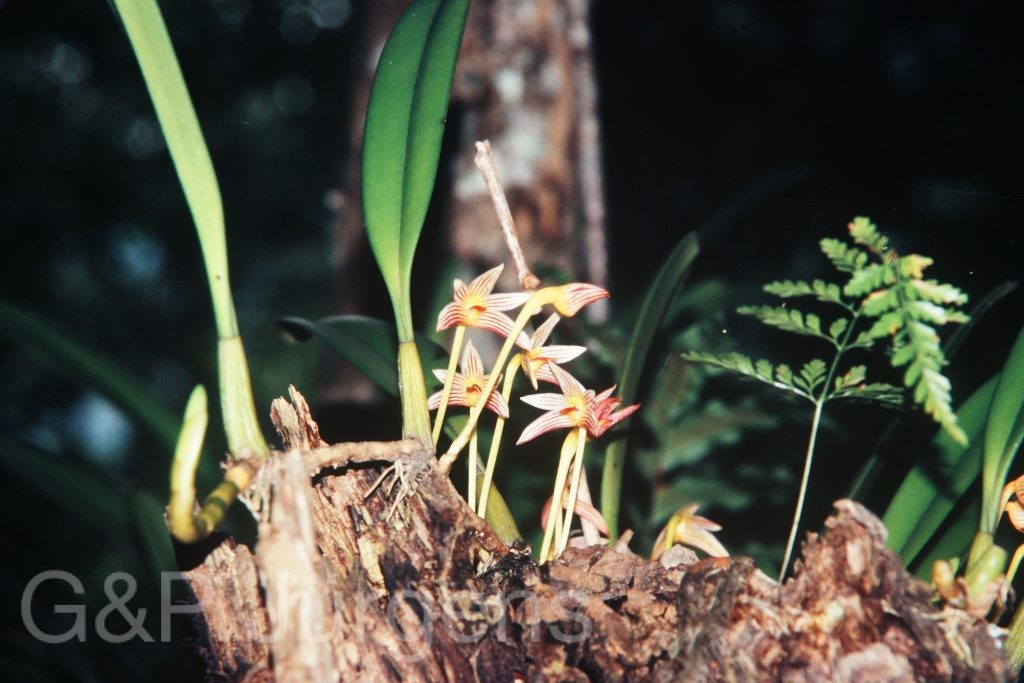
Bulbophyllum griffithii is an epiphytic orchid distributed from the eastern Himalayas (Nepal, northeast India, Bhutan) through southwest China (Yunnan) to Taiwan. The species is named after William Griffith (1810–1845), the pioneering British botanist who collected extensively in Bhutan and northeast India. It occurs in cool, humid montane forests at elevations of 1,500–2,800 m, favouring mossy tree trunks in the cloud forest zone.

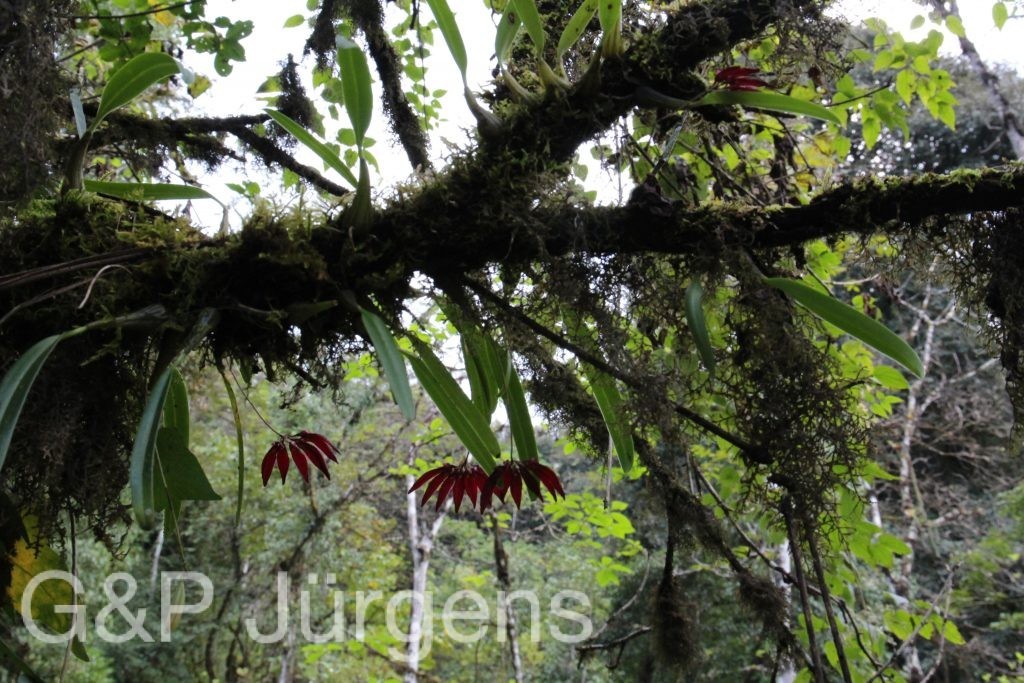
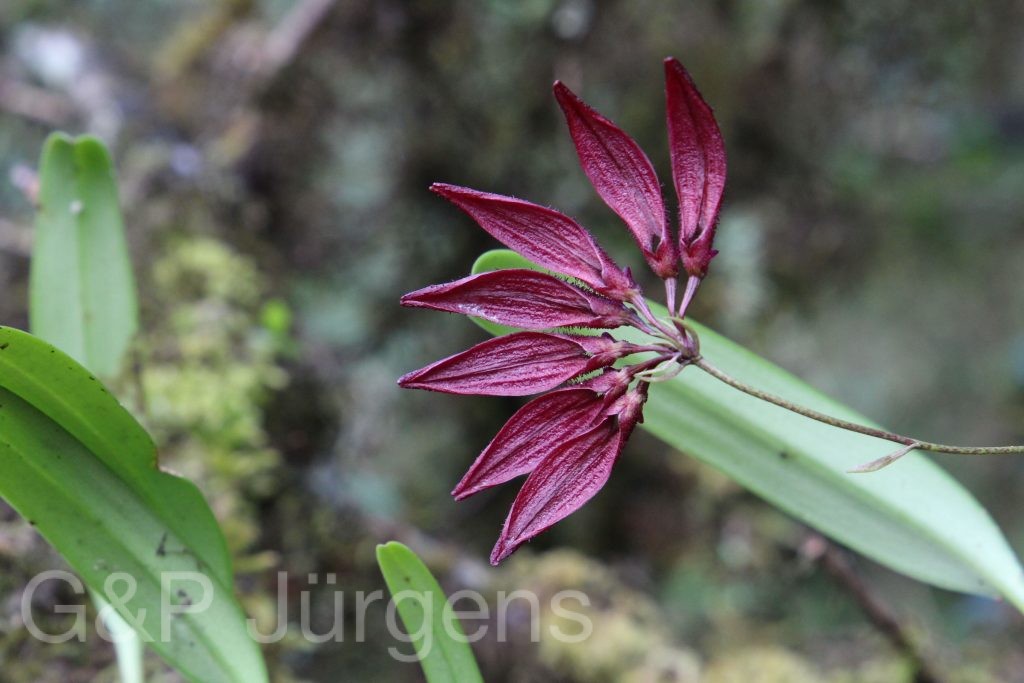
The pseudobulbs are ovoid to subglobose, 1.5–3 cm tall, widely spaced on a stout rhizome. Each bears a single, coriaceous, oblong-elliptic leaf 8–15 cm long. The inflorescence is an umbel-like, subglobose cluster of 5–12 flowers, carried on a slender peduncle 10–20 cm tall — a floral arrangement typical of section Cirrhopetalum. The flowers are about 2 cm across, pale yellow to greenish with purple-red stripes and spots. The dorsal sepal is erect, the lateral sepals elongated and twisted, and the lip is small, curved, and dark purple. Flowering occurs from August to October.

Within the complex taxonomy of Bulbophyllum section Cirrhopetalum, B. griffithii is recognised by its umbellate inflorescence with relatively few, medium-sized flowers and its distinctive striped pattern. GBIF records confirm a limited distribution centred on the eastern Himalayas and East Asia.

Author: Rchb.f. · Sources: POWO (Kew), Flora of Bhutan Vol. 3, GBIF, Pearce & Cribb: The Orchids of Bhutan (2002)
Lindl.

Bhutan2015 573
Bhutan Mo-Chu 1550m, October
Bhutan2015 574
Bhutan Mo-Chu 1550m, October

Description

Bulbophyllum hirtum is an epiphytic orchid distributed across the eastern Himalayas and Southeast Asia, from Nepal and northeast India through Bhutan, Myanmar, southwest China, Thailand, and Vietnam. It grows in warm to temperate broadleaved forests at 500–2,000 m elevation, on moss-covered tree trunks and larger branches, occasionally on rocks near streams.

The plant has ovoid, somewhat compressed pseudobulbs 1.5–2.5 cm tall, spaced 2–5 cm apart on a creeping rhizome. Each pseudobulb bears a single, elliptic-oblong, coriaceous leaf 6–12 cm long. The inflorescence is a lax raceme 5–15 cm long, carrying 5–15 flowers. The specific epithet 'hirtum' (meaning hairy) refers to the distinctive pubescence on the floral parts: the flowers are small, 6–10 mm across, yellowish to brownish-green with conspicuous fine hairs on the sepals and petals. The lip is fleshy, recurved, and densely papillose, dark purple, hinged to the column foot. Flowering occurs from September to November.

Bulbophyllum hirtum is classified within Bulbophyllum section Brachystachya. The pubescent flower surfaces are thought to play a role in pollinator attraction by enhancing both visual texture and scent dispersal, as the genus is predominantly pollinated by small flies (Diptera).

Author: Lindl. · Sources: POWO (Kew), Flora of Bhutan Vol. 3, GBIF, Vermeulen: Orchid Monographs 7: Bulbophyllum (1993)

Rchb.f.

Bhutan2015 44
Bhutan Wangdi Phodrang 2000m, October
Bhutan2015 53
Bhutan Wangdi Phodrang 2000m, October

Description

Bulbophyllum retusiusculum is a widespread epiphytic orchid ranging from the eastern Himalayas (Nepal, northeast India, Bhutan) through Myanmar, southern China, Taiwan, Vietnam, and Thailand. GBIF records document over 550 occurrences across this range. The species inhabits broadleaved and mixed forests at 800–2,500 m elevation, growing on tree trunks and branches in moderately humid conditions.

The pseudobulbs are narrowly ovoid to cylindrical, 1–2 cm tall, clustered on a short rhizome. Each bears a single, oblong-elliptic, leathery leaf 4–10 cm long with a slightly retuse (shallowly notched) apex — the feature reflected in the specific epithet 'retusiusculum'. The inflorescence is an erect to arching, densely many-flowered raceme 5–15 cm long. The flowers are minute, 3–4 mm across, arranged in a dense, cylindrical spike, typically pale yellowish-green to cream. The dorsal sepal is concave, the lateral sepals spreading, and the lip is small, fleshy, and recurved. Flowering occurs from September to November.

B. retusiusculum belongs to Bulbophyllum section Brachystachya, characterised by densely flowered, spike-like racemes. The species shows moderate morphological variation across its extensive range, particularly in flower colour and pseudobulb spacing.

Author: Rchb.f. · Sources: POWO (Kew), Flora of China Vol. 25, GBIF, Pearce & Cribb: The Orchids of Bhutan (2002)

Rchb.f.

Bhutan2012 1351
Bhutan Yankel 400m, October

Description

Bulbophyllum striatum is an epiphytic orchid confined to the eastern Himalayas and adjacent regions, with documented occurrences in northeast India (Sikkim, Assam, Meghalaya), Bhutan, Nepal, Bangladesh, and southwest China (Yunnan). It inhabits warm, humid subtropical and tropical forests at low to moderate elevations of 200–1,500 m — among the lower-altitude Bulbophyllum species in the Himalayan flora.

The pseudobulbs are ovoid, 2–3 cm tall, set at intervals on a stout, creeping rhizome. Each bears a single, oblong-lanceolate, coriaceous leaf 10–18 cm long. The inflorescence is an arching to pendent, laxly few-flowered raceme, 8–15 cm long, producing 3–8 flowers. The specific epithet 'striatum' (striped) refers to the conspicuous reddish-brown longitudinal striations on the sepals: flowers are 1.5–2 cm across, yellowish-green with prominent dark reddish-brown veining. The lip is dark purple, fleshy, curved, and mobile on the column foot. Flowering occurs from September to November.

The relatively low-altitude habitat of B. striatum at Yankel (400 m) in southern Bhutan reflects the warm, subtropical character of the Mo-Chu and lower Punatsangchu valleys, which harbour a distinct orchid flora adapted to high humidity and temperatures atypical for most of Bhutan.

Author: Rchb.f. · Sources: POWO (Kew), Flora of Bhutan Vol. 3, GBIF, Pearce & Cribb: The Orchids of Bhutan (2002)
J.J.Sm.

Bhutan2012 1178
Bhutan Tashiyangtse 2000m, October
Bhutan2012 1180
Bhutan Tashiyangtse 2000m, October
Bhutan2012 1181
Bhutan Tashiyangtse 2000m, October

Description

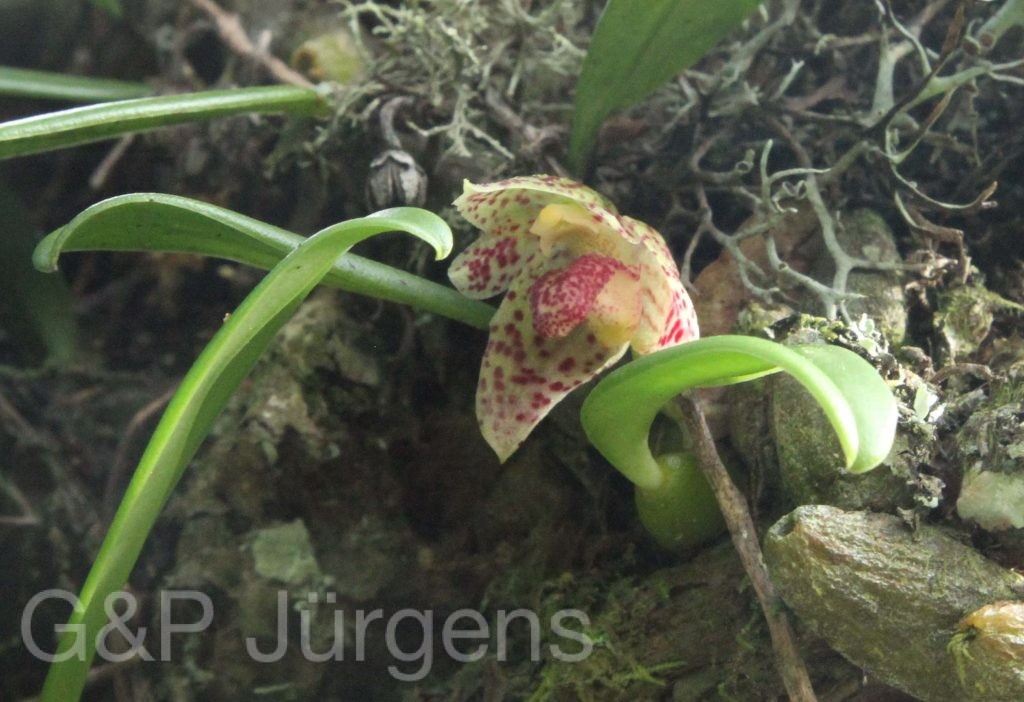
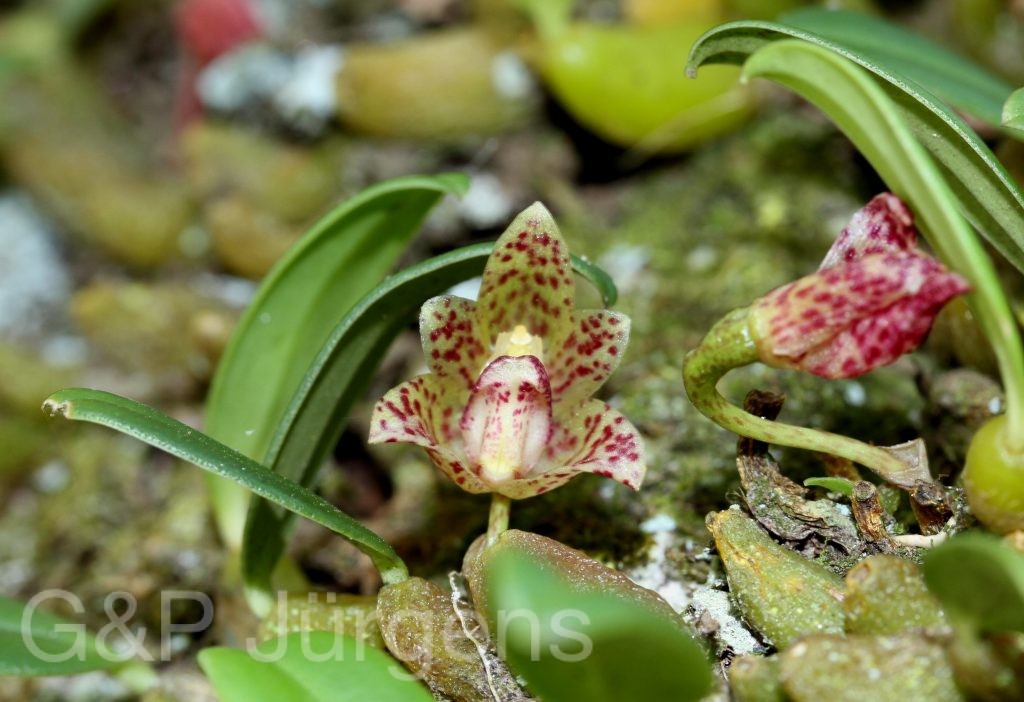
Bulbophyllum yoksunense is a rare epiphytic orchid with a restricted distribution in the eastern Himalayas. The species is named after Yuksom (also spelled Yoksum or Yoksun) in western Sikkim, India, where the type specimen was collected. Its known range includes Sikkim, Bhutan, eastern Nepal, and northern Myanmar. With only 17 documented occurrences in GBIF, it is among the less frequently recorded Bulbophyllum species in the region. It grows on mossy tree trunks in temperate broadleaved forests at 1,500–2,500 m elevation.

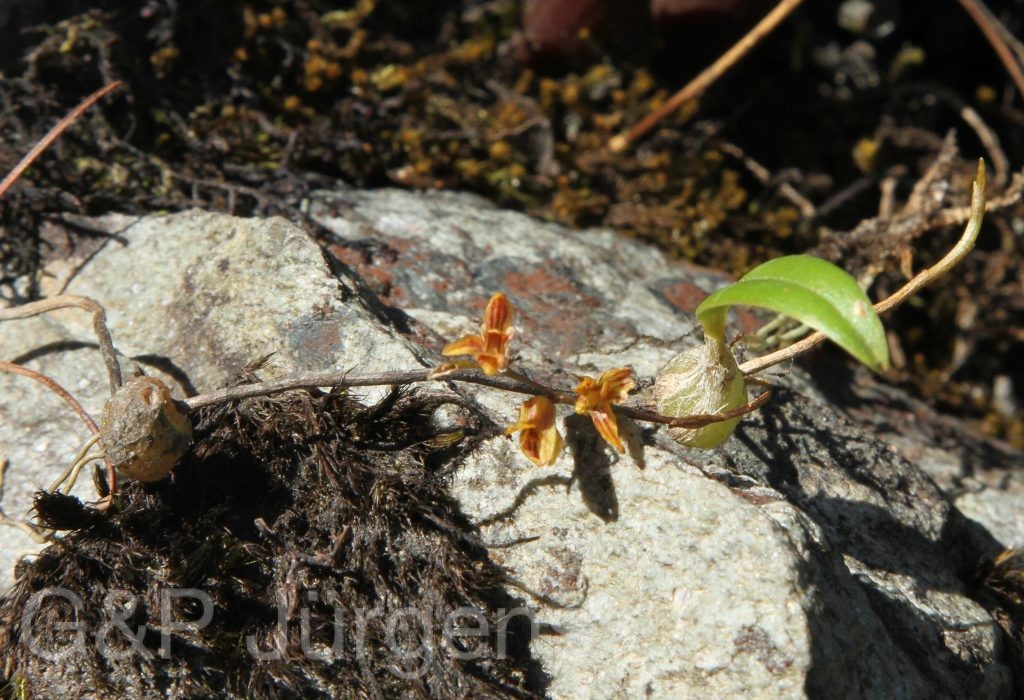
The pseudobulbs are ovoid, 1–2 cm tall, closely set on a creeping rhizome. Each bears a single, elliptic, coriaceous leaf 5–10 cm long. The inflorescence is a short, few-flowered raceme. Flowers are small, about 8–12 mm across, with distinctive coloration: the sepals are pale greenish-yellow with fine purple veining, and the lip is dark purple, fleshy, and slightly recurved. The lateral sepals are slightly longer than the dorsal sepal. Flowering in Bhutan occurs in October.

B. yoksunense is poorly known in cultivation and in the wild. Its apparent rarity may partly reflect under-collection in the remote eastern Himalayan forests of Bhutan and Sikkim. Further field survey is needed to clarify its true distribution and conservation status.

Author: J.J.Sm. · Sources: POWO (Kew), GBIF, Pearce & Cribb: The Orchids of Bhutan (2002), J.J. Smith: Orchidaceae Novae (1910)