Urticaceae

D.Don

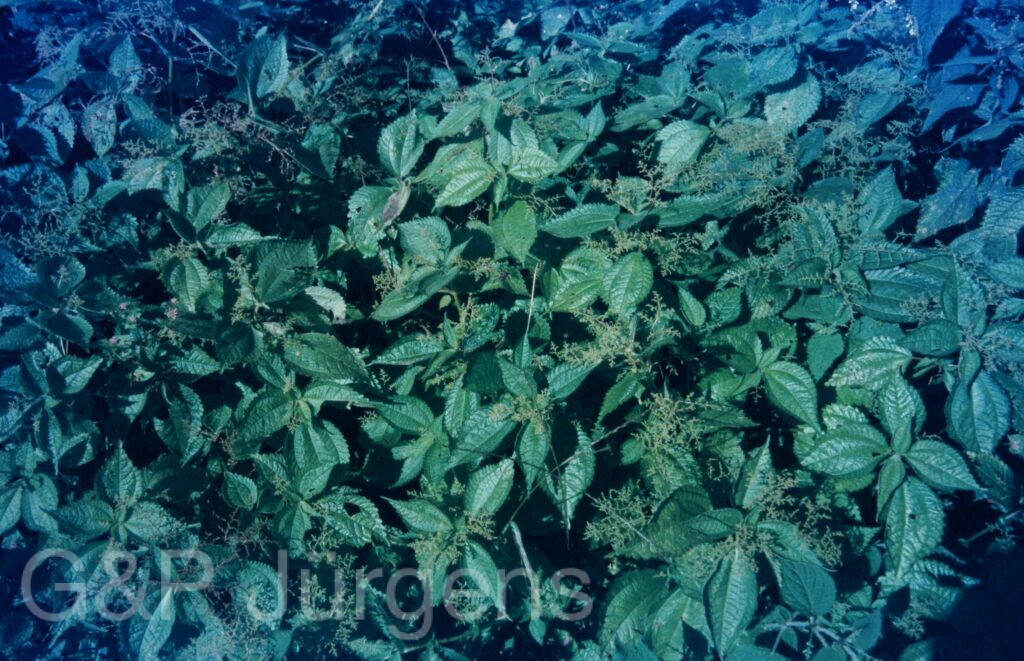
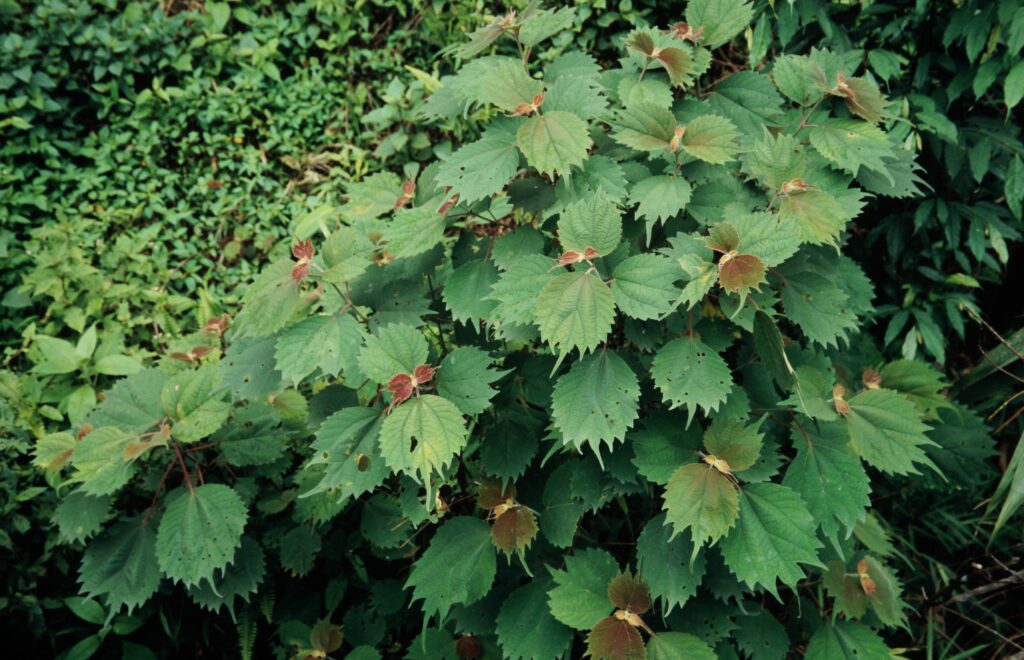
Sikkim 2006 258 ergebnis
India West-Bengal, Lingza 1300m, May

Description

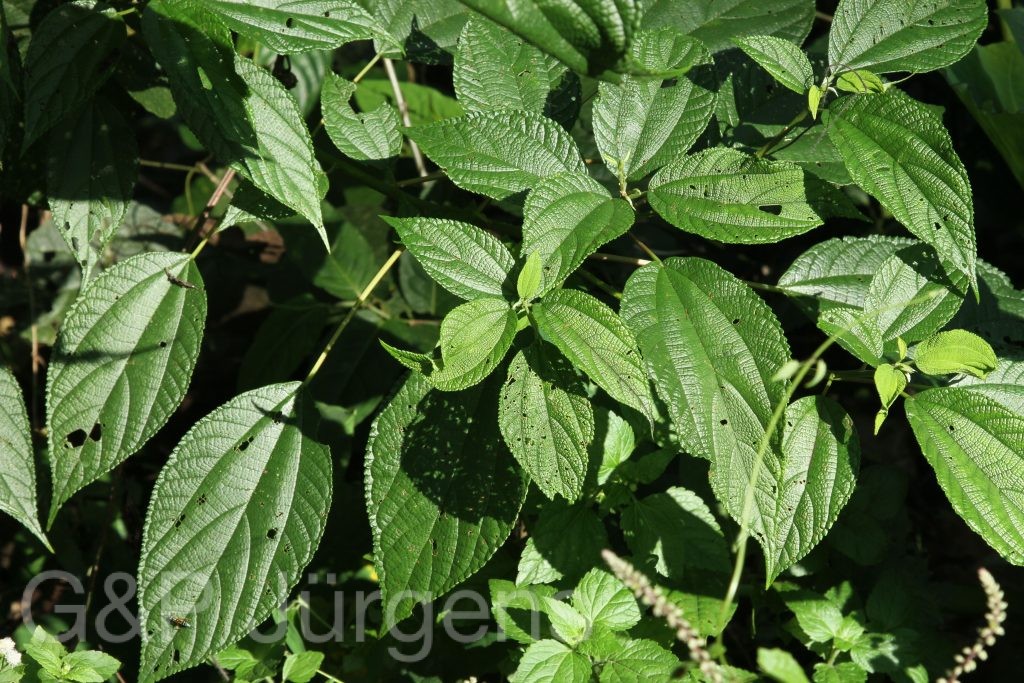
Boehmeria ternifolia is a shrubby member of the nettle family ranging through the eastern Himalaya and adjacent regions, recorded from Nepal, India and Bhutan, with GBIF documenting nearly two hundred occurrences across these countries; scattered records from France and the United States represent herbarium and cultivated holdings rather than wild populations. It is a plant of warm-temperate to subtropical broadleaved forest, favouring shaded ravines, streamsides, moist forest margins and roadside banks, typically between roughly 1000 and 2200 m. The specimen illustrated from Lingza in the Darjeeling district of West Bengal at about 1300 m, in May, is representative of these humid mid-elevation forests of the Sikkim-Darjeeling Himalaya, where high rainfall and deep shade favour the soft-leaved, non-stinging habit of the genus.

The plant is an erect shrub or subshrub with woody lower stems and herbaceous, often four-angled younger branches that lack stinging hairs. The leaves are characteristically arranged in whorls of three (occasionally opposite), the basis of the epithet ternifolia; they are ovate to lanceolate, with a long-acuminate apex, serrate margins and a three-veined base, the lamina thin and somewhat rough above. Stipules are present and soon falling. The minute unisexual flowers are borne in slender, interrupted axillary spikes or glomerules, the staminate flowers with a four-lobed perianth and four stamens, the pistillate flowers tubular and enclosing a single ovary with a filiform stigma. The fruit is a small achene tightly invested by the persistent perianth.

Boehmeria is a pantropical and warm-temperate genus best known for ramie (B. nivea), an important bast-fibre crop, and several Himalayan species likewise yield serviceable cordage fibres from their stems. The whorled, ternate leaf arrangement of B. ternifolia is a useful diagnostic character separating it from the many opposite-leaved congeners of the region. As a common, ecologically tolerant forest-edge shrub with a wide elevational and geographic span, it is of no conservation concern, and its abundance along disturbed margins suggests considerable resilience to moderate human impact within the eastern Himalayan forest belt.

Author: D.Don · Sources: POWO (Kew), GBIF, Flora of China Vol. 5, Flora of Bhutan Vol. 1 Part 2, Flora of Nepal, A Revision of Boehmeria (Urticaceae) (W.T. Wang and C.J. Chen)
(Hornem.) Friis & Wilmot-Dear

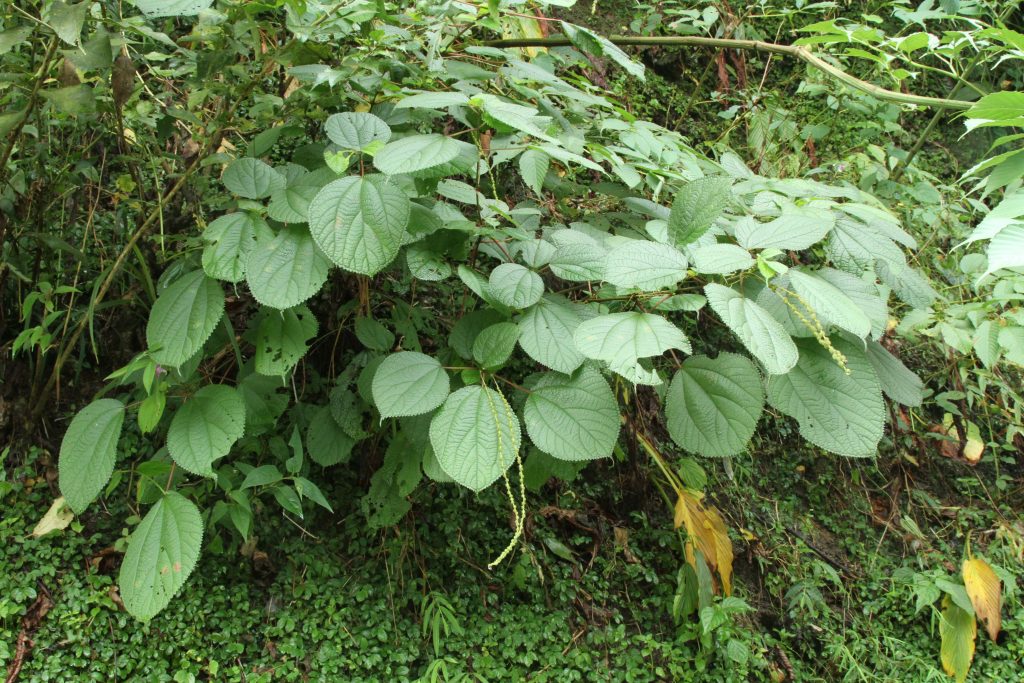
Bhutan2012 730
Bhutan Galephu 500m, October

Description

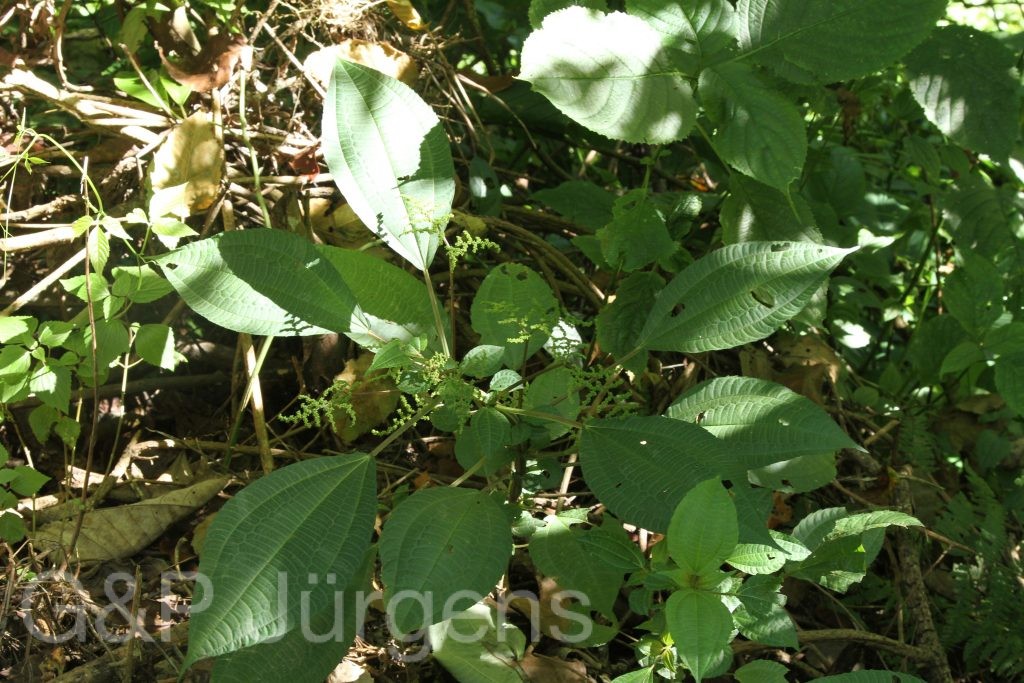
Boehmeria virgata subsp. macrophylla (Hornem.) Friis & Wilmot-Dear is a widespread paleotropical shrub of the nettle family, recorded by GBIF in over 2500 occurrences across an extraordinarily broad range that includes India (IN), Nepal (NP), China (CN), Thailand (TH) and Indonesia (ID), as well as much of tropical Africa (Tanzania, Cameroon, Gabon, Uganda, Angola), the Indian Ocean islands (Madagascar, Réunion, Mauritius, Comoros) and Australia (AU). It occupies forest margins, streambanks, clearings and disturbed secondary vegetation at low to mid elevations, and was photographed at Galephu in southern Bhutan at 500 m in October, in the warm subtropical foothills.

The plant is a shrub or coarse perennial herb with terete, often pubescent stems. The leaves are large, alternate or subopposite, broadly ovate to elliptic with a serrate margin, acuminate apex and three prominent basal veins, the lower surface frequently pale and softly hairy. As in all Boehmeria, the foliage lacks the stinging hairs found elsewhere in Urticaceae. The plant is monoecious, with minute unisexual flowers crowded into globose clusters arranged along slender, often elongate, interrupted spike-like inflorescences; female flowers have a tubular perianth enclosing a single ovule. The fruit is a small achene enclosed in the persistent, sometimes winged perianth.

This taxon belongs to a polymorphic complex that has been treated under various names including Boehmeria macrophylla, and the subspecific rank reflects Friis and Wilmot-Dear's revision integrating the Asian and African material. Wind pollination and the dust-like achenes account for its vast distribution. Stem fibres of Boehmeria species, notably ramie, are economically important, and the plant readily colonises disturbed ground, making it a frequent component of regenerating tropical and subtropical forest.

Author: (Hornem.) Friis & Wilmot-Dear · Sources: POWO (Kew), GBIF, Flora of Bhutan, Flora of China, Urticaceae revision (Friis & Wilmot-Dear)

(Siebold & Zucc.) Wedd

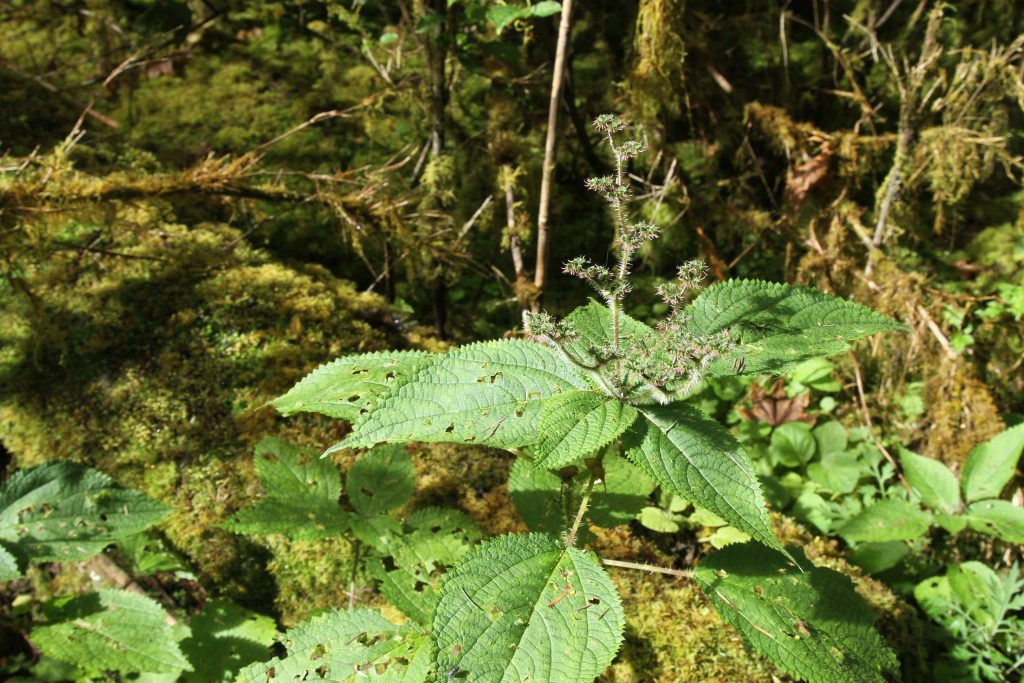
Bhutan2012 855
Bhutan Nangsephal 2800m, October

Description

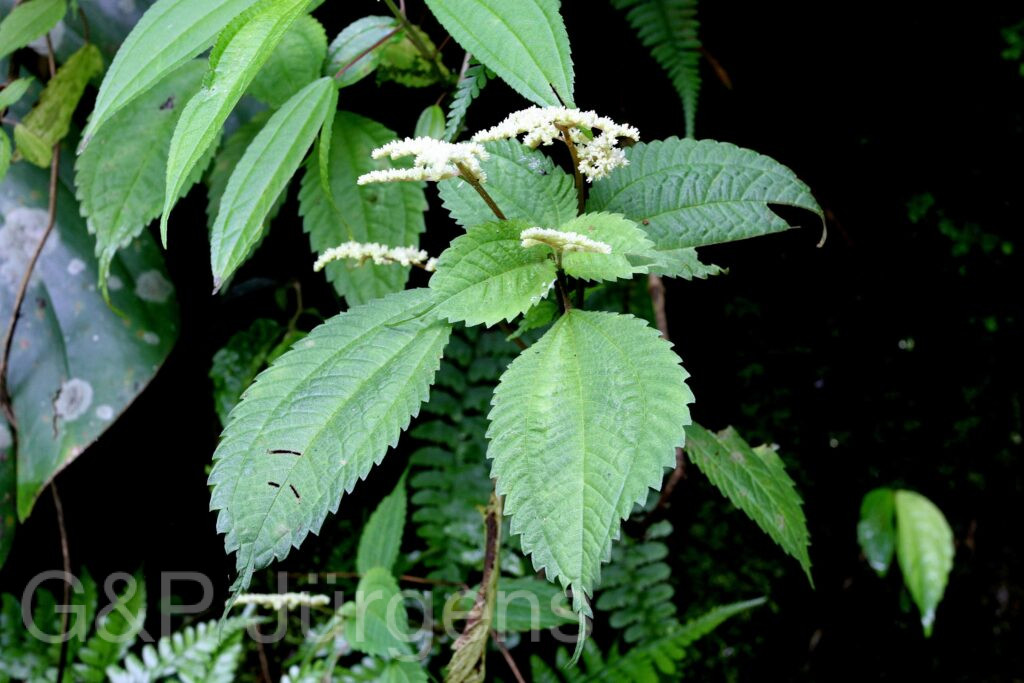
Laportea bulbifera is a widespread perennial nettle ranging across East and South Asia, with GBIF documenting more than 4500 occurrences from Japan, China, Korea, the Russian Far East, the Himalaya, Taiwan and into Southeast Asia and Sri Lanka. It colonises moist forest margins, ravines, streamsides and shaded clearings, often forming patches on humus-rich soils in temperate and subtropical woodland. The photographed population grows in Bhutan at Nangsephal around 2800 m, still in flower or fruit in October; the species occurs broadly from the lowlands to roughly 3000 m, thriving where moisture and partial shade coincide.

The plant produces erect, often unbranched stems from a creeping rootstock, the herbage armed with stinging hairs delivering an irritant on contact. Distinctive bulbils (gemmae) form in the upper leaf axils, giving the epithet bulbifera and providing a means of vegetative propagation. The leaves are alternate, ovate to elliptic, acuminate, serrate-margined and three-nerved from the base, on slender petioles. Small unisexual flowers are borne in axillary, paniculate cymes, the female inflorescences asymmetric with the achene set obliquely on an enlarged pedicel; the dry, flattened achene is the fruit.

Laportea belongs to the Urticeae, the tribe of true stinging nettles, and L. bulbifera is among its most morphologically variable and geographically far-flung members, prompting recognition of several infraspecific forms across its enormous range. The axillary bulbils represent an effective clonal strategy in disturbed, shaded habitats. The species is abundant and of least concern; in parts of its range young shoots are gathered as a cooked vegetable and the fibrous stems occasionally used locally.

Author: (Siebold & Zucc.) Wedd · Sources: POWO (Kew), GBIF, Flora of China, Flora of Bhutan, Urticaceae monograph (Friis / Chen)

(Royle) Wedd.

Bhutan2015 105
Bhutan Galephug 600m, October

Description

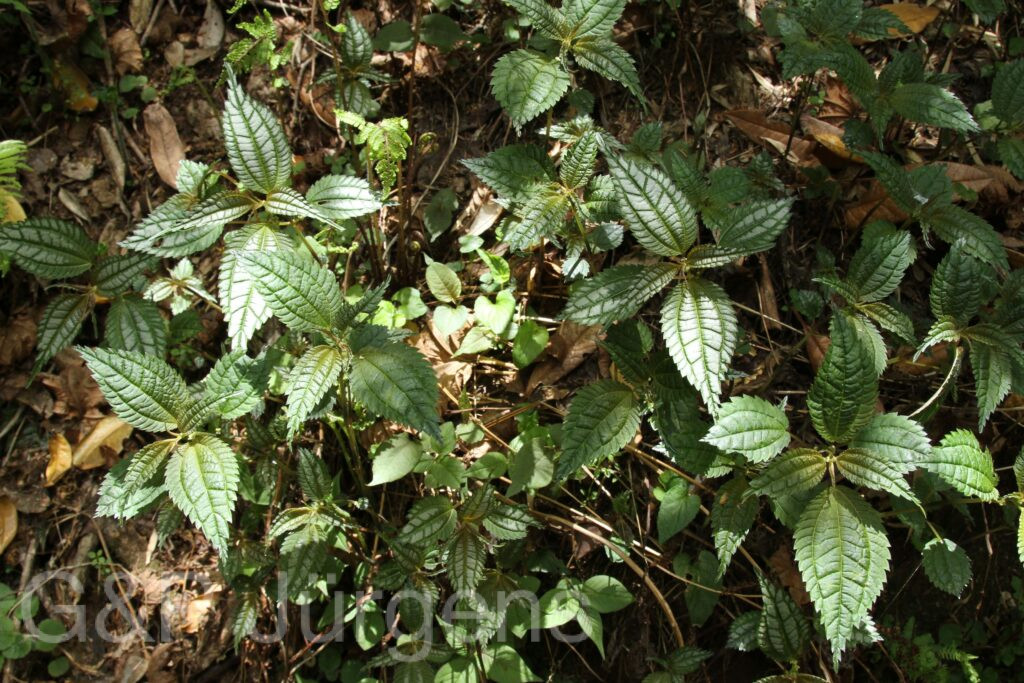
Lecanthus peduncularis is a widespread herb of tropical and subtropical Asia and beyond, ranging from the Himalaya (Nepal, India, Bhutan, Pakistan) through China, Taiwan, Japan and South-East Asia to Indonesia, the Philippines, Papua New Guinea and parts of Africa (Cameroon, Equatorial Guinea, Ethiopia); its very numerous GBIF records (over 2150) reflect this broad distribution. It grows in moist, shady places in evergreen and mixed forest, on damp banks, by streams, on dripping rocks and at forest margins, from the lowlands up to mid-montane elevations of around 2500 m. The photographed plant from Galephug in southern Bhutan at 600 m in October is typical of its warm, humid foothill habitat.

It is a soft, succulent perennial or annual herb with weak, ascending to creeping stems, glabrous to sparsely hairy and rooting at the lower nodes. The opposite leaves are ovate to elliptic, membranous, with a serrate to crenate-dentate margin, an acuminate apex and conspicuous cystoliths, borne on slender petioles. The minute, unisexual flowers are crowded in flat, disc-like receptacular heads subtended by an involucre and carried on long, slender axillary peduncles, the long peduncle giving the species its epithet. The fruit is a small, compressed, ovoid achene.

The small genus Lecanthus belongs to the Urticaceae and is allied to Pilea and Elatostema, distinguished by its long-stalked, involucrate flower-heads. As a shade- and moisture-loving understorey herb of wide ecological tolerance, L. peduncularis is common and not of conservation concern; it has minor local use as a potherb and in traditional remedies across its Asian range.

Author: (Royle) Wedd. · Sources: POWO (Kew), GBIF, Flora of China, Flora of Bhutan, Annotated Checklist of the Flowering Plants of Nepal, Urticaceae revision (Friis & Wilmot-Dear)

Wedd.

Bhutan2015 180
Bhutan Zhemgang 1000m, October

Description

Pilea anisophylla is a perennial herb of the family Urticaceae, widely distributed through the Himalaya and Indo-Malayan region. GBIF records place it in China, Nepal, India, Bhutan, Bangladesh, Myanmar, Thailand and Indonesia, indicating a broad subtropical to warm-temperate range. It is a plant of moist, shaded habitats, growing on damp rocks, mossy boulders, stream banks, forest floors and shaded walls in evergreen and semi-evergreen broad-leaved forest, generally from low elevations up to about 2,500 m. The specimen illustrated from Zhemgang in central Bhutan at roughly 1,000 m in October typifies the humid mid-montane forest where the genus flourishes.

The plant is a soft, fleshy, often somewhat succulent herb with terete, frequently translucent stems that may root at the lower nodes. As the epithet indicates, the paired leaves of each node are strongly anisophyllous, one of the pair being markedly larger than the other; the blades are ovate to elliptic, with a toothed or crenate-serrate margin, three-veined from the base, and dotted with the linear cystoliths characteristic of the family. Stipules are present at the nodes. The flowers are minute, greenish and unisexual, borne in small axillary cymose clusters; like other Urticaceae the staminate flowers have explosively dehiscent stamens that scatter pollen, and the inconspicuous pistillate flowers develop into small, compressed achenes.

Pilea is the largest genus of the nettle family and is taxonomically difficult, with many species separated on subtle vegetative and achene characters; the conspicuous leaf inequality of P. anisophylla is a useful field character. Lacking stinging hairs, the plant is harmless to handle, and as a shade- and moisture-loving understorey herb it is a minor but consistent component of Himalayan forest ground flora. It is not regarded as threatened, its wide range and tolerance of disturbed shaded sites buffering it against habitat change.

Author: Wedd. · Sources: POWO (Kew), GBIF, Flora of China Vol. 5, Flora of Bhutan Vol. 1, Flora of Nepal, Friis: Urticaceae of the Himalaya

Wedd.

Sikkim2011 6
Bhutan Tista-valley 1900m, October

Description

Pilea insolens is a Sino-Himalayan herbaceous species distributed from central Nepal through Sikkim, Bhutan, and northeast India (Darjeeling, Arunachal Pradesh) to Bangladesh, Myanmar, southern China, Japan, and Indonesia. GBIF records 94 occurrences across this range. The species inhabits damp, shaded habitats in subtropical and warm-temperate forests at elevations of 800–2,400 m, where it colonises moist rocks, stream banks, tree bases, and old walls in areas of high humidity. It is most abundant in the eastern Himalayan valleys that receive heavy monsoon precipitation.
Pilea insolens is a succulent, erect to ascending, monoecious perennial herb, 15–40 cm tall. Stems are fleshy, translucent, glabrous, and often reddish-brown at the base. Leaves are opposite, markedly anisophyllous — a characteristic feature, with the larger leaf of each pair broadly ovate to suborbicular, 3–8 cm long, and the smaller leaf often reduced to a stipule-like scale or small blade less than 1 cm. The larger leaf surface is dark green, often with a cystolith-dotted texture visible as pale streaks, with crenate to serrate margins and three prominent basal veins. Stipules are small, membranous, and soon deciduous. Male and female flowers are borne in separate axillary cymes on the same plant; the male flowers are minute with four perianth segments, while the female flowers are even smaller, with an achene enclosed by persistent perianth lobes.
The photographed specimen from the Tista valley in Bhutan at 1,900 m in October represents a typical occurrence in the humid, deeply incised river valleys of the eastern Himalayas. Pilea insolens is distinguished from other Himalayan congeners by its pronounced leaf anisophylly combined with the broadly ovate, crenate larger leaf. The genus Pilea is enormous, with over 700 species globally, and the eastern Himalayan region is a centre of diversity with numerous narrowly distributed endemics. The species' extension from the Himalayas into Japan and Indonesia reflects a shared subtropical element across the monsoon-influenced forests of East and Southeast Asia. Its reliance on humid, undisturbed forest microsites makes it sensitive to deforestation and stream-channel modification.

Author: Wedd. · Sources: POWO (Kew), GBIF, Flora of China Vol. 5, Flora of Bhutan Vol. 1, Grierson & Long (1983), Chen (1982) — Revision of Chinese Pilea

Wedd.

Bhutan2014 833
Bhutan Thimphu 2450m, May

Description

Pilea symmeria is a herbaceous member of the nettle family with a broad Asian range, GBIF documenting it from China, Nepal, Bhutan, NE India, Thailand, Indonesia and Japan across some 217 records. It is a plant of shaded, humid habitats, growing on moist rock faces, stream banks, ravines and the floor of broadleaved evergreen forest. The photographed plant from Thimphu in Bhutan at 2,450 m (May) is representative of its mid-montane occurrence, where it favours cool, sheltered and consistently damp microsites typical of the genus.

It is a soft, glabrous perennial or annual herb with succulent, often translucent stems frequently rooting at the lower nodes. The leaves are opposite, equal or somewhat unequal in a pair, ovate to elliptic, with a toothed or crenate margin and conspicuous linear cystoliths visible on the surface, the venation triplinerved at the base as is characteristic of Pilea. The plants are typically monoecious, the minute unisexual flowers borne in small axillary cymes; the male flowers have a 4-merous perianth and explosively dehiscent stamens, while the female flowers produce a small, compressed achene.

The family is here correctly Urticaceae. Pilea is the largest genus of the nettle family and a notoriously difficult one, the species separated on subtle differences in leaf shape, stipules, cystolith pattern and inflorescence. The explosive release of pollen by the recoiling stamens is a hallmark dispersal mechanism of the family. As a widespread, shade-adapted forest herb of no particular rarity, P. symmeria is not regarded as threatened, though it is sensitive to disturbance of the humid forest understorey it requires.

Author: Wedd. · Sources: POWO (Kew), Flora of Bhutan Vol. 1, GBIF, Flora of China Vol. 5, Friis: Urticaceae (in Families and Genera of Vascular Plants)

Wedd. ex. Blume

Garw 2005 220 ergebnis ergebnis
India Garhwal Simkarok 2700m, September

Description

Pilea umbrosa is a shade-loving herb of moist montane forests across the Himalaya and into south-east Asia, recorded from Nepal, India, China, Pakistan, Bhutan and Vietnam. The roughly 307 georeferenced collections trace the temperate forest belt from the western Himalaya eastward. As its epithet (umbrosa, "of shady places") implies, it occupies damp, humus-rich, deeply shaded sites: forest floors, rock crevices, mossy banks and the margins of streams beneath broadleaved and mixed canopy. The photographed material from Garhwal at Simkarok at 2700 m in September is characteristic of its upper-temperate habitat and its late-monsoon fruiting period.

It is a succulent, often fleshy perennial herb with semi-translucent, somewhat brittle stems that may root at the lower nodes. The opposite leaves are markedly anisophyllous, the two of a pair unequal in size, ovate to elliptic, with a toothed (serrate to crenate) margin and a characteristic triple primary venation; linear cystoliths are visible on the surface, a diagnostic feature of the genus. Stipules are present at the nodes. As in most Urticaceae the inflorescences are small, axillary cymes of inconspicuous, unisexual, greenish flowers, the male flowers with reflexed tepals and explosively dehiscent stamens that fling pollen at maturity. The fruit is a minute, compressed achene.

Pilea is one of the largest genera of Urticaceae, predominantly tropical and subtropical, and unusually for the family it lacks stinging hairs, making it harmless to handle. The explosive stamen mechanism enabling wind dispersal of pollen is a hallmark of the family. P. umbrosa is a widespread, locally abundant understorey element with no conservation concern, valued ecologically as ground cover that stabilises soil on shaded forest slopes.

Author: Wedd. ex. Blume · Sources: POWO (Kew), GBIF, Flora of China Vol. 5, Flora of Bhutan Vol. 1, Flora of Pakistan, Friis's Revision of Asian Urticaceae