
(Blume) Merr.
Description
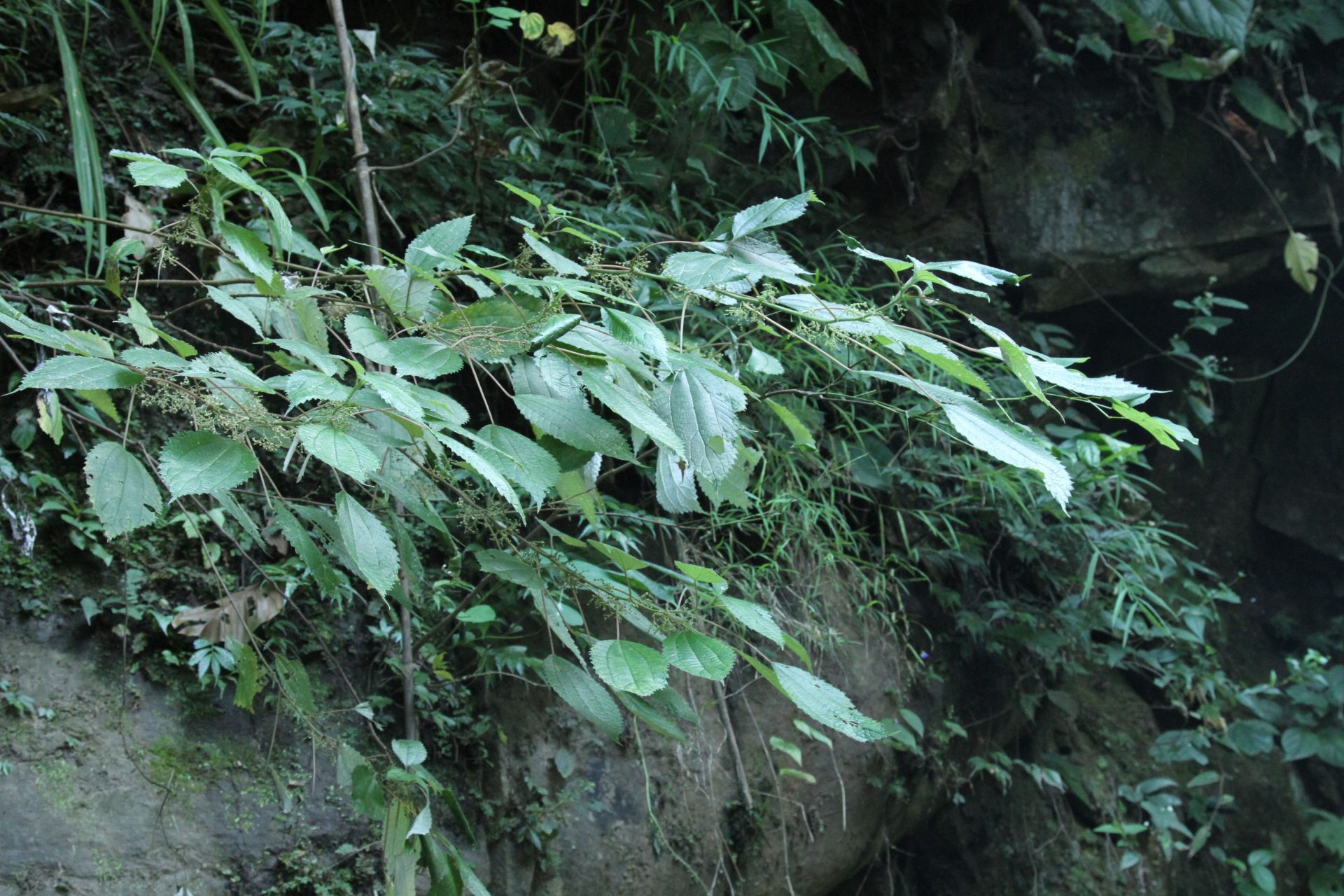
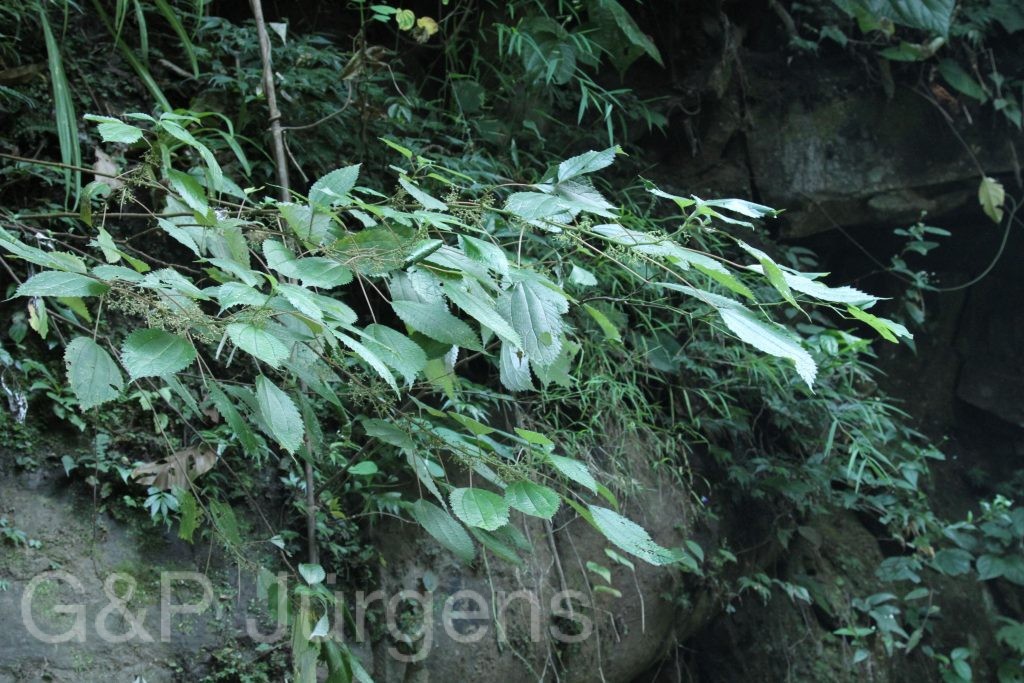
Pouzolzia sanguinea (Blume) Merr. is a widespread shrub of the nettle family ranging through tropical and subtropical Asia, from the Himalaya and India eastward to China, Taiwan, Japan, and across Southeast Asia to Indonesia, Malaysia and the Philippines; GBIF holds over 3100 occurrences. It is a plant of forest margins, secondary scrub, ravines, roadside banks and disturbed slopes at low to mid elevations, ascending into the warm broad-leaved zone. In Bhutan it was recorded at Zhemgang at about 1000 m in October, a subtropical hill setting typical of its preference for humid, partially shaded ground in the outer ranges.
It is an erect to spreading shrub with terete, often reddish or purple-tinged young branches that are appressed-pubescent. The leaves are alternate, ovate to elliptic-lanceolate, acuminate, with three prominent basal veins, the upper surface scabrid or strigose and the lower paler and pubescent; stipules are present and the leaves lack the stinging hairs of true nettles. The plant is monoecious, the small greenish flowers borne in dense axillary glomerules, with unisexual perianths; the female flowers develop into a small, shining, longitudinally ribbed achene enclosed by the persistent accrescent perianth.
The species is taxonomically variable and several infraspecific variants have been recognised across its broad range, contributing to a tangled synonymy under Pouzolzia. Like many Urticaceae it yields a strong bast fibre and is used locally for cordage, while leaves serve as fodder and in folk medicine. Its tolerance of disturbance and wide ecological amplitude make it a common pioneer rather than a species of conservation concern, and it figures as a characteristic element of regenerating Himalayan hill forest.
Author: (Blume) Merr. · Sources: POWO (Kew), GBIF, Flora of China, Flora of Bhutan, Flora of British India, Urticaceae monograph (Friis; Wilmot-Dear & Friis revision of Pouzolzia)