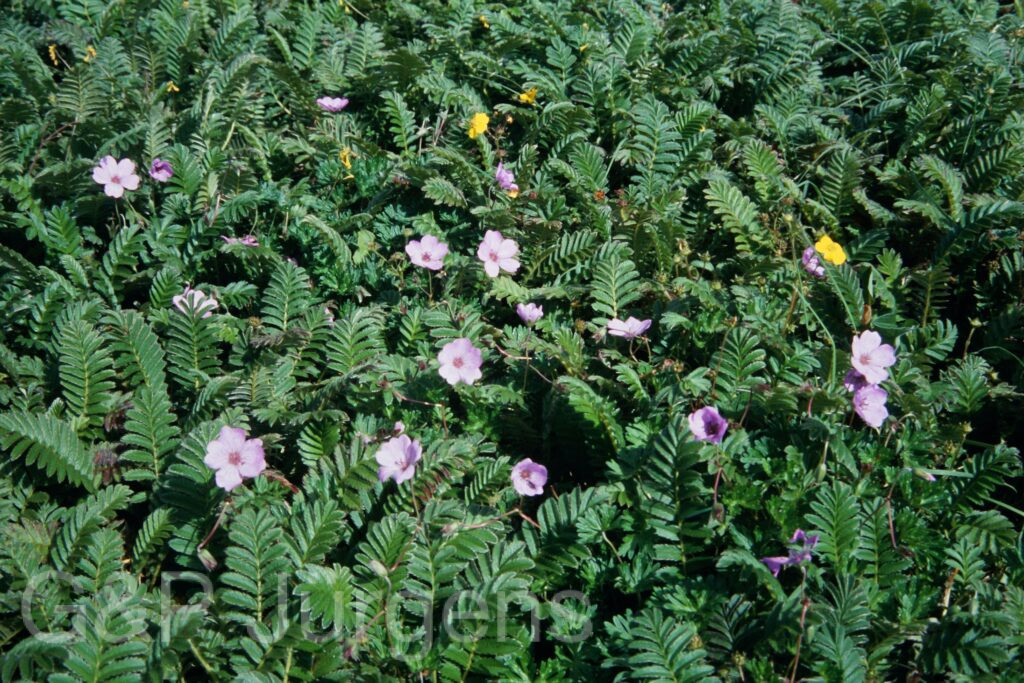
Geraniaceae

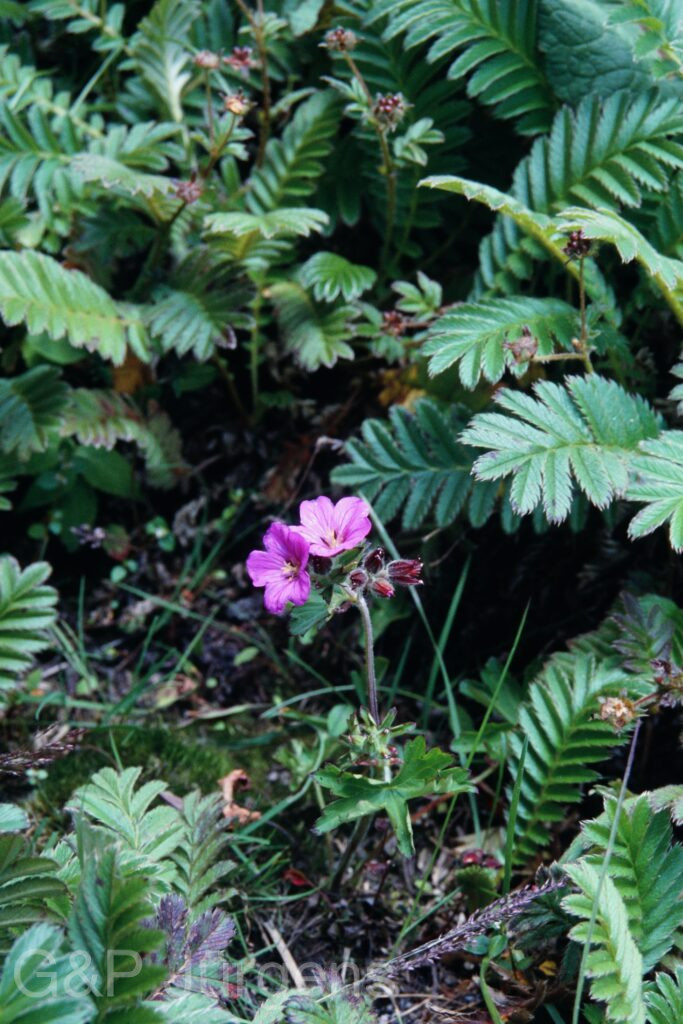
Sweet

BhutanPG2011 106
Bhutan Tsochenchen, 3450m June
Sikkim2003 181 G247
Sikkim Dzongri 4100m 08.2003

Description

Geranium donianum is an alpine cranesbill of the Himalaya and southwestern China, recorded by GBIF from China, Nepal, India, Bhutan and Myanmar across roughly 795 occurrences. It grows in alpine and subalpine meadows, open grassy slopes, scrub margins and stony turf, generally at high elevations where it forms part of the herb-rich alpine sward. The photographed plants were found in Bhutan at Tsochenchen at 3450 m in June and in Sikkim at Dzongri at 4100 m in August, situations typical of its preference for sunny, well-drained montane grassland through the brief alpine summer.

It is a low, tufted perennial arising from a stout, often woody rootstock, with somewhat spreading, hairy stems. The leaves are orbicular to reniform in outline and palmately divided nearly to the base into several wedge-shaped, deeply lobed segments, the lobes again toothed; basal leaves are long-petiolate. The flowers are relatively large and showy, with five free, obovate petals that are typically deep pink to purplish-red and conspicuously darker-veined, sometimes notched at the apex. There are ten stamens and a five-lobed superior ovary; the fruit is the characteristic beaked schizocarp of the genus, whose mericarps separate elastically at maturity to fling out the seeds.

GBIF accepts the name. Within Geranium it belongs among the Himalayan alpine cranesbills allied to G. orientali-tibeticum and related taxa, a group well represented across the high ranges. The vivid dark-veined petals serve as nectar guides for bee and fly pollinators. Widespread and locally common in alpine pastures, G. donianum is assessed as of least conservation concern.

Author: Sweet · Sources: POWO (Kew), GBIF, Flora of Nepal, Flora of China, Yeo monograph of Geranium
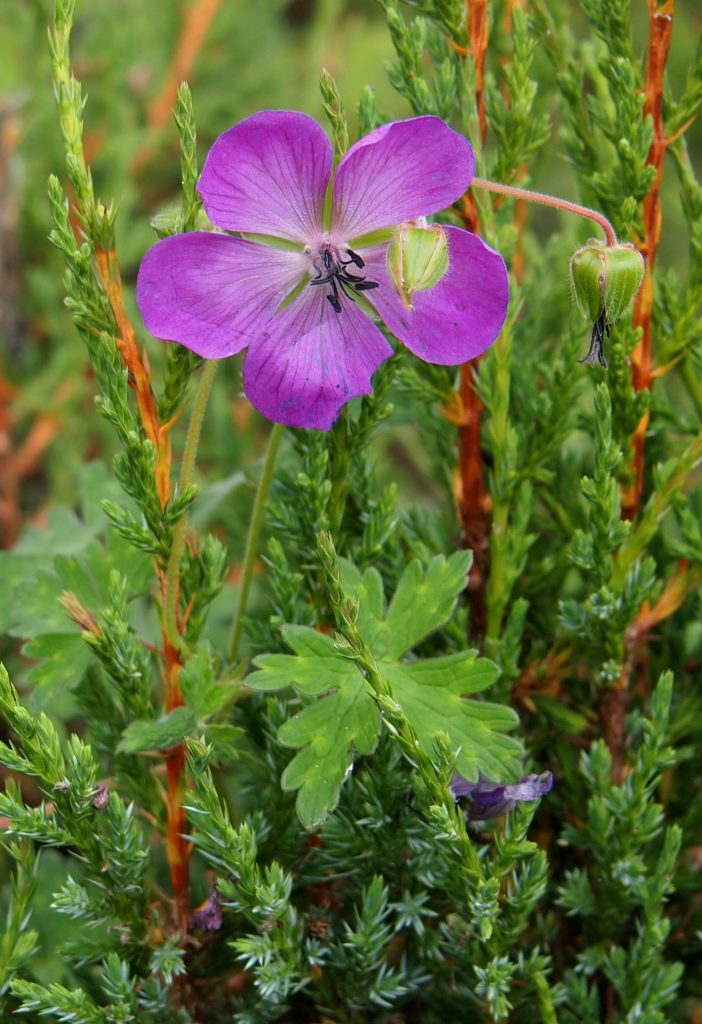
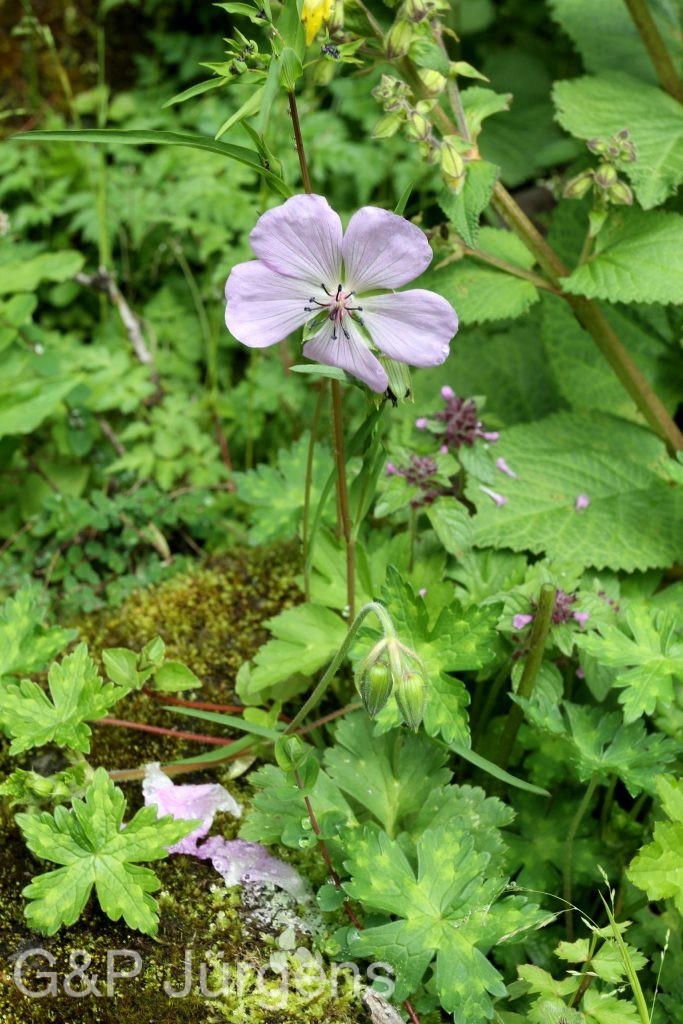
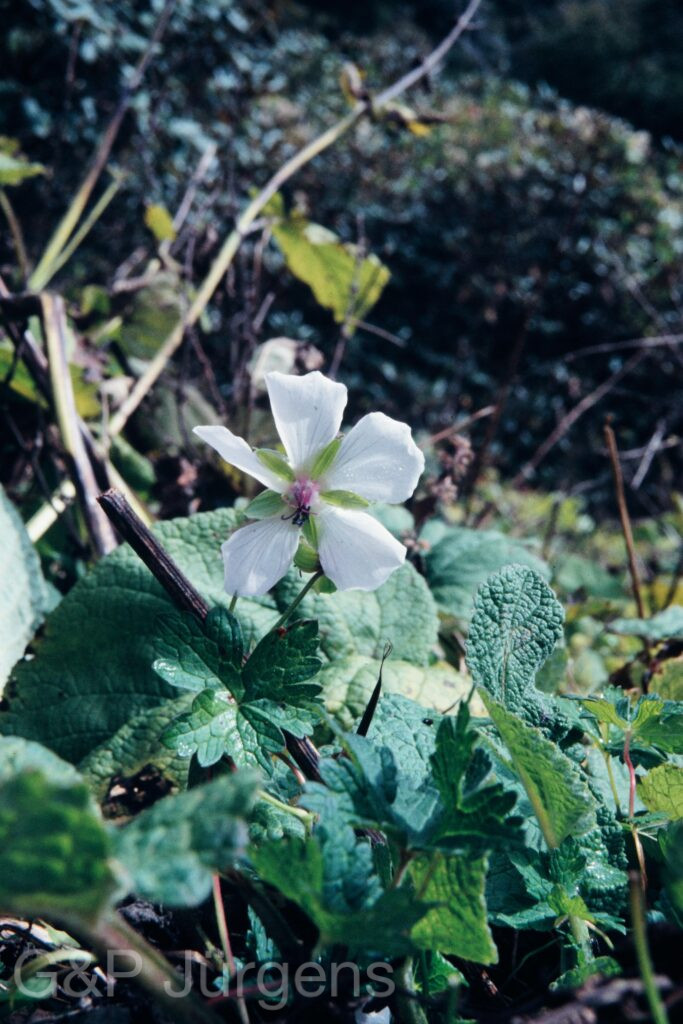
Sweet

Bhutan2012 218
Bhutan Shele-La, 3800m September
BhutanPG2011 679 01 01
Bhutan Luksur, 3700m July
Nepal 95 389P688 ergebnis
Nepal Bahanjyang 3700m October

Description

Geranium lambertii is a perennial herb of the high Himalaya, distributed through China, India, Nepal, Bhutan and Pakistan, with about 304 georeferenced records (additional codes from Canada, Japan and Europe reflect its presence in cultivation). It inhabits subalpine and alpine meadows, forest clearings, shrubberies and moist rocky slopes, often among dwarf rhododendron and on the margins of birch forest. The collections cited from Bhutan at Shele-La (3800 m, September) and Luksur (3700 m, July) and from Bahanjyang in Nepal (3700 m, October) place it firmly in the 3500-4000 m belt, flowering through the late monsoon and into autumn.

It forms a clump of trailing to ascending stems from a stout rootstock. The leaves are long-petiolate and palmately divided into five to seven deeply lobed and toothed segments, sparsely hairy. The flowers are among the most distinctive in the genus, nodding and saucer- to bell-shaped, with five broad, satiny white petals usually flushed pink and contrasting with a dark crimson-purple centre; the ten stamens and the style cluster are conspicuous, and the pedicels recurve in fruit. The fruit is the typical geranium schizocarp, with a long beak that splits elastically to fling the seeds.

Geranium lambertii, named by Sweet, is a well-marked species of the Himalayan endemic assemblage and a long-cultivated ornamental prized for its pendent, dark-eyed blooms. Its mid- to late-season flowering supports bumblebees and other high-altitude pollinators, and the spring-loaded mericarps achieve effective ballistic seed dispersal. It is widespread and not considered threatened, though localised meadow populations are sensitive to heavy grazing.

Author: Sweet · Sources: POWO (Kew), GBIF, Flora of Bhutan, Annotated Checklist of the Flowering Plants of Nepal, Yeo Hardy Geraniums

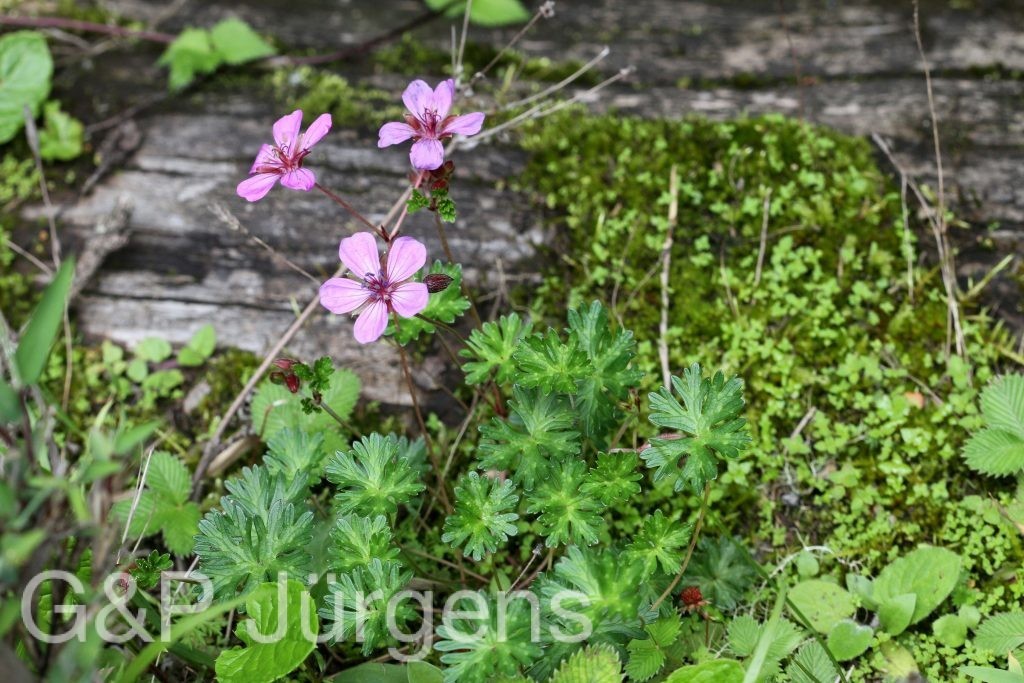
Edgew. & Hook.f.

Sikkim2003 204 P284
Sikkim Dzongri 3900m 08.2003

Description

Geranium polyanthes is a perennial cranesbill of the high Himalaya and the mountains of southwestern China, recorded by GBIF from China, India, Nepal, Bhutan and Myanmar (with scattered cultivated or vouchered records elsewhere) across about 331 georeferenced occurrences. It is a plant of subalpine and alpine meadows, open hillsides, grassy slopes and forest clearings near and above the treeline, characteristically flowering in the monsoon months of July and August. Its elevational range extends from roughly 3,000 m to over 4,000 m, well represented by the photographed plant from Dzongri in Sikkim at about 3,900 m in August, where it grows among dwarf rhododendron and herbaceous alpine turf.

The species forms a clump from a stout rootstock, the stems erect to ascending and clothed, like the rest of the plant, in spreading hairs. The leaves are orbicular-reniform in outline and palmately lobed into shallow, broad, crenate-toothed segments, the basal leaves long-petioled. As the epithet polyanthes ("many-flowered") indicates, the inflorescence is comparatively dense and many-flowered, an umbel-like cluster of pink to rose-pink flowers with five obovate, slightly notched petals veined with darker lines, ten stamens and a beaked pistil. The fruit is the characteristic geraniaceous schizocarp with an elongate rostrum that splits explosively into one-seeded mericarps, ejecting the seeds.

Geranium polyanthes belongs to the large genus Geranium (subgenus Geranium) and is one of a suite of pink-flowered Himalayan perennial cranesbills that includes G. donianum and G. nakaoanum, from which it is separated by its denser, many-flowered inflorescence and leaf division. As a nectar-rich alpine herb it is visited by bees and other insects and contributes to the floral diversity of Himalayan summer pastures. It is locally common and not considered threatened, though the alpine meadow habitats it occupies are sensitive to overgrazing and to the upslope shifts in vegetation associated with a warming climate.

Author: Edgew. & Hook.f. · Sources: POWO (Kew), GBIF, Flora of China Vol. 11, Flora of Bhutan Vol. 2, Flora of Nepal, Flora of Pakistan, Yeo: Hardy Geraniums and the systematic monograph of the genus Geranium

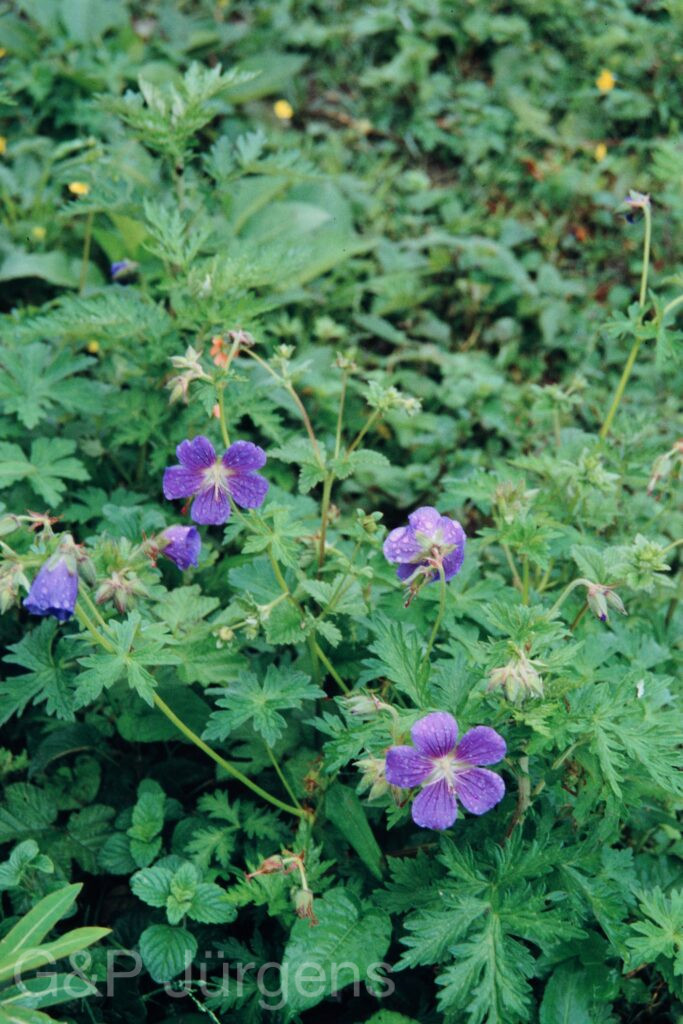
L.

Nepal 99 89 ergebnis
West-Nepal Bhulbhule 3500m, June

Description

Geranium pratense, the meadow cranesbill, is a widespread perennial of temperate Eurasia. With over 190,000 GBIF occurrences it is abundantly documented across Britain, Germany, France, the Nordic and Baltic states, the Low Countries, central Europe and Russia, extending through Central Asia to the Himalaya. It grows in moist meadows, grassy slopes, streamsides and open woodland margins. In the high Himalaya it ascends to subalpine pastures; the illustrated plant was photographed at Bhulbhule in western Nepal at about 3,500 m, flowering in June, where it is a characteristic component of moist alpine-meadow turf during the early monsoon.

The plant forms a stout, branched rootstock bearing erect, glandular-pubescent stems 30–80 cm tall. The leaves are deeply palmately 5–7-lobed, the lobes themselves pinnatifid and sharply toothed, the basal leaves long-petiolate. The flowers are large and showy, 2.5–4 cm across, borne in pairs on long peduncles; the five petals are violet-blue with fine darker veins. The fruit is the characteristic geraniaceous schizocarp with an elongate beak that springs apart explosively at maturity, ejecting the five mericarps.

Geranium pratense is taxonomically variable across its vast range, with several recognised subspecies and forms; Himalayan populations have at times been segregated but are generally treated within the broad species. It is of least conservation concern, being common and adaptable, and is widely grown ornamentally with numerous cultivars. Its presence links the Himalayan flora biogeographically to the temperate grasslands of the western Palaearctic.

Author: L. · Sources: POWO (Kew), Flora of Nepal, Flora of Pakistan, GBIF, Yeo: Hardy Geraniums (2002)

D.Don

Garw 2005 271 ergebnis
India Garhwal Kunol 2650m, October

Description

Geranium wallichianum is a perennial cranesbill native to the Himalaya and adjacent mountain systems, distributed from Afghanistan and Pakistan through northern India (Kashmir, Himachal Pradesh, Uttarakhand) to Nepal, Bhutan, and southwestern China. It inhabits alpine and subalpine meadows, forest margins, open shrublands, and grassy slopes at elevations of 2,000–4,000 m, frequently forming extensive patches in disturbed and grazed areas. The species has been documented near Kunol in the Garhwal Himalaya at 2,650 m, where it flowers late into the autumn season in October.
The plant is a spreading to trailing perennial herb with a thick, woody rootstock and procumbent to ascending stems 20–60 cm long, covered in retrorse or patent hairs. Leaves are long-petiolate, orbicular in outline, 5–10 cm in diameter, deeply palmately divided into five to seven rhombic, further lobed and toothed segments. The flowers are large and showy, 3–4 cm in diameter, borne singly or in pairs on long, glandular-hairy pedicels. Petals are five, broadly obovate, typically violet-blue to lavender with a conspicuous white centre and darker veins radiating from the base. Stamens are ten with dark anthers. The fruit is a schizocarp with a persistent beak (rostrum) 2–3 cm long; at maturity the five mericarps separate elastically, each retaining a single seed.
Geranium wallichianum is among the most horticulturally significant Himalayan cranesbills, widely cultivated in temperate gardens worldwide since the nineteenth century. The cultivar 'Buxton's Variety' (syn. 'Buxton's Blue'), selected for its clear blue flowers with prominent white eyes, has received the Royal Horticultural Society's Award of Garden Merit and remains one of the most popular autumn-flowering hardy geraniums. In its native range, the species is ecologically important as a ground-cover plant that stabilizes soil on slopes and provides late-season nectar for pollinators. It is named after the Danish botanist Nathaniel Wallich, who collected extensively in Nepal and India.

Author: D.Don · Sources: POWO (Kew), GBIF, Flora of China Vol. 11, Yeo: Hardy Geraniums (2002), Annotated Checklist of the Flowering Plants of Nepal