
Edgew. & Hook.

Description
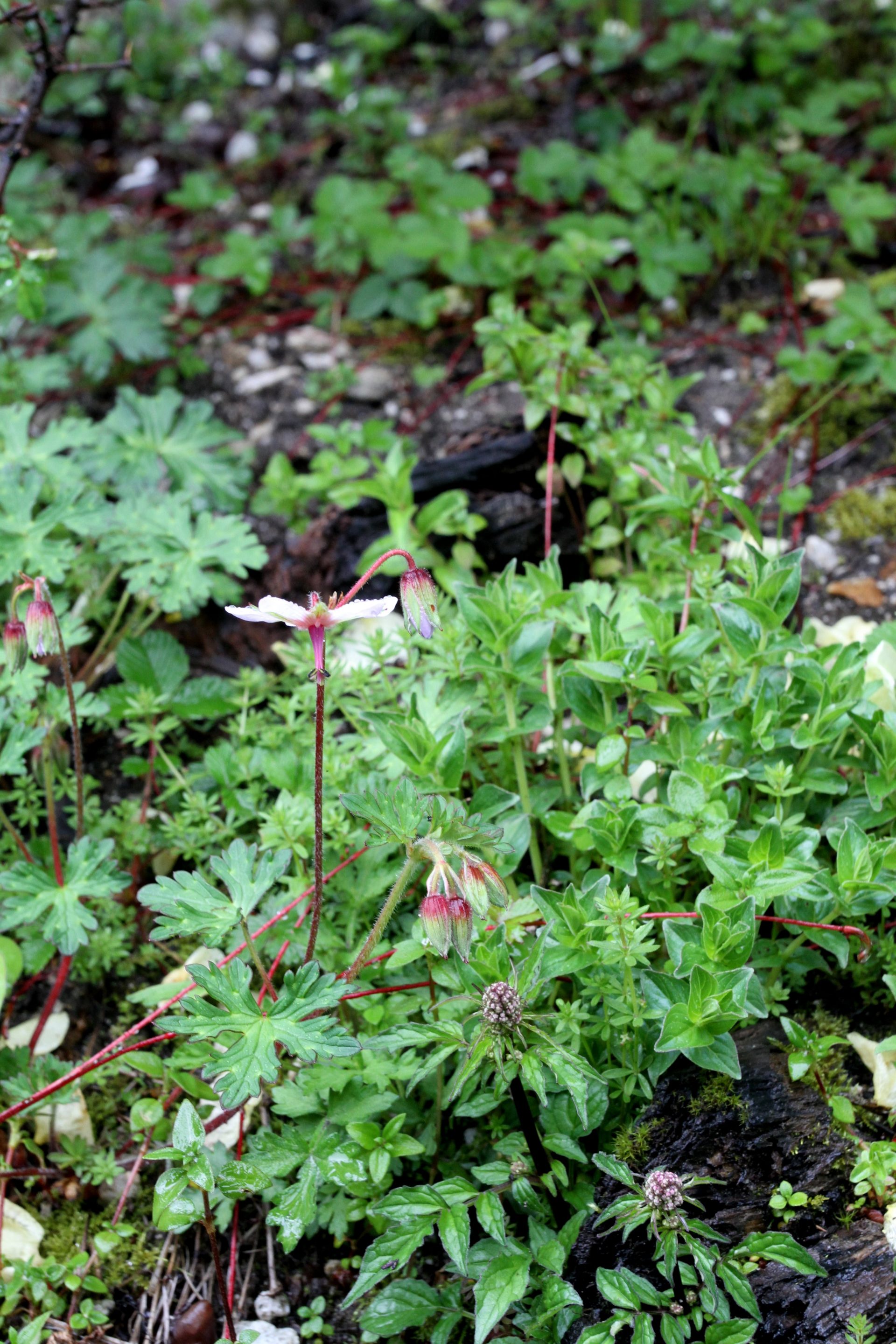
Geranium refractum is a perennial herb of the eastern and central Himalaya and adjacent China, distributed through China, Nepal, India, Bhutan and Myanmar, with about 645 georeferenced records concentrated in the subalpine and alpine zones. It grows in alpine meadows, forest clearings, shrubberies and moist, rocky slopes, often among dwarf rhododendron and on streamside banks. The plant photographed along the Ludlow-Sherriff trail near the Managed-Chu in Bhutan at 3550 m, flowering in June, is typical of its high-elevation habitat, where it appears with the early summer thaw.
It forms ascending to spreading stems from a perennial rootstock, the foliage palmately divided into five to seven deeply incised and toothed lobes. The flowers, as the epithet indicates, are nodding and become strongly reflexed, with five reflexed to spreading white or pale pinkish petals; the ten stamens and the long style column are exserted and conspicuous against the recurved corolla, recalling a small cyclamen or shooting-star in posture. The fruit is the characteristic geranium schizocarp with an elongate beak, the mericarps releasing seeds by elastic ejection.
Geranium refractum, described by Edgeworth and Hooker f., belongs to the same Himalayan group of nodding-flowered species as G. lambertii, from which it differs in its reflexed white flowers and exserted reproductive parts. Its early-summer blooms are visited by bumblebees and other montane insects, and the spring-loaded mericarps disperse seed ballistically. It is reasonably widespread across the eastern Himalaya and is not regarded as threatened, although alpine meadow populations are subject to grazing pressure.
Author: Edgew. & Hook. · Sources: POWO (Kew), GBIF, Flora of China, Flora of Bhutan, Annotated Checklist of the Flowering Plants of Nepal, Yeo Hardy Geraniums