Saxifragaceae

(Haw.) Sternb.

Sikkim2011 28
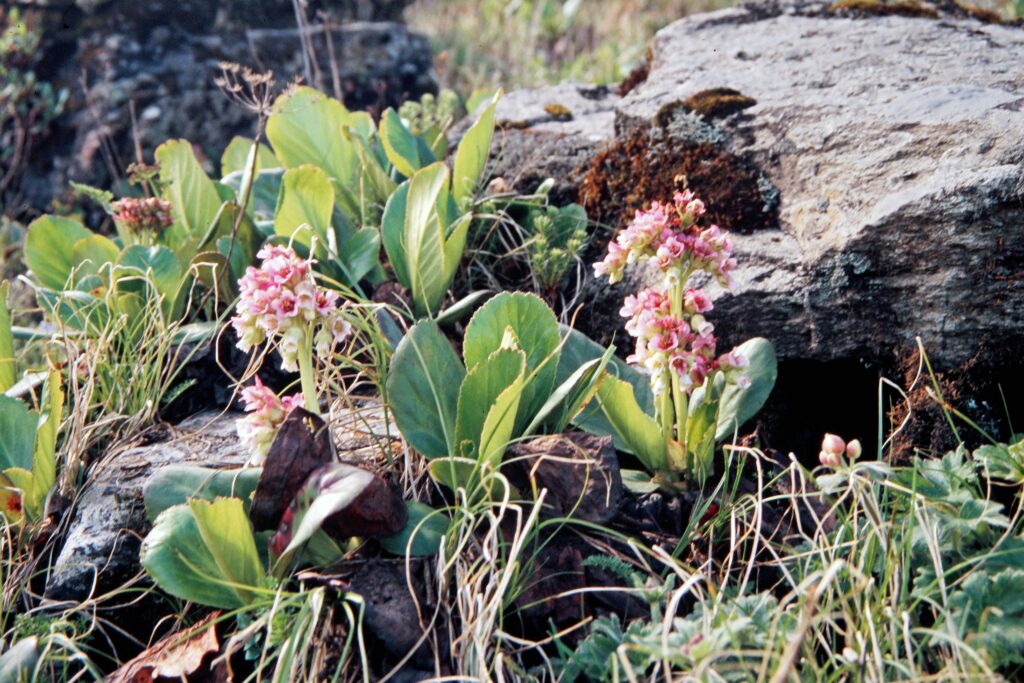
Sikkim Lachen 2800m, June
Nepal 97 303 G604
Nepal Honggaon 2360m May
Nepal 2001 463 ergebnis ergebnis
Nepal (Gorkha) Gunda 1700m, May

Description

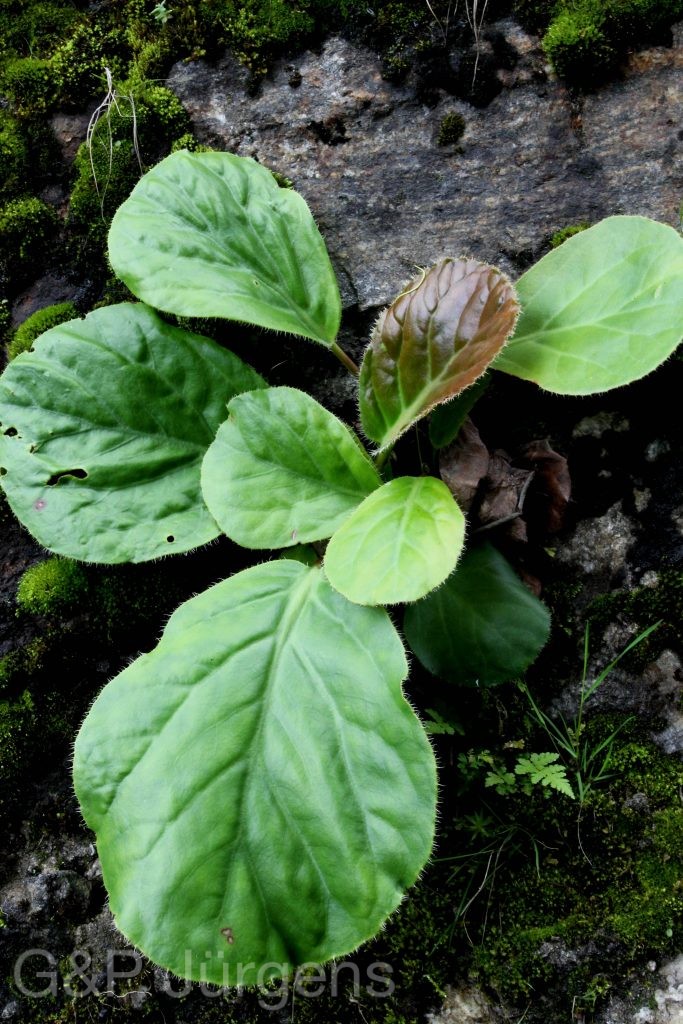
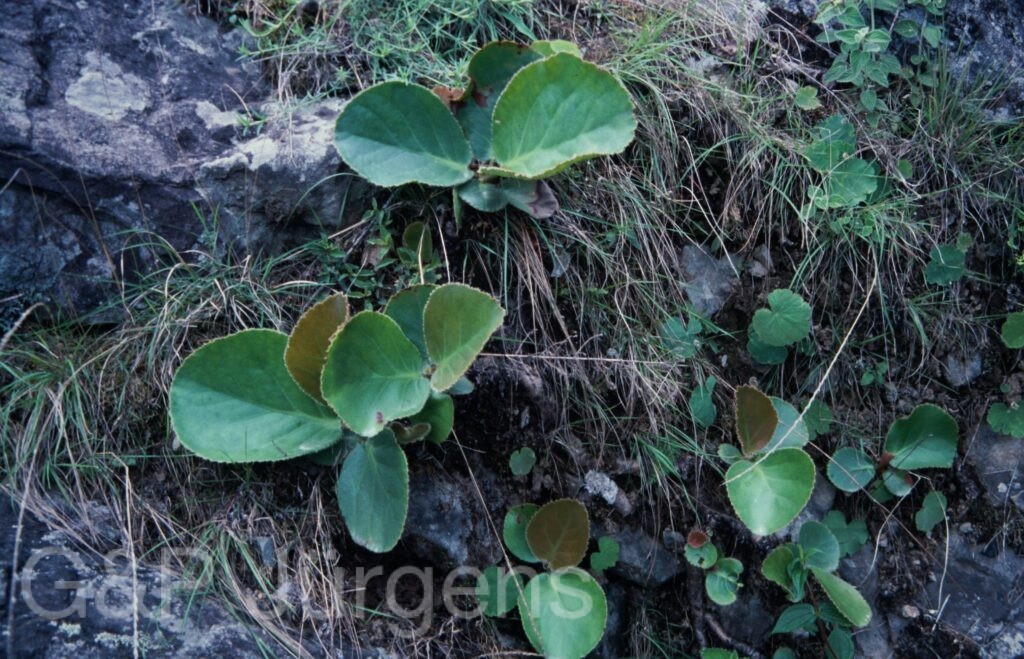
Bergenia ciliata (Haw.) Sternb. is a robust rosette-forming perennial widely distributed through the Himalaya from Pakistan and Afghanistan eastward across India, Nepal, Sikkim and Bhutan into south-west China. It is a characteristic plant of shaded, moist rock crevices, cliff ledges, stream banks and boulder-strewn slopes in the temperate forest belt, generally between about 1500 and 3000 m. The photographed gatherings span this range, from Gunda in the Gorkha region of Nepal at 1700 m and Honggaon at 2360 m up to Lachen in northern Sikkim at 2800 m, flowering in May and June. It favours cool, humid, semi-shaded microsites with seepage and good drainage, often forming extensive colonies on damp rock.

The plant arises from a stout, fleshy, creeping rhizome bearing the persistent remains of old leaf bases. The leaves are large, obovate to broadly elliptic, rounded and shortly toothed at the margin, and notably ciliate-hairy on both surfaces and margin (the basis of the epithet ciliata), distinguishing it from the glabrous-leaved B. purpurascens. The leafless scape carries a branched cymose panicle of showy flowers; the five petals are white to pale pink, broadly obovate, set off by a reddish calyx and conspicuous stamens, opening often before the new foliage is fully expanded. The fruit is a two-lobed capsule containing numerous small seeds.

Within Saxifragaceae the genus Bergenia is a small Asian group, and B. ciliata is one of its most widespread members, intergrading with relatives where ranges overlap. The thick rhizome ("pashanbhed") is important in Ayurvedic and folk medicine, valued for treating urinary calculi, which has led to heavy wild harvesting. Though not globally threatened, localised over-collection and habitat disturbance make sustainable management of this medicinally prized saxifrage a conservation concern.

Author: (Haw.) Sternb. · Sources: POWO (Kew), GBIF, Flora of China, Annotated Checklist of the Flowering Plants of Nepal, Flora of Bhutan, A Monograph of the Genus Bergenia (Yeo)
(Hook.f. & Thomson) Engl.

Sikkim2011 288
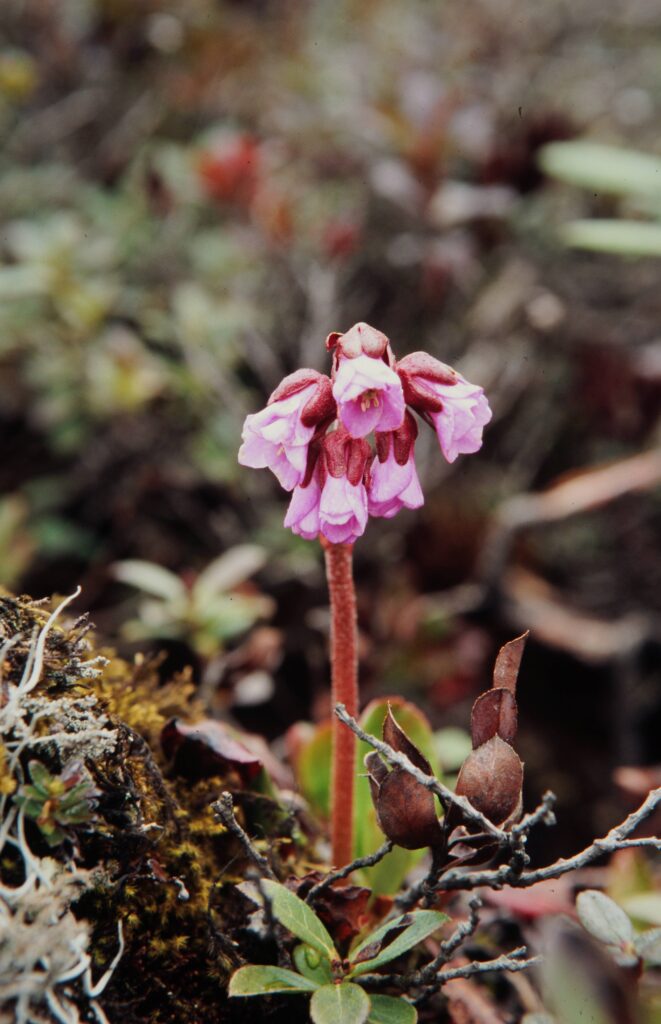
Sikkim Yumthang 3600m, June
BhutanPG2011 606 scaled
Bhutan Ludlow-Sherriff-Trail Warrtlang-La, 4500m June
Sikkim 2006 394 ergebnis
India West-Bengal, Kishong 3700m, May

Description

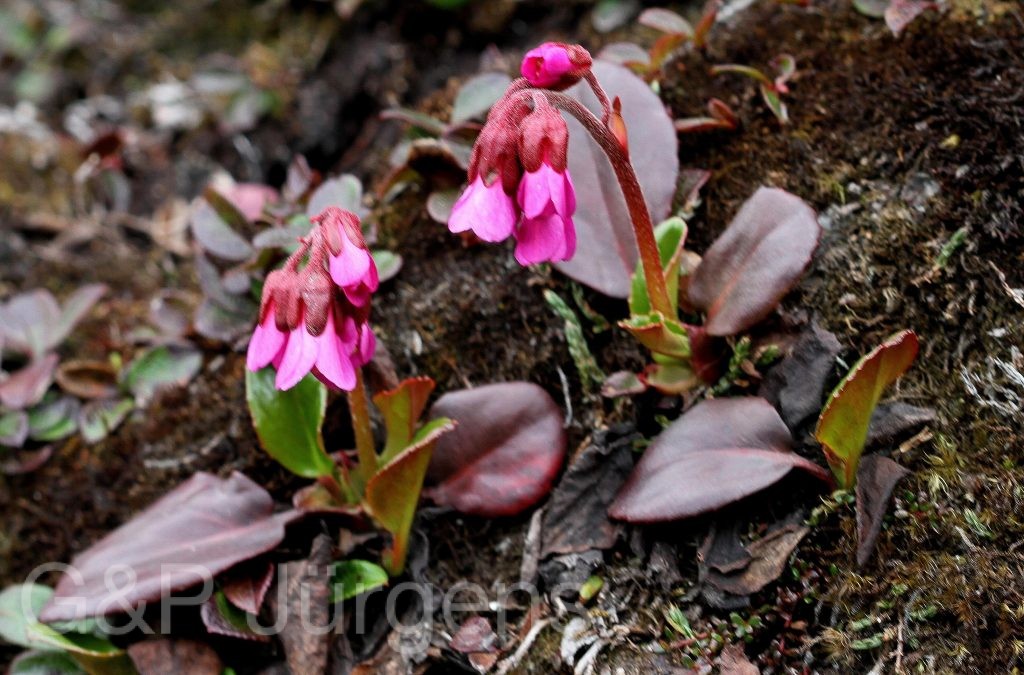
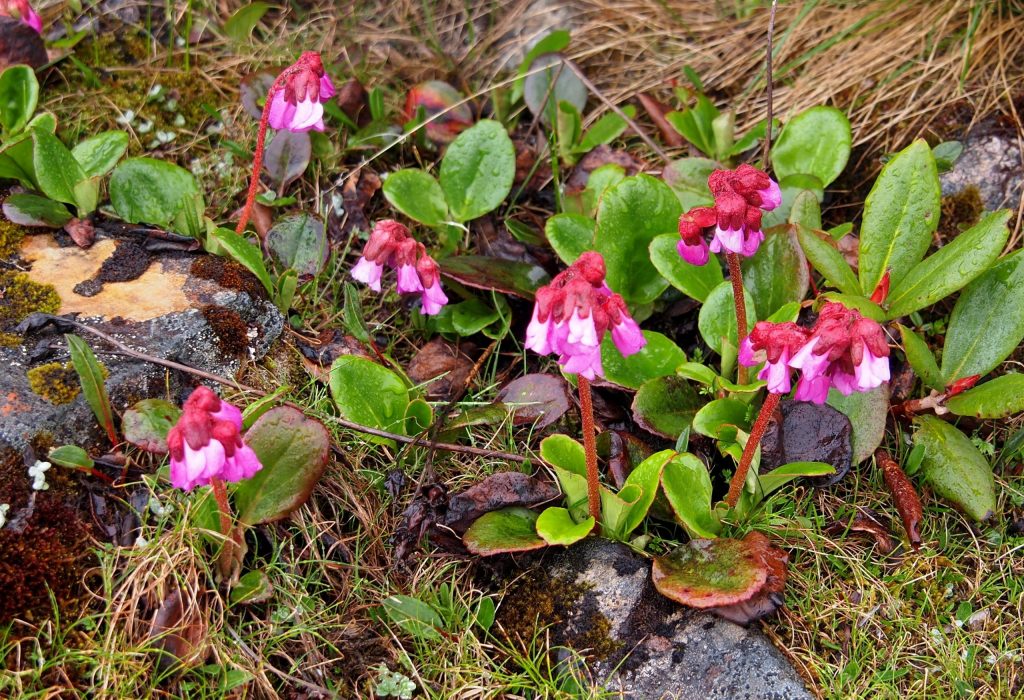
Bergenia purpurascens is a robust perennial of the high Himalaya and adjacent mountains, native to China, Nepal, India, Bhutan and Myanmar, and represented in cultivation across Europe and North America, where naturalised or garden-derived records inflate its GBIF tally to nearly a thousand occurrences. In the wild it is a plant of the alpine and upper subalpine belt, growing on rocky slopes, cliff ledges, moist meadows and the margins of rhododendron scrub. Field records illustrate this altitudinal range well: Sikkim at Yumthang around 3600 m in June, the Ludlow-Sherriff-Trail near Warrtlang-La in Bhutan at some 4500 m in June, and Kishong in West Bengal at about 3700 m in May.

The plant arises from a stout, woody, creeping rhizome bearing a basal rosette of large, leathery, obovate to elliptic leaves; these are glabrous, with entire to obscurely toothed margins and prominent reticulate venation, frequently flushing deep red or purple in autumn and cold exposure. The flowering scape is erect, reddish and glandular, terminating in a dense, nodding cyme. The flowers are showy, with five purple-red to magenta petals, a campanulate calyx of fleshy, often purplish sepals, ten stamens, and a bicarpellate ovary. The fruit is a capsule splitting to release numerous small seeds.

Described by Engler on the basis of Hooker and Thomson's material, B. purpurascens is the principal high-elevation representative of the genus in the eastern Himalaya. Its rhizomes are used in local traditional medicine, and the species is a parent of numerous ornamental Bergenia hybrids. It remains common within its broad range and is not considered threatened.

Author: (Hook.f. & Thomson) Engl. · Sources: POWO (Kew), GBIF, Flora of China, Flora of Bhutan, Pan's monograph of Bergenia

(Hook.f. & Thomson) Engl.

Description

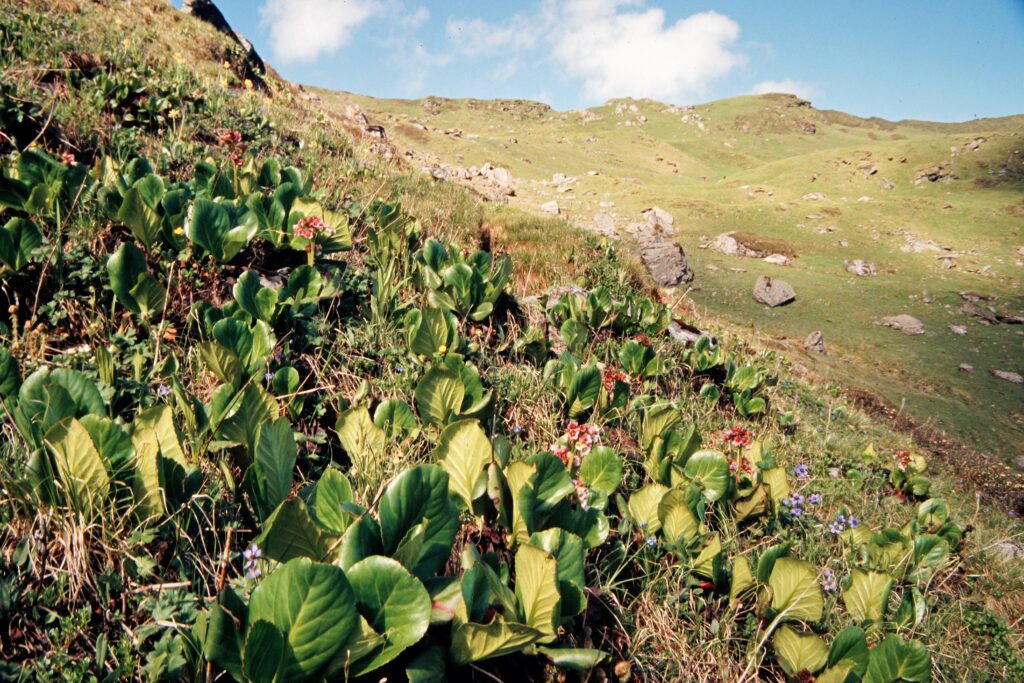
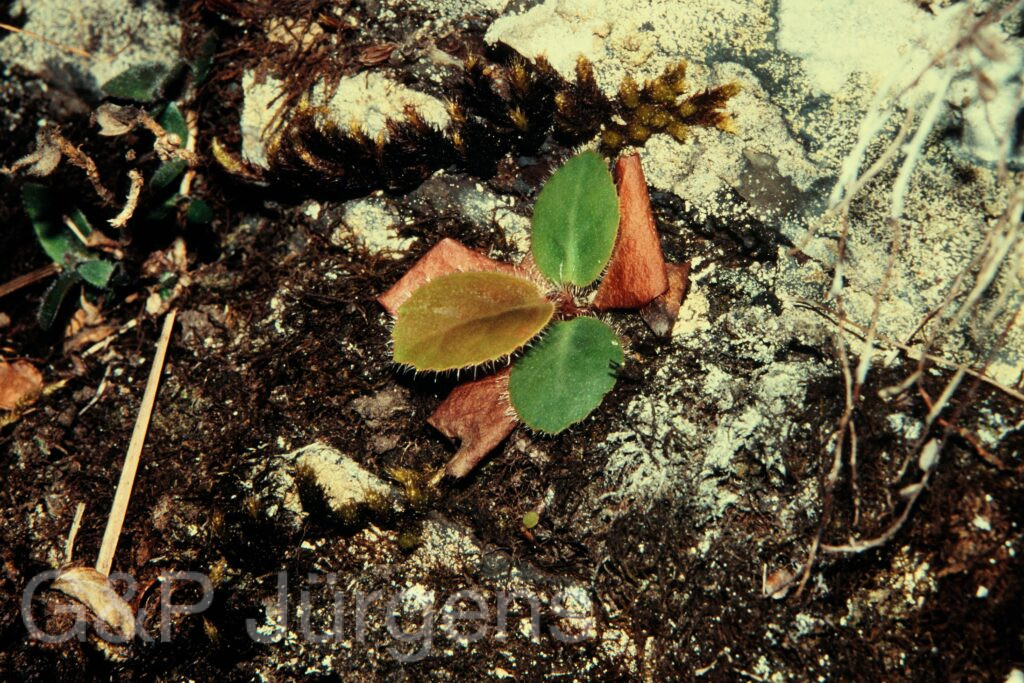
Bergenia stracheyi (Hook.f. & Thomson) Engl. is a perennial rock-dwelling herb of the higher Himalaya, native to Pakistan, north-west India, Afghanistan and adjacent China, with a GBIF record total (371 occurrences) inflated by its popularity in cultivation across Europe and North America. In its natural range it is a plant of moist alpine and subalpine ledges, screes, cliff crevices and stream banks, typically between about 3000 and 4500 m. The photographed individual, from Seema in Garhwal (Indian Himalaya) at 3700 m in June, exemplifies its habitat among shaded, humus-filled rock fissures where snowmelt provides reliable summer moisture.

The plant develops a stout, woody, creeping rhizome anchoring rosettes of thick, leathery, evergreen leaves. The leaf blades are obovate to broadly elliptic, glabrous, with crenate to entire ciliate margins and prominent reticulate venation, often flushing red in cold or exposed conditions. The inflorescence is a compact, nodding to erect cyme borne on a short fleshy scape, carrying campanulate flowers with five rose-pink to deep magenta petals, a persistent calyx, ten stamens and a bicarpellate, partly inferior ovary. The fruit is a capsule splitting to release numerous small seeds.

The genus Bergenia, often called elephant's-ears, comprises a small group of Asian saxifrages prized horticulturally for their bold foliage and early flowers; B. stracheyi is among the most cold-hardy and compact species and figures in the parentage of garden hybrids. In the wild its rhizomes have local medicinal use. Though not threatened owing to its broad montane distribution, populations are localised by their specialised cliff and scree microhabitats.

Author: (Hook.f. & Thomson) Engl. · Sources: POWO (Kew), GBIF, Flora of Pakistan, Flora Simlensis, Saxifragaceae of the Sino-Himalaya, Royal Horticultural Society monograph on Bergenia

Hook.f. & Thomson

BhutanPG2011 277
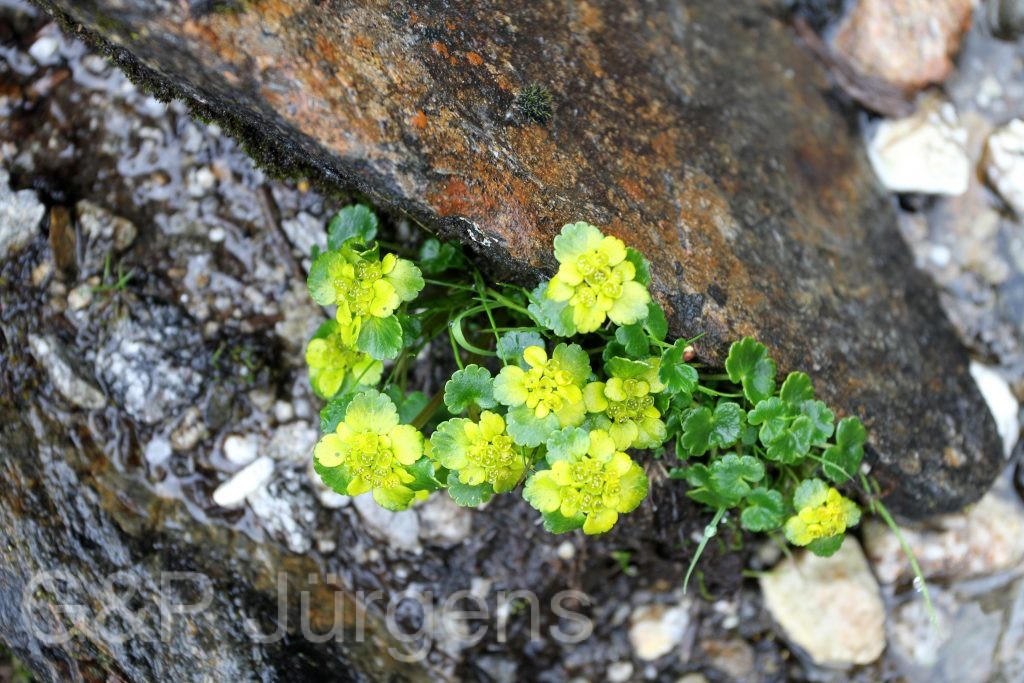
Bhutan Jule-La 4610m, June

Description

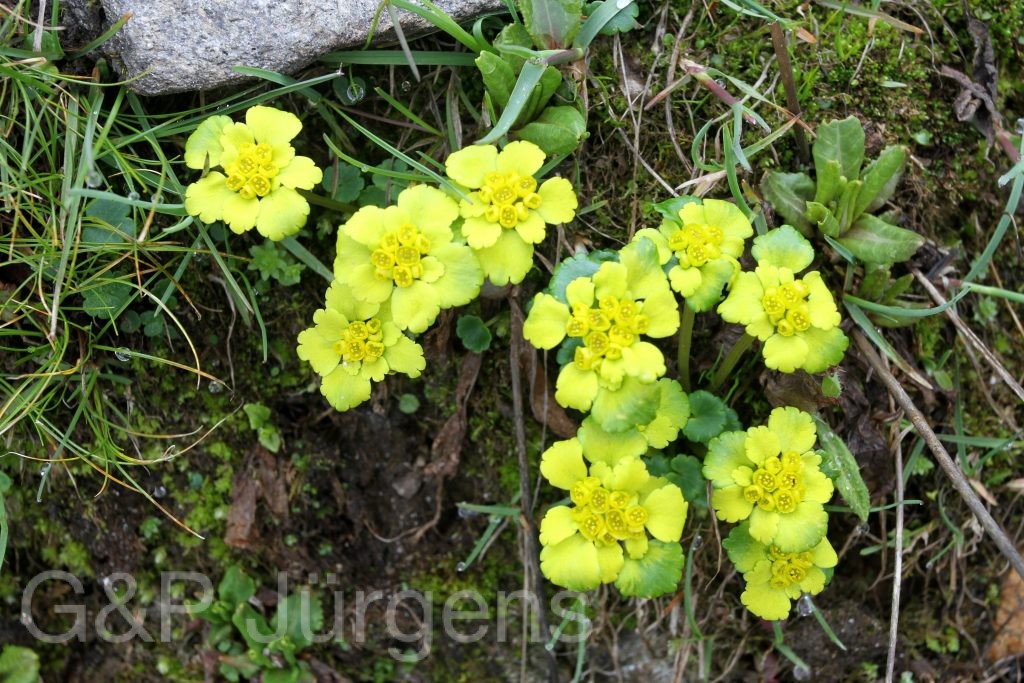
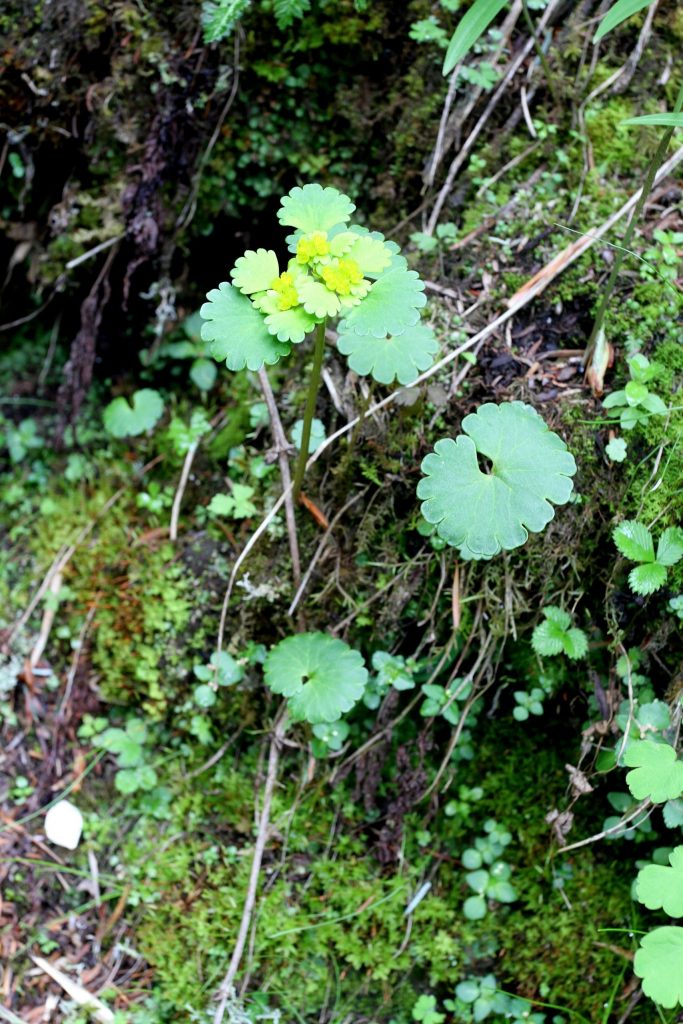
A small perennial golden-saxifrage of the high Himalaya and the eastern Tibetan region, recorded from China, Bhutan, India and Nepal, with about 485 GBIF occurrences. It is a plant of cold, wet ground, frequenting seepages, stream margins, dripping rock ledges, snowmelt flushes and moist alpine meadows, generally between about 3300 and 4800 m. The figured plant was photographed in June on the Jule-La in Bhutan at roughly 4610 m, an exceptionally high, water-saturated alpine habitat that suits its preference for permanently moist, cool substrates.

The species is a low, somewhat fleshy herb spreading by short stolons and slender rhizomes to form loose patches. The leaves are mostly alternate, with rounded to flabellate, crenate blades on slender petioles. The inflorescence is a flattened, leafy-bracted cyme in which the conspicuous element is not the petals, which are absent, but the four spreading, yellow to greenish-yellow sepals surrounding a flat floral disc. Each flower has eight stamens inserted around the disc and a semi-inferior ovary of two carpels with divergent styles. The fruit is a two-beaked, widely gaping capsule that opens to expose numerous tiny seeds, which are splashed out by raindrops, a dispersal mode well suited to its wet habitats.

Accepted by POWO and GBIF, C. griffithii belongs to a genus of typically apetalous, water-loving herbs in which species are separated by leaf arrangement, stolon habit and seed surface. Ecologically it is a specialist of alpine springs and flushes, often growing among mosses, and is an indicator of cold, base-rich seepage. Restricted to such microhabitats but widespread across the high Himalaya, it is locally frequent and not regarded as threatened, though dependent on stable hydrology in a warming alpine environment.

Author: Hook.f. & Thomson · Sources: POWO (Kew), GBIF, Flora of China, Flora of Bhutan, Hara revision of Himalayan Saxifragaceae

Hook.f. & Thomson

Bhutan2014 828
Bhutan Punaka 1310, May

Description

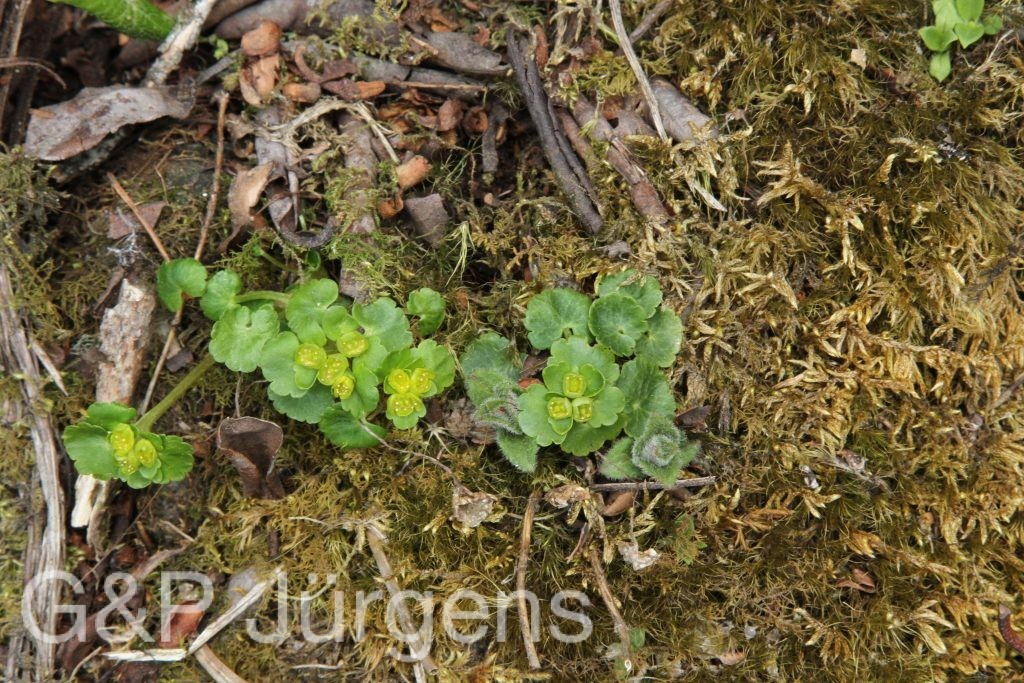
Chrysosplenium lanuginosum Hook.f. & Thomson is a small golden-saxifrage of the Sino-Himalayan region, recorded from China, Taiwan, Bhutan, India, Nepal and Japan, with around 430 occurrences in GBIF. It is a herb of moist, shaded habitats, growing on wet rocks, streambanks, seepage faces, mossy ledges and damp forest floors, broadly between about 1000 and 3000 m. The photographed plant was found at Punakha in Bhutan at about 1310 m in May, in the warm, humid lower-montane forest zone where this creeping herb forms patches on perpetually wet substrates beside watercourses.

The plant is a low, soft, stoloniferous perennial spreading by slender prostrate runners that root at the nodes, the whole plant clothed in a soft woolly indumentum (the epithet lanuginosum, woolly). The leaves are alternate or the lower opposite, orbicular to flabellate or broadly ovate with a crenate margin, somewhat fleshy and hairy. The inflorescence is a small terminal cyme subtended by leafy, often yellowish-green floral bracts that enhance the display. The flowers are minute and apetalous, the showy part being the four greenish-yellow sepals; the stamens are typically eight, and the ovary is half-inferior. The fruit is a small two-beaked capsule splitting to release numerous tiny seeds.

Within Saxifragaceae, Chrysosplenium is a distinctive genus of shade- and moisture-loving herbs distinguished by their petal-less flowers and conspicuous coloured bracts that attract small insect pollinators. Adapted to constantly humid, low-light microhabitats, the species is an indicator of clean seepage and streamside conditions. It is fairly widespread across the eastern Himalaya and not of conservation concern, though dependent on undisturbed riparian forest.

Author: Hook.f. & Thomson · Sources: POWO (Kew), GBIF, Flora of China, Flora of Bhutan, Annotated Checklist of the Flowering Plants of Nepal, Hara revision of Asiatic Chrysosplenium

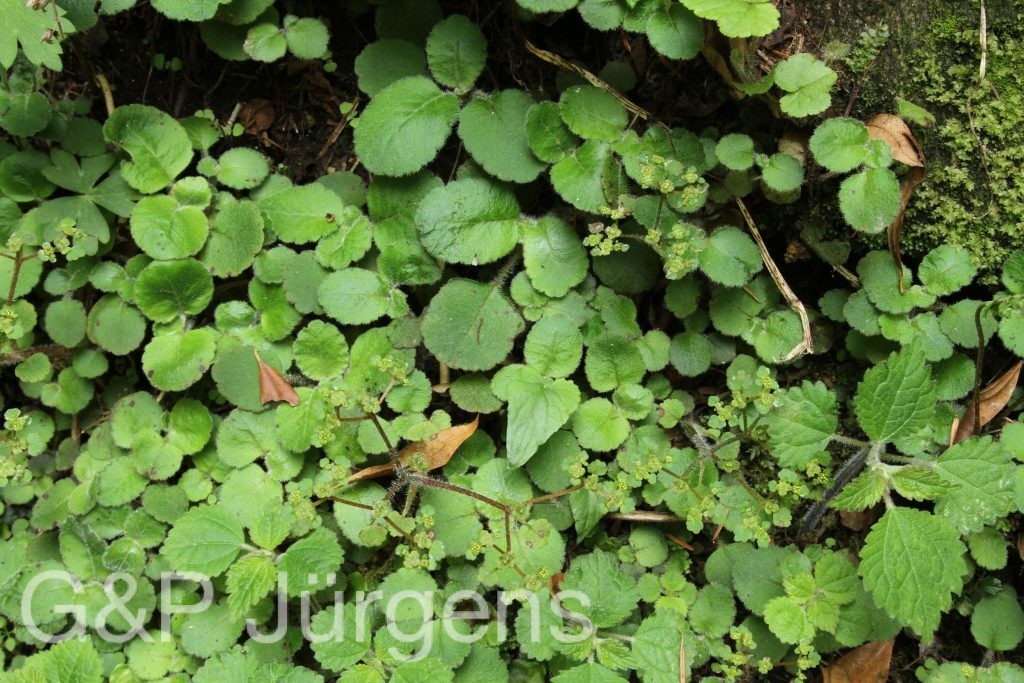
D.Don

Bh2008 378 P588
Bhutan Thimphu-Chu, 2800m April
Bh2008 10 P16
Bhutan Thimphu-Chu, 2800m April
Sikkim2004 54 P97
Sikkim West-Bengal, Bersay 2810m April

Description

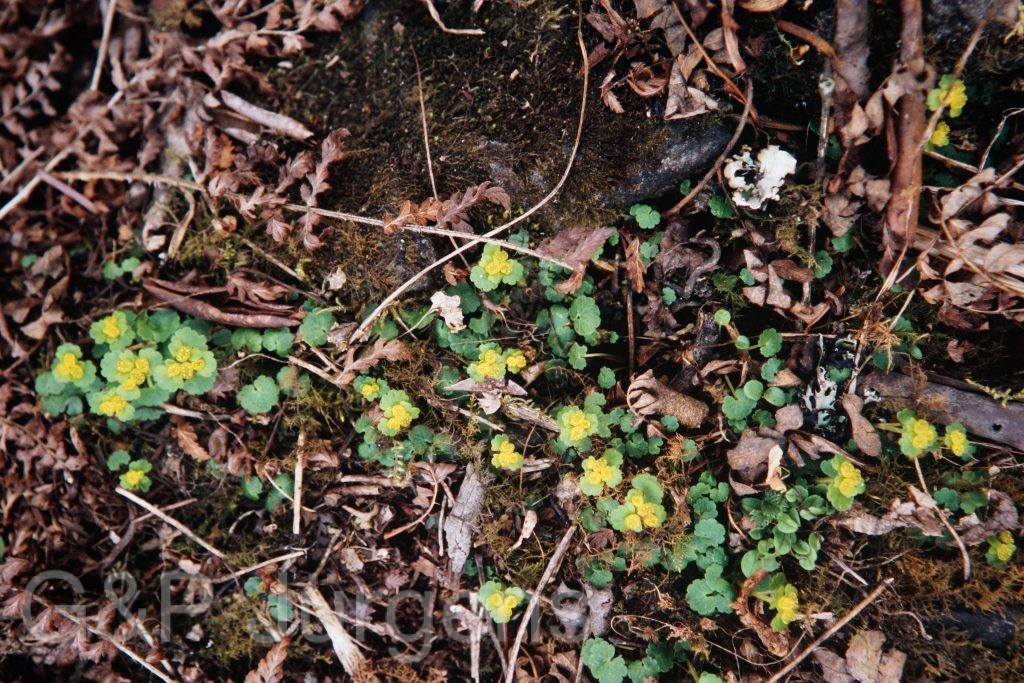
Chrysosplenium nepalense is a small herbaceous perennial of the eastern Himalaya and adjacent mountains, recorded by GBIF (339 occurrences) from Nepal, India, Bhutan, Myanmar and southwestern China. It is a plant of cool, perpetually moist habitats, colonising shaded stream banks, dripping rock faces, springs and damp humus-rich ground within temperate forest, generally between about 2500 and 3500 m. The collections illustrated from the Thimphu Chu in Bhutan at 2800 m and from Bersay in Sikkim, West Bengal, at 2810 m, both in April, are typical of its early-season flowering when snowmelt keeps the substrate saturated.

The plant is a low, mat-forming herb with slender, creeping and rooting stems that produce leafy stolons. The leaves are opposite, petiolate and reniform to broadly ovate, with a shallowly crenate margin and a cordate base. As in the genus, the flowers lack petals; the inflorescence is a flattened terminal cyme subtended by conspicuous yellowish-green leafy bracts that function as the principal visual attractant. Each small flower has four greenish-yellow sepals, four or eight stamens inserted around a flattened disc, and a half-inferior ovary. The fruit is a two-lobed, beaked capsule that splits widely to expose numerous minute seeds.

Chrysosplenium is a taxonomically intricate genus of moisture-loving saxifrages, and C. nepalense belongs to the opposite-leaved Himalayan assemblage that has been variously circumscribed. The petal-less flowers are pollinated by small flies and beetles drawn to the bract display, while the dispersal of seeds is aided by raindrop splash from the open capsules. The species is widespread within its moist montane niche and faces no recognised conservation threat, though its dependence on undisturbed seeps makes it locally sensitive to changes in hydrology and forest cover.

Author: D.Don · Sources: POWO (Kew), GBIF, Flora of China, Flora of Bhutan, Annotated Checklist of the Flowering Plants of Nepal, Monograph of Chrysosplenium (Hara)

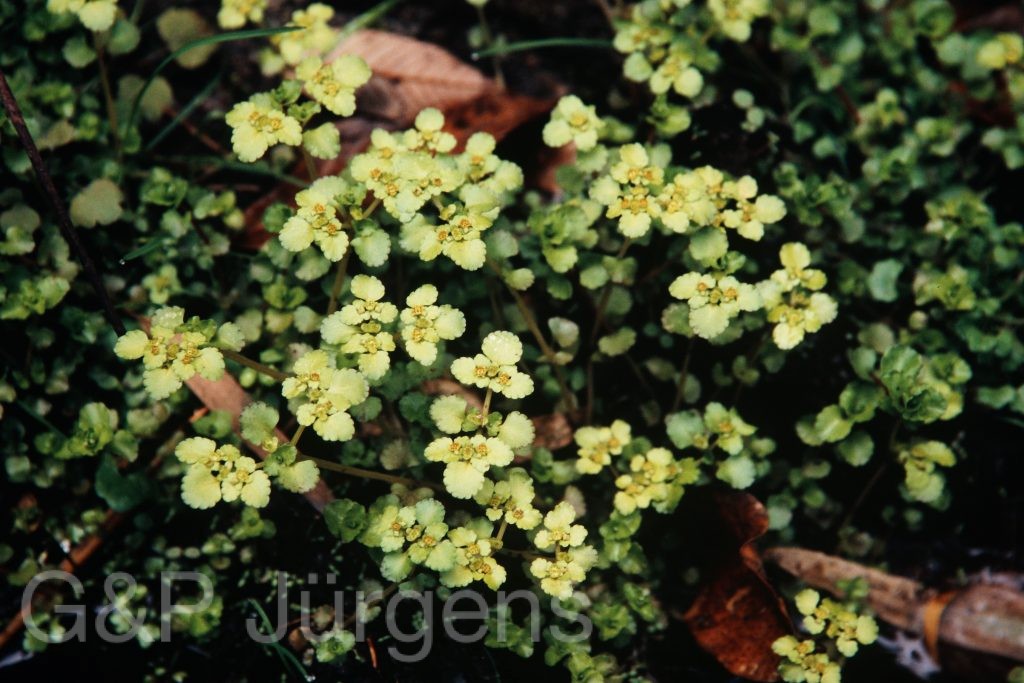
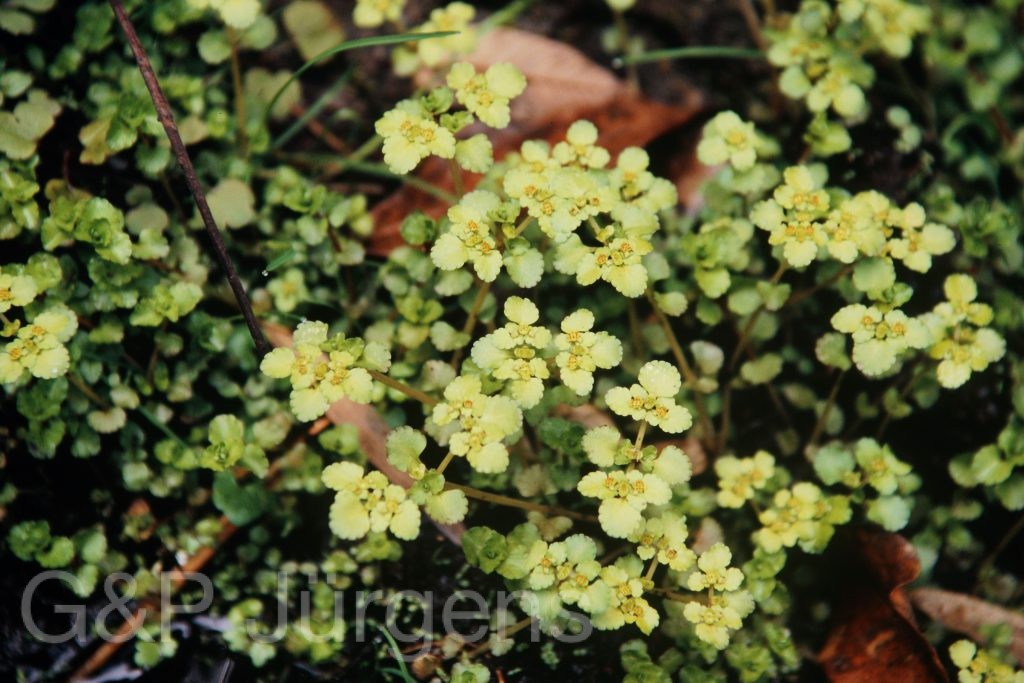
Bunge

BhutanPG2011 422
Bhutan Warrthang, 4400m June
BhutanPG2011 212 scaled
Bhutan Warrthang, 4400m June

Description

Chrysosplenium nudicaule is a small alpine herb of the high mountains of central and eastern Asia, recorded from China, the Russian Far East and Siberia, Kazakhstan, Kyrgyzstan, Nepal, Bhutan, northern India and Japan, with 323 GBIF occurrences. It is a plant of moist, cold, rocky habitats: streambanks, wet gravels, seepages, scree and the margins of snow-melt rills in the alpine and subnival zones, generally between 3500 and 5300 m. The illustrated plant was photographed at Warrthang in Bhutan at 4400 m in June, when the species flowers shortly after snow-melt in the brief high-alpine growing season.

It is a low, tufted, fleshy perennial spreading by slender stolons or rhizomes and forming small mats. The largely basal leaves are reniform to flabellate with a few broad crenate teeth, somewhat succulent, on slender petioles, while the flowering stems are nearly leafless (hence nudicaule). The inflorescence is a compact terminal cyme subtended by conspicuous yellow-green floral bracts. The flowers are apetalous, the showy parts being four erect, suborbicular yellow-green sepals; there are eight stamens and a bicarpellate ovary with two diverging styles. The fruit is a two-lobed capsule splitting to release numerous minute, finely papillose seeds.

The golden saxifrages, Chrysosplenium, are a north-temperate and arctic-alpine genus distinguished by petal-less, sepal-coloured flowers; C. nudicaule belongs to a Sino-Himalayan group of stoloniferous high-elevation species. Its small bract-framed flowers attract flies and other small insects, and stolon growth permits clonal spread across unstable wet substrates. With a very wide circum-Asian distribution it is not considered threatened, although its dependence on reliable snow-melt moisture makes it a useful indicator of alpine hydrological change.

Author: Bunge · Sources: POWO (Kew), GBIF, Flora of China, Flora of Bhutan, Hara: The Flora of Eastern Himalaya

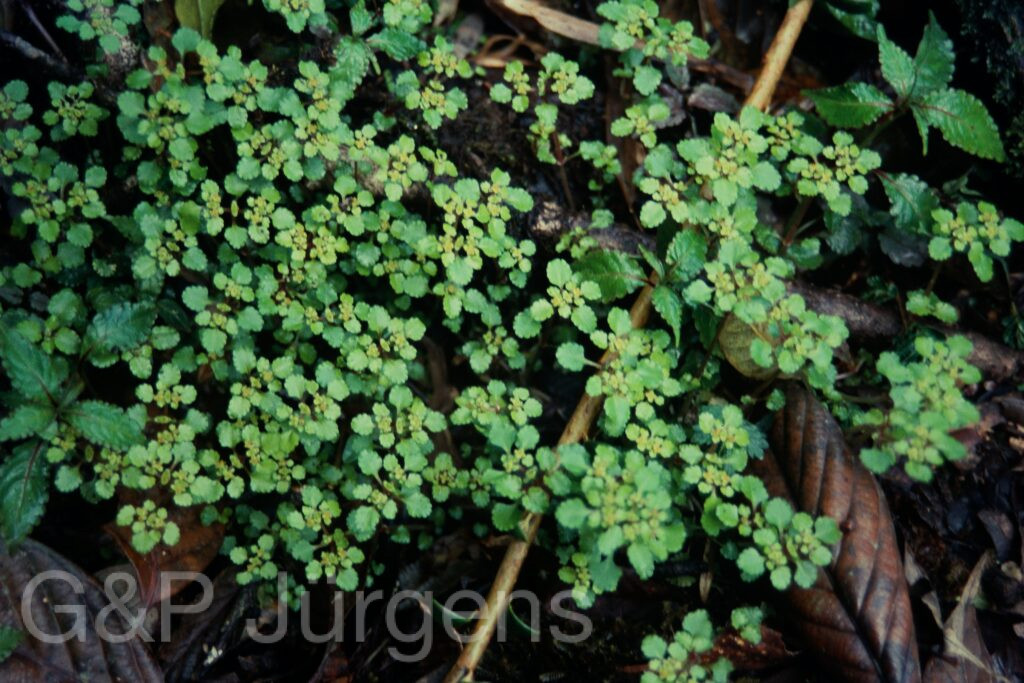
Hook.f. & Thomson

Bhutan2014 917
Bhutan Chele-La 4300m, May
Bh2008 583 P873
Bhutan Chele-La 3900m April

Description

Chrysosplenium tenellum is a diminutive, high-alpine member of its genus restricted to the central and eastern Himalaya, with a sparse GBIF record (32 occurrences) from India, Nepal, Bhutan and China that reflects both its narrow range and its inconspicuous habit. It grows in cold, wet places near the upper limit of vegetation: on dripping rocks, beside snowmelt rills, in mossy seepages and on shaded humus among boulders, generally between about 3500 and 4500 m. The collections illustrated from the Chele La in Bhutan, at 4300 m in May and 3900 m in April, document its very early flowering immediately following snowmelt at these elevations.

The plant is a delicate, slender perennial herb, the epithet tenellum aptly describing its tenuous form. It produces fine, creeping and rooting stems that form small loose patches, with thin filiform stolons. The leaves are small, alternate or the lower opposite, petiolate and reniform to orbicular with a few shallow crenations. As in all Chrysosplenium the flowers lack petals; the tiny terminal cyme is subtended by small yellowish-green leafy bracts that provide the floral display. Each flower has four greenish sepals, few stamens and a half-inferior ovary maturing into a small two-lobed, divaricately beaked capsule that opens to release minute seeds dispersed by splashing water.

Within the moisture-dependent genus Chrysosplenium, C. tenellum represents the alpine extreme, a slight plant of fragile, ephemerally wet microhabitats at the margins of permanent snow. Its small flowers are visited by the few high-altitude flies active early in the season. Owing to its restricted distribution, specialised hydrological niche and low number of documented occurrences, the species is potentially vulnerable to warming-driven shifts in snowmelt regimes, although it has not been formally assessed.

Author: Hook.f. & Thomson · Sources: POWO (Kew), GBIF, Flora of China, Flora of Bhutan, Annotated Checklist of the Flowering Plants of Nepal, Monograph of Chrysosplenium (Hara)

Losinsk.

BhutanPG2011 567 1
Bhutan Jule-Tso, 4300m June

Description

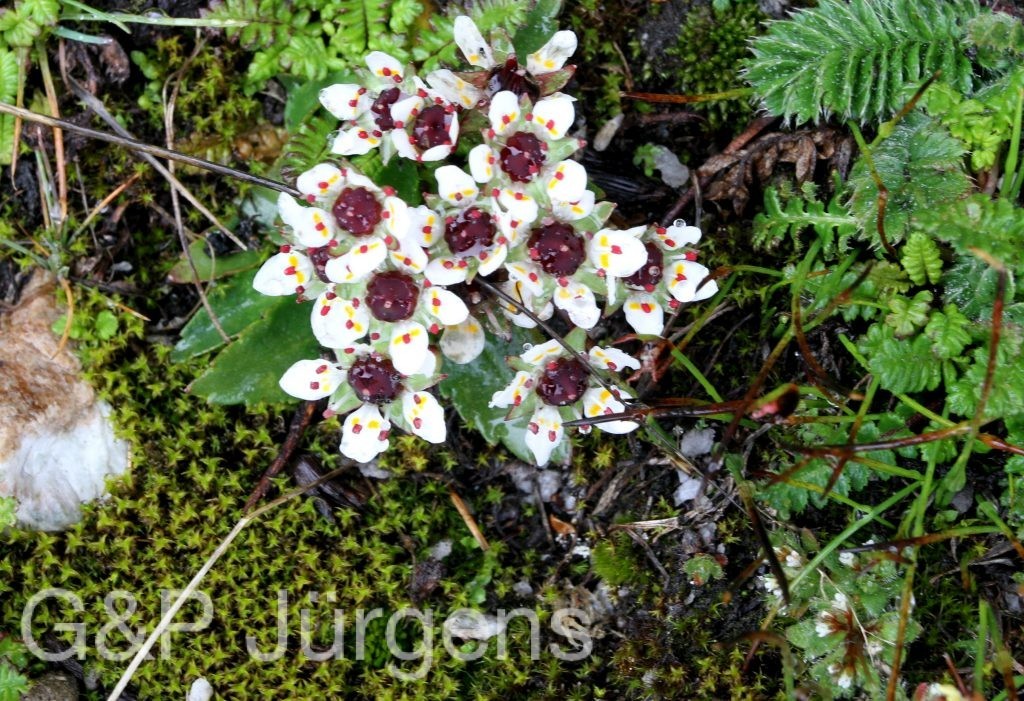
Micranthes melanocentra (long known as Saxifraga melanocentra) ranges through the high mountains of China, Nepal, India, Bhutan and Pakistan, with about 784 records tracing the Himalaya and the Hengduan and Tibetan ranges. It is a true alpine, the image documenting it at Jule-Tso in Bhutan at about 4300 m in June, at the onset of the brief alpine summer. It occupies open alpine meadow, stony slopes, moraine, streamsides and damp turf above the treeline on moist, well-drained gravelly and rocky substrates, where snowmelt provides early-season moisture and the growing season is compressed into a few weeks.

It is a small rosette-forming perennial herb arising from a short rootstock. The leaves are basal, obovate to spathulate, with crenate to dentate margins, narrowing to a broad petiole and often somewhat fleshy. From the rosette rises a leafless, glandular-hairy scape bearing a corymbose to subcapitate cyme of several flowers. The flowers have five white (sometimes pink-tinged) petals, and the species takes its epithet from the dark, almost blackish, contrasting centre formed by the deep-coloured ovary and the conspicuous reddish to purple-black anthers. The fruit is a two-beaked capsule releasing numerous small seeds.

The species was described by Losinskaja and is now placed in the segregate genus Micranthes, separated from Saxifraga sensu stricto on molecular and morphological grounds, comprising the rosette-leaved, scapose saxifrages. Its dark-centred white flowers are visually distinctive among Himalayan alpines and provide a contrasting nectar guide for insect pollinators. Adapted to cold, high-radiation alpine conditions, it is widespread and locally common across its montane range and is not considered threatened.

Author: Losinsk. · Sources: POWO (Kew), GBIF, Flora of China, Flora of Bhutan, Saxifragaceae monograph and Micranthes phylogenetic studies

Losinsk.

BhutanPG2011 366
Bhutan Tsochenchen, 3550m June

Description

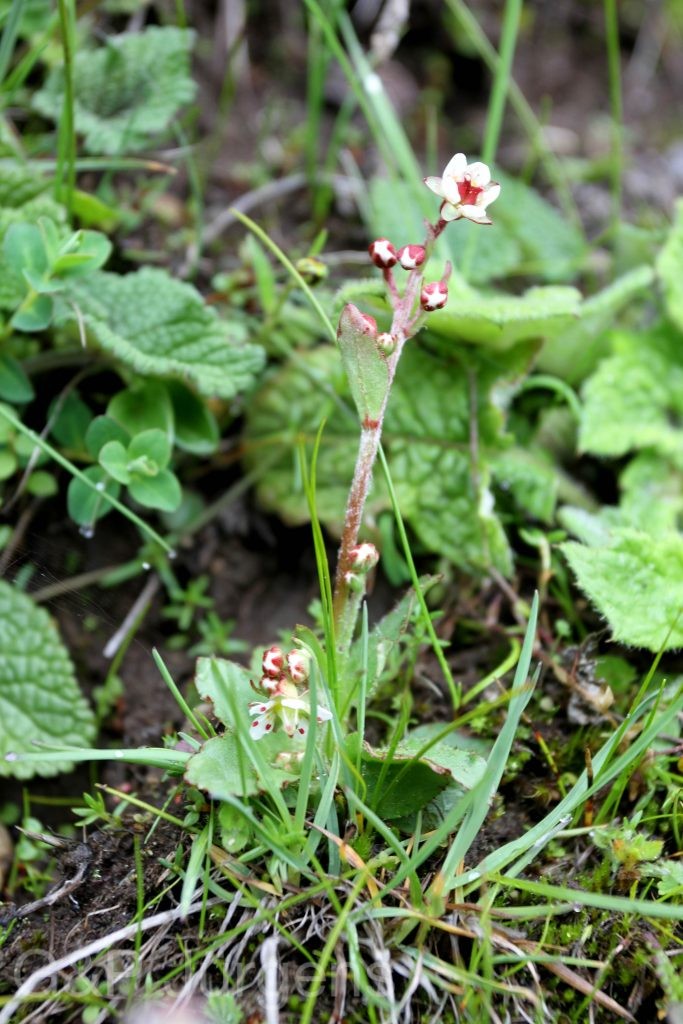
Micranthes pallida (formerly placed in Saxifraga, as reflected in the source link) is a Himalayan rosette herb distributed across the high mountains from Pakistan and northern India through Nepal and Bhutan into south-western China and northern Myanmar; with over 650 georeferenced occurrences (CN, NP, IN, BT, PK, MM) it is one of the more frequent members of its group. It inhabits damp alpine meadows, mossy rock ledges, stream margins and shaded slopes, typically between about 3000 and 4500 m. The plant recorded at Tsochenchen in Bhutan at 3550 m in June, flowering in the brief alpine summer, is characteristic of its cool, moist montane-to-alpine habitat.

It is a perennial herb forming a basal rosette of leaves on a short rhizome. The leaves are spathulate to obovate or broadly ovate, with a cuneate base tapering into a broad petiole, the margins coarsely toothed or crenate, and the blade thin-textured and often somewhat pale or glaucous. From the rosette rises a slender, glandular-pubescent flowering stem bearing a lax, often paniculate or corymbose cyme of small flowers. Each flower has five spreading whitish to pale greenish petals, ten stamens and a half-inferior, bicarpellate ovary that ripens into a many-seeded, two-beaked capsule.

Micranthes is now widely recognised as a genus distinct from Saxifraga sensu stricto, corresponding to the former Saxifraga sect. Micranthes, supported by molecular and morphological evidence; M. pallida belongs to this assemblage of broad-leaved, rosette-forming species. Adapted to the harsh alpine regime through its perennating rhizome and ground-hugging habit, it is widespread and not regarded as threatened across its extensive range.

Author: Losinsk. · Sources: POWO (Kew), GBIF, Flora of China, Flora of Bhutan, Flora of Pakistan, Gornall's revision of Saxifragaceae