
Hook.f. & Thomson
Description
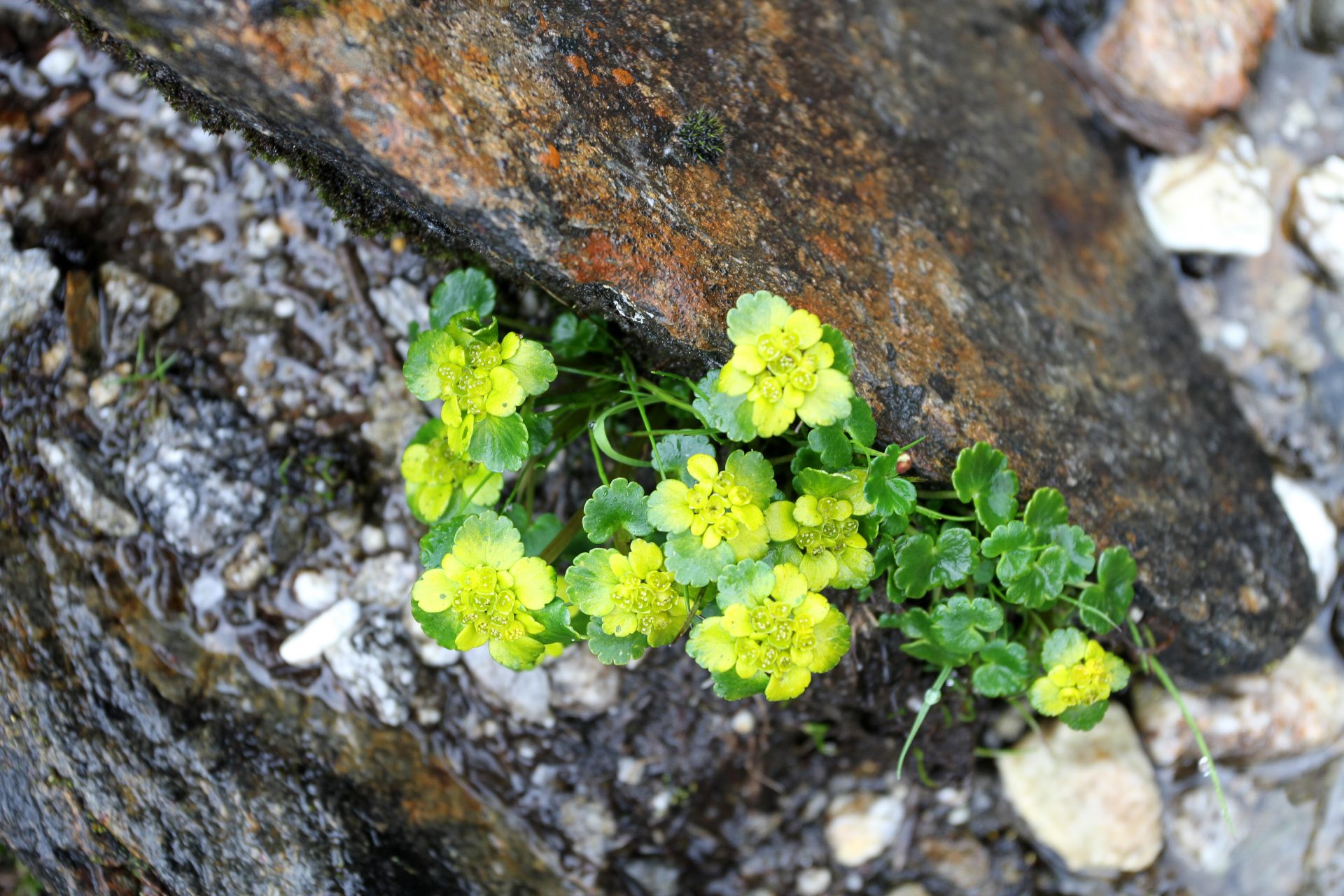
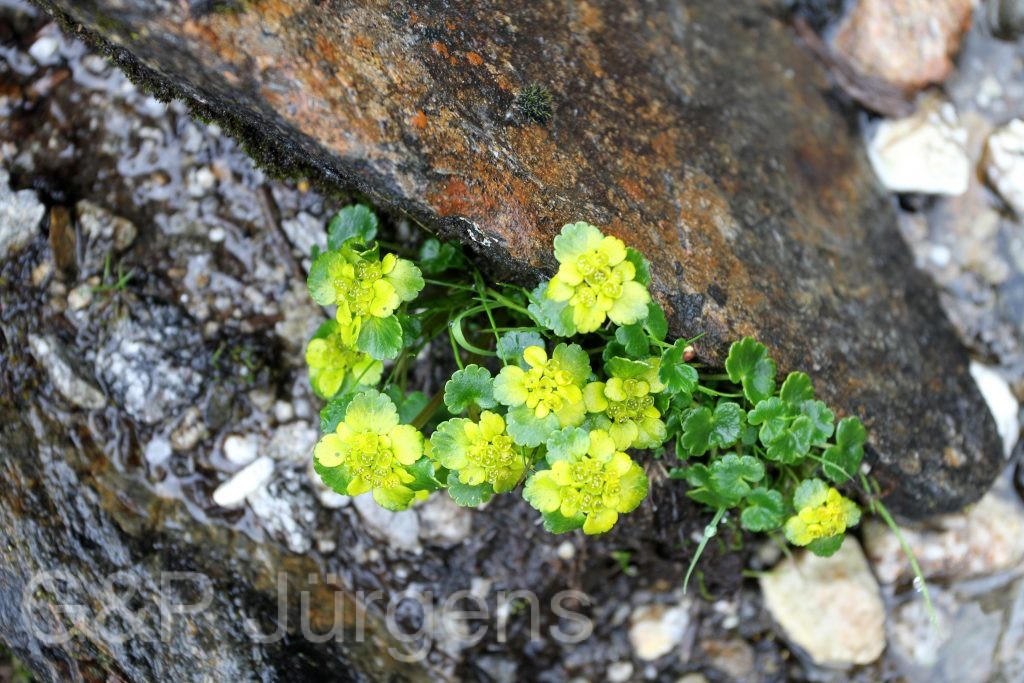
A small perennial golden-saxifrage of the high Himalaya and the eastern Tibetan region, recorded from China, Bhutan, India and Nepal, with about 485 GBIF occurrences. It is a plant of cold, wet ground, frequenting seepages, stream margins, dripping rock ledges, snowmelt flushes and moist alpine meadows, generally between about 3300 and 4800 m. The figured plant was photographed in June on the Jule-La in Bhutan at roughly 4610 m, an exceptionally high, water-saturated alpine habitat that suits its preference for permanently moist, cool substrates.
The species is a low, somewhat fleshy herb spreading by short stolons and slender rhizomes to form loose patches. The leaves are mostly alternate, with rounded to flabellate, crenate blades on slender petioles. The inflorescence is a flattened, leafy-bracted cyme in which the conspicuous element is not the petals, which are absent, but the four spreading, yellow to greenish-yellow sepals surrounding a flat floral disc. Each flower has eight stamens inserted around the disc and a semi-inferior ovary of two carpels with divergent styles. The fruit is a two-beaked, widely gaping capsule that opens to expose numerous tiny seeds, which are splashed out by raindrops, a dispersal mode well suited to its wet habitats.
Accepted by POWO and GBIF, C. griffithii belongs to a genus of typically apetalous, water-loving herbs in which species are separated by leaf arrangement, stolon habit and seed surface. Ecologically it is a specialist of alpine springs and flushes, often growing among mosses, and is an indicator of cold, base-rich seepage. Restricted to such microhabitats but widespread across the high Himalaya, it is locally frequent and not regarded as threatened, though dependent on stable hydrology in a warming alpine environment.
Author: Hook.f. & Thomson · Sources: POWO (Kew), GBIF, Flora of China, Flora of Bhutan, Hara revision of Himalayan Saxifragaceae