
(Hook.f. & Thomson) Engl.
Description
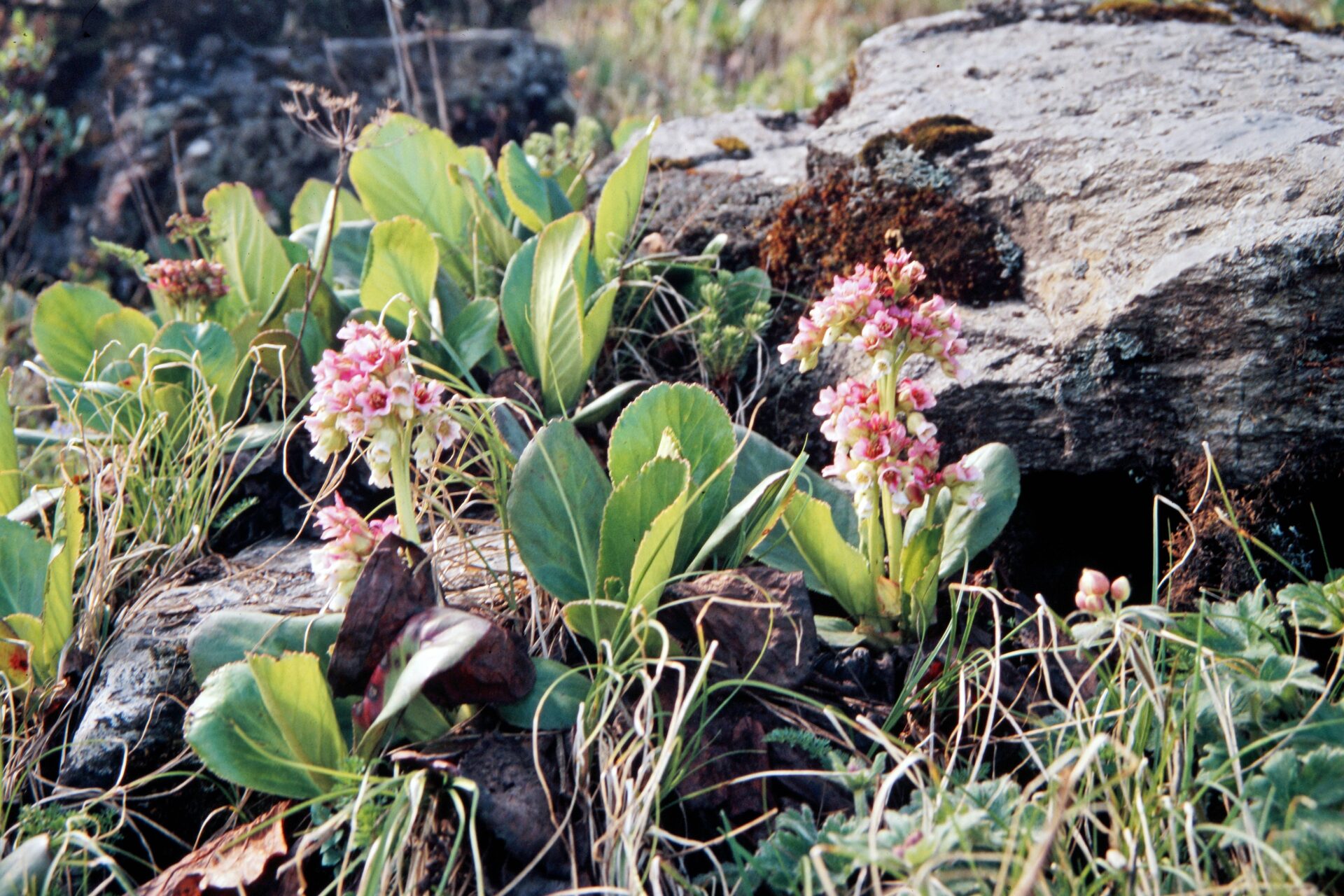
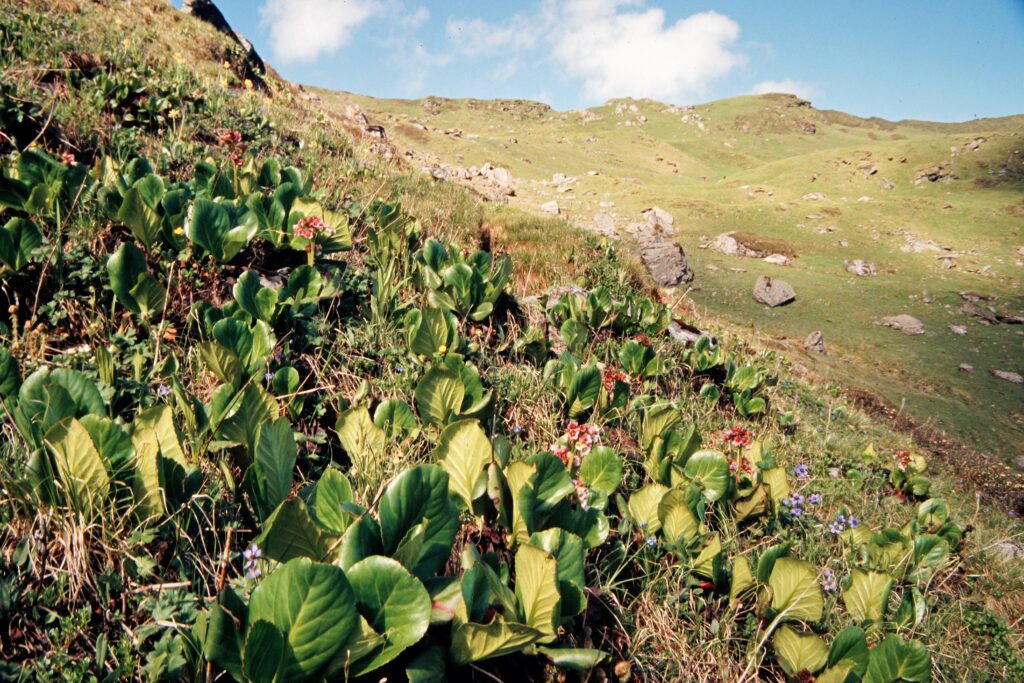
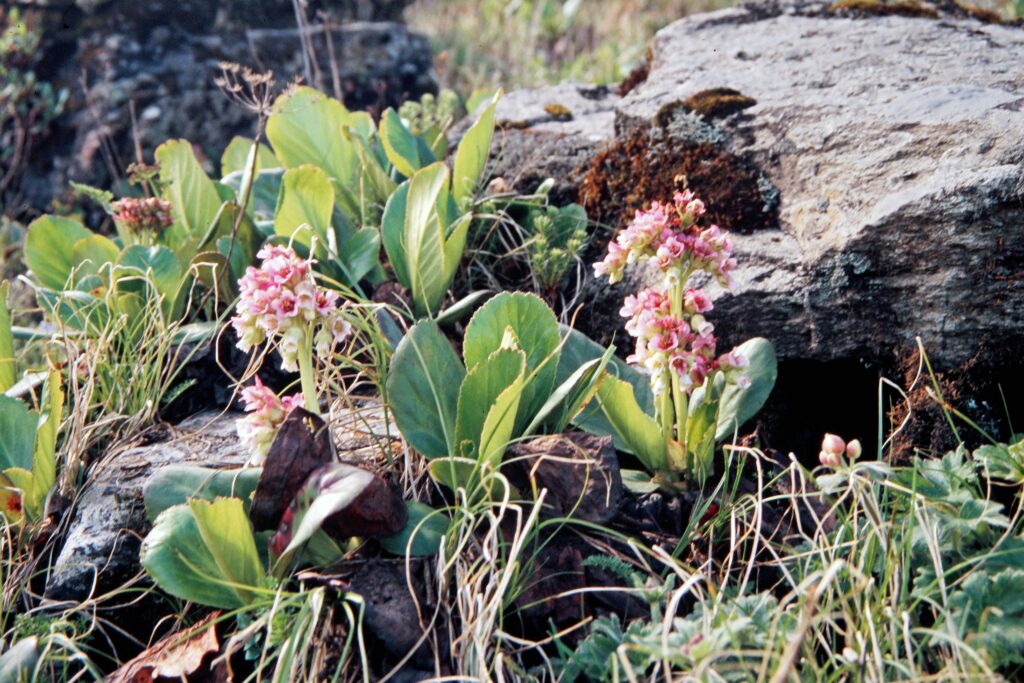
Bergenia stracheyi (Hook.f. & Thomson) Engl. is a perennial rock-dwelling herb of the higher Himalaya, native to Pakistan, north-west India, Afghanistan and adjacent China, with a GBIF record total (371 occurrences) inflated by its popularity in cultivation across Europe and North America. In its natural range it is a plant of moist alpine and subalpine ledges, screes, cliff crevices and stream banks, typically between about 3000 and 4500 m. The photographed individual, from Seema in Garhwal (Indian Himalaya) at 3700 m in June, exemplifies its habitat among shaded, humus-filled rock fissures where snowmelt provides reliable summer moisture.
The plant develops a stout, woody, creeping rhizome anchoring rosettes of thick, leathery, evergreen leaves. The leaf blades are obovate to broadly elliptic, glabrous, with crenate to entire ciliate margins and prominent reticulate venation, often flushing red in cold or exposed conditions. The inflorescence is a compact, nodding to erect cyme borne on a short fleshy scape, carrying campanulate flowers with five rose-pink to deep magenta petals, a persistent calyx, ten stamens and a bicarpellate, partly inferior ovary. The fruit is a capsule splitting to release numerous small seeds.
The genus Bergenia, often called elephant's-ears, comprises a small group of Asian saxifrages prized horticulturally for their bold foliage and early flowers; B. stracheyi is among the most cold-hardy and compact species and figures in the parentage of garden hybrids. In the wild its rhizomes have local medicinal use. Though not threatened owing to its broad montane distribution, populations are localised by their specialised cliff and scree microhabitats.
Author: (Hook.f. & Thomson) Engl. · Sources: POWO (Kew), GBIF, Flora of Pakistan, Flora Simlensis, Saxifragaceae of the Sino-Himalaya, Royal Horticultural Society monograph on Bergenia