
(K.C.Sahni & Bahadur) C.Y.Wu & T.L.Ming
Description
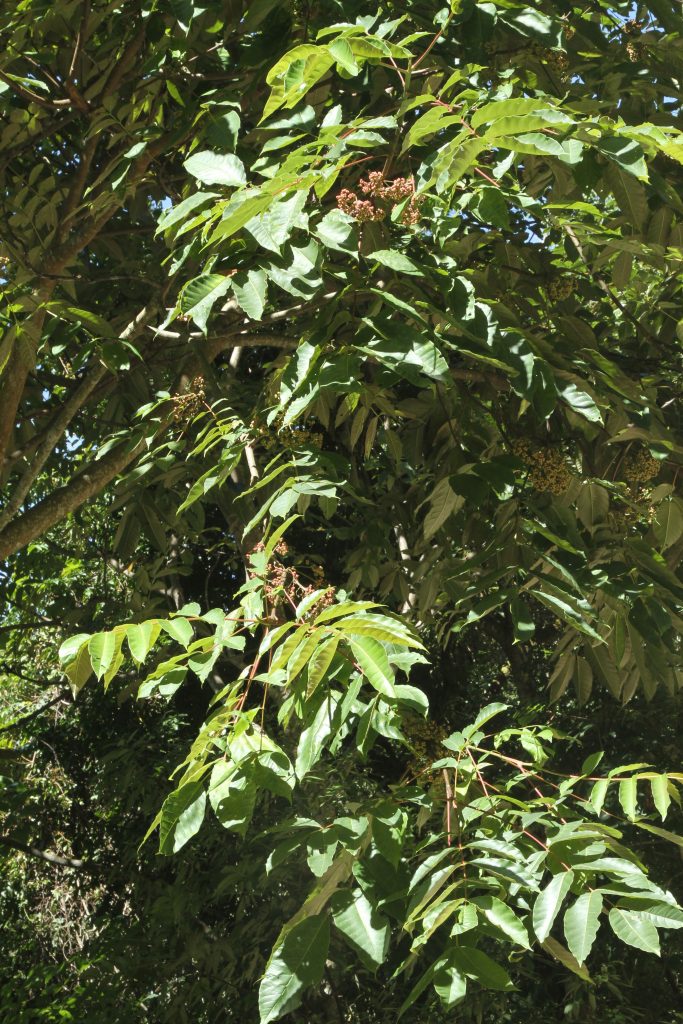
Toxicodendron hookeri is a Himalayan and southwest Chinese sumac distributed through Nepal, the Indian Himalaya, Bhutan, southern China and into Thailand, with about 104 GBIF occurrences. It is a tree of warm subtropical and lower temperate broadleaved forest, growing along forest margins, on open slopes, in secondary woodland and in ravines on well-drained soils. The plant photographed at Zhemgang in central Bhutan at about 1000 m in October is representative of its preferred lower-montane belt of roughly 800-2500 m, where the autumn collection captures the foliage as it turns brilliant red, the leaves reddening before they fall.
It is a deciduous shrub or small to medium tree with greyish bark and stout, glabrescent twigs exuding an irritant resinous sap. The leaves are alternate and pinnately compound with several pairs of opposite, ovate to oblong-lanceolate, entire leaflets and a terminal one, the rachis sometimes narrowly winged, the whole turning vivid scarlet in autumn. The small, greenish-yellow, functionally unisexual flowers are borne in axillary panicles, with a five-parted calyx and corolla and a single-loculed ovary. The fruit is a small, dry, somewhat compressed drupe with a hard endocarp, ripening pale and persisting on the bare branches.
The plant's legacy link refers to it under the name Rhus succedanea, reflecting the former placement of these taxa in a broad Rhus; modern treatments segregate the lacquer-sap species into Toxicodendron, of which T. hookeri is one. As in poison ivy and the lacquer tree, the sap contains urushiol-type alkylcatechols that cause severe contact dermatitis. The species belongs to the resin-yielding, wax-producing group long valued in eastern Asia, and its bright autumnal colour makes it conspicuous in the Himalayan forest.
Author: (K.C.Sahni & Bahadur) C.Y.Wu & T.L.Ming · Sources: POWO (Kew), GBIF, Flora of China, Flora of Bhutan, Min & Barfod Anacardiaceae account, Gillis revision of Toxicodendron