Caprifoliaceae

Wall.

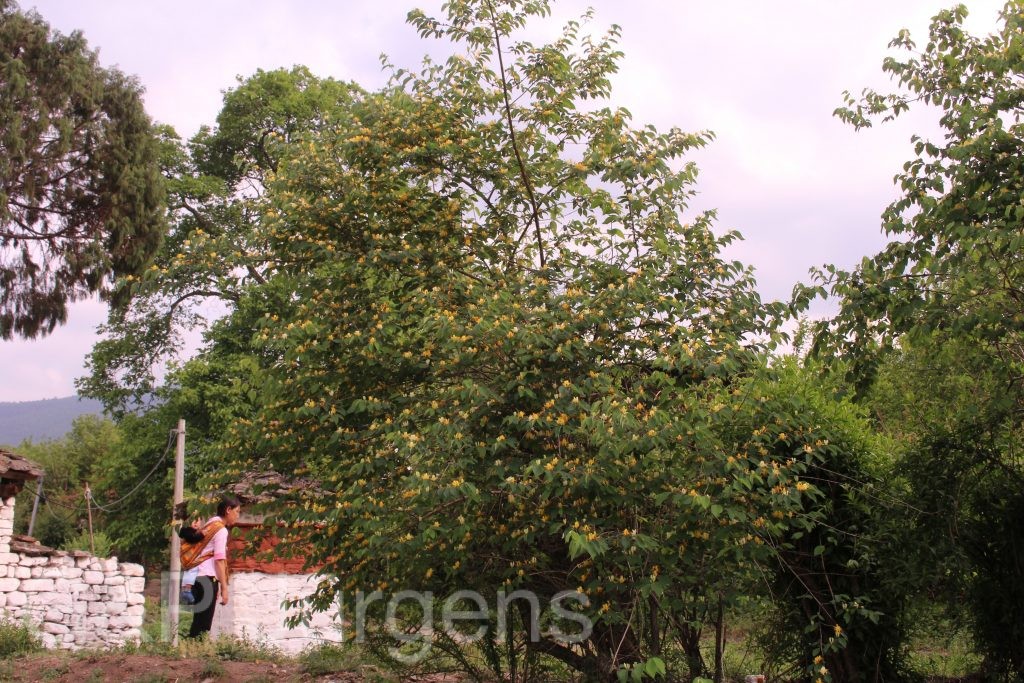
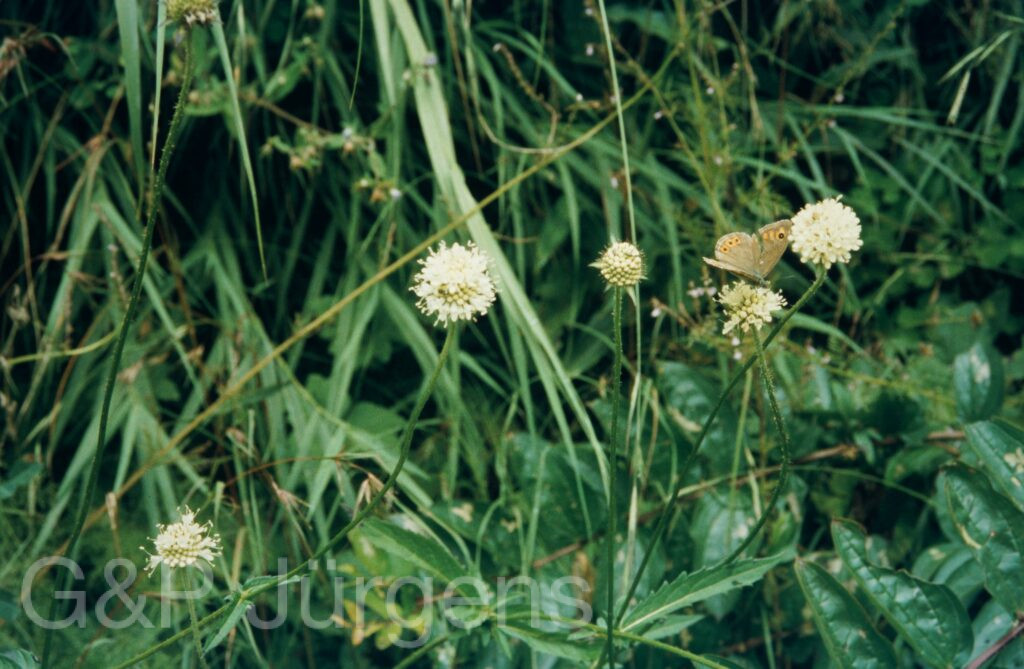
Bhutan2015 479
  Bhutan Pele-La 3200m, October
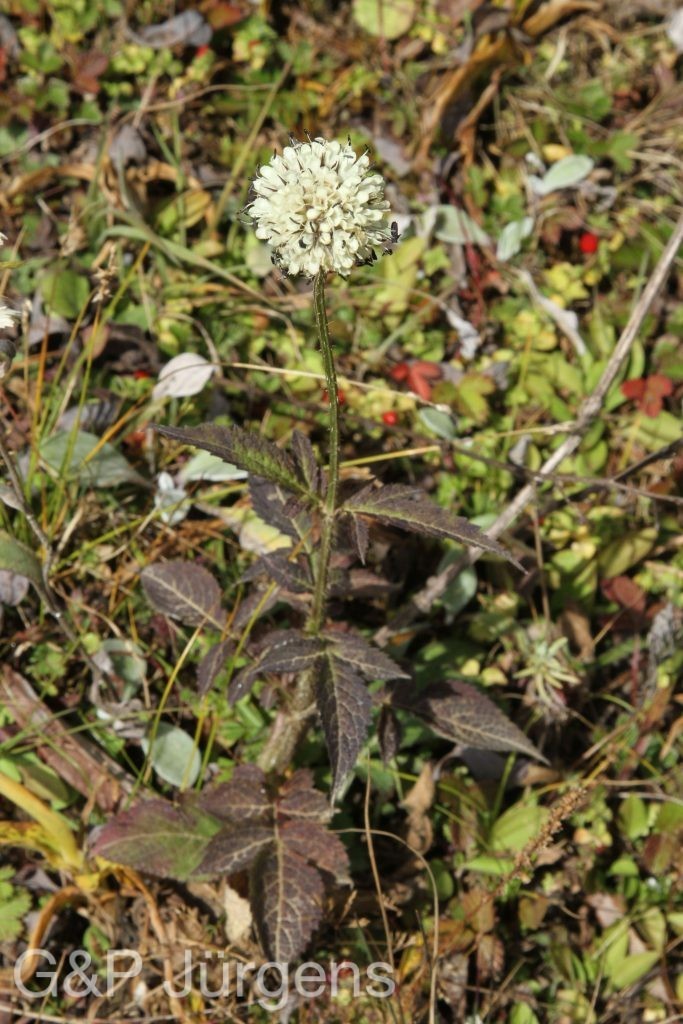
Garw 2005 272 ergebnis
India Garhwal Kunol 2450m, September

Description

Dipsacus inermis is a tall biennial or short-lived perennial herb widely distributed through the temperate Himalaya and into China and Myanmar, with naturalised and casual occurrences recorded as far afield as Britain, Ireland, Portugal, Turkey and the United States among its 830-odd documented records. Within its native range it grows in forest clearings, along streamsides, in damp meadows and on disturbed slopes from about 1800 to 3500 m. The illustrated plants come from Pele-La in Bhutan at 3200 m in October and from Kunol in Garhwal, India, at 2450 m in September, the latter date capturing the fruiting season.

The species develops a furrowed, sparsely prickly to nearly unarmed stem (whence the epithet inermis), distinguishing it from the strongly spiny teasels. Leaves are opposite, the lower petiolate and often lyrate-pinnatifid, the cauline sessile and lanceolate, frequently connate at the base. The inflorescence is a dense ovoid to globose capitulum subtended by linear involucral bracts; the receptacular bracts are awned. Individual flowers are small, with a four-lobed whitish to pale purple corolla and an epicalyx surrounding each floret; the calyx is cup-shaped and the fruit an achene crowned by the persistent calyx.

Formerly placed in the family Dipsacaceae, the genus is now subsumed within an enlarged Caprifoliaceae following molecular reclassification. The plant is insect-pollinated and its seed-heads provide forage for granivorous birds. It is a vigorous coloniser of disturbed ground, accounting for its sporadic naturalisation outside Asia; it carries no conservation concern across its extensive native distribution.

Author: Wall. · Sources: POWO (Kew), GBIF, Flora of China, Flora of Bhutan, Flowers of the Himalaya, Caprifoliaceae monograph
(Hook. f. & Thomson) Hook.f.

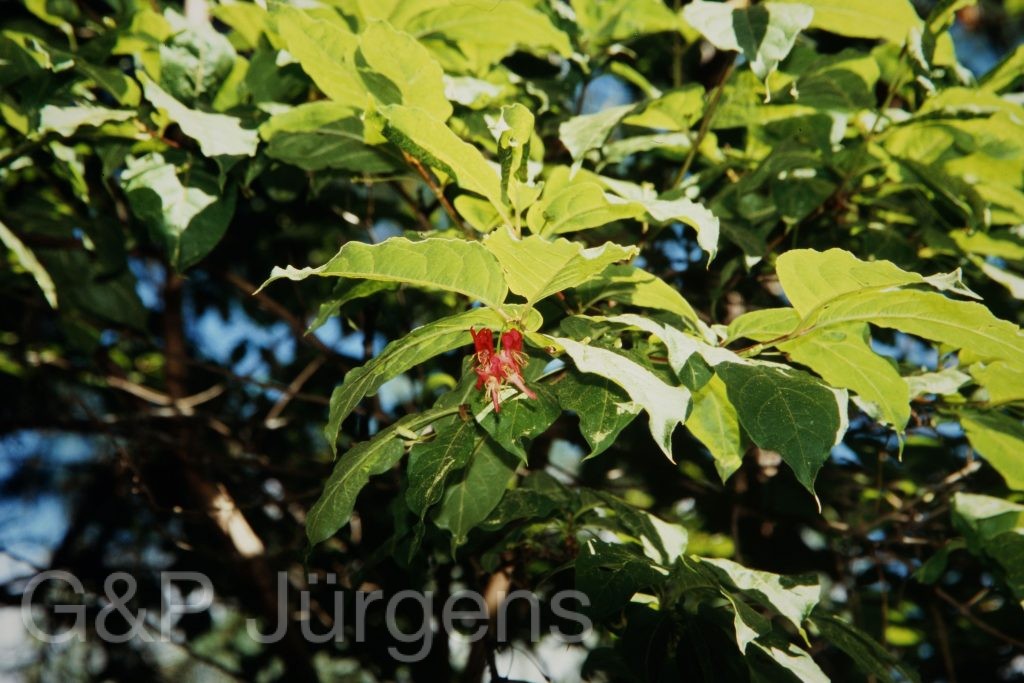
Bhutan2014 312
Bhutan Tumching-La 2600m, May

Description

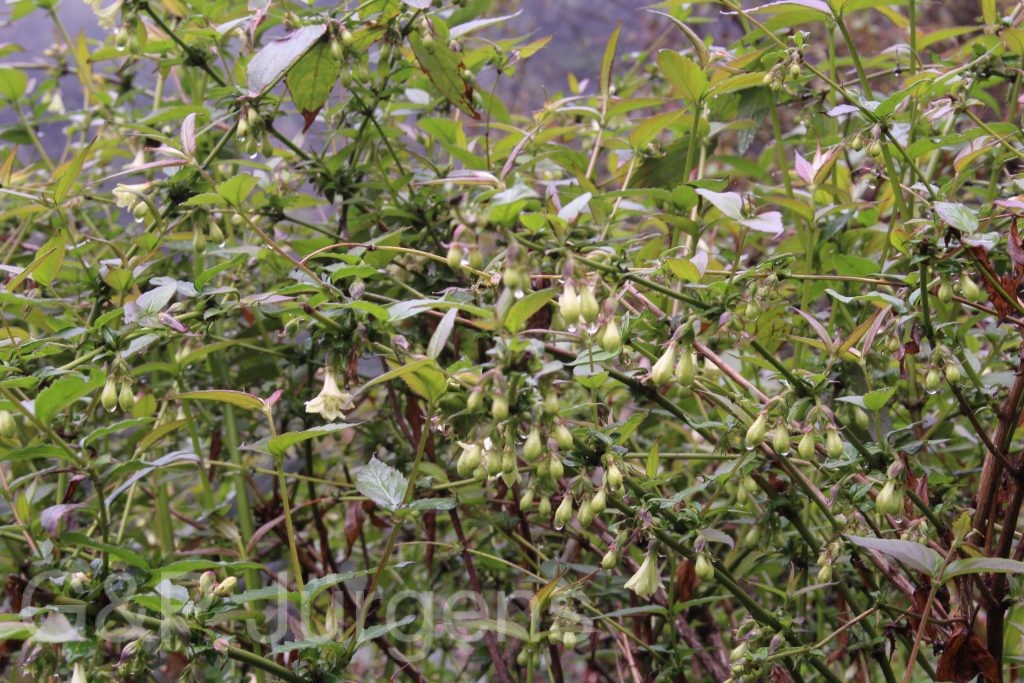
Leycesteria glaucophylla is an eastern Himalayan shrub distributed across India, China, Bhutan and Nepal and into Myanmar; GBIF documents about 113 occurrences, including a few cultivated records in Great Britain and New Zealand. It is a plant of temperate montane forest, occurring at forest margins, in shrubberies, along stream sides and in clearings, generally between about 2000 and 3000 m. The photographed individual grows in Bhutan at Tumching La at around 2600 m in May, a setting typical of this shade-tolerant honeysuckle relative within the cool, humid forests of the eastern Himalaya during the pre-monsoon period.

The species is an erect, deciduous shrub with hollow, often glaucous young stems. The leaves are opposite, ovate to lanceolate, acuminate, entire to slightly toothed, and conspicuously glaucous, particularly beneath, a feature reflected in the epithet glaucophylla. The flowers are borne in pendulous, bracteate terminal and axillary inflorescences subtended by leafy bracts; each has a tubular, funnel-shaped, white to pinkish corolla with five short lobes. The fruit is a many-seeded berry ripening to a dark purplish colour, attractive to birds which act as the principal seed dispersers.

Leycesteria glaucophylla (Hook.f. & Thomson) Hook.f. belongs to a small genus of Himalayan and Sino-Himalayan shrubs allied to Lonicera, placed in Caprifoliaceae; its showy bracts and pendulous spikes give the genus ornamental interest, and several species are cultivated. The species is restricted to the eastern Himalaya and adjacent ranges but is locally frequent in montane forest and not currently regarded as threatened. Its bird-dispersed berries aid colonisation of forest gaps and margins.

Author: (Hook. f. & Thomson) Hook.f. · Sources: POWO (Kew), GBIF, Flora of Bhutan, Flora of China, taxonomic revisions of Leycesteria (Caprifoliaceae)

(Kurz) Airy Shaw

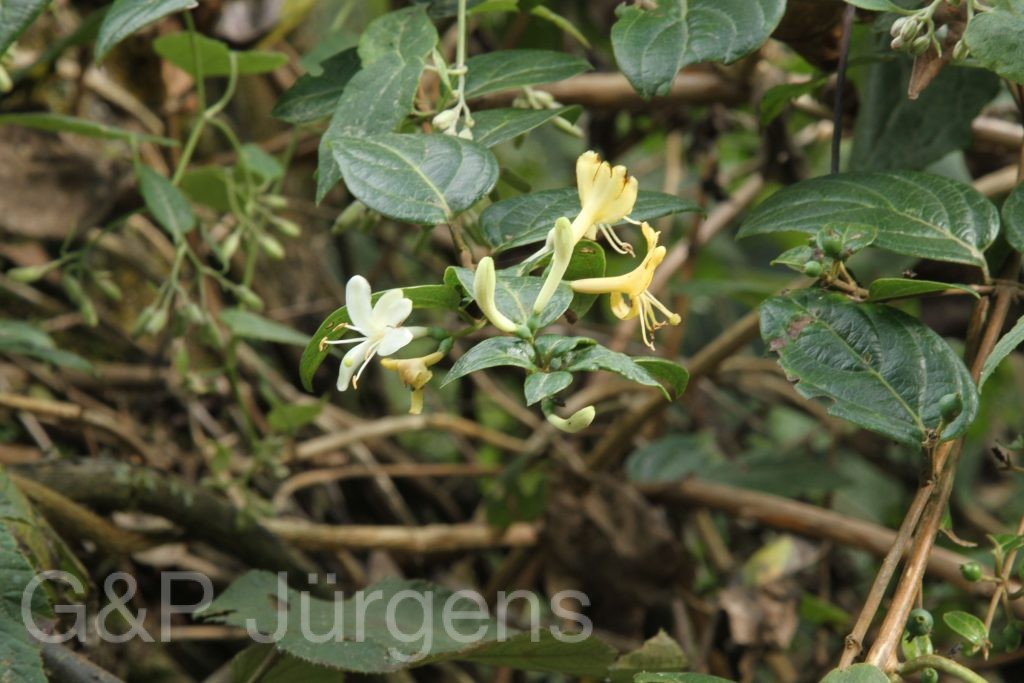
Bh2008 326 P504
Bhutan Jakar, 3000m April

Description

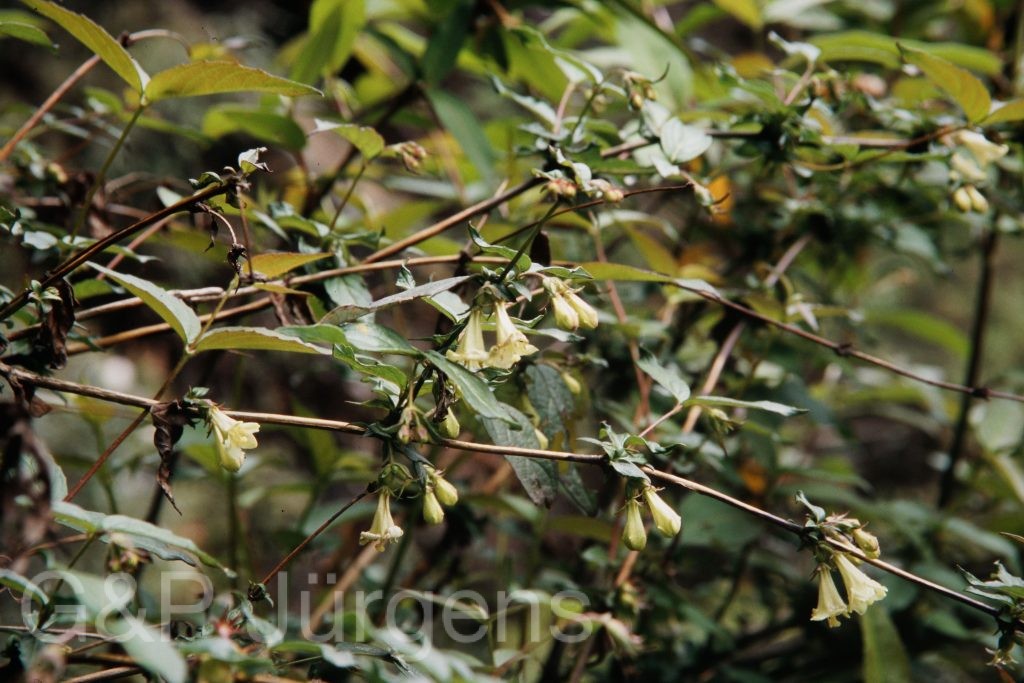
Leycesteria gracilis is a Himalayan and Sino-Himalayan shrub, GBIF recording around 232 occurrences from China, India, Bhutan, Nepal and Myanmar, with scattered records from Japan. It grows in the understorey and at the margins of temperate broadleaved and mixed forest, in shrubberies, along forest tracks and on shaded, moist banks, generally at mid to upper montane elevations between about 2400 and 3300 m. The plant photographed from Jakar (Bumthang) in central Bhutan at 3000 m, in early flower in April, is characteristic of its preference for cool, humid montane forest where it leafs and blooms in spring ahead of the summer rains.

It is a slender, erect to arching deciduous shrub with hollow, often glaucous young stems, more delicate in habit than its relative L. formosa—hence "gracilis." The leaves are opposite, ovate-lanceolate to lanceolate, long-acuminate, entire to finely toothed and thin in texture. The flowers are borne in pendulous, interrupted spikes or whorled clusters subtended by leafy, sometimes purplish bracts; each has a small calyx and a tubular to funnel-shaped, five-lobed corolla in shades of white, pink or pale purple. The fruit is a small, several-seeded berry ripening dark purplish to nearly black.

Transferred by Airy Shaw from Kurz's original epithet, L. gracilis belongs to the small Himalayan genus Leycesteria, now placed in Caprifoliaceae in its broad modern sense. It is locally frequent and not regarded as threatened, though dependent on intact montane forest. Ecologically its tubular flowers attract insect and bird pollinators, while its fleshy dark berries are taken by birds that disperse the seed, making it a useful component of regenerating montane scrub.

Author: (Kurz) Airy Shaw · Sources: POWO (Kew), GBIF, Flora of Bhutan, Flora of China, Airy Shaw revision of Leycesteria (Caprifoliaceae)

Wall. ex DC.

BhutanPG2011 141
Bhutan Tsochenchen, 3550m June
Bh09 325 P531
Bhutan Tumching, 3700m June

Description

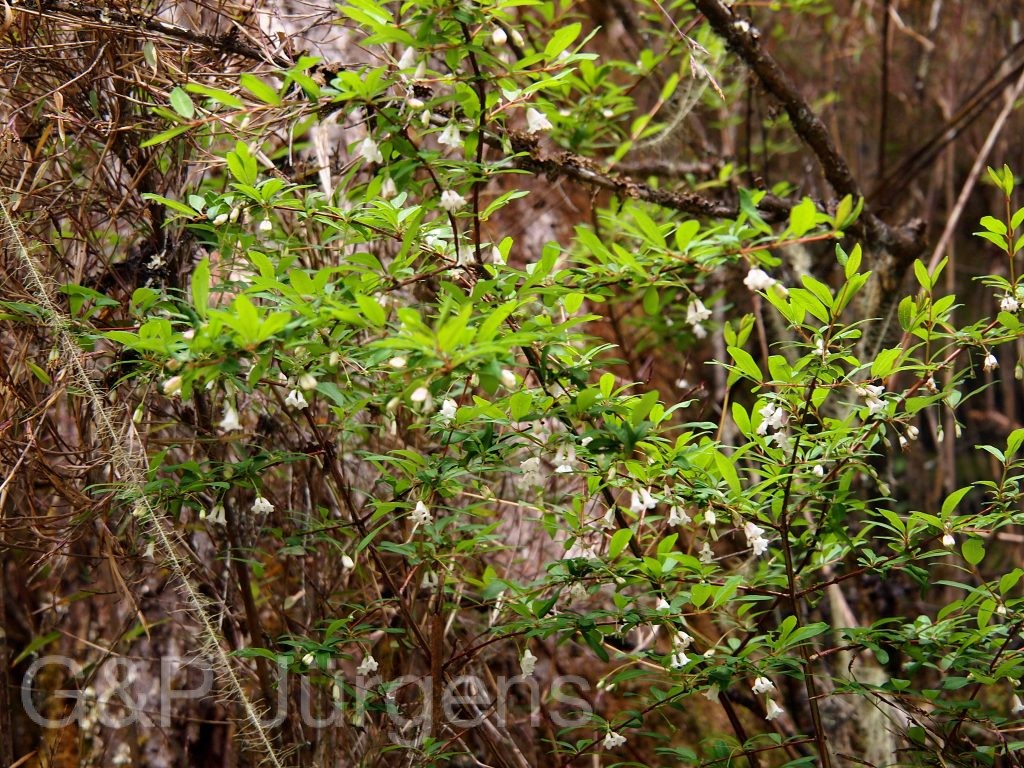
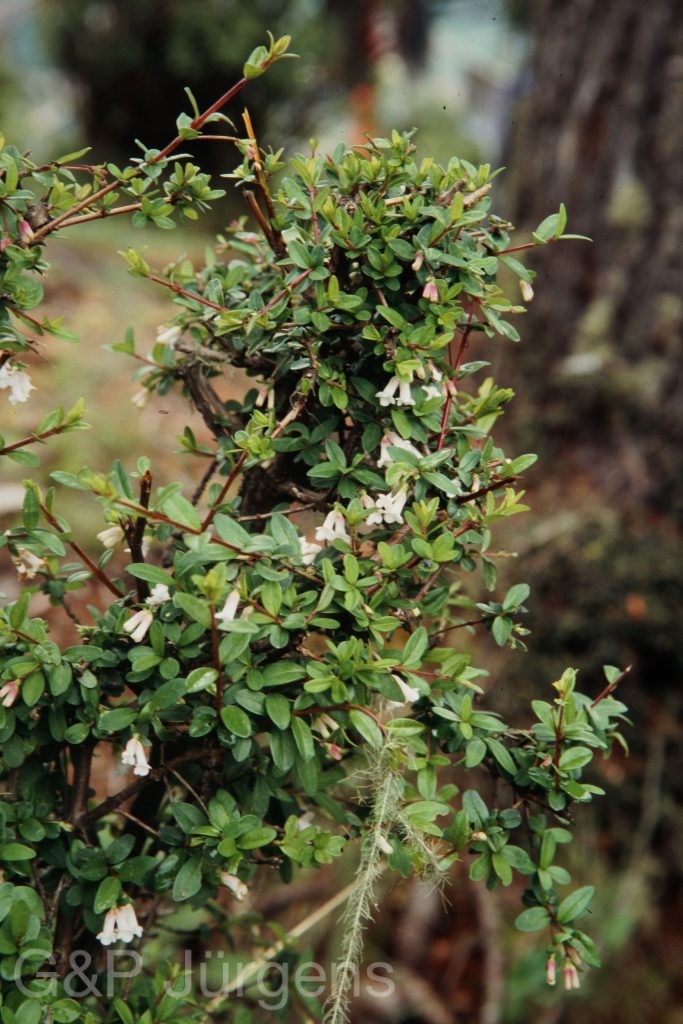
Lonicera angustifolia is a Sino-Himalayan honeysuckle distributed along the Himalaya from Afghanistan and Pakistan through India, Nepal and Bhutan to south-western China, with scattered records eastward to Myanmar; GBIF lists around 1,200 occurrences, several reflecting cultivation in Europe and North America. It is a shrub of the upper temperate and subalpine zones, occupying open coniferous and mixed forest, scrub, forest margins and rocky slopes, broadly from 2,400 to 4,000 m. The plants photographed at Tsochenchen at 3,550 m and Tumching at 3,700 m in Bhutan, both in June, show it flowering in early summer within high subalpine shrubbery near the upper forest limit.

It is an erect, much-branched deciduous shrub reaching 1-2.5 m, with slender greyish branchlets. The leaves are opposite, narrowly elliptic to oblong-lanceolate or linear, hence the epithet angustifolia ('narrow-leaved'), 1-4 cm long, entire and glabrous to thinly pubescent. The flowers are borne in axillary pairs on a common peduncle, each pair subtended by small bracts; the corolla is tubular-funnelform, two-lipped and pale pink to whitish, and the paired ovaries are partly fused. The two berries are connate at the base, ripening red and remaining largely free at the apex, each containing several seeds.

Lonicera section Isika, to which L. angustifolia belongs, comprises numerous shrubby, paired-flowered honeysuckles that are particularly diverse in the Himalaya and western China. Its tubular pink corollas are adapted to pollination by bees and long-tongued insects, while the bright red, partly fused berries are dispersed by birds and form an important food source in the subalpine zone. As a widespread, hardy and ecologically tolerant species spanning a broad elevational range, it is of least concern; its cold-hardiness and ornamental berries account for its occasional cultivation in temperate gardens.

Author: Wall. ex DC. · Sources: POWO (Kew), GBIF, Flora of China, Flora of Bhutan, Flowers of the Himalaya (Polunin & Stainton), monograph of Lonicera (Caprifoliaceae)

(Hook. f. & Thomson) Q. E. Yang, Landrein, Borosova & J. Osborne

Bh09 326 P532
Bhutan Tumching-La, 3700m June

Description

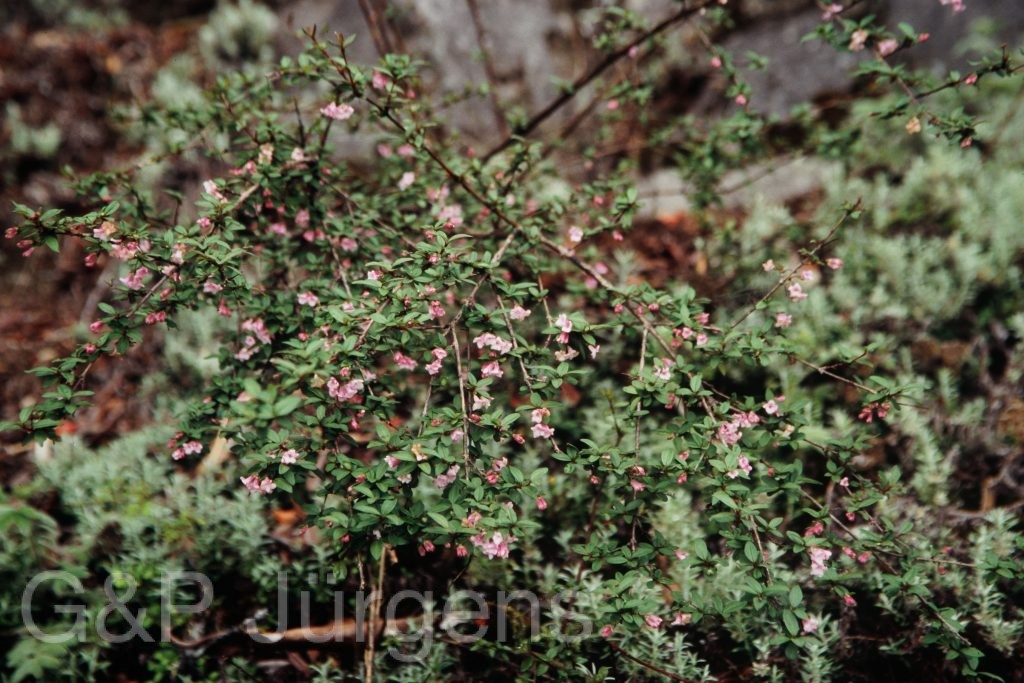
Lonicera angustifolia var. myrtillus is a high-montane to subalpine shrub of the Himalaya and adjacent ranges, recorded from China, Nepal, India, Pakistan, Bhutan, Afghanistan and Myanmar; GBIF holds about 873 occurrences for the taxon, with scattered cultivated records elsewhere. It is characteristic of the upper temperate and subalpine zone, typically between roughly 3000 and 4000 m, the photographed plant deriving from Tumching-La in Bhutan at 3700 m in June, at the onset of flowering. It grows in open coniferous and rhododendron forest, at the forest-line ecotone, and among scrub on rocky, well-drained slopes, often forming part of the dwarf-shrub understorey.

This variety is a small, much-branched deciduous shrub with slender, often arching twigs and small, opposite, entire leaves that are narrowly oblong to elliptic, the var. myrtillus being notably small-leaved and bilberry-like in aspect. The flowers are borne in axillary pairs on short peduncles; each pair subtended by bracts, the tubular-funnelform corolla is white to pale pink, weakly two-lipped or nearly regular. The paired ovaries are partly connate, and at maturity produce small, fused, juicy berries that ripen red, dispersed by birds, as is typical of the genus.

The combination (Hook. f. & Thomson) Q. E. Yang, Landrein, Borosova & J. Osborne reflects modern revisionary work on Himalayan Lonicera within an enlarged Caprifoliaceae. As an intraspecific taxon of a widespread, ecologically tolerant species, it is of no conservation concern, and like other shrubby honeysuckles it contributes nectar and fleshy fruit to subalpine pollinator and frugivore networks at the upper forest margin.

Sources: POWO (Kew), GBIF, Flora of China, Flora of Bhutan, Flora of Pakistan, Yang et al. revision of Lonicera (Caprifoliaceae), Rehder Synopsis of the Genus Lonicera

Wall.

Bhutan2015 600
Bhutan Gasa 1950m, October
Bhutan2015 601
Bhutan Gasa 1950m, October

Description

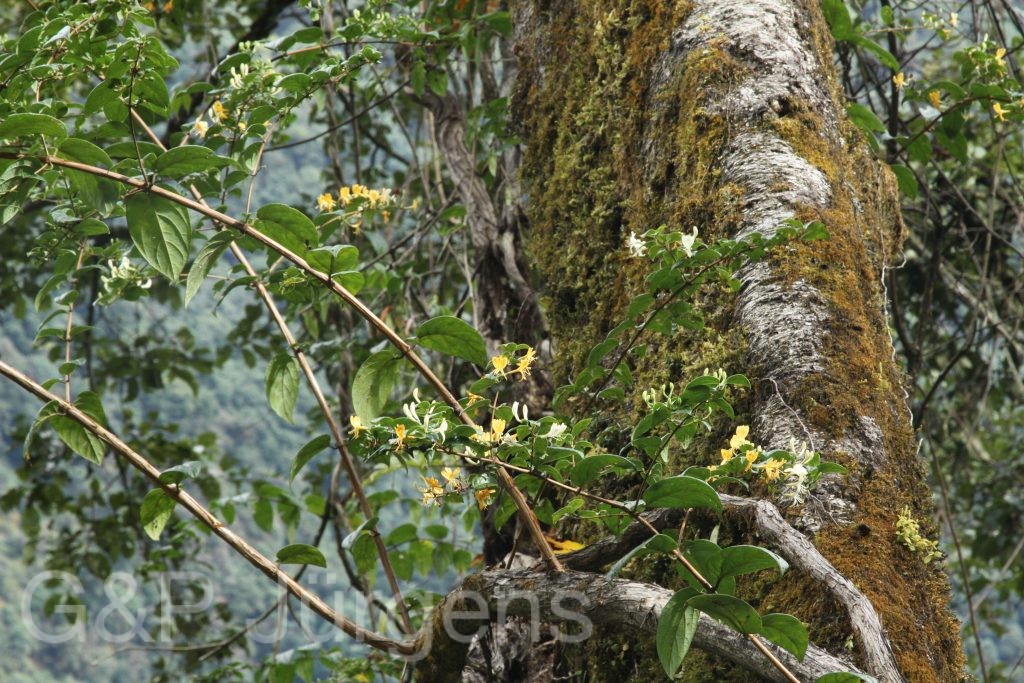
Lonicera glabrata is a Himalayan and Sino-Himalayan honeysuckle distributed from Nepal and India through Bhutan and Myanmar into south-western China; its c. 150 georeferenced records concentrate along the temperate forest belt of the eastern Himalaya. It grows in broadleaf and mixed forest, forest margins, thickets and shrubby slopes, generally between 1500 and 3000 m. The plant photographed at Gasa in northern Bhutan at 1950 m in October occupies the temperate forest zone, where its autumn fruiting follows the late-spring to early-summer flowering typical of the species.

It is a glabrous deciduous shrub, sometimes scandent, 1.5-3 m tall, distinguished as the epithet "glabrata" implies by its smooth, hairless foliage. The leaves are opposite, ovate to lanceolate, acuminate, entire and rather thin in texture. The flowers are borne in axillary pairs on a slender common peduncle, each two-lipped and creamy-white to pale yellow, fragrant, with a slender tube. Paired bracteoles subtend the ovaries. The fruit is a paired berry, the two ripening red to purplish-black, the partly fused pairs offering a conspicuous food reward. The four to five stamens and slender style are exserted from the corolla mouth.

Described by Wallich (as Wall.), L. glabrata belongs to Lonicera section Coeloxylosteum of the Caprifoliaceae, a group of paired-flowered Himalayan shrubs. The tubular, nectar-rich flowers are pollinated by bees and long-tongued insects, while the colourful berries are dispersed by birds. The species is widespread within its range and locally common in forest understorey, with no significant conservation concern, though it is sensitive to deforestation of mid-elevation broadleaf woodland.

Author: Wall. · Sources: POWO (Kew), GBIF, Flora of Bhutan, Flora of China, Flora of Nepal, Rehder's monograph of Lonicera (Caprifoliaceae)

Pall. ex Schult.

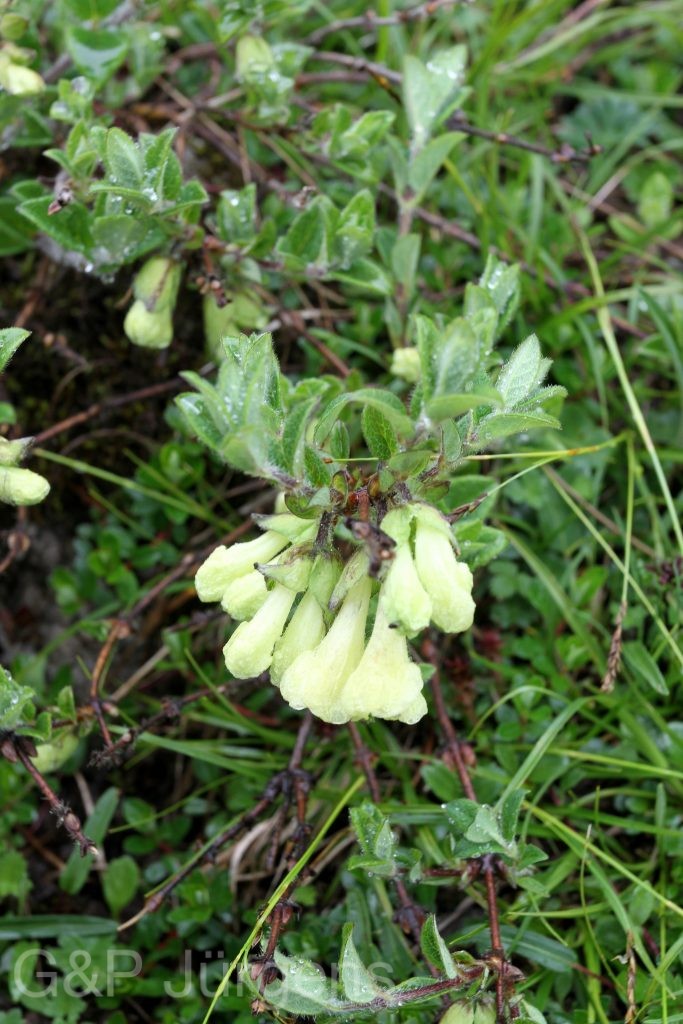
BhutanPG2011 590
Bhutan Kem-La 4100m, July
Garh 07 111 ergebnis
India Garhwal Meggu Kichatti 3200m, June

Description

Lonicera hispida is a deciduous shrub of the high mountains of Central and High Asia, ranging through the Himalaya from Pakistan and India to Nepal and Bhutan, across Tibet and western China, and northward into the Tien Shan, Pamir-Alai and Altai of Central Asia and Russia. It grows in subalpine and alpine scrub, open coniferous forest, stream banks and rocky slopes, typically between about 2500 and 4500 m. The photographed material comes from Kem-La in Bhutan at around 4100 m and from Meggu Kichatti in Indian Garhwal at about 3200 m, flowering in June and July. With over 3100 georeferenced records it is a well-documented and widespread montane honeysuckle.

It forms an erect, much-branched shrub up to about 2 m, the young shoots and petioles bristly-hispid with stiff spreading hairs and glandular bristles, the older bark exfoliating. The leaves are opposite, oblong to elliptic, ciliate and bristly-margined, often glaucous beneath. The flowers are borne in axillary pairs subtended by large, broad, persistent bracts that enlarge in fruit; the corolla is tubular-funnelform, white to pale yellow, weakly two-lipped, with a gibbous base and exserted stamens and style. The paired ovaries are partly united, and the fruit is a fleshy berry, red at maturity, the bracts often colouring and partly enclosing the twin fruits.

Lonicera hispida belongs to section Isika and is distinguished by its conspicuously hispid bristly indumentum and large floral bracts. It is morphologically variable across its enormous range, and several varieties have been recognised. The berries are taken by birds, aiding dispersal. As a common, broadly distributed alpine shrub it is of least conservation concern.

Author: Pall. ex Schult. · Sources: POWO (Kew), GBIF, Flora of China, Flora of Bhutan, Rehder's revision of Lonicera

Walp.

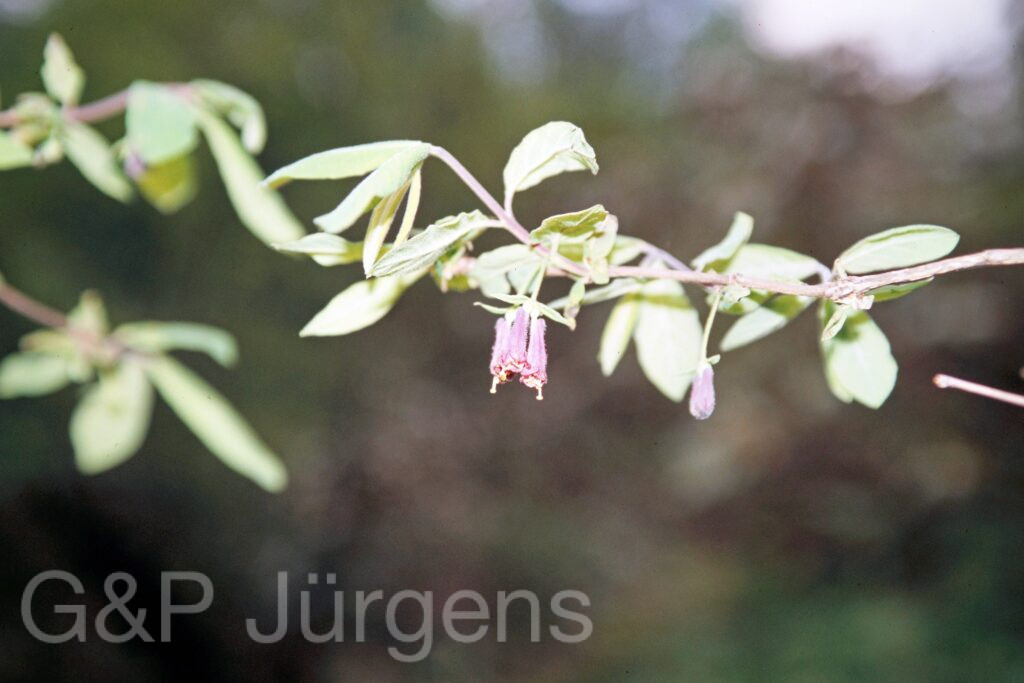
Garh 07 112 ergebnis
India Garhwal Meggu Kichatti 3200m, June

Description

Lonicera purpurascens Walp. is a deciduous shrubby honeysuckle of the western and central Himalaya. GBIF occurrence data place it principally in India, Pakistan, Nepal, Afghanistan, Bhutan and Myanmar, confirming a chiefly Himalayan distribution. It is a plant of subalpine forest and shrubberies, growing among Abies, Betula and Rhododendron stands and along open rocky slopes, generally between about 2,800 and 3,800 m. The illustrated plant from Meggu Kichatti in Garhwal at 3,200 m, flowering in June, is characteristic of its occurrence in the upper temperate to subalpine belt where it blooms shortly after snowmelt.

It is an erect to spreading shrub up to 1.5–2 m tall with terete, glabrescent young branches and ovate to elliptic, entire leaves that are often glaucous and purplish-tinged beneath. The flowers are borne in axillary pairs on a common peduncle, subtended by bracts; the corolla is two-lipped, gibbous at the base, and ranges from yellowish to purple-flushed, hence the epithet. The paired ovaries are partly fused, and the resulting berries are red, more or less connate, each containing several seeds.

The species is one of numerous Himalayan Lonicera within the section Isika, and the purplish foliage and connate fruits distinguish it from allied taxa such as L. quinquelocularis and L. webbiana. Its berries provide food for montane birds, contributing to seed dispersal. The species is widespread within the Himalayan arc and is not currently regarded as of conservation concern.

Author: Walp. · Sources: POWO (Kew), GBIF, Flora of Pakistan, Flora of Bhutan Vol. 2, Rehder: Synopsis of the Genus Lonicera

Hardw.

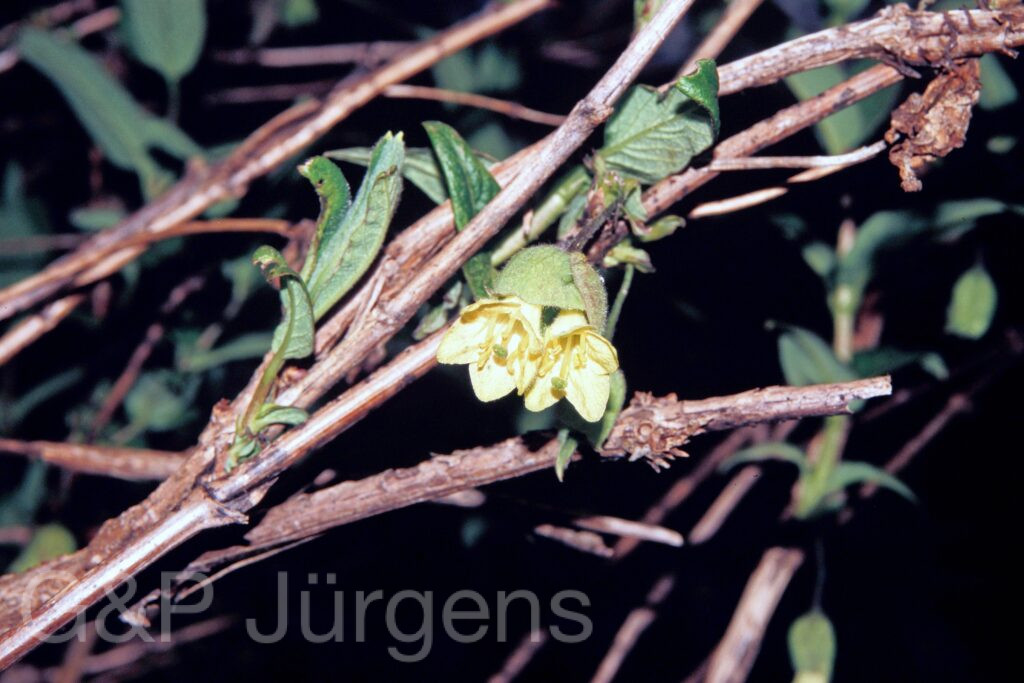
Bhutan2014 1083
Bhutan Paro 2000m, May

Description

Lonicera quinquelocularis is a deciduous shrub of the Himalayan and Sino-Himalayan temperate zone, ranging from Afghanistan and Pakistan eastward through India, Nepal and Bhutan into south-western China; with some 873 georeferenced records it is among the better-documented honeysuckles of the region (European and North American records reflect cultivation). It grows in open forest, scrub, forest margins, riverine thickets and rocky hillsides, chiefly between 1500 and 3000 m. The illustrated plant from Paro in western Bhutan at 2000 m, flowering in May, typifies its occurrence in the temperate broadleaf and conifer zone where it forms part of the understorey and forest-edge shrub community.

It is a much-branched shrub 2-5 m tall with greyish, peeling bark and ovate to elliptic, entire leaves that are softly pubescent, often greyish beneath, arranged in opposite pairs. The flowers are borne in axillary pairs on a common peduncle; each is two-lipped and creamy-white, ageing to yellow, fragrant, with a short tube. The bracts and bracteoles subtend the paired ovaries. A diagnostic feature reflected in the epithet is the five-locular ovary. The most striking character is the fruit: the two berries of each pair fuse and ripen translucent, the seeds visible within, turning purple-black, giving rise to the English name "translucent-berry honeysuckle."

Described by Hardwicke (as Hardw.), the species belongs to Lonicera section Coeloxylosteum of the Caprifoliaceae. The conspicuous semi-transparent berries are dispersed by birds, while the nectar-rich flowers attract bees and other insects. The species is widespread and locally common, used as fuel and hedging and occasionally cultivated as an ornamental; it is not considered threatened.

Author: Hardw. · Sources: POWO (Kew), GBIF, Flora of Bhutan, Flora of Pakistan, Flora of China, Rehder's monograph of Lonicera (Caprifoliaceae)

Wall.

Bh09 39 P71
Bhutan Paro 2400m, June

Description

Lonicera webbiana is a deciduous shrub of the temperate Himalaya and adjoining Central Asian mountains, distributed from Afghanistan, Pakistan and Kyrgyzstan eastwards through Kashmir, northern India, Nepal and Bhutan into south-western China and Myanmar, with over 2000 occurrence records (those from Europe and North America representing cultivated material). It grows in coniferous and mixed forest, forest margins, thickets and shrubberies, chiefly between about 2400 and 3600 m. The specimen photographed at Paro in Bhutan at 2400 m in June illustrates its early-summer flowering within the upper temperate forest belt.

The shrub reaches 2-3 m, with hollow young branches and ovate to elliptic-lanceolate leaves that are acuminate at the apex, often ciliate and softly pubescent beneath. Flowers are borne in pairs on a slender, drooping peduncle, each pair subtended by small linear bracts; the corolla is two-lipped and reddish to purplish, the tube short and gibbous at the base. The paired ovaries are largely free, and the fruit develops into red, ellipsoid berries which are partly fused at the base, a feature aiding recognition of the species.

Lonicera webbiana belongs to Caprifoliaceae and to the large, taxonomically complex section Isoxylosteum (the bush honeysuckles); it has at times been confused with related Himalayan species such as L. quinquelocularis and L. angustifolia. The nectar-bearing flowers attract long-tongued bees and other pollinators, while the conspicuous red berries are dispersed by birds. Widespread and locally frequent across an extensive range, the species is of least conservation concern and is a characteristic understorey shrub of Himalayan fir and spruce forests.

Author: Wall. · Sources: POWO (Kew), GBIF, Flora of China, Flora of Pakistan, Flora of Bhutan, Rehder revision of Lonicera, Annotated Checklist of the Flowering Plants of Nepal

  • 1
  • 2