
Wall.
Description
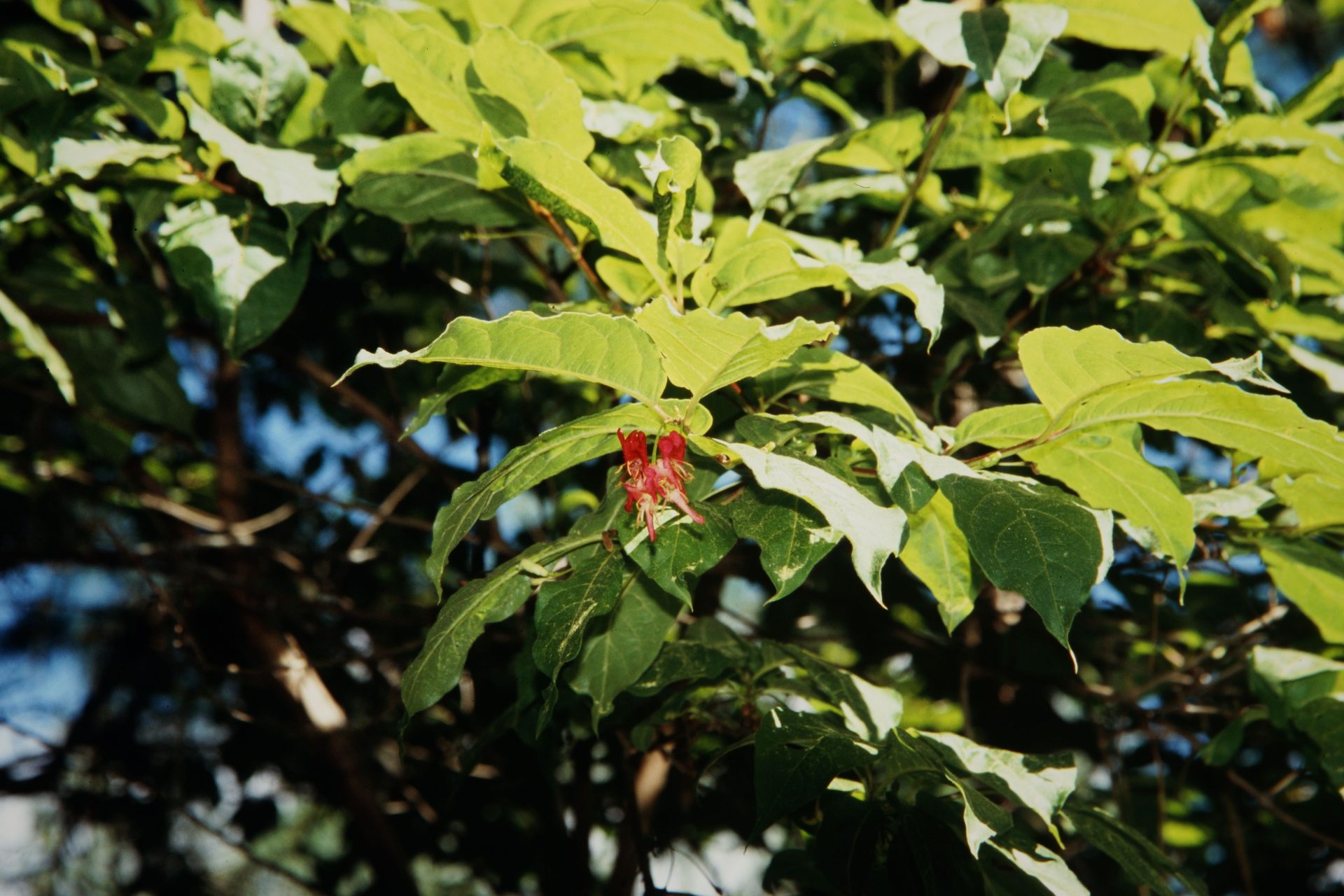
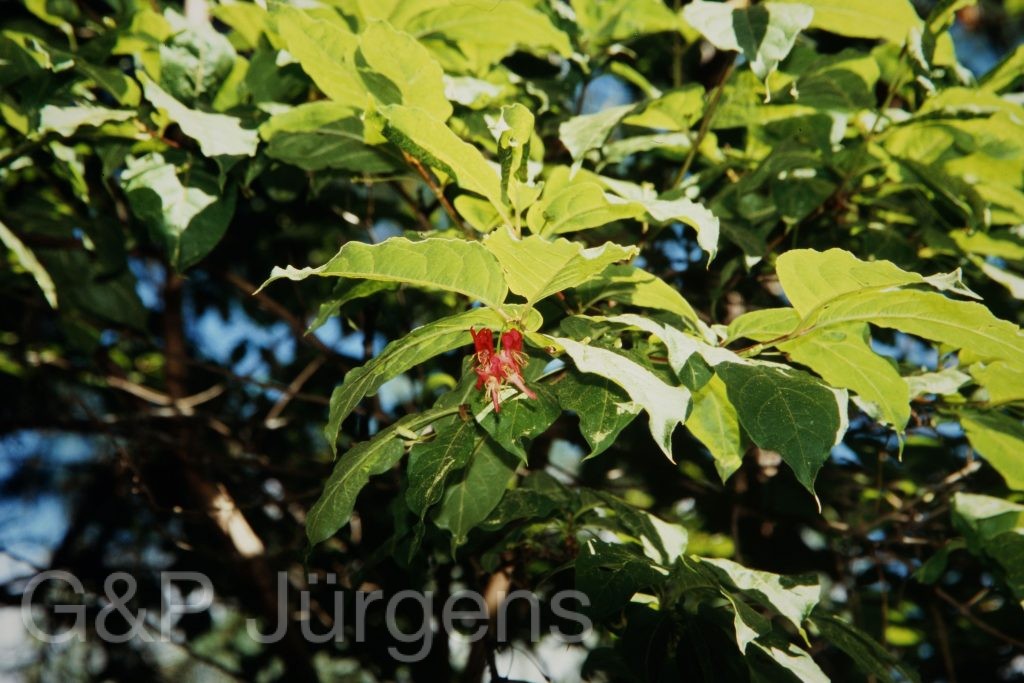
Lonicera webbiana is a deciduous shrub of the temperate Himalaya and adjoining Central Asian mountains, distributed from Afghanistan, Pakistan and Kyrgyzstan eastwards through Kashmir, northern India, Nepal and Bhutan into south-western China and Myanmar, with over 2000 occurrence records (those from Europe and North America representing cultivated material). It grows in coniferous and mixed forest, forest margins, thickets and shrubberies, chiefly between about 2400 and 3600 m. The specimen photographed at Paro in Bhutan at 2400 m in June illustrates its early-summer flowering within the upper temperate forest belt.
The shrub reaches 2-3 m, with hollow young branches and ovate to elliptic-lanceolate leaves that are acuminate at the apex, often ciliate and softly pubescent beneath. Flowers are borne in pairs on a slender, drooping peduncle, each pair subtended by small linear bracts; the corolla is two-lipped and reddish to purplish, the tube short and gibbous at the base. The paired ovaries are largely free, and the fruit develops into red, ellipsoid berries which are partly fused at the base, a feature aiding recognition of the species.
Lonicera webbiana belongs to Caprifoliaceae and to the large, taxonomically complex section Isoxylosteum (the bush honeysuckles); it has at times been confused with related Himalayan species such as L. quinquelocularis and L. angustifolia. The nectar-bearing flowers attract long-tongued bees and other pollinators, while the conspicuous red berries are dispersed by birds. Widespread and locally frequent across an extensive range, the species is of least conservation concern and is a characteristic understorey shrub of Himalayan fir and spruce forests.
Author: Wall. · Sources: POWO (Kew), GBIF, Flora of China, Flora of Pakistan, Flora of Bhutan, Rehder revision of Lonicera, Annotated Checklist of the Flowering Plants of Nepal