
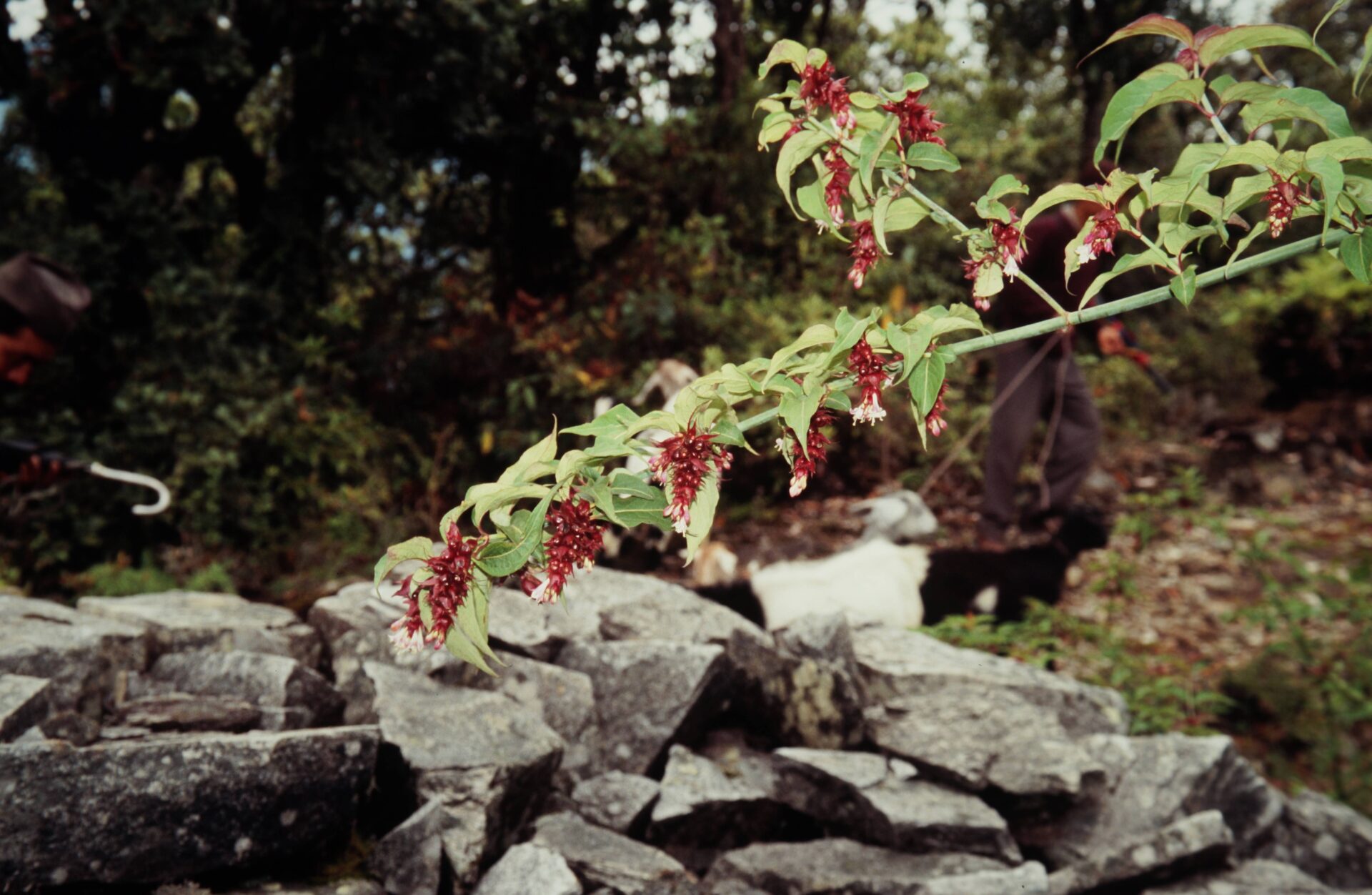
Wall.
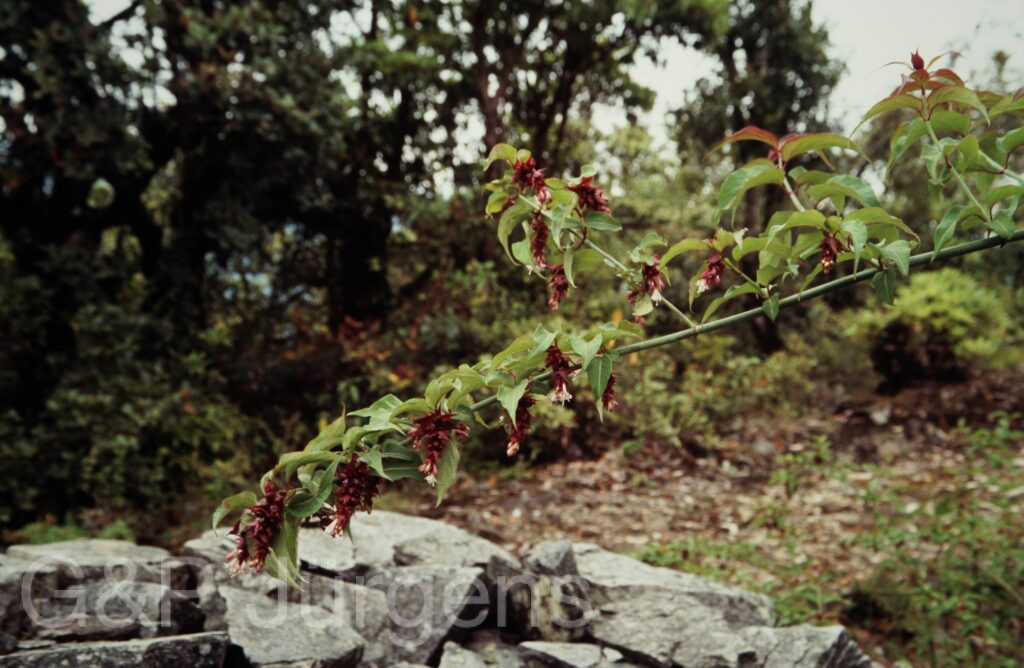
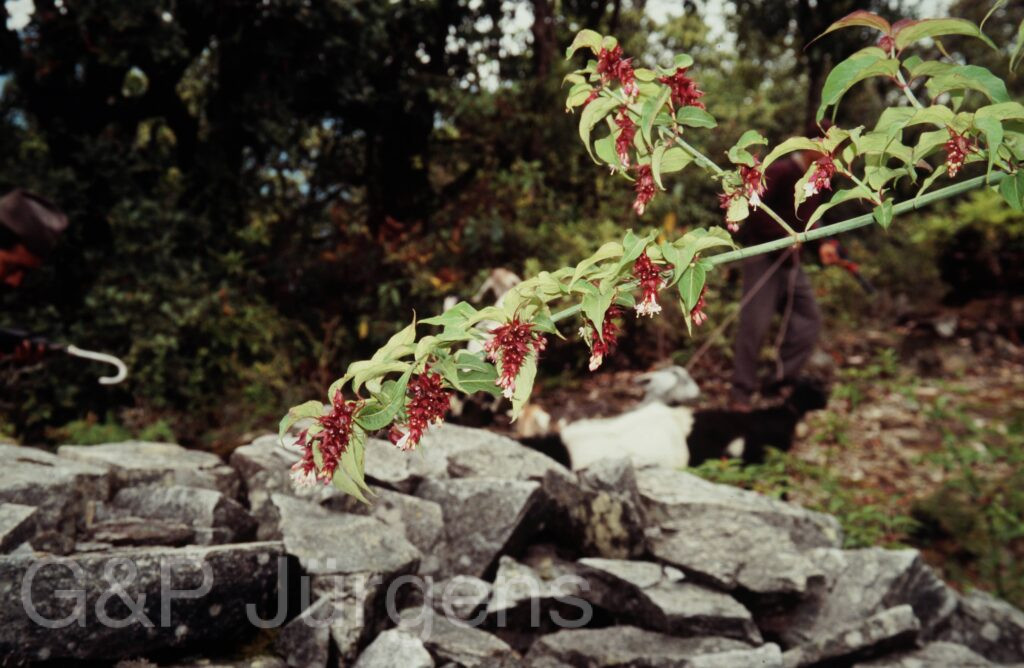
Description
Leycesteria formosa is a Himalayan shrub native to the temperate forests of Nepal, India, Bhutan, Pakistan and southwestern China, where it grows in moist montane woodland, forest margins, ravines, streamsides and shrubby clearings, typically between about 1500 and 3000 m. The photographed plant from the Indrawati drainage in the Helambu region of Nepal, recorded in May, is characteristic of these cool, humid mid-elevation habitats. Far beyond its native range, however, the species is among the most frequently recorded plants in GBIF, with over 42,000 occurrences, the great majority from regions where it has become naturalised after cultivation as an ornamental, notably Great Britain, Ireland, France, the Netherlands, Belgium, Germany, Switzerland, Spain, Portugal, the United States, Australia and New Zealand, where it is regarded as an invasive woodland weed.
It is a deciduous, hollow-stemmed shrub 1-2.5 m tall, with erect, glaucous, bamboo-like green canes that are conspicuously jointed and unbranched or sparingly branched. The leaves are opposite, ovate to ovate-lanceolate, long-acuminate, entire to slightly toothed and often weakly cordate at the base, frequently with a few basal lobes. The inflorescences are pendent, interrupted spike-like racemes of whorled flowers subtended by showy, claret-purple, leaf-like bracts. Each funnel-shaped corolla is white flushed with purple-pink and five-lobed; the ovary is inferior. The fruit is a many-seeded berry that ripens from green through reddish-purple to a glossy deep maroon-black, soft and sweetish, much sought by birds, which disperse the abundant small seeds.
The genus Leycesteria, named for the Bengal magistrate William Leycester, comprises a small group of Sino-Himalayan shrubs traditionally placed in Caprifoliaceae (Lonicereae) near Lonicera. Bird-mediated seed dispersal underlies both the plant's ecological success and its problematic naturalisation abroad, where it colonises disturbed woodland and riparian thickets; in New Zealand in particular it is listed as an environmental weed. Within its native Himalayan range it is common and of no conservation concern, valued horticulturally for its colourful pendent inflorescences and ornamental berries, sometimes grown under the names "Himalayan honeysuckle" or "pheasant berry."
Author: Wall. · Sources: POWO (Kew), GBIF, Flora of China Vol. 19, Flora of Bhutan Vol. 2, Flora of Nepal, Flora of Pakistan, Airy Shaw's revision of Leycesteria