Violaceae

Hara

Bhutan2014 205
Bhutan Trashyangtse 2100m, May

Description

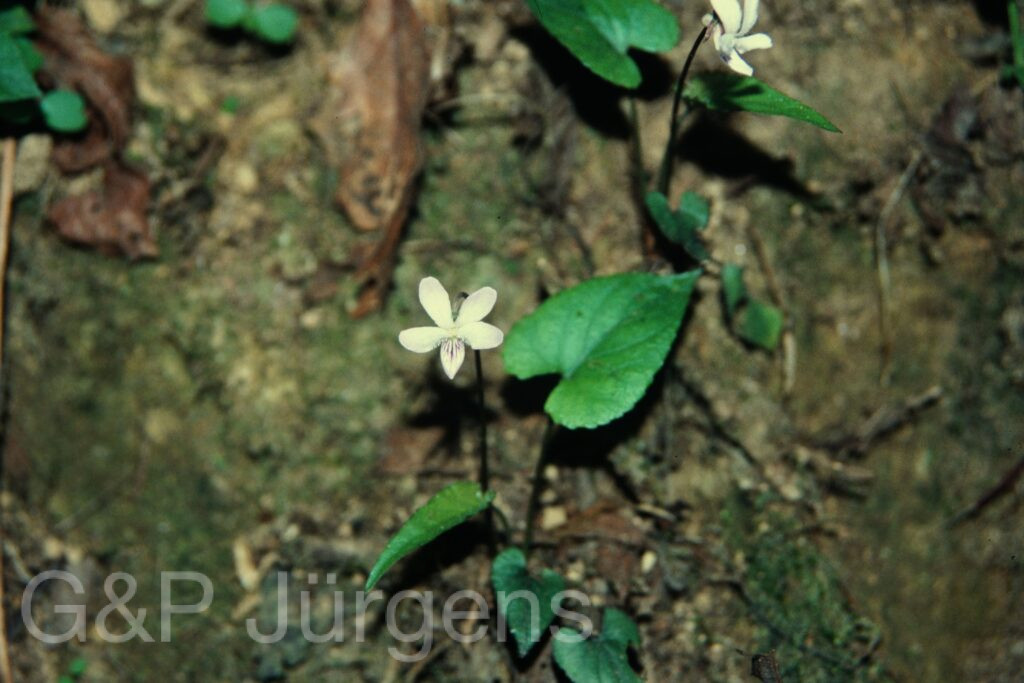
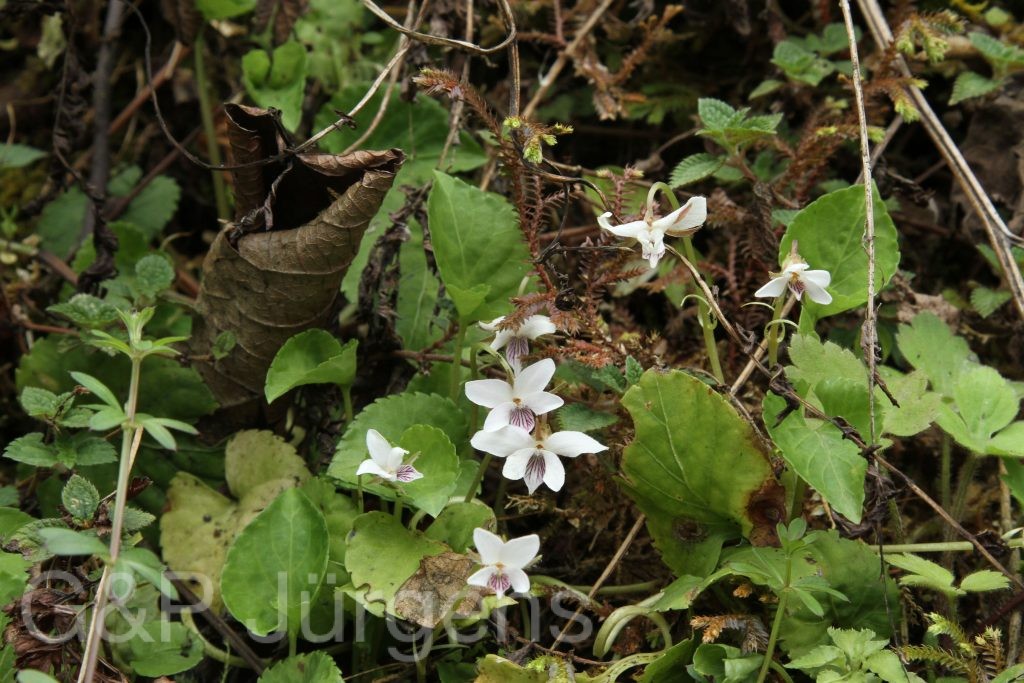
Viola bhutanica is a rare and range-restricted species endemic to Bhutan with marginal occurrence in adjacent parts of southern China. With only eight occurrences recorded in GBIF, it is among the least collected violets in the Himalayan region. The species inhabits moist, shaded forest floors in warm-temperate to subtropical broadleaved forests at elevations of 1,800–2,500 m, growing on humus-rich soils among mosses and leaf litter. The collection from Trashyangtse district in eastern Bhutan at 2,100 m typifies its preferred habitat in the moist valleys of the eastern Himalayan biodiversity hotspot.
Viola bhutanica is a perennial, acaulescent herb with a short, erect rhizome. Leaves are basal, long-petiolate, with ovate to broadly ovate blades 3–6 cm long, cordate at the base, crenate-serrate along the margins, and sparsely pubescent on both surfaces. Peduncles are slender, arising from the rootstock, exceeding the leaves, each bearing a single zygomorphic flower. Flowers are 1.5–2 cm across, with pale violet to lilac petals; the lateral petals are bearded, and the lowest petal bears a short, obtuse spur 3–5 mm long with darker violet veining that serves as a nectar guide. The fruit is an ellipsoid capsule dehiscing explosively by three valves, projecting seeds several centimetres from the parent plant.
Described by H. Hara in 1971, Viola bhutanica remains one of the most poorly known Himalayan violets. Its extreme rarity in herbarium collections and the very low number of GBIF records suggest either genuine scarcity or significant under-collection in its remote eastern Bhutanese habitats. The species belongs to the section Nomimium and is morphologically allied to V. pilosa, differing in its leaf indumentum and spur morphology. Given its highly restricted known range and the increasing pressures of land-use change in subtropical eastern Bhutan, V. bhutanica merits conservation assessment and targeted field surveys to clarify its population status.

Author: Hara · Sources: POWO (Kew), GBIF, Flora of Bhutan Vol. 1, Hara: Flora of Eastern Himalaya (1971), Noltie: Flora of Bhutan Vol. 3 (2000)
Viola hookeri

by GP Jürgens

Thomson ex Hook.f.

Sikkim2004 73 P128
Sikkim West-Bengal, Bersay 2700m April
Sikkim 2006 160 ergebnis
India West-Bengal, Molley 3200m, May

Description

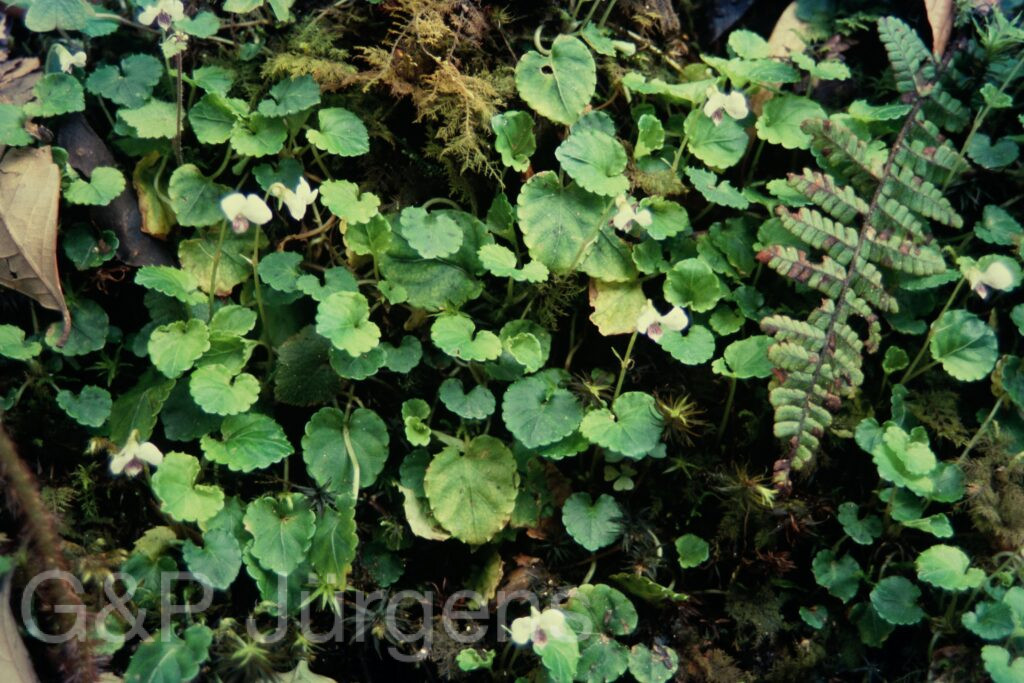
Viola hookeri Thomson ex Hook.f. is a small Himalayan violet of the eastern ranges, occurring in Sikkim, Darjeeling and adjacent India, Nepal and Bhutan. The GBIF figures attached to this record (over 3.8 million occurrences across chiefly European and North American countries) pertain to the genus Viola as a whole, not to this species, whose true range is confined to the temperate eastern Himalaya. It grows in cool, moist, shaded forest, on mossy banks and along path margins. The photographed plants are from the Sikkim-West Bengal border at Bersay (2,700 m, April) and from Molley (3,200 m, May), placing it in the upper temperate to subalpine forest belt.

It is a small acaulescent perennial herb forming a basal rosette from a slender rhizome, without elongated leafy stems. The leaves are long-petiolate, the lamina ovate to cordate-reniform with a crenate margin and a stipulate base. The solitary flowers are borne on slender axillary peduncles and have the characteristic zygomorphic violet structure: five unequal petals, the lowest spurred, white to pale lilac and often violet-veined, with the lower lateral petals sometimes bearded. As in many violets, cleistogamous flowers may also be produced. The fruit is a small, ellipsoid, three-valved loculicidal capsule that splits explosively to eject the smooth seeds.

Viola (Violaceae) is a near-cosmopolitan genus with a strong Himalayan radiation of acaulescent, rosette-forming species adapted to montane woodland. V. hookeri belongs to this eastern Himalayan group, in which basal rosettes, spurred flowers and frequent cleistogamy reflect adaptation to shaded, seasonally cool conditions. The species is not formally assessed but, like its relatives, depends on intact temperate forest.

Author: Thomson ex Hook.f. · Sources: POWO (Kew), GBIF, Flora of Bhutan, Flora of China, Hooker Flora of British India, Annotated Checklist of the Flowering Plants of Nepal, Becker conspectus of Viola

Franch.

Sikkim2004 339 G600
Sikkim/India Choka 3000m May

Description

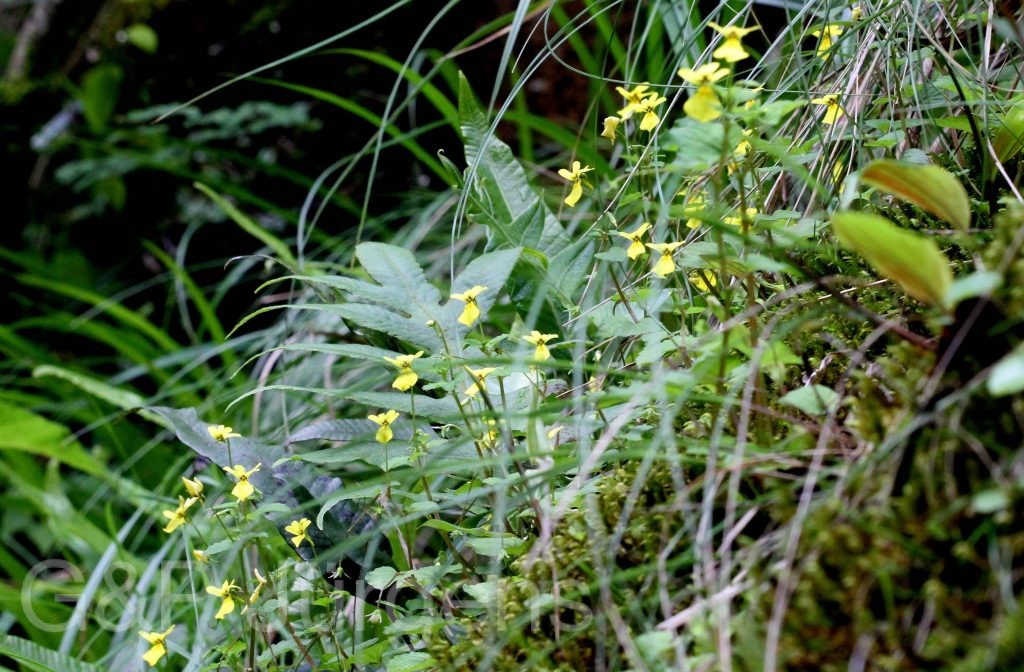
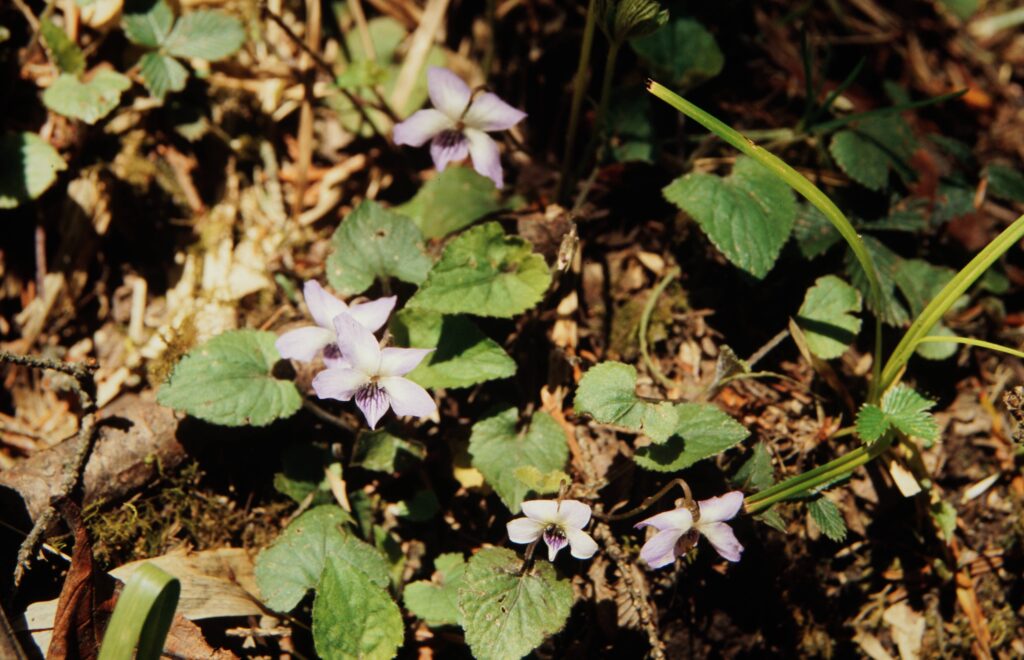
Viola moupinensis Franch. is a stemless perennial violet of the Sino-Himalayan mountains, distributed according to GBIF across China, India, Myanmar, Nepal and Bhutan. It inhabits cool, moist temperate and subalpine forests, shaded grassy slopes, forest margins and stream sides, typically between about 2,000 and 3,500 m. The May record from Choka in Sikkim at 3,000 m reflects its flowering during the spring monsoon onset in mossy, humus-rich woodland, where it grows among ferns and other shade-tolerant herbs in the understorey of mixed conifer and broad-leaved forest.

The species is an acaulescent (rosette-forming) perennial arising from a short, stout rhizome bearing fibrous roots. The leaves are basal, long-petiolate, with broadly cordate to reniform-cordate blades that are crenate-serrate at the margin and somewhat pubescent, often enlarging considerably after flowering. The solitary, long-pedunculate flowers are pale violet to whitish with darker purple veining on the lower petals; the lowermost petal bears a short, blunt spur. As is typical of Viola, the plant also produces self-pollinating cleistogamous flowers later in the season, and the fruit is an ellipsoid, three-valved capsule that dehisces explosively to disperse the seeds, which are further dispersed by ants via their elaiosomes.

Viola moupinensis belongs to section Viola and is closely allied to the temperate stemless violets of Eurasia. Its combination of showy chasmogamous and reliable cleistogamous flowers ensures reproductive success in shaded, insect-poor forest understoreys. As a frequent and adaptable woodland species across a broad elevational and geographic range, it is not of conservation concern but is a valued component of Himalayan spring flora.

Author: Franch. · Sources: POWO (Kew), GBIF, Flora of China Vol. 13, Flora of Bhutan Vol. 1, Wang Wencai: Violaceae monographic studies

Ging.

Sikkim2011 165
Sikkim Vista-valley 2500m, June
Sikkim2011 167
Sikkim Vista-valley 2500m, June
Sikkim 2006 460 ergebnis
India West-Bengal, Ruigi-Chu 2100m, May

Description

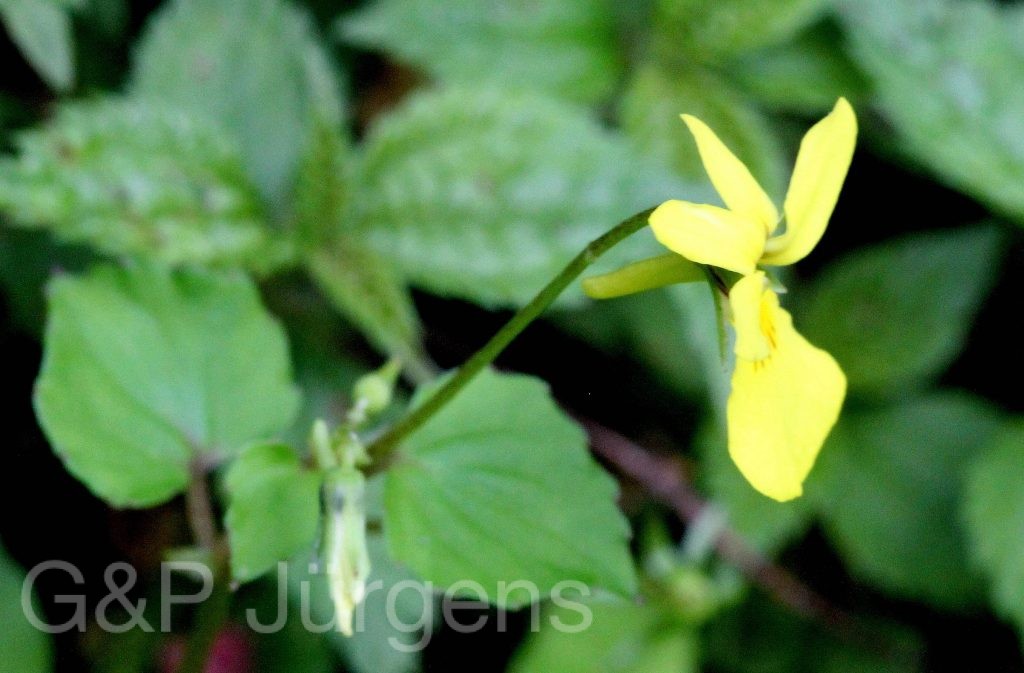
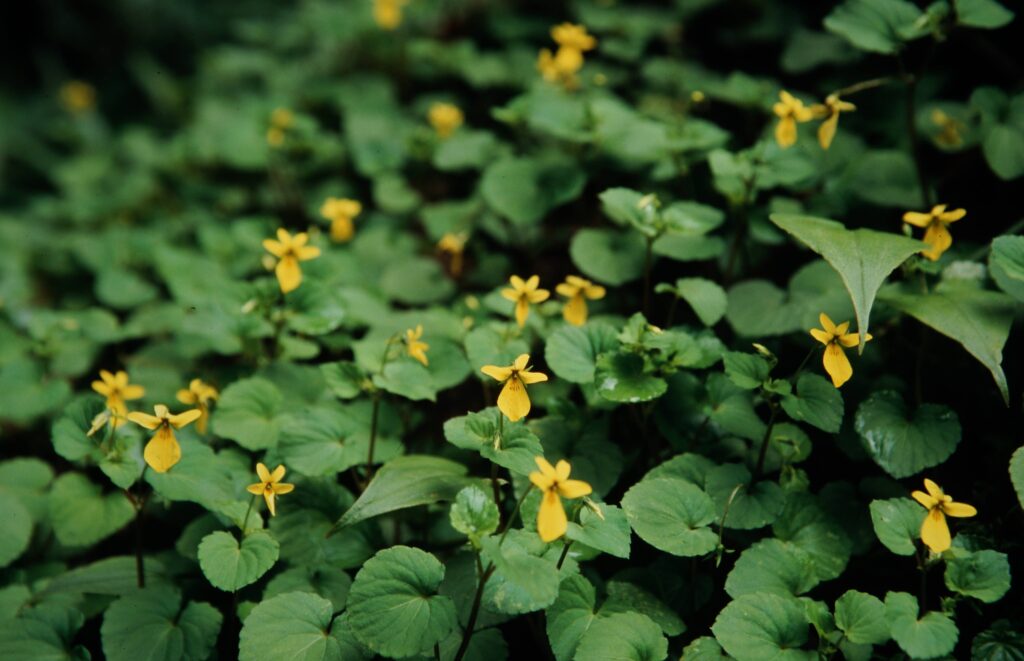
Viola wallichiana is a small perennial herb of the Himalaya, distributed through Nepal, northern India, Sikkim, Bhutan and southwestern China, with peripheral or introduced records noted from Australia; GBIF holds about 79 collections, reflecting a relatively localised eastern Himalayan range. It grows in shaded, moist temperate forest, on mossy banks, humus-covered slopes and shaded rock ledges, typically between about 2000 and 3000 m. The photographed plants were found in Sikkim's Vista valley at around 2500 m in June and in the West Bengal hills at Ruigi-Chu near 2100 m in May, on the cool, sheltered, leaf-littered forest floor it inhabits through late spring and the early monsoon.

The plant is a low, stemless to short-stemmed perennial arising from a slender rhizome, sometimes spreading by short stolons. The leaves are basal or nearly so, long-petiolate, the blade ovate to cordate or reniform with a crenate margin and conspicuous fringed stipules. The flowers are solitary on slender axillary peduncles, zygomorphic and spurred in typical violet fashion, pale violet to bluish or whitish with darker veining on the lower petal, the spur short. Cleistogamous flowers may also be produced. The fruit is a small loculicidal capsule that splits into three valves, ejecting the seeds elastically.

Viola (Violaceae) is a large, cosmopolitan genus, and V. wallichiana belongs to the temperate Himalayan group of rosulate, spurred-flowered violets, commemorating Nathaniel Wallich. Its cordate basal leaves, fringed stipules and pale veined flowers distinguish it from congeners. It is a typical understorey forb of mid-elevation forest, locally common but not assessed as threatened.

Author: Ging. · Sources: POWO (Kew), GBIF, Flora of China Vol. 13, Flora of Bhutan Vol. 2, Flora of Nepal, Flora of Pakistan, Becker conspectus of Himalayan Viola