
Wall.
Description
Ribes glaciale is a Himalayan and Sino-Himalayan currant distributed from Afghanistan and Pakistan through Nepal, NW India and Bhutan into SW and central China, with 2,141 GBIF occurrences (records from Europe and the Americas reflect cultivated or naturalised material). It is a shrub of subalpine and temperate forest, forest margins, shrubberies and rocky slopes, typically between about 2,500 and 4,000 m. The Nepalese collection from a kharka (high pasture) at 3,140 m in May captures it flowering in the spring, when it forms a component of mixed deciduous and conifer understorey thickets.
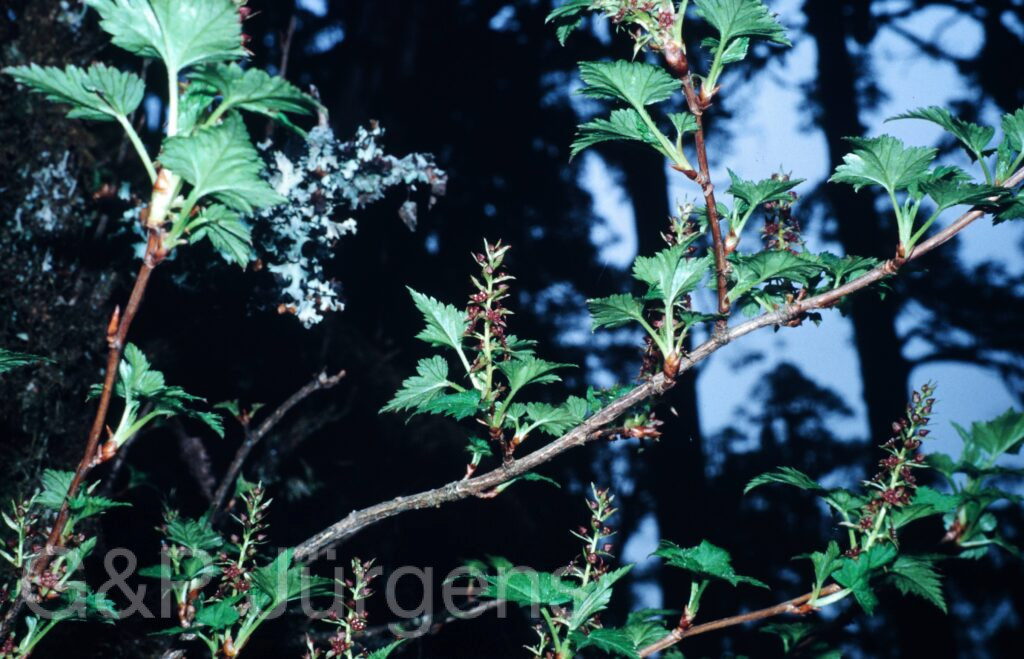
It is a deciduous, unarmed shrub 1–2 m tall with slender, glabrous to sparsely glandular branches. The leaves are alternate, small, broadly ovate to suborbicular, 1.5–4 cm wide, palmately 3–5-lobed with the central lobe longer, the margins toothed, on slender petioles. The plant is functionally dioecious or sub-dioecious; the flowers are borne in short erect racemes, small and reddish to purplish, with a shallow campanulate hypanthium, five reflexed sepals and minute petals. The fruit is a small, globose to ovoid red berry crowned by the persistent calyx.
The species belongs to Ribes subgen. Ribes and is one of several closely allied, lobed-leaved Himalayan currants that can be difficult to separate. GBIF treats the name as accepted; note that the image filename references R. laciniatum, but the named taxon R. glaciale is followed here. The red berries are taken by birds and provide effective dispersal, and the species is widespread and of least concern.
Author: Wall. · Sources: POWO (Kew), Flora of China Vol. 8, Flora of Pakistan, GBIF, Berger: A Taxonomic Review of Currants and Gooseberries (1924)