Apocynaceae

(Van Heurck & Müll.Arg.) Monach.
Bh2008 497 P766
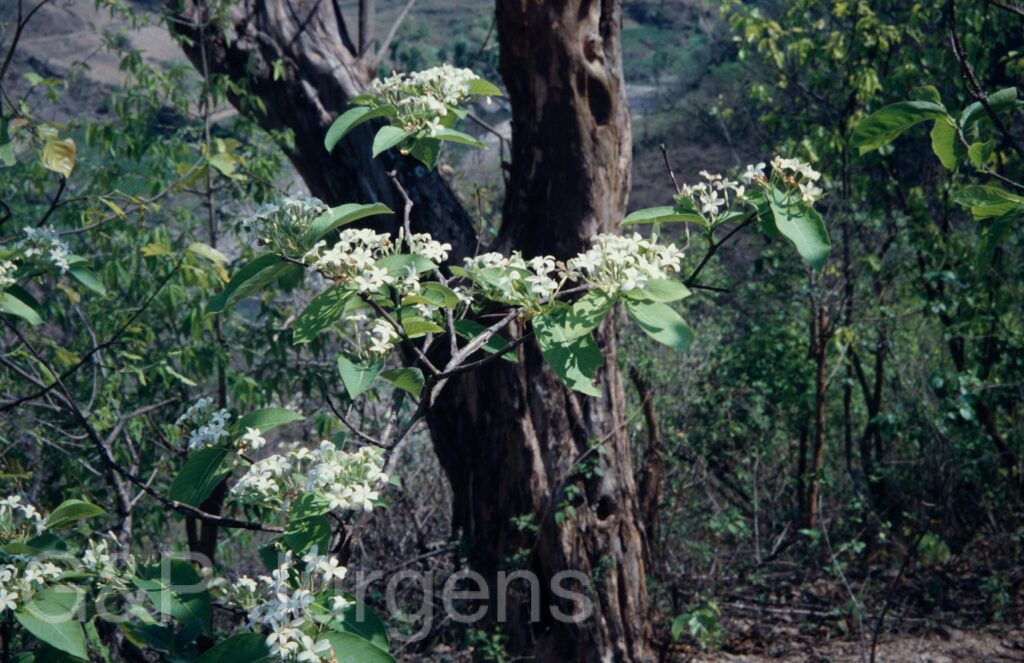
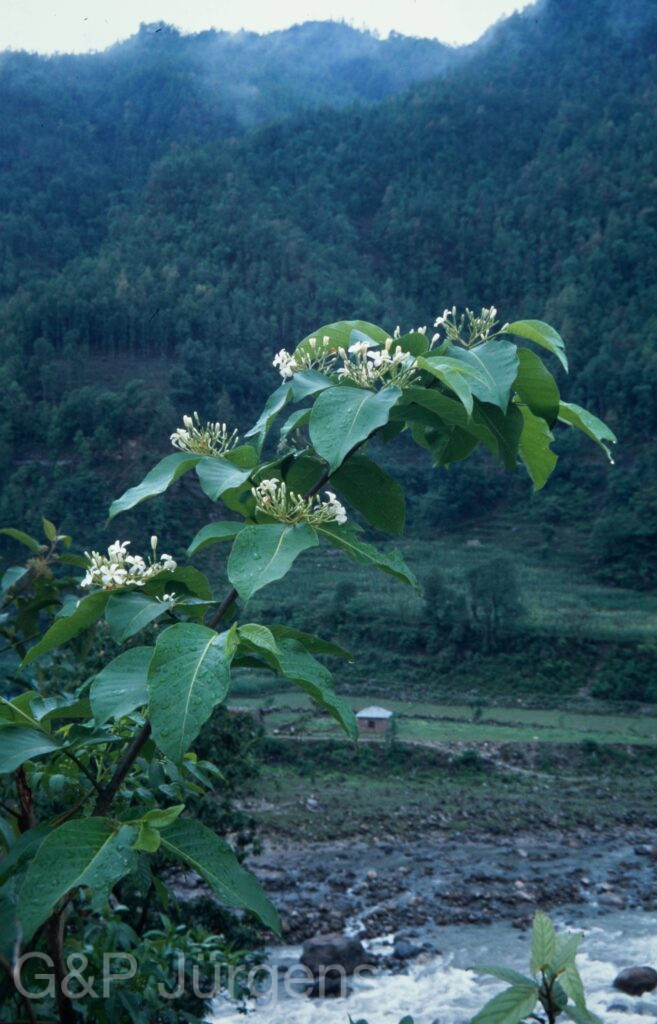
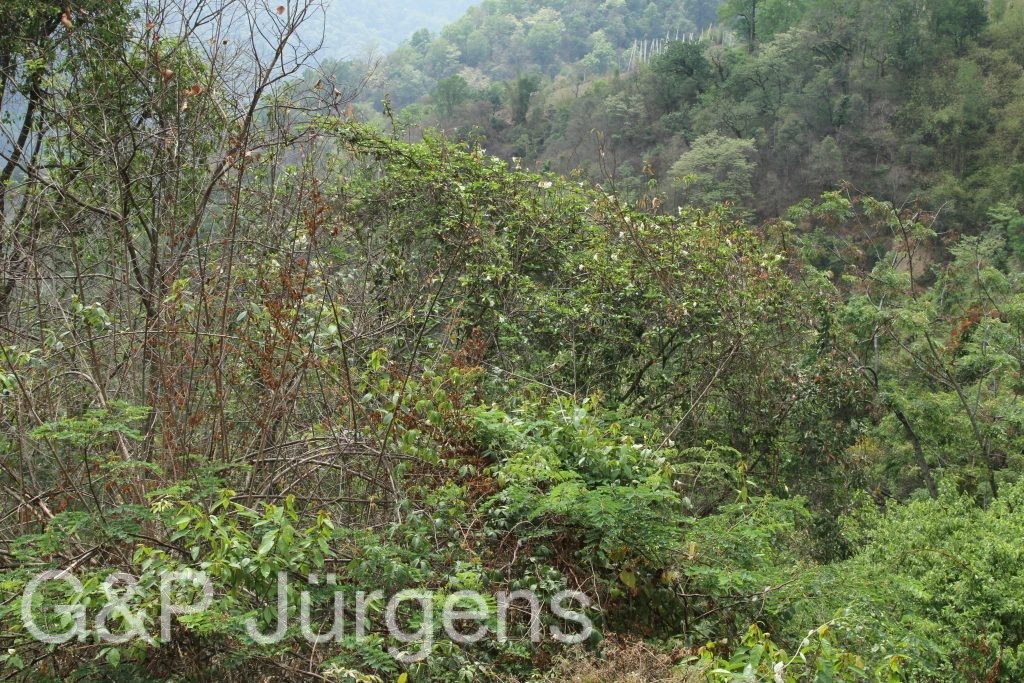
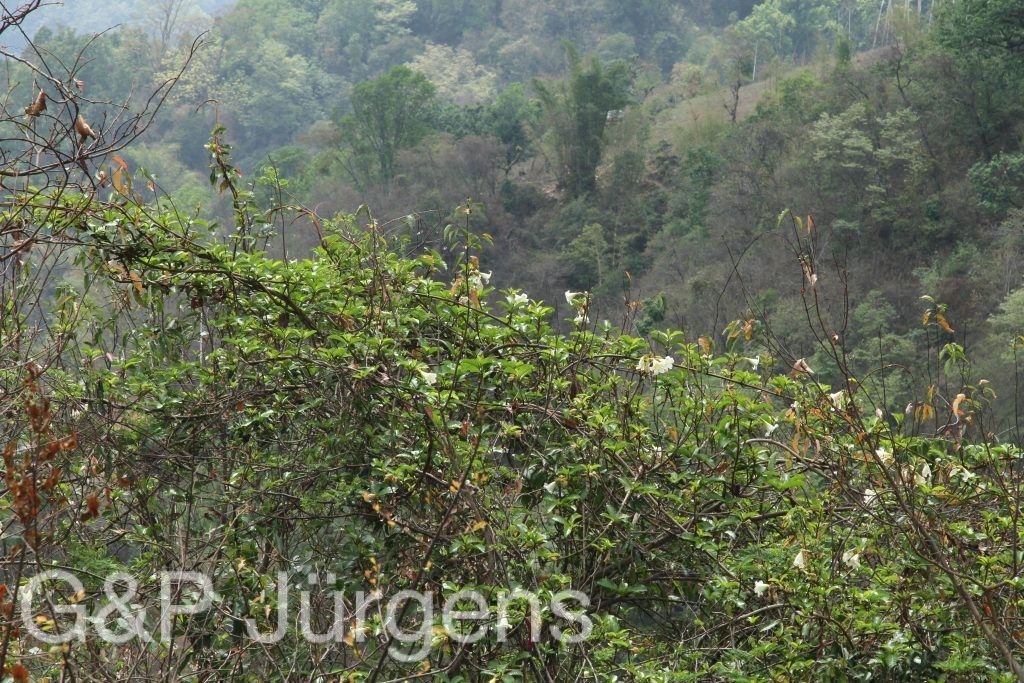
Bhutan Samtengang, 2200m April

Description

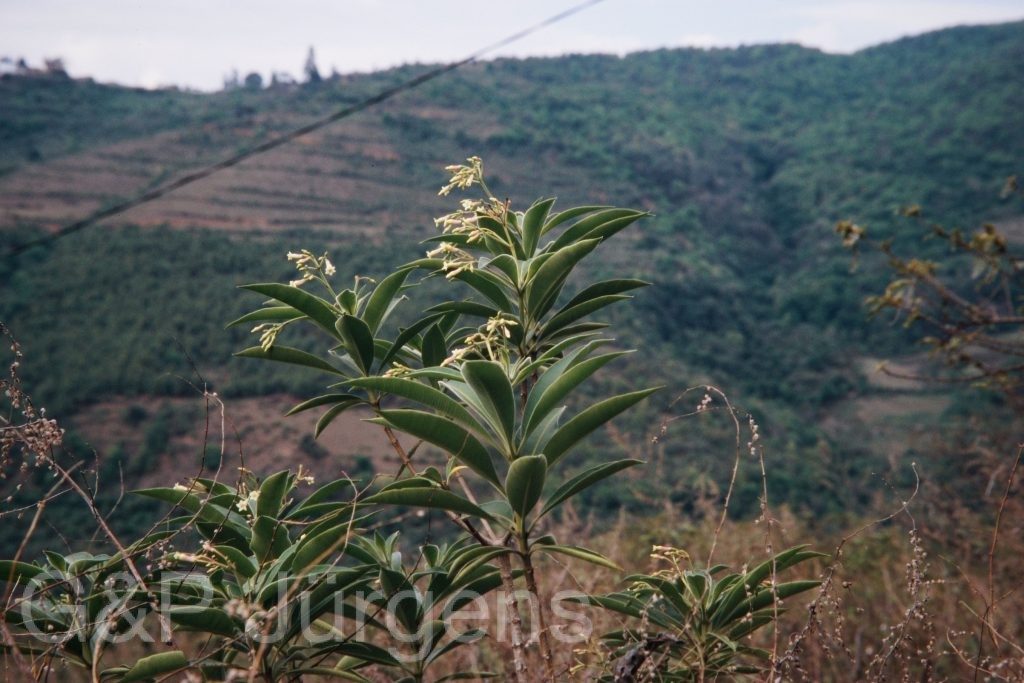
Alstonia sebusi (the accepted spelling being Alstonia sebusii) is a tree of montane forests in the eastern Himalaya and adjacent Southeast Asia, recorded from Bhutan, India, China (Yunnan), Myanmar and Japan, with about 50 georeferenced occurrences in GBIF. It occurs in broadleaved evergreen and mixed montane forest, typically on slopes within the warm- to cool-temperate belt. The specimen illustrated was photographed at Samtengang in Bhutan at about 2200 m in April; across its range it generally favours humid, well-drained forest soils where it grows as a canopy or sub-canopy tree.

The species is a small to medium-sized evergreen tree exuding milky latex when cut, as is characteristic of the genus. The leaves are arranged in whorls of three to several at the nodes, simple, entire, leathery and elliptic to oblong, with numerous closely parallel lateral veins. The flowers are small, white to cream, borne in terminal cymose clusters, with a salverform corolla whose tube bears overlapping lobes; the gynoecium consists of two carpels. The fruit comprises a pair of slender, pendulous follicles that split to release numerous flattened seeds bearing tufts of hair at each end, adapted for wind dispersal.

Alstonia (Apocynaceae, subfamily Rauvolfioideae) is a pantropical genus of latex-bearing trees rich in indole alkaloids, several of which have medicinal and pharmacological interest. The whorled leaves and paired follicles with comose seeds are diagnostic. Like other Alstonia species it provides soft, light timber locally used for carving and utility purposes. No major conservation threat is documented, though the species is dependent on the continued integrity of mid-elevation montane forest, which faces pressure from logging and land conversion in parts of its range.

Author: (Van Heurck & Müll.Arg.) Monach. · Sources: POWO (Kew), GBIF, Flora of China, Flora of Bhutan, Flora of Bhutan and Sikkim, Sidiyasa Revision of the Genus Alstonia
Wall.

Bhutan2014 270
Bhutan Trithangebe near a farmhouse 700m, May
Bhutan2014 271
Bhutan Trithangebe near a farmhouse 700m, May

Description

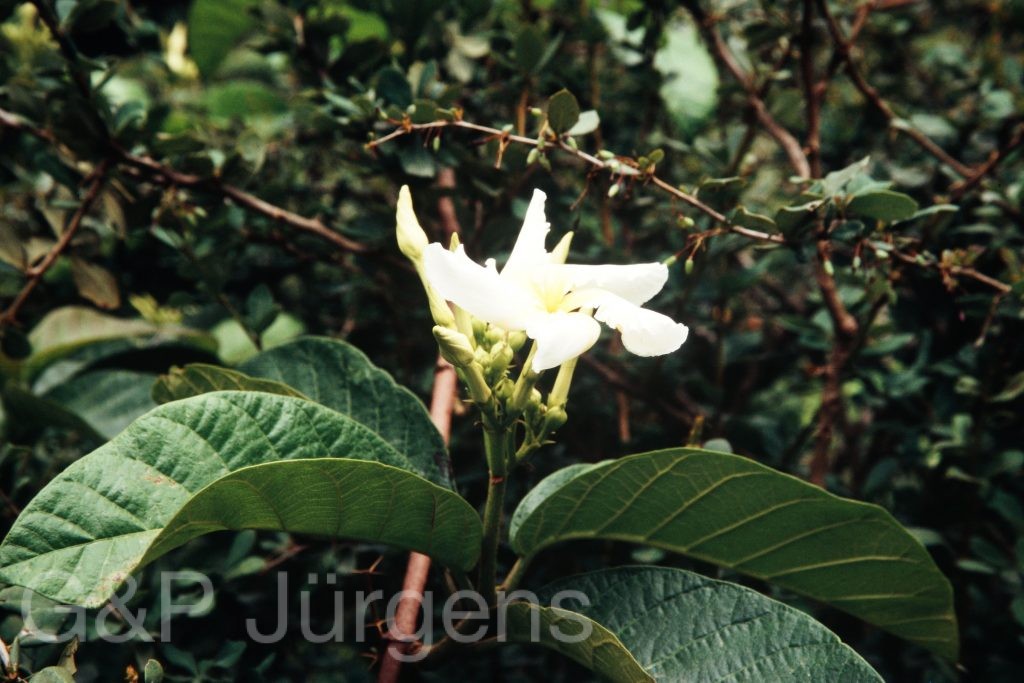
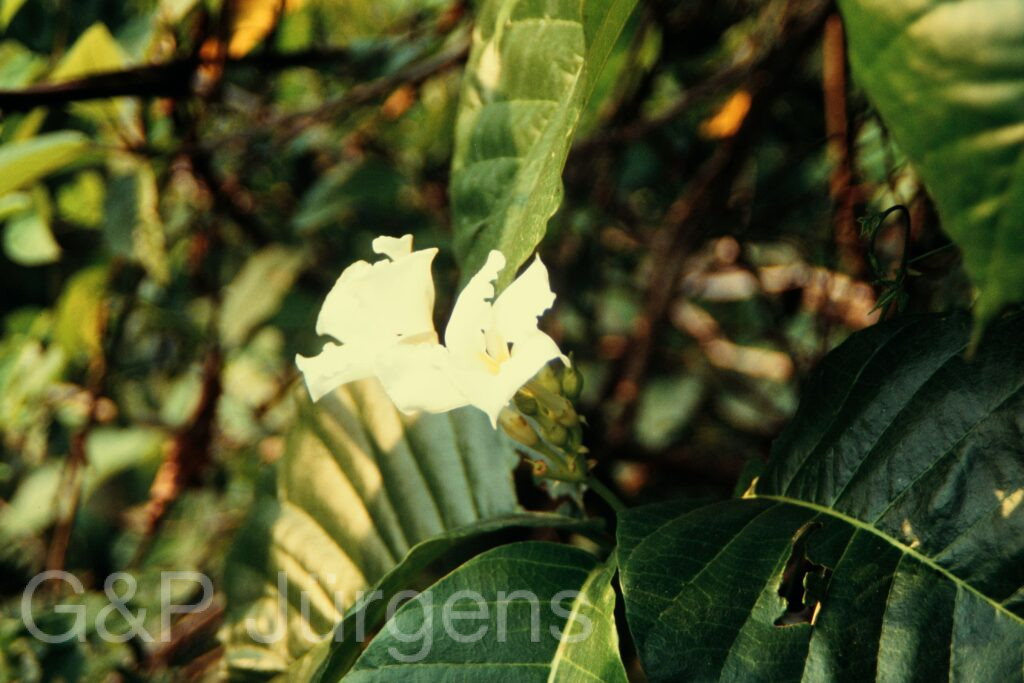
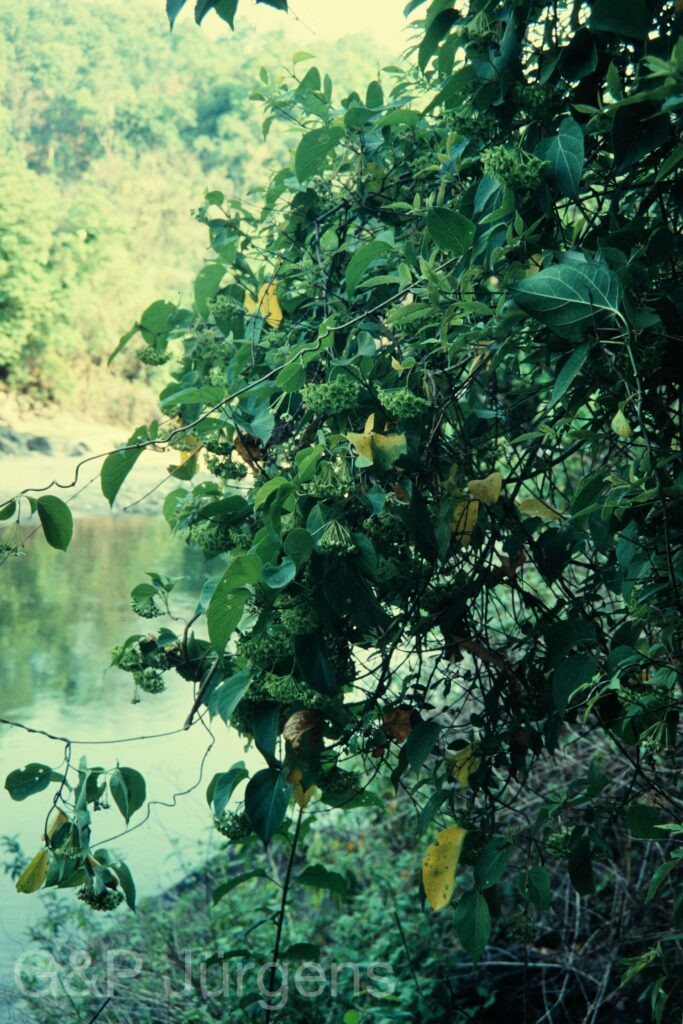
Beaumontia grandiflora is a large woody climber native to the eastern Himalaya and Indo-Chinese region, with native occurrences in India, China, Nepal, Bhutan, Thailand and Vietnam; the long list of additional countries among its roughly 602 records, spanning the Americas, Africa, the Caribbean and Oceania, reflects its extensive use as an ornamental in tropical and subtropical gardens worldwide. In the wild it is a plant of warm, humid lowland to lower-montane forest, scrambling over trees at forest margins and along streams. The photographed plant near a farmhouse at Trithangebe in Bhutan, at about 700 m and flowering in May, is consistent with its subtropical foothill habitat and its spring flowering, and hints at its frequent cultivation around dwellings.

It is a vigorous, large liana with stout woody stems exuding milky latex when cut. The leaves are opposite, simple, large, obovate to elliptic, leathery and glossy above with prominent venation and often rusty-pubescent beneath. The flowers, among the showiest in the family, are large, fragrant and trumpet-shaped, borne in terminal cymes; the corolla is broadly funnelform to campanulate, white, with five spreading lobes and a conspicuously expanded green-veined throat, giving rise to its garden name of Herald's-trumpet or Easter-lily vine. The five stamens have arrow-shaped anthers connivent around the stigma, and the fruit is a pair of large, woody, divergent follicles releasing numerous flat seeds, each with a tuft of silky hairs for wind dispersal.

Beaumontia belongs to the subfamily Apocynoideae of Apocynaceae, a family characterised by latex, contorted corolla aestivation and a specialised gynostegial pollination apparatus; the genus is allied to other tropical Asian lianas of the tribe Apocyneae. The plumed seeds and large insect-pollinated flowers fit a strategy of conspicuous floral display and wind-borne dispersal. Though valued and widely planted as a spectacular flowering vine, in its native Himalayan and Indo-Chinese range it is a natural component of subtropical forest and is not regarded as threatened.

Author: Wall. · Sources: POWO (Kew), GBIF, Flora of Bhutan, Flora of China, Flora of British India, Middleton's revisionary studies of Asian Apocynaceae

H.Huber

Nepal 99 917 ergebnis
West-Nepal Roha 2900m, July
Nepal 99 918 ergebnis
West-Nepal Roha 2900m, July

Description

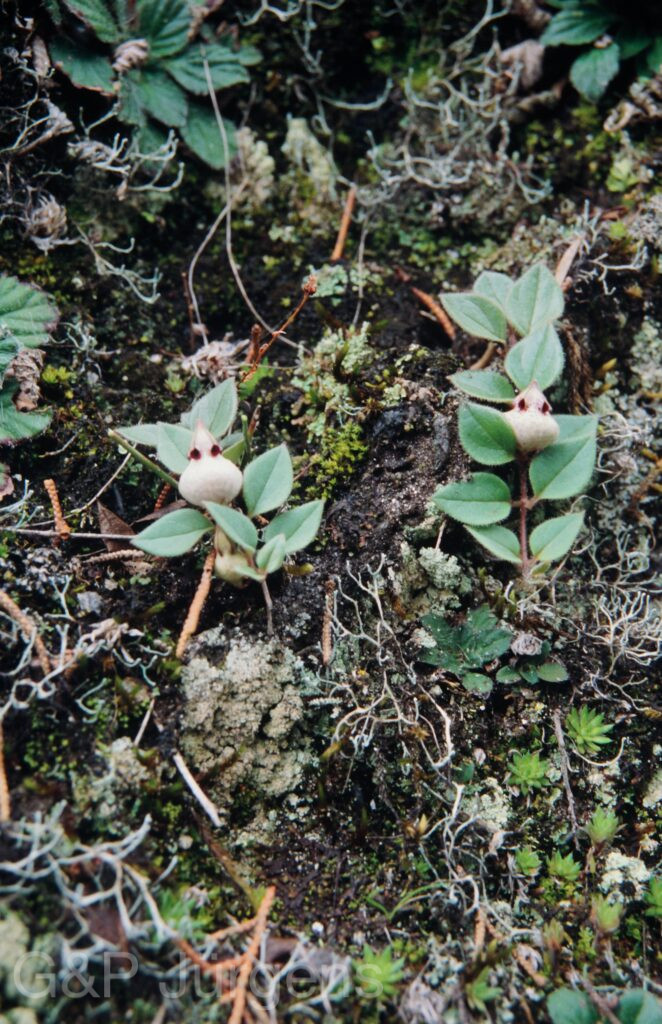
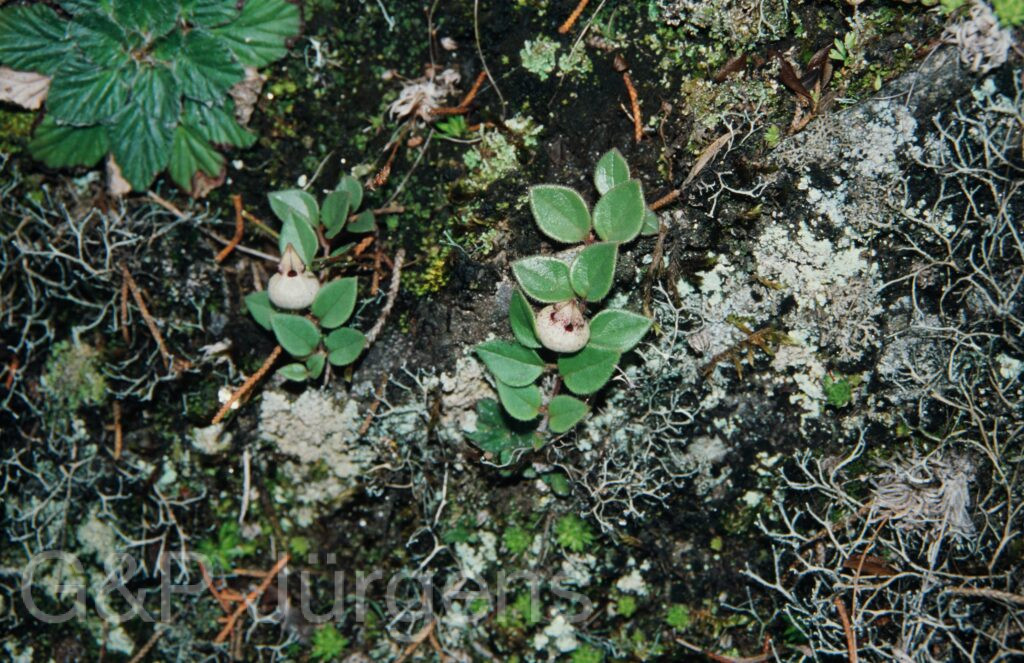
Ceropegia meleagris is a narrowly endemic herbaceous climber of the Apocynaceae (subfamily Asclepiadoideae), known only from the western Himalaya. GBIF records are few (18 occurrences) and confined to Nepal, indicating a restricted range and limited collection. The species grows in the temperate forest belt, scrambling through shrubs and herbaceous vegetation on banks, in scrub and at forest margins. The photographed plant from Roha in West Nepal at 2,900 m in July reflects its occurrence in the monsoon-moist middle hills, where flowering coincides with the summer rains.

The plant arises from a tuberous or fascicled rootstock and produces slender, twining, often somewhat fleshy stems. The leaves are opposite, simple, narrowly ovate to lanceolate and shortly petiolate. The flowers are the diagnostic feature of the genus: tubular and zygomorphic, with the five corolla lobes united at their tips to form a distinctive lantern- or cage-like canopy over the inflated, slightly curved corolla tube. The mottled, speckled patterning of the corolla evokes the guineafowl plumage from which the epithet meleagris is taken. As in all Ceropegia, the flowers function as temporary kettle traps that detain small Diptera, achieving pollination by means of paired pollinia. The fruit is a slender, paired follicle releasing comose seeds.

Ceropegia is a large, taxonomically intricate genus now construed to include the former Brachystelma and stapeliads, united by their elaborate trap-pollination syndrome. As a Himalayan endemic with very few documented localities, C. meleagris is of biogeographic and conservation interest; its restricted range, tuberous habit and specialised pollination make it potentially vulnerable to habitat disturbance and collection.

Author: H.Huber · Sources: POWO (Kew), Flora of Nepal, Flora of Bhutan Vol. 2, GBIF, Bruyns: A Revision of Ceropegia (Apocynaceae, Asclepiadoideae)

Alston

Bh09 349 P564
Bhutan Wangdi, 2600m June
Nepal 97 552 G1079
Nepal Sabha-Khola 550m May

Description

Chonemorpha fragrans Alston is a large woody climber of tropical and subtropical Asia, ranging from India, Nepal and Myanmar through southern China and Indochina to Thailand, Sri Lanka and western Malesia; GBIF documents about 769 occurrences across this Indo-Malesian span. It is a liana of moist forest, forest margins and riverine thickets, climbing into the canopy from low elevations into the lower hills. The photographed material spans this amplitude, from the Sabha-Khola in lowland Nepal at 550 m in May to Wangdi in Bhutan at 2,600 m in June, the latter an unusually high record for an essentially subtropical climber.

It is a robust, twining liana with stout woody stems exuding milky latex when cut, as is general in the family. The leaves are opposite, large, broadly ovate to obovate, often softly tomentose beneath, with an acuminate apex and entire margin. The flowers are large and showy, borne in terminal cymes; the salverform corolla is white with a yellow throat, fragrant, and 5-8 cm across, with five broad, asymmetric, overlapping lobes. The fruit is a pair of long, slender, cylindrical follicles that split to release numerous flattened seeds, each bearing an apical tuft of silky hairs (coma) for wind dispersal.

Chonemorpha belongs to the Apocynaceae (subfam. Apocynoideae), the woody twining members of the dogbane family. C. fragrans is grown as an ornamental for its large fragrant blooms and yields a stem fibre and medicinally used alkaloids. Widespread across forested Indo-Malesia and tolerant of forest-edge and disturbed habitats, it is not of conservation concern; its comose seeds and liana habit support effective dispersal and rapid colonisation of canopy gaps.

Author: Alston · Sources: POWO (Kew), GBIF, Flora of China, Flora of Nepal, Flora of Bhutan, Apocynaceae treatment in Flora Malesiana, Middleton studies of Asian Apocynaceae

Wall. ex G.Don

Nepal 1994 329 ergebnis
Ost-Nepal Chainpur 1300m May 
Nepal 2001 503 ergebnis ergebnis
Nepal (Gorkha) Arkhet 720m, May

Description

Holarrhena pubescens is a widely distributed paleotropical shrub or small tree with one of the broadest ranges in this set, documented by over 3,000 GBIF records spanning the Indian subcontinent (India, Nepal, Bangladesh, Pakistan), Southeast Asia (Myanmar, Thailand, Laos, Vietnam, Cambodia, Malaysia), southern China and much of sub-Saharan Africa (Tanzania, Malawi, Mozambique, Zimbabwe, Zambia, South Africa, Kenya, Democratic Republic of the Congo). It is a plant of dry deciduous forest, savanna woodland, scrub and ravine margins, generally below about 1,300 m. The cited Nepalese plants, from Chainpur in the east at 1,300 m and from Arkhet in Gorkha at 720 m, both flowering in May, mark the upper Himalayan foothill edge of its altitudinal range.

The plant is a deciduous shrub to small tree exuding milky latex when cut. The leaves are opposite, simple, broadly elliptic to ovate, shortly petiolate, softly pubescent beneath and entire-margined. The flowers appear with or before the new leaves in dense terminal corymbose cymes; each is salverform with five white, fragrant, contorted petals on a slender tube, collectively giving a showy, jasmine-like display. The fruit is a pair of long, slender, pendulous cylindrical follicles, often spotted, splitting to release numerous flat seeds bearing an apical tuft of silky hairs adapted for wind dispersal.

The species is medicinally important: its bark and seeds (the drug "Kurchi") yield steroidal alkaloids such as conessine, long used against amoebic dysentery. It is the type-related species of the small Old World genus Holarrhena within tribe Malouetieae of subfamily Apocynoideae. Despite extensive harvesting for traditional medicine, its wide range and habitat tolerance keep it secure.

Author: Wall. ex G.Don · Sources: POWO (Kew), Flora of China Vol. 16, Flora of Pakistan, GBIF, Endress & Bruyns: A revised classification of the Apocynaceae

Hook.f.

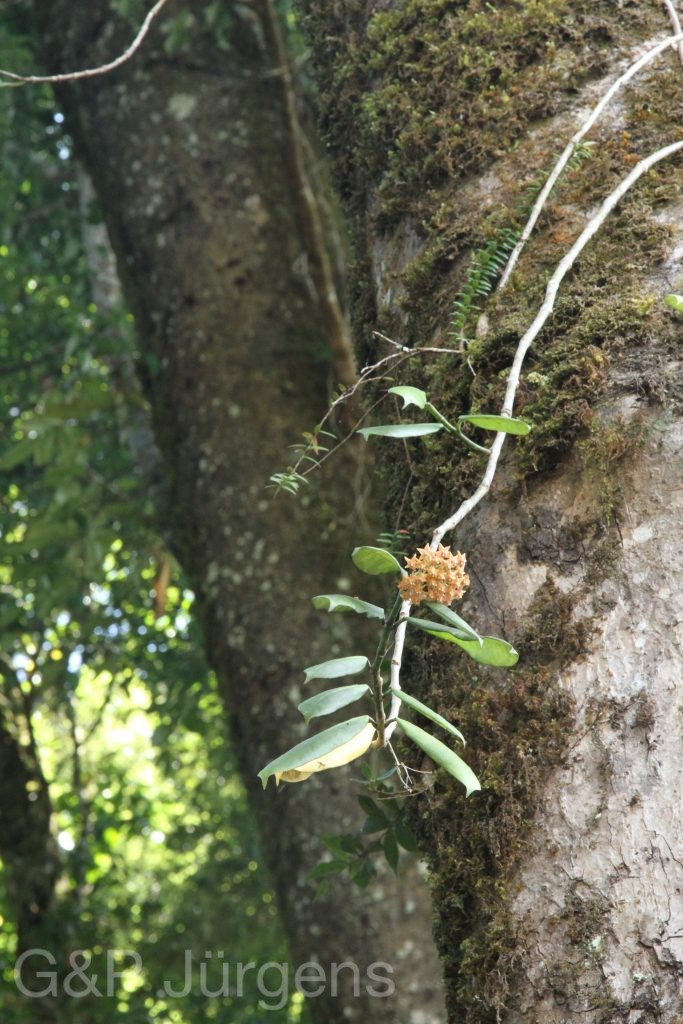
Bhutan2015 213
Bhutan Zhemgang 910m, October

Description

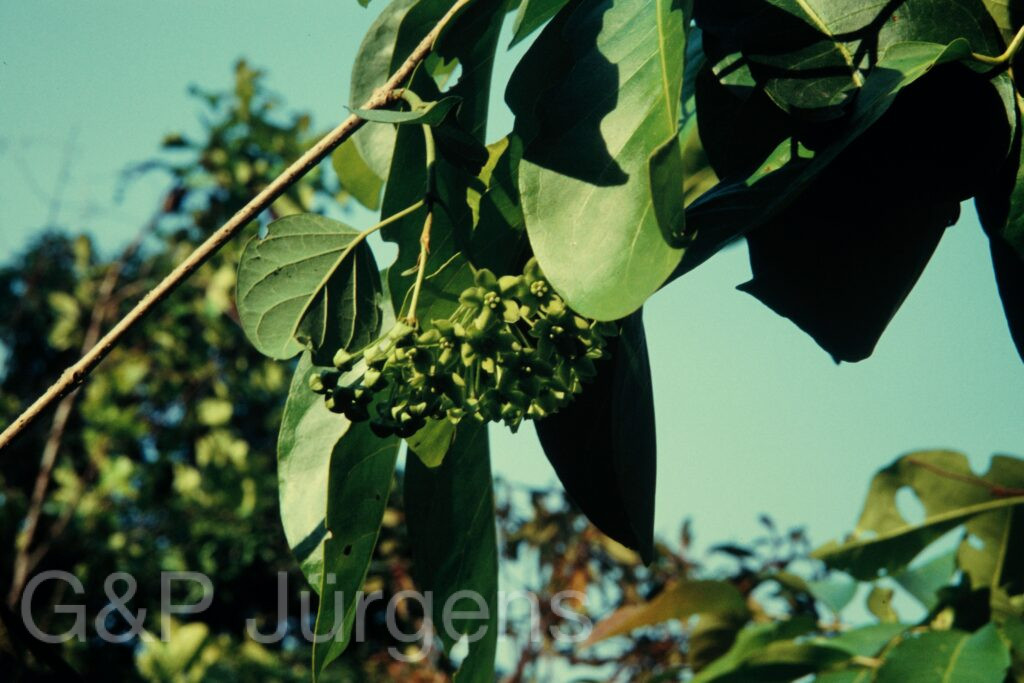
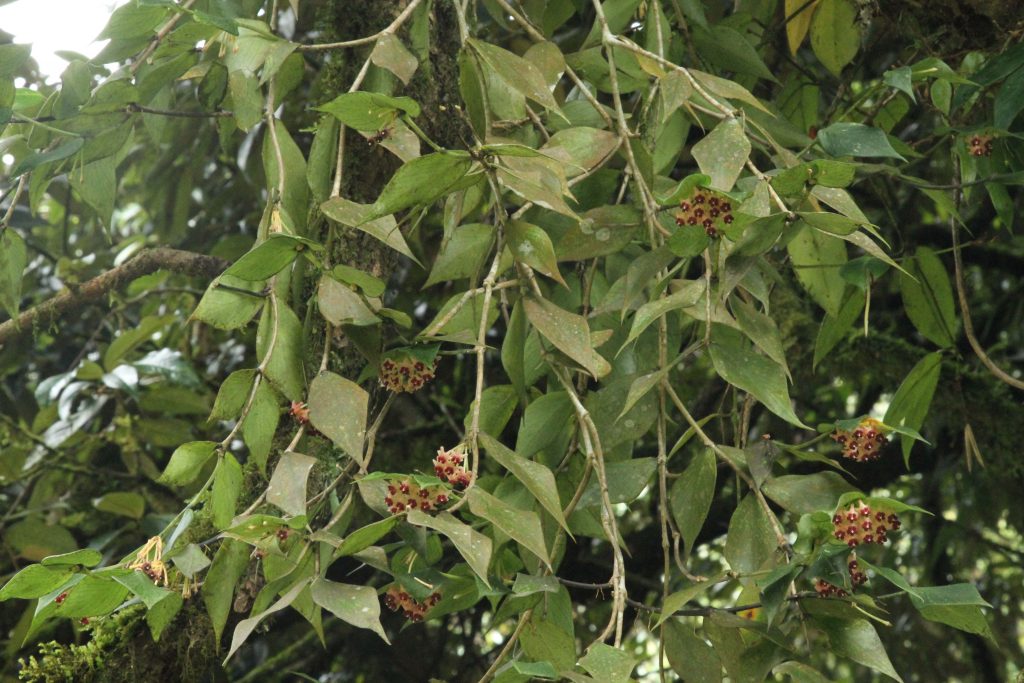
Hoya globulosa Hook.f. is an epiphytic climber of the eastern Himalaya and adjoining Indochina, recorded from India, Bhutan, China and Vietnam, with scattered cultivated material elsewhere; the GBIF total of about 115 occurrences reflects its moderately frequent presence in warm, humid montane forest. It grows as an epiphyte on mossy trunks and branches, occasionally as a lithophyte, in subtropical to warm-temperate broad-leaved evergreen forest, broadly between 700 and 1800 m. The photographed plant from Zhemgang in central Bhutan at about 910 m, flowering in October, typifies its occurrence in the moist, shaded foothill forests of southern Bhutan during the post-monsoon season.

The species is a robust, woody, climbing or pendent epiphytic vine with stout stems rooting at the nodes and exuding milky latex when broken. The leaves are opposite, thick and coriaceous, large, elliptic to oblong-lanceolate, acuminate, with a stout midrib and prominent, somewhat impressed lateral venation. The inflorescence is a dense, many-flowered, globose, umbelliform cyme on a persistent peduncle — the rounded flower-head giving the epithet globulosa. The flowers are small, with a fleshy, reflexed, hairy-margined corolla, pale yellow to greenish-white often suffused pink, surmounted by the characteristic waxy, glistening, star-shaped staminal corona. Pollen is borne in paired pollinia, and the fruit is a slender, elongate paired follicle releasing plumed seeds.

Hoya (Apocynaceae, subfamily Asclepiadoideae) is a large palaeotropical genus distinguished by its waxy coronate flowers and pollinarial reproduction; H. globulosa belongs to the large-leaved, dense-umbelled Himalayan-Indochinese assemblage. Its bold foliage and tight spherical flower-heads have made it sought-after in specialist Hoya cultivation. As a forest-dependent epiphyte it is potentially threatened by lowland deforestation and collection pressure, although formally unassessed and locally not uncommon within intact forest.

Author: Hook.f. · Sources: POWO (Kew), GBIF, Flora of China, Flora of Bhutan, Flora of British India, Surveswaran et al. — Phylogeny and revision of Hoya

Wall. ex D.Don

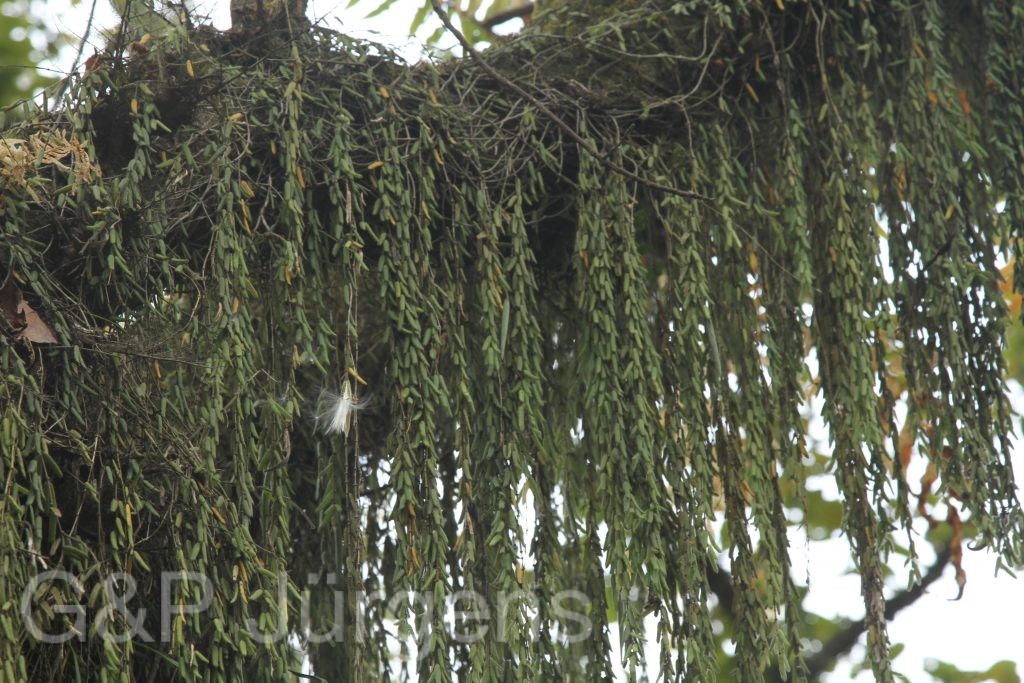
Bhutan2012 1175
Bhutan Trashiyantse 1780m, October
Bhutan2012 1177
Bhutan Trashiyantse 1780m, October

Description

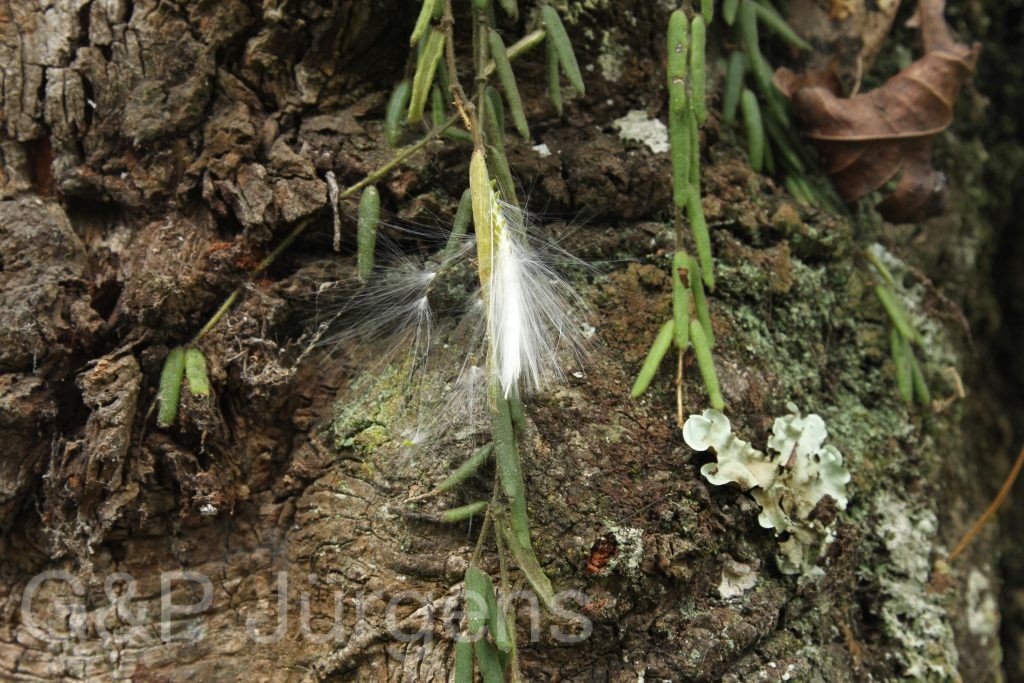
Hoya linearis is a Himalayan epiphytic wax-plant, GBIF recording around 106 occurrences from India, Bhutan, Nepal, China and Myanmar, the remaining records (US, ZA, FI, VN) representing cultivated material of this popular ornamental. It grows as a pendent epiphyte on mossy tree trunks and branches in humid, shaded broadleaved and evergreen montane forest, generally between about 1500 and 2500 m, where persistent cloud and high humidity sustain its succulent foliage. The plant photographed from Trashiyangtse (Trashiyantse) in eastern Bhutan at 1780 m, flowering in October, typifies its occurrence in cool, moist mid-montane forest where it festoons the canopy in long hanging masses.

It is a glabrous to softly hairy epiphytic subshrub with slender, trailing or pendent stems rooting at the nodes. The leaves are distinctive: linear, narrow, soft, slightly fleshy and grooved above, hanging in dense curtains quite unlike the broad succulent leaves of most Hoya. The flowers are borne in pendent umbellate cymes; each has a small calyx and a fleshy, white, five-lobed, star-shaped corolla with a central corona typical of the asclepiad group, sweetly fragrant especially in the evening. The fruit is a slender paired follicle releasing comose seeds dispersed by wind.

Described by Wallich (ex D. Don), H. linearis is placed in Hoya within Apocynaceae (subfamily Asclepiadoideae, formerly Asclepiadaceae). Its specialised epiphytic, narrow-leaved habit makes it readily recognisable and a much-grown houseplant, though wild populations depend on intact humid montane forest and are vulnerable to deforestation and over-collection. Ecologically its fragrant flowers attract insect pollinators, while its plumed seeds exploit air currents to colonise new host trees.

Author: Wall. ex D.Don · Sources: POWO (Kew), GBIF, Flora of Bhutan, Flora of China, The Genus Hoya (Asclepiadaceae) – Kleijn & van Donkelaar monograph

Hoya obcordata

by GP Jürgens

Hook.f.

Nepal 97 554 P1081
Nepal Sabha-Khola 550m May
Nepal 97 553 P1080
Nepal Sabha-Khola 550m May

Description

Hoya obcordata is an epiphytic climber of the eastern Himalayan foothills and adjacent subtropical forests, documented from north-east India and Bhutan, with collections also referable to lowland Nepal. It is poorly recorded, GBIF holding only five georeferenced occurrences, reflecting both its restricted range and the difficulty of collecting canopy epiphytes. It grows as a twining liana or root-climber on tree trunks and rocks in humid broad-leaved and riverine forest at low elevations. The plant from Sabha Khola in eastern Nepal at 550 m in May occupies just such a warm, humid valley floor, flowering in the late dry season.

It is a glabrous, somewhat succulent vine with slender twining stems rooting adventitiously at the nodes and exuding milky latex. The leaves are opposite, thick and fleshy, obovate to obcordate with a notched or rounded apex (whence obcordata) and shortly petiolate. The flowers are borne in pendent, umbelliform cymes from extra-axillary peduncles, each umbel of many small star-shaped blooms. The corolla is rotate and five-lobed, pale and reflexed, surmounted by the fleshy five-parted corona typical of Hoya around the gynostegium of fused stamens and stigma. The pollen forms waxy pollinia, and the fruit is a slender paired follicle releasing comose, wind-dispersed seeds.

Hoya belongs to subfamily Asclepiadoideae of an expanded Apocynaceae, defined by the gynostegium, corona and pollinium-bearing flowers formerly placed in Asclepiadaceae. H. obcordata is among the less collected Himalayan members of this largely Malesian genus, and its scarcity in herbaria leaves its full distribution imperfectly known. Such epiphytes are vulnerable to lowland deforestation, and the species would merit targeted survey to clarify its conservation status.

Author: Hook.f. · Sources: POWO (Kew), GBIF, Flora of China Vol. 16, Flora of Bhutan Vol. 2, Annotated Checklist of the Flowering Plants of Nepal, Wallich revisions of Asiatic Hoya

Hook.f.

Bhutan2015 202
Bhutan Zhemgang 1000m, October
Bhutan2012 764
Bhutan Zemgang 1400m, October

Description

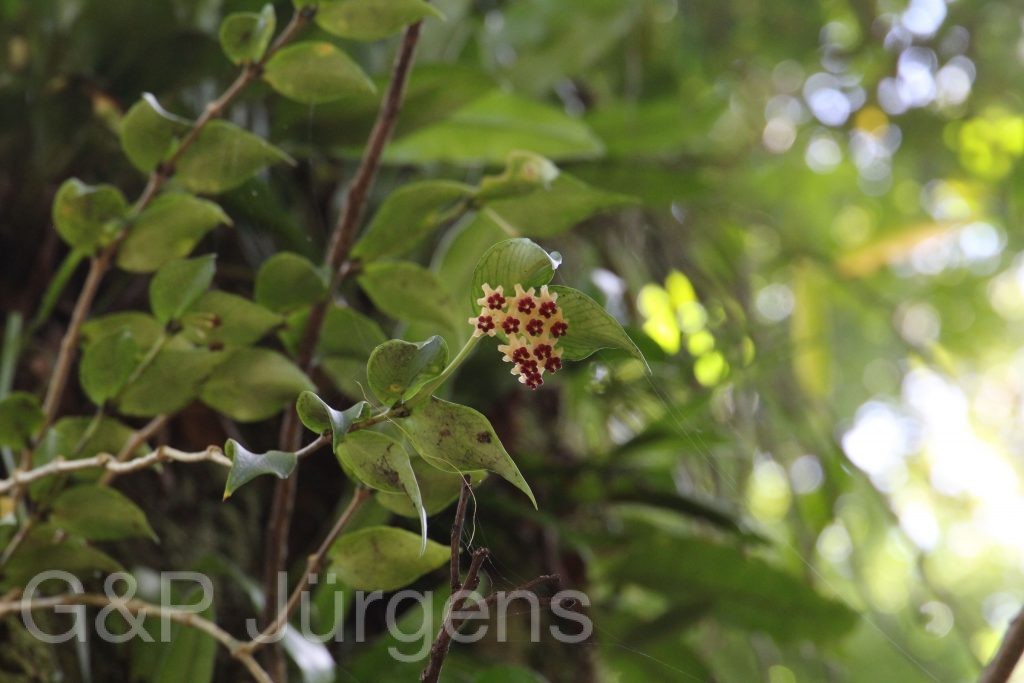
Hoya polyneura Hook.f. is an epiphytic vine of the eastern Himalaya and adjoining ranges, recorded from India, Bhutan, Nepal and China, with disjunct material from Japan; the GBIF total of about 59 occurrences reflects its scattered, locally frequent presence in humid mid-montane forest. It grows as an epiphyte or lithophyte on mossy trunks and damp rock faces in subtropical to warm-temperate broad-leaved evergreen forest, broadly between 800 and 2000 m. The photographed plants from Zhemgang in central Bhutan at about 1000 and 1400 m, flowering in October, illustrate its occurrence in the moist, shaded forest interior of the southern Bhutanese foothills.

The species is a slender, twining to pendent epiphytic subshrub with thin, flexible stems rooting at the nodes and exuding milky latex when cut. The leaves are opposite, distinctly thin-textured and elliptic to ovate, with a prominent, fish-bone-like venation of fine, parallel lateral nerves arching to the margin — the feature giving the epithet polyneura. The inflorescence is an axillary, umbelliform cyme of few to several flowers; each has a fleshy, reflexed, five-pointed corolla, cream to yellowish often marked with red, surmounted by the waxy, star-shaped, glistening staminal corona typical of the genus. Pollen is aggregated into paired pollinia, and the fruit is a slender paired follicle releasing comose seeds.

Hoya (Apocynaceae, subfamily Asclepiadoideae) is a large palaeotropical genus distinguished by its waxy, coronate flowers and pollinarial pollination. H. polyneura is among the most distinctive Himalayan species owing to its conspicuously veined, almost translucent leaves, a prized character in cultivation where it is grown as the "fishtail Hoya." As a forest-dependent epiphyte it is sensitive to deforestation and over-collection for the ornamental trade, though formally unassessed and locally not uncommon within intact montane forest.

Author: Hook.f. · Sources: POWO (Kew), GBIF, Flora of China, Flora of Bhutan, Flora of British India, Surveswaran et al. — Phylogeny and revision of Hoya

Plumeria rubra

by GP Jürgens

L.

Nepal 97 575 P1112
Nepal Sabha-Khola 550m May
Nepal 1994 36 ergebnis
Ost-Nepal Simbhuwa Kola 
1000m April

Description

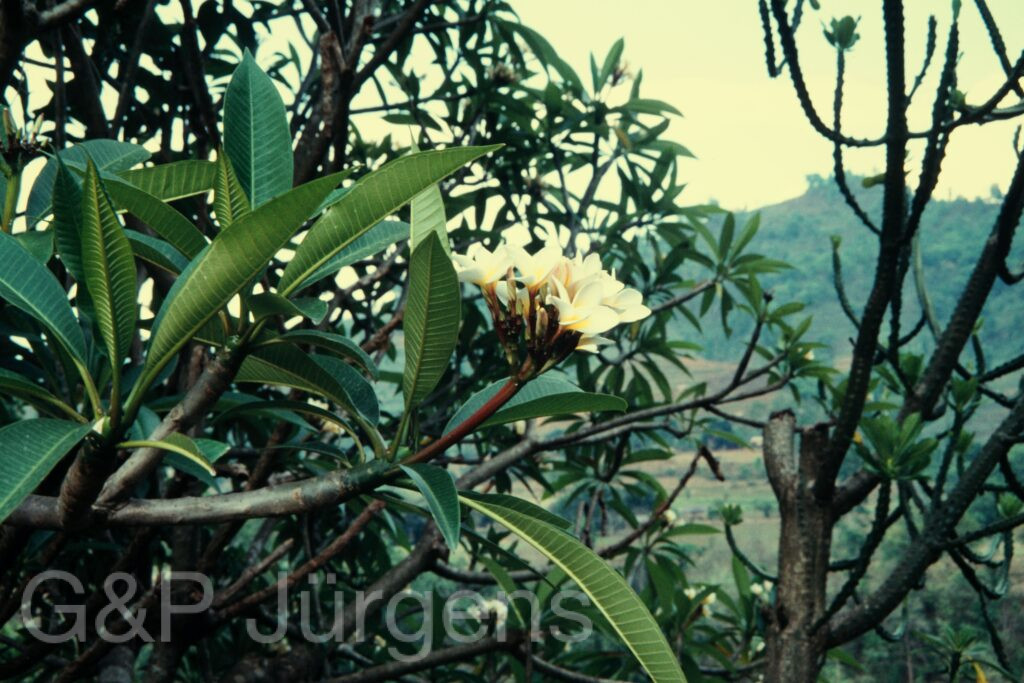
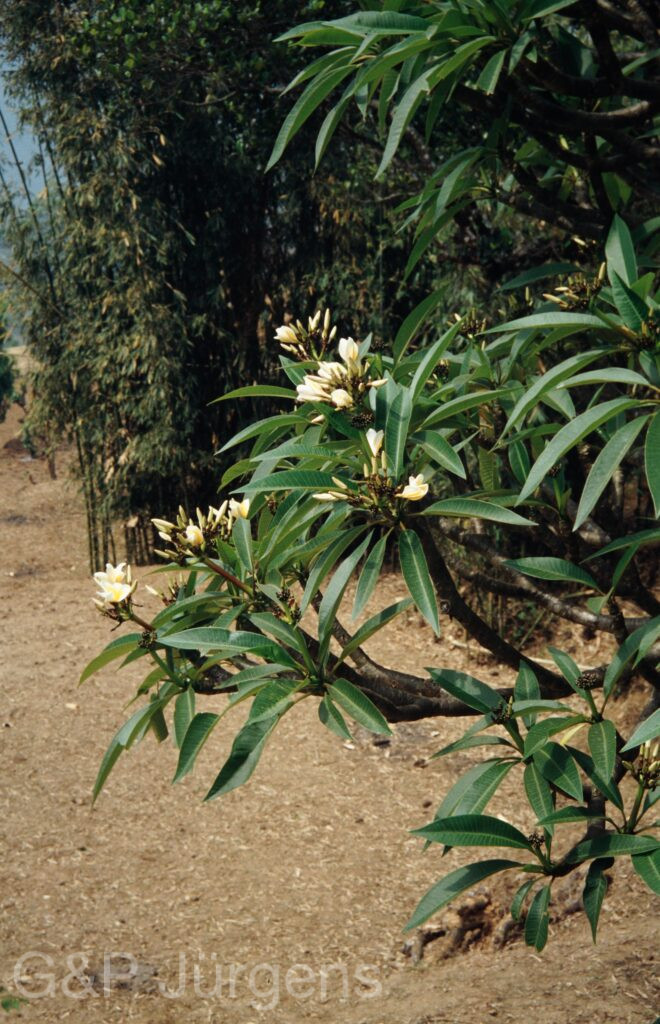
Plumeria rubra, the red frangipani, is a small tree native to Mexico and Central America but now pantropical through cultivation, a spread vividly reflected in its GBIF record of over 11,600 occurrences spanning Mexico, Guatemala, Costa Rica, Panama, Brazil, Colombia, Ecuador, Peru, the United States, India, South Africa, Indonesia, China, French Polynesia and many more. In the Himalayan foothills it is an introduced ornamental and temple tree rather than a wild element; the images from the Sabha-Khola valley (550 m, May) and the Simbhuwa Kola in eastern Nepal (1000 m, April) document it in the warm, frost-free lowland and lower hill zone where it is widely planted around dwellings, gardens and shrines. It tolerates seasonal drought, thriving in open, sunny, well-drained sites and flowering through the warm pre-monsoon and monsoon months.

It is a deciduous tree to about 5-8 m with a spreading crown of stout, blunt, sparingly branched stems exuding copious milky latex when cut. The large, alternate leaves are clustered toward the branch tips, oblong to elliptic-lanceolate, leathery, with prominent pinnate lateral veins joined by a marginal collecting vein. The strongly fragrant flowers are borne in terminal cymes; each has a salverform corolla with five overlapping, asymmetric lobes, typically white to yellow with a yellow eye in many forms but ranging to pink and deep red in the species and its cultivars. The fruit is a pair of divergent, cylindrical follicles releasing numerous winged seeds.

Plumeria belongs to the Apocynaceae subfamily Rauvolfioideae and comprises several New World species, of which P. rubra is the most variable and most widely grown, hybridising freely in cultivation. Its latex contains the iridoid glycoside plumieride and related compounds, and the plant carries deep cultural significance across South and Southeast Asia for use in offerings and garlands. Though of conservation concern nowhere because of its vast cultivated range, in the Himalaya it persists entirely as a human-introduced ornamental and has not naturalised into native forest.

Author: L. · Sources: POWO (Kew), GBIF, Flora of China Vol. 16, Flora of Nepal, Woodson's revision of Plumeria (Apocynaceae of the New World)

  • 1
  • 2