
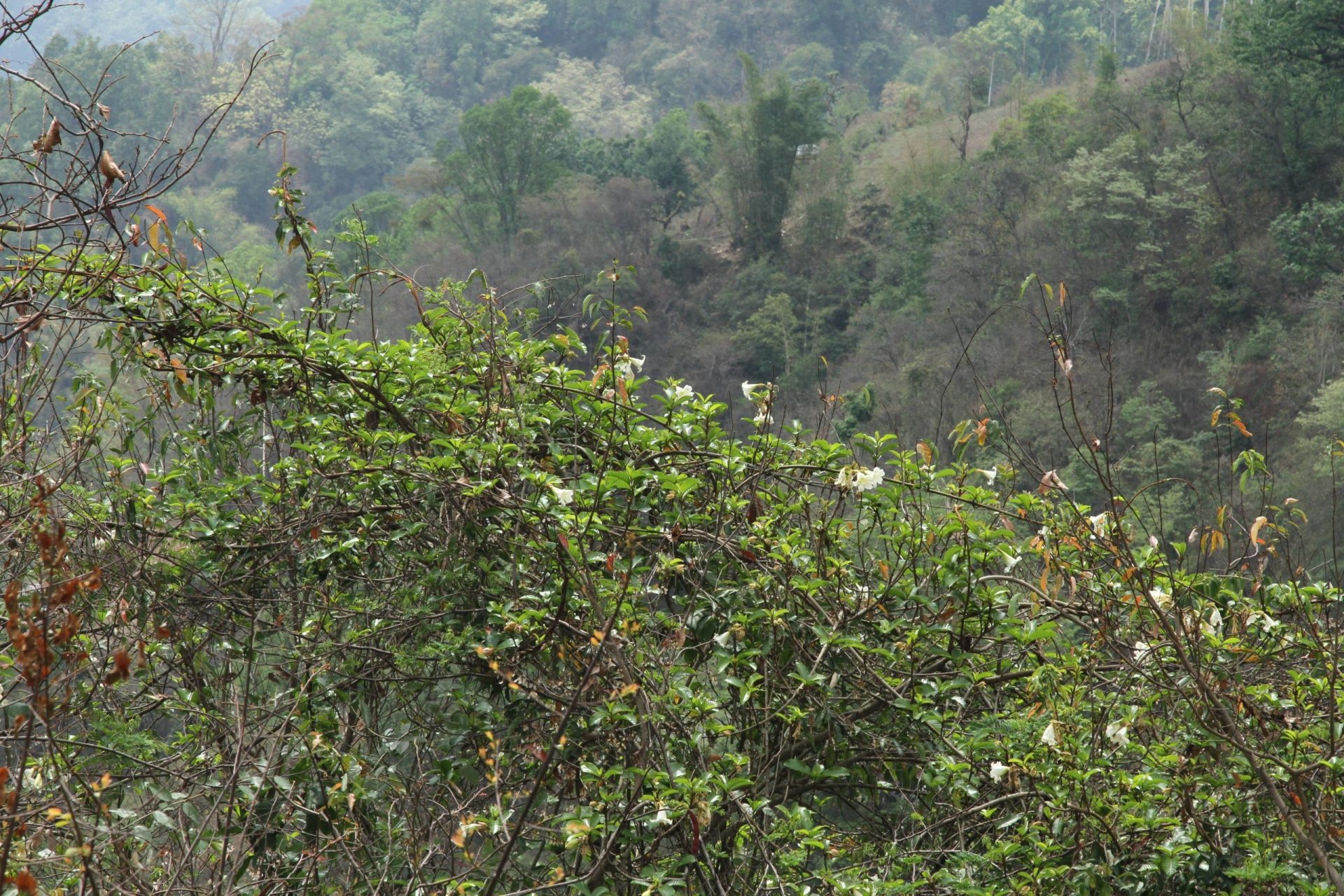
Wall.
Description
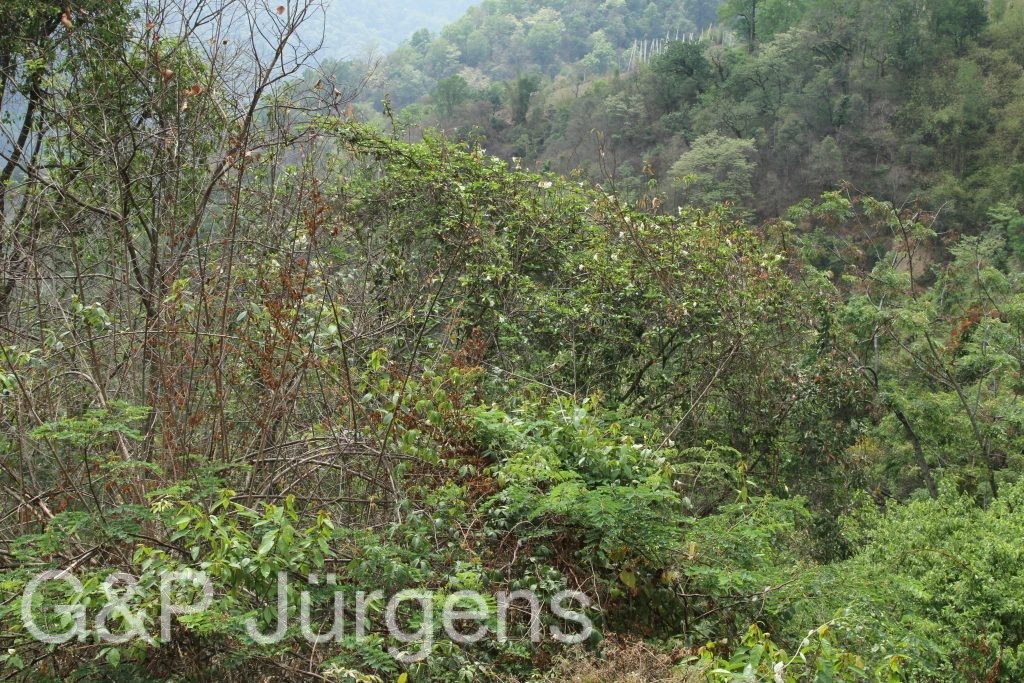
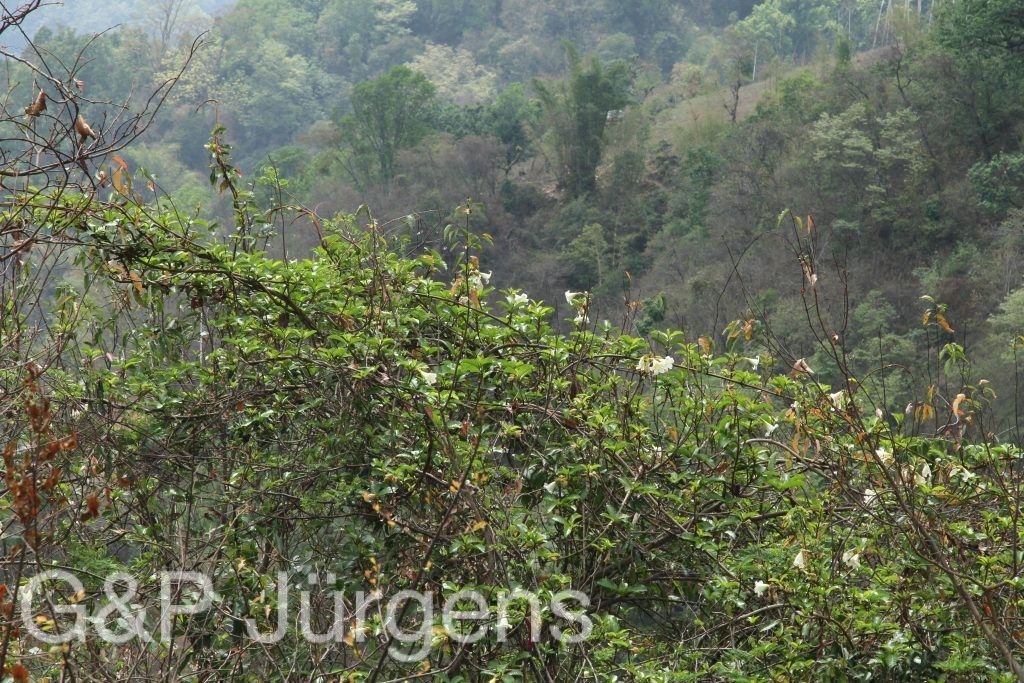
Beaumontia grandiflora is a large woody climber native to the eastern Himalaya and Indo-Chinese region, with native occurrences in India, China, Nepal, Bhutan, Thailand and Vietnam; the long list of additional countries among its roughly 602 records, spanning the Americas, Africa, the Caribbean and Oceania, reflects its extensive use as an ornamental in tropical and subtropical gardens worldwide. In the wild it is a plant of warm, humid lowland to lower-montane forest, scrambling over trees at forest margins and along streams. The photographed plant near a farmhouse at Trithangebe in Bhutan, at about 700 m and flowering in May, is consistent with its subtropical foothill habitat and its spring flowering, and hints at its frequent cultivation around dwellings.
It is a vigorous, large liana with stout woody stems exuding milky latex when cut. The leaves are opposite, simple, large, obovate to elliptic, leathery and glossy above with prominent venation and often rusty-pubescent beneath. The flowers, among the showiest in the family, are large, fragrant and trumpet-shaped, borne in terminal cymes; the corolla is broadly funnelform to campanulate, white, with five spreading lobes and a conspicuously expanded green-veined throat, giving rise to its garden name of Herald's-trumpet or Easter-lily vine. The five stamens have arrow-shaped anthers connivent around the stigma, and the fruit is a pair of large, woody, divergent follicles releasing numerous flat seeds, each with a tuft of silky hairs for wind dispersal.
Beaumontia belongs to the subfamily Apocynoideae of Apocynaceae, a family characterised by latex, contorted corolla aestivation and a specialised gynostegial pollination apparatus; the genus is allied to other tropical Asian lianas of the tribe Apocyneae. The plumed seeds and large insect-pollinated flowers fit a strategy of conspicuous floral display and wind-borne dispersal. Though valued and widely planted as a spectacular flowering vine, in its native Himalayan and Indo-Chinese range it is a natural component of subtropical forest and is not regarded as threatened.
Author: Wall. · Sources: POWO (Kew), GBIF, Flora of Bhutan, Flora of China, Flora of British India, Middleton's revisionary studies of Asian Apocynaceae